111. Figure 6-4.
The following information is available for Department X for August:
Work in process, August 1:
Materials
$ 8,000
Conversion costs
$15,000
Costs added during August:
Materials
$28,000
Conversion costs
$25,000
Equivalent units of production (weighted average):
Materials
4,000
Conversion
5,000
Refer to Figure 6-4. Department X’s cost per equivalent unit for conversion using the weighted average method would be
112. Figure 6-7.
Geller Manufacturing uses a process cost system to manufacture sensors for the security industry. The following
information pertains to operations for the month of March.
Units
Beginning work-in-process inventory, March 1
12,000
Started in production during March
110,000
Completed production during March
88,000
Ending work-in-process inventory, March 31
34,000
The beginning inventory was 70 percent complete for materials and 30 percent complete for conversion costs. The ending inventory was 90 percent
complete for materials and 50 percent complete for conversion costs.
Costs pertaining to the month of March are as follows:
Beginning inventory costs are: materials, $44,400; conversion cost $30,500.
Costs incurred during March are: materials used, $588,000; conversion cost $624,000.
Refer to Figure 6-7. Using the weighted average method, the unit cost of materials for March is:
113. Figure 6-7.
Geller Manufacturing uses a process cost system to manufacture sensors for the security industry. The following
information pertains to operations for the month of March.
Units
Beginning work-in-process inventory, March 1
12,000
Started in production during March
110,000
Completed production during March
88,000
Ending work-in-process inventory, March 31
34,000
The beginning inventory was 70 percent complete for materials and 30 percent complete for conversion costs. The ending inventory was 90 percent
complete for materials and 50 percent complete for conversion costs.
Costs pertaining to the month of March are as follows:
Beginning inventory costs are: materials, $44,400; conversion cost $30,500.
Costs incurred during March are: materials used, $588,000; conversion cost $624,000.
Refer to Figure 6-7. Using the weighted average method, the equivalent unit conversion cost for March is:
114. Figure 6-7.
Geller Manufacturing uses a process cost system to manufacture sensors for the security industry. The following
information pertains to operations for the month of March.
Units
Beginning work-in-process inventory, March 1
12,000
Started in production during March
110,000
Completed production during March
88,000
Ending work-in-process inventory, March 31
34,000
The beginning inventory was 70 percent complete for materials and 30 percent complete for conversion costs. The ending inventory was 90 percent
complete for materials and 50 percent complete for conversion costs.
Costs pertaining to the month of March are as follows:
Beginning inventory costs are: materials, $44,400; conversion cost $30,500.
Costs incurred during March are: materials used, $588,000; conversion cost $624,000.
Refer to Figure 6-7. Using the weighted average method the total equivalent units of production for direct materials is:
115. Figure 6-7.
Geller Manufacturing uses a process cost system to manufacture sensors for the security industry. The following
information pertains to operations for the month of March.
Units
Beginning work-in-process inventory, March 1
12,000
Started in production during March
110,000
Completed production during March
88,000
Ending work-in-process inventory, March 31
34,000
The beginning inventory was 70 percent complete for materials and 30 percent complete for conversion costs. The ending inventory was 90 percent
complete for materials and 50 percent complete for conversion costs.
Costs pertaining to the month of March are as follows:
Beginning inventory costs are: materials, $44,400; conversion cost $30,500.
Costs incurred during March are: materials used, $588,000; conversion cost $624,000.
Refer to Figure 6-7. Using the weighted average method, the total cost of the units in the ending work–in-process inventory at March 31 is:
116. Assuming conversion costs represent a single category, how many input categories would a department
receiving transferred-in goods normally have?
117. Conversion costs include:
118. Figure 6-2.
The Bing Corporation produces a product that passes through two processes. During June, the first department
transferred 60,000 units to the second department. The cost of the units transferred was $90,000. Materials are
added uniformly in the second process. The following information was provided about the second department’s
operations during June:
Units, beginning work in process
5,000
Units, ending work in process
13,000
Refer to Figure 6-2. Units started in the second department during June for Bing Corporation would be
119. Figure 6-2.
The Bing Corporation produces a product that passes through two processes. During June, the first department
transferred 60,000 units to the second department. The cost of the units transferred was $90,000. Materials are
added uniformly in the second process. The following information was provided about the second department’s
operations during June:
Units, beginning work in process
5,000
Units, ending work in process
13,000
Refer to Figure 6-2. Units completed in the second department during June for Bing Corporation would be
120. Figure 6-2.
The Bing Corporation produces a product that passes through two processes. During June, the first department
transferred 60,000 units to the second department. The cost of the units transferred was $90,000. Materials are
added uniformly in the second process. The following information was provided about the second department’s
operations during June:
Units, beginning work in process
5,000
Units, ending work in process
13,000
Refer to Figure 6-2. Units started and completed in Bing Corporation’s second department during June would be
121. In process manufacturing, the manufacturing input categories include:
122. The cost of a department’s transferred-in goods is the cost of:
123. Assuming that there is a one-to-one relationship between the output measures, the units started in a
subsequent department is:
124. Nonuniform manufacturing inputs affect:
125. Process accounting’s solution for nonuniform manufacturing inputs is:
126. Figure 6-1.
The following information is available for Department Z for the month of July:
Units
Cost
Work in process, July 1 (70% complete)
5,000
Direct materials
$ 6,000
Direct labor
3,000
Manufacturing overhead
4,000
Total work in process, July 1
$13,000
Started in production during July
20,000
Costs added:
Direct materials
$18,000
Direct labor
8,000
Manufacturing overhead
10,000
Total costs added during July
$36,000
Work in process, July 31, (80% complete)
2,000
Materials are added at the beginning of the process. (Round unit costs to two decimal places.)
Refer to Figure 6-1. Department Z’s cost per equivalent unit of production for materials using the FIFO method would be
127. Figure 6-1.
The following information is available for Department Z for the month of July:
Units
Cost
Work in process, July 1 (70% complete)
5,000
Direct materials
$ 6,000
Direct labor
3,000
Manufacturing overhead
4,000
Total work in process, July 1
$13,000
Started in production during July
20,000
Costs added:
Direct materials
$18,000
Direct labor
8,000
Manufacturing overhead
10,000
Total costs added during July
$36,000
Work in process, July 31, (80% complete)
2,000
Materials are added at the beginning of the process. (Round unit costs to two decimal places.)
Refer to Figure 6-1. Department Z’s cost per equivalent unit of production for conversion costs using the FIFO method would be
128. Figure 6-1.
The following information is available for Department Z for the month of July:
Units
Cost
Work in process, July 1 (70% complete)
5,000
Direct materials
$ 6,000
Direct labor
3,000
Manufacturing overhead
4,000
Total work in process, July 1
$13,000
Started in production during July
20,000
Costs added:
Direct materials
$18,000
Direct labor
8,000
Manufacturing overhead
10,000
Total costs added during July
$36,000
Work in process, July 31, (80% complete)
2,000
Materials are added at the beginning of the process. (Round unit costs to two decimal places.)
Refer to Figure 6-1. Department Z’s cost of goods transferred out using the FIFO method would be
129. Figure 6-1.
The following information is available for Department Z for the month of July:
Units
Cost
Work in process, July 1 (70% complete)
5,000
Direct materials
$ 6,000
Direct labor
3,000
Manufacturing overhead
4,000
Total work in process, July 1
$13,000
Started in production during July
20,000
Costs added:
Direct materials
$18,000
Direct labor
8,000
Manufacturing overhead
10,000
Total costs added during July
$36,000
Work in process, July 31, (80% complete)
2,000
Materials are added at the beginning of the process. (Round unit costs to two decimal places.)
Refer to Figure 6-1. Department Z’s cost of ending work in process using the FIFO method would be
130. The two categories of completed units needed in the FIFO method so that each category can be costed
correctly are:
131. The total associated manufacturing costs under the FIFO method are the sum of the prior-period costs plus
the costs incurred in the current period to finish the units for:
132. Information concerning Department A of Ali Company for the month of June is as follows:
Materials
Units
Costs
Work in process, beginning of month
20,000
$14,250
Started in June
85,000
$66,600
Units completed
90,000
Work in process, end of month
15,000
All materials are added at the beginning of the process. Using the first-in, first-out method, the equivalent units for materials would be:
133. Information concerning Department A of Ali Company for the month of June is as follows:
Materials
Units
Costs
Work in process, beginning of month
20,000
$14,250
Started in June
85,000
$66,600
Units completed
90,000
Work in process, end of month
15,000
All materials are added at the beginning of the process. Using the first-in, first-out method, the cost (rounded to two places) per equivalent unit for
materials is:
134. Which of the following methods considers the percentage of completion of beginning work-in–process?
135. Montgomery Corporation produces boxes of cookies that go through three departments: Mixing, Cooking
and Packaging. During April, Montgomery produced 250,000 boxes of cookies with the following costs:
Mixing department
Cooking department
Packaging department
Direct materials
$325,000
$110,000
$90,000
Direct labor
65,000
35,000
80,000
Applied Overhead
85,000
30,000
95,000
Required:
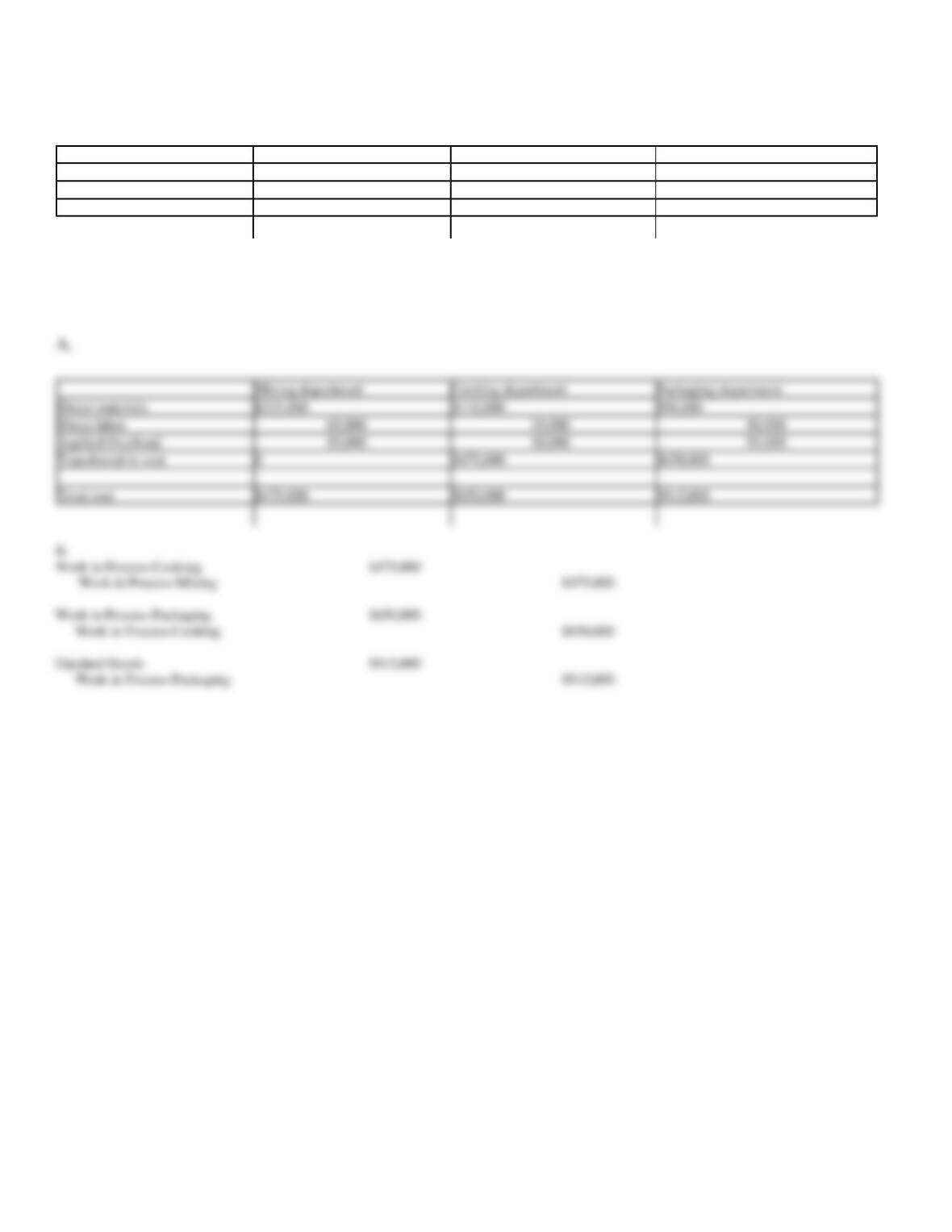
A. Calculate the costs transferred out of each department.
B. Prepare journal entries that reflect these cost transfers.
Mixing department
Cooking department
Packaging department
Direct materials
$325,000
$110,000
$90,000
Direct labor
65,000
35,000
80,000
Applied Overhead
85,000
30,000
95,000
Transferred-in cost
0
$475,000
$650,000
Total cost
$475,000
$650,000
$915,000
Work in Process-Cooking
$475,000
Work in Process-Mixing
$475,000
Work in Process-Packaging
$650,000
Work in Process-Cooking
$650,000
Finished Goods
$915,000
Work in Process-Packaging
$915,000
136. The bottling department had the following data for the month of January:
Units in BWIP
–
Units completed
7,500
Units in EWIP (35% complete)
1,200
Total manufacturing costs
13,500
Required:
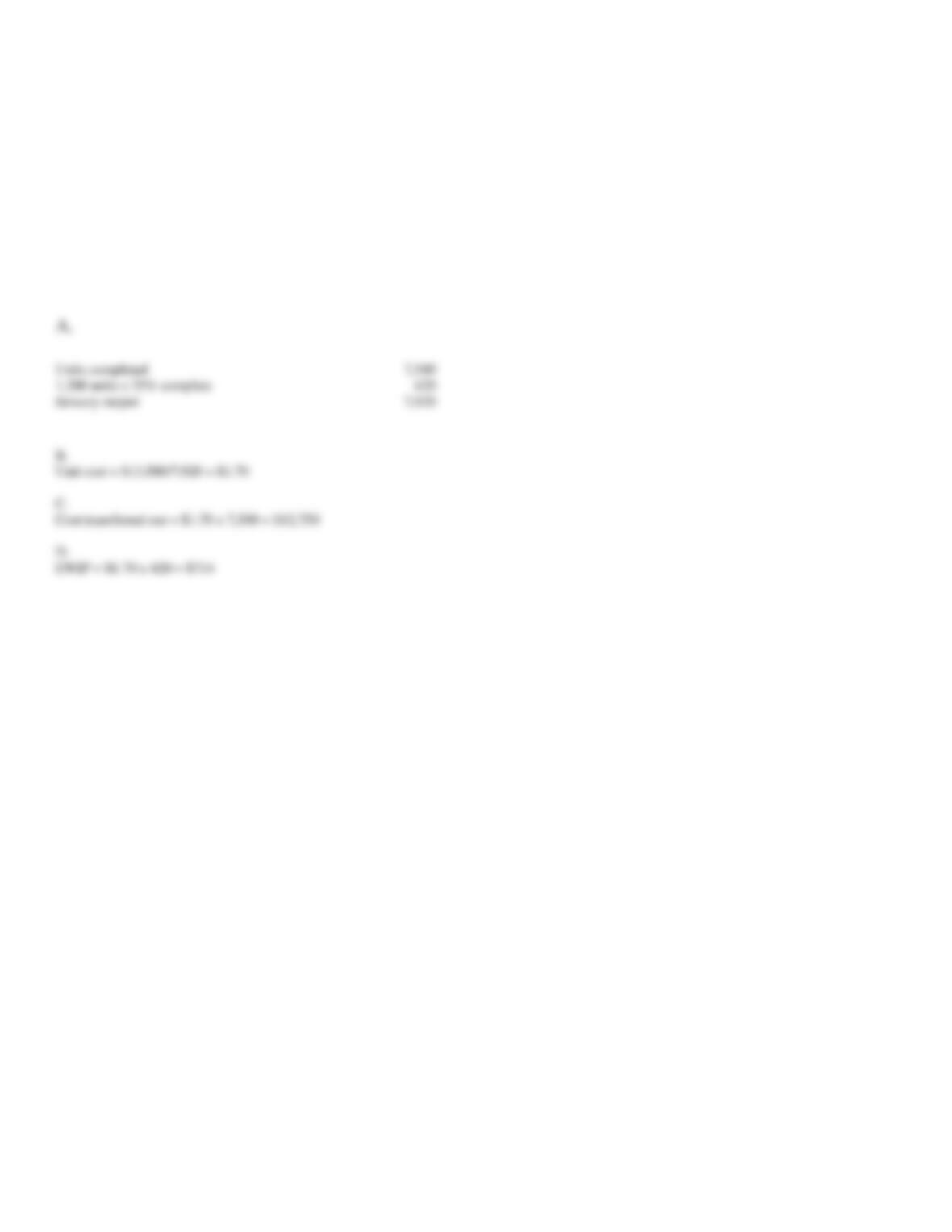
A. What is the output in equivalent units for January?
B. What is the unit manufacturing cost for January?
C. Calculate the cost of goods transferred out for January.
D. Calculate the value of January’s EWIP
Units completed
7,500
January output
7,920
137. Scott Inc., manufactures a product that passes through two processes: mixing and molding. All
manufacturing costs are added uniformly in the mixing department.
Information for the mixing department for May follows:
Work in process, May 1:
Units (45% complete)
10,000
Direct materials
$23,000
Direct labor
$37,000
Overhead
$15,000
During May, 65,000 units were completed and transferred to the molding department. The following costs were incurred by the mixing department
during May:
Direct materials
$115,000
Direct labor
$140,000
Overhead
$55,000
By May 31, 4,000 units that were 80 percent complete remained in Mixing. Scott uses the weighted average method.
Required:
A. Calculate the equivalent units of production using the weighted average method.
B. Calculate the total costs to account for.
C. Calculate total cost per equivalent unit of production.
D. Calculate the cost of goods transferred to the molding department during May.
E. Calculate the cost of May’s ending work-in-process for the mixing department.
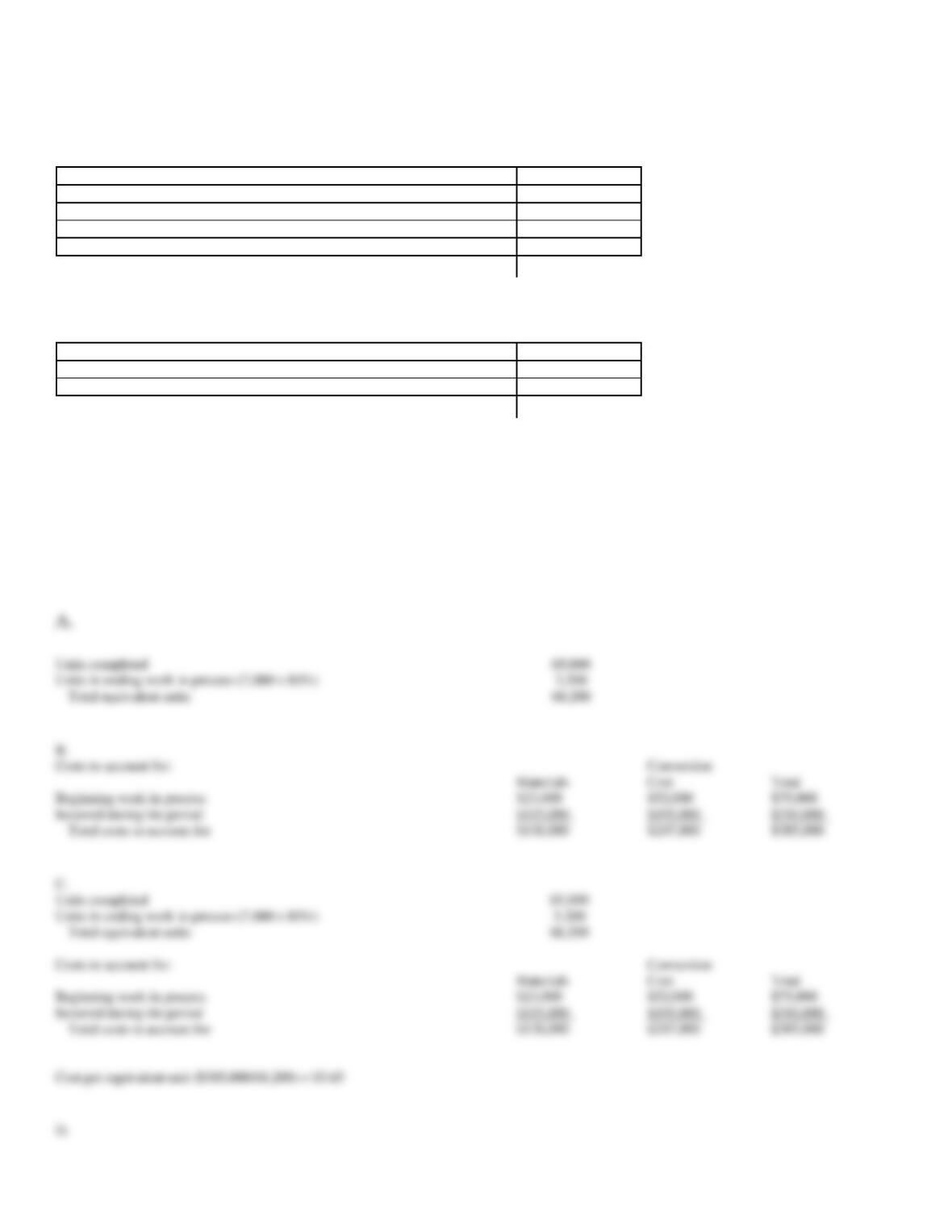
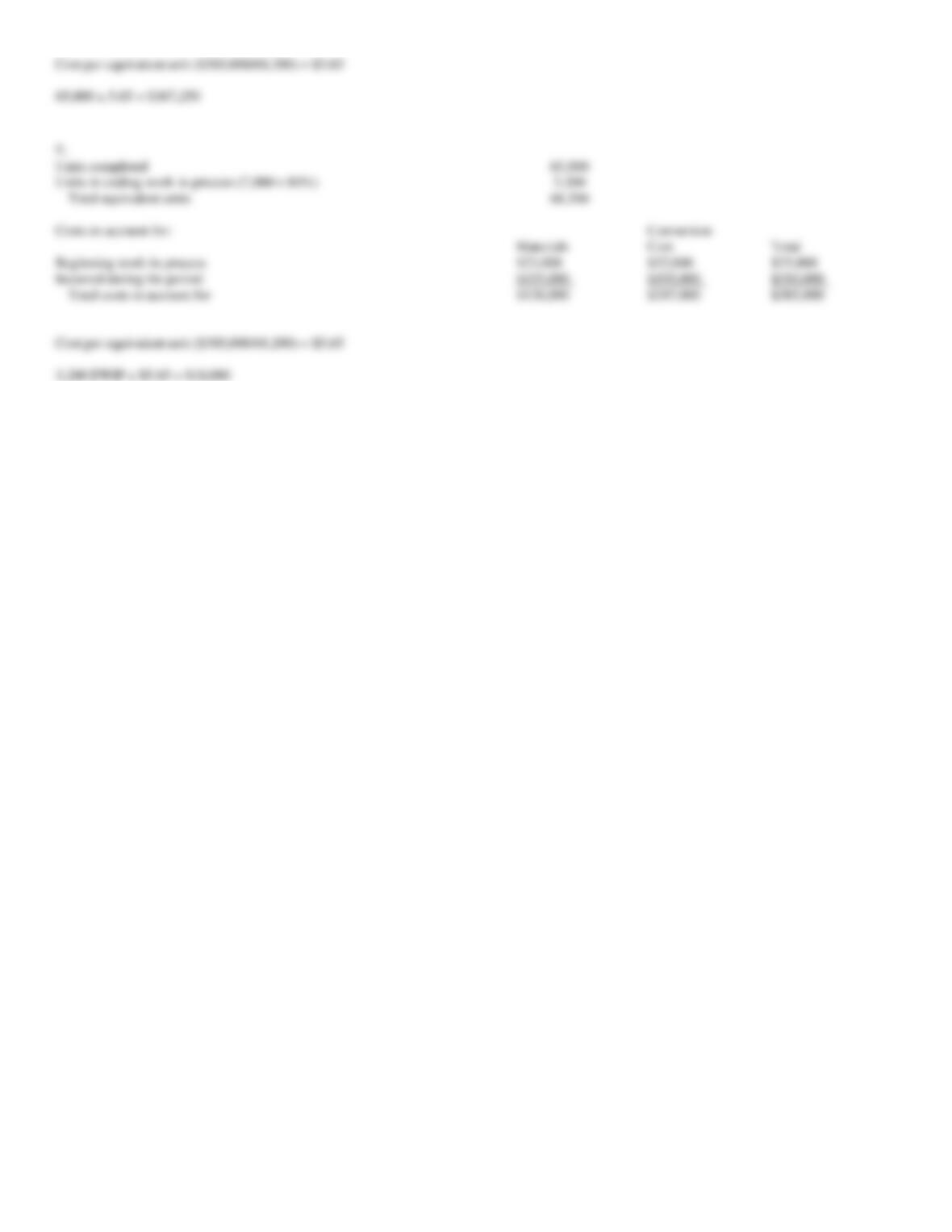
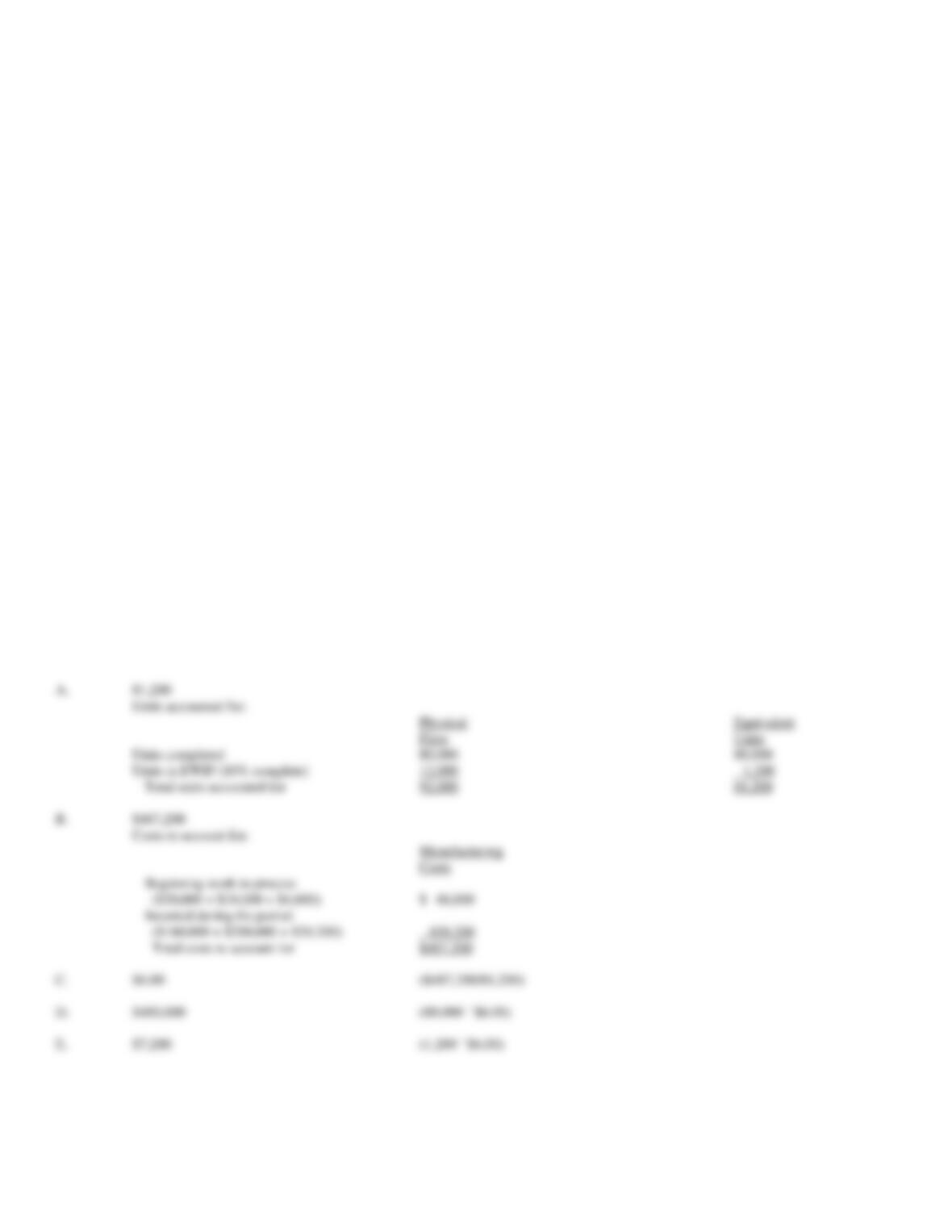
Units completed
65,000
Units in ending work in process (7,000 x 80%)
3,200
Total equivalent units
68,200
Costs to account for:
Conversion
Materials
Cost
Total
Beginning work in process
$23,000
$52,000
$75,000
Incurred during the period
$115,000
$195,000
$310,000
Total costs to account for
$138,000
$247,000
$385,000
Units completed
65,000
Units in ending work in process (7,000 x 80%)
3,200
Total equivalent units
68,200
Costs to account for:
Conversion
Materials
Cost
Total
Beginning work in process
$23,000
$52,000
$75,000
Incurred during the period
$115,000
$195,000
$310,000
Total costs to account for
$138,000
$247,000
$385,000
Cost per equivalent unit ($385,000/68,200) = $5.65
138. Barr Inc., manufactures a product that passes through two processes: mixing and packaging. All
manufacturing costs are added uniformly in the mixing department.
Information for the mixing department for June follows:
Work in process, June 1
Units (60% complete)
5,000
Direct materials
$20,000
Direct labor
$24,000
Overhead
$ 4,000
During June, 80,000 units were completed and transferred to packaging.
The following costs were incurred by the mixing department during June:
Direct materials
$180,000
Direct labor
200,000
Overhead
59,200
At June 30, 12,000 units that were 10 percent complete remained in the mixing department.
Use the weighted average method and round unit costs to two decimal places.
Required:
A.
Determine equivalent units of production for June.
B.
Determine June’s total costs to account for.
C.
Determine total cost per equivalent unit of production.
D.
Determine the cost of goods transferred to the packaging department.
E.
Determine the cost of June’s ending work in process for the mixing department.
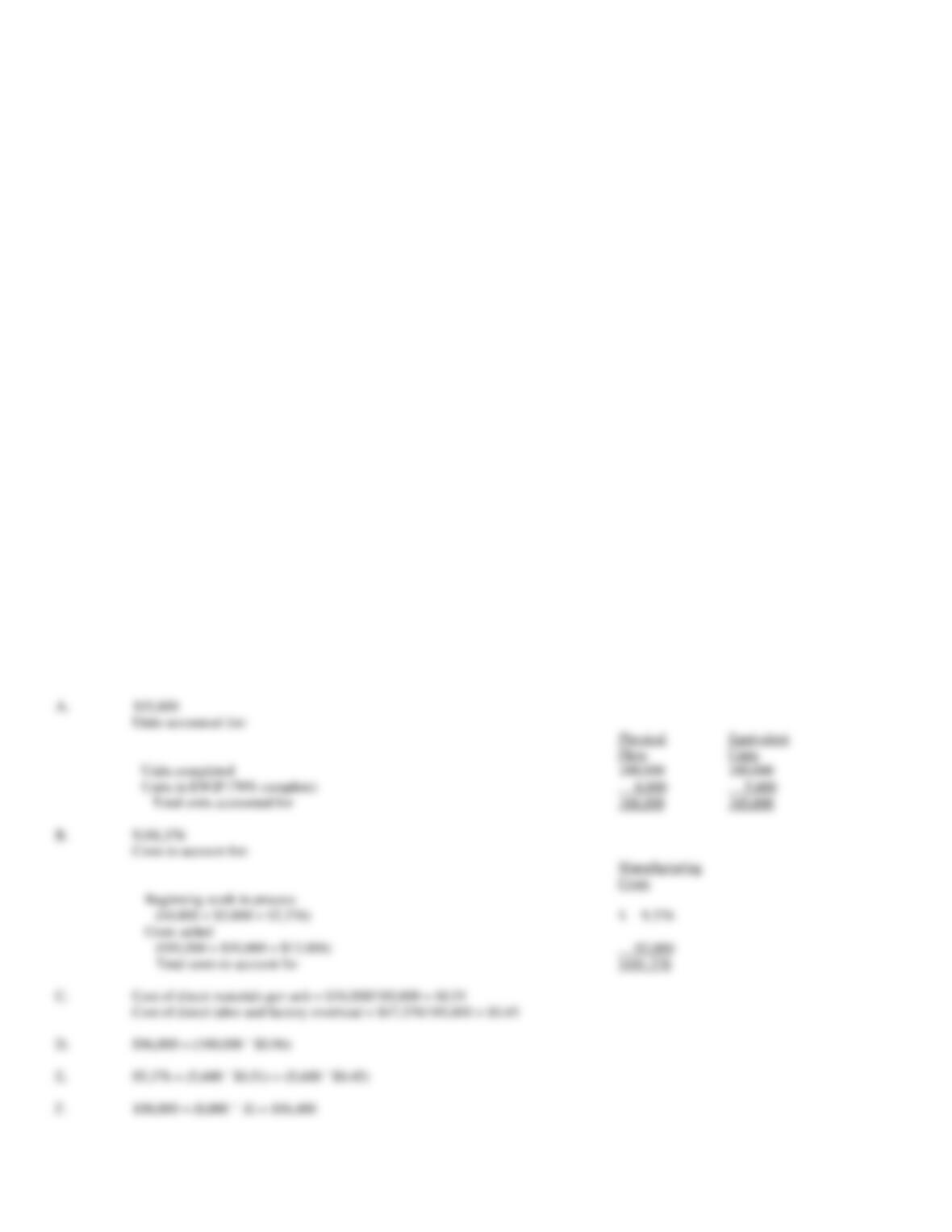
A.
81,200
Units accounted for:
Physical
Equivalent
Flow
Units
Units completed
80,000
80,000
Units in EWIP (10% complete)
12,000
1,200
Total units accounted for
92,000
81,200
B.
$487,200
Costs to account for:
Manufacturing
Costs
Beginning work in process
($20,000 + $24,000 + $4,000)
$ 48,000
Incurred during the period
($180,000 + $200,000 + $59,200)
439,200
Total costs to account for
$487,200
C.
$6.00
($487,200/81,200)
D.
$480,000
(80,000 ´ $6.00)
$7,200
(1,200 ´ $6.00)
139. Star Inc., manufactures a product that passes through two processes: mixing and packaging. All
manufacturing costs are added uniformly in the mixing department.
Information for the mixing department for June follows:
Work in process, June 1:
Units (30% complete)
15,000
Direct materials
$ 4,000
Direct labor
$ 3,000
Overhead
$ 2,376
During June, 100,000 units were completed and transferred to packaging.
The following costs were incurred by the mixing department during June:
Direct materials
$50,000
Direct labor
30,000
Overhead
12,000
At June 30, 8,000 units that were 70 percent complete remained in the mixing department.
Use the weighted average method, and round unit costs to two decimal places.
Required:
A.
Determine equivalent units of production for June.
B.
Determine June’s total costs to account for.
C.
Determine total cost per equivalent unit of production.
D.
Determine the cost of goods transferred to the packaging department.
E.
Determine the cost of June’s ending work in process for the mixing department.
F.
Determine the equivalent units of production for June if ending inventory had been 80% complete.
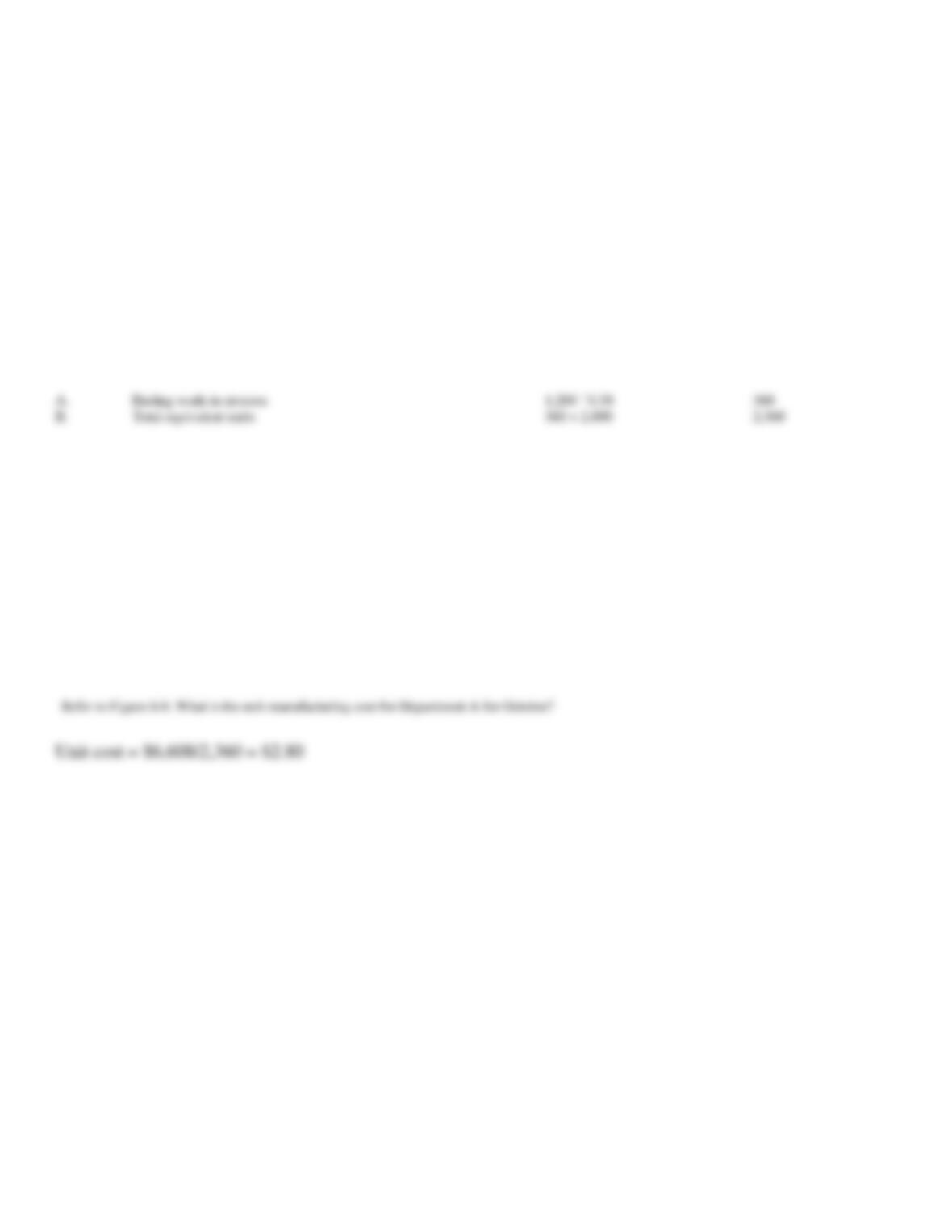
A.
105,600
Units accounted for:
Physical
Equivalent
Flow
Units
Units completed
100,000
100,000
Units in EWIP (70% complete)
8,000
5,600
Total units accounted for
108,000
105,600
B.
$101,376
Costs to account for:
Manufacturing
Costs
Beginning work in process
($4,000 + $3,000 + $2,376)
$ 9,376
Costs added
($50,000 + $30,000 + $12,000)
92,000
Total costs to account for
$101,376
D.
$96,000 = (100,000 ´ $0.96)
140. Figure 6-8.
Department A had the following data for October:
Units in beginning work in process
0
Units Completed
2,000
Units in ending work in process (30% complete)
1,200
Total manufacturing cost
$6,608
Refer to Figure 6-8.
A.
Calculate the equivalent units of production in ending work-in-process inventory.
B.
Calculate total equivalent units of production for Department A for October.
141. Figure 6-8.
Department A had the following data for October:
Units in beginning work in process
0
Units Completed
2,000
Units in ending work in process (30% complete)
1,200
Total manufacturing cost
$6,608
Ending work-in-process
1,200 ´ 0.30
B.
Total equivalent units
360 + 2,000
2,360
142. Figure 6-8.
Department A had the following data for October:
Units in beginning work in process
0
Units Completed
2,000
Units in ending work in process (30% complete)
1,200
Total manufacturing cost
$6,608
Refer to Figure 6-8.
A.
What is the cost of goods transferred out?
B.
What is the cost of ending work-in-process inventory?
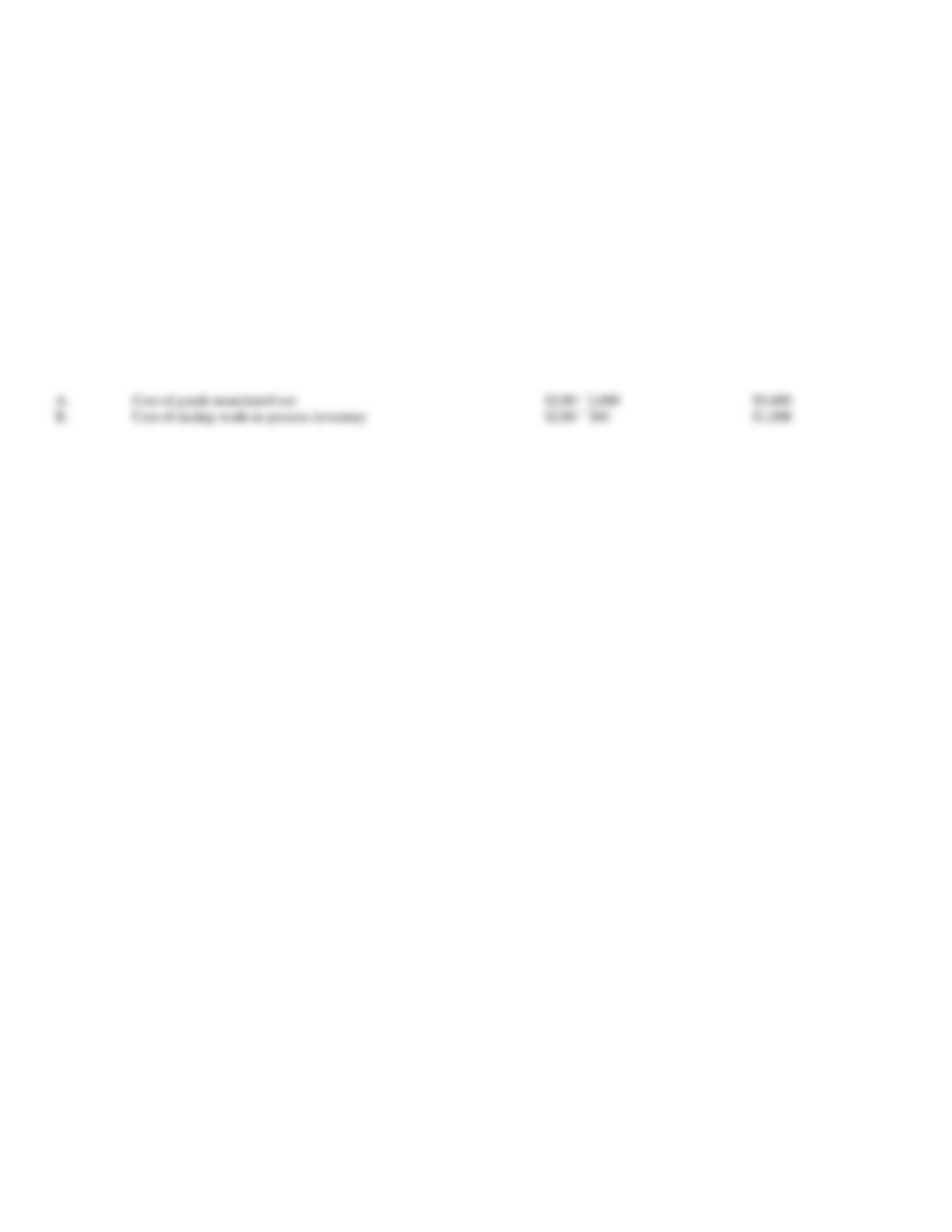
Cost of goods transferred out
$2.80 ´ 2,000
$5,600
B.
Cost of ending work-in-process inventory
$2.80 ´ 360
$1,008