
Chapter 17: Activity Resource Usage Model and Tactical Decision Making
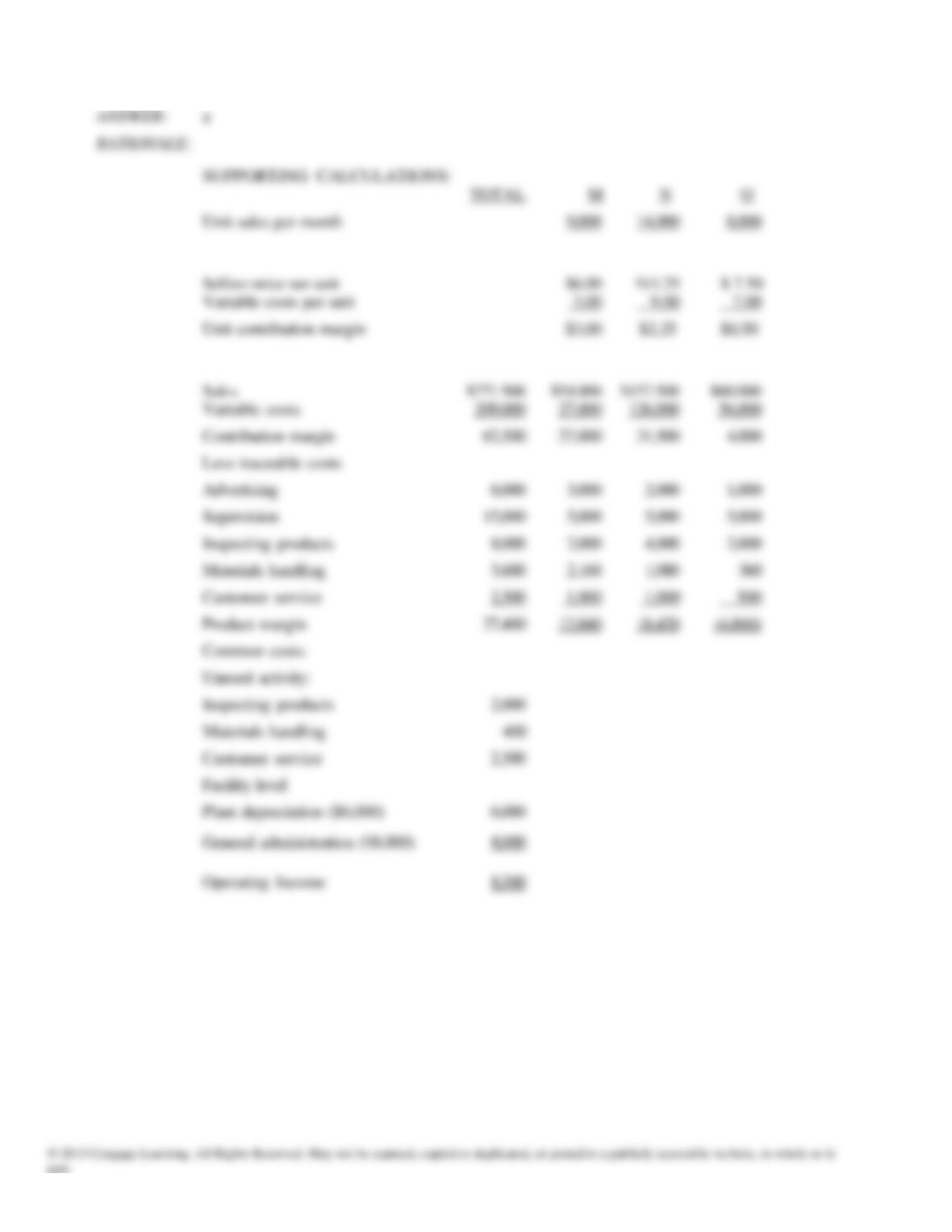
76. Refer to Figure 17–1. When Montrose converted over to ABC it discovered the following:
inspecting products
—
20 percent of the inspection activity was
unused. The inspections used were based on the
number of batches produced.
materials handling
—
10 percent of the materials handling activity
was unused. The materials handling activity
used was based on the number of production
runs.
customer service
—
50 percent of the customer service activity was
unused. The usage was given as follows: M
1,000, N 1,000, O 500
plant depreciation
—
facility level cost
general administration
—
facility level cost
The operating income for Montrose would be
a. $8,500.
b. $9,000.
c. $19,000.
d. $27,000.
Chapter 17: Activity Resource Usage Model and Tactical Decision Making

Chapter 17: Activity Resource Usage Model and Tactical Decision Making
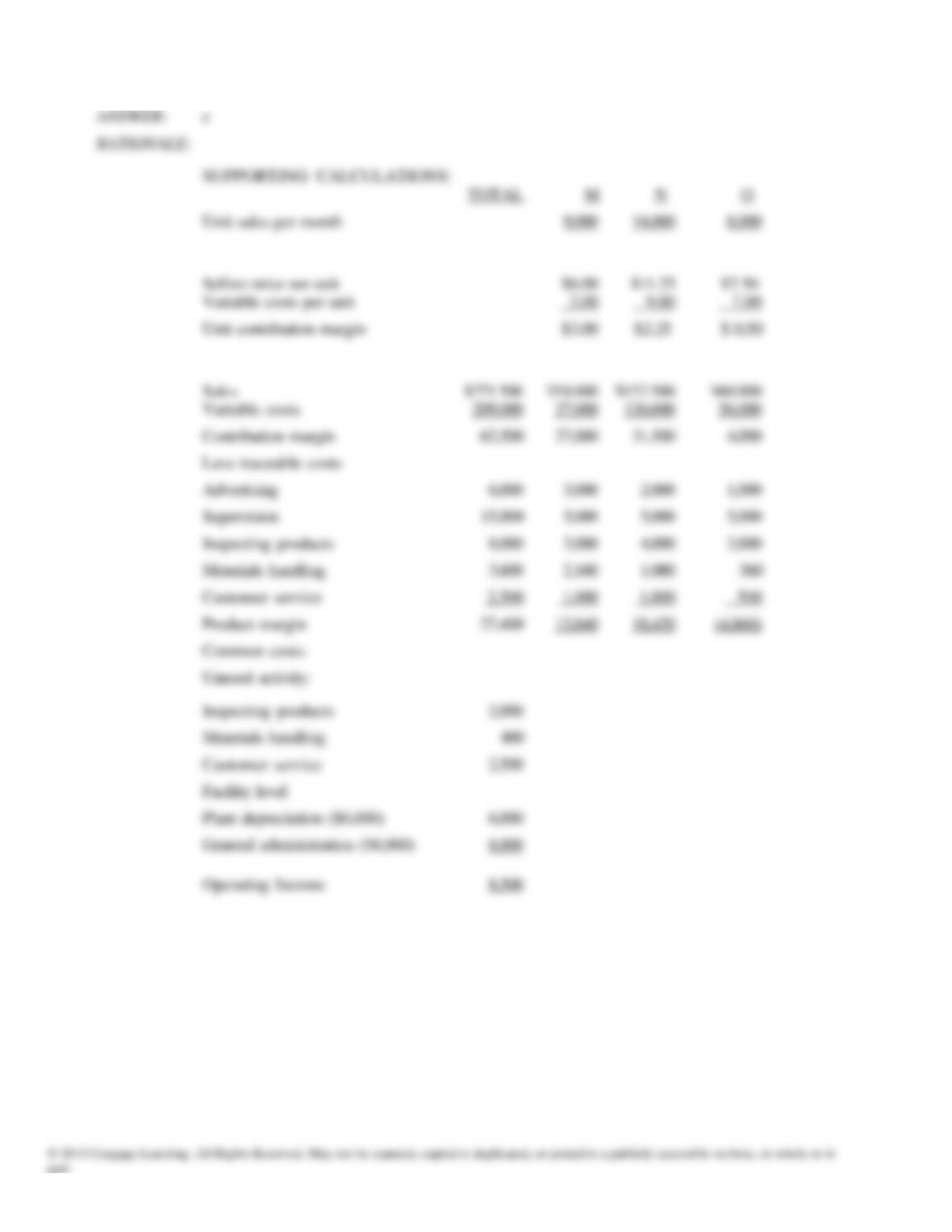
77. Refer to Figure 17–1. When Montrose converted over to ABC it discovered the following:
Inspecting products — 20% of the inspection activity was unused. The
inspections used were based on the number of batches produced.
Materials handling — 10% of the materials handling activity was unused.
The materials handling activity used was based on the number of
production runs.
Customer service — 50% of the customer service activity was unused. The
usage was given as follows: M 1,000, N 1000, O 500
Plant depreciation — facility level cost
General administration — facility level cost
The product margin for product M using ABC would be
a. $9,000.
b. $19,000.
c. $13,840.
d. $27,000.
Chapter 17: Activity Resource Usage Model and Tactical Decision Making
Chapter 17: Activity Resource Usage Model and Tactical Decision Making
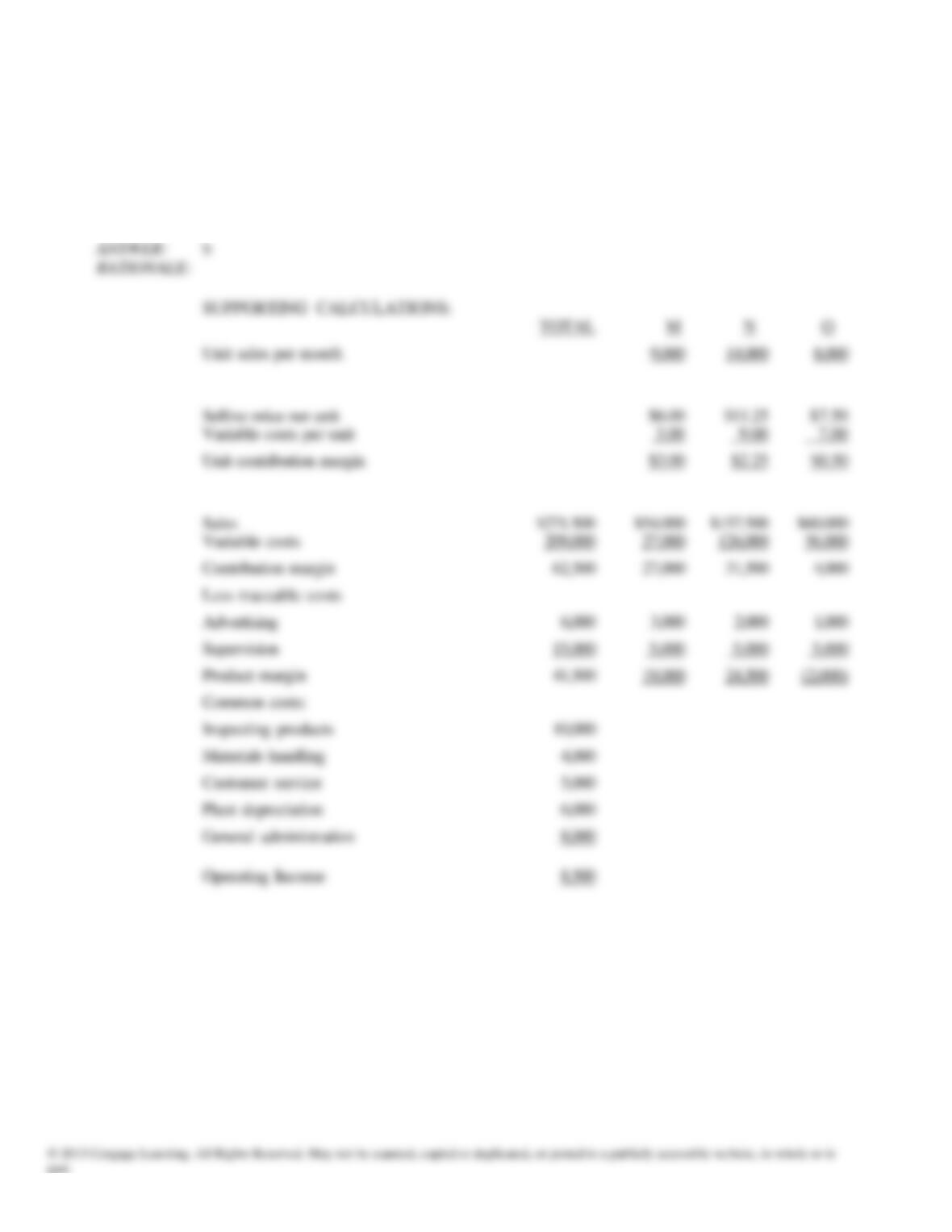
78. Refer to Figure 17–1. The product margin for product M using functional-based costing would be
a. $41,500.
b. $19,000.
c. $13,840.
d. $9,000.
Chapter 17: Activity Resource Usage Model and Tactical Decision Making
79. The operations of California Corporation are divided into the Mendocino Division and the Napa Division.
Projections for the next year are as follows:
Mendocino
Napa
Division
Division
Total
Sales
$430,000
$252,000
$682,000
Variable costs
147,000
115,500
262,500
Contribution margin
$283,000
$136,500
$419,500
Direct fixed costs
126,000
105,000
231,000
Segment margin
$157,000
$ 31,500
$188,500
Allocated common costs
63,000
47,250
110,250
Operating income (loss)
$94,000
$(15,750)
$78,250
Operating income for California Corporation as a whole if the Napa Division were dropped would be
a. $46,750.
b. $94,000.
c. $78,250.
d. $109,750.
80. San Antonio Corporation manufacturers a part for its production cycle. The costs per unit for 5,000 units of this
part are as follows:
Direct materials
$32
Direct labor
40
Variable overhead
16
Fixed overhead
32
Total
$120
Amarillo Company has offered to sell San Antonio Corporation 5,000 units of the part for $112 per unit. If San
Antonio Corporation accepts Amarillo Company‘s offer, total fixed costs will be reduced to $60,000. What
alternative is more desirable and by what amount is it more desirable?
Alternative Amount
a. Buy $100,000
b. Buy $40,000
c. Make $20,000
d. Make $120,000
SUPPORTING CALCULATIONS:
Chapter 17: Activity Resource Usage Model and Tactical Decision Making
81. A decision to make or eliminate an unprofitable product is a
a. special–order decision.
b. make–or–buy decision.
c. keep–or-drop a product-line decision.
d. both b and c.
82. The operations of Smithsonian Corporation are divided into the Manhattan Division and the Bronx
Division. Projections for the next year are as follows:
Manhattan
Bronx
Division
Division
Total
Sales
$250,000
$180,000
$430,000
Variable costs
90,000
100,000
190,000
Contribution margin
$160,000
$ 80,000
$240,000
Direct fixed costs
75,000
62,500
137,500
Segment margin
$85,000
$17,500
$102,500
Allocated common costs
35,000
27,500
62,500
Operating income (loss)
$50,000
$(10,000)
$40,000
Operating income for Smithsonian Corporation as a whole if the Bronx Division were dropped would be
a. $40,000.
b. $22,500.
c. $50,000.
d. $60,000.
Chapter 17: Activity Resource Usage Model and Tactical Decision Making
83. The following information pertains to Dallas Churning Company’s three products:
D
E
F
Unit sales per month
900
1,400
800
Selling price per unit
$6.00
$11.25
$ 7.50
Variable costs per unit
3.00
9.00
7.80
Unit contribution margin
$3.00
$ 2.25
$(0.30)
Assume that product F is discontinued and the space used to produce product F is rented for $600 per month.
Monthly profits will
a. increase by $360.
b. increase by $840.
c. increase by $600.
d. decrease by $5,400.
84. The following information pertains to Dallas Churning Company’s three products:
D
E
F
Unit sales per month
900
1,400
800
Selling price per unit
$6.00
$11.25
$ 7.50
Variable costs per unit
3.00
9.00
7.80
Unit contribution margin
$3.00
$ 2.25
$(0.30)
Assume that product F is discontinued and the space is used to produce E. Product E’s production is increased
to 2,200 units per month, but E’s selling price of all units of E is reduced to $10.20. Monthly profits will
a. decrease by $2,070.
b. increase by $1,200.
c. increase by $2,640.
d. decrease by $270.
Chapter 17: Activity Resource Usage Model and Tactical Decision Making
85. The following information pertains to the Dallas Churning Company‘s three products:
D
E
F
Unit sales per month
900
1,400
800
Selling price per unit
$6.00
$11.25
$ 7.50
Variable costs per unit
3.00
9.00
7.80
Unit contribution margin
$3.00
$ 2.25
$(0.30)
Assume that the selling price of product F is increased to $8.25 with a reduction in monthly sales to 400
units. Monthly profits will
a. increase by $420.
b. decrease by $60.
c. increase by $180.
d. increase by $2,070.
86. The following information pertains to Salamandre Company‘s three products:
A
B
C
Unit sales per year
250
400
250
Selling price per unit
$9.00
$12.00
$ 10.00
Variable costs per unit
3.60
9.00
11.00
Unit contribution margin
$5.40
$ 3.00
$(1.00)
Contribution margin ratio
60%
25%
(10)%
Assume that product C is discontinued and the extra space is rented for $300 per month. All other information
remains the same as the original data. Annual profits will
a. remain the same.
b. increase by $250.
c. decrease by $250.
d. increase by $550.
Chapter 17: Activity Resource Usage Model and Tactical Decision Making
Figure 17-2
Wannabee Company manufactures a product with the following costs per unit at the expected production level of
84,000 units:
Direct materials
$12
Direct labor
36
Variable manufacturing overhead
18
Fixed manufacturing overhead
24
The company has the capacity to produce 90,000 units. The product regularly sells for $120.
87. Refer to Figure 17–2. A wholesaler has offered to pay $110 a unit for 7,500 units.
If the special order is accepted, the effect on operating income would be a
a. $249,000 increase.
b. $429,000 increase.
c. $495,000 increase.
d. $75,000 decrease.
Chapter 17: Activity Resource Usage Model and Tactical Decision Making
88. Refer to Figure 17–2. If a wholesaler offered to buy 4,500 units for $100 each, the effect of the special order
on income would be a
a. $45,000 increase.
b. $153,000 increase.
c. $450,000 increase.
d. $90,000 decrease.
89. A decision that focuses on whether a specially priced order should be accepted or rejected is a
a. special–order decision.
b. keep–or–drop a product–line decision.
c. make-or–buy decision.
d. both a and c.
90. Firms may be asked to accept a special order of their product for a reduced price if
a. it can be concealed from the government.
b. excess capacity exists.
c. the order is small.
d. the plant is producing at maximum capacity.
Chapter 17: Activity Resource Usage Model and Tactical Decision Making
91. The following information relates to a product produced by Malkovich Company:
Direct materials
$24
Direct labor
15
Variable overhead
30
Fixed overhead
18
Unit cost
$87
Fixed selling costs are $500,000 per year, and variable selling costs are $12 per unit sold. Although production
capacity is 600,000 units per year, the company expects to produce only 400,000 units next year. The product
normally sells for $120 each. A customer has offered to buy 60,000 units for $90 each.
The incremental cost per unit associated with the special order is
a. $64.
b. $69.
c. $81.
d. $84.
Chapter 17: Activity Resource Usage Model and Tactical Decision Making
92. The following information relates to a product produced by Malkovich Company:
Direct materials
$24
Direct labor
15
Variable overhead
30
Fixed overhead
18
Unit cost
$87
Fixed selling costs are $500,000 per year, and variable selling costs are $12 per unit sold. Although production
capacity is 600,000 units per year, the company expects to produce only 400,000 units next year. The product
normally sells for $120 each. A customer has offered to buy 60,000 units for $90 each.
If the firm produces the special order, the effect on income would be a
a. $360,000 increase.
b. $360,000 decrease.
c. $540,000 decrease.
d. $540,000 increase.
Chapter 17: Activity Resource Usage Model and Tactical Decision Making
93. Zildjian Corporation manufactures a single product with the following unit costs for 1,250 units:
Direct materials
$2,300
Direct labor
960
Factory overhead (30% variable)
1,800
Selling expenses (50% variable)
900
Administrative expenses (10% variable)
840
Total per unit
$6,800
Recently, a company approached Zildjian Corporation about buying 100 units for $5,100 each. Currently, the models
are sold to dealers for $7,900. Zildjian Corporation‘s capacity is sufficient to produce the extra 100 units. No
additional selling expenses would be incurred on the special order.
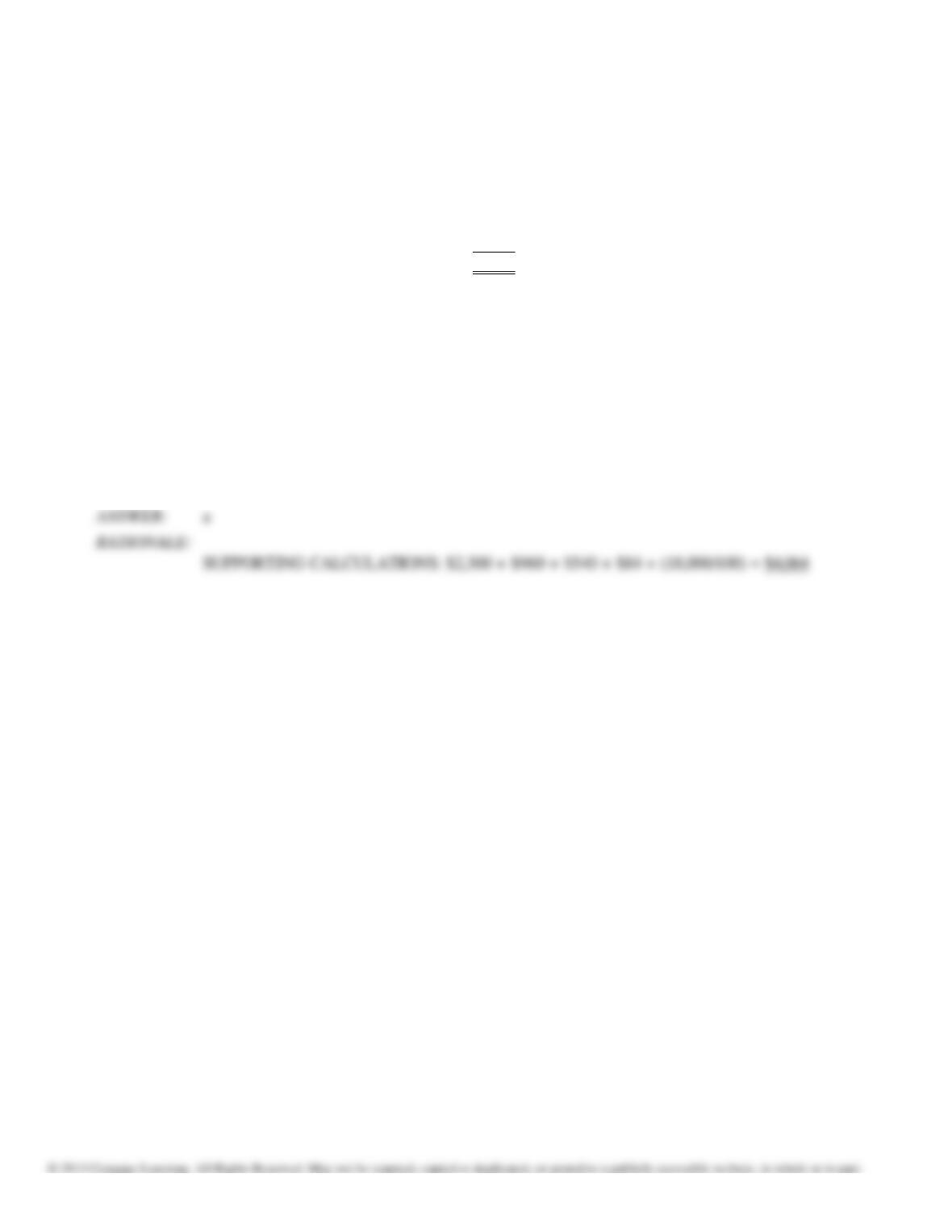
What is the profit earned by Zildjian Corporation on the original 1,250 units?
a. $6,800,000
b. $7,875,000
c. $2,750,000
d. $1,375,000
94. Zildjian Corporation manufactures a single product with the following unit costs for 1,250 units:
Direct materials
$2,300
Direct labor
960
Factory overhead (30% variable)
1,800
Selling expenses (50% variable)
900
Administrative expenses (10% variable)
840
Total per unit
$6,800
Recently, a company approached Zildjian Corporation about buying 100 units for $5,100 each. Currently, the models
are sold to dealers for $7,900. Zildjian Corporation‘s capacity is sufficient to produce the extra 100 units. No
additional selling expenses would be incurred on the special order.
How much will income change if the special order is accepted?
a. no change
b. increase by $121,600
c. decrease by $180,000
d. increase by $76,600
Chapter 17: Activity Resource Usage Model and Tactical Decision Making
95. Zildjian Corporation manufactures a single product with the following unit costs for 1,250 units:
Direct materials
$2,300
Direct labor
960
Factory overhead (30% variable)
1,800
Selling expenses (50% variable)
900
Administrative expenses (10% variable)
840
Total per unit
$6,800
Recently, a company approached Zildjian Corporation about buying 100 units for $5,100 each. Currently, the models
are sold to dealers for $7,900. Zildjian Corporation‘s capacity is sufficient to produce the extra 100 units. No
additional selling expenses would be incurred on the special order.
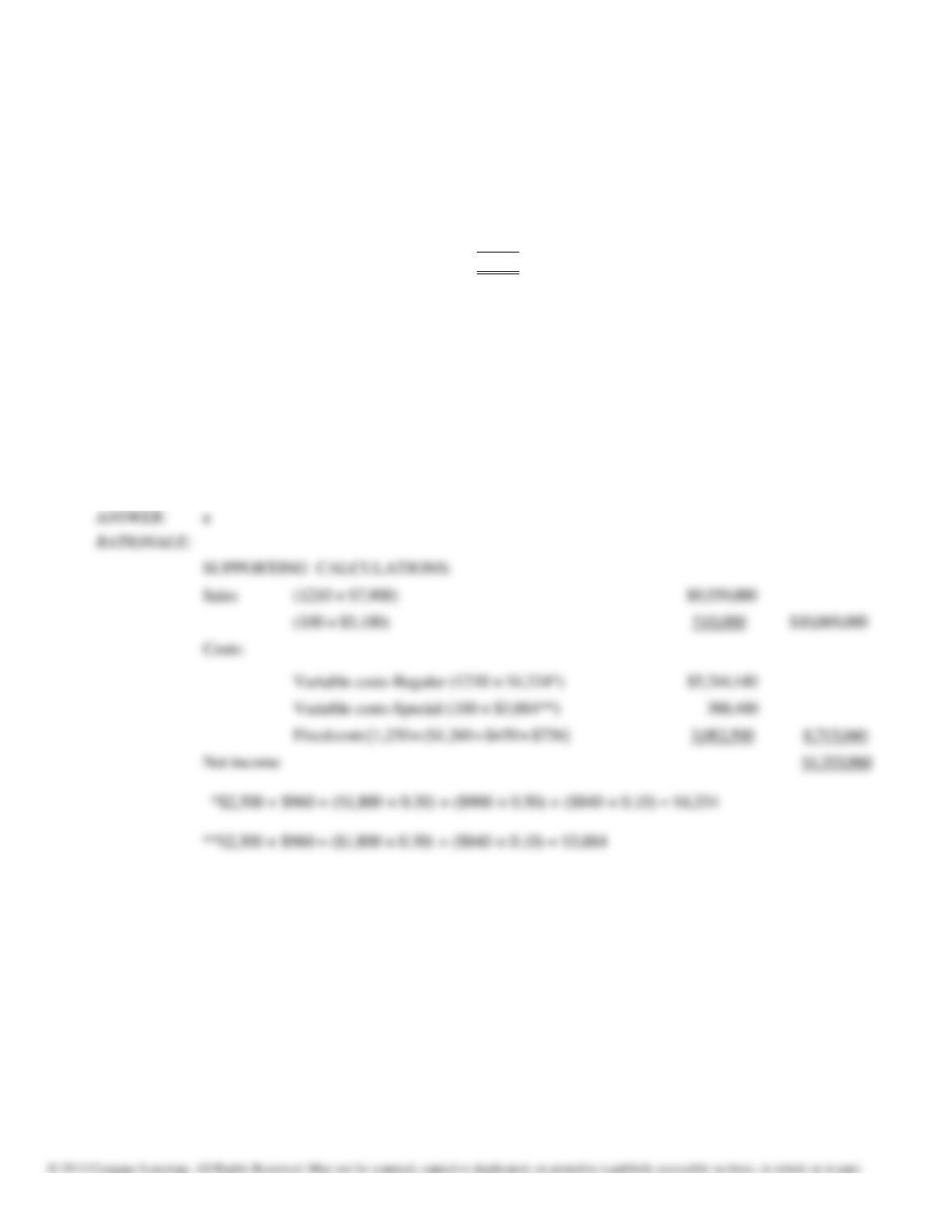
If Zildjian Corporation wants to increase its profit by $18,000 on the special order, what is the minimum price it
should charge per unit?
a. $4,064
b. $4,514
c. $5,100
d. $6,900
Chapter 17: Activity Resource Usage Model and Tactical Decision Making
96. Zildjian Corporation manufactures a single product with the following unit costs for 1,250 units:
Direct materials
$2,300
Direct labor
960
Factory overhead (30% variable)
1,800
Selling expenses (50% variable)
900
Administrative expenses (10% variable)
840
Total per unit
$6,800
Recently, a company approached Zildjian Corporation about buying 100 units for $5,100 each. Currently, the models
are sold to dealers for $7,900.
Assume there is additional capacity for 60 more units and the firm has to reduce regular customer sales by 40 units
in order to contract the special order. There are selling expenses on only the sales to the regular customers. What is
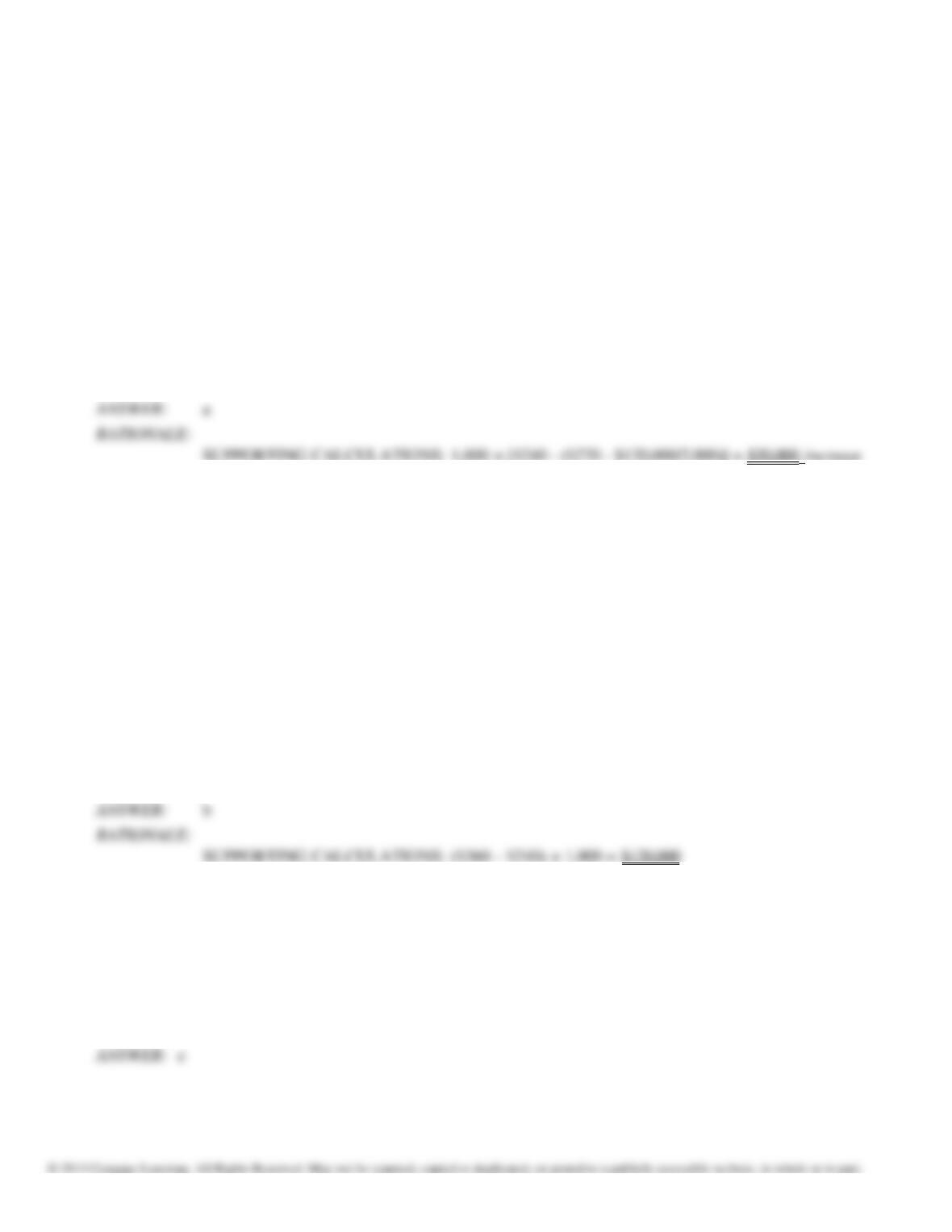
the net income if the special order of 100 units is accepted?
a. $1,353,960
b. $894,960
c. $1,029,600
d. $918,000
Chapter 17: Activity Resource Usage Model and Tactical Decision Making
97. Noreaster Company produces a product that has a regular selling price of $360 per unit. At a typical monthly
production volume of 2,000 units, the product‘s average unit cost of goods sold amounts to $270. Included in
this average is $120,000 of fixed manufacturing costs. All selling and administrative costs are fixed and
amount to $30,000 per month.
Noreaster Company has just received a special order for 1,000 units at $240 per unit. The buyer will pay
transportation, and the regular selling price will not be affected if Noreaster accepts the order.
Assuming Noreaster Company has excess capacity, the effect on profits of accepting the order would be a
a. $30,000 increase.
b. $30,000 decrease
c. $60,000 increase.
d. $60,000 decrease..
98. Noreaster Company produces a product that has a regular selling price of $360 per unit. At a typical monthly
production volume of 2,000 units, the product‘s average unit cost of goods sold amounts to $270. Included in
this average is $120,000 of fixed manufacturing costs. All selling and administrative costs are fixed and
amount to $30,000 per month.
Noreaster Company has just received a special order for 1,000 units at $240 per unit. The buyer will pay
transportation, and the regular selling price will not be affected if Noreaster accepts the order.
Assuming Noreaster Company is operating at capacity and accepting the order would require an offsetting
reduction in regular sales, the effect on profits of accepting the order would be a
a. $240,000 decrease.
b. $120,000 decrease.
c. $150,000 decrease.
d. $30,000 increase.
99. If there is excess capacity, the minimum acceptable price for a special order must cover
a. variable costs associated with the special order.
b. variable and fixed manufacturing costs associated with the special order.
c. variable and incremental fixed costs associated with the special order.
d. variable costs and incremental fixed costs associated with the special order plus the contribution margin
usually earned on regular units.
Chapter 17: Activity Resource Usage Model and Tactical Decision Making
100. If a firm is at full capacity, the minimum special order price must cover
a. variable costs associated with the special order.
b. variable and fixed manufacturing costs associated with the special order.
c. variable and incremental fixed costs associated with the special order.
d. variable costs and incremental fixed costs associated with the special order plus foregone contribution margin
on regular units not produced.
101. Gandolph Company manufactures a product with the following costs per unit at the expected production of 30,000
units:
Direct materials
$4
Direct labor
12
Variable manufacturing overhead
6
Fixed manufacturing overhead
8
The company has the capacity to produce 40,000 units. The product regularly sells for $40. A wholesaler has
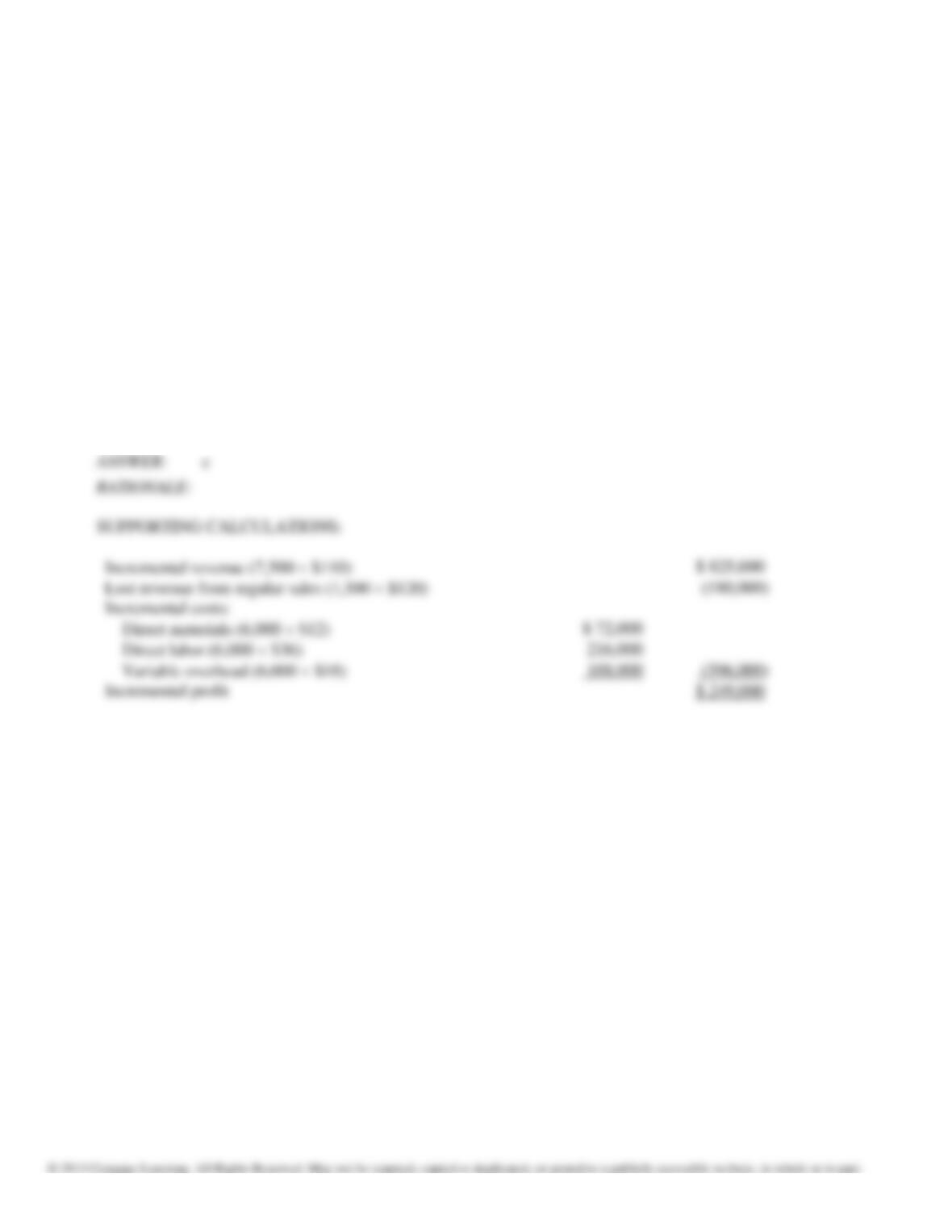
offered to pay $32 a unit for 2,000 units.
If the firm is at capacity and the special order is accepted, the effect on operating income would be
a. $-0-.
b. a $4,000 increase.
c. a $16,000 decrease.
d. a $20,000 increase.
Chapter 17: Activity Resource Usage Model and Tactical Decision Making
102. Wallyworld Company manufactures a product with the following costs per unit at the expected production level
of 84,000 units:
Direct materials
$12
Direct labor
36
Variable manufacturing overhead
18
Fixed manufacturing overhead
24
The company has the capacity to produce 90,000 units. The product regularly sells for $120. A wholesaler has
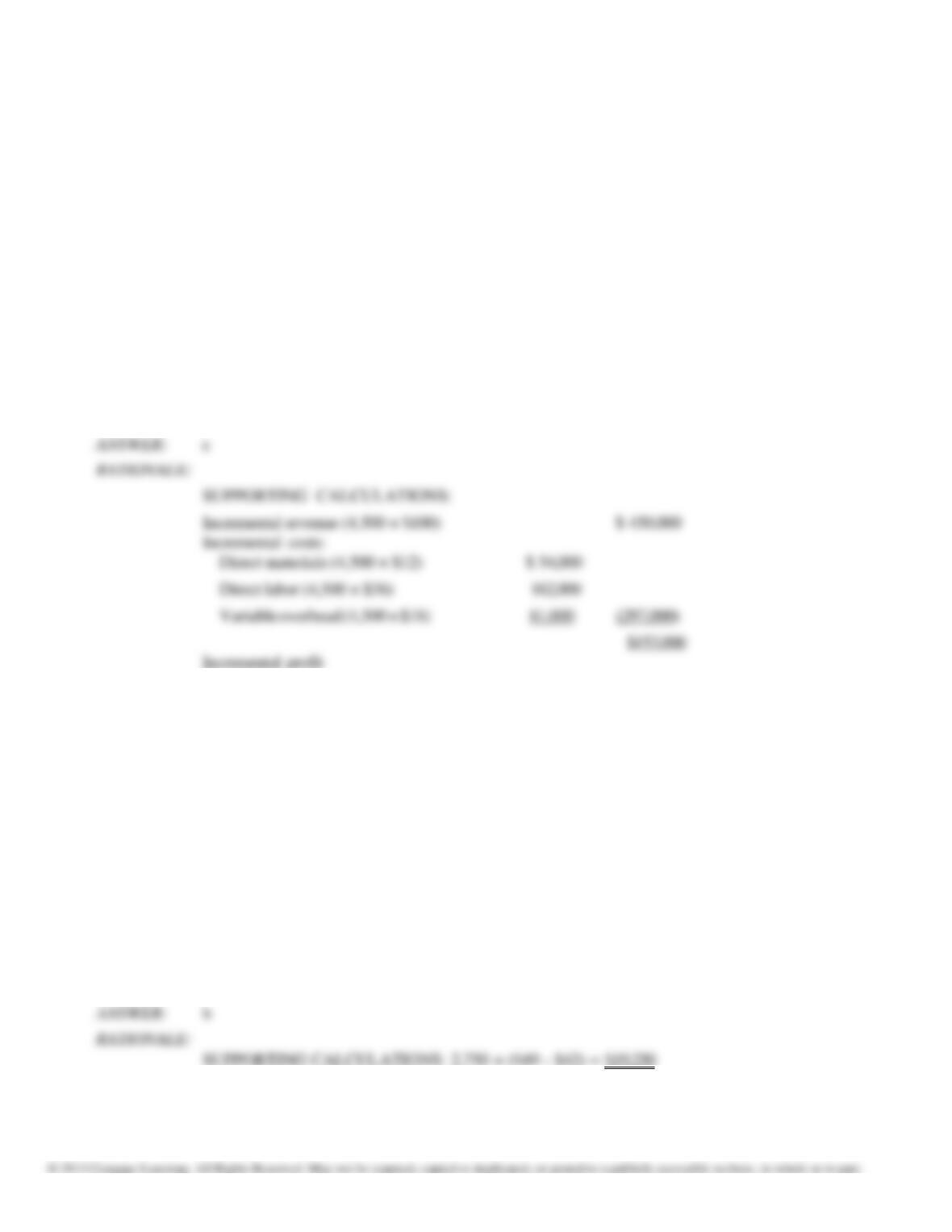
offered to pay $110 a unit for 7,500 units.
If the special order is accepted, the effect on operating income would be a
a. $75,000 decrease.
b. $429,000 increase.
c. $249,000 increase.
d. $495,000 increase.
Chapter 17: Activity Resource Usage Model and Tactical Decision Making
103. Wallyworld Company manufactures a product with the following costs per unit at the expected production level of
84,000 units:
Direct materials
$12
Direct labor
36
Variable manufacturing overhead
18
Fixed manufacturing overhead
24
The company has the capacity to produce 90,000 units. The product regularly sells for $120.
If a wholesaler offered to buy 4,500 units for $100 each, the effect of the special order on income would be a
a. $450,000 increase.
b. $45,000 increase.
c. $153,000 increase.
d. $90,000 decrease.
104. Rosario Manufacturing Company had the following unit costs:
Direct materials $24
Direct labor 8
Variable factory overhead 10
Fixed factory overhead (allocated) 18
A one-time customer has offered to buy 2,750 units at a special price of $49 per unit. Assuming that sufficient
unused production capacity exists to produce the order and no regular customers will be affected by the order, how
much additional profit (loss) will be generated by accepting the special order?
a. $134,750 profit
b. $19,250 profit
c. $84,000 loss
d. $16,500 loss