
Name:
Class:
Date:
Chapter 17: Externalities and the Environment
d. the marginal social cost of air quality increases.
e. the marginal social benefit of air quality decreases.
83. If production is characterized by variable technology and generates pollution, the optimal level of air quality occurs
where:
a. the marginal private cost of air quality equals the marginal social benefit.
b. the marginal social cost of air quality equals the marginal social benefit.
c. the marginal social cost of air quality equals the marginal private cost of air quality.
d. government regulators set it.
e. the average private cost equals the average social cost.
84. The marginal social benefit curve for water quality slopes downward because:
a. the total benefit from clean water decreases as water becomes cleaner.
b. the added benefit from cleaner water is greater when water quality is poor than when water quality is high.
c. the added benefit from cleaner water is smaller when water quality is poor than when water quality is high.
d. the total benefit from clean water increases as water becomes cleaner.
e. the average benefit of clean water is higher.
85. Markets fail when externalities are present:
a. because all the costs and benefits of producing goods are reflected in the market prices of the goods.
b. because some of the costs and benefits of producing goods are not reflected in the market prices of the goods.
c. because monopoly power arises.
d. because profits are not maximized.
e. because there is underprovision of merit goods.
86. Which of the following is not used by the U.S. government to limit overfishing in U.S. waters?
a. Laws to limit the total catch
b. Laws to limit the size of fish caught
c. Laws to impose the minimum price of fish
d. Limits to the length of the fishing season
e. Limits to the types of fishing equipment used
87. A meditation class meets on the second floor of a building; the first floor is a nightclub. The loud music from the club
disturbs the classes. The club could be soundproofed for a cost of $5,000 or move at a cost of $8,000. The class cannot be
soundproofed enough to overcome the music, but could be moved for $4,000. According to the Coase theorem, _____.
a. the club should be soundproofed so both businesses can stay open
b. the club should be soundproofed because it is the one generating the externality
c. the club should move rather than be soundproofed because eliminating an externality is better than compensating
for it
d. the class should move because it can eliminate the externality at a lower cost than can the nightclub
e. whichever business has been there longer has a property right and the other should adjust

Name:
Class:
Date:
Chapter 17: Externalities and the Environment
88. A meditation class meets on the second floor of a building; the first floor is a dance academy. The loud music from the
academy disturbs the meditation classes. The academy could be soundproofed for a cost of $6,000 or move at a cost of
$9,000. The class cannot be soundproofed enough to overcome the music, but could be moved for $5,000. According to
the Coase theorem, a socially optimal solution can be achieved if:
a. the government purchases the building.
b. the dance academy is relocated.
c. property rights to be noisy are granted to the nightclub.
d. property rights to a quiet environment are granted to the meditation class.
e. both the dance academy and the meditation class relocate.
89. According to the Coase theorem, if the appropriate property right is assigned to __________, an efficient solution to
an externality problem will be achieved.
a. the party that has a higher marginal social cost
b. the party that has a lower marginal social cost
c. the party that has a higher marginal private benefit
d. the party that has a lower marginal private benefit
e. either one of the parties involved
90. According to the Coase theorem, externality problems may be solved if the parties involved can negotiate. Which of
the following is also required for an efficient solution?
a. Clearly defined bargaining costs and low transaction costs
b. Enforceable bargaining costs and high transaction costs
c. Enforceable property rights and low bargaining costs
d. Enforceable property right and high bargaining costs
e. Government intervention
91. Fishing, lumbering, tourism, and city buildings in Canada are harmed by acid rain, most of which comes from the
United States. According to the Coase theorem, the problem is:
a. easy to solve because the United States and Canada are geographically close.
b. easy to solve because the United States and Canada are have similar geographical features.
c. easy to solve because same international property rights are applicable to both the countries.
d. hard to solve because international negotiations are costly.
e. hard to solve because Canadians have property rights to clean, nonacidic rain.
92. According to the Coase theorem, _____.
a. government regulation is necessary to eliminate negative externalities
b. externality problems can be solved efficiently by the assignment of property rights if transaction costs are low
c. it is necessary to assign property rights when bargaining costs are high
d. the assignment of property rights lead to equitable but inefficient solutions to externality problems
e. externality problems can be solved efficiently by the assignment of property rights if transaction costs are high
93. According to the Coase theorem, there will be an efficient solution to the problem of toxic waste:

Name:
Class:
Date:
Chapter 17: Externalities and the Environment
a. if the creator of the toxic waste is assigned the property right and the bargaining costs are high.
b. if the victim of toxic waste is assigned the property right and the bargaining costs are high.
c. regardless of which party is assigned the property right as long as the bargaining costs are small.
d. if the property rights are shared equally between the creator and the victim of toxic waste.
e. if the government intervenes.
94. The Coase theorem argues that the assignment of property rights will generate an efficient solution to the problem of:
a. arbitrage as long as bargaining costs are small.
b. negative externalities as long as bargaining costs are small.
c. negative externalities as long as bargaining costs are high.
d. moral hazard as long as bargaining costs are small.
e. adverse selection as long as bargaining costs are small.
95. A metal stamping factory moves next to a day care center. Noise from the factory makes it impossible for the kids to
take a nap. Which of the following is likely to be true given the scenario?
a. The factory should move.
b. The day care center should move.
c. The factory should install sound insulation.
d. The day care center should install sound insulation.
e. Optimal solution cannot be achieved unless the costs are given.
96. A metal stamping factory moves next to a day care center. Noise from the factory makes it impossible for the kids to
nap. It would cost the factory $5 million to move and $1 million for the day care center to move. Sound insulation for the
factory costs $1 million, while insulation for the day care center costs $200,000. The court determines that the day care
center has the property right. Which of the following optimal solution is likely to be true given the scenario?
a. The factory should install sound insulation because that is cheaper than moving.
b. The factory should pay for the relocation of the day care center.
c. The factory should buy insulation for the day care center.
d. The day care center should buy its own insulation.
e. The day care center should relocate.
97. A metal-stamping factory moves next to a day care center. Noise from the factory makes it impossible for the kids to
nap. It would cost the factory $5 million to move and $1 million for the day care center to move. Sound insulation for the
factory costs $1 million; insulation for the day care center costs $200,000. The court initially determines that the day care
center has the property right. But, on appeal, the factory is awarded the property right. Which of the following is likely to
be true given the scenario?
a. Insulation for the day care center would be bought, a result consistent with the Coase theorem.
b. Insulation for the factory would be bought, a result consistent with the Coase theorem.
c. Insulation for the day care center would be bought by the factory, a result consistent with the Coase theorem.
d. Insulation for the factory would be bought by the day care center, a result inconsistent with the Coase theorem.
e. The day care center would move instead of buying insulation, a result consistent with the Coase theorem.
98. According to the Coase theorem, _____ in order to solve a negative externality problem efficiently.
Name:
Class:
Date:
Chapter 17: Externalities and the Environment
a. the property right must be assigned to the party with the least-cost alternative
b. the property right must be assigned to the victim of pollution
c. bargaining costs must be high
d. bargaining costs must be low
e. property rights must be determined by the government
99. The Coase solution to the problem of externalities:
a. applies in every situation where externalities are present.
b. only applies to activities that generate positive externalities.
c. only works under perfect competition.
d. only works when bargaining costs are low.
e. applies when the number of parties involved in the transaction is large.
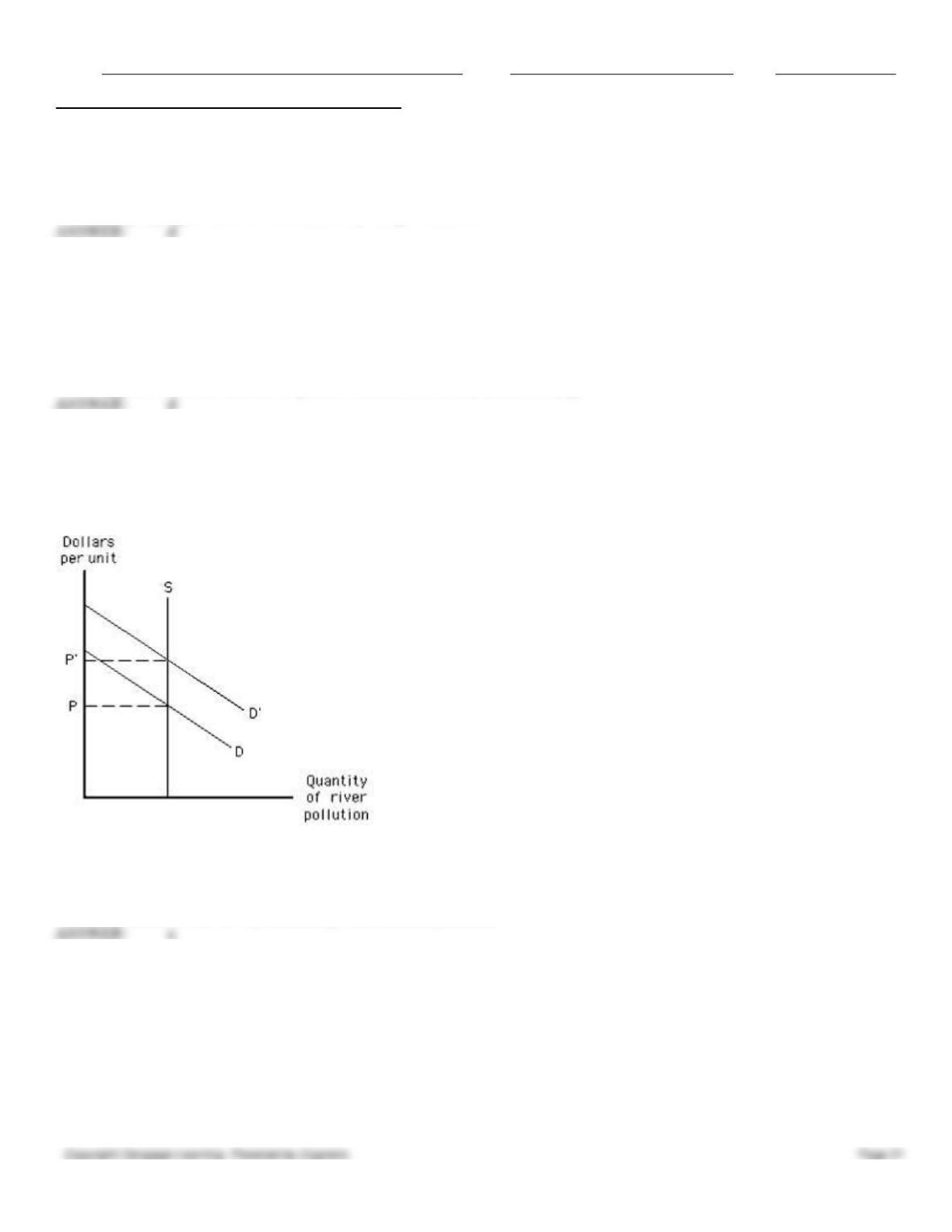
100. The following graph shows the market for pollution rights. The shift of the demand curve from D to D’ indicates that
______.
Figure 17.4
a. producers want to discharge more pollution into the river
b. producers want to use more of the river in a nonpolluting way
c. consumers want producers to clean up the polluted river
d. consumers want to buy goods that use technology that does not pollute
e. consumers want to buy technology that reduces pollution
101. The following graph shows the market for pollution rights. The supply curve represents the amount of ______.
Figure 17.4
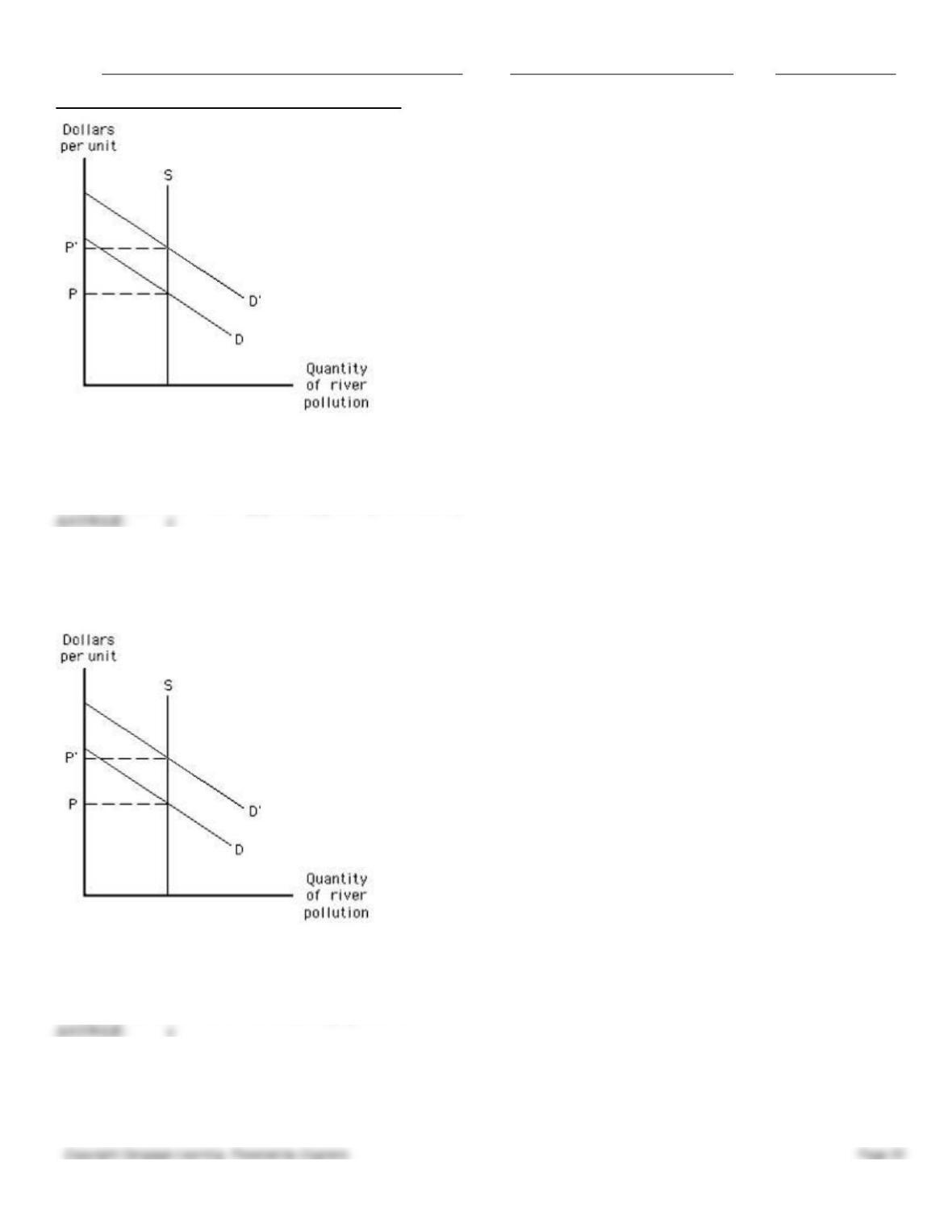
Name:
Class:
Date:
Chapter 17: Externalities and the Environment
a. toxins the firms want to dump into the river
b. water that can be used as an input by firms
c. toxins that can be dumped into the river without reducing the water quality below a certain level
d. pollution the firm is willing to clean up
e. the pollution-causing good supplied by the industry
102. The following graph shows the market for pollution rights. An increase in demand indicates ______.
Figure 17.4
a. a rise in pollution
b. increased environmental damage
c. an increase in the price of the right to pollute
d. an increase in the benefit of cleaning up the pollution
e. an increase in the cost of cleaning up the river
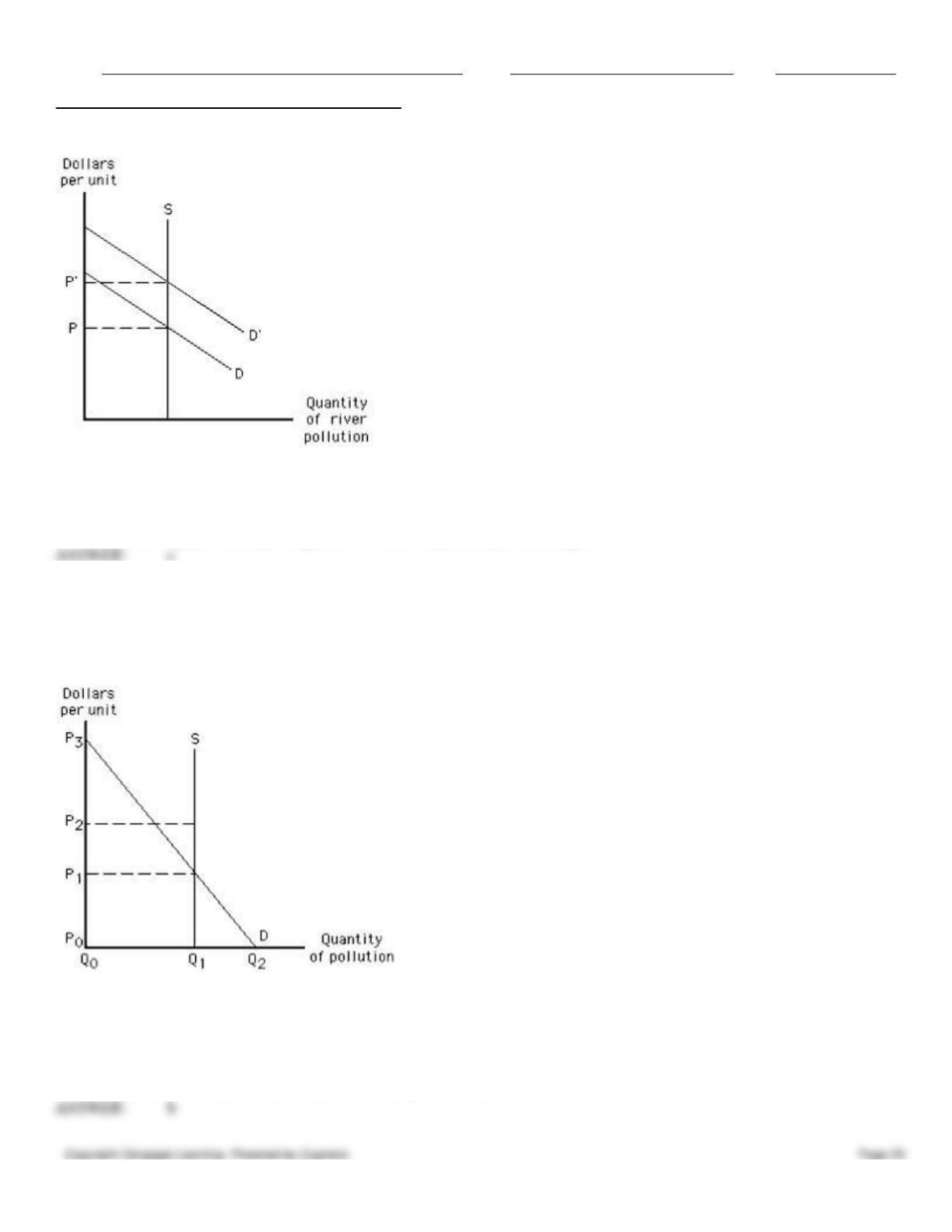
103. The following graph shows the market for pollution rights. Which of the following could not have caused an increase
in the demand for pollution rights?
Name:
Class:
Date:
Chapter 17: Externalities and the Environment
Figure 17.4
a. An increase in the number of polluting firms
b. An increase in the ability of the firm to absorb pollutants
c. A decrease in the cost of pollution abatement equipment
d. The ability of existing firms to sell pollution rights at a price lower than the market price.
e. The subsidy provided by the government on the price of pollution rights
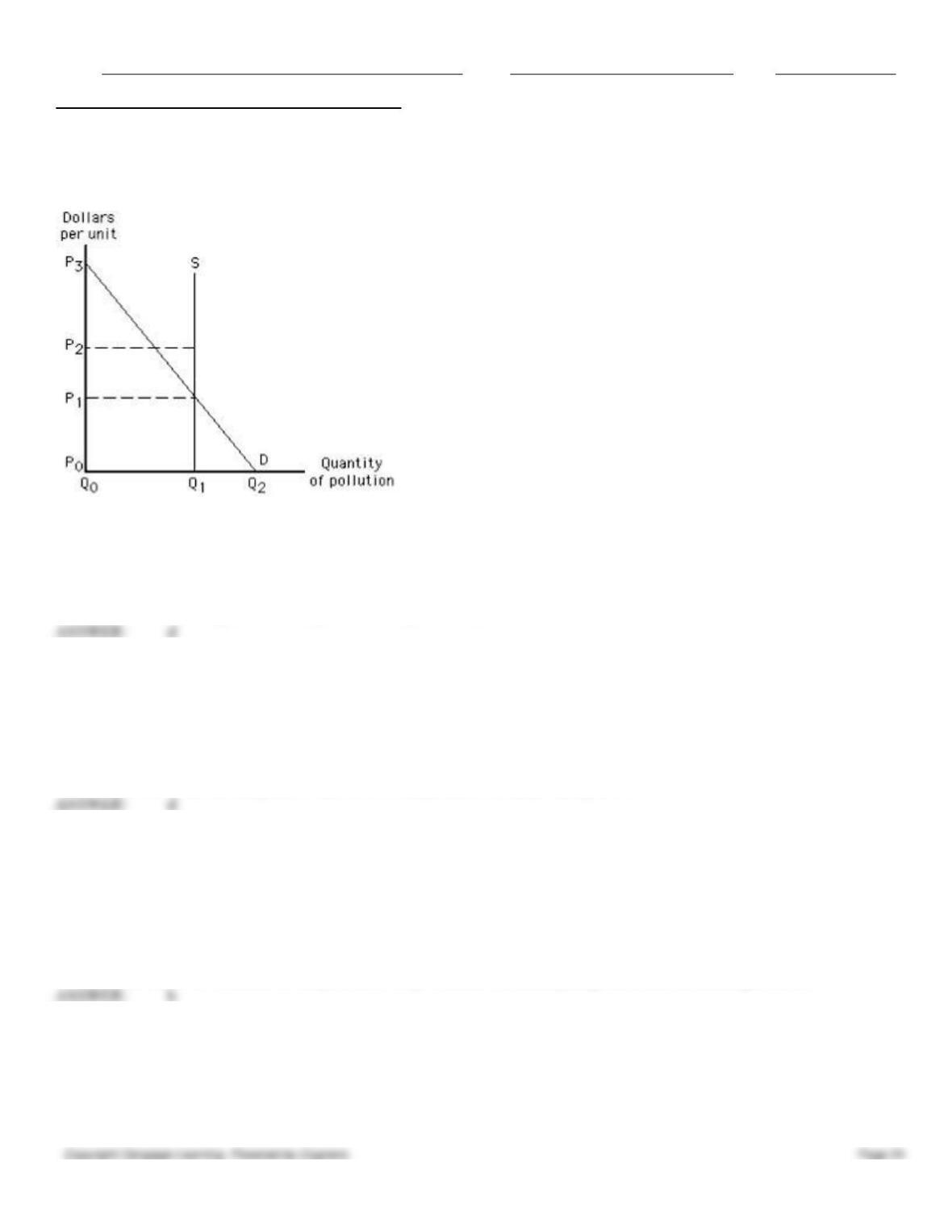
104. The following graph shows the optimal allocation of pollution rights to firms polluting a river. If the government
does not charge firms for polluting the river, the ______.
Figure 17.5
a. firms will emit Q1 units of the pollutant at a price of P0 each
b. firms will emit Q2 units of the pollutant at a price of P0 each
c. firms will emit Q0 units of the pollutant at a price of P3 each
d. firms will emit Q1 units of the pollutant at a price of P1 each
e. firms will emit Q2 units of the pollutant at a price of P0 each
Name:
Class:
Date:
Chapter 17: Externalities and the Environment
105. The following graph shows the optimal allocation of pollution rights to firms polluting a river. If the government
sells the right to pollute a river, _____.
Figure 17.5
a. firms will emit Q1 units of the pollutant at a price of P0 each
b. firms will emit Q2 units of the pollutant at a price of P0 each
c. firms will emit Q0 units of the pollutant at a price of P3 each
d. firms will emit Q1 units of the pollutant at a price of P1 each
e. firms will emit Q2 units of the pollutant at a price of P3 each
106. The price of a pollution right is _______.
a. determined by the consumers consuming the products of the polluting firms
b. determined by the government
c. determined by the polluting firms
d. determined by the supply of and the demand for pollution rights
e. determined by the marginal social costs of the products of the polluting firms
107. The government passes a new law allowing only 1,000 tons of pollution per day to be generated and simultaneously
sells 1,000 transferable rights to emit one ton each of pollution per day. Which of the following is true?
a. Pollution will be created by those least willing and able to pay the damages.
b. Pollution will be created by those most willing and able to pay for the right to pollute.
c. The funds collected by the government will be enough to compensate any individual harmed by the pollution.
d. Pollution will increase from zero to 1,000 units per day.
e. There will be no incentive for polluters to try to sneak emissions past government monitoring devices.
108. Which of the following would happen if the government increased the quantity of pollution rights to be sold, other
things equal?
a. Pollution would not be affected.
b. The price of pollution rights would rise, and the amount of pollution would decrease.
c. The price of pollution rights would fall, and the amount of pollution would decrease.

Name:
Class:
Date:
Chapter 17: Externalities and the Environment
d. The price of pollution rights would fall, and the amount of pollution would increase.
e. The price of pollution rights would rise, and the amount of pollution would increase.
109. Markets for pollution rights:
a. assign property rights to those firms which have high market shares.
b. assign property rights to those who value them least.
c. allow the government to assign property rights.
d. enable those who value them most to pollute.
e. requires government intervention.
110. Suppose environmental groups pressure the local government to reduce the number of pollution rights to be sold.
Other things equal, ______.
a. pollution would not be affected
b. the price of pollution rights would rise and the amount of pollution would decrease
c. the price of pollution rights would fall and the amount of pollution would decrease
d. the price of pollution rights would fall and the amount of pollution would increase
e. the price of pollution rights would rise and the amount of pollution would increase
111. If producers cannot afford the fees for pollution rights, then:
a. they will adopt ways to pollute without getting detected.
b. they will buy pollution rights illegally.
c. they will have to sell their pollution rights.
d. they will have to find a cheaper way to deal with their pollution.
e. they will not be able to use their pollution rights.
112. The Clean Air Act of 1970:
a. set up a depletion tax system.
b. reduced air pollution standards.
c. recognized air as an economic resource.
d. established a system of transferable pollution rights.
e. forbade producers to emit any pollutants into the air.
113. The Clean Air Act of 1970 has:
a. been ineffective at reducing lead emissions in automobiles.
b. actually caused an increase in auto emissions.
c. been fairly successful in reducing auto emissions, especially lead.
d. been unsuccessful in reducing auto emissions, especially sulfur oxides.
e. been ineffective at reducing carbon monoxide emissions.
114. Dumping raw sewage into Boston Harbor is an example of a:
a. negative externality.

Name:
Class:
Date:
Chapter 17: Externalities and the Environment
b. positive externality.
c. private cost.
d. sunk cost.
e. public good.
115. Untreated raw sewage in the U.S. is dumped directly into rivers and oceans by ______.
a. the less developed parts of the U.S.
b. factories in rural areas
c. factories near the rivers and oceans
d. every large city
e. some of the largest cities
116. Which of the following helps explain why pesticides account for much of the water pollution in the United States?
a. Pesticide regulations were repealed by the Environmental Protection Agency.
b. Pesticide regulations favored genetically engineered crops.
c. Pesticide regulations were applicable only to large farms.
d. Pesticide regulations were administered by state agricultural departments.
e. Pesticide regulations were administered by the federal government.
117. A major source of water pollution in the United States is _____.
a. factories
b. sulfur dioxide (i.e., acid rain)
c. cars
d. chemicals (used in pesticides and fertilizers) and sewage
e. garbage
118. Control of water pollution from pesticide runoff in the United States is the responsibility of:
a. the U.S. Department of Agriculture.
b. the Environmental Protection Agency.
c. state attorneys general.
d. state departments of agriculture.
e. state environmental protection agencies.
119. The Superfund law was designed to clean up:
a. the acid rain problem.
b. air pollution from automobiles, buses, and trucks.
c. water pollution from agricultural sources (i.e., pesticides).
d. water pollution from dumping raw sewage.
e. toxic waste dumps.
120. Nearly half of the Superfund has been spent on:

Name:
Class:
Date:
Chapter 17: Externalities and the Environment
a. education of the public on environmental issues.
b. research.
c. court costs and legal fees.
d. cleaning rivers that have been polluted.
e. the development and installation of antipollution devices.
121. The main objective of the Comprehensive Environmental Response, Compensation, and Liability Act, was to ensure
that:
a. companies that generated hazardous wastes pay to clean up any wastes that are improperly disposed.
b. individuals who dispose garbage and other hazardous wastes in rivers pay for the cleanup of rivers.
c. automobile emissions are reduced by 90 percent.
d. all waste products are converted into reusable materials.
e. harmful pesticides are not used by farmers.
122. _____ are usually recycled in the United States.
a. Hazardous chemical materials
b. Processed wood
c. Natural textiles
d. Newspapers
e. Electronic appliances
123. In Japan, recycling is prevalent and landfill use is relatively smaller than the United States because:
a. the Japanese have less developed technology for landfills.
b. the externality problem is not present in Japan.
c. land is relatively more scarce in Japan.
d. the Japanese have better recycling technology.
e. littering is illegal there.
124. Which of the following accounts for the recent decline in the growth of trash-to-energy plants?
a. Decline in energy prices
b. Less favorable tax treatment
c. Decline in the amount of garbage per capita
d. Removal of subsidies
e. High cost of legal consultation
125. In the U.S., people tend to discard items rather than repair them because:
a. leisure is valued more than work.
b. of the high opportunity cost of time.
c. it is costly to use land for waste disposal.
d. high wages in the waste disposal industry discourage repairs.
e. of the low opportunity cost of time.

Name:
Class:
Date:
Chapter 17: Externalities and the Environment
126. When the consumption of a good generates positive externalities, _____.
a. the private demand curve for the good shifts rightward.
b. the private demand curve for the good shifts leftward.
c. the private demand curve for the good lies below the marginal social benefit curve.
d. the private demand curve for the good lies above the marginal social benefit curve.
e. the equilibrium quantity of the good determined by the free private market is too high.
127. When consuming a good creates positive externalities, _____.
a. the private demand for the good increases.
b. the private demand for the good decreases.
c. the private demand curve overstates the marginal social benefit of the good.
d. the private demand curve understates the marginal social benefit of the good.
e. the equilibrium quantity traded of the good increases without government intervention.
128. Which of the following is a positive externality?
a. Inoculations against a disease that reduce the likelihood of transmitting it to others
b. Phosphates from laundry detergents
c. Litter from fast food containers
d. Ozone depletion due to the production of fast food containers
e. The greenhouse effect
129. If consuming a good creates a positive externality, _____.
a. the marginal private benefit from consuming the good exceeds the marginal social benefits
b. the marginal social benefit from consuming the good exceeds the marginal private benefits
c. the private demand for the good is equal to the marginal social benefit
d. the private demand for the good is greater than the marginal social benefit
e. the private demand curve for the good shifts to the right to coincide with the marginal social benefit curve
130. If the quantity of smallpox vaccinations is determined by the market forces of demand and supply, which of the
following is most likely to be true?
a. The equilibrium quantity will be too low for efficiency.
b. The equilibrium price and quantity will be too high for efficiency.
c. The equilibrium price will be too low for efficiency.
d. The equilibrium quantity will be too high for efficiency.
e. The equilibrium price and quantity will be efficient.
131. If farmers decide individually whether or not to vaccinate their cattle against mad cow disease, which of the
following is true?
a. The equilibrium quantity is too low for efficiency.
b. The equilibrium price and quantity are too high for efficiency.
c. The equilibrium price is efficient.
d. The equilibrium quantity is too high for efficiency.

Name:
Class:
Date:
Chapter 17: Externalities and the Environment
e. The equilibrium price and quantity are efficient.
132. Education confers positive externalities because:
a. some education is done outside the market.
b. curricula are regulated by the government, even in private schools.
c. an educated person consuming education gains many personal benefits.
d. an educated person behaves in a way that benefits others.
e. education gives benefits to individuals in excess of the costs they pay to get it.
133. If the consumption of education creates a positive externality, then to increase efficiency relative to the outcome
determined by private decisions, _____.
a. more public education should be produced
b. the same amount of education must be produced and the price should be lower
c. less education must be produced and the price should be higher
d. less education must be produced and the price should be lower
e. less education must be produced at the same price
134. In order to increase society’s well-being, a production process that generates a positive externality should be:
a. taxed to discourage production.
b. subsidized to encourage production.
c. taxed to encourage production.
d. subsidized to discourage production.
e. continued without government intervention.
135. In order to increase society’s well-being, education should be:
a. taxed to discourage production.
b. subsidized to encourage production.
c. taxed to encourage production.
d. subsidized to discourage production.
e. provided without government intervention.
136. In order to increase society’s well-being, measles vaccinations should be:
a. taxed to discourage production.
b. subsidized to encourage production.
c. taxed to encourage production.
d. subsidized to discourage production.
e. provided without government intervention.
137. Which of the following creates a positive externality?
a. A paper mill that pollutes a river
b. A stock market crash

Name:
Class:
Date:
Chapter 17: Externalities and the Environment
c. A neighbor who beautifies her lawn
d. A car that emits carbon monoxide
e. A person who smokes in a public place
138. When the benefits to society of using a product exceed the benefits to the user, then:
a. the product should be strictly regulated.
b. the product should be taxed.
c. the product provides a positive externality.
d. the product is overproduced at the privately determined equilibrium.
e. the product provides a negative externality.
139. If the benefits to society of students attending college exceed the benefits to the students, then:
a. higher education should be strictly regulated.
b. higher education should be taxed.
c. higher education provides a positive externality.
d. higher education is overproduced at the privately determined equilibrium.
e. higher education provides a negative externality.
140. Which of the following provides a positive externality?
a. Smog
b. Inoculating children against measles
c. Smoking in public places
d. Littering roads
e. Listening to loud music
141. Which of the following responses to a positive externality enhances society’s welfare?
a. Taxes
b. Subsidies
c. Effluent fees
d. Quotas
e. A cut in funding
142. To enhance social welfare, the government should encourage the production of:
a. private goods.
b. goods that produce moral hazard.
c. goods that produce positive externalities.
d. goods that have close substitutes.
e. goods that produce negative externalities.
143. If education creates positive externalities, then:
a. private markets provide less than the socially optimal quantity of education.
Name:
Class:
Date:
Chapter 17: Externalities and the Environment
b. private markets provide more than the socially optimal quantity of education.
c. the marginal private benefit curve is higher than the marginal social benefit curve.
d. the marginal private cost curve is higher than the marginal social cost curve.
e. the government should impose a depletion tax.
144. Unpriced byproducts of production or consumption that provide benefits to other consumers or other firms are
known as:
a. negative externalities.
b. merit goods.
c. positive externalities.
d. private benefits.
e. pure substitutes.
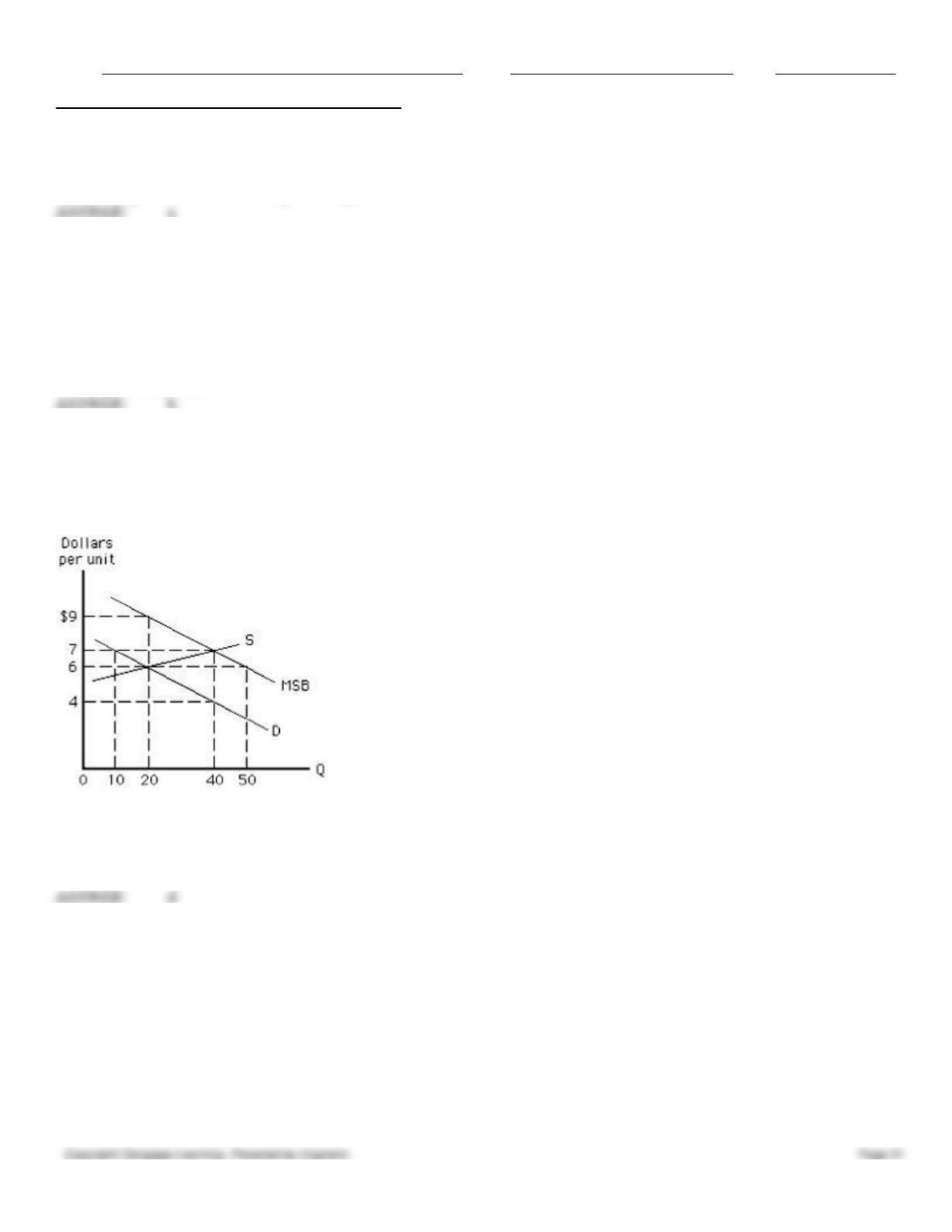
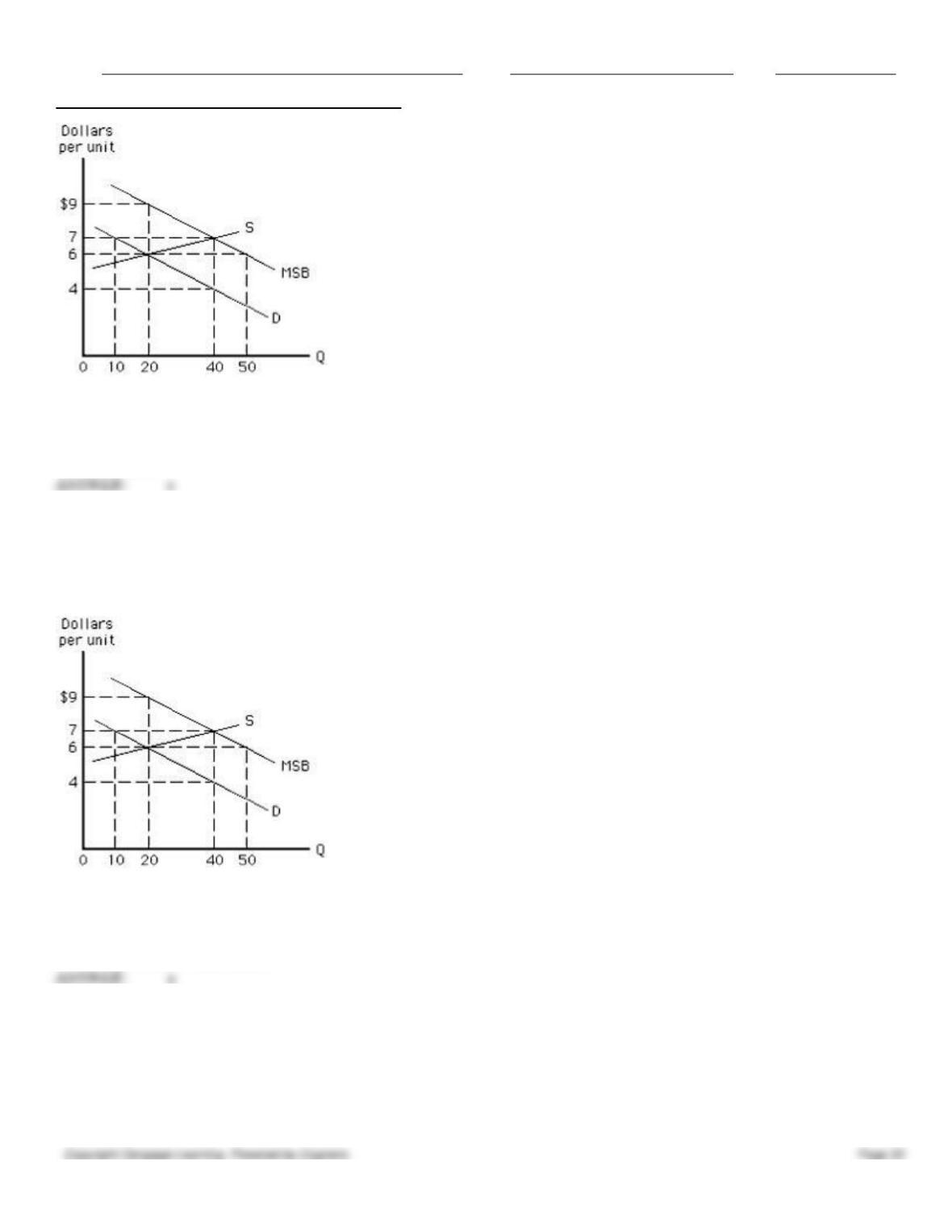
145. The following graph shows the demand, the supply, and the marginal social benefit curves. The socially efficient
level of output is _______.
Figure 17.6
a. 0 units
b. 10 units
c. 20 units
d. 40 units
e. 50 units
146. The following graph shows the demand, the supply, and the marginal social benefit curves. An unregulated market
would produce ______.
Figure 17.6
Name:
Class:
Date:
Chapter 17: Externalities and the Environment
a. 0 units
b. 10 units
c. 20 units
d. 40 units
e. 50 units
147. The following graph shows the demand, the supply, and the marginal social benefit curves. The graph shows market
equilibrium in the presence of ______.
Figure 17.6
a. positive externalities
b. positive and negative externalities
c. negative externalities
d. the Coase theorem
e. asymmetric information
148. Free markets produce too little output when:
a. negative externalities exist.
b. positive externalities exist.
c. production uses fixed-production technology.
d. production uses variable technology.
e. the resource is exhaustible.

Name:
Class:
Date:
Chapter 17: Externalities and the Environment
149. Which of the following is an example of an activity that generates positive externalities?
a. Driving a car that emits high amounts of carbon monoxide
b. Dumping wastes into a river
c. Littering streets
d. Initiating a program to encourage education
e. Smoking in a public place
150. When society receives more benefits from a good than the individuals who consume the good, then:
a. the marginal social benefit from the good is less than the marginal social cost.
b. the average social benefit is less than the average social cost.
c. the property rights on the good has been well defined.
d. the production of the good generates a positive externality.
e. the production of the good generates a negative externality.