4) Which of the following statements about commission systems of compensation is false?
A) They increase the risk to workers because sometimes output declines for reasons not
connected to the worker’s effort.
B) During sluggish periods, an employer’s payroll expenses will decline along with sales.
C) If workers are paid on the basis of the number of units produced, they may become less
concerned about quality.
D) The lack of income stability will induce the more productive workers to leave in search of
more secure employment.
5) Despite evidence that companies will find it more profitable to use a commission system of
compensation rather than a salary system, many companies continue to pay their workers
salaries. Which of the following is one reason why firms choose a salary system?
A) Most business owners and managers are not trained economists; therefore, they are unaware
of the research that shows a commission system is more profitable than a salary system.
B) Firms often use salary systems to overcome their principal-agent problems.
C) Firms that have salary systems do not have to use compensating differentials to attract
employees to do hazardous jobs.
D) Many workers dislike risk and prefer to be paid a salary rather than to be paid by commission.
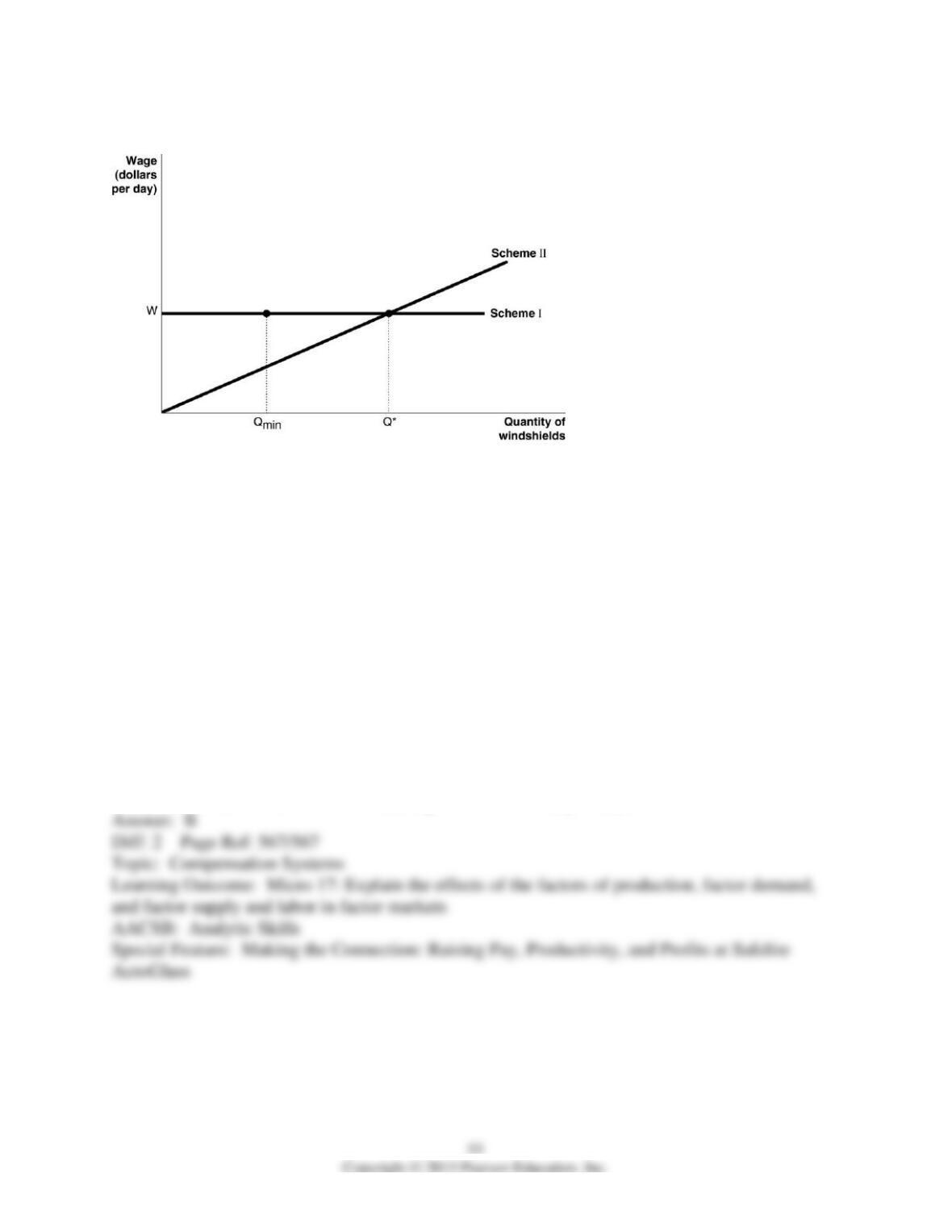
Figure 17-5
Figure 17-5 shows two different compensation schemes for the Safelite Glass Corporation, an
installer of auto glass windshields. Under Scheme I, the firm pays a consistent wage of $80 per
day based on an 8-hour workday. Qmin represents the cut-off point under the hourly-wage
system: if a worker installed fewer than Qmin windshields, the worker got fired. Scheme II
represents a piece-rate scheme with an earnings floor: no worker would get less than $80 per day
(for an 8-hour workday) and would have to produce at least Qmin. For any output level beyond
Q* the worker earned an additional $20 for each unit produced.
6) Refer to Figure 17-5. Under Scheme I,
A) workers compete with each other to see who can produce beyond Qmin in the shortest
possible time.
B) workers have no incentive to produce beyond Qmin.
C) workers signal their productivity to the firm by consistently producing above Qmin.
D) the incentive to increase productivity depends on where Qmin is set; if it is at a very high
level, then workers will rise to the challenge for fear of losing their jobs.
7) Refer to Figure 17-5. Which of the following statements about Scheme II is false?
A) It is likely to draw highly productive workers who see the opportunity to increase their wages.
B) It could discourage less productive workers and induce them to leave the firm.
C) It allows workers to increase their daily wage without penalizing those who are content with
their daily wage.
D) It is more risky for senior employees.
8) Refer to Figure 17-5. Suppose Qmin = 2 windshields and Q*=5 windshields. Under Scheme
II, a worker has to install Q* windshields before she earns an additional $20 per windshield
installed. What is a potential problem with this scheme?
A) Workers might be more concerned with increasing output beyond Q* and less concerned with
the quality of their work.
B) Any increase in output between Qmin and Q* benefits the employer only.
C) It violates labor laws because workers are not compensated for output between Qmin and Q*.
D) Workers have no incentive to produce output to between Qmin and Q*.
9) A commission system of compensation reduces the risk to workers during seasonal periods
when business is sluggish.
10) When workers are paid on a piece-rate basis, an employer must be able to easily measure
each worker’s output.
11) A firm might prefer a commission system of compensation when the nature of the work is
repetitive and monotonous and can be performed by an individual.
12) What is personnel economics?
13) What is the difference between “straight-time pay”, “commission pay”, and “piece-rate pay”?
14) If commission or piece-rate systems of compensating workers have important advantages for
firms, why don’t more firms use them?
17.6 The Markets for Capital and Natural Resources
1) If a firm is the sole employer of a factor of production, it is known as
A) a monopoly.
B) a competitor.
C) a monopsony.
D) an economically discriminating firm.
2) The marginal revenue product of capital is
A) the cost to the firm of renting an additional unit of capital.
B) the change in the firm’s revenue as a result of employing one more unit of capital, such as a
machine.
C) the economic rent received by hiring an additional unit of capital.
D) the revenue generated by substituting capital for labor in the production process.

3) Which of the following statements regarding equilibrium in the markets for capital and for a
natural resource used in producing a good is true?
A) The marginal revenue product of capital will equal the marginal revenue product of the
natural resource.
B) The rental price of capital will equal the price of the natural resource.
C) The marginal product of capital will equal the rental price of capital and the marginal product
of the natural resource will equal the price of the natural resource.
D) The marginal revenue product of capital will equal the rental price of capital and the marginal
revenue product of the natural resource will equal the price of the natural resource.
4) The Buda Agri Corporation is the sole employer in rural Hungary. In the labor market, Buda
Agri is a
A) monopolistic competitor.
B) monopsony.
C) monopoly.
D) perfect competitor.
5) Economic rent is defined as
A) what you pay to rent your apartment or house.
B) the revenue received by a factor of production with an upward sloping supply curve.
C) the price of a factor of production that is fixed in supply.
D) the surplus received by employing a factor of production in its highest valued use.

6) The town of Saddle Peak has a fixed supply of mountain view lots. In this case, the price per
square foot of mountain view lots is
A) determined only by supply.
B) determined only by demand.
C) set by government officials of Saddle Peak.
D) negotiated by environmental groups and property developers.
7) According to the marginal productivity theory of income,
A) the greater the quantity of resources owned by an individual, the greater his incentive to
increase productivity and his income.
B) the average income received by an individual who supplies resources is influenced by the
resources owner’s marginal productivity.
C) the income received by an individual who supplies labor services equals the incremental
benefit generated to the firm by that individual’s labor.
D) the income received by an individual who supplies labor services equals the profit generated
to the firm by that individual’s labor.
8) The marginal productivity theory of income states that a person’s total income is determined
by
A) the amount and productivity of factors of production the individual owns.
B) how much the individual works.
C) how profitable the firm the individual works for is.
D) how much the individual has inherited.

9) The supply curve of a uniquely talented actor or superstar athlete will be perfectly inelastic.
10) The market price of a factor of production that is in fixed is determined only by demand.
11) A monopsony is a firm which is the sole producer of a product.
12) What is a monopsony?
13) What is the marginal productivity theory of income distribution?
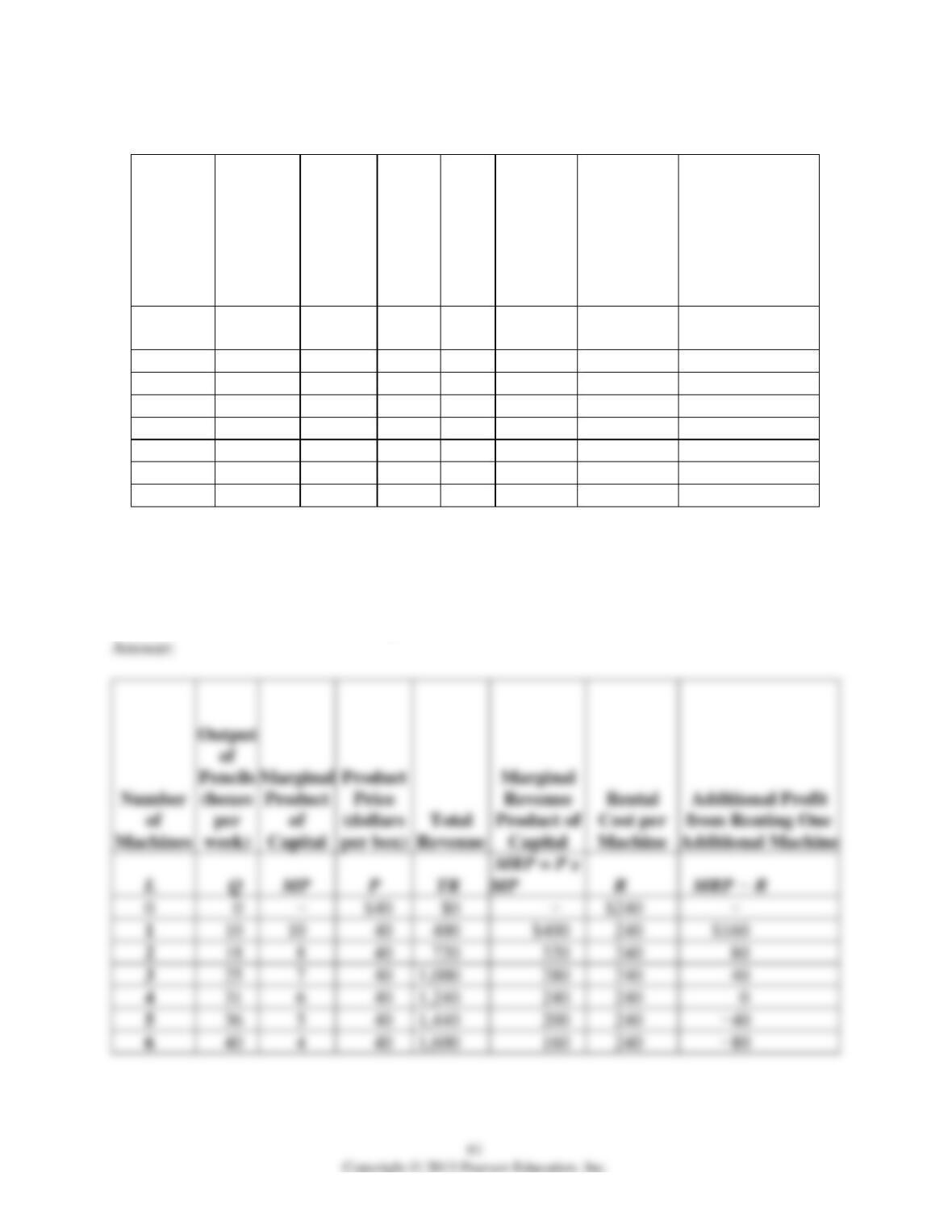
Table 17-4
Number
of
Machines
Output of
Pencils
(boxes per
week)
Marginal
Product
of
Capital
Produc
t Price
(dollars
per
box)
Total
Reven
ue
Marginal
Revenue
Product
of Capital
Rental Cost
per
Machine
Additional Profit
from Renting
One Additional
Machine
L
Q
MP
P
TR
MRP
R
0
0
−
$40
−
$240
1
10
40
240
2
18
40
240
3
25
40
240
4
31
40
240
5
36
40
240
6
40
40
240
14) Refer to Table 17-4. Dante owns a pencil factory and faces the situation shown in the table
and the cost of renting a machine is $240 per week.
a. Fill in the blanks in the table and determine the profit-maximizing number of machines for
Dante to rent. Explain why renting this number of machines is profit maximizing.
b. Draw Dante’s demand curve for capital.
Marginal
Additional Machine
L
Q
MP
P
TR
MRP = P x
R
MRP − R
0
0
−
$40
$0
−
$240
−
1
10
10
40
400
$400
240
$160
2
18
8
40
720
320
240
80
3
25
7
40
1,000
280
240
40
4
31
6
40
1,240
240
240
0
5
36
5
40
1,440
200
240
−40
6
40
4
40
1,600
160
240
−80