169. The FASB and the IASB are reconsidering the role of uncertainty, or probability, in the definition,
recognition, and measurement of liabilities. Existing recognition criteria include a probable future sacrifice of
resources; one issue involves the minimum probability level to warrant recognition of an uncertain obligation as
a liability. U.S. GAAP does not specify a minimum probability level, although the rule-of-thumb in practice is
approximately _____ percent.
170. Which of the following is not true?
171. The joint efforts of the FASB and the IASB to set forth qualitative characteristics of financial reporting
information have led to which of the following?
172. The joint efforts of the FASB and the IASB to set forth qualitative characteristics of financial reporting
information have led to which of the following tentative enhancing qualitative characteristics?
173. The joint efforts of the FASB and the IASB to set forth qualitative characteristics of financial reporting
information have led to which of the following tentative pervasive constraints?
174. Which of the following is/are a criteria for asset recognition under the FASB’s and IASB’s conceptual
framework?
175. The IASB’s conceptual framework defines _____ as increases in economic benefits during an accounting
period in the form of inflows or enhancements of assets or decreases in liabilities that result in increases in
equity, other than those relating to contributions from equity participants.
176. The FASB and the IASB are reconsidering the role of uncertainty, or probability, in the definition,
recognition, and measurement of liabilities. Existing recognition criteria include a probable future sacrifice of
resources; one issue involves the minimum probability level to warrant recognition of an uncertain obligation as
a liability. IFRS imply a minimum probability level of greater than _____ percent.
177. The IASB’s conceptual framework defines a(n) _____ as a resource controlled by an entity as a result of
past events and from which a firm expects future economic benefits.
178. Which of the following is/are not true?
179. The joint efforts of the FASB and the IASB to set forth qualitative characteristics of financial reporting
information have led to which of the following tentative fundamental qualitative characteristics?
180. U.S. GAAP and IFRS provide criteria for distinguishing operating leases from capital leases. Which of the
following is/are not true?
181. U.S. GAAP and IFRS provide criteria for distinguishing operating leases from capital leases. Which of the
following is not true?
182. U.S. GAAP and IFRS account for notes and nonconvertible bonds payable similarly.Which of the
following is/are not true?
183. U.S. GAAP and IFRS require firms to disclose the fair value of long-term notes and bonds in notes to the
financial statements. Fair value is
184. Which of the following is/are true about accounting for errors and changes in accounting principles and
changes in accounting estimates?
185. A _____ is used to record properly the effects of an event or transaction that was improperly recorded
during the accounting period.
186. When a firm has securities outstanding that, if exchanged for shares of common stock, would decrease
basic earnings per share by _____ or more, generally accepted accounting principles require a dual
presentation: basic earnings per share and diluted earnings per share.
187. Accountants and financial analysts criticize earnings per share as a measure of profitability because it does
188. One firm may have a lower earnings per share simply because it has a
189. Which of the following is true regarding the price-earnings ratio?
190. Earnings per share is a measure of
191. The following information pertains to the Kathy Company for the year ended December 31, Year 2:
Common shares outstanding
1,000,000
Stated value per share
$10.00
Market price per share
$80.00
Year 1 dividends paid per share
$ 4.00
Year 2 dividends paid per share
$ 5.00
Earnings per share
$ 8.00
The price-earnings ratio for Kathy’s common stock is
192. Earnings per share of common stock (assuming no convertible or other potentially dilutive securities
outstanding)
193. (CMA adapted, Jun 96 #18) The book value per share calculation of a corporation is usually significantly
different from the market value of the stock’s selling price due to the
194. Publicly held firms that apply U.S. GAAP or IFRS must show earnings per common share data. Firms
reporting multiple categories of income items must disclose earnings per common share
195. Earnings per common share result from dividing net income
196. Publicly held firms that apply U.S. GAAP or IFRS must show earnings per common share data in the
197. Correction of a material error occurring in prior periods is reported as
198. A separate section of the income statement reporting information about discontinued operations is
included
199. Accrual accounting requires frequent, ongoing changes in estimates. Which of the following is/are not
true?
200. U.S. GAAP and IFRS require firms to account for correction of errors, if material, by
201. The current price of a share of common stock reflects current economic conditions, not the requirements of
authoritative guidance. Market-to-book-value ratios tend to be large for firms that
202. U.S. GAAP and IFRS aid the investors’ analysis process by requiring firms to classify income transactions
in particular ways in the financial statements which include

203. Young Corporation’s capital stock at December 31 consisted of the following:
(a)
Common stock, $2 par value; 100,000 shares authorized, issued, and outstanding.
(b)
10% noncumulative, nonconvertible preferred stock, $100 par value; 1,000 shares authorized, issued, and outstanding.
Young’s common stock, which is listed on a major stock exchange, was quoted at $4 per share on December 31. Young’s net income for the year
ended December 31 was $50,000. The yearly preferred dividend was declared. No capital stock transactions occurred. What was the price earnings
ratio on Young’s common stock at December 31?
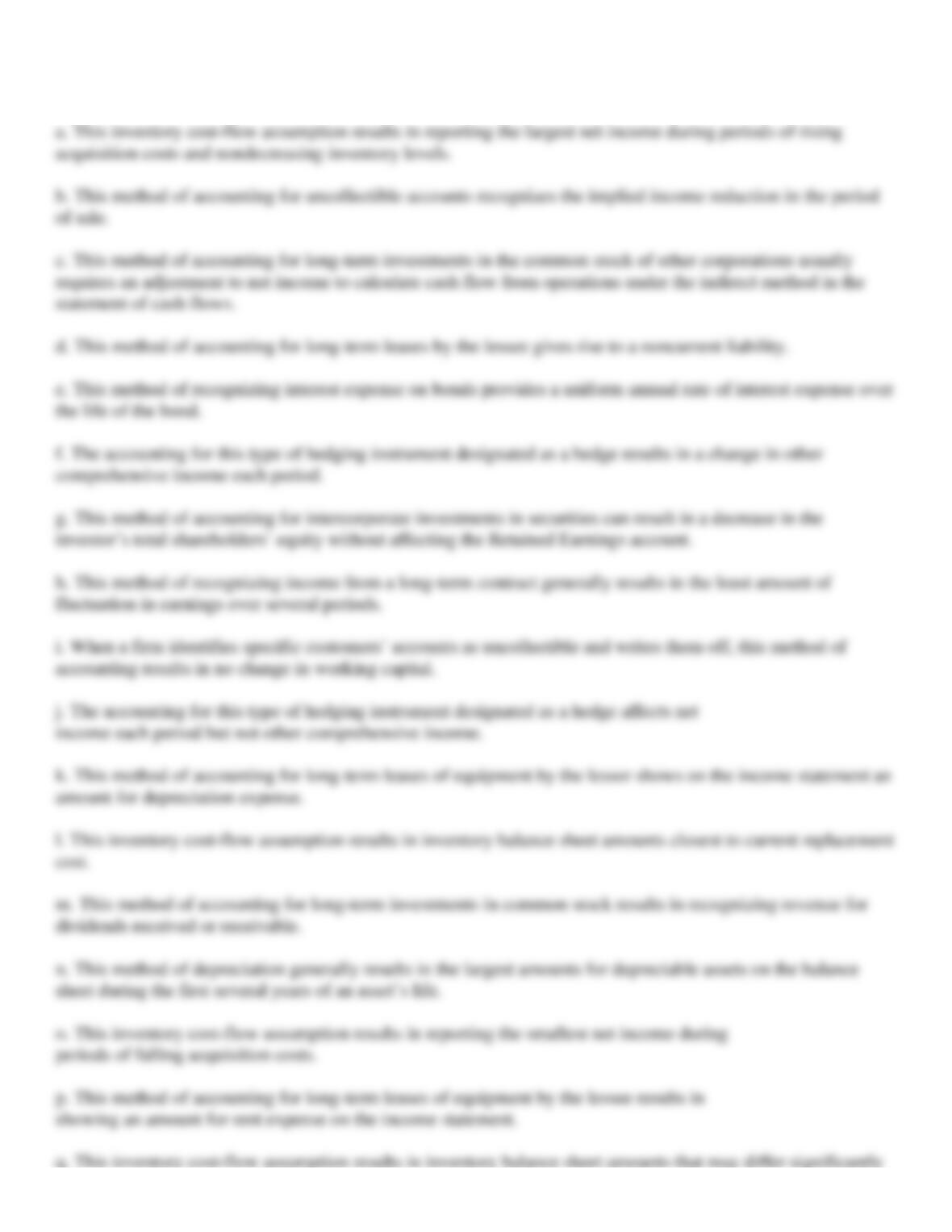
204. Identifying accounting principles. Indicate the accounting principle or method described in each of the
following statements.
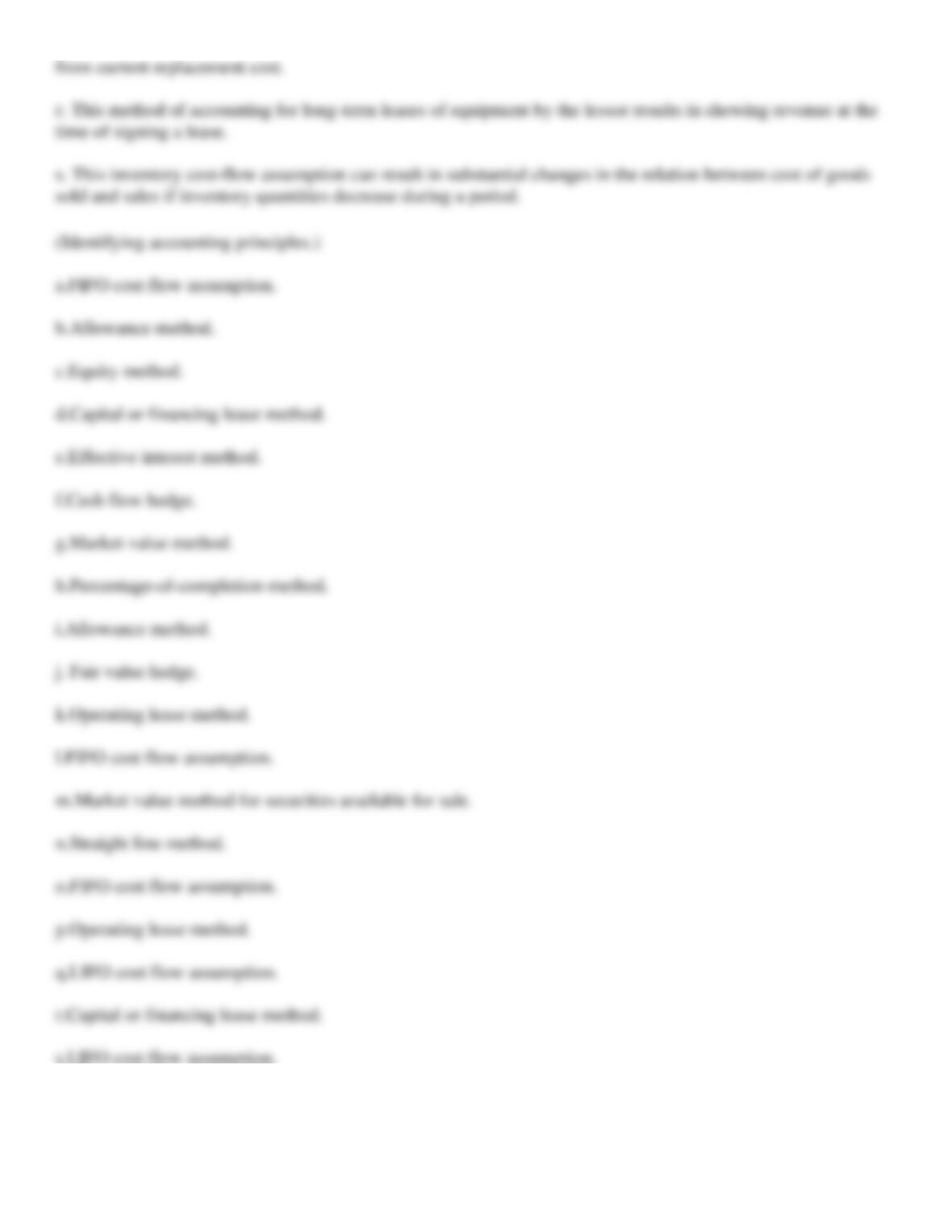

205. For each of the following generally accepted accounting principles, identify an alternative acceptable
accounting principle.
a.
Installment method
b.
Operating lease
c.
Straight-line, depreciation
d.
Last-in, first-out
206. (U.S. GAAP) A and X are exactly alike except for their choice of accounting methods. A uses straight-
line depreciation while X uses 200 percent declining balance depreciation. A uses FIFO and X uses LIFO
inventory methods.
a.
Both corporations issue 5,000 shares of $1 par value stock on January 1, for $15 per share.
b.
Both A and X acquire equipment on January 1, for $40,000 cash. The equipment has a 5-year life and a $5,000 salvage value.
c.
Both A and X purchase inventory as follows:
Date
# Units
Unit Price
1/1
100
$100
7/1
150
110
11/1
110
115
Total
360
d.
Both A and X sell 200 units of inventory at $250 each. No credit sales are made.
e.
Other expenses for the year, excluding depreciation, total $10,000.
Required:
Identify and give the balance of any balance sheet and income statement accounts that have different balances at year end for companies A and X
based on the above information. Ignore any tax effects.
DR(CR)
DR(CR)
Accumulated depreciation
(16,000)
Inventory
18,150
16,600
Depreciation expense
7,000
16,000
Cost of goods sold
21,000
22,550
a.
Cost recovery first method
b.
Capital lease
c
declining-balance or units-of-production
d.
FIFO, weighted average, specific identification

207. Using U.S. GAAP, a merchandising firm is trying to decide between using LIFO or FIFO for an inventory
cost flow assumption. The firm had inventory purchases and sales over 3 years as follows:
Units
Unit Price
Beginning inventory
0
–
Year 1 Purchases
1/1
100
$0.90
5/1
150
0.85
11/1
120
0.95
Year 1 Withdrawals
(140)
Year 2 Purchases
2/1
120
0.95
6/1
110
0.96
9/1
100
0.98
Year 2 Withdrawals
(300)
Year 3 Purchases
1/1
150
0.90
6/1
100
0.95
10/1
120
0.95
Year 3 Withdrawals
(340)
The firm estimates that using LIFO will cost the firm $50 for additional clerical work. The tax rate for all years is 30%. Net income before cost of
goods sold for each year is as follows:
Year 1 – $1,000
Year 2 – $2,000
Year 3 – $2,500
Required:
a.
What is net income after taxes under each method for years 1 through 3?
b.
Which method will result in a higher after tax cash flow for each year?
Net Income after Taxes
Greater After-Tax
Year
FIFO
LIFO
Cash Flow
1
$ 613.20
FIFO
2
1,208.20
1,162.63
FIFO
3
1,523.83
1,493.10
FIFO

208. For financial reporting purposes, Structural Builders uses the completed contract method of accounting for
long-term contracts. For tax purposes, Structural Builders uses the percentage-of-completion or the installment
method of accounting for the same contract. The contract is completed in Year 3. The terms of the contract, and
Structural Builders’ estimate of costs to be incurred are as follows:
Cash Receipts
Cost Incurred
Year 1
$1,000,000
$1,500,000
Year 2
2,000,000
1,500,000
Year 3
3,000,000
1,500,000
Total
$6,000,000
$4,500,000
Required:
What amount of deferred tax asset/liability will be reported by Structural Builders each year if:
a.
The percentage-of-completion method is used for tax reporting?
b.
The installment method is used for tax reporting? Assume the tax rate is 35%.
Current Year Deferred Taxes
Year
% Completion
Installment
1
$175,000
$ 87,500
2
175,000
175,000
3
(350,000)
(262,500)
209. Identifying accounting principles.
Indicate the accounting principle or procedure apparently used to record each of the following independent
transactions. Also, describe the transaction or event recorded in each case.
a. Cash. . . . . . . . . . . . . . . . . . . . . . . . . . . . . . . . . . . . . . . . . . . . . . . . X
Dividend Revenue. . . . . . . . . . . . . . . . . . . . . . . . . . . . . . . . . . X
b. Unrealized Holding Loss on
Marketable Securities Available for Sale . . . . . . . . . . . . . . . . . . . . X
Marketable Securities . . . . . . . . . . . . . . . . . . . . . . . . . . . . . . . X
c. Cash. . . . . . . . . . . . . . . . . . . . . . . . . . . . . . . . . . . . . . . . . . . . . . . . X
Investment in Affiliated Company. . . . . . . . . . . . . . . . . . . . . . X
Dividend declared and received from affiliated company.
d. Bad Debt Expense. . . . . . . . . . . . . . . . . . . . . . . . . . . . . . . . . . . . . . X
Allowance for Uncollectibles . . . . . . . . . . . . . . . . . . . . . . . . X
e. Rent Expense for Lease . . . . . . . . . . . . . . . . . . . . . . . . . . . . . . . . .X
Cash. . . . . . . . . . . . . . . . . . . . . . . . . . . . . . . . . . . . . . . . . . . .
Investment in Affiliated Company. . . . . . . . . . . . . . . . . . . . . . . . . . . X
Equity in Earnings of Affiliated Company . . . . . . . . . . . . . . . . X
g. Allowance for Uncollectibles . . . . . . . . . . . . . . . . . . . . . . . . . . . . . . X
Accounts Receivable. . . . . . . . . . . . . . . . . . . . . . . . . . . . . X
h. Loss from Price Decline of Inventories. . . . . . . . . . . . . . . . . . . . . . . X
Merchandise Inventories . . . . . . . . . . . . . . . . . . . . . . . . . . . . X
i. Liability Under Long-Term Lease . . . . . . . . . . . . . . . . . . . . . . . . X
Interest Expense . . . . . . . . . . . . . . . . . . . . . . . . . . . . . . . . . . . . . X
Cash. . . . . . . . . . . . . . . . . . . . . . . . . . . . . . . . . . . . . . . . . . . . X
j. Treasury Stock . . . . . . . . . . . . . . . . . . . . . . . . . . . . . . . . . . . . . . . X
Cash. . . . . . . . . . . . . . . . . . . . . . . . . . . . . . . . . . . . . . . . . X
k. Interest Rate Swap Contract. . . . . . . . . . . . . . . . . . . . . . . . . . . . . . X
Gain on Remeasurement of Swap Contract
(Income Statement) . . . . . . . . . . . . . . . . . . . . . . . . . . . . . . . X
210. As part of their normal course of business, companies sometimes sell off entire divisions or segments. The
accounting treatment for such sales is composed of two components and a reporting format.
Required:
a. Describe the accounting treatment and reporting format used for such sales.
b. Discuss why such sales are separated from other parts of the income statement.
211. As part of a company’s normal course of business, errors, omissions, and changes occur in the financial
statements. Certain items may be reported on the income statement, some may directly adjust the balance in
retained earnings, while others do not affect the current period’s income statement or retained earnings.
Required:
a.
Consider a change in estimate, such as the useful life of an asset moving from five to eight years. How is this handled on the income
statement and/or through the retained earnings account?
b.
Consider an error/omission, such as merchandise inventory being left out of the final yearly count. How is this handled on the income
statement and/or through the retained earnings account?
b.
An error/omission such as leaving off ending inventory amounts is handled by directly increasing the retained earnings account in the
the normal business processes of the firm.
212. Discuss recent changes in the financial reporting environment.
Recent changes in the financial reporting environment include the following:
213. What are the financial reporting objectives?
FINANCIAL REPORTING OBJECTIVES
214. Discuss the definition, recognition, and measurement of assets.
Asset