10) If national laws protecting the health and safety of workers completely eliminate any and all
risk, then
A) workers in risky occupations become better off.
B) compensating wage differentials disappear and workers in risky occupations may be no better
off.
C) compensating differentials would grow because workers could not be compensated by being
given lower risk jobs.
D) more people would be employed.
11) If workers in nuclear power plants underestimate the true risk of their jobs,
A) employers will pay compensating differential to compensate employees fully for the risk they
have assumed.
B) safety legislation will not make workers better off.
C) the wages of these workers will not be high enough to compensate them fully for the risk they
have assumed.
D) the supply of workers in this occupation will exceed demand.
12) In the United States, about ________ of the population is covered by private health
insurance, most of which is provided by employers.
A) one-fourth
B) one-half
C) two-thirds
D) three-fourths
13) If labor markets determine equilibrium compensation, a reduction in employer contributions
for health insurance should
A) lead to an offsetting increase in wages.
B) increase the supply of labor.
C) decrease total worker compensation.
D) decrease the demand for labor.
14) Economic discrimination takes place when an employer
A) pays workers the lowest wage possible.
B) pays workers different wages on the basis of some arbitrary characteristics of workers that are
irrelevant to the job performed.
C) pays lower wages to workers who are not as productive as other workers.
D) pays workers compensating wage differentials.
15) Wage differences among workers of different races and gender could be due to all of the
following except
A) differences in preferences for jobs.
B) differences in work experience.
C) differences in education.
D) labor unions.
16) Women typically earn less than men, even in the same occupation. Which of the following is
an explanation for this discrepancy?
A) Women do not work as hard as men because of cultural influences.
B) Women have, on average, less workforce experience than men of the same age.
C) Women are, on average, less motivated than men and therefore tend to avoid taking on more
responsibilities.
D) Women tend to take riskier jobs and earn compensating wage differentials.
17) Worker discrimination occurs when
A) workers refuse to perform risky tasks.
B) workers refuse to work with persons of a different race.
C) customers refuse to buy products produced by a racially diverse workforce.
D) employers pay different employees different wages based on race.
18) Customer discrimination occurs when
A) a firm pays workers different wages based on irrelevant factors.
B) customers refuse to buy products produced by a racially diverse workforce.
C) customers refuse to buy products they believe to be of poor quality.
D) workers refuse to serve customers of a different race.

19) Which of the following is a reason why it is difficult to estimate the extent of economic
discrimination in the labor market?
A) Employers who discriminate are likely to do so in overt ways such as awarding some workers
with benefits-in-kind.
B) Ultimately, employers who discriminate cannot remain profitable.
C) Employers who discriminate pay an economic penalty.
D) Differences in wages can be attributed to many other factors as well, such as differences in
productivity and preferences.
20) That some talented people may not enter an occupation because they have heard that people
with their personal characteristics do not get hired in that occupation is known as
A) economic discrimination.
B) a compensating difference.
C) a negative feedback loop.
D) worker discrimination.
21) Consider the following pieces of information:
a. According to Bonnie Reyes, president and chief operating officer of Better Investing, a
national organization of investment clubs, women have traditionally made up about 60 percent of
the membership of investment clubs. By contrast, less than a third of team-managed mutual
funds on Wall Street have even one woman on the management team.
b. Research conducted by professors E. Brooke Harrington and Max Planck concluded that
mixed investment clubs, on average, outperformed the typical single-sex investment club.
c. The lack of gender diversity in Wall Street could be influenced by its reputation, according to
professor Harrington, “for being inhospitable to women.”
Source: Michael Hulbert, “Strategies: At some Funds, a Gender Communications Gap”, The
New York Times, October 7, 2007, Sunday Money, page 5.
The information presented is an example of
A) economic discrimination.
B) a negative feedback loop.
C) marginal productivity theory.
D) the absence of comparable worth.
22) The primary purpose of labor unions is to
A) ensure that workers receive adequate safety training.
B) ensure that all members earn identical incomes.
C) negotiate with employers about wages and working conditions.
D) endorse candidates and donate money to them.
23) Comparable worth legislation
A) will eliminate the earnings gap between men and women.
B) mandate that employers pay the same wages to workers, regardless of their gender, for jobs
that have comparable worth.
C) mandate that potential employers demonstrate that they are worth the wages they expect to
earn.
D) guide markets toward the economically efficient wage.
Scenario 17-1
In academia, professors in some disciplines receive higher salaries than others. For example,
professors teaching in business schools receive higher salaries than professors in the English
department. Suppose at Unity College, assistant professors in the business school earn $80,000
while assistant professors in the English department earn $50,000. Now suppose the government
passes comparable worth legislation that requires academic institutions to pay all faculty the
same salaries.
24) Refer to Scenario 17-1. Following the passage of comparable worth legislation, Unity
College responds by placing salaries for all assistant professors at $80,000. Which of the
following is the result of the legislation?
A) The supply of English professors increases; the market for business professors is not affected.
B) The demand for English professors decreases; the market for business professors is not
affected.
C) There will be a surplus in the market for English professors and a shortage in the market for
business professors.
D) There will be a surplus in the market for English professors and the market for business
professors will not be affected.
25) Refer to Scenario 17-1. Following the passage of comparable worth legislation, Unity
College responds by placing salaries at $65,000. Which of the following is the result of the
legislation?
A) The supply of English professors increases and the supply of business professors decreases.
B) The demand for English professors decreases and the demand for business professors
increases.
C) There will be a surplus in the market for English professors and a shortage in the market for
business professors.
D) There will be a surplus in the market for English professors and the market for business
professors will not be affected.
26) In a study conducted by Marianne Bertrand and Sendhil Mullianthan, identical resumes were
sent in response to help wanted ads in newspapers, with half of the resumes assigned an African-
American-sounding name and half assigned a white-sounding name. The study found that
A) employers were equally likely to interview workers with white-sounding names and with
African-American-sounding names.
B) employers were 50 percent more likely to interview workers with African-American-
sounding names.
C) employers were 50 percent more likely to interview workers with white-sounding names.
D) no employers chose to interview workers with African-American-sounding names.
27) In labor economics, the term “customer discrimination” refers to a situation where customers
are charged different prices for services rendered by a firm.

28) The most important factor contributing to wage differences in the labor market is differences
in the level of education and training among workers.
29) While labor unions tend to negotiate above-equilibrium wage rates for their members, they
also tend to reduce the quantity of labor hired.
30) What is a compensating differential?
31) Why do professional basketball players earn more than police officers? Illustrate this
situation graphically.
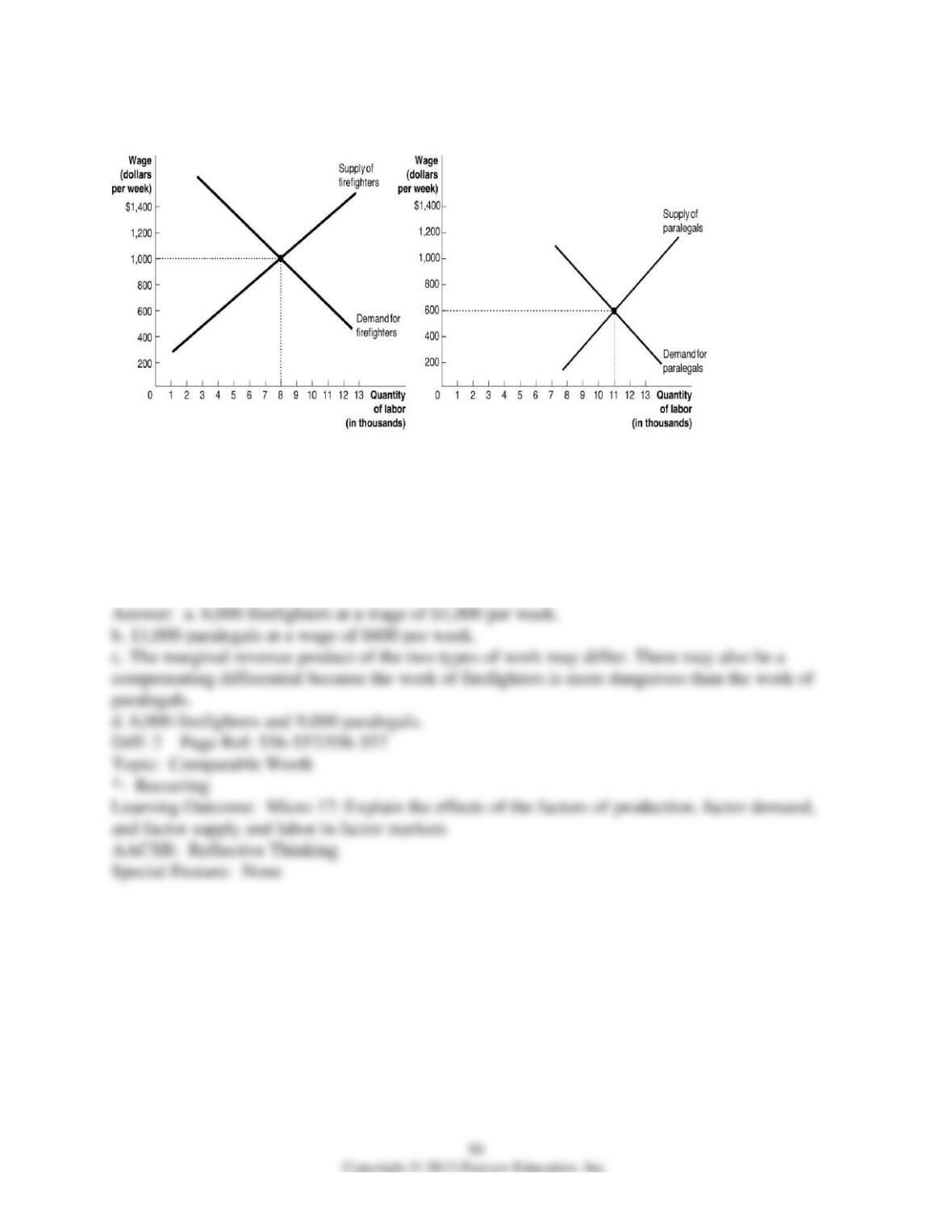
Figure 17-4
32) Refer to Figure 17-4 to answer the following questions.
a. What is the equilibrium quantity of firefighters hired, and what is the equilibrium wage?
b. What is the equilibrium quantity of paralegals hired, and what is the equilibrium wage?
c. Explain why firefighters might earn a higher weekly wage than paralegals.
d. Suppose that comparable worth legislation is passed, and the government requires that
firefighters and paralegals be paid the same wage, $800 per week. Now how many firefighters
will be hired and how many paralegals will be hired?
17.5 Personnel Economics
1) Personnel economics is
A) the study of the factors that determine wage rates.
B) the study of how workers are affected by tax law changes.
C) the application of economic analyses to human resource issues.
D) the application of economic analysis to the hiring decision.
2) A successful compensation scheme
A) must pay workers with comparable skills a comparable wage.
B) must induce effort from workers and ensure that both employer and employees benefit.
C) must enable workers to enjoy a certain standard of living and must enable employers to earn a
normal rate of return.
D) must allow employees to participate in a firm’s profits.
3) Which of the following is a reason why some firms do not use commission pay?
A) It gives workers incentive to produce more.
B) It increases firm profits.
C) It is difficult to measure the output and attribute output to a particular worker.
D) The best workers stay and less productive workers leave.