
74) Which of the following reactions is most suitable for a fuel cell?
A) MnO2(s) + Li(s) → LiMnO2(s)
B) Pb(s) + PbO2(s) + 2 H+(aq) + HSO4–(aq) → PbSO4(s) + 2 H2O(l)
C) HgO(l) + Zn(s) → ZnO(s) + Hg(l)
D) 2 CO(g) + O2(g) → 2 CO2(g)
75) Which of the following statements concerning a lithium battery is false?
A) A lithium battery is rechargeable.
B) A lithium battery has a relatively high voltage, due in part to the high oxidation potential of
lithium.
C) It takes a small mass of lithium to provide one mole of electrons in the cell reaction.
D) The cell reaction produces toxic mercury, so the batteries should be recycled.
76) Shown below are the reactions occurring in the direct methanol fuel cell (DMFC).
I 2 CH3OH(aq) + 2 H2O(l) → 2 CO2(g) +12 H+(aq) +12 e–
II 3 O2(g) + 12 H+(aq) + 12 e– → 6 H2O(l)
Overall 2 CH3OH(aq) + 3 O2(g) → 2 CO2(g) + 4 H2O(l)
Which is the anode reaction, and what is being oxidized in the overall reaction?
A) I, CH3OH
B) I, H2O
C) II, O2
D) II, H+
77) Shown below are the reactions occurring in the proton-exchange membrane (PEM) fuel cell.
I 2 H2(g) → 4 H+(aq) + 4 e–
II O2(g) + 4 H+(aq) + 4 e– → 2 H2O(l)
Overall 2 H2(g) + O2(g) → 2 H2O(l)
Which is the cathode reaction, and what is being oxidized in the overall reaction?
A) I, H2
B) I, O2
C) II, H2
D) II, O2

22
78) Which of the following statements concerning the rusting of iron is false?
A) The oxidation site can occur at a different place on the metal surface than the reduction site.
B) The metal is reduced.
C) The rusting of iron requires both oxygen and water.
D) Salt increases the rate of corrosion by providing ions to carry the current.
79) Galvanized steel is steel coated with a layer of
A) Fe2O3.
B) Mg.
C) Sn.
D) Zn.
80) What is least easily oxidized?
A) Al
B) Fe
C) Mg
D) Zn
81) Aluminum requires relatively little protection from corrosion because
A) aluminum has little tendency to react with oxygen.
B) the reduction potential for Al3+/Al is very low.
C) the oxidation of aluminum produces a hard, relatively impenetrable film of Al2O3.
D) aluminum is protected by cathodic protection.
82) A steel pipe can be protected from corrosion by attaching the pipe to a piece of magnesium
because
A) magnesium forms a tight oxide coating.
B) magnesium is more easily oxidized than iron.
C) magnesium is inert.
D) magnesium and steel form a corrosion resistant alloy.
83) An electrolytic cell is
A) a battery.

23
B) a cell in which the cell reaction is spontaneous.
C) a cell in which an electric current drives a nonspontaneous reaction.
D) a cell in which reactants are continuously supplied to the cell.
84) For an electrolytic cell
A) E is negative and ΔG is negative for the cell reaction.
B) E is negative and ΔG is positive for the cell reaction.
C) E is positive and ΔG is negative for the cell reaction.
D) E is positive and ΔG is positive for the cell reaction.
85) For a dead battery
A) E is negative and ΔG is positive for the cell reaction.
B) E is negative and ΔG is negative for the cell reaction.
C) E is zero and ΔG is positive for the cell reaction.
D) E is zero and ΔG is zero for the cell reaction.
86) Which statement is true?
A) The cathode is positive for a galvanic cell and negative for an electrolytic cell.
B) Electrons flow through the external circuit to the cathode in a galvanic cell and to the anode in
an electrolytic cell.
C) Oxidation occurs at the anode in a galvanic cell and at the cathode in an electrolytic cell.
D) Oxidation occurs at the cathode in a galvanic cell and at the anode in an electrolytic cell.
87) Which statement concerning overvoltage is false?
A) Overvoltage is the additional voltage above the calculated voltage required to bring about
electrolysis.
B) Overvoltage is often due to a high activation energy for the reaction at one electrode.
C) Overvoltage is small for half-reactions involving the formation of O2(g) or H2(g).
D) Overvoltage must be experimentally determined.
88) O2(g) + 4 H+(aq) + 4 e–→ 2 H2O(l) E° = +1.23 V
I2(s) + 2 e– → 2 I–(aq) E° = +0.54 V

2 H2O(l) + 2 e– → H2(g) + 2 OH–(aq) E° = -0.83 V
Mg2+(aq) + 2 e– → Mg(s) E° = -2.37 V
Based on the data above, electrolysis of an aqueous solution of MgI2, with inert electrodes, is
expected to produce
A) Mg at the cathode and I2 at the anode.
B) H2 at the cathode and I2 at the anode.
C) Mg at the cathode and O2 at the anode.
D) H2 at the cathode and O2 at the anode.
89) O2(g) + 4 H+(aq) + 4 e– → 2 H2O(l) E° = +1.23 V
Pb2+(aq) + 2 e– → Pb(s) E° = -0.13 V
2 H2O(l) + 2 e– → H2(g) + 2 OH–(aq) E° = -0.83 V
Based on the half-reactions above, electrolysis of an aqueous solution of Pb(NO3)2 is expected
to produce.
A) Pb at the cathode and H2 at the anode.
B) Pb at the cathode and O2 at the anode.
C) H2 at the cathode and Pb at the anode.
D) O2 at the cathode and Pb at the anode.
90) The chlor-alkali industry is based on the electrolysis of aqueous NaCl. What are the products
of this electrolysis?
A) Na and Cl2
B) NaOH, H2, and O2
C) NaOH, H2, and Cl2
D) NaOH, O2, and Cl2

91) The Hall-Heroult process for the production of aluminum involves the electrolysis of
A) an aqueous solution of Al(NO3)3.
B) molten Al2O3.
C) molten cryolite, Na3AlF6.
D) a molten mixture of Al2O3 and Na3AlF6.
92) Which requires the most electricity (in terms of faradays of charge transferred) per gram of
useful product formed?
A) electrolysis of aqueous NaCl (chlor-alkali industry)
B) electrolysis of molten NaCl/CaCl2 in a Downs cell
C) electrorefining copper metal
D) production of aluminum in the Hall-Heroult process
93) Which of the following statements concerning the electrorefining of copper in not true?
A) The anode is constructed of chalcocite, Cu2S.
B) The anode mud is a valuable source of silver, gold, and platinum.
C) Copper is oxidized at the anode and copper(II) ions are reduced at the cathode.
D) The process is used to purify copper.
94) The gas OF2 can be produced from the electrolysis of an aqueous solution of KF, as shown
in the equation below.
OF2(g) + 2 H+(aq) + 4 e– → H2O(l) + 2 F–(aq) E° = +2.15 V
Using the given standard reduction potential, calculate the amount of OF2 that is produced, and
the electrode at which the OF2 is produced, upon the passage of 0.240 faradays through an
aqueous KF solution.
A) 3.24 g of OF2 at the anode
B) 13.0 g of OF2 at the anode
C) 3.24 g of OF2 at the cathode
D) 13.0 g of OF2 at the cathode
95) When an aqueous solution of NaCl is electrolyzed is produced at the cathode according to
the following equation:
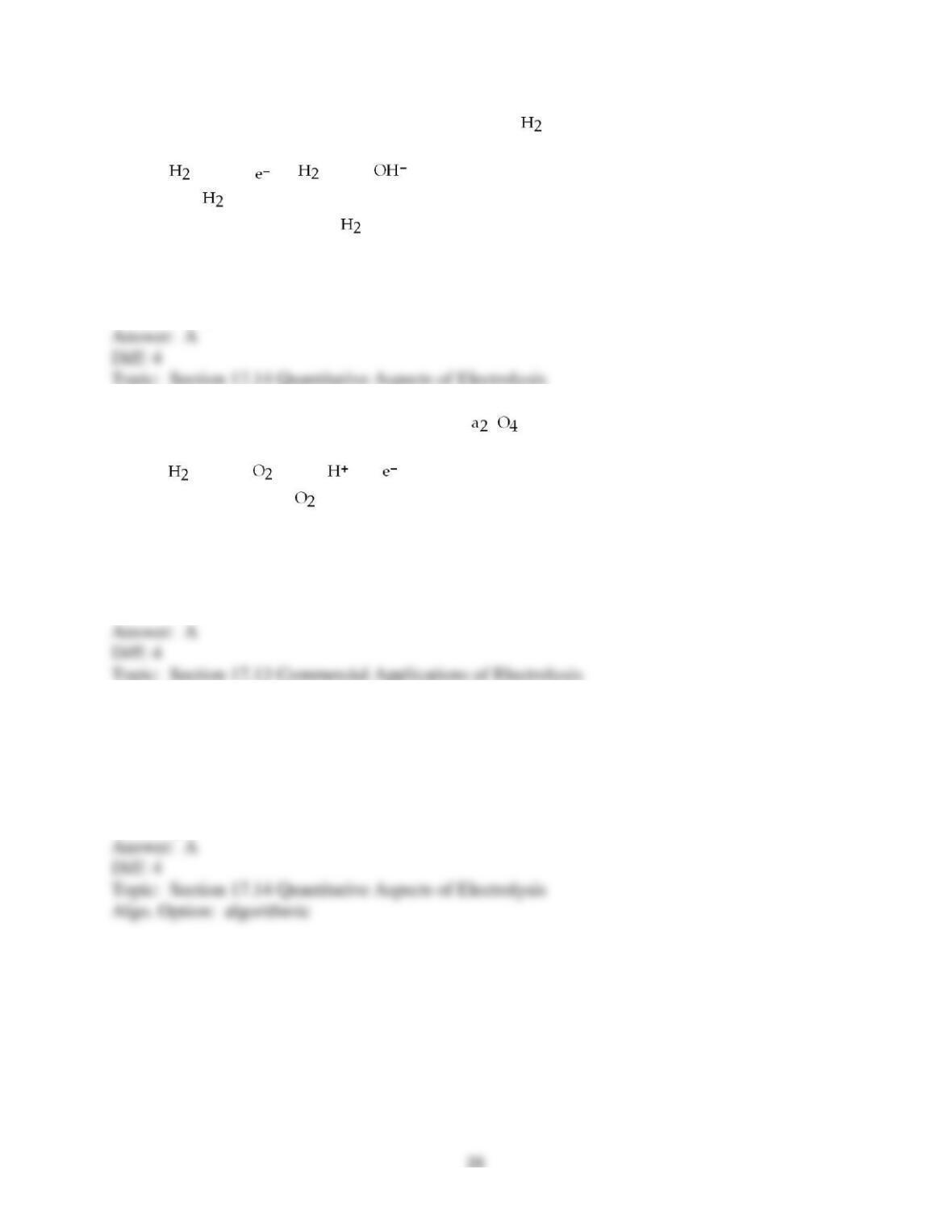
2 O(l) + 2 → (g) + 2 (aq)
If 3.13 L of at STP was produced and the current passing through the cell was 0.250 A, how
long did it take to produce the ?
A) 30.0 hours
B) 14.2 hours
C) 29.7 minutes
D) 40.1 minutes
96) The electrolysis of an aqueous solution of N S produces oxygen at the anode according
to the following equation:
2 O (l) → (g) + 4 + 4
Calculate the volume of at STP that is produced by the passage of 3.00 A through this
solution for 150 minutes.
A) 1.57 L
B) 0.0261 L
C) 6.28 L
D) 0.0700 L
97) How many grams of chromium metal are plated out when a constant current of 8.00 A is
passed through an aqueous solution containing Cr3+ ions for 40.0 minutes?
A) 3.45 g
B) 6.15 g
C) 10.3 g
D) 31.0 g

27
98) How many grams of nickel metal are plated out when a constant current of 15.0 A is passed
through aqueous NiCl2 for 80.0 minutes?
A) 14.7 g
B) 21.9 g
C) 43.8 g
D) 48.4 g
99) How long must a constant current of 50.0 A be passed through an electrolytic cell containing
aqueous Cu2+ ions to produce 3.00 moles of copper metal?
A) 0.311 hours
B) 0.621 hours
C) 1.61 hours
D) 3.22 hours
100) Chromium can be electroplated from an aqueous solution containing sulfuric acid and
chromic acid, H2CrO4. What current is required to deposit chromium at a rate of 1.25 g/min?
A) 38.1 A
B) 38.7 A
C) 116 A
D) 232 A
101) A constant current is passed through a solution containing Cu2+(aq) resulting in the
deposition of 4.40 g of Cu at the cathode. Assuming a current efficiency of 100%, if this same
current is passed through a solution of TcO4– for the same amount of time, how many grams of
Tc would form at the cathode?
A) 0.969 g
B) 1.94 g
C) 6.78 g
D) 13.6 g
102) The bright colors of anodized aluminum are due to
A) electrodeposition of organic dyes on the aluminum surface.
B) the formation of an aluminum alloy with chromium and copper.
C) iridescence involving the semitransparent outer layer of Al2O3.
D) trapping of organic dye molecules in a spongy Al2O3 matrix.
103) The bright colors of anodized titanium are due to
A) electrodeposition of organic dyes on the titanium surface.
B) the formation of a titanium alloy with chromium and copper.
C) iridescence involving the semitransparent outer layer of TiO2.
D) trapping of organic dye molecules in a spongy TiO2 matrix.
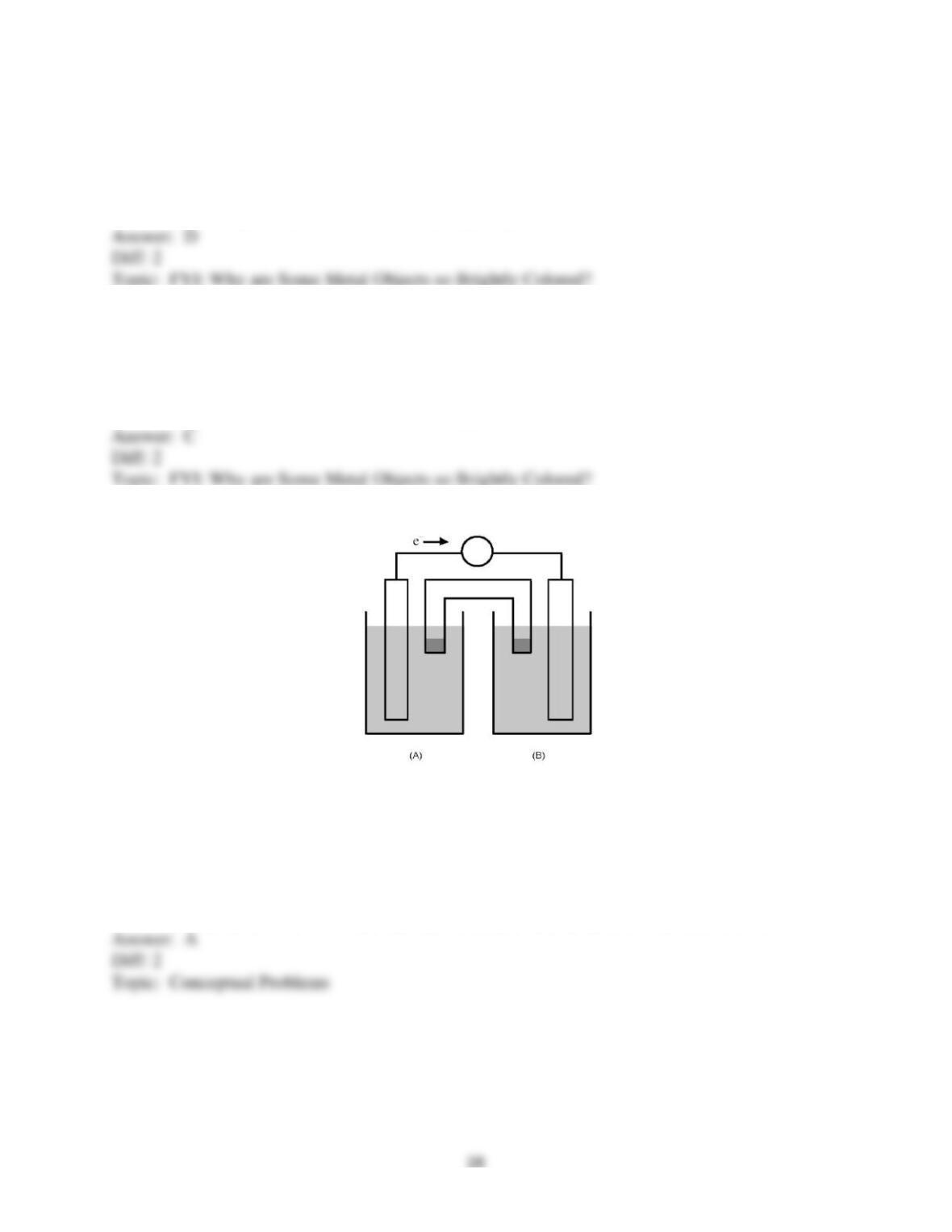
104) For the galvanic cell shown above, in what direction should the anions and cations in half-
cell A move?
A) The anions tend to move to the solid electrode and the cations into the salt bridge.
B) The anions tend to move into the salt bridge and the cations toward the solid electrode.
C) The anions tend to move toward the solid electrode and the cations should not move.
D) The cations tend to move toward the solid electrode and the anions should not move.

29
105) The cell reaction 2 Fe3+(aq) + Zn(s) → Zn2+(aq) + 2 Fe2+(aq) occurs in the galvanic cell
shown above. Where should the Fe3+(aq) and Fe2+(aq) be found?
A) Half-cell (A) contains Fe3+(aq) and half-cell (B) contains Fe2+(aq).
B) Half-cell (A) contains Fe2+(aq) and half-cell (B) contains Fe3+(aq).
C) Half-cell (A) contains Fe3+(aq) and Fe2+(aq).
D) Half-cell (B) contains Fe3+(aq) and Fe2+(aq).
106) The cell reaction 2 Fe3+(aq) + Zn(s) → Zn2+(aq) + 2 Fe2+(aq) occurs in the galvanic cell
shown above. Which would be the most appropriate choices for the solid electrode in half-cell
(A) and in half-cell (B)?
A) Fe(s) for half-cell (A) and Zn(s) for half-cell (B)
B) Pt(s) for half-cell (A) and Zn(s) for half-cell (B)
C) Fe(s) for half-cell (A) and Fe(s) for half-cell (B)
D) Zn(s) for half-cell (A) and Pt(s) for half-cell (B)
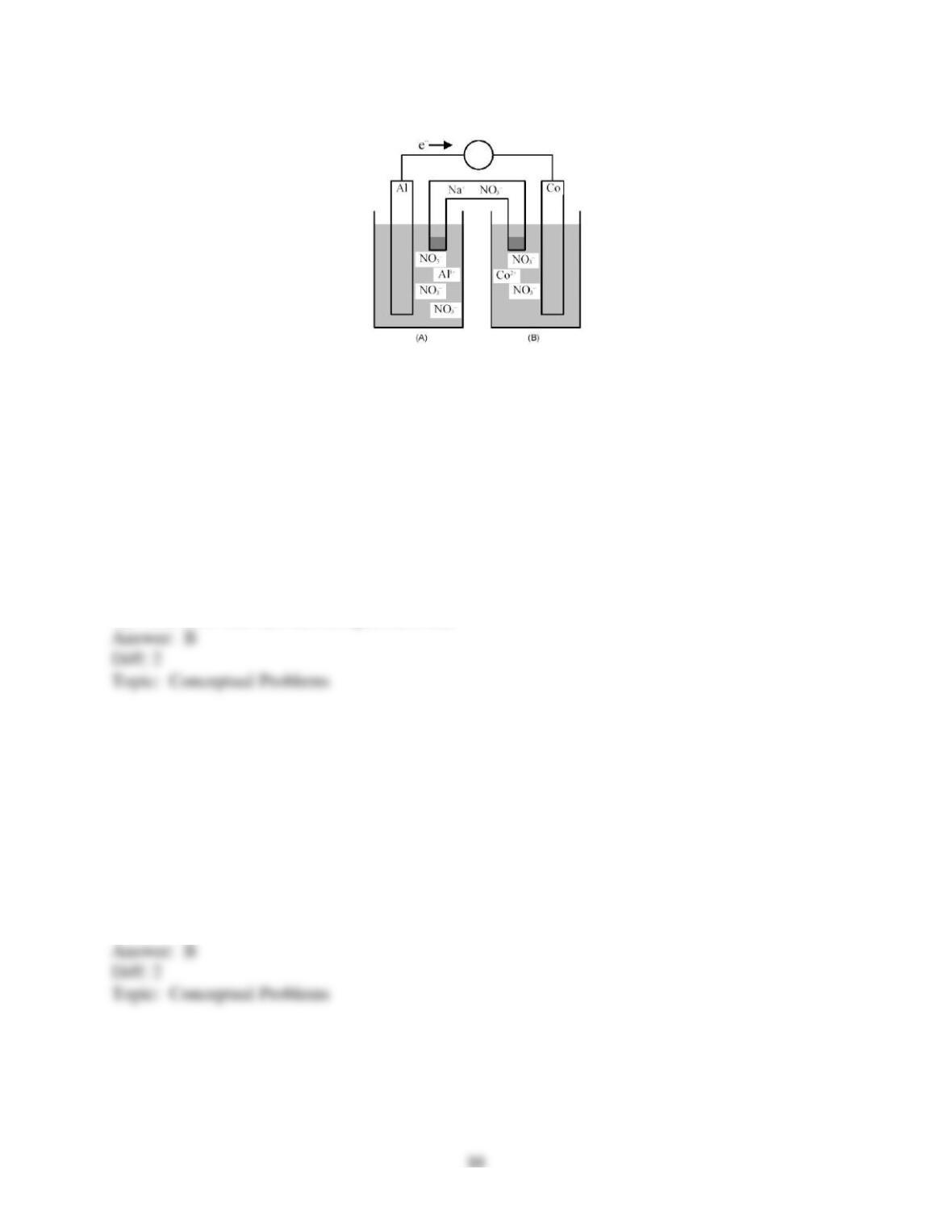
Consider the galvanic cell shown below.
107) Identify the anode and cathode, and indicate the direction of Na+ ion and NO3– ion flow
from the salt bridge.
A) Al is the anode and Co is the cathode; Na+ ions flow into half-cell compartment (A) and
NO3– ions flow into half-cell compartment (B).
B) Al is the anode and Co is the cathode; NO3– ions flow into half-cell compartment (A) and
Na+ ions flow into half-cell compartment (B).
C) Co is the anode and Al is the cathode; Na+ ions flow into half-cell compartment (A) and
NO3– ions flow into half-cell compartment (B).
D) Co is the anode and Al is the cathode; NO3– ions flow into half-cell compartment (A) and
Na+ ions flow into half-cell compartment (B).
108) Identify the anode and cathode, and indicate the direction of ion flow to and from each
electrode.
A) Al is the anode and Co is the cathode; Al3+ ions flow to the anode and Co2+ ions flow from
the cathode.
B) Al is the anode and Co is the cathode; Co2+ ions flow to the cathode and Al3+ ions flow from
the anode.
C) Co is the anode and Al is the cathode; Al3+ ions flow to the cathode and Co2+ ions flow from
the anode.
D) Co is the anode and Al is the cathode; Co2+ ions flow to the anode and Al3+ ions flow from
the cathode.
31
109) What is the balanced equation for the cell reaction?
A) 2 Al(s) + 3 Co(s) → 2 Al3+(aq) + 3 Co2+(aq)
B) 2 Al3+(aq) + 3 Co2+(aq) → 2 Al(s) + 3 Co(s)
C) 2 Al(s) + 3 Co2+(aq) → 2 Al3+(aq) + 3 Co(s)
D) 2 Al3+(aq) + 3 Co(s) → 2 Al(s) + 3 Co2+(aq)
110) What is the shorthand notation for the cell?
A) Al(s) | Al3+(aq) || Co(s) | Co2+(aq)
B) Al(s) | Al3+(aq) || Co2+(aq) | Co(s)
C) Co(s) | Co2+(aq) || Al(s) | Al3+(aq)
D) Co(s) | Co2+(aq) || Al3+(aq)| Al(s)
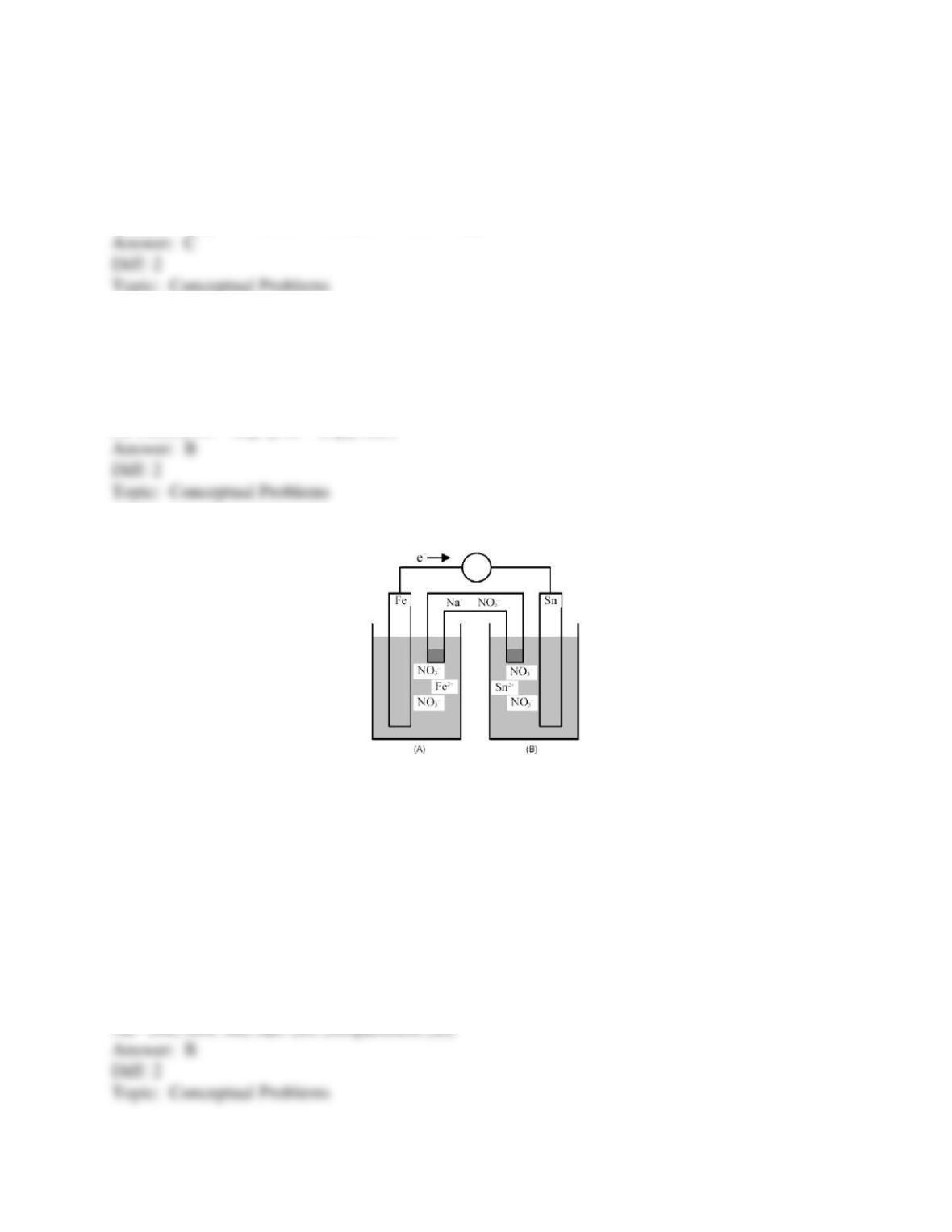
Consider the following galvanic cell.
111) Identify the anode and cathode, and indicate the direction of Na+ ion and NO3– ion flow
from the salt bridge.
A) Fe is the anode and Sn is the cathode; Na+ ions flow into half-cell compartment (A) and
NO3– ions flow into half-cell compartment (B).
B) Fe is the anode and Sn is the cathode; NO3– ions flow into half-cell compartment (A) and
Na+ ions flow into half-cell compartment (B).
C) Sn is the anode and Fe is the cathode; Na+ ions flow into half-cell compartment (A) and
NO3– ions flow into half-cell compartment (B).
D) Sn is the anode and Fe is the cathode; NO3– ions flow into half-cell compartment (A) and
112) Identify the anode and cathode, and indicate the direction of ion flow to and from each

electrode.
A) Fe is the anode and Sn is the cathode; Fe2+ ions flow to the anode and Sn2+ ions flow from
the cathode.
B) Fe is the anode and Sn is the cathode; Sn2+ ions flow to the cathode and Fe2+ ions flow from
the anode.
C) Sn is the anode and Al is the cathode; Fe2+ ions flow to the cathode and Sn2+ ions flow from
the anode.
D) Sn is the anode and Al is the cathode; Sn2+ ions flow to the anode and Fe2+ ions flow from
the cathode.
113) What is the balanced equation for the cell reaction?
A) Fe(s) + Sn(s) → Fe2+(aq) + Sn2+(aq)
B) Fe2+(aq) + Sn2+(aq) → Fe(s) + Sn(s)
C) Fe(s) + Sn2+(aq) → Fe2+(aq) + Sn(s)
D) Fe2+(aq) + Sn(s) → Fe(s) + Sn2+(aq)
114) What is the shorthand notation for the cell?
A) Fe(s) | Fe2+(aq) || Sn(s) | Sn2+(aq)
B) Fe(s) | Fe2+(aq) || Sn2+(aq) | Sn(s)
C) Sn(s) | Sn2+(aq) || Fe(s) | Fe2+(aq)
D) Sn(s) | Sn2+(aq) || Fe2+(aq) | Fe(s)
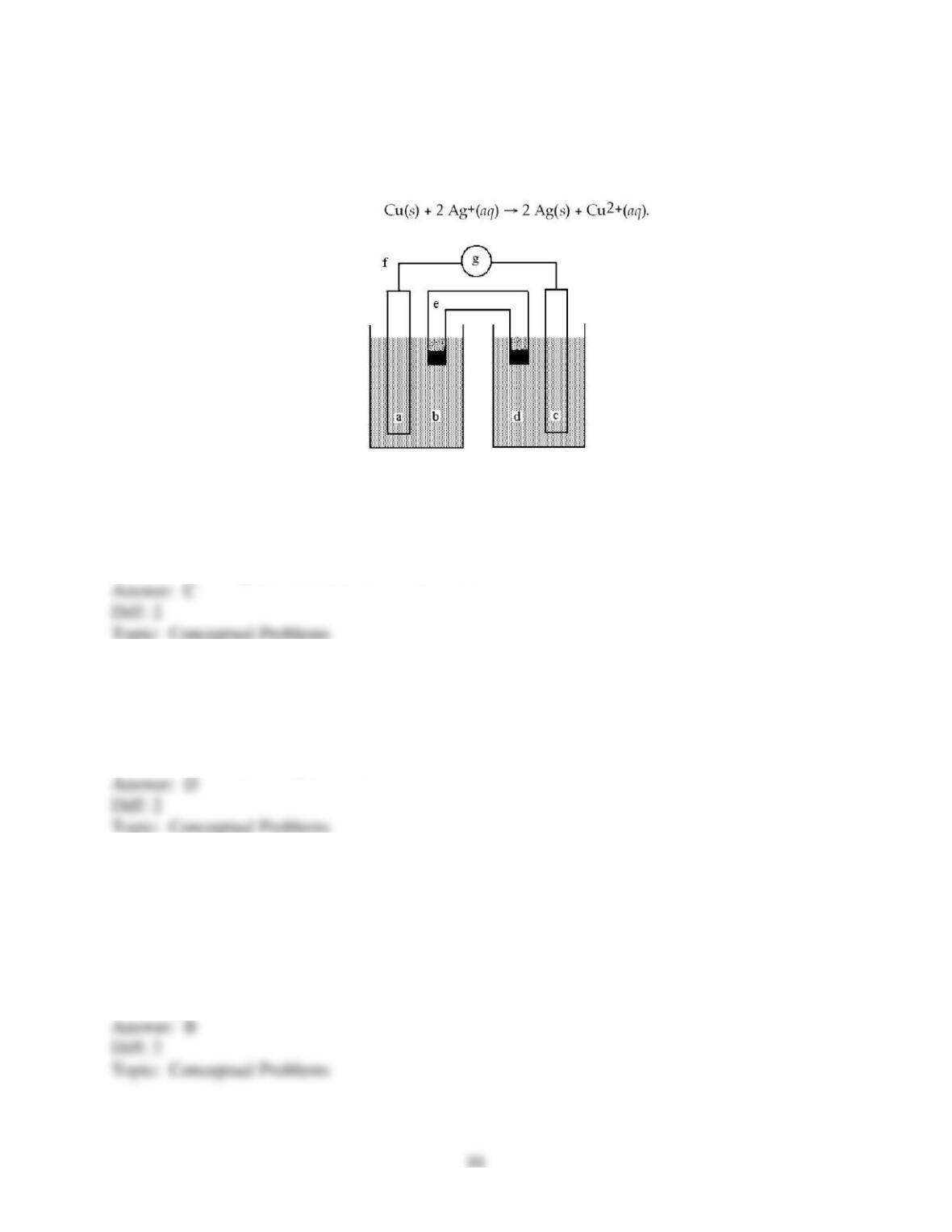
Shown below is a galvanic cell with anode compartment b containing anode a and cathode
compartment d containing cathode c. Electrons flow through wire f, ions flow through salt bridge
e, and the cell potential is read using voltmeter g.
This galvanic cell uses the reaction:
115) Identify the electrodes and the direction of electron flow.
A) a is Ag, c is Cu and electrons flow from a to c.
B) a is Ag, c is Cu and electrons flow from c to a.
C) a is Cu, c is Ag and electrons flow from a to c.
D) a is Cu, c is Ag and electrons flow from c to a.
116) Identify and give the sign of each electrode.
A) a is Ag and (+), c is Cu and (-).
B) a is Ag and (-), c is Cu and (+).
C) a is Cu and (+), c is Ag and (-).
D) a is Cu and (-), c is Ag and (+).
117) NaNO3(aq) is employed in the salt bridge. Give the direction of electron flow and the
direction of ion flow from the salt bridge.
A) Electrons flow from a to c; Na+ flows into b and NO3– flows into d.
B) Electrons flow from a to c; NO3– flows into b and Na+ flows into d.
C) Electrons flow from c to a; Na+ flows into b and NO3– flows into d.
D) Electrons flow from c to a; NO3– flows into b and Na+ flows into d.

34
118) Identify the anode and cathode half-reactions and categorize each as either oxidation or
reduction.
A) Anode reaction: Ag+(aq) + e– → Ag(s) (oxidation)
Cathode reaction: Cu(s) → Cu2+(aq) + 2e– (reduction)
B) Anode reaction: Ag+(aq) + e– → Ag(s) (reduction)
Cathode reaction: Cu(s) → Cu2+(aq) + 2e– (oxidation)
C) Anode reaction: Cu(s) → Cu2+(aq) + 2e– (oxidation)
Cathode reaction: Ag+(aq) + e– → Ag(s) (reduction)
D) Anode reaction: Cu(s) → Cu2+(aq) + 2e– (reduction)
Cathode reaction: Ag+(aq) + e– → Ag(s) (oxidation)
119) What is the shorthand notation for this cell?
A) Cu2+(aq) ∣ Cu(s) ∣∣ Ag+(aq) ∣ Ag(s)
B) Cu(s) ∣ Cu2+(aq) ∣∣ Ag(s) ∣ Ag+(aq)
C) Cu2+(aq) ∣ Cu(s) ∣∣ Ag(s) ∣ Ag+(aq)
D) Cu(s) ∣ Cu2+(aq) ∣∣ Ag+(aq) ∣ Ag(s)
120) Given the half-cell potentials below, calculate the cell potential.
Ag+(aq) + e– → Ag(s) 0.80 V
Cu2+(aq) + 2 e– → Cu(s) 0.34 V
A) 0.46 V
B) 1.14 V
C) 1.26 V
D) 1.94 V
121) If the concentrations of Ag+(aq) and Cu2+(aq) are varied in this galvanic cell, which of the
following four cells has the largest cell potential?
A) [Ag+] = 0.10 M and [Cu2+] = 0.10 M
B) [Ag+] = 1.0 M and [Cu2+] = 0.10 M
C) [Ag+] = 0.10 M and [Cu2+] = 1.0 M
D) [Ag+] = 1.0 M and [Cu2+] = 1.0 M
122) The initial concentrations of Ag+(aq) and Cu2+(aq) are both What will happen to the