49)
Which of the following statements is false?
49)
A)
From an accounting perspective, dividends generally reduce the firm’s current (or
accumulated) retained earnings.
B)
The way a firm chooses between paying dividends and retaining earnings is referred to as its
payout policy.
C)
Occasionally, a firm may pay a one–time, special dividend that is usually much larger than a
regular dividend.
D)
Most companies that pay dividends pay them semi–annually.
50)
Anyone who purchases the stock on or after the ________ date will not receive the dividend.
50)
A)
record
B)
distribution
C)
ex–dividend
D)
declaration
Use the information for the question(s) below.
Omicron Technologies has $50 million in excess cash and no debt. The firm expects to generate additional free cash flows of
$40 million per year in subsequent years and will pay out these future free cash flows as regular dividends. omicrons
unlevered cost of capital is 10% and there are 10 million shares outstanding. Omicron‘s board is meeting to decide whether
to pay out its $50 million in excess cash as a special dividend or to use it to repurchase shares of the firm’s stock.
51)
Assume that Omicron uses the entire $50 million in excess cash to pay a special dividend.
Omicron’s cum–dividend price is closest to:
51)
A)
$40.00
B)
$45.00
C)
$50.00
D)
$5.00
52)
Including its cash, Omicron’s total market value is closest to:
52)
A)
$450 million
B)
$500 million
C)
$400 million
D)
$900 million
Use the information for the question(s) below.
Consider the following tax rates:
Year
Corporate
Tax Rate
Capital
Gains Rate
Ordinary
Income Rate
Dividend
Rate
1997–2000 35% 20% 40% 40%
2001–2002 35% 20% 39% 39%
2003–35% 15% 35% 15%
*The current tax rates are set to expire in 2008 unless Congress extends them. The tax rates shown are for financial assets held
for one year. For assets held less than one year, capital gains are taxed at the ordinary income tax rate (currently 35% for the
highest bracket); the same is true for dividends if the assets are held for less than 61 days.
53)
In 2006, Luther Incorporated paid a special dividend of $5 per share for the 100 million shares
outstanding. If Luther has instead retained that cash permanently and invested it into treasury bills
earning 6%, then the present value of the additional taxes paid by Luther would be closest to:
53)
A)
$175 million
B)
$290 million
C)
$585 million
D)
$35 million
A
54)
Consider the following equation:
Pcum – Pex = Div ×1–
d–g
1–g
The term Pcum is
54)
A)
the personal tax rate for capital gains.
B)
the personal tax rate for dividend.
C)
the price per share before a dividend is paid.
D)
the price per share after a dividend is paid.
C
A
55)
A(n) ________ is the most common way that firms repurchase shares.
55)
A)
tender offer
B)
open market share repurchases
C)
targeted repurchase
D)
Dutch auction share repurchase
56)
Which of the following equations is incorrect?
56)
A)
*
d=
d–g
1 –g
B)
Pcum –Pex =Div ×
1 –d
1 –g
C)
Pcum – Pex = Div ×1 –
d–g
1 –g
D)
(Pcum –Pex)(1 –d) =Div(1 –g)
Use the information for the question(s) below.
Rockwood Industries has 100 million shares outstanding, a current share price of $25, and no debt. Rockwood’s
management believes that the shares are under–priced, and that the true value is $30 per share. Rockwood plans to pay $250
million in cash to its shareholders by repurchasing shares. Management expects that very soon new information will come
out that will cause investors to revise their opinion of the firm and agree with Rockwood’s assessment of the firm’s true
value.
57)
Assume that Rockwood is not able to repurchase shares prior to the market becoming aware of the
new information regarding Rockwood’s true value. If Rockwood repurchases the shares following
the release of the new information, then the number of shares outstanding following the repurchase
is closest to:
57)
A)
10 million
B)
90 million
C)
75 million
D)
92 million
58)
Consider the following equation:
Pretain =Pcum ×
(1 –c)(1 –g)
(1 –i)
The term c in this equation represents
58)
A)
the investor’s tax rate on capital gains.
B)
the investor’s tax rate on interest income.
C)
the corporation‘s tax rate on interest income.
D)
the investor’s tax rate on cumulative dividends.
Use the information for the question(s) below.
Consider the following tax rates:
Year
Capital
Gains Rate
Ordinary
Income Rate
Dividend
Rate
1997–2000 20% 40% 40%
2001–2002 20% 39% 39%
2003–15% 35% 15%
*The current tax rates are set to expire in 2008 unless Congress extends them. The tax rates shown are for financial assets held
for one year. For assets held less than one year, capital gains are taxed at the ordinary income tax rate (currently 35% for the
highest bracket); the same is true for dividends if the assets are held for less than 61 days.
59)
The effective dividend tax rate for a pension fund in 1999 is closest to:
59)
A)
25%
B)
40%
C)
20%
D)
0%
Use the information for the question(s) below.
Omicron Technologies has $50 million in excess cash and no debt. The firm expects to generate additional free cash flows of
$40 million per year in subsequent years and will pay out these future free cash flows as regular dividends. omicrons
unlevered cost of capital is 10% and there are 10 million shares outstanding. Omicron‘s board is meeting to decide whether
to pay out its $50 million in excess cash as a special dividend or to use it to repurchase shares of the firm’s stock.
60)
Omicron’s enterprise value is closest to:
60)
A)
$900 million
B)
$450 million
C)
$400 million
D)
$500 million
61)
Which of the following statements is false?
61)
A)
Long–term investors are more heavily taxed on capital gains, so they would prefer dividend
payments to share repurchases.
B)
Tax rates vary by income, by jurisdiction, and by whether the stock is held in a retirement
account. Because of these differences, firms may attract different groups of investors
depending on their dividend policy.
C)
While many investors have a tax preference for share repurchases rather than dividends, the
strength of that preference depends on the difference between the dividend tax rate and the
capital gains tax rate that they face.
D)
One–year investors, pension funds, and other non–taxed investors have no tax preference for
share repurchases over dividends, they would prefer a payout policy that most closely
matches their cash needs.
Use the information for the question(s) below.
Iota Industries is an all–equity firm with 50 million shares outstanding. Iota has $200 million in cash and expects future free
cash flows of $75 million per year. Management plans to use the cash to expand the firm’s operations, which in turn will
increase future free cash flows by 12%. Iota’s cost of capital is 10% and assume that capital markets are perfect.
62)
The NPV of Iota’s expansion project is closest to:
62)
A)
–$137.5 million
B)
$75 million
C)
–$110 million
D)
$0
63)
A(n) ________ may occur if a major shareholder desires to sell a large number of shares but the
market for the shares is not sufficiently liquid to sustain such a large sale without severely affecting
the price.
63)
A)
targeted repurchase
B)
tender offer
C)
Dutch auction share repurchase
D)
open market share repurchases
64)
Consider the following equation:
Pretain =Pcum ×
(1 –c)(1 –g)
(1 –i)
The term Pretain in this equation represents
64)
A)
the percentage of net income paid out as a cash dividend.
B)
the price of the stock if it retains cash to use in a share repurchase.
C)
the price of the stock if it retains and invests the cash.
D)
the percentage of net income retained or reinvested back into the firm.
Use the information for the question(s) below.
Consider the following tax rates:
Year
Corporate
Tax Rate
Capital
Gains Rate
Ordinary
Income Rate
Dividend
Rate
1997–2000 35% 20% 40% 40%
2001–2002 35% 20% 39% 39%
2003–35% 15% 35% 15%
*The current tax rates are set to expire in 2008 unless Congress extends them. The tax rates shown are for financial assets held
for one year. For assets held less than one year, capital gains are taxed at the ordinary income tax rate (currently 35% for the
highest bracket); the same is true for dividends if the assets are held for less than 61 days.
65)
The effective tax disadvantage for retaining cash in 2000 is closest to:
65)
A)
13.35%
B)
14.75%
C)
35.00%
D)
15.00%
Use the information for the question(s) below.
Consider the following tax rates:
Year
Capital
Gains Rate
Ordinary
Income Rate
Dividend
Rate
1997–2000 20% 40% 40%
2001–2002 20% 39% 39%
2003–15% 35% 15%
*The current tax rates are set to expire in 2008 unless Congress extends them. The tax rates shown are for financial assets held
for one year. For assets held less than one year, capital gains are taxed at the ordinary income tax rate (currently 35% for the
highest bracket); the same is true for dividends if the assets are held for less than 61 days.
66)
The effective dividend tax rate for a buy and hold individual investor in 2006 is closest to:
66)
A)
20%
B)
35%
C)
15%
D)
0%
67)
Which of the following statements is false?
67)
A)
If there is a reasonable likelihood that future earnings will be insufficient to fund future
positive–NPV investment opportunities, a firm may start accumulating cash to make up the
difference.
B)
Paying out excess cash through dividends or share repurchases can boost the stock price by
reducing managers’ ability and temptation to waste resources.
C)
According to the managerial entrenchment theory of payout policy, managers pay out cash
only when pressured to do so by the firm’s investors.
D)
A firm must therefore balance the tax costs of holding cash with the potential benefits of
having to raise external funds in the future.
Use the information for the question(s) below.
Omicron Technologies has $50 million in excess cash and no debt. The firm expects to generate additional free cash flows of
$40 million per year in subsequent years and will pay out these future free cash flows as regular dividends. omicrons
unlevered cost of capital is 10% and there are 10 million shares outstanding. Omicron‘s board is meeting to decide whether
to pay out its $50 million in excess cash as a special dividend or to use it to repurchase shares of the firm’s stock.
68)
Assume that Omicron uses the entire $50 million to repurchase shares. The number of shares that
Omicron will have outstanding following the repurchase is closest to:
68)
A)
1.2 million
B)
9.0 million
C)
8.9 million
D)
8.8 million
ESSAY. Write your answer in the space provided or on a separate sheet of paper.
Use the information for the question(s) below.
Consider the following tax rates:
Year
Corporate
Tax Rate
Capital
Gains Rate
Ordinary
Income Rate
Dividend
Rate
1997–2000 35% 20% 40% 40%
2001–2002 35% 20% 39% 39%
2003–35% 15% 35% 15%
*The current tax rates are set to expire in 2008 unless Congress extends them. The tax rates shown are for financial assets held
for one year. For assets held less than one year, capital gains are taxed at the ordinary income tax rate (currently 35% for the
highest bracket); the same is true for dividends if the assets are held for less than 61 days.
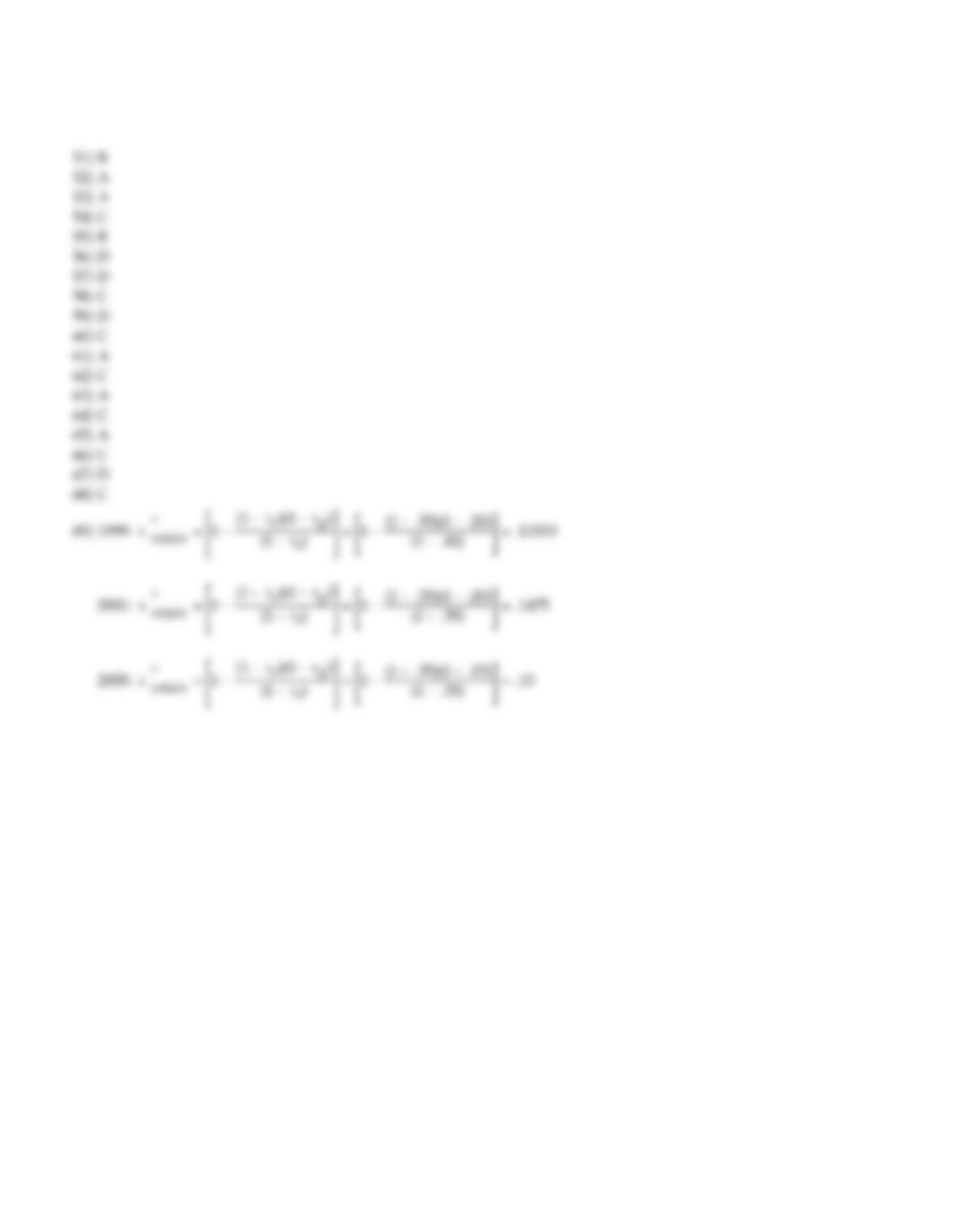
69)
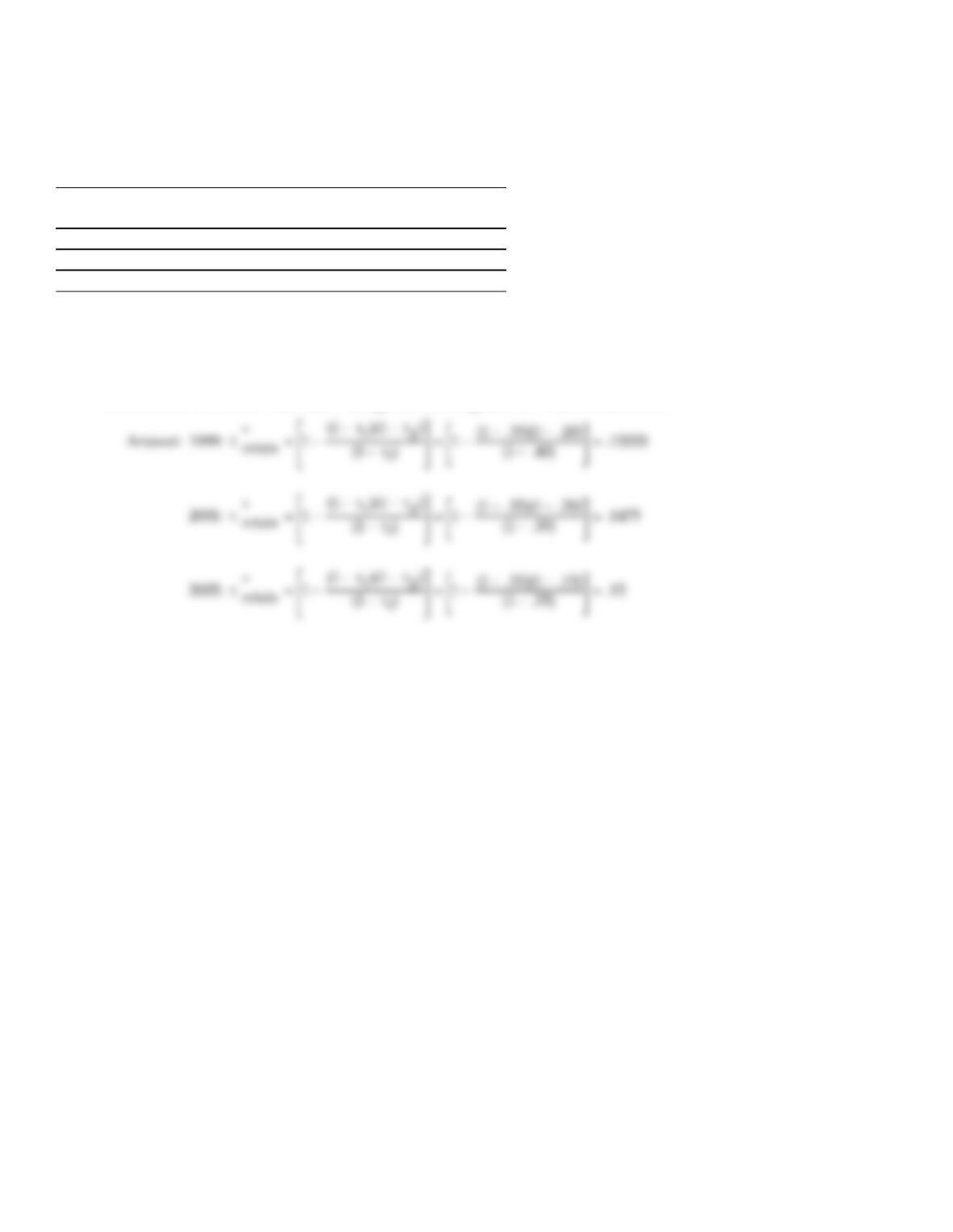
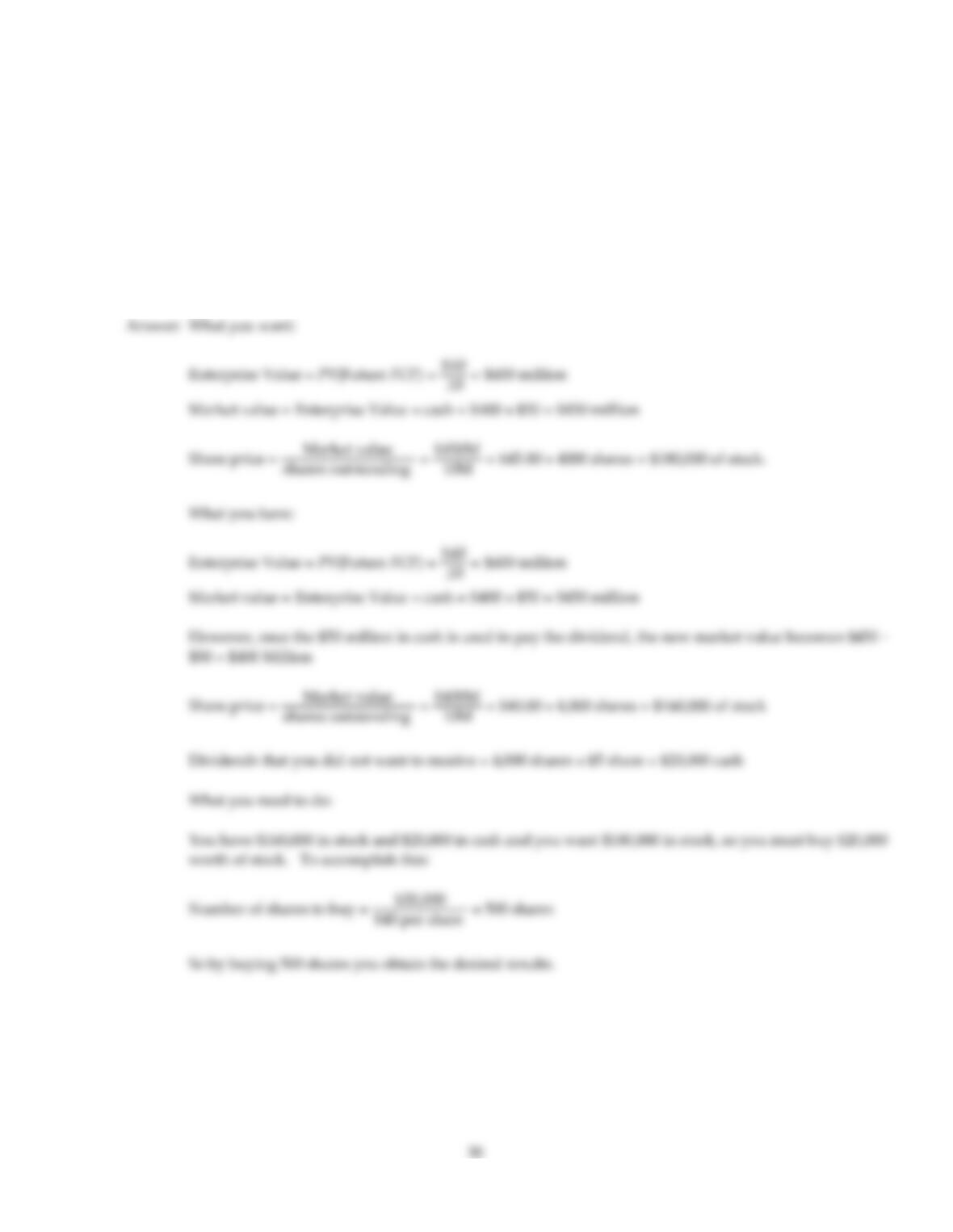
Calculate the effective tax disadvantage for retaining cash in 1999, 2001, and 2005.
29
Use the information for the question(s) below.
Omicron Technologies has $50 million in excess cash and no debt. The firm expects to generate additional free cash flows of
$40 million per year in subsequent years and will pay out these future free cash flows as regular dividends. omicrons
unlevered cost of capital is 10% and there are 10 million shares outstanding. Omicron‘s board is meeting to decide whether
to pay out its $50 million in excess cash as a special dividend or to use it to repurchase shares of the firm’s stock.
70)
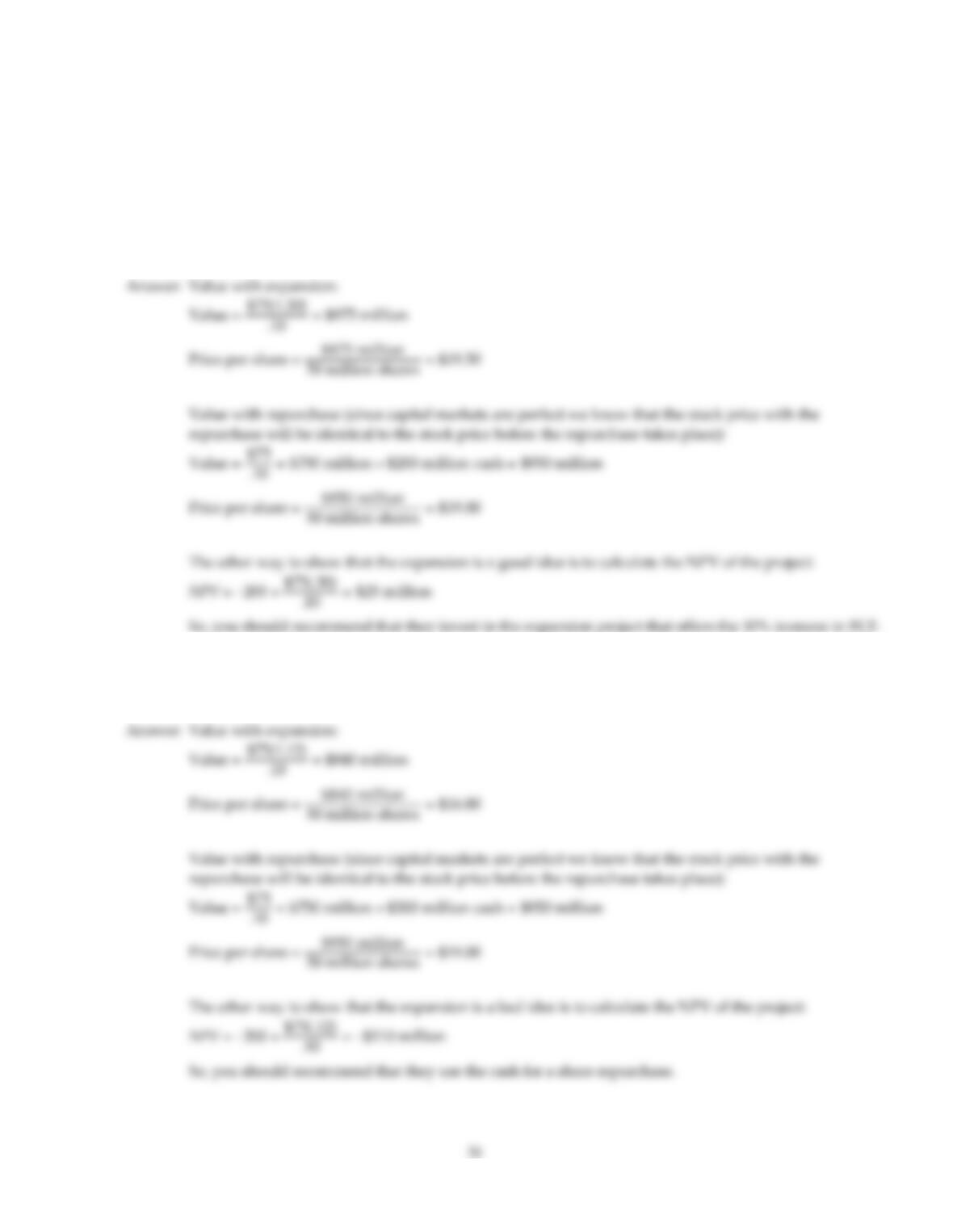
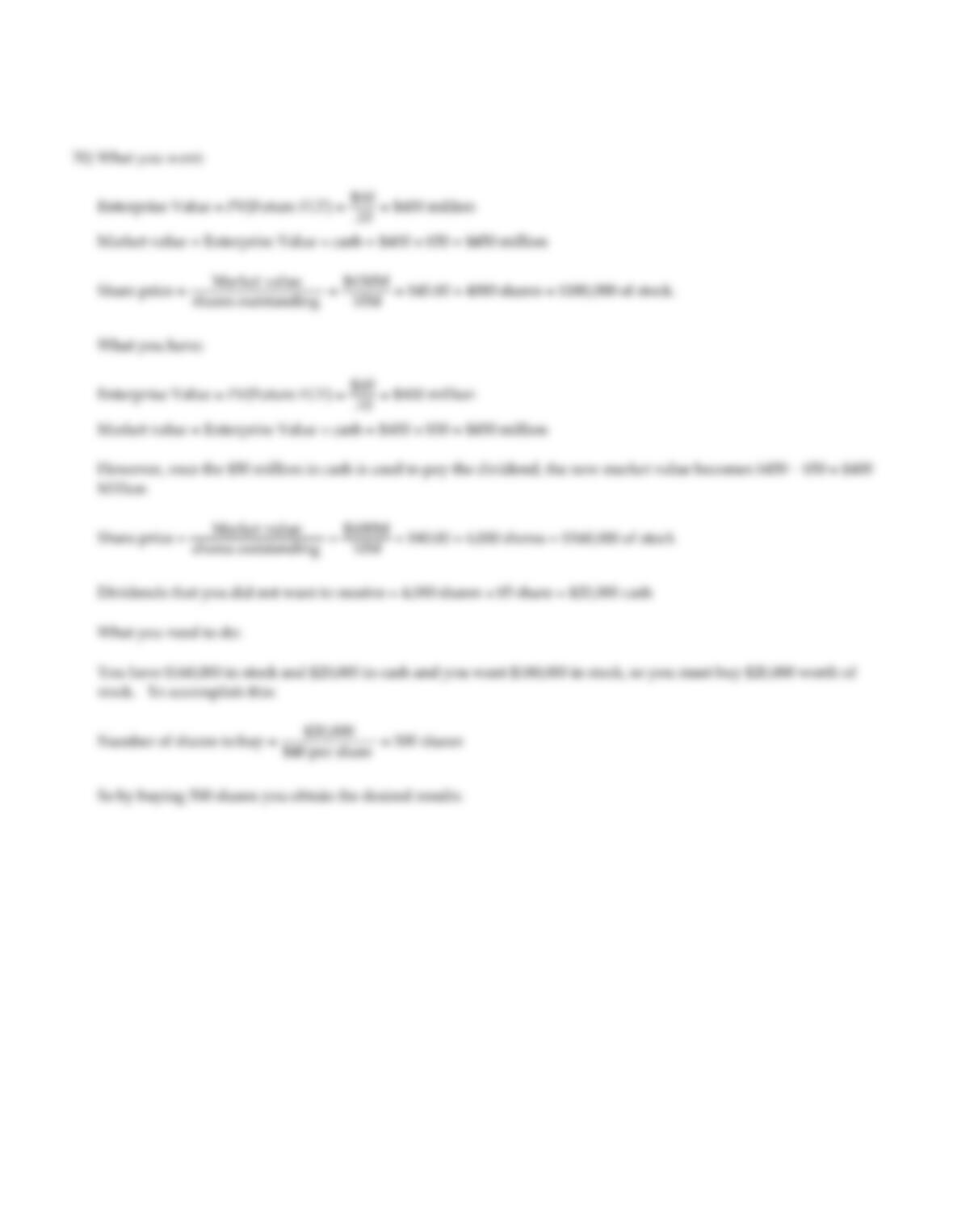
Assume that you own 4000 shares of Omicron stock and that Omicron uses the entire $50 million to pay a
special dividend. Suppose you are unhappy with Omicron’s decision and would have preferred that Omicron
used the excess cash to repurchase stock. Detail exactly how you could undo the dividend in a way that will
provide you with the same combination of cash and stock that you would have received if Omicron had not
paid the special dividend.
Use the information for the question(s) below.
Iota Industries is an all–equity firm with 50 million shares outstanding. Iota has $200 million in cash and expects future free
cash flows of $75 million per year. Management plans to use the cash to expand the firm’s operations, which in turn will
increase future free cash flows by 12%. Iota’s cost of capital is 10% and assume that capital markets are perfect.
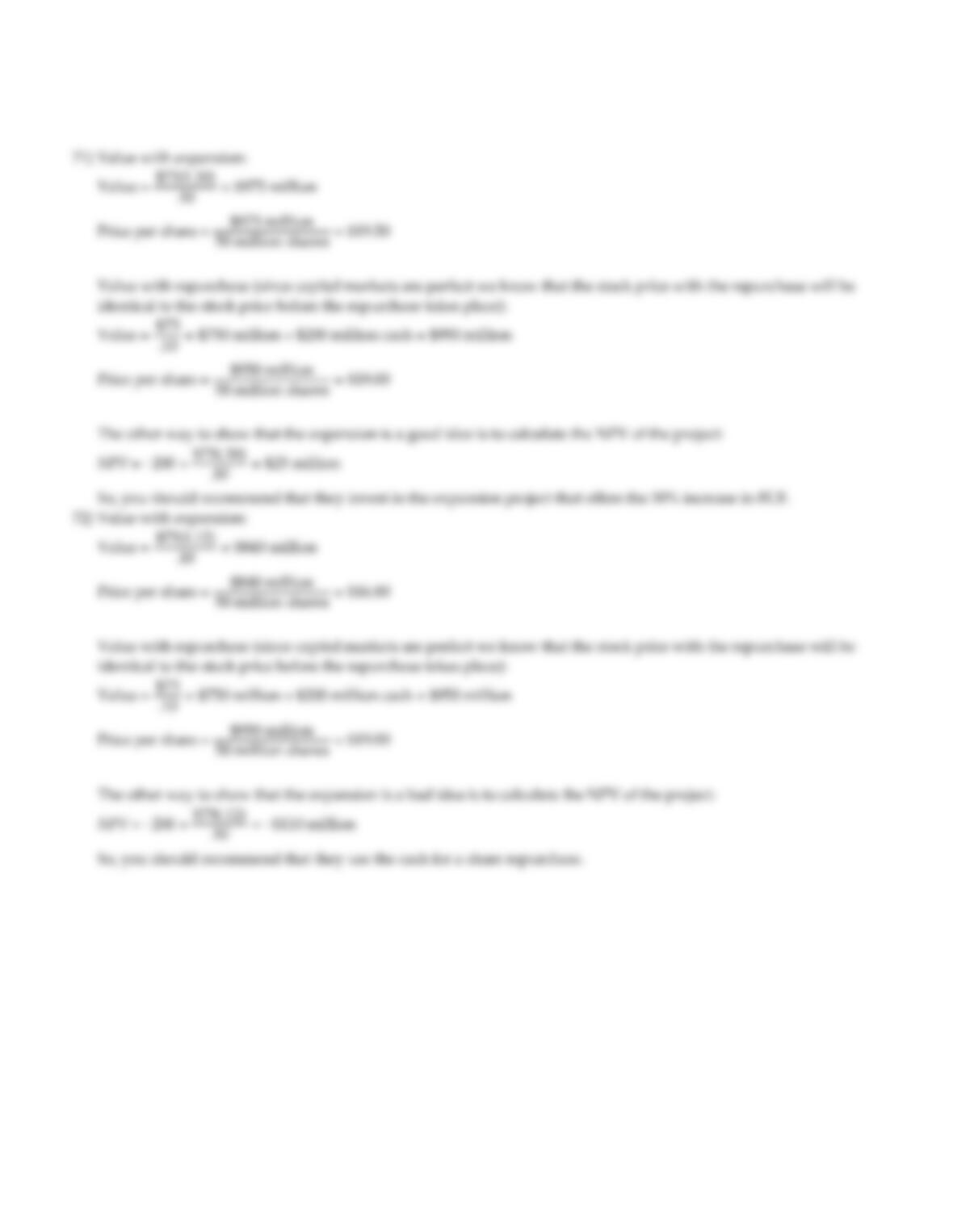
71)
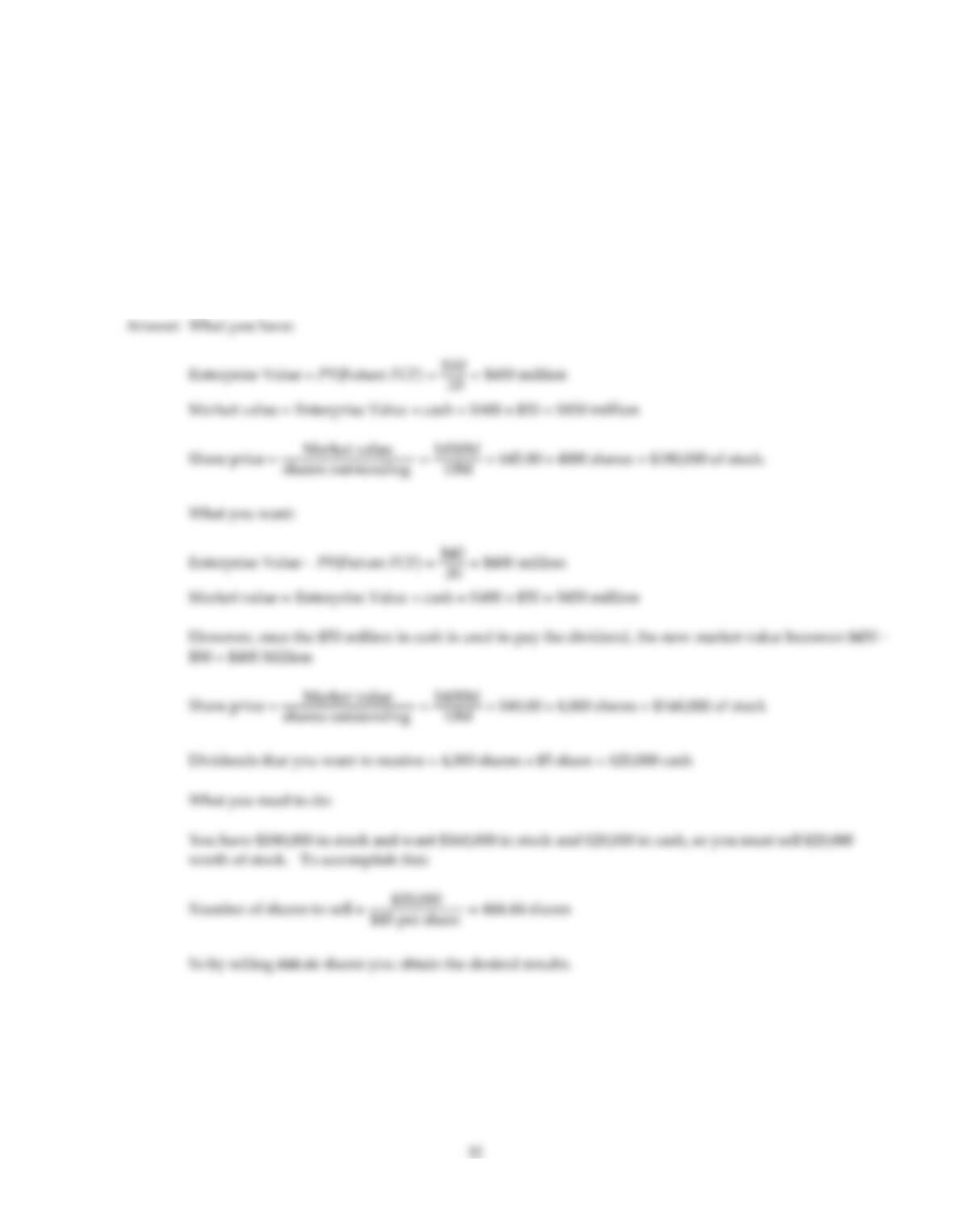
Suppose that Iota is able to invest the $200 million in excess cash into a project that will increase future free cash
flows by 30% If you were advising the board, what course of action would you recommend, investing the $200
million in an expansion project that will raise future free cash flows by 30% or use the $200 million to
repurchase shares? Which provides the higher stock price?
72)
A member of Iota’s board of directors suggests that Iota’s stock price would be higher if they used the $200
million to repurchase shares instead of funding the expansion. If you were advising the board, what course of
action would you recommend, expansion or repurchase? Which provides the higher stock price?
Use the information for the question(s) below.
Omicron Technologies has $50 million in excess cash and no debt. The firm expects to generate additional free cash flows of
$40 million per year in subsequent years and will pay out these future free cash flows as regular dividends. omicrons
unlevered cost of capital is 10% and there are 10 million shares outstanding. Omicron‘s board is meeting to decide whether
to pay out its $50 million in excess cash as a special dividend or to use it to repurchase shares of the firm’s stock.
73)
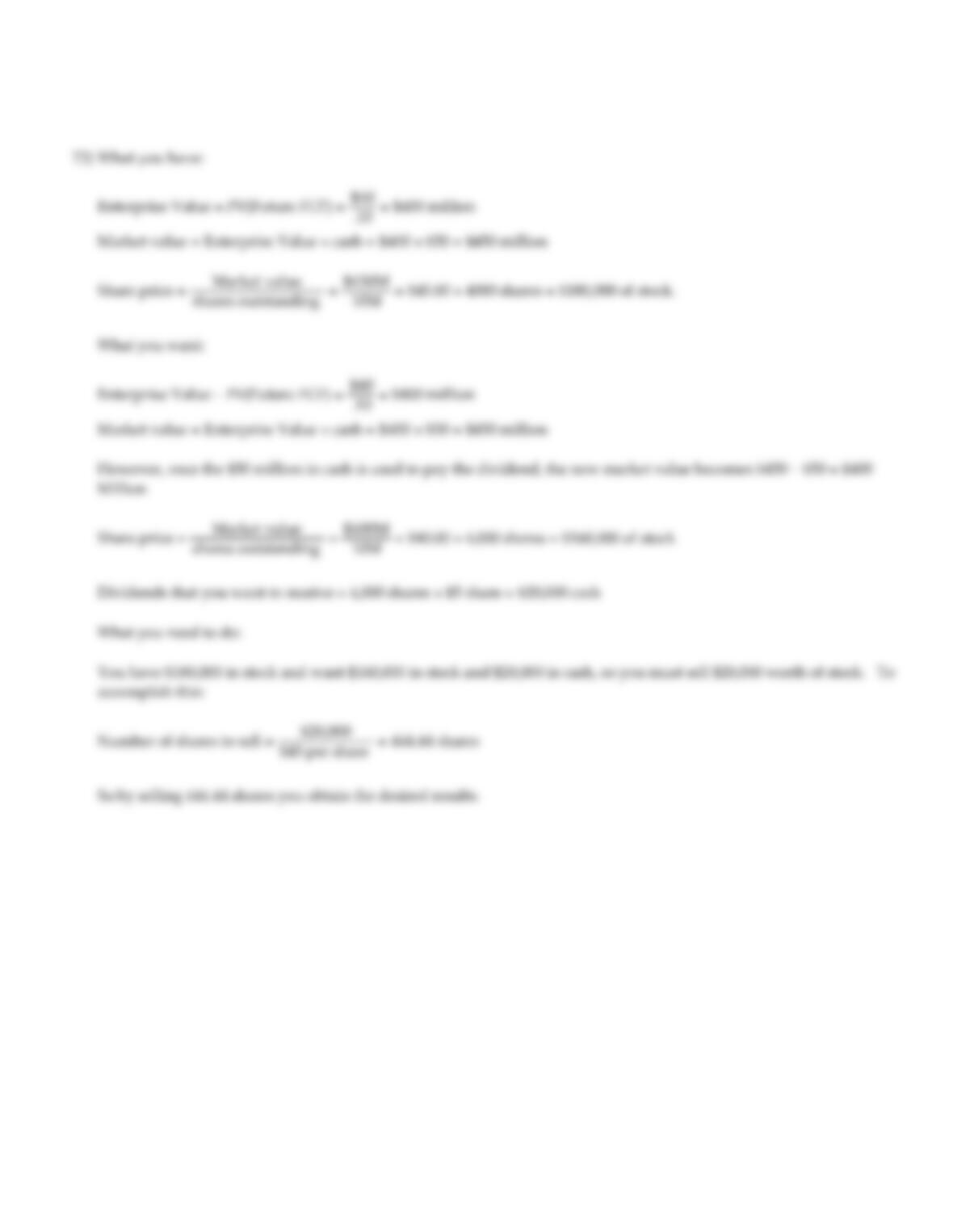
Assume that you own 4000 shares of Omicron stock and that Omicron uses the entire $50 million to repurchase
shares. Suppose you are unhappy with Omicron’s decision and would have preferred that Omicron used the
excess cash to pay a special dividend. Detail exactly how you could create a homemade dividend that will
provide you with the same combination of cash and stock that you would have received if Omicron paid the
special dividend.
Use the information for the question(s) below.
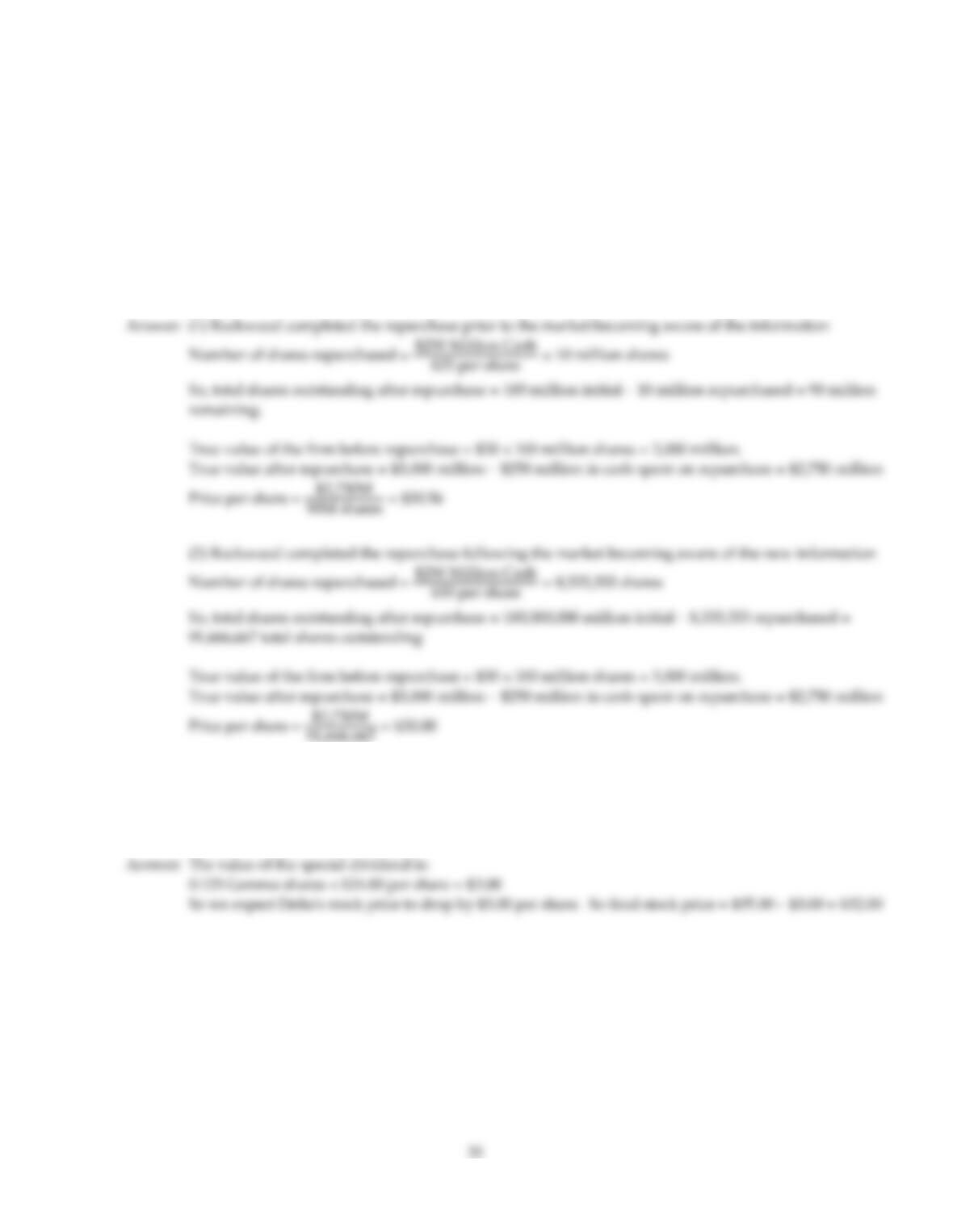
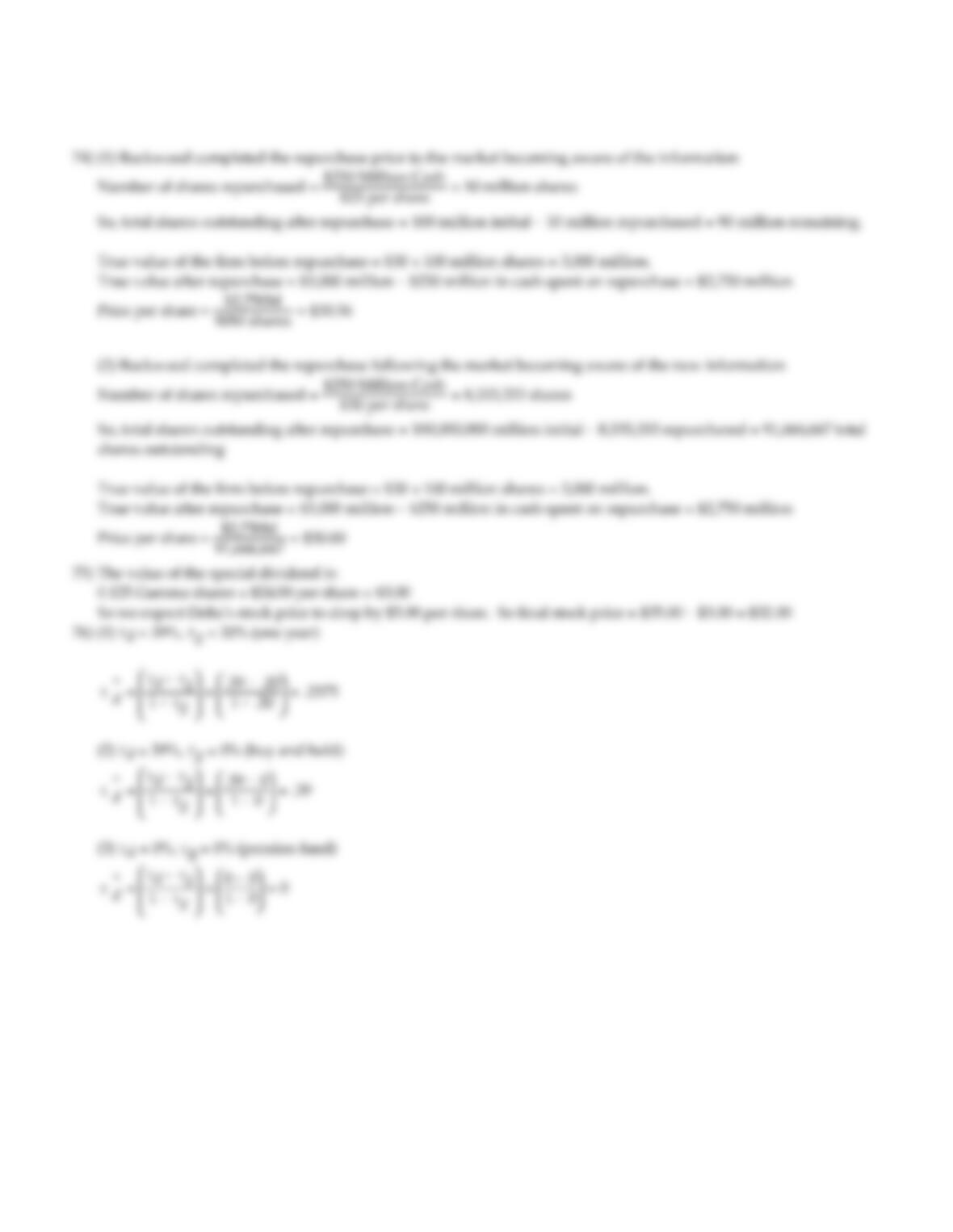
Rockwood Industries has 100 million shares outstanding, a current share price of $25, and no debt. Rockwood’s
management believes that the shares are under–priced, and that the true value is $30 per share. Rockwood plans to pay $250
million in cash to its shareholders by repurchasing shares. Management expects that very soon new information will come
out that will cause investors to revise their opinion of the firm and agree with Rockwood’s assessment of the firm’s true
value.
74)
Calculate Rockwood’s stock price following the market becoming aware of the new information regarding
Rockwood’s true value, if (1) Rockwood completed the repurchase prior to the market becoming aware of the
information and (2) Rockwood completed the repurchase following the market becoming aware of the new
information.
75)
Delta Products has decided to spin–off one of its subsidiaries, Gamma Technologies. Each Delta shareholder
will receive 0.125 shares of Gamma for each share of Delta they own. Delta’s price is $35.00 cum–dividend and
immediately after the spin–off Gamma Technologies was trading for $24.00 per share. In a perfect capital
market, what would Delta Product’s ex–dividend share price be after this transaction?
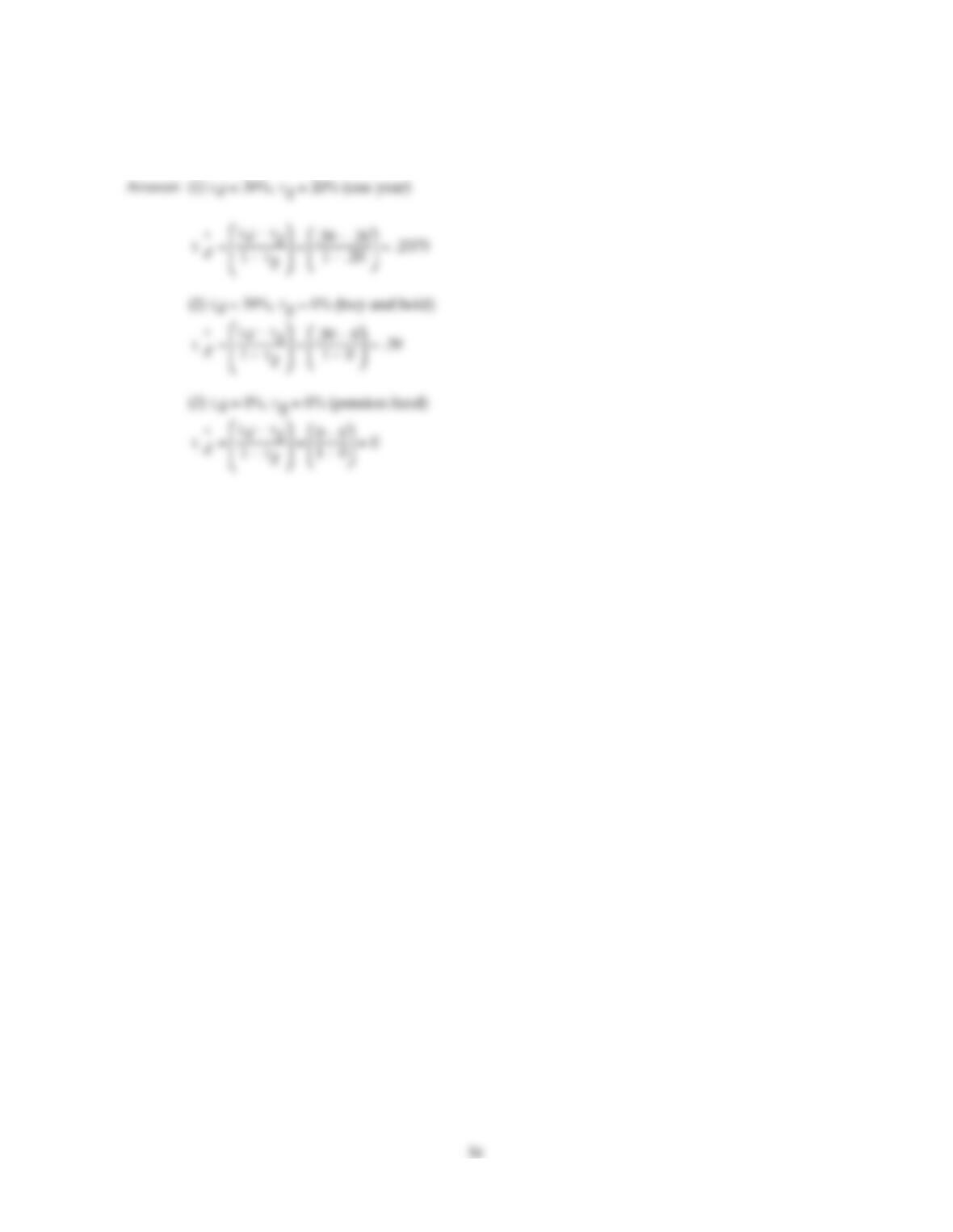
76)
Using the available tax information for 2002, calculate the effective dividend tax rate for a:
(1) one–year individual investor
(2) buy and hold individual investor
(3) pension fund
Answer Key
Testname: C17
Answer Key
Testname: C17
36
Answer Key
Testname: C17
37
Answer Key
Testname: C17
38
Answer Key
Testname: C17
39
Answer Key
Testname: C17
40