17.2 The Supply of Labor
1) An individual’s labor supply curve shows
A) the maximum wage rates offered to that individual by various potential employers.
B) the relationship between wages and the quantity of labor that she is willing to supply.
C) the relationship between wages and the quantity of labor that a firm is willing to employ.
D) the relationship between the quantity of hours worked and total income earned by that
individual.
2) The labor supply for an industry would decrease if
A) the wage rate falls.
B) the percentage of the population from age 16 to 65 decreases.
C) the government welcomes foreign workers into the country.
D) a greater percentage of women want to work outside the home.

3) How will an increase in population affect the labor market?
A) It will shift the market supply curve.
B) It will cause a decrease in the quantity of labor demanded.
C) It will increase the supply of jobs.
D) It will increase the opportunity cost of leisure.
4) All of the following will shift the labor supply curve except
A) an increase in labor force participation rate among women.
B) an increase in the average age of retirement.
C) an increase in the wage rate.
D) a change in a country’s immigration policy.
5) Which of the following best explains why unemployment rates are higher in the European
economies than in the United States?
A) More Europeans go to school fulltime and are therefore not able to participate in the labor
market.
B) Unemployment benefits are more generous in Europe than in the United States.
C) Workers in Europe are less productive than workers in the United States.
D) European industries pay a lower wage rate than industries in the United States.

6) If Molly Bee increases her work hours when her wage increases, then
A) the income effect of the wage increase outweighs the substitution effect.
B) the substitution effect of the wage increase outweighs the income effect.
C) leisure is an inferior good to Molly.
D) Molly is spending beyond her means.
7) If Alan Shaw reduces his work hours when his salary increases, then
A) the income effect of his salary increase dominates the substitution effect.
B) the substitution effect of his salary increase dominates the income effect.
C) the income effect of his salary increase is completely offset by the substitution effect.
D) leisure is an inferior good to Alan.
8) At low wages, the labor supply curve for most people slopes upward because
A) the supply of labor is perfectly inelastic at low wages.
B) as wages increase the opportunity cost of leisure increases.
C) as wages increase income also increases unless hours worked decrease.
D) the demand for labor is perfectly elastic at low wages.

9) The substitution effect of a wage increase is observed when
A) the higher wage income causes workers to take more leisure and work less.
B) leisure’s higher opportunity cost causes workers to take less leisure and work more.
C) the higher wage income causes workers to take more leisure and work more.
D) leisure’s higher opportunity cost causes workers to take more leisure and work less.
10) The income effect of a wage increase is observed when
A) the higher wage income causes workers to take more leisure and work less.
B) leisure’s higher opportunity cost causes workers to take less leisure and work more.
C) the higher wage income causes workers to take less leisure and work more.
D) leisure’s higher opportunity cost causes workers to take more leisure and work less.
11) The combined effect (both income and substitution) of a wage increase is that
A) the substitution effect always dominates, leading to more work at a higher wage.
B) the income effect always dominates, leading to less work at a higher wage.
C) if the substitution effect outweighs the income effect, the labor supply curve slopes upward,
but if the income effect outweighs the substitution effect, the labor supply curve is backward
bending.
D) if the substitution effect outweighs the income effect, the labor supply curve is backward
bending, but if the income effect outweighs the substitution effect, the labor supply curve slopes
upward.
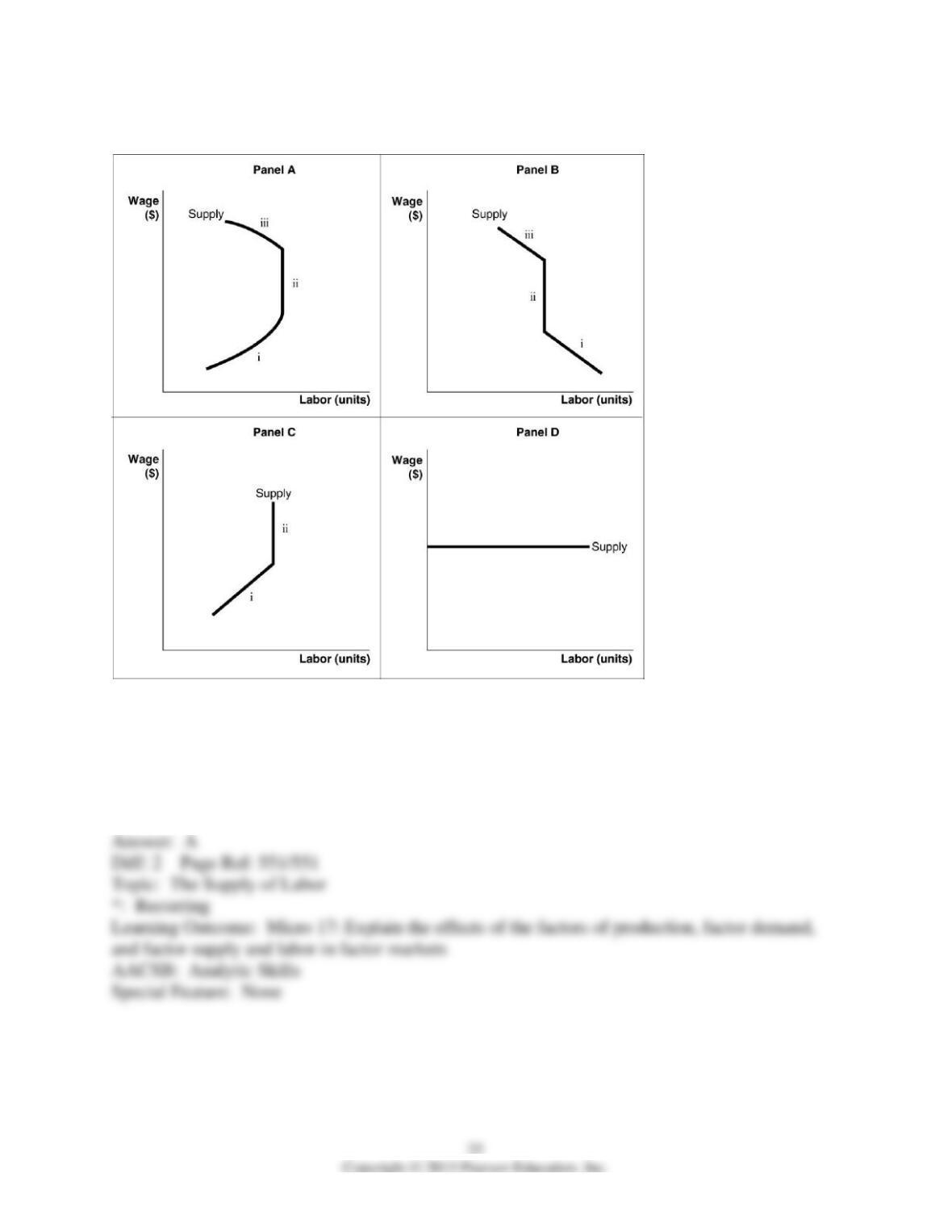
Figure 17-2
12) Refer to Figure 17-2. Which of the panels in the diagram best represents an individual’s
labor supply curve?
A) Panel A
B) Panel B
C) Panel C
D) Panel D

13) Refer to Figure 17-2. Which of the following statements is true?
A) Panel B correctly describes a situation in which the income effect dominates the substitution
effect at low wages (segment i) and again at very high wages (segment iii).
B) Panel B incorrectly describes a situation in which the income effect dominates the substitution
effect at low wages (segment i) and a situation in which the substitution effect dominates the
income effect at very high wages (segment iii).
C) Panel B incorrectly describes a situation in which the income effect dominates the substitution
effect at low wages (segment i).
D) Panel B incorrectly describes a situation in which the income effect dominates the
substitution effect at very high wages (segment iii)
14) Refer to Figure 17-2. Panel D is appropriate when used to represent
A) the quantity of labor demanded by an input price taker.
B) the labor supply curve facing an input price taker.
C) the quantity of labor supplied by someone working a fixed number of hours.
D) the highly-skilled labor market supply curve.
15) Refer to Figure 17-2. In Panel A, at low wages (segment i),
A) the substitution effect outweighs the income effect.
B) the income effect outweighs the substitution effect.
C) the substitution effect offsets the income effect.
D) labor suppliers demand more leisure as wages increase.
16) Refer to Figure 17-2. In Panel A, at high wages (segment iii),
A) the price of leisure is rising relative to the price of labor.
B) the price of leisure is falling relative to the price of labor.
C) laborers work more as wages increase.
D) labor suppliers take more leisure as wages increase.
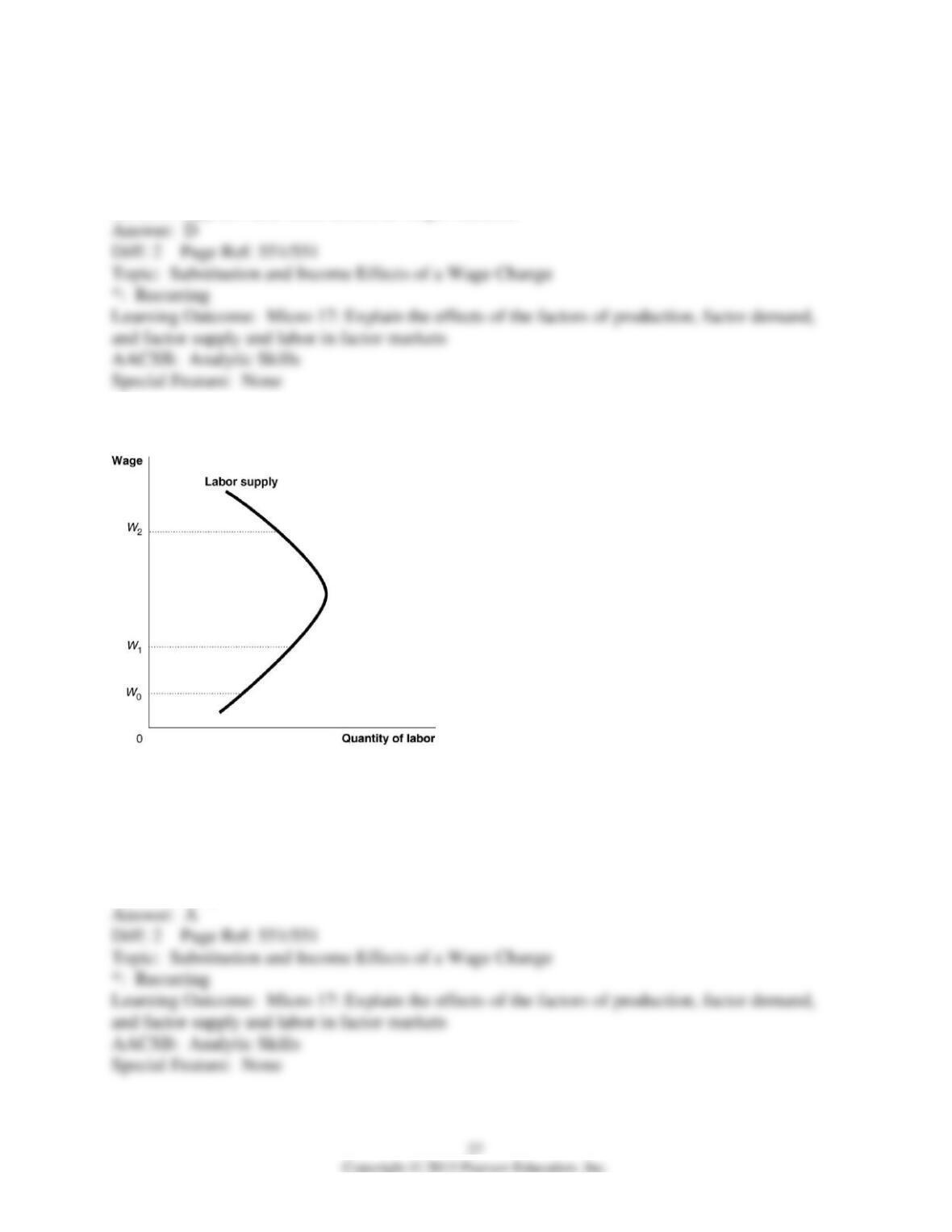
Figure 17-3
17) Refer to Figure 17-3. Which of the following is true if the wage rate increases from W1 to
W2?
A) The income effect is larger than the substitution effect.
B) The substitution effect is larger than the income effect.
C) The income effect and the substitution effect are equal.
D) The supply curve is unit-elastic.

18) Refer to Figure 17-3. Which of the following is true at W0?
A) The income effect is larger than the substitution effect.
B) The substitution effect is larger than the income effect.
C) The income effect and the substitution effect are equal.
D) The supply curve is positively sloped.
19) If the market wage rate increases, a firm’s labor demand curve does not shift but the labor
supply curve shifts to the right.
20) If the substitution effect of a wage increase dominates the income effect, the labor supply
curve has a positive slope.
21) The income effect of a wage decrease examines the effect of the decrease in wage income on
a worker’s ability to purchase goods and services.

22) An increase in wages raises the opportunity cost of leisure and leads to an increase in the
quantity supplied of labor.
23) What is the substitution effect of a wage increase? What is the income effect of a wage
increase? Under what conditions will a worker’s labor supply curve become downward sloping?
24) Serafina was earning $75 per hour and working 50 hours per week. Serafina’s wage rose to
$90 per hour, and as a result, she now works 60 hours per week. What can you conclude from
this information about the income effect and the substitution effect of a wage change for
Serafina?

25) Suppose that Hawaii legalizes casino gambling. By imposing a tax on casino revenues, the
state government is able to eliminate the state income tax on wages. What is likely to be the
effect on the labor supply curve in Hawaii?
17.3 Equilibrium in the Labor Market
1) The equilibrium wage and quantity of labor in the market for skilled workers is determined by
A) the strength of labor unions.
B) the monopsony power of firms.
C) the demand and supply of labor.
D) the market value created by the output of these skilled workers.
2) What happens to the equilibrium wage and quantity of labor if output price rises?
A) The equilibrium wage and the equilibrium quantity of labor rise.
B) The equilibrium wage and the equilibrium quantity of labor fall.
C) The equilibrium wage falls and the equilibrium quantity of labor rises.
D) The equilibrium wage rises and the equilibrium quantity of labor falls.

3) Consider the market for opticians. What is likely to happen to the equilibrium wage and
quantity of opticians if more and more people turn to laser eye surgery instead of wearing glasses
or contact lens?
A) The equilibrium wage and the equilibrium quantity of opticians rise.
B) The equilibrium wage and the equilibrium quantity of opticians fall.
C) The equilibrium wage rises and the equilibrium quantity of opticians falls.
D) The equilibrium quantity falls and the equilibrium wage of opticians rises.
4) Suppose the government grants child care subsidies to mothers entering the labor force. What
is likely to happen to the equilibrium wage and quantity of labor?
A) The equilibrium wage and the equilibrium quantity of labor rise.
B) The equilibrium wage and the equilibrium quantity of labor fall.
C) The equilibrium wage falls and the equilibrium quantity of labor rises.
D) The equilibrium wage rises and the equilibrium quantity of labor falls.
5) Consider the market for pilots. What is likely to happen to the equilibrium wage and quantity
of pilots if the government enforces a lower mandatory retirement age, say from age 65 to age
62?
A) The equilibrium wage and the equilibrium quantity of pilots rise.
B) The equilibrium wage and the equilibrium quantity of pilots fall.
C) The equilibrium wage falls and the equilibrium quantity of pilots rises.
D) The equilibrium wage rises and the equilibrium quantity of pilots falls.

6) Suppose the following two events occur in the domestic market for radiologists:
a. Some hospitals are outsourcing some radiology services such as reading x-rays.
b. Some medical schools have closed down their radiology departments as fewer students enroll
in this field.
What is likely to happen to the equilibrium wage and quantity of radiologists following these two
events?
A) The equilibrium wage and the equilibrium quantity of radiologists rise.
B) The equilibrium wage and the equilibrium quantity of radiologists fall.
C) The equilibrium quantity falls and the effect on the equilibrium wage of radiologists is
indeterminate.
D) The equilibrium wage falls and the effect on equilibrium quantity of radiologists is
indeterminate.
7) Suppose the following two events occur in the market for elementary school teachers:
a. Overcrowded schools and education budget cuts have discouraged young college students
from pursuing careers in teaching.
b. With an increasing birth rate, the number of children entering the elementary school system
is expected to increase significantly over the next ten years.
What is likely to happen to the equilibrium wage and quantity of teachers as a result of these two
events?
A) The equilibrium quantity and the equilibrium wage of elementary school teachers fall.
B) The equilibrium wage rises and the effect on the equilibrium quantity of elementary school
teachers is indeterminate.
C) The equilibrium quantity falls and the effect on the equilibrium wage of elementary school
teachers is indeterminate.
D) The equilibrium quantity falls and the equilibrium wage of elementary school teachers rises.

8) Consider this quote from an article in the Wall Street Journal: “The stock of educated workers
isn’t increasing fast enough to keep up with rising demand. ……. Employers are paying the typical
four-year college graduate [without graduate school] 75% more than they pay high-school grads.
Twenty-five years ago, they were paying 40% more. Employers insist on ever better-educated,
skilled workers. ”
Source: David Wessel, “Lack of Well-Educated Workers Has Lots of Roots, No Quick Fix”, Wall
Street Journal, April 19, 2007, Page A2.
Which of the following best explains the rapid increase in the wage differential between college
graduates and high school graduates?
A) The demand for college educated workers shifted to the right while the supply of college
educated workers shifted to the left.
B) The supply of high-school educated workers shifted to the right faster than the demand for
college educated workers shifted to the right.
C) The demand for college educated workers shifted to the right faster than the supply of college
educated workers shifted to the right.
D) The demand for high-school educated workers shifted to the left faster than the supply of
college educated workers shifted to the right.
9) According to the signaling hypothesis,
A) signaling about job openings occurs in help wanted classified ads.
B) a college diploma signals to employers that a person has certain desirable characteristics.
C) a slowdown in output signals to companies the need to hire more labor.
D) a high unemployment rate is a signal to the government to take some policy action.

10) Consider the following statements about the signaling hypothesis of education:
a. The signaling hypothesis of education is based on the idea that college graduates are more
productive than non-college graduates.
b. The signaling hypothesis of education suggests that firms rely on human capital requirements
to ensure worker quality.
c. Employers rely on certain signals, such as a college diploma, to gauge a potential employee’s
abilities because it could lower the cost of acquiring information about the person that is not
easily observed.
Which of the statements above is true about the signaling hypothesis of education?
A) a, b, and c
B) a and b only
C) b and c only
D) a and c only
11) The success of Walt Disney’s animated film The Lion King in 1994, increased production of
animated films, increasing the demand for animators much faster than the supply of animators
was increasing. As a result, in the market for animators, the equilibrium wage fell and the
equilibrium quantity increased.
12) Since Poland joined the European Union in 2004, many young and educated Poles have
emigrated to the United Kingdom. As a result, the labor supply curve in the United Kingdom
shifts to the right and the equilibrium wage rises.
13) The signaling hypothesis of education states that education is a costly activity that enhances
a worker’s productivity.
14) If the labor demand curve shifts to the right and the labor supply curve remains unchanged,
what will happen to the equilibrium wage and the equilibrium level of employment? Illustrate
your answer with a graph.
15) If the labor supply curve shifts to the left and the labor demand curve remains unchanged,
what will happen to the equilibrium wage and the equilibrium level of employment? Illustrate
your answer with a graph.
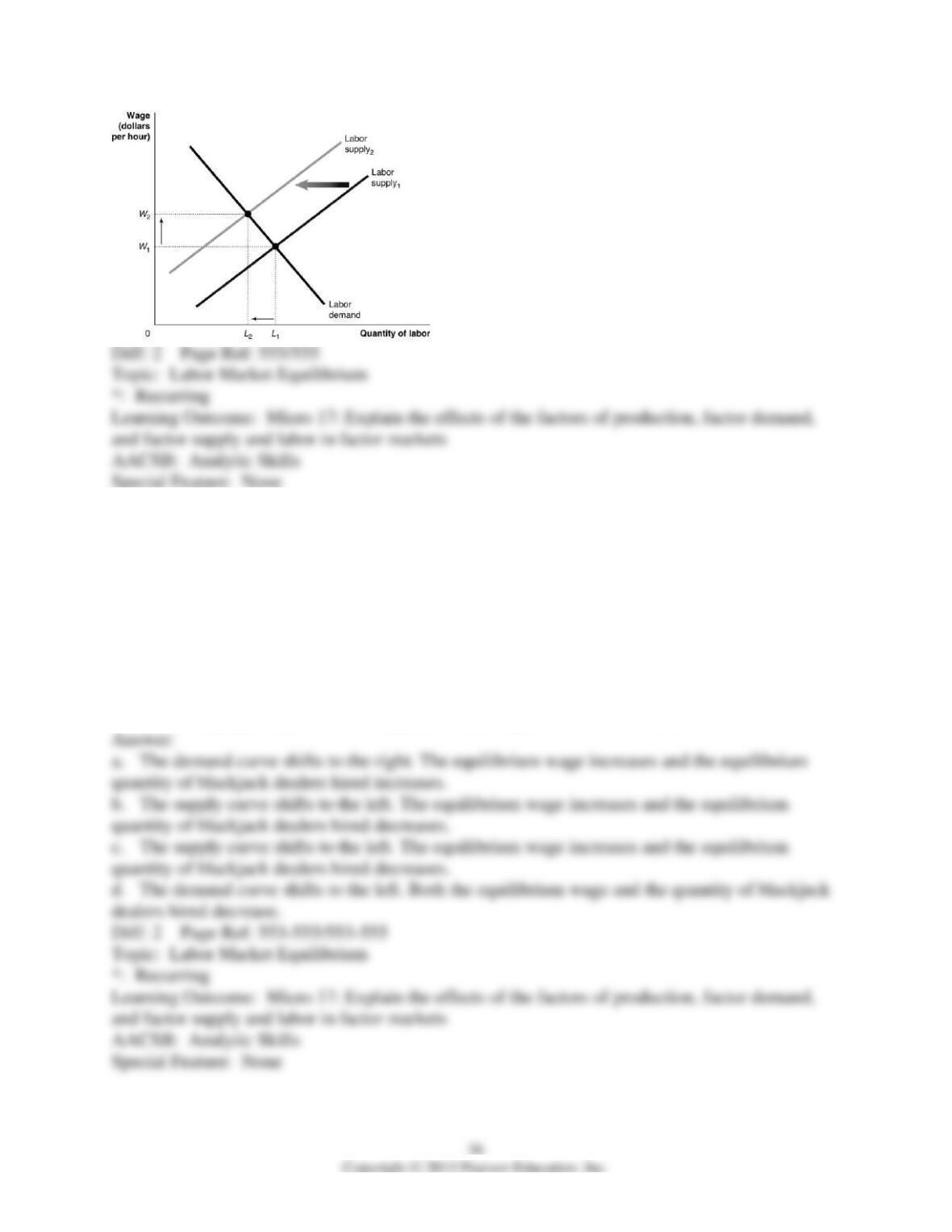
16) Consider the market for blackjack dealers in Las Vegas. In each of the following cases,
explain what happens to the equilibrium wage rate and the quantity of blackjack dealers hired.
a. Three new large resort casinos open in Las Vegas.
b. Fewer students are attending classes to learn to become blackjack dealers.
c. Traditionally, blackjack dealing is a field that attracts foreign workers. However, changes in
immigration laws have made it more difficult for foreign workers to come to Las Vegas to obtain
jobs. The demand for blackjack dealers, however, does not change.
d. Advances in technology have increased the popularity of electronic blackjack machines and
decreased the popularity of live table games which require the use of a dealer.
17) What is the signaling hypothesis of education?
17.4 Explaining Differences in Wages
1) Painters who paint water towers earn higher wages relative to painters who paint houses
because
A) the demand for tower painters is greater than the demand for residential painters.
B) painting water towers is more risky than painting houses.
C) the tower painters’ union is probably more powerful than the house painters’ union.
D) the supply of water tower painters exceeds the supply of house painters.
2) Wage differentials between occupations can be explained by all of the following except
A) the fact that some occupations require higher levels of human capital than others.
B) the fact that some occupations are more desirable than others.
C) the market power of different employers.
D) the relative differences between demand and supply in various occupations

3) A study by Price Fishback and Shawn Kantor of the University of Arizona shows that after the
passage of workers’ compensation laws, wages received by workers in the coal and lumber
industries fell.
Source: Price V. Fishback and Shawn Everett Kantor, “Did Workers Pay for the Passage of
Workers’ Compensation Laws?” Quarterly Journal of Economics, Vol. 100, No. 3, August 1995,
pp. 713-742.
Which of the following could explain why passage of workers’ compensation laws led to a fall in
wages in some industries?
A) The passage of the workers’ compensation laws made it more expensive for firms to employ
workers, thus reducing the demand for workers.
B) The passage of the workers’ compensation laws allowed employers in hazardous industries to
reduce compensating differentials which, in turn, reduce wages.
C) Employers reduced wages to partially offset the cost of having to purchase insurance that
would compensate workers for injuries suffered on the job.
D) The supply of labor in these hazardous industries increased following the passage of the
workers’ compensation laws because jobs in these industries now pose less risk.
4) Some superstar athletes in the sports industry earn very high levels of income relative to other
occupations, and over time the wage differential has been increasing. What could have caused
this?
A) The supply of star athletes has decreased.
B) The supply of star athletes has increased due to college athletic programs.
C) Technological advances such as cable television has increased the demand for sports
entertainment.
D) The market power of athletes’ unions has increased.

5) Which of the following explains why talented major league baseball players command much
higher salaries than neurosurgeons?
A) because the total value of baseball games is much higher than the total value of neurosurgery
B) because it takes far more skill and training to be a major league baseball player than to be a
neurosurgeon
C) because the supply of talented major league baseball players is relatively low compared to the
supply of neurosurgeons. Therefore, major league baseball players exert far more market power
than neurosurgeon.
D) because the supply of talented major league baseball players is low relative to its demand
compared to the supply of neurosurgeons. Therefore, adding another player yields far greater
marginal benefit than adding another neurosurgeon.
6) There are 345 Division 1-A college basketball programs. Based on this information, the labor
supply curve for Division 1-A head basketball coaches is
A) upward sloping.
B) downward sloping.
C) horizontal.
D) vertical.

7) There are 345 Division 1-A college basketball programs. As the value of a Division 1-A
basketball team increases, the equilibrium wage (salary) paid to head coaches ________ and the
equilibrium quantity of head coaching positions ________.
A) increases; increases
B) increases; remains the same.
C) increases; decreases
D) remains the same; decreases
8) Compensating differentials are
A) non-monetary benefits from being employed, such as health-care benefits.
B) wages paid to workers where the supply of labor is great relative to demand.
C) higher wages that compensate workers for unpleasant aspects of a job.
D) higher wages that compensate the more experienced workers in a field.
9) Which of the following is an example of a compensating wage differential?
A) Nurse anesthetists are paid less than anesthesiologists (who have medical degrees).
B) Workers in a dynamite mine receive higher wages than if they worked in other jobs that
require the same level of skills.
C) In the market for lawyers, top graduates from the top programs earn starting salaries that are
significantly higher than the starting salaries earned by lower-ranked graduates from the lower-
ranked programs.
D) Popular movie stars like George Clooney command much higher salaries than other talented
but lesser-known actors.