Chemistry: The Central Science, 13e (Brown et al.)
Chapter 17 Additional Aspects of Aqueous Equilibria
17.1 Multiple-Choice Questions
1) Which one of the following pairs cannot be mixed together to form a buffer solution?
A) HONH2, HONH3Cl
B) NaCl, HCl
C) RbOH, HF
D) KOH, HNO2
E) H2SO3, KHSO3
2) Which one of the following pairs cannot be mixed together to form a buffer solution?
A) NH3, NH4Cl
B) NaC2H3O2, HCl (C2H3O2– = acetate)
C) RbOH, HBr
D) KOH, HF
E) H3PO4, KH2PO4
3) Which one of the following pairs cannot be mixed together to form a buffer solution?
A) C5H5N, C5H5NHCl
B) HC2H3O2, NaOH (C2H3O2– = acetate)
C) KOH, HI
D) NH2CH3, HCl
E) NaClO, HNO3
4) A solution containing which one of the following pairs of substances will be a buffer solution?
A) NaI, HI
B) KBr, HBr
C) RbCl, HCl
D) CsF, HF
E) none of the above
5) A solution containing which one of the following pairs of substances will be a buffer solution?
A) KI, HI
B) AgBr, HBr
C) CuCl, HCl
D) CsI, HI
E) none of the above
6) What change will be caused by addition of a small amount of HCl to a solution containing fluoride ions
and hydrogen fluoride?
A) The concentration of hydronium ions will increase significantly.
B) The concentration of fluoride ions will increase as will the concentration of hydronium ions.
C) The concentration of hydrogen fluoride will decrease and the concentration of fluoride ions will
increase.
D) The concentration of fluoride ion will decrease and the concentration of hydrogen fluoride will
increase.
E) The fluoride ions will precipitate out of solution as its acid salt.
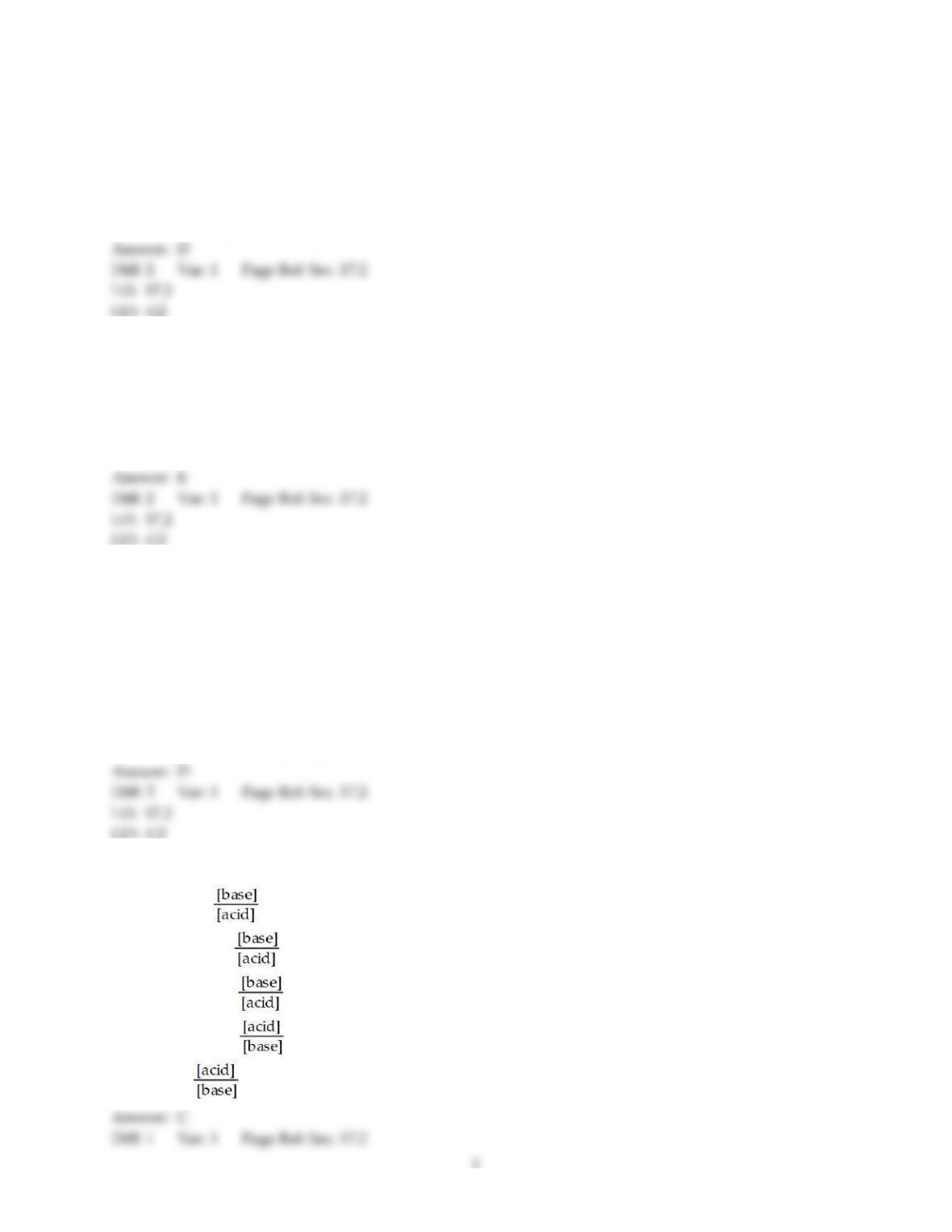
7) The Henderson-Hasselbalch equation is ________.
A) [H+] = Ka +
B) pH = pKa – log
C) pH = pKa + log
D) pH = pKa + log
E) pH = log
3
8) In a solution, when the concentrations of a weak acid and its conjugate base are equal, ________.
A) the system is not at equilibrium
B) the buffering capacity is significantly decreased
C) the -log of the [H+] and the –log of the Ka are equal
D) All of the above are true.
9) Of the following solutions, which has the greatest buffering capacity?
A) 0.521 M HC2H3O2 and 0.217 M NaC2H3O2
B) 0.821 M HC2H3O2 and 0.713 M NaC2H3O2
C) 0.365M HC2H3O2 and 0.497 M NaC2H3O2
D) 0.121 M HC2H3O2 and 0.116 M NaC2H3O2
10) Of the following solutions, which has the greatest buffering capacity?
A) 0.543 M NH3 and 0.555 M NH4Cl
B) 0.087 M NH3 and 0.088 M NH4Cl
C) 0.234 M NH3 and 0.100 M NH4Cl
D) 0.100 M NH3 and 0.455 M NH4Cl
E) They are all buffer solutions and would all have the same capacity.
11) The addition of hydrofluoric acid and ________ to water produces a buffer solution.
A) HCl
B) NaNO3
C) NaCl
D) NaOH
E) NaBr
12) The addition of hydrochloric acid and ________ to water produces a buffer solution.
A) HC6H5O
B) NaOH
C) NH3
D) HNO3
E) NaNO3
13) The addition of hydrochloric acid and ________ to water produces a buffer solution.
A) HC6H5O
B) NaOH
C) NaCl
D) C2H5NH2
E) none of the above
14) The addition of sodium hydroxide and ________ to water produces a buffer solution.
A) HCl
B) NaC2H3O2
C) NaF
D) NH3
E) none of the above
15) Which of the following could be added to a solution of sodium acetate to produce a buffer?
A) acetic acid only
B) acetic acid or hydrochloric acid
C) hydrochloric acid only
D) potassium acetate only
E) sodium chloride or potassium acetate
16) Which of the following could be added to a solution of potassium fluoride to prepare a buffer?
A) sodium hydroxide
B) potassium acetate
C) hydrochloric acid
D) sodium fluoride
E) ammonia
17) Which of the following could be added to a solution of acetic acid to prepare a buffer?
A) sodium hydroxide
B) hydrochloric acid
C) nitric acid
D) more acetic acid
E) None of the above can be added to an acetic acid solution to prepare a buffer.
18) Which of the following could be added to a solution of acetic acid to prepare a buffer?
A) sodium acetate only
B) sodium acetate or sodium hydroxide
C) nitric acid only
D) hydrofluoric acid or nitric acid
E) sodium hydroxide only
19) The primary buffer system that controls the pH of the blood is the ________ buffer system.
A) carbon dioxide, carbonate
B) carbonate, bicarbonate
C) carbonic acid, carbon dioxide
D) carbonate, carbonic acid
E) carbonic acid, bicarbonate
20) What are the principal organs that regulate the pH of the carbonic acid–bicarbonate buffer system in
the blood?
A) kidneys, liver
B) lungs, kidneys
C) spleen, liver
D) lungs, skin
E) brain stem, heart
6
21) Human blood is ________.
A) neutral
B) very basic
C) slightly acidic
D) very acidic
E) slightly basic
22) Which one of the following will cause hemoglobin to release oxygen?
A) increase in pH
B) decrease in pH
C) decrease in temperature
D) decrease in CO2 concentration
E) increase in O2 concentration
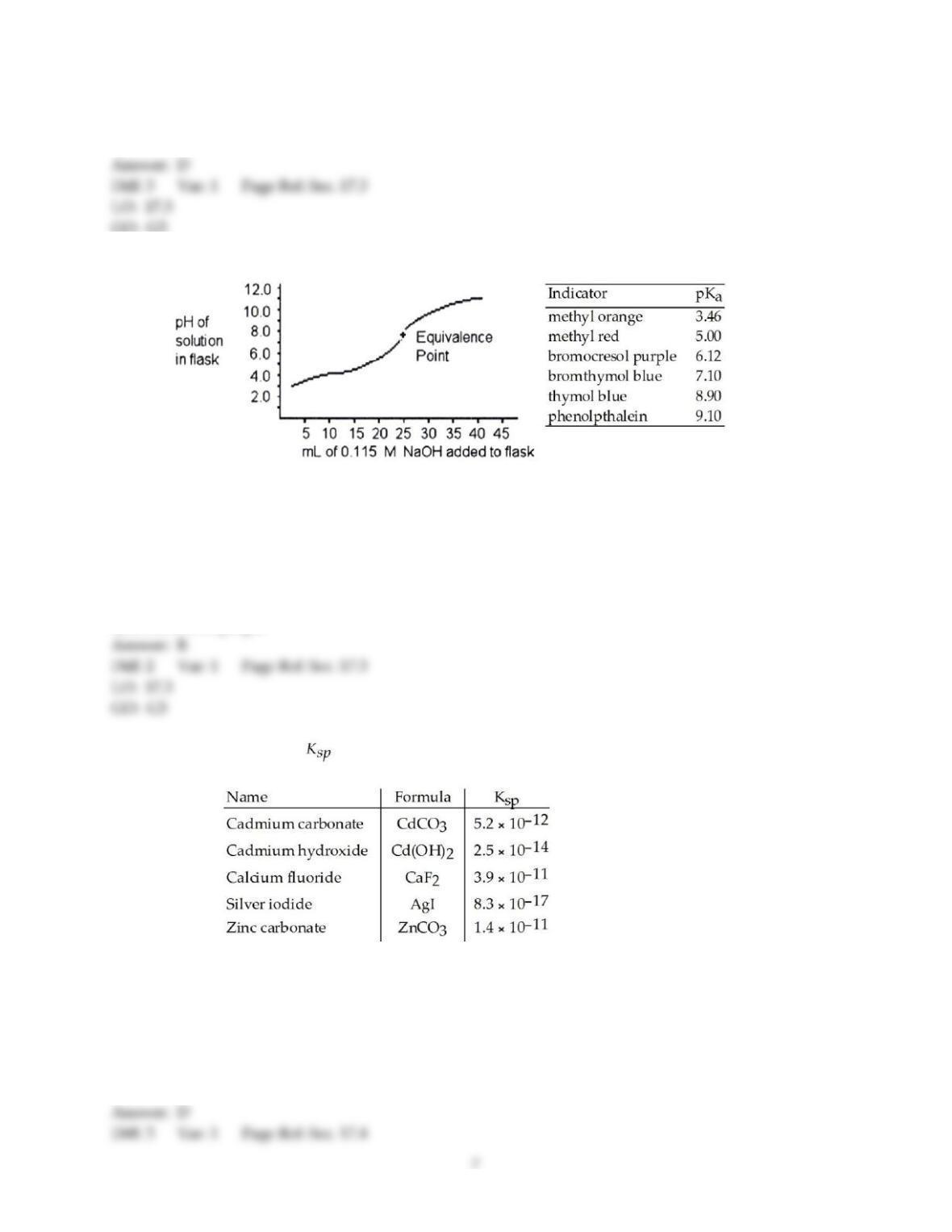
23) A 25.0 mL sample of a solution of an unknown compound is titrated with a 0.115 M NaOH solution.
The titration curve above was obtained. The unknown compound is ________.
A) a strong acid
B) a strong base
C) a weak acid
D) a weak base
E) neither an acid nor a base
24) A 25.0 mL sample of a solution of a monoprotic acid is titrated with a 0.115 M NaOH solution. The
titration curve above was obtained. The concentration of the monoprotic acid is about ________ mol/L.
A) 25.0
B) 0.0600
C) 0.240
D) 0.120
E) 0.100
25) A 25.0 mL sample of a solution of a monoprotic acid is titrated with a 0.115 M NaOH solution. The
titration curve above was obtained. Which of the following indicators would be best for this titration?
A) methyl red
B) bromthymol blue
C) thymol blue
D) phenolpthalein
E) bromocresol purple
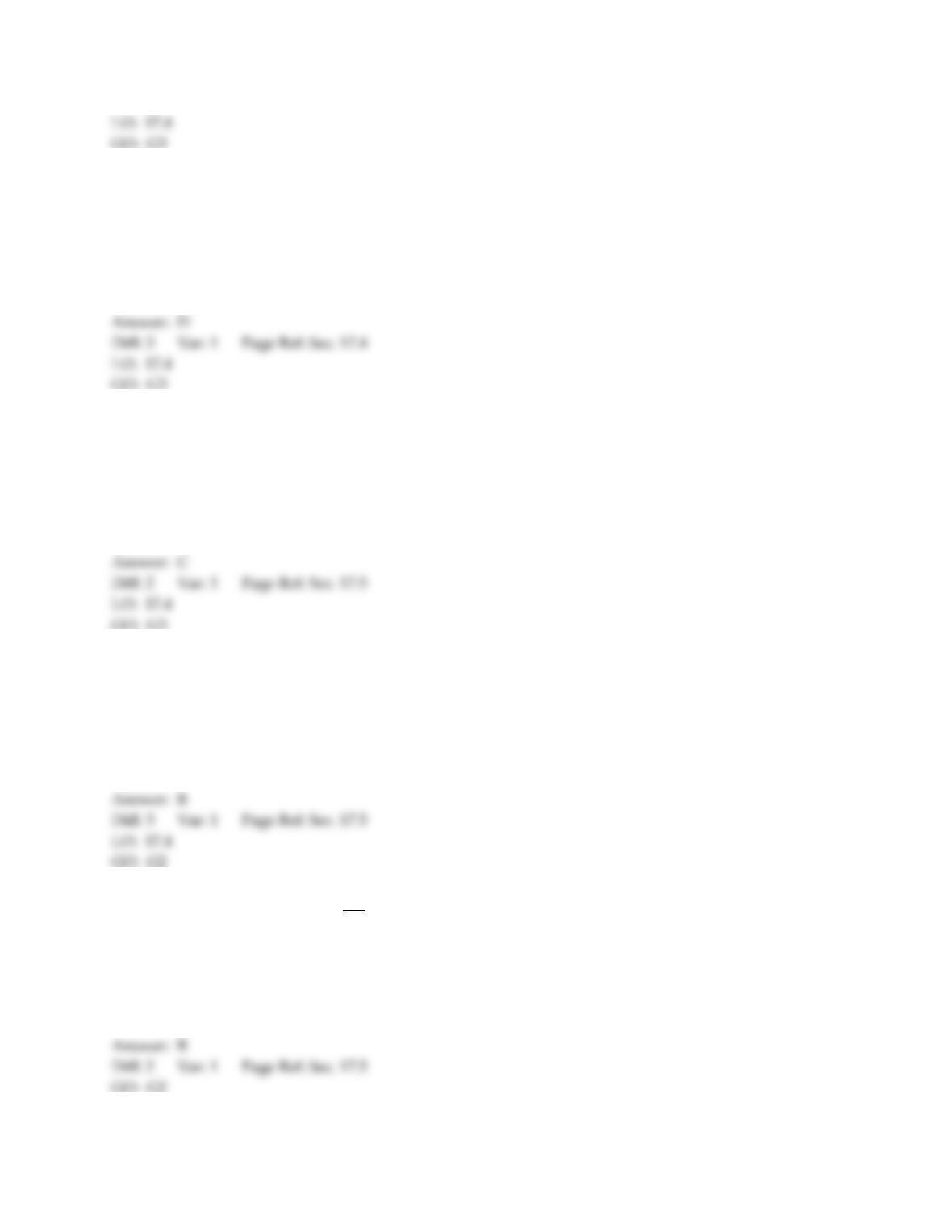
Consider the following table of values.
26) Which compound listed below has the greatest molar solubility in water?
A) CdCO3
B) Cd(OH)2
C) AgI
D) CaF2
E) ZnCO3
8
27) Which compound listed below has the smallest molar solubility in water?
A) ZnCO3
B) Cd(OH)2
C) CdCO3
D) AgI
E) CaF2
28) The molar solubility of ________ is not affected by the pH of the solution.
A) Na3PO4
B) NaF
C) KNO3
D) AlCl3
E) MnS
29) In which one of the following solutions is silver chloride the most soluble?
A) 0.181 M HCl
B) 0.0176 M NH3
C) 0.744 M LiNO3
D) pure water
E) 0.181 M NaCl
30) Which one of the following is not amphoteric?
A) Al(OH)3
B) Ca(OH)2
C) Cr(OH)3
D) Zn(OH)2
E) Sn(OH)2
31) For which salt should the aqueous solubility be most sensitive to pH?
9
A) Ca(NO3)2
B) CaF2
C) CaCl2
D) CaBr2
E) CaI2
32) Which below best describe(s) the behavior of an amphoteric hydroxide in water?
A) With conc. aq. NaOH, its suspension dissolves.
B) With conc. aq. HCl, its suspension dissolves.
C) With conc. aq. NaOH, its clear solution forms a precipitate.
D) With conc. aq. HCl, its clear solution forms a precipitate.
E) With both conc. aq. NaOH and conc. aq. HCl, its suspension dissolves.
33) Why does fluoride treatment render teeth more resistant to decay?
A) Fluoride kills the bacteria in the mouth that make the acids that decay teeth.
B) Fluoride stimulates production of tooth enamel to replace that lost to decay.
C) Fluoride reduces saliva production, keeping teeth drier and thus reducing decay.
D) Fluoride converts hydroxyapatite to fluoroapatite that is less reactive with acids.
E) Fluoride dissolves plaque, reducing its decaying contact with teeth.
34) A result of the common-ion effect is ________.
A) that some ions, such as Na+ (aq), frequently appear in solutions but do not participate in solubility
equilibria
B) that common ions, such as Na+ (aq), don’t affect equilibrium constants
C) that the selective precipitation of a metal ion, such as Ag+, is promoted by the addition of an
appropriate counterion (X–) that produces a compound (AgX) with a very low solubility
D) that ions such as K+ and Na+ are common ions, so that their values in equilibrium constant
expressions are always 1.00
E) that common ions precipitate all counter-ions
17.2 Bimodal Questions
1) The Ka of benzoic acid is 6.30 × 10⁻⁵. The pH of a buffer prepared by combining 50.0 mL of 1.00 M
potassium benzoate and 50.0 mL of 1.00 M benzoic acid is ________.
10
A) 1.705
B) 0.851
C) 3.406
D) 4.201
E) 2.383
2) Calculate the pH of a solution prepared by dissolving 0.150 mol of benzoic acid and 0.300 mol of
sodium benzoate in water sufficient to yield 1.00 L of solution. The Ka of benzoic acid is 6.30 × 10⁻⁵.
A) 2.516
B) 3.892
C) 4.502
D) 10.158
E) 4.195
3) Calculate the pH of a solution prepared by dissolving 0.150 mol of acetic acid and 0.300 mol of sodium
acetate in water sufficient to yield 1.00 L of solution. The Ka of acetic acid is 1.76 × 10⁻⁵.
A) 2.516
B) 3.892
C) 4.502
D) 10.158
E) 5.056
4) The pH of a solution prepared by dissolving 0.350 mol of solid methylamine hydrochloride
(CH3NH3Cl) in 1.00 L of 1.10 M methylamine (CH3NH2) is ________. The Kb for methylamine is
4.40 × 10⁻⁴. (Assume the final volume is 1.00 L.)
A) 1.66
B) 2.86
C) 10.28
D) 11.14
E) 10.61
5) The pH of a solution prepared by dissolving 0.350 mol of solid dimethylamine hydrochloride
((CH3)2NH2Cl) in 1.00 L of 1.10 M dimethylamine ((CH3)2NH) is ________. The Kb for methylamine is
5.40 × 10⁻⁴. (Assume the final volume is 1.00 L.)
A) 1.66
B) 2.77
C) 11.23
D) 11.14
E) none of the above
6) A 25.0 mL sample of 0.723 M HClO4 is titrated with a 0.27 M KOH solution. The H3O+ concentration
after the addition of 80.0 mL of KOH is ________ M.
A) 0.4
B) 1 × 10⁻⁷
C) 0.7
D) 3 × 10–13
E) 4 × 10⁻²
7) The pH of a solution prepared by mixing 50.0 mL of 0.125 M KOH and 50.0 mL of 0.125 M HCl is
________.
A) 6.29
B) 7.00
C) 8.11
D) 5.78
E) 0.00
8) The pH of a solution prepared by mixing 40.0 mL of 0.125 M Mg(OH)2 and 150.0 mL of 0.125 M HCl is
________.
A) 6.29
B) 4.11
C) 1.14
D) 5.78
E) 1.34
9) The pH of a solution prepared by mixing 50.0 mL of 0.125 M NaOH and 40.0 mL of 0.125 M HNO3 is
________.
A) 13.29
B) 7.00
C) 8.11
D) 11.00
E) 12.14
10) A 50.0 mL sample of an aqueous H2SO4 solution is titrated with a 0.375 M NaOH solution. The
equivalence point is reached with 62.5 mL of the base. The concentration of H2SO4 is ________ M.
A) 0.234
B) 0.469
C) 0.150
D) 0.300
E) 0.938
11) The concentration of iodide ions in a saturated solution of lead (II) iodide is ________ M. The
solubility product constant of PbI2 is 1.4 × 10⁻⁸.
A) 3.8 × 10⁻⁴
B) 3.0 × 10⁻³
C) 1.5 × 10⁻³
D) 3.5 × 10⁻⁹
E) 1.4 × 10⁻⁸
12) The concentration of fluoride ions in a saturated solution of barium fluoride is ________ M. The
solubility product constant of BaF2 is 1.7 × 10⁻⁶.
A) 3.8 × 10⁻⁴
B) 3.0 × 10⁻³
C) 1.5 × 10⁻²
D) 7.5 × 10⁻³
E) 1.4 × 10⁻⁴
13) The concentration of iodide ions in a saturated solution of silver iodide is ________ M. The solubility
product constant of AgI is 8.3 × 10⁻¹⁷.
A) 3.8 × 10⁻¹¹
B) 3.0 × 10⁻¹⁰
C) 9.1 × 10⁻⁹
D) 3.5 × 10⁻⁹
E) 1.4 × 10⁻⁸
14) The solubility of lead (II) chloride (PbCl2) is 1.6 × 10⁻² M. What is the Ksp of PbCl2?
A) 5.0 × 10⁻⁴
B) 4.1 × 10⁻⁶
C) 3.1 × 10⁻⁷
D) 1.6 × 10⁻⁵
E) 1.6 × 10⁻²
15) The solubility of manganese (II) hydroxide (Mn(OH)2) is 2.2 × 10⁻⁵ M. What is the Ksp of Mn(OH)2?
A) 1.1 × 10⁻¹⁴
B) 4.3 × 10⁻¹⁴
C) 2.1 × 10⁻¹⁴
D) 4.8 × 10⁻¹⁰
E) 2.2 × 10⁻⁵
16) Determine the Ksp for magnesium hydroxide (Mg(OH)2) where the solubility of Mg(OH)2 is
1.4 × 10⁻⁴ M.
A) 2.7 × 10⁻¹²
B) 1.1 × 10⁻¹¹
C) 2.0 × 10⁻⁸
D) 3.9 × 10⁻⁸
E) 1.4 × 10⁻⁴
14
17) Calculate the maximum concentration (in M) of silver ions (Ag+) in a solution that contains 0.025 M of
CO32-. The Ksp of Ag2CO3 is 8.1 × 10⁻¹².
A) 1.8 × 10⁻⁵
B) 1.4 × 10⁻⁶
C) 2.8 × 10⁻⁶
D) 3.2 × 10⁻¹⁰
E) 8.1 × 10⁻¹²
18) Calculate the maximum concentration (in M) of magnesium ions (Mg+2) in a solution that contains
0.025 M of CO32-. The Ksp of MgCO3 is 3.5 × 10⁻⁸.
A) 1.8 × 10⁻⁵
B) 1.4 × 10⁻⁶
C) 2.8 × 10⁻⁶
D) 3.2 × 10⁻¹⁰
E) 8.1 × 10⁻¹²
19) What is the solubility (in M) of PbCl2 in a 0.15 M solution of HCl? The Ksp of PbCl2 is 1.6 × 10⁻⁵.
A) 2.0 × 10⁻³
B) 1.1 × 10⁻⁴
C) 1.8 × 10⁻⁴
D) 7.1 × 10⁻⁴
E) 1.6 × 10⁻⁵
20) The Ksp for Zn(OH)2 is 5.0 × 10⁻¹⁷. Determine the molar solubility of Zn(OH)2 in a buffer solution
with a pH of 11.5.
A) 5.0 × 10⁶
B) 1.2 × 10⁻¹²
C) 1.6 × 10⁻¹⁴
D) 5.0 × 10⁻¹²
E) 5.0 × 10⁻¹⁷
17.3 Algorithmic Questions
1) Calculate the pH of a solution that is 0.278 M in sodium formate (NaHCO2) and 0.222 M in formic acid
(HCO2H). The Ka of formic acid is 1.77 × 10⁻⁴.
A) 3.843
B) 3.647
C) 13.90
D) 10.16
E) 4.954
2) Calculate the percent ionization of formic acid (HCO2H) in a solution that is 0.322 M in formic acid and
0.178 M in sodium formate (NaHCO2). The Ka of formic acid is 1.77 × 10⁻⁴.
A) 35.6
B) 0.1011
C) 10.8
D) 1.03 × 10⁻³
E) 3.488
3) Calculate the percent ionization of formic acid (HCO2H) in a solution that is 0.152 M in formic acid.
The Ka of formic acid is 1.77 × 10⁻⁴.
A) 2.74 × 10⁻⁵
B) 0.0180
C) 3.44
D) 0.581
E) 8.44
4) Calculate the pH of a solution that is 0.322 M in nitrous acid (HNO2) and 0.178 M in potassium nitrite