ch17 Key
1. A flexible budget is a budget that is valid within the firm’s relevant range of activity.
2. The variable-overhead efficiency variance measures the cost of variable overhead cost driver.
3. Activity levels in the flexible budget are based on output measures.
4. In a multiproduct firm, units of output usually are not a meaningful measure because one would have to add
numbers of unlike units.
5. The activity-based budget provides a less accurate benchmark against which to compare actual costs.
6. In a standard costing system, overhead application refers to the addition of actual overhead cost to the
Work-in-Process inventory as a product cost.
7. Variable-overhead cost and the activity measure for the flexible budget should move together as overall
productive activity changes.
8. The flexible overhead budget is the cost manager’s primary tool for the control of manufacturing–overhead
costs under traditional cost management techniques.
9. Sales variance analysis attempts to explain the difference between actual sales performance and budgeted
sales performance by focusing on several factors that underlie overall sales results.
10. The sales–volume variance can be broken down into the revenue sales–mix variance and the revenue
sales–quantity variance.
11. The individual products‘ mix variance components convey a meaningful interpretation for management’s
analysis.
12. A flexible budget is not based on only one level of activity.
13. The variable-overhead spending variance is the real control variance for variable overhead.
14. Budgeted fixed overhead is the basis for controlling fixed overhead because it provides the benchmark
against which actual expenditures are compared.
15. Total budgeted monthly overhead cost can be determined by means of the following formula: (budgeted
variable-overhead cost per unit x total activity units) + budgeted fixed-overhead cost per month.
16. The real cost of underutilizing productive capacity is due to the lost contribution margins of the products
that are not produced when capacity is underutilized.
17. The overhead cost performance report includes the spending and efficiency variances for variable items and
the budget and volume variances for fixed items.
18. In a conventional flexible budget only one cost driver is used while several cost drivers are used in an
activity-based flexible budget.
19. Standard cost variances are automatically closed to Cost of Goods Sold at the end of each month.
20. An activity base or cost driver applies factory overhead to products.
21. Overhead application can use standard costing to apply the overhead to work in process.
22. An unexpected increase in property taxes on the plant could cause a fixed-overhead budget variance.
23. A company based its fixed overhead cost allocation upon the production of 1,000,000 units, but actually
produced 900,000 units. The company should expect a positive or unfavorable fixed-overhead volume
variance.
24. If a cost is fixed with respect to a single volume-based cost driver, it must always be fixed.
25. [Appendix A] Proration of variances recognizes that underestimation or overestimation of production costs
affects Cost of Goods Sold, Work–in-Process inventory and Finished Goods inventory.
26. [Appendix A] The amount of the current period’s standard cost remaining in Work-in-Process Inventory,
Finished Goods Inventory, and Cost of Goods Sold is the basis for the variance proration procedures.
27. [Appendix B] Under standard backflush costing all standard costs are initially charged to Cost of Goods
Sold and, if any inventories exist at the end of the period, a portion of the current period standard costs
originally charged to Cost of Goods Sold is transferred to the respective inventory accounts as an end–of-period
adjustment.
28. [Appendix B] Variances occurring in a standard backflush cost system are charged to a separate account as
incurred and, if immaterial, are not prorated to inventories or, if material, they are prorated in the same manner
as under a traditional standard cost system.
29. The revenue budget variance can be broken down into the sales-price variance and the revenue-sales volume
variance.
Use the following to answer questions 30-31:
Riyyad Co. produces its only product in a highly automated process, expected monthly production is 50,000
units. The required direct material costs $0.85 per unit. Manufacturing overhead costs are $75,000 per month
and are allocated based on units of production.
Hilton – Chapter 17
30. What is the budgeted manufacturing overhead rate?
31. What is the total flexible budget for 50,000 units and 25,000 units, respectively?
Use the following to answer questions 32-33:
The traceable fixed and variable costs of the purchasing activity center are $260,000. An analysis of the center’s
cost behavior showed a fixed cost of $100,000 and the appropriate cost driver to be the number of lines inputted.
The total number of lines inputted is 2,000,000.
Hilton – Chapter 17
32. What is the overhead cost function for this activity center?
33. What would the total flexible overhead budget if the number of lines decreased to 1,800,000?
Use the following to answer questions 34-35:
Henendez Co. collects its fixed overhead into a single cost pool. The budget for April was $600,000 and
$775,000 was actually spent. April production was 15,000 units with actual machine hours of 12,000. Budgeted
production for April was 12,000 units using 14,000 machine hours.
Hilton – Chapter 17
34. What is the budgeted fixed overhead rate per output unit (round to nearest dollar)?
35. What is budgeted fixed overhead rate per unit of input (round to nearest dollar)?
36. Doyle Company uses machine hours to allocate variable manufacturing overhead to its product. The
expected production for the coming period is 500 batches using 500 machine hours. The existing machine uses
12 KWH per machine hour at a cost of $8 per KWH. The company is considering purchasing a new machine
that will use only 9 KWH per machine hour. Using the variable overhead spending and efficiency variances,
how much would the company be willing to pay for this new machine?
37. The _____measures the differences between the actual amount of variable overhead incurred and the actual
quantity of variable overhead at the budgeted amount.
38. When preparing a flexible budget, ______remain the same regardless of the output levels as long as the
company is producing within the relevant range.
39. XYZ Corp. produced 26,000 units of its only product. Machine hours per unit are 2.8. The budget planned
for 23,000 units. What are the budgeted machine hours and the flexible-budget machine hours, respectively?
40. Which of the following is not a step in the preparation of a flexible budget?
Use the following to answer questions 41-42:
Grachev Co. manufactures hedge clippers, its only product. The following information relates to the company’s
manufacturing overhead
for an output of 20,000 clippers:
Hilton – Chapter 17
41. What is the variable manufacturing overhead static budget variance (i.e. a flexible budget is not used)?
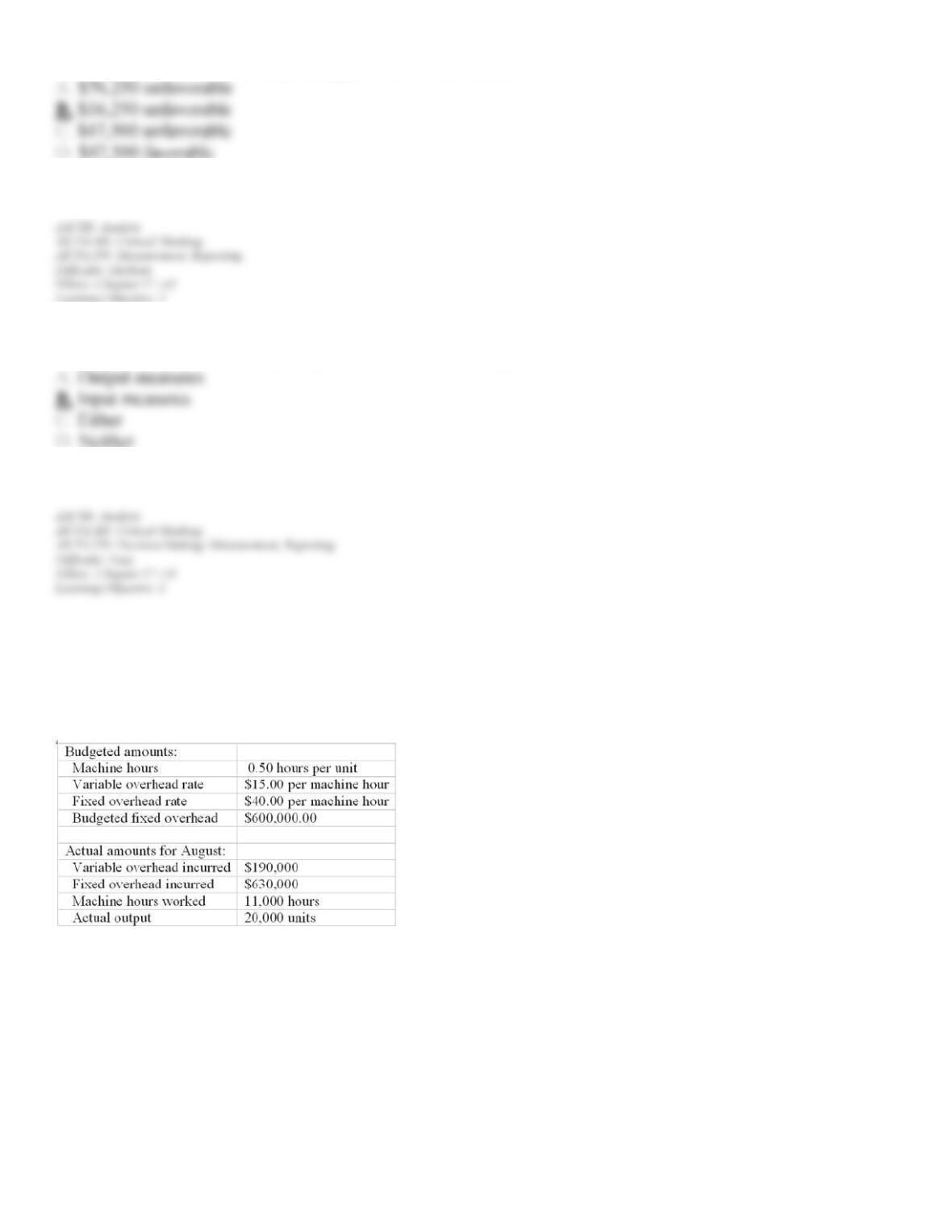
42. What is the variable manufacturing overhead total variance?
43. In a multi-product firm, activity levels for a flexible budget are based on
Use the following to answer questions 44-48:
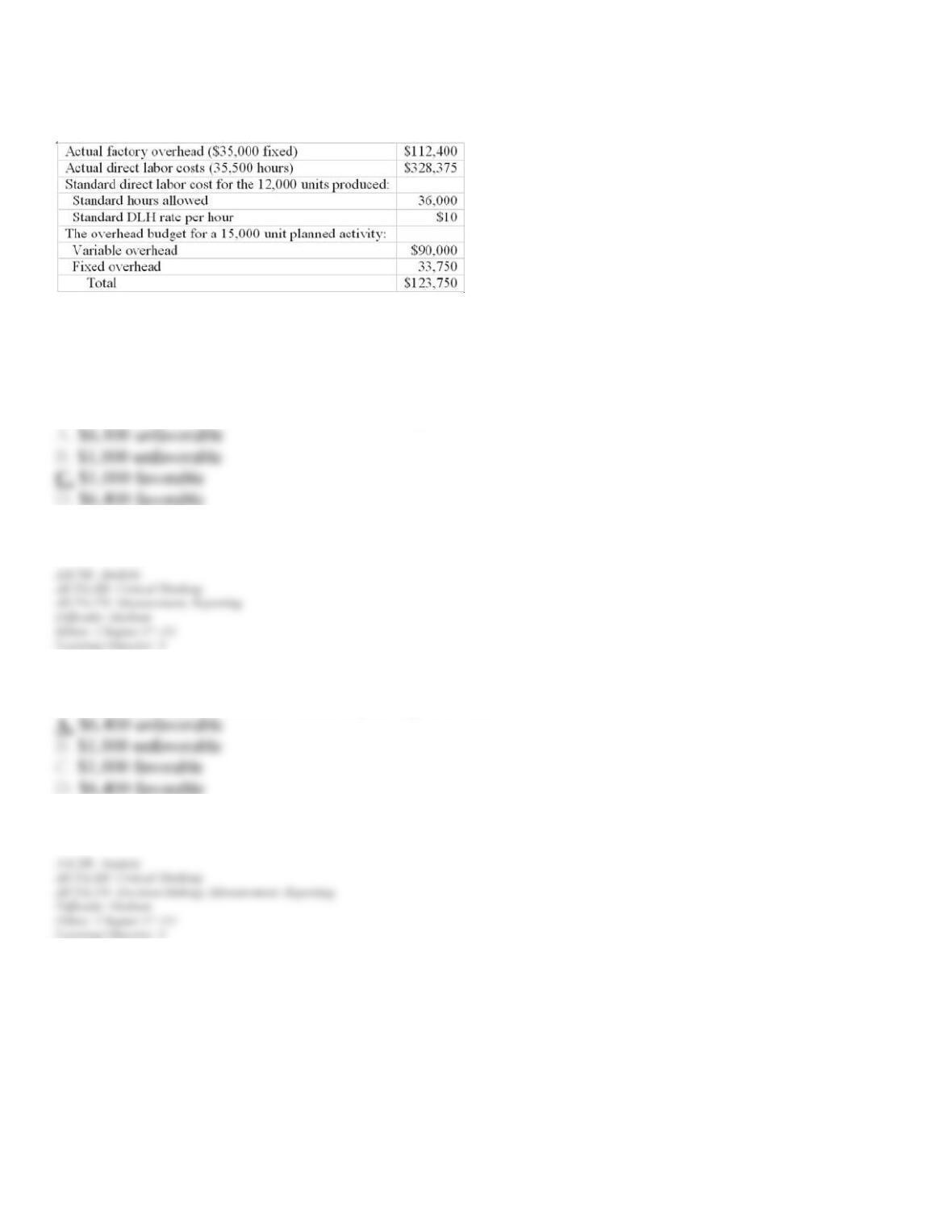
Controller Rachel Tabak of Johnson Inc. is in the process of analyzing its manufacturing overhead costs for
March. March results follow:
Budgeted machine hours per unit are used to allocate variable and fixed manufacturing overhead and a four-way
variance analysis is used
Hilton – Chapter 17
44. What is the variable overhead spending variance?
45. What are the variable overhead efficiency and variable volume variance, respectively?
46. What is the fixed overhead budget variance?
47. What are the fixed overhead efficiency and volume variances, respectively?
48. Which of the following journal entries is correct for recording actual variable overhead costs when
incurred?
Use the following to answer questions 49-51:
Arco Inc.’s fixed overhead budget is $400,000; the standard fixed overhead rate is $5 per direct labor hour or
$10 per unit of product. During the immediate past year Arco produced 45,000 units of product, incurred
$385,000 of fixed overhead, and used 82,500 direct labor hours.
Hilton – Chapter 17
49. How much is Arco’s fixed overhead budget variance?
50. What is the budgeted activity level on which Arco based its fixed overhead rate?
51. How much is Arco‘s fixed overhead volume variance?
52. Which of the following statements about flexible budgets is not true?
Use the following to answer questions 53-55:
Tillinghuisen Inc. uses a standard cost system. Last year’s records showed the following information:
Hilton – Chapter 17
53. How much is the variable overhead efficiency variance?
54. How much is the variable overhead spending variance?
55. How much is the fixed overhead volume variance?
56. If applied fixed manufacturing overhead was $156,100 and there was a $3,900 favorable budget variance
and a $3,000 unfavorable volume variance, budgeted fixed manufacturing overhead must have been:
57. Fixed factory overhead was budgeted at $350,000 and 50,000 machine hours. If the fixed overhead volume
variance was $5,000 unfavorable and the budget variance was $4,000 favorable, fixed overhead applied must
have been:
58. A primary difference between overhead costs in manufacturing companies and non–manufacturing
companies is that
59. Which of the following variances would not be included in an Overhead Cost Performance Report?
60. An overhead cost performance report shows which of the following items?
61. Which of the following statements about activity-based flexible budgeting are true?
62. Which of the following statements about activity measures is false?
Use the following to answer questions 63-66:
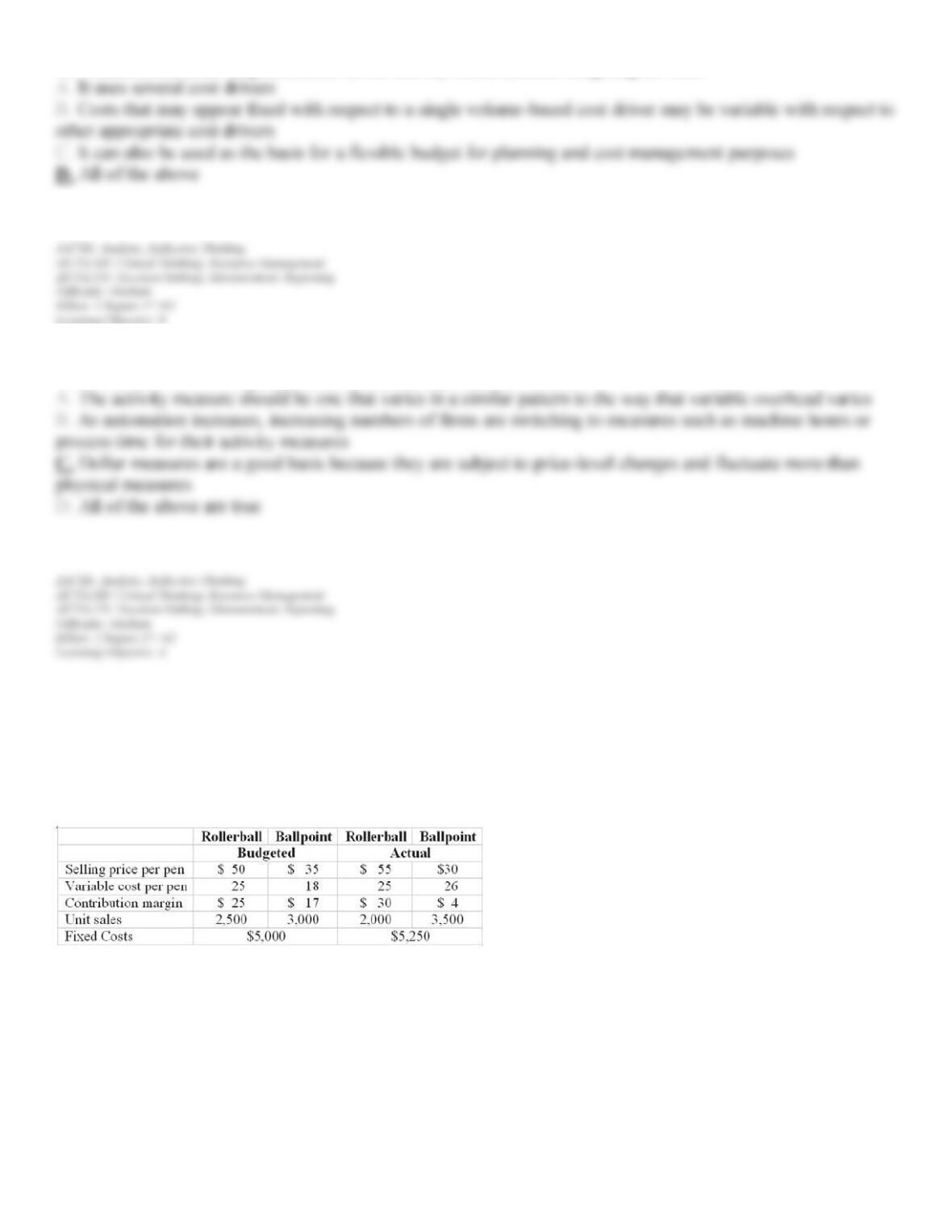
The WriteAll Company sells two types of pens – rollerball and ballpoint – to specialty retailers. The company
budgets by month in order to anticipate the peak demands occurring at various times during the year. The
following information is available for July.
Hilton – Chapter 17