CHAPTER 17
Interpreting Norm-Referenced Scores
ITEMS
1. On a spelling test taken by a class of 40 pupils, Melissa got 90. How well did Melissa perform?
(a) Melissa’s performance is good.
(b) Melissa’s performance is average.
(c) Melissa’s performance is above average.
(d) Now enough information is given to answer this question.
2. Which of the following describes a derived score?
(a) A number telling the percentage of test items a student got correct.
(b) A number telling the percentage of students performing above a particular obtained score in a
group.
(c) A number telling the grade level corresponding to a student’s performance on a test.
(d) All of the above are derived scores.
3. Classroom teachers can use derived scores to describe their students’ performance when they want
to
(a) compare student’s achievement with the total domain to be learned.
(b) compare students’ positions within the group.
(c) Both (a) and (b)
4. If the teacher wants to select the best students in reading comprehension in her class, the norm-
referencing framework is the only appropriate framework to use.
(a) True
(b) False
5. Which of the following is a criterion-referenced interpretation?
(a) Brenda’s score is higher than eighty-five percent of her classmates’ scores.
(b) Matilda can spell eighty-five percent of the words in her spelling book.
(c) Tanya’s grade equivalent is 8.2.
(d) John’s raw score is 14 on the Vocabulary test.
(e) Both (b) and (d) are criterion-referenced interpretations.
6. Which of the following must a teacher do to make a valid interpretation of a student’s assessment
performance?
(a) Relate the student’s performance to the domain of learning objectives the assessment
sampled.
(b) Compare the student’s performance with the performance of other students who took the
same assessment.
(c) Both (a) and (b) are necessary for making valid interpretations.
(d) Neither (a) nor (b) are necessary for making valid interpretation.
7. Which of the following is NOT used for criterion-referenced scores?
(a) Percentage of points earned
(b) Grade-equivalent of the test performance
(c) Speed of performance
(d) Precision of performance
8. Which of the following is a necessary condition for a highly valid criterion-referenced
interpretation of test scores?
(a) A large number of items should be written to assess any one learning objective.
(b) The test range should cover a broad range of learning objectives.
(c) The test items should sample a well-defined domain of learning objectives.
(d) The test items should be familiar to the students.
9. Standardized tests’ norms are quality standards against which a school can judge how well its
students are learning.
(a) True
(b) False
10. It is acceptable to use two different publishers’ national norms interchangeably because their large
norm-samples overlap quite a bit.
(a) True
(b) False
11. Why should local norms always be used in addition to national norms when making norm-
referenced interpretations of standardized test scores?
(a) Local norms provide a clear educational standard.
(b) Local norms measure educational growth more accurately.
(c) Local norms contain students with the same educational background and community
experience.
(d) All of the above.

12. A teacher wants to use a norm-referencing framework to interpret Ashley’s standardized test score.
Ashley is a sixth-grade student in a high socioeconomic status community in the Northeast. Which
of the following norm groups should the teacher give the first priority for interpreting Ashley’s
score?
(a) National norms representing sixth grade students in schools of all sizes and from all
geographic locations.
(b) Regional norms representing sixth grade students in large urban schools in the Northeast.
(c) Regional norms representing sixth grade students in private and higher socioeconomic
schools in the Northeast.
(d) Local norms representing only sixth grade students in Ashley’s community.
Question 13 refers to the information below.
A school principal wants to compare her school building’s sixth grade students’
average standardized test scores in each subject area with those of other school
buildings. She accurately calculates the average scores but erroneously looks them
up in the individual student norms tables instead of the school averages norms tables.
She find that the averages are near the 75th percentile in all subjects.
13. Suppose the principal had looked up the averages properly in the school averages norm table. What
would the results show?
(a) Her school averages would rank lower than the 75th percentile.
(b) Her school averages would rank the same.
(c) Her school averages would rank higher than the 75th percentile.
(b) We cannot determine how the results will compare to the 75th percentile because we do not
have the school averages norms tables.
14. A standardized test was standardized between March 10th and March 24th. Assume that your
school cannot test in March. On which of the following dates would it be best to schedule your
school’s testing in order to provide the most accurate estimate of a student’s standing in the norm
group?
(a) Third week in January
(b) Third week in February
(c) Fourth week in April
(d) First week in May
15. Norms with large sample sizes are always representative of the population.
(a) True
(b) False
16. Failure to ensure recency of norms usually results in lower student scores in relation to the norms.
(a) True
(b) False
17. What does a percentile rank of 75 mean?
(a) 75% of the items were answered correctly by the student.
(b) 75% of the group tested had the same score as the student.
(c) 75% of the group tested did better than the student.
(d) 75% of the group tested did poorer than the student.
18. Which of the following is a property of percentile ranks?
(a) They can be used to determine what content or skills a student is deficient in.
(b) They describe the level of learning a student has achieved.
(c) They allow comparison of students’ performance.
19. What do we mean when we say a publisher’s norms are relevant?
(a) They adequately sample the population the publisher claims.
(b) They are not out-dated.
(c) They match the curriculum.
(d) They comprise a group to which you want to compare your students.
20. Which of the following types of scores is BEST to use to explain a student’s strengths or
weaknesses across different curriculum areas to parents?
(a) Percent of items correct on tests from the different areas
(b) Percentile ranks in the norm group on tests from the different areas
(c) Standard scores in the norm group on tests from the different areas
(d) Grade-equivalent scores in the norm group on tests from the different areas
21. Which of the following types of scores would be best to use to explain to parents how well a
student has achieved the learning objectives in a particular curriculum area?
(a) Percent correct on clusters of items assessing the learning objectives
(b) Speed of performance in completing the test items
(c) Grade-equivalent score in the norm group on the test
(d) Percentile rank in the norm group on the test
22. What type of scores would be best to use to explain to parents a child’s growth in learning in a
particular curriculum area?
(a) Raw scores on tests in the area over the past few years
(b) Percent correct scores on tests in the area over the past few years
(c) Percentile ranks on tests in the area over the past few years
(d) Grade-equivalent scores on tests in the area over the past few years
23. A standardized test has a mean of 40 and a standard deviation of 10. Ashley’s percentile rank is 45
while Sophia’s is 50. Bill’s percentile rank is 50 while Chad’s is 55. Blake’s percentile ranks is 90
while Jesse’s is 95. For which pair of students is the difference in raw scores likely to be largest?
(a) Ashley vs. Sophia
(b) Bill vs. Chad
(c) Blake vs. Jesse
(d) None. The difference in raw scores is likely to be the same for each pair.
24. A standardized test reports results in terms of T-scores. Joan obtains a T-score of 50 and her
parents do not understand the score. What is the proper way to interpret this score?
(a) Joan’s performance is near the bottom of the group.
(b) Joan’s performance is equal to the group’s average.
(c) Joan’s performance is in great need of improvement.
(d) Joan has mastered 50% of the material.
25. Anthony obtained a score of 75 on a test which has a standard deviation of 5 and a mean of 70.
What is his SS-score?
(a) 40
(b) 60
(c) 70
(d) 75
26. The norm data reported in a test manual cannot have a normal distribution unless students’ raw
scores naturally have a normal distribution.
(a) True
(b) False
27. What is the percentile rank of a student whose T-score is 60?
(a) PR = 50
(b) PR = 60
(c) PR = 84
(d) PR = 93
28. SS-scores have the same percentile rank interpretations as T-scores.
(a) True
(b) False
29. Which of the following is considered to be a disadvantage when using stanines to interpret scores?
(a) They are not equally distributed along the x-axis.
(b) They do not precisely pinpoint a student’s position in a group.
(c) They are not useful for norm-referenced interpretations.
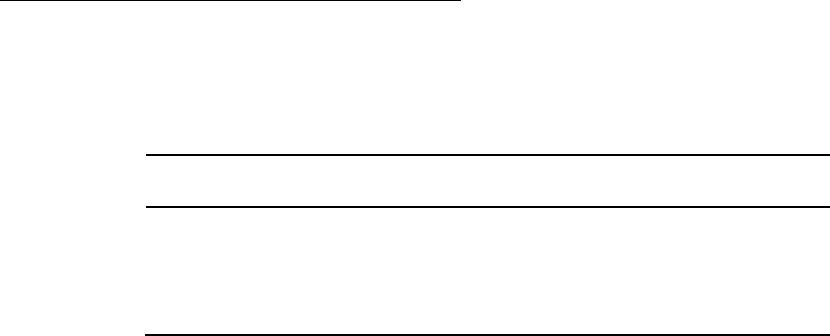
Questions 30, 31, 32, and 33 refer to the table below
Below is a section of a norm-table for a fifth grade standardized achievement test. The
table shows raw scores, grade-equivalents (GE), and percentile ranks (PR). Assume the
test matches the fifth grade school curriculum, norms were developed in March, and the
local fifth grade students were tested in March.
Raw
Vocabulary
Reading
Language
Arithmetic
Score
GE
PR
GE
PR
GE
PR
GE
PR
20
4.8
43
4.6
40
5.0
30
5.0
43
30
5.7
50
5.0
45
5.7
52
5.6
51
40
7.1
73
5.6
51
7.2
72
6.1
72
50
8.0
84
6.2
74
8.1
81
7.1
91
70
8.7
95
7.1
90
9.3
94
8.3
98
30. Alice’s Reading raw score is 40. This suggests that she is an average fifth grade reader.
(a) True
(b) False
31. Sue’s raw scores are Vocabulary = 30, Reading = 40, Language = 30, and Arithmetic = 30. This
means she is more able in reading than in the other subjects.
(a) True
(b) False
32. James’s grade-equivalent profile is:
Vocabulary = 7.1, Reading = 6.2, Language = 7.2, and Arithmetic = 6.1.
This means that his weak areas are Reading and Language.
(a) True
(b) False
33. Joan’s grade-equivalent scores in Reading and Language are both equal to 5.0. Therefore, Joan is
equally able in these two subjects.
(a) True
(b) False
34. Bryce’s Arithmetic grade-equivalent is 7.1. This means he knows arithmetic as well as a seventh
grader in the first month of school.
(a) True
(b) False
35. Half of a school’s sixth graders have grade-equivalent scores below their grade placement. This
means that instructional quality in this school is generally poor.
(a) True
(b) False
36. Harry’s grade-equivalent score is 3.3. This means that he has mastered three tenths of the third
grade curriculum.
(a) True
(b) False
37. A student who obtained a percentile rank of 50 in grade three social studies and obtained the same
percentile rank in grade four social studies has not shown any educational growth.
(a) True
(b) False
38. Which of the following is BEST for monitoring a student’s educational development over time.
(a) Grade-equivalent Scores (G-Es)
(b) Percentile Ranks (PR)
(c) Stanines
(d) SS-scores
(e) T-scores
39. Which of the following would be the LEAST appropriate classroom use of standardized test
results?
(a) Identifying students’ strengths and weaknesses
(b) Ranking students in terms of national norms
(c) Confirming information about achievement obtained through other assessments
(d) Understanding the achievement of the class as a whole
40. States are said to use a standards-referenced framework when they align state test items with state
standards and set the performance levels that qualify as “basic,” “proficient,” and so on. Why is
this not simply an example of “criterion–referencing”?
(a) Student performance data is used in the standard-setting process.
(b) Items must be matched to the state standards one at a time.
(c) The ability level of typical students in each grade helps determine item difficulty.
CHAPTER 17
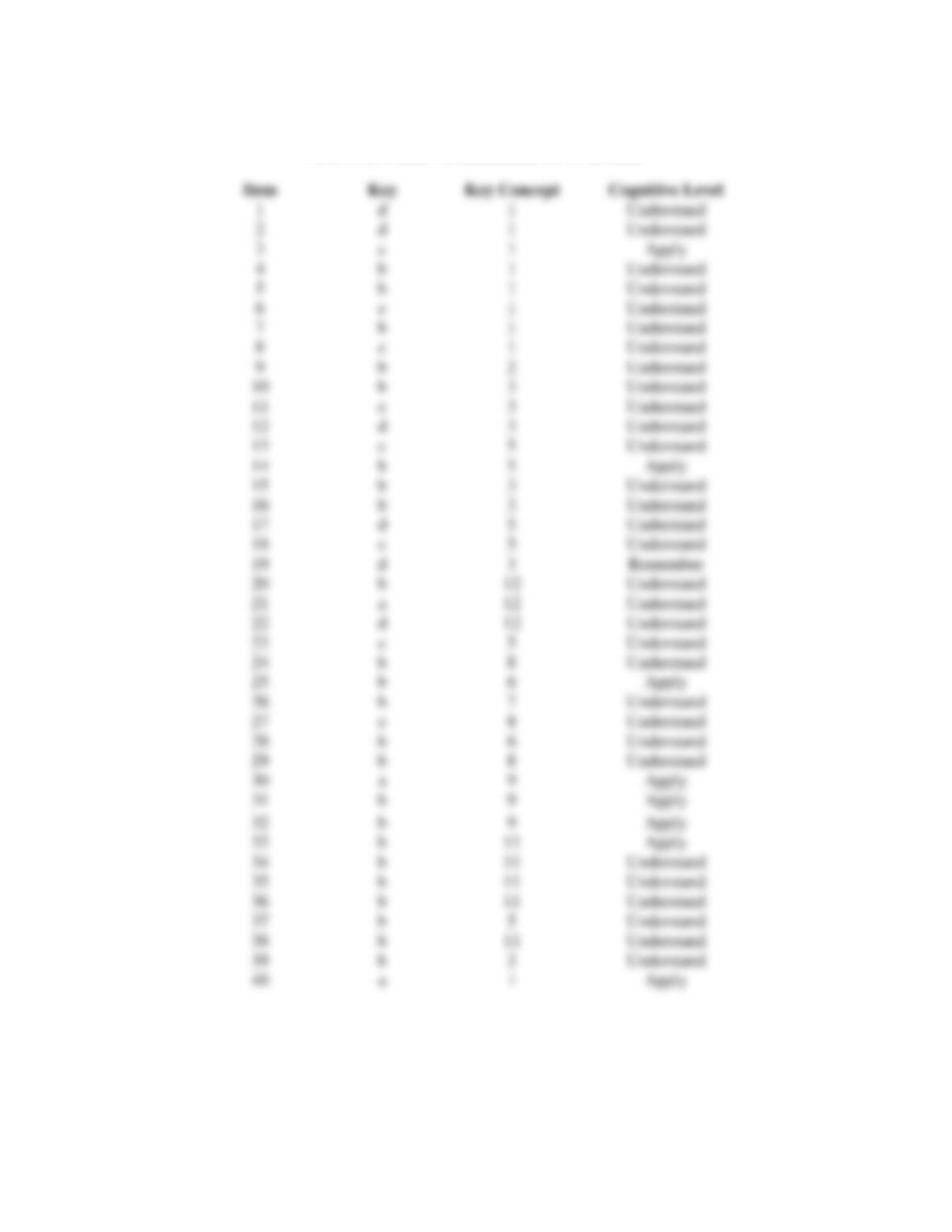
Answers and Classification of Items