College Physics: A Strategic Approach, 3e (Knight)
Chapter 17 Wave Optics
17.1 Conceptual Questions
1) A light beam has speed c in vacuum and speed v in a certain plastic. The index of refraction n
of this plastic is
A) n = cv.
B) n = (v/c)2.
C) n = v/c.
D) n = c/v.
E) n = (c/v)2.
2) If the index of refraction of a material is 2, this means that light travels
A) 2 times as fast in air as it does in vacuum.
B) 2 times as fast in the material as it does in air.
C) 2 times as fast in vacuum as it does in the material.
D) 2 times as fast in the material than it does in vacuum.
E) 1/2 as fast in air as it does in the material.
3) When light travels from air into water,
A) its velocity, wavelength and frequency all change.
B) its velocity changes, but its frequency and wavelength do not change.
C) its frequency changes, but its velocity and wavelength do not change.
D) its velocity and wavelength change, but its frequency does not change.
E) its wavelength changes, but its velocity and frequency do not change.
4) Monochromatic coherent light shines through a pair of slits. If the distance between these slits
is decreased, which of the following statements are true of the resulting interference pattern?
(There could be more than one correct choice.)
A) The distance between the maxima stays the same.
B) The distance between the maxima decreases.
C) The distance between the minima stays the same.
D) The distance between the minima increases.
E) The distance between the maxima increases.
5) Monochromatic coherent light shines through a pair of slits. If the wavelength of the light is
decreased, which of the following statements are true of the resulting interference pattern?
(There could be more than one correct choice.)
A) The distance between the maxima stays the same.
B) The distance between the maxima decreases.
C) The distance between the minima stays the same.
D) The distance between the minima increases.
E) The distance between the minima decreases.
6) A double-slit interference experiment is performed in the air. Later, the same apparatus is
immersed in benzene (which has an index of refraction of 1.50), and the experiment is repeated.
When the apparatus is in benzene, you observe that the interference fringes are
A) more closely spaced than when the apparatus is in air.
B) equally spaced as when the apparatus is in air.
C) more widely spaced than when the apparatus is in air.
7) In a double-slit interference experiment you are asked to use laser light of different
wavelengths and determine the separation between adjacent maxima. You observe that this
separation is greatest when you illuminate the double slit with
A) blue light.
B) green light.
C) yellow light.
D) red light.
E) The separation is the same for all wavelengths.
8) Two light sources are said to be coherent if they are
A) of the same frequency.
B) of the same frequency, and maintain a constant phase difference.
C) of the same amplitude, and maintain a constant phase difference.
D) of the same frequency and amplitude.
9) What do we mean when we say that two light rays striking a screen are in phase with each
other?
A) When the electric field due to one is a maximum, the electric field due to the other is also a
maximum, and this relation is maintained as time passes.
B) They are traveling at the same speed.
C) They have the same wavelength.
D) They alternately reinforce and cancel each other.
10) Two beams of coherent light start out at the same point in phase and travel different paths to
arrive at point P. If the maximum constructive interference is to occur at point P, the two beams
must travel paths that differ by
A) a whole number of wavelengths.
B) an odd number of half-wavelengths.
C) a whole number of half-wavelengths.
11) Two beams of coherent light start out at the same point in phase and travel different paths to
arrive at point P. If the maximum destructive interference is to occur at point P, the two beams
must travel paths that differ by
A) a whole number of wavelengths.
B) an odd number of half-wavelengths.
C) a whole number of half-wavelengths.
12) If a sheet containing two very thin slits is heated (without damaging it), what happens to the
angular location of the first-order interference minimum?
A) It moves toward the centerline.
B) It moves away from the centerline.
C) It doesn’t change.
13) In a double-slit experiment, it is observed that the distance between adjacent maxima on a
remote screen is 1.0 cm. What happens to the distance between adjacent maxima when the slit
separation is cut in half?
A) It increases to 2.0 cm.
B) It increases to 4.0 cm.
C) It decreases to 0.50 cm.
D) It decreases to 0.25 cm.
E) None of these choices are correct.
14) In a single-slit diffraction experiment, the width of the slit through which light passes is
reduced. What happens to the width of the central bright fringe in the resulting diffraction
pattern?
A) It stays the same.
B) It becomes narrower.
C) It becomes wider.
15) A single-slit diffraction pattern is formed on a distant screen. Assuming the angles involved
are small, by what factor will the width of the central bright spot on the screen change if the
wavelength of the illuminating light is doubled?
A) It will be cut to one-quarter its original size.
B) It will be cut in half.
C) It will double.
D) It will become four times as large.
E) It will become eight times as large.
16) A single-slit diffraction pattern is formed on a distant screen. Assuming the angles involved
are small, by what factor will the width of the central bright spot on the screen change if the slit
width is doubled?
A) It will be cut to one-quarter its original size.
B) It will be cut in half.
C) It will double.
D) It will become four times as large.
E) It will become eight times as large.
17) If a sheet containing a single slit is heated (without damaging it) and therefore expands, what
happens to the angular location of the first-order diffraction minimum?
A) It moves toward the centerline.
B) It moves away from the centerline.
C) It doesn’t change.
18) If a sheet containing a single thin slit is heated (without damaging it) and therefore expands,
what happens to the width of the central bright diffraction region on a distant screen?
A) It gets narrower.
B) It gets wider.
C) It doesn’t change.
19) What principle is responsible for light spreading as it passes through a narrow slit?
A) refraction
B) polarization
C) diffraction
D) dispersion
20) Radio waves are diffracted by large objects such as buildings, whereas light is not noticeably
diffracted. Why is this?
A) Radio waves are unpolarized, whereas light is normally polarized.
B) The wavelength of light is much smaller than the wavelength of radio waves.
C) The wavelength of light is much greater than the wavelength of radio waves.
D) Radio waves are coherent and light is usually not coherent.
E) Radio waves are polarized, whereas light is usually unpolarized.
21) Which of the following changes would increase the separation between the bright fringes in
the diffraction pattern formed by a diffraction grating?
A) Increase the wavelength of the light used.
B) Increase the separation between the slits.
C) Immerse the apparatus in water.
D) All of these.
E) None of these.
22) Light of the same wavelength passes through two diffraction gratings. One grating has 4000
lines/cm, and the other one has 6000 lines/cm. Which grating will spread the light through a
larger angle in the first-order pattern?
A) the 4000-line grating
B) the 6000-line grating
C) Both gratings spread the light the same.
23) If a diffraction grating is heated (without damaging it) and therefore expands, what happens
to the angular location of the first-order maximum?
A) It moves toward the centerline.
B) It moves away from the centerline.
C) It doesn’t change.
24) Light in a frozen block of ice reflects off the ice-air interface at the surface of the block.
What phase shift does it undergo?
A) 0°
B) 90°
C) 180°
D) 270°
E) It does not undergo any phase shift.
25) Light reflects off the surface of Lake Superior. What phase shift does it undergo?
A) 0°
B) 90°
C) 180°
D) 270°
E) It does not undergo any phase shift.
26) When a beam of light that is traveling in glass strikes an air boundary at the surface of the
glass, there is
A) a 90° phase change in the reflected beam.
B) no phase change in the reflected beam.
C) a 180° phase change in the reflected beam.
D) a 60° phase change in the reflected beam.
E) a 45° phase change in the reflected beam.
27) When a beam of light that is traveling in air is reflected by a glass surface, there is
A) a 90° phase change in the reflected beam.
B) no phase change in the reflected beam.
C) a 180° phase change in the reflected beam.
D) a 60° phase change in the reflected beam.
E) a 45° phase change in the reflected beam.
28) When a light wave enters into a medium of different refractive index,
A) only its speed and frequency change.
B) only its speed and wavelength change.
C) only its frequency and wavelength change.
D) its speed, frequency, and wavelength change.
29) When a beam of light, originally traveling in air, enters a piece of glass having an index of
refraction of 3/2, its frequency
A) increases by a factor of 3/2.
B) is reduced to 2/3 its original value.
C) is unaffected.
30) When a beam of light, originally traveling in air, enters a piece of glass having an index of
refraction of 3/2, its wavelength
A) increases by a factor of 3/2.
B) is reduced to 2/3 its original value.
C) is unaffected.
31) When a beam of light, originally traveling in air, enters a piece of glass having an index of
refraction of 3/2, its speed
A) increases by a factor of 3/2.
B) is reduced to 2/3 its original value.
C) is unaffected.
32) The colors on an oil slick are caused by reflection and
A) diffraction.
B) interference.
C) refraction.
D) polarization.
E) ionization.
33) If a metal sheet containing a tiny hole is heated (without damaging it) and therefore expands,
what happens to the angular location of the first-order diffraction maximum?
A) It moves toward the centerline.
B) It moves away from the centerline.
C) It doesn’t change.
17.2 Problems
1) Light having a speed in vacuum of 3.0 × 10⁸ m/s enters a liquid of refractive index 2.0. In this
liquid, its speed will be
A) 6.0 × 10⁸ m/s
B) 3.0 × 10⁸ m/s
C) 1.5 × 10⁸ m/s
D) 0.75 × 10⁸ m/s
E) 0.67 × 10⁸ m/s
2) The speed of light in a certain material is measured to be 2.2 × 10⁸ m/s. What is the index of
refraction of this material? (c = 3.0 × 10⁸ m/s)
A) 1.1
B) 1.2
C) 1.4
D) 1.6
E) 1.8
3) The index of refraction of a certain glass is measured to be 1.5. What is the speed of light in
that glass? (c = 3.0 × 10⁸ m/s)
A) 1.0 × 10⁸ m/s
B) 2.0 × 10⁸ m/s
C) 3.0 × 10⁸ m/s
D) 4.0 × 10⁸ m/s
E) 5.0 × 10⁸ m/s
4) Red light with a wavelength of 650 nm travels from air into a liquid with an index of 1.33.
What are the frequency and wavelength of the light in the liquid? (c = 3.0 × 10⁸ m/s)
5) Light of wavelength 550 nm in air is found to travel at 1.96 × 10⁸ m/s in a certain liquid. (c =
3.0 × 10⁸ m/s)
(a) What is the index of refraction of this liquid?
(b) What is the frequency of the light in air?
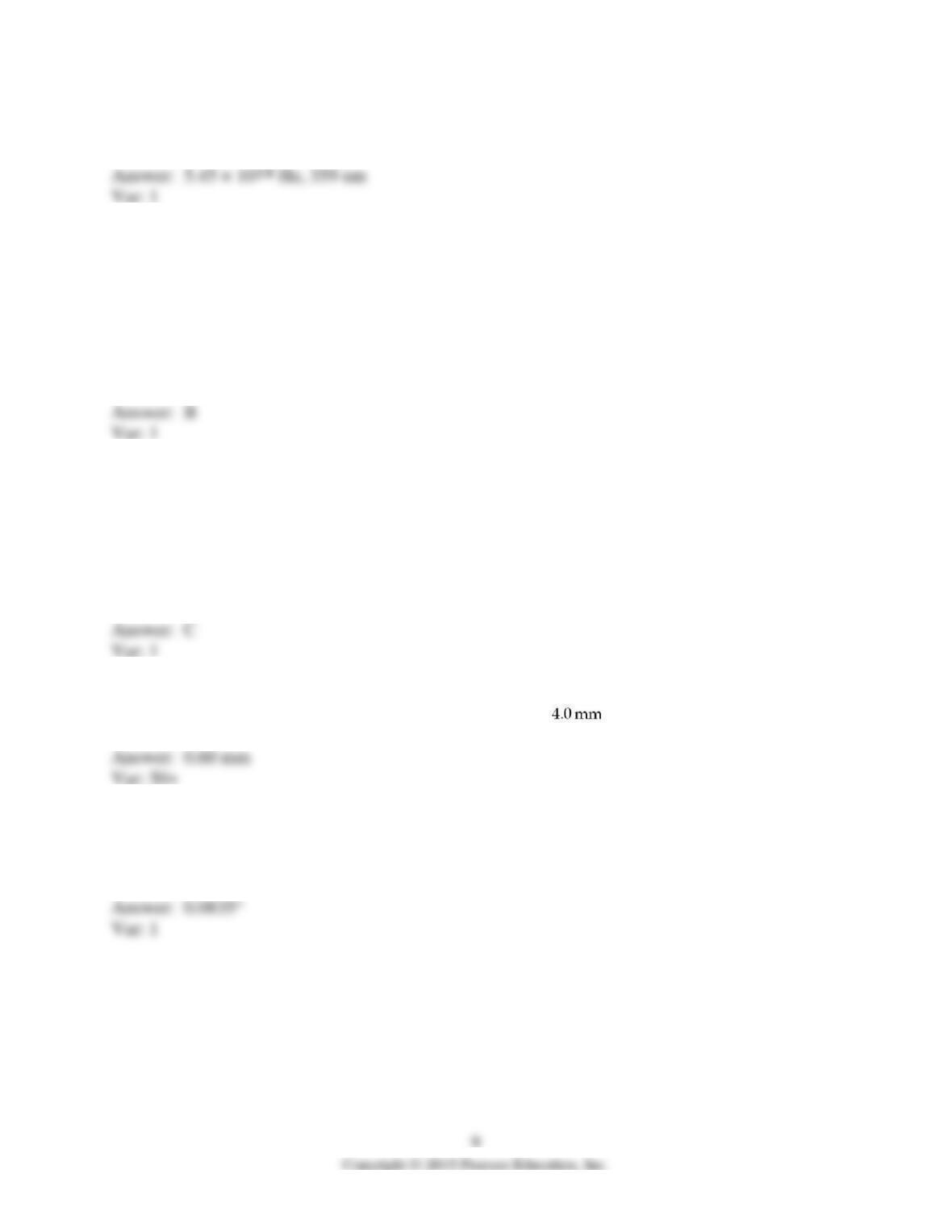
6) Light of wavelength 550 nm in air is found to travel at 1.96 × 10⁸ m/s in a certain liquid.
What are the frequency and wavelength of the light in this liquid? (c = 3.0 × 10⁸ m/s)
7) Light having a frequency in vacuum of 6.0 × 10¹⁴ Hz enters a liquid of refractive index 2.0.
What is the frequency of the light in this liquid? (c = 3.0 × 10⁸ m/s)
A) 12 × 1014 Hz
B) 6.0 × 10¹⁴ Hz
C) 3.0 × 10¹⁴ Hz
D) 1.5 × 10¹⁴ Hz
E) 2.0 × 10¹⁴ Hz
8) Light having a wavelength in vacuum of 600 nm enters a liquid of refractive index 2.0. In this
liquid, what is the wavelength of the light? (c = 3.0 × 10⁸ m/s)
A) 1200 nm
B) 600 nm
C) 300 nm
D) 150 nm
E) 200 nm
9) Coherent light of wavelength 519 nm passes through two slits. In the resulting interference
pattern on a screen 4.6 m away, adjacent bright fringes are apart. What is the separation of
the two slits?
10) In a double-slit experiment, the slit separation is 1.75 mm, and two coherent wavelengths of
light, 425 nm and 510 nm, illuminate the slits. At what angle from the centerline on either side of
the central maximum will a bright fringe from one pattern first coincide with a bright fringe from
the other pattern?
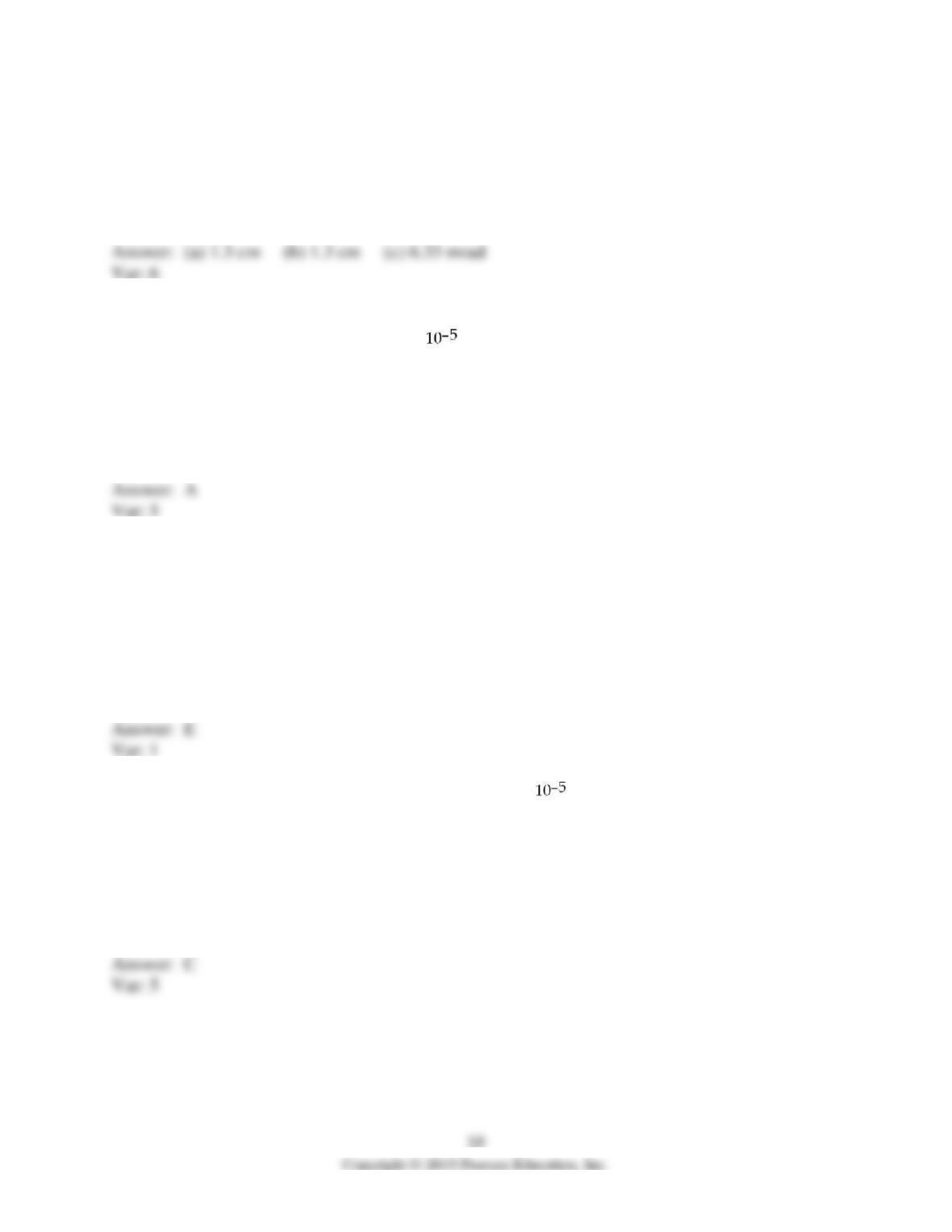
11) A double-slit experiment uses coherent light of wavelength 633 nm with a slit separation of
0.100 mm and a screen placed 2.0 m away.
(a) How wide on the screen is the central bright fringe?
(b) What is the distance on the screen between first-order and second-order bright fringes?
(c) What is the angular separation (in radians) between the central maximum and the first-order
maximum?
12) In a two-slit experiment, monochromatic coherent light of wavelength 600 nm passes
through a pair of slits separated by 2.20 x m. At what angle away from the centerline does
the first bright fringe occur?
A) 1.56°
B) 2.22°
C) 3.12°
D) 4.70°
E) 6.24°
13) In a two-slit experiment, monochromatic coherent light of wavelength 600 nm passes
through a pair of slits separated by 2.20 × 10⁻⁵ m. At what angle away from the centerline does
the second dark fringe occur?
A) 4.70°
B) 3.51°
C) 3.94°
D) 1.17°
E) 2.34°
14) In a two-slit experiment, the slit separation is 3.00 × m. The interference pattern is
created on a screen that is 2.00 m away from the slits. If the 7th bright fringe on the screen is
10.0 cm away from the central fringe, what is the wavelength of the light?
A) 100 nm
B) 204 nm
C) 214 nm
D) 224 nm
E) 234 nm
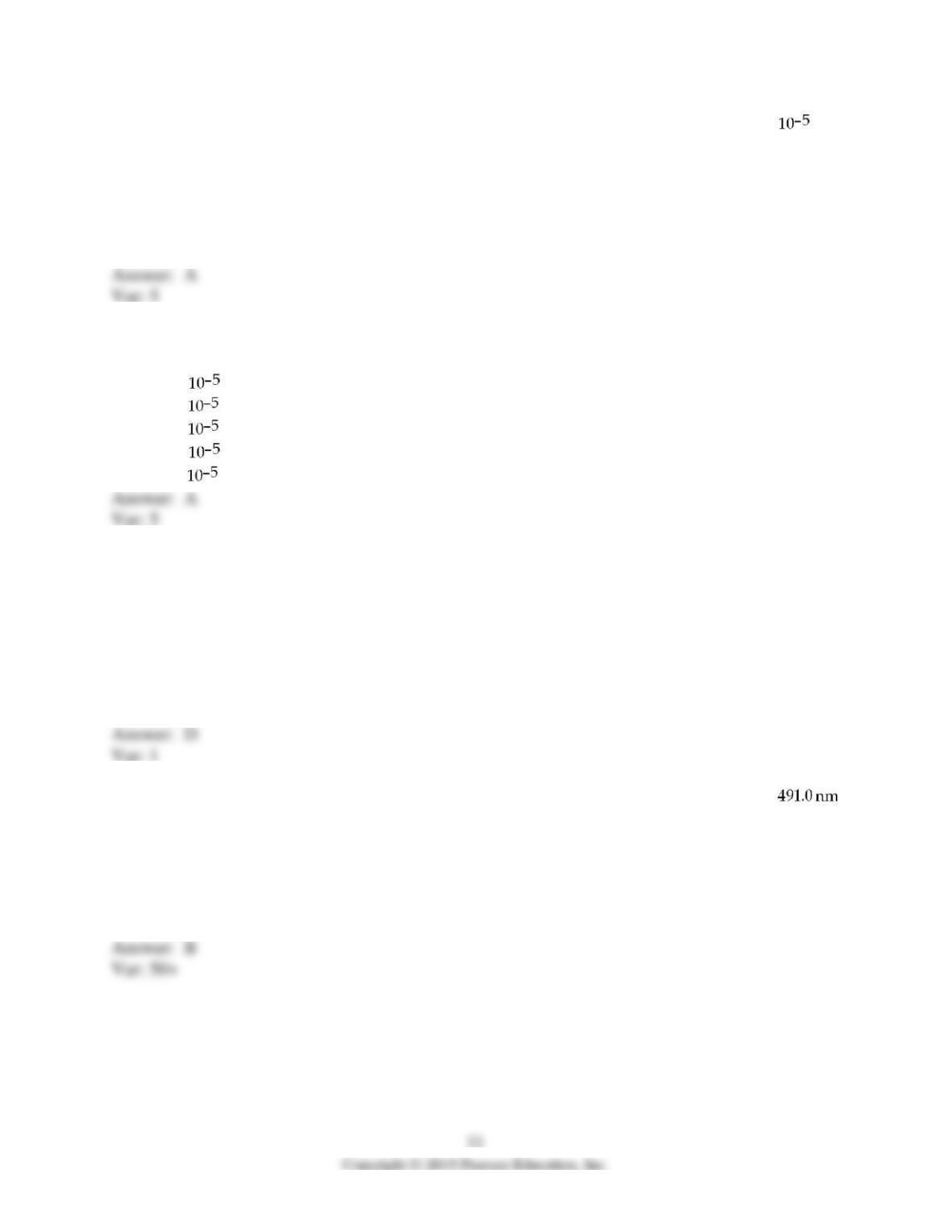
15) Coherent light of wavelength 540 nm passes through a pair of thin slits that are 3.4 × m
apart. At what angle away from the centerline does the second bright fringe occur?
A) 1.8°
B) 3.7°
C) 4.3°
D) 1.5°
E) 5.0°
16) In a two-slit experiment, a third-order bright fringe is observed at an angle of 7.10° away
from the centerline. If the wavelength of light is 595 nm, how far apart are the two slits?
A) 1.44 × m
B) 1.07 × m
C) 2.12 × m
D) 2.53 × m
E) 3.76 × m
17) In a two-slit experiment using coherent light, the distance between the slits and the screen is
1.10 m, and the distance between the slits is 0.100 mm. If the first-order bright fringe is
measured to be 3.40 cm from the centerline, what is the wavelength of the light?
A) 354 nm
B) 241 nm
C) 133 nm
D) 3.09 μm
E) 2.11 μm
18) A two-slit arrangement with 60.3 μm separation between the slits is illuminated with
coherent light. If a viewing screen is located 2.14 m from the slits, find the distance from the first
dark fringe on one side of the central maximum to the second dark fringe on the other side.
A) 52.3 mm
B) 34.9 mm
C) 69.7 mm
D) 24.6 mm
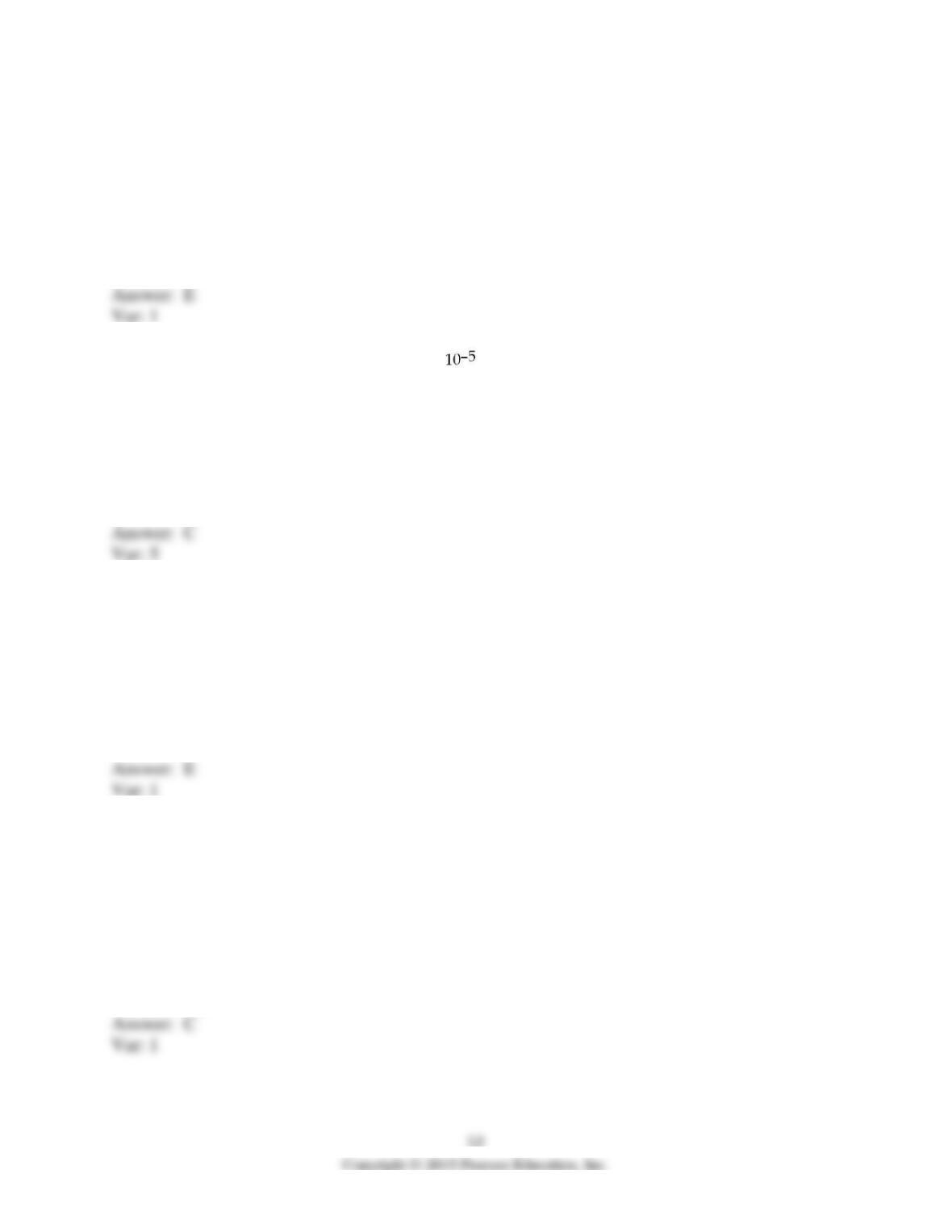
19) In a two-slit experiment using coherent light, the distance between the slits and the screen is
1.10 m, and the distance between the slits is 0.0400 mm. If the second order bright fringe is
measured to be 4.20 cm from the centerline on the screen, what is the wavelength of light?
A) 200 nm
B) 381 nm
C) 401 nm
D) 620 nm
E) 763 nm
20) The distance between two slits is 1.50 × m. A beam of coherent light of wavelength 600
nm illuminates these slits, and the distance between the slit and the screen is 2.00 m. What is the
distance on the screen between the central bright fringe and the fourth-order bright fringe?
A) 0.132 m
B) 0.201 m
C) 0.324 m
D) 0.528 m
E) 0.688 m
21) A pair of narrow slits that are 1.8 mm apart is illuminated by a monochromatic coherent light
source. A fringe pattern is observed on a screen 4.8 m from the slits. If there are 5.0 bright
fringes/cm on the screen, what is the wavelength of the monochromatic light?
A) 550 nm
B) 600 nm
C) 650 nm
D) 700 nm
E) 750 nm
22) A pair of narrow slits that are 1.8 mm apart is illuminated by a monochromatic coherent light
source. A fringe pattern is observed on a screen 4.8 m from the slits. If the wavelength of the
monochromatic light is 450 nm, what is the angular separation between adjacent dark fringes on
the screen, measured in milliradians?
A) 0.15 mrad
B) 0.20 mrad
C) 0.25 mrad
D) 0.30 mrad
E) 0.36 mrad
23) A double slit that is illuminated with coherent light of wavelength 644 nm produces a pattern
of bright and dark fringes on a screen 6.00 cm from the slits. If the slits are 2783 nm apart, what
is the distance on the screen between the 4th and the 2nd bright fringes on one side of the central
maximum?
A) 23.0 cm
B) 17.6 cm
C) 11.5 cm
D) 3.13 cm
E) 14.7 cm
24) An optical engineer needs to ensure that the bright fringes from a double-slit are 15.7 mm
apart on a detector that is from the slits. If the slits are illuminated with coherent light of
wavelength 633 nm, how far apart should the slits be?
A) 68.5 μm
B) 74.0 μm
C) 79.5 μm
D) 63.0 μm
25) A two-slit arrangement with 60.3 μm separation between the slits is illuminated with 537.0–
nm wavelength light. If a viewing screen is located 2.14 m from the slits, find the distance on the
screen from the first dark fringe on one side of the central maximum to the second dark fringe on
the other side.
A) 57.2 mm
B) 38.1 mm
C) 76.3 mm
D) 26.9 mm
26) Two thin slits are 6.00 μm apart. Monochromatic coherent light falls on these slits, and
produces a fifth-order bright interference fringe at an angle of 32.3° away from the centerline.
What is the wavelength of the light?
A) 164 nm
B) 416 nm
C) 614 nm
D) 641 nm
27) Coherent light of wavelength 575 nm falls on a double-slit and the third-order bright fringe is
seen at an angle of 6.5° away from the centerline. How far apart are the double slits?
A) 5.0 μm
B) 10 μm
C) 15 μm
D) 20 μm
28) In a double-slit experiment, the slit separation is 2.0 mm, and two wavelengths, 750 nm and
900 nm, illuminate the slits. A screen is placed 2.0 m from the slits. At what distance from the
central maximum on the screen will a bright fringe from one pattern first coincide with a bright
fringe from the other?
A) 1.5 mm
B) 3.0 mm
C) 4.5 mm
D) 6.0 mm
29) Two radio antennas are 130 m apart on a north-south line. The two antennas radiate in phase
at a frequency of 3.6 MHz. All radio measurements are made far from the antennas. What is the
smallest angle, reckoned east of north from midway between the antennas, at which constructive
interference of two radio waves occurs? (c = 3.00 × 10⁸ m/s)
A) 50°
B) 55°
C) 45°
D) 40°
E) 35°
30) Two radio antennas are 120 m apart on a north-south line. The two antennas radiate in phase
at a frequency of 5.6 MHz. All radio measurements are made far from the antennas. What is the
smallest angle, reckoned north of east from midway between the antennas, at which destructive
interference of the two radio waves occurs? (c = 3.00 × 10⁸ m/s)
A) 13°
B) 6.4°
C) 9.7°
D) 16°
E) 19°
31) Two radio antennas are 10 km apart on a north-south axis on high mountain tops at the
seacoast. The antennas broadcast identical AM radio signals, in phase, at a frequency of 4.70
MHz. A steamship, 200 km offshore, travels toward the north at 15 km/h and passes east of the
antennas. A radio on board the ship is tuned to the broadcast frequency. The reception of the
radio signal on the ship is a maximum at a given instant. How much later until the next
occurrence of maximum reception? (c = 3.00 × 10⁸ m/s)
A) 5.1 min
B) 3.8 min
C) 6.4 min
D) 7.7 min
E) 8.9 min
32) At most, how many bright fringes can be formed on one side of the central bright fringe (not
counting the central bright fringe) when light of 625 nm falls on a pair of slits that are
apart?
A) 10
B) 9
C) 8
D) 11
E) 12
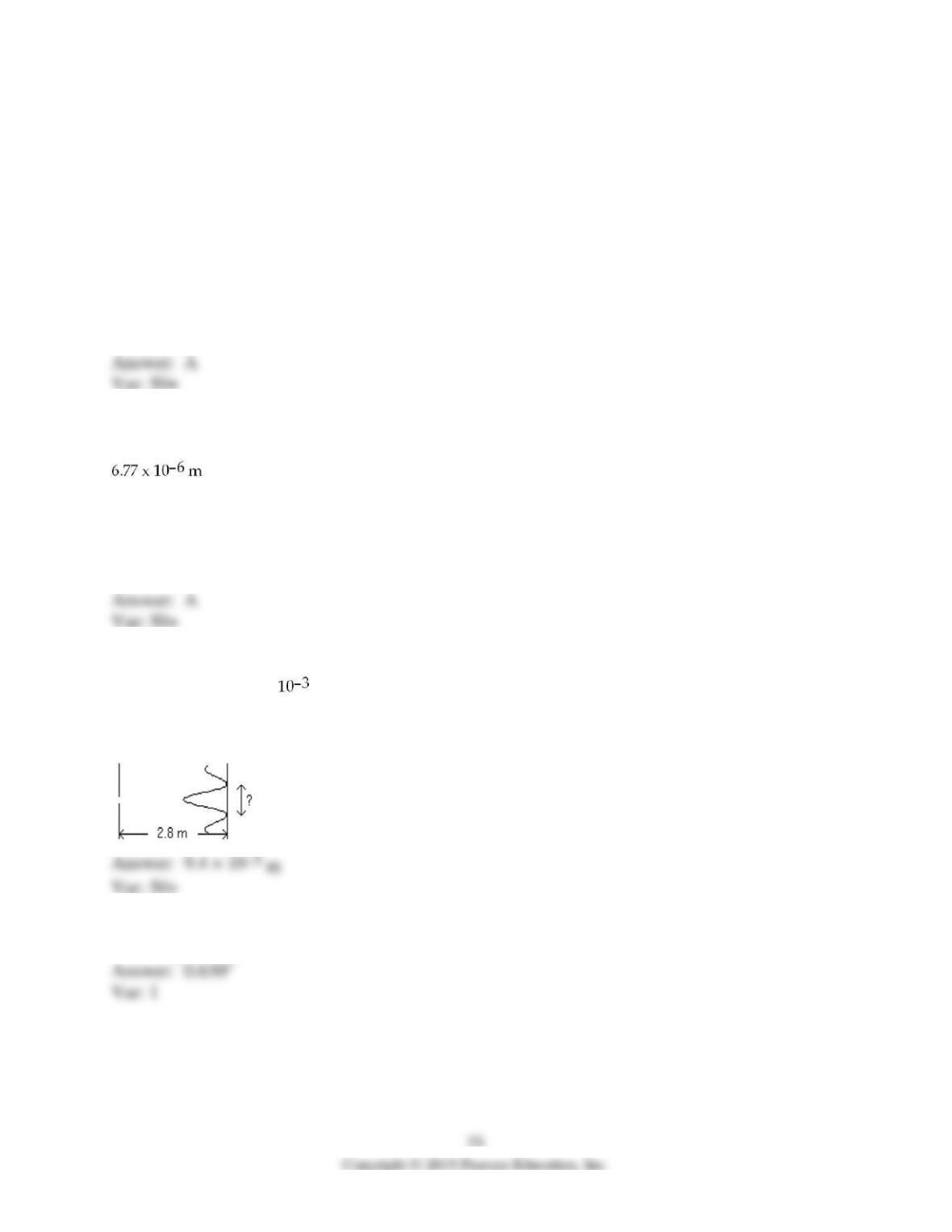
33) The figure shows the resulting pattern when a single slit is illuminated by monochromatic
light. The slit is 0.3 × m wide and is illuminated by light of wavelength 506 nm. A
diffraction pattern is seen on a screen 2.8 m from the slit. What is the linear distance on the
screen between the first two diffraction minima on either side of the central diffraction
maximum?
34) A single slit, which is 0.0500 mm wide, is illuminated by light of 550 nm wavelength. What
is the angular separation between the first two minima on either side of the central maximum?