1
Environment: Science Behind the Stories, 2e Cdn. Ed. (Withgott)
Chapter 17 Energy Alternatives
17.1 Graph and Figure Interpretation Questions
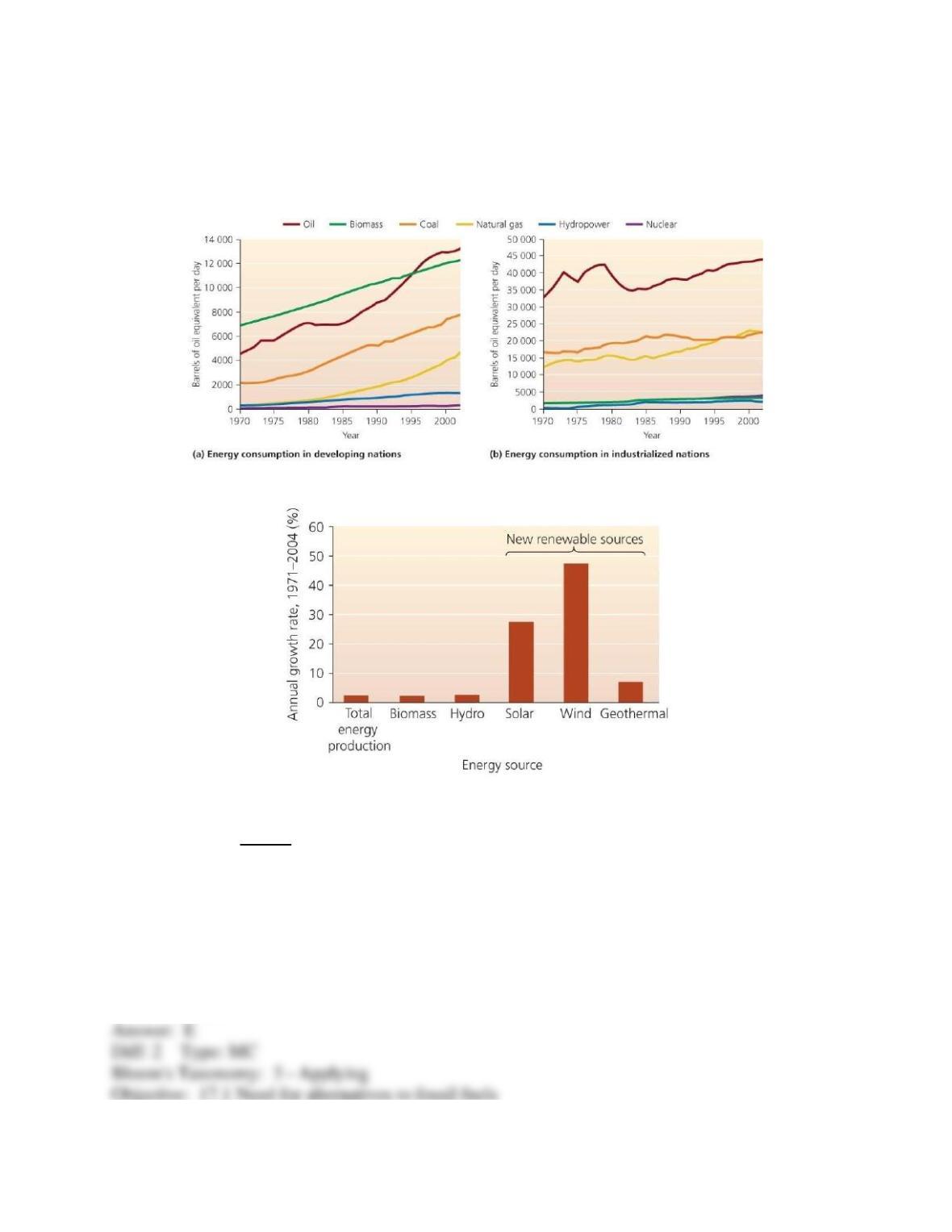
Figure 17.1
Figure 17.2
Use Figure 17.1 and/or Figure 17.2 to answer the following questions.
1) Refer to Figure 17.1 and/or Figure 17.2. Of the power sources listed below, which has had the
most stable percentage of global energy consumption since 1970?
A) oil
B) biomass
C) coal
D) natural gas
E) hydropower
2) Refer to Figure 17.1 and/or Figure 17.2. Which of the following can we infer for the period
between 1970 and 2004?
A) Both developing and developed nations met the majority of their energy needs with biomass.
B) World consumption of oil decreased.
C) Both developing and developed nations met the majority of their energy needs with fossil
fuels.
D) World consumption of natural gas decreased.
E) Developing countries met most of their energy needs with renewable sources.
3) Refer to Figure 17.1 and/or Figure 17.2. Which of the following can we infer for the decade
1980-1989?
A) Both developing and developed nations met the majority of their energy needs with biomass.
B) World consumption of coal decreased compared to the preceeding decade.
C) The use of “new” renewable resources increased compared to the preceeding decade.
D) Consumption of oil in industrialized countries decreased compared to the preceeding decade.
E) Developing countries met most of their energy needs with renewable sources.
4) Refer to Figure 17.1 and/or Figure 17.2. Based on this graph ________.
A) developing countries use less biomass than the developed countries, reflecting the increased
use of biodiesel and ethanol in the developed world
B) fossil fuel use stabilized worldwide
C) oil consumption surpassed consumption of biomass in industrialized nations
D) until now, economic development has increased reliance on fossil fuels
E) energy consumption in developing nations surpassed energy consumption in developed
nations
5) Refer to Figure 17.1 and/or Figure 17.2. Which of the following, for primary energy, is the
major renewable source in the world that is growing at the fastest rate (i.e., has increased the
most since its 1970 level)?
A) wind
B) geothermal
C) solar
D) biomass
E) hydroelectric
6) Refer to Figure 17.1 and/or Figure 17.2. Between 1970 and 2004, the “old” renewable energy
source that increased the most in absolute numbers (i.e., the output of energy per year) was
________.
A) solar power
B) hydropower
C) biomass
D) biomass and hydro generation; they increased approximately the same amount
E) There is not enough information to answer this question.
7) Refer to Figure 17.1 and/or Figure 17.2. Between 1970 and 2004 the share of the ________
energy in the total energy production ________.
A) geothermal; increased, but increased five times less than solar
B) hydropower; slightly decreased
C) biomass; did not change much in industrialized countries
D) biomass; increased more than the share of hydro generation
E) “new” renewable sources of; increased by as much as “conventional” renewable sources
17.2 Matching Questions
Match the following.
A) Yucca Mountain
B) Peanut oil
C) PV solar
D) natural gas
E) solar
F) Canola oil
G) Three Gorges
H) geothermal
I) Chernobyl
J) fission
K) wind
L) ethanol and biodiesel
M) Gardinier Dam
N) Kyoto
O) fusion
P) methanol and dioxin
Q) photovoltaic cells
R) Three Mile Island
S) Canada
T) Australia
U) quadrathermal cells
V) Los Alamos
W) geomagnetic
X) Hanford
1) Location of the most serious nuclear power plant accident in the United States
2) Location of the most severe nuclear power plant accident in the world
3) Source of biodiesel in Canada
4) Location in the United States evaluated as a possible repository for radioactive waste
5) Location that is the site of one-third of the world’s production of uranium
6) The world’s largest hydroelectric dam
7) Liquid biofuels in heaviest production
8) The process in which a collision with a neutron splits a uranium atom into smaller atoms and
releases two or three neutrons, radiation, and energy
9) An inexhaustible, nonpolluting, decentralized energy source
10) A form of kinetic energy that can be harnessed with turbines
11) A form of energy that may not be completely renewable and can produce air pollution
12) A method of converting electromagnetic to electrical energy
Diff: 1 Type: MA
Bloom’s Taxonomy: 2 – Understanding
Objective: 17.7 Solar energy
17.3 Short Answer Questions
1) Discuss the conventional alternatives to fossil fuels.
2) Why is radioactive waste disposal less of a problem in Canada than in the United States?
Include in your discussion the Canadian site in northern Manitoba and the U.S. site on Yucca
Mountain.
3) Explain the role of radioisotopes in generating nuclear power. What is spent fuel?
4) What is a breeder reactor? What are its advantages and disadvantages?
5) Compare Three Mile Island and Chernobyl.
6) Briefly discuss the pros and cons of hydropower.
7) ________ uses the kinetic energy of moving water to turn turbines and generate electricity.
8) In Canada over ________% of electricity comes from hydroelectric facilities.
9) Compare gasification and pyrolysis.
10) What are the benefits of using electrolysis to produce and store energy?
11) Why are we harvesting so little of the vast amount of solar energy that is available?
12) Explain the major problem with wind energy. How can we mitigate this problem?
13) What are some of the benefits of using hydrogen as a fuel?
14) What are the benefits of using offshore sites for collecting wind power?
15) Briefly describe how a hydrogen fuel cell works to produce electricity.
16) The most commonly used approach to solar energy collection is ________, in which
buildings are designed and building materials chosen to maximize their direct absorption of
sunlight in winter, even as they keep the interior cool in the heat of summer.
17) We can harness power from wind by using devices called ________, mechanical assemblies
that convert wind’s kinetic energy, or energy of motion, into electrical energy.
17.4 Multiple-Choice Questions
1) Worldwide, the most widely used renewable energy resource is ________.
A) solar
B) hydroelectric
C) biomass
D) wind
E) nuclear
2) Biomass energy ________.
A) can be created by microbial action or burned directly as wood or dung
B) requires fossil fuel input to produce
C) produces no greenhouse gases when burned
D) could not supply an alternative fuel to gasoline
E) is a form of fossil fuel
3) ________ strongly influences the amount of energy generated from hydropower.
A) The temperature of reservoir water
B) Latitude
C) The phase of the Moon
D) The volume of water released and the height of the fall
E) The amount of biomass contained in reservoir water
4) The run-of-river approach describes ________.
A) impounding water in reservoirs behind concrete dams
B) the purchase of state-run dams by major corporations
C) dams that are reliable but unsustainable
D) the most expensive type of dams to build and maintain
E) the diversion of a portion of a river’s flow through pipes
5) Which of the following represents the proper ranking of the world’s total primary energy
supply from the most used to the least used?
A) fossil fuels, biomass, nuclear, hydroelectric, new renewables
B) fossil fuels, biomass, hydroelectric, nuclear, new renewables
C) fossil fuels, biomass, hydroelectric, new renewables, nuclear
D) fossil fuels, nuclear, hydroelectric, biomass, new renewables
E) biomass, fossil fuels, nuclear, hydroelectric, new renewables
6) Which of the following represents proper ranking of the Canadian total primary energy supply
from the most used to the least used?
A) fossil fuels, hydroelectric, nuclear
B) fossil fuels, hydroelectric, new renewables
C) hydroelectric, nuclear, fossil fuels,
D) hydroelectric, fossil fuels, nuclear
E) hydroelectric, biomass , fossil fuels
7) New renewables include ________.
A) biodiesel
B) wind power
C) nuclear
D) sustainably harvested fuelwood
E) “bogas” methane
8) Nuclear power plants ________.
A) were first developed commercially in the early 1990s
B) experienced the most growth during the 1970s and 1980s
C) have not been allowed in France and Lithuania
D) supply most of the United States’s electricity
E) produce more greenhouse gas emissions than burning fossil fuels
9) Atomic energy in power plants is created via ________.
A) fusion of electrons
B) ionic transformation of atoms
C) extraction of energy from the nucleus of cells
D) bombarding radioactive elements with electrons
E) fissioning uranium atoms by bombarding them with neutrons
10) The International Thermonuclear Experimental Reactor (ITER) is a ________.
A) prototype nuclear fusion reactor
B) solar energy collector in the California desert
C) prototype cold fusion reactor
D) prototype nuclear fission reactor
E) project aiming to bury spent uranium in the western United States
11) Which of the following characterizes Canadian nuclear power plants?
A) largely unregulated
B) highly subsidized
C) widely accepted by the public
D) account for nearly one-sixth of domestic energy production
E) inexpensive to operate
12) Effects attributed to Chernobyl ________.
A) were contained within the Ukraine
B) have not been extensively documented
C) did not include fatalities
D) increased the incidence of thyroid cancers
E) increased the incidence of emphysema
13) E-85 ________.
A) was an international summit of 85 nations that met to restrict greenhouse gas emissions
B) was an international summit of 85 nations that met to determine vehicle fuel efficiency
standards
C) was an international summit of 85 nations that met to restrict CFC use
D) is an isotope of uranium used to generate electricity
E) is an ethanol–gasoline mixture used in flexible-fuel vehicles
14) Biodiesel ________.
A) is widely used in Canada
B) is produced from sugarcane
C) can be used in vehicles with diesel engines without engine modification
D) is twice as expensive as petrodiesel
E) produces more pollution than petrodiesel
15) Which of the following are documented negative impacts of dams?
A) habitat destruction, alteration of river sediment deposition
B) alteration of river salinity
C) acid deposition
D) increased atmospheric carbon dioxide and CFCs
E) increased carbon monoxide emissions, decreased rainfall
16) Which of the following countries has the highest percentage of electricity generated from
nuclear power plants?
A) France
B) United States
C) Canada
D) Sweden
E) Russia
17) Which of the following countries has the most nuclear power plants?
A) France
B) United States
C) Canada
D) Sweden
E) Russia
18) A permanent nuclear storage facility in Canada is being considered deep underground at
________.
A) Lac du Bonnet, Manitoba
B) Vonage, Saskatchewan
C) Yucca Mountain
D) Port Hope, Ontario
E) Sydney, Nova Scotia
19) Ultimately, all biofuels are ________, because they are the result of ________.
A) geological; sedimentation
B) solar; photosynthesis
C) inefficient; decomposition by microorganisms
D) synthetic; chemical manipulation of hydrocarbons
E) polymers; biological metabolic processes
20) Biofuels and nuclear power may prove useful as ________.
A) pollution-free sustainable energies
B) energies to bridge the time between fossil fuel depletion and new renewables
C) replacement fuels for motor vehicles
D) stages in the development of fusion generators
E) inexpensive technologies for developing nations
21) “New renewables” are ________.
A) solar, wind, geothermal
B) wind, wood, alcohol
C) hydro, biomass
D) coal, natural gas
E) fusion, fission
22) Currently, the fastest–growing source of electricity generation using new renewable sources
is ________.
A) solar
B) wind
C) hydro
D) natural gas
E) coal
23) The second fastest-growing source of electricity generation using new renewable sources is
________.
A) solar
B) wind
C) hydro
D) natural gas
E) coal
24) One of the obstacles to the rapid replacement of nonrenewable energy sources with
renewable energy sources is ________.
A) the improvement in the infrastructure for using renewable energy sources
B) the lack of government and private financial support for the development of renewable energy
sources
C) advancements in the technological development of renewable energy sources
D) the motivation of private industry to proactively develop renewable energy sources
E) a unified energy policy by the government that supports the development of alternative energy
sources
25) Which of the following methods can be called passive solar energy collection?
A) using heat–absorbing construction materials
B) rooftop solar panels
C) OTEC
D) photovoltaic cells
E) rooftop flat–plate solar collectors
26) Solar represents a minuscule portion of Canadian energy production because of ________.
A) technological limitations
B) lack of investment
C) lack of scientific interest
D) the poor outlook for this energy source’s potential
E) the potential for pollution from this source of energy
27) Prior to 1950, the main use of windmills in Canada was for ________.
A) energy generation
B) grinding grain for bread
C) pumping water for irrigating crops
D) draining wetlands
E) pumping drinking water for cattle
28) Windmill towers are generally more productive if they are ________.
A) higher; this minimizes turbulence and maximizes wind speed
B) lower; this minimizes turbulence and maximizes wind speed
C) higher; this minimizes the number of birds that interfere with blade turning
D) lower; this increases heat convection from the ground
E) higher; this increases heat convection from the ground
29) A major disadvantage to using wind to produce electricity is ________.
A) the emissions it produces once in place
B) its energy efficiency compared to conventional power sources
C) that one has to develop a large–scale wind farm before wind power is economically viable
D) the initial startup cost
E) that land can be leased for wind power development
30) A major obstacle to the establishment of wind farms near the population centres that need
them is ________.
A) the lack of infrastructure to support wind–generated electricity
B) NIMBY
C) the lack of financial support for the construction of wind farms
D) EROI
E) the lack of large land areas needed to construct wind farms