Exam
Name___________________________________
MULTIPLE CHOICE. Choose the one alternative that best completes the statement or answers the question.
Evaluate the determinant.
1)
0–3
1 0
1)
A)
–3
B)
3
C)
–2
D)
0
2)
–10 8
0–4
2)
A)
32
B)
40
C)
–40
D)
–80
Use Cramer’s rule to solve the linear system. If D = 0, use another method to determine the solution set.
3)
4x – 4y – 5z = –48
4x + 2y + 8z = 98
–6x – 4y + 2z = –42
3)
A)
{(6, 5, 8)}
B)
{(5, 7, 8)}
C)
{(7, 8, 7)}
D)
{(5, –7, –8)}
Evaluate the determinant.
4)
414
353
532
4)
A)
233
B)
51
C)
–81
D)
–51
1
Provide an appropriate response.
5)
Suppose that you are solving a system of three linear equations and have evaluated D, Dx, Dy, and
Dz. Under what condition does Cramer’s rule not apply?
5)
A)
D = 0; and either Dx= 0, Dy= 0, or Dz= 0
B)
D = 0
C)
Dx= 0, Dy= 0, or Dz= 0
D)
Dx= 0
6)
Indicate whether the following statement is true or false. Interchanging corresponding rows and
columns of a matrix changes the sign of the determinant of the matrix.
6)
A)
True
B)
False
Evaluate the determinant.
7)
070
523
306
7)
A)
273
B)
–273
C)
–147
D)
147
Provide an appropriate response.
8)
Fill in the blank to complete the statement. In order for a matrix to have a determinant, it must be
a(n) matrix.
8)
A)
minor
B)
square
C)
rectangular
D)
augmented
Solve the equation by finding an expression for the determinant on the left, and then solving using the appropriate
method.
9)
x 0 0
4 x 1
621 = –1
9)
A)
{1}
B)
{–1}
C)
D)
{3}
Use Cramer’s rule to solve the linear system. If D = 0, use another method to determine the solution set.
10)
9x + 3 =6y
5x + 3y =11
10)
A)
{(0, 3)}
B)
Cramer’s rule does not apply since D = 0;
C)
{(1, 3)}
D)
{(1, 2)}
11)
x – y + 4z = 5
4x + z =0
x + 2y + z = –10
11)
A)
{(0, 0, –5)}
B)
Cramer’s rule does not apply since D = 0;
C)
{(0, –5, 0)}
D)
{(0, –5, 5)}
12)
6x – 7y =49
4x + 2y = –14
12)
A)
{(–1, –6)}
B)
{(0, –7)}
C)
Cramer’s rule does not apply since D = 0;
D)
{(0, –6)}
3
Solve the equation by finding an expression for the determinant on the left, and then solving using the appropriate
method.
13)
x 3
2 1 =12
13)
A)
{18}
B)
{12}
C)
{4}
D)
{–2}
Provide an appropriate response.
14)
For a certain system of two linear equations, the solution set is {–4, 8}, and D =30. Find the values
of Dx and Dy.
14)
A)
Dx= –120; Dy=240
B)
Dx= –4; Dy=8
C)
Dx= – 2
15; Dy=4
15
D)
Dx=240; Dy= –120
Solve the equation by finding an expression for the determinant on the left, and then solving using the appropriate
method.
15)
0 0 x
–4 x –4
1 1 x = 4
15)
A)
{5}
B)
{–2}
C)
D)
{2}
Use Cramer’s rule to solve the linear system. If D = 0, use another method to determine the solution set.
16)
x + y + z = 9
2x – 3y + 4z = 7
16)
A)
Cramer’s rule does not apply since D = 0; –7z + 34
5, 2z + 11
5, z
B)
Cramer’s rule does not apply since D = 0;
C)
Cramer’s rule does not apply since D = 0; z + 34
5, 2z + 11
5, z
D)
Cramer’s rule does not apply since D = 0; –7z + 34
5, 2z – 11
5, z
Provide an appropriate response.
17)
For a certain system of three linear equations, the solution set is {–8, 3, –6}, and D = –15. Find the
values of Dx, Dy, and Dz.
17)
A)
Dx=15
8; Dy= – 5; Dz=5
2
B)
Dx= –8; Dy=3; Dz= –6
C)
Dx= –45; Dy=120; Dz=90
D)
Dx=120; Dy= –45; Dz=90
Solve the equation by finding an expression for the determinant on the left, and then solving using the appropriate
method.
18)
–2 5
1 x = –9
18)
A)
{–9}
B)
C)
{2}
D)
{7}
Use Cramer’s rule to solve the linear system. If D = 0, use another method to determine the solution set.
19)
2x + 2y + z = 15
2x – 3y – z = 4
3x + y + 4z = 28
19)
A)
{(5, 1, 3)}
B)
{(3, 1, 5)}
C)
{(5, 3, 1)}
D)
Cramer’s rule does not apply since D = 0;
Evaluate the determinant.
20)
9 5
8 9
20)
A)
121
B)
–27
C)
41
D)
–41
Use Cramer’s rule to solve the linear system. If D = 0, use another method to determine the solution set.
21)
2x – 5y – z = –9
x – 3y – 4z = –34
–9x + y + z = –52
21)
A)
{(7, –3, –8)}
B)
{(8, 1, 8)}
C)
{(3, 8, 3)}
D)
{(7, 3, 8)}
Provide an appropriate response.
22)
What is the value of m n p
0 0 0
q r s for any values of the variables?
22)
A)
0
B)
–1
C)
Undefined
D)
1
Solve the equation by finding an expression for the determinant on the left, and then solving using the appropriate
method.
23)
3 x
2–1=3
23)
A)
{3}
B)
3
2
C)
1
D)
{–3}
Evaluate the determinant.
24)
2 0 0
5–8 0
–8 6 5
24)
A)
–80
B)
50
C)
–110
D)
80
25)
2 6
8 8
25)
A)
–52
B)
64
C)
32
D)
–32
26)
0 1 2
–4 2 1
–4–2 4
26)
A)
52
B)
44
C)
–44
D)
–20
27)
343
434
312
27)
A)
–89
B)
–7
C)
149
D)
7
Use Cramer’s rule to solve the linear system. If D = 0, use another method to determine the solution set.
28)
6x + 9y =18
–3x + 7y = –9
28)
A)
{(3, 1)}
B)
Cramer’s rule does not apply since D = 0;
C)
{(3, 0)}
D)
{(2, 1)}
29)
x + y =1
x + y =8
29)
A)
{(1, 8)}
B)
Cramer’s rule does not apply since D = 0; {(8– y, y)}
C)
{(0, 9)}
D)
Cramer’s rule does not apply since D = 0;
30)
x + y + z = –5
x – y + 2z = –8
2x + y + z = –4
30)
A)
{(–5, 1, –1)}
B)
{(–5, –1, 1)}
C)
{(1, –1, –5)}
D)
Cramer’s rule does not apply since D = 0;
Evaluate the determinant.
31)
2 3
1 2
31)
A)
4
B)
1
C)
–1
D)
7
Provide an appropriate response.
32)
Indicate whether the following statement is true or false. If every element of a 9 ×9 matrix is
multiplied by 4, the determinant of the new matrix is 4 times the determinant of the original
matrix.
32)
A)
True
B)
False
Use Cramer’s rule to solve the linear system. If D = 0, use another method to determine the solution set.
33)
x – 5y = –5
6x – 4y = –4
33)
A)
{(1, 0)}
B)
{(–1, 0)}
C)
Cramer’s rule does not apply since D = 0;
D)
{(0, 1)}
34)
8x + 7z = 59
–7x + 8y + 8z = 83
8x – 5y = –16
34)
A)
{(3, –8, –5)}
B)
({4, 6, 5)}
C)
{(3, 8, 5)}
D)
{(8, 5, 8)}
Evaluate the determinant.
35)
–6–5
b a
35)
A)
30 – ab
B)
ba – 30
C)
–6a + 5b
D)
6a – 5b
Use Cramer’s rule to solve the linear system. If D = 0, use another method to determine the solution set.
36)
x + 6y = –34
–4x + 5y = –67
36)
A)
{(8, –7)}
B)
{(–8, –6)}
C)
Cramer’s rule does not apply since D = 0;
D)
{(7, –6)}
Provide an appropriate response.
37)
Indicate whether the following statement is true or false. If two of the rows of a 3 × 3 matrix are
identical, but its other row is different, then the determinant of the matrix equals 0.
37)
A)
True
B)
False
Evaluate the determinant.
38)
545
334
328
38)
A)
–17
B)
–79
C)
17
D)
379
Provide an appropriate response.
39)
Suppose that you attempt to solve a system of equations and find that D = 0. What can you
conclude about the solutions of this system?
39)
A)
The system has exactly one solution.
B)
The system has no solution.
C)
The system has either no solution or an infinite number of solutions.
D)
The system has an infinite number of solutions.
Use Cramer’s rule to solve the linear system. If D = 0, use another method to determine the solution set.
40)
2x + 6y + 4z =32
x + 3y + 2z = –16
x + y + z = –2
40)
A)
{(–2, 5, –4)}
B)
Cramer’s rule does not apply since D = 0; {(2z–1, z + 2, z)}
C)
{(5, –4, –2)}
D)
Cramer’s rule does not apply since D = 0;
Evaluate the determinant.
41)
0 0 3
5–4 1
0 6 4
41)
A)
–106
B)
–90
C)
74
D)
90
42)
a b
b a
42)
A)
2ab
B)
a2– b2
C)
0
D)
a2+ b2
Solve the equation by finding an expression for the determinant on the left, and then solving using the appropriate
method.
43)
x 1
2 x =7
43)
A)
{7}
B)
{–3, 3}
C)
{3}
D)
Provide an appropriate response.
44)
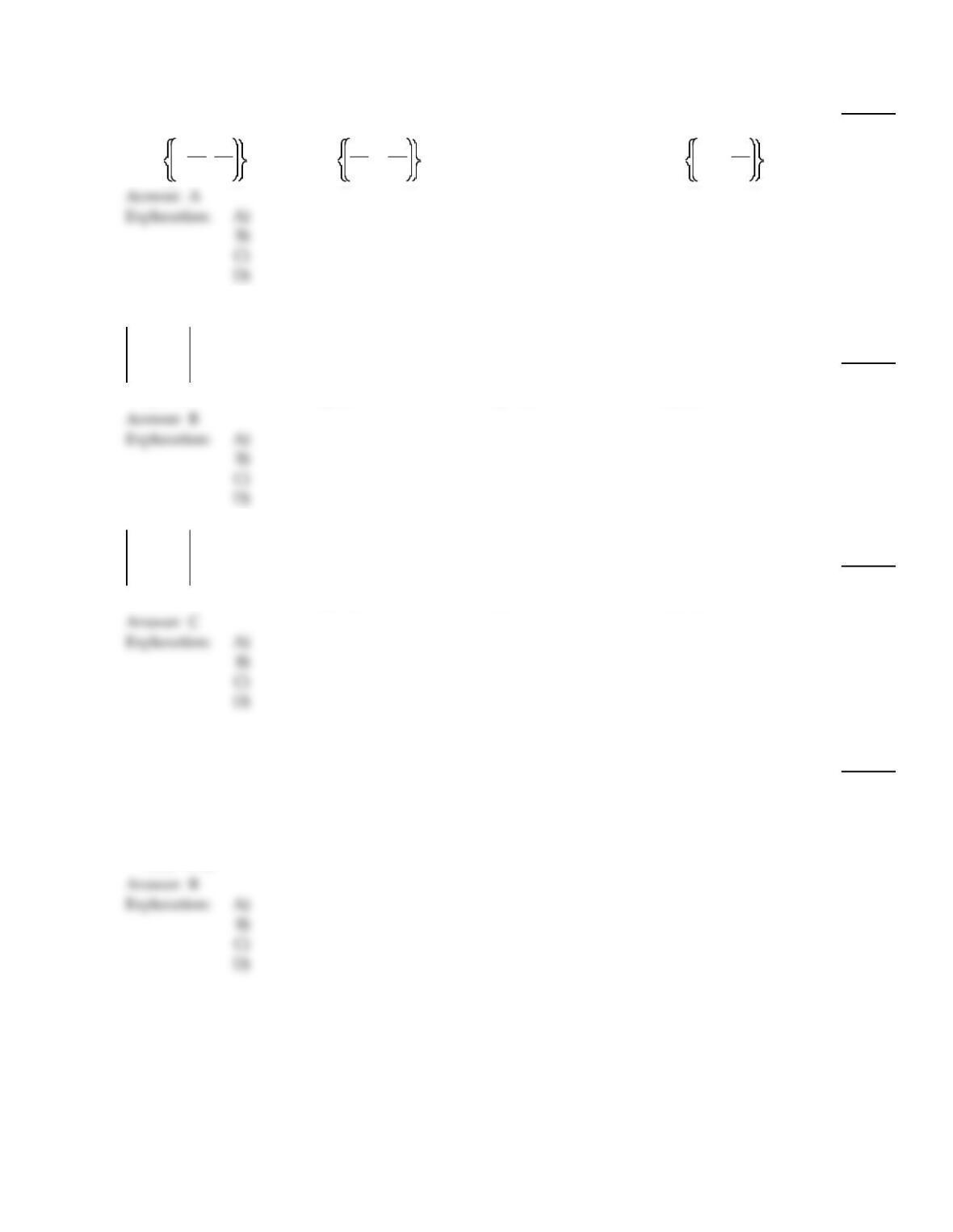
For a certain system of two linear equations, the values of the determinants used in Cramer’s rule
are D = –30, Dx=2, and Dy= –8. What is the solution set of the system?
44)
A)
–1
15, 4
15
B)
4
15, –1
15
C)
{(2, –8)}
D)
– 15, 15
4
Evaluate the determinant.
45)
1–1 1
5 4 5
–1–3 5
45)
A)
–34
B)
54
C)
–54
D)
44
46)
5–6 5
0 1 3
0 0 –1
46)
A)
5
B)
–13
C)
–5
D)
–23
Use Cramer’s rule to solve the linear system. If D = 0, use another method to determine the solution set.
47)
9x + 9y =9
–2x – 7y = –37
47)
A)
Cramer’s rule does not apply since D = 0;
B)
{(–6, 7)}
C)
{(–6, 8)}
D)
{(–7, 8)}
12
48)
x – y + z = 3
x + y + z = –5
x + y – z = –7
48)
A)
{(1, –2, –4)}
B)
{(–2, 1, –4)}
C)
Cramer’s rule does not apply since D = 0;
D)
{(–2, –4, 1)}
49)
x + y =8
4x + 4y =32
49)
A)
Cramer’s rule does not apply since D = 0; {(8– y, y)}
B)
Cramer’s rule does not apply since D = 0;
C)
{(1, 7)}
D)
{(0, 0)}
Solve the equation by finding an expression for the determinant on the left, and then solving using the appropriate
method.
50)
2 4
x 3 = –2
50)
A)
{–1}
B)
C)
{2}
D)
{–2}
Use Cramer’s rule to solve the linear system. If D = 0, use another method to determine the solution set.
51)
x – y + 3z =11
4x + z =5
x + 2y + z =13
51)
A)
{(5, 4, 0)}
B)
{(5, 0, 4)}
C)
{(0, 4, 5)}
D)
Cramer’s rule does not apply since D = 0;
13
Solve the equation by finding an expression for the determinant on the left, and then solving using the appropriate
method.
52)
3 x
x 4 = –13
52)
A)
B)
{25}
C)
13
3
D)
{–5, 5}
Answer Key
Testname: C17

Answer Key
Testname: C17