Exam
Name___________________________________
MULTIPLE CHOICE. Choose the one alternative that best completes the statement or answers the question.
Provide an appropriate response.
1)
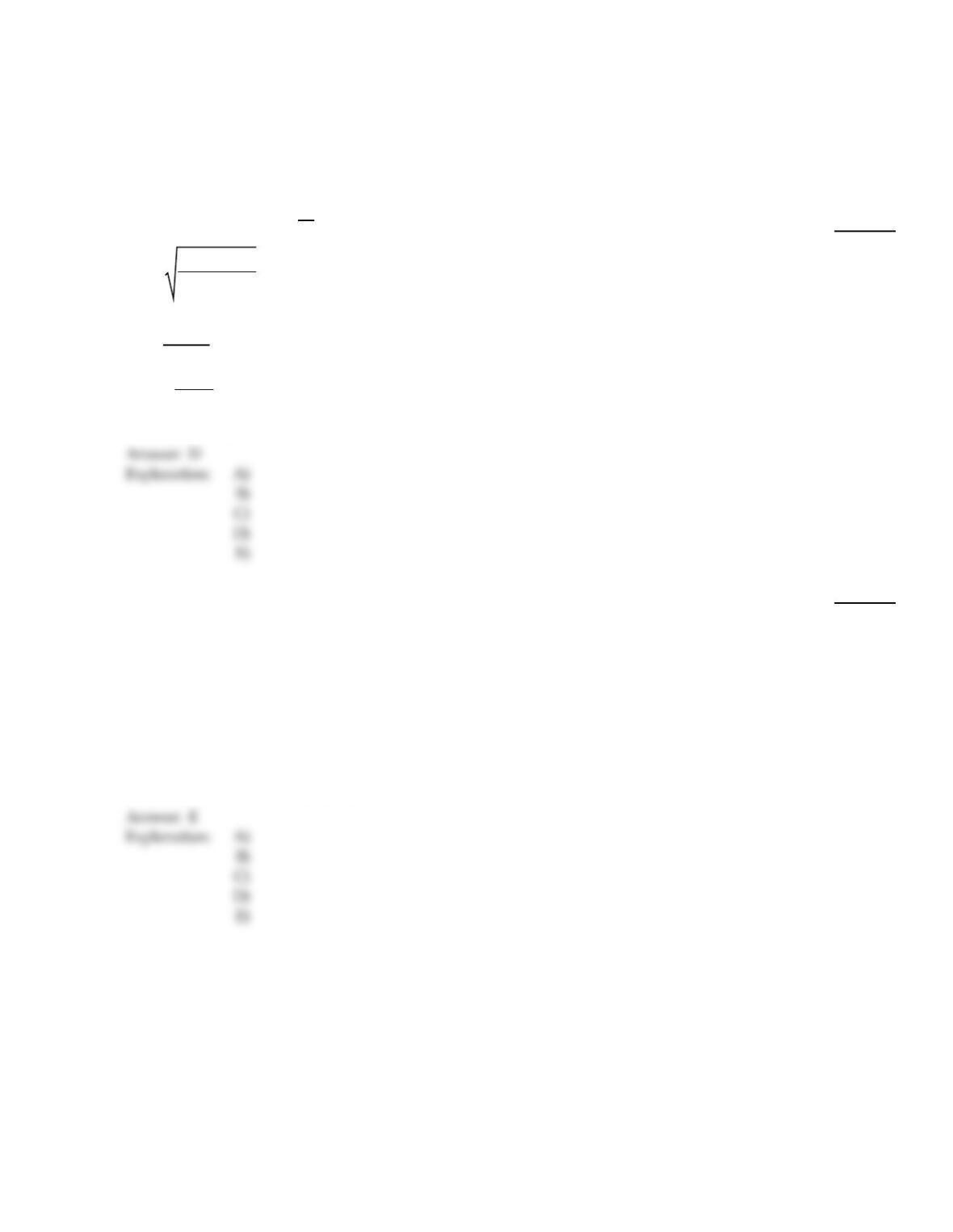
If s3t3+ 2r2–s2= 1, then t
r=
1)
A)
31 – 2r2+s2
s3.
B)
4r.
C)
r– 3s2
t.
D)
–4r
3s3t2.
E)
none of the above
2)
A monopolist produces two products, A, and B. The joint–cost function is c= 5qA+ 3qB+ 5000
where c is the total cost of producing qA units of A and qB units of B. the demand functions for these
products are given by pA= 205 – 2qA–qBand pB= 153 –qA–qB, where pA and pB are the prices of
A and B, respectively. The number of units of A and the number of units B that should be sold to
maximize the monopolist’s profit is
2)
A)
15 units of A and 25 units of B.
B)
50 units of A and 75 units of B.
C)
75 units of A and 100 units of B.
D)
10 units of A and 15 units of B.
E)
25 units of A and 50 units of B.
1
3)
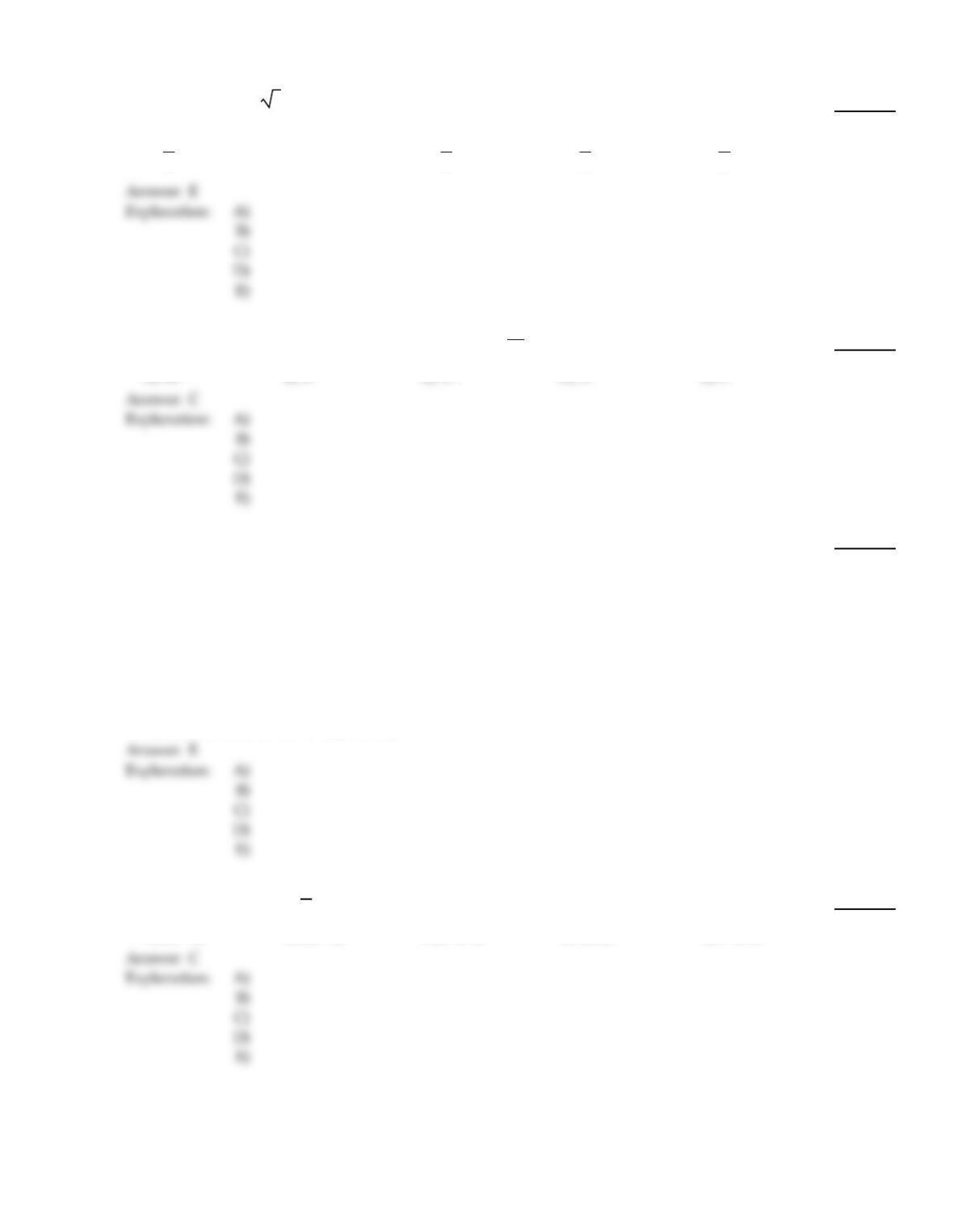
Evaluate:
1
0
2x
0
xdy dx
3)
A)
2
5
B)
2
C)
8
5
D)
6
5
E)
4
5
4)
If z=x3y2+x2y3– 3xy and x= 2r+ 3s and y=r–s, then z
s when r= 1 and s= 0 is
4)
A)
35.
B)
8.
C)
17.
D)
5.
E)
1.
5)
A company must fill an order for 200 units of its product. It wishes to distribute the production
between its two plants, plant A and plant B. The total cost function is
c= 300qA+ 200qB+q2
B+ 8000, where qA and qB are the number of units produced at plant A and
plant B, respectively. To minimize costs, plant A and plant B should produce
5)
A)
100 units and 100 units, respectively.
B)
25 units and 175 units, respectively.
C)
175 units and 25 units, respectively.
D)
50 units and 150 units, respectively.
E)
150 units and 50 units, respectively.
6)
The function f(x, y) =x2+1
3y3+ 2xy – 8y+ 6 has a relative minimum at
6)
A)
(2, –2).
B)
(6, –6).
C)
(–4, 4).
D)
(3, 6).
E)
(–3, 3).
2
7)
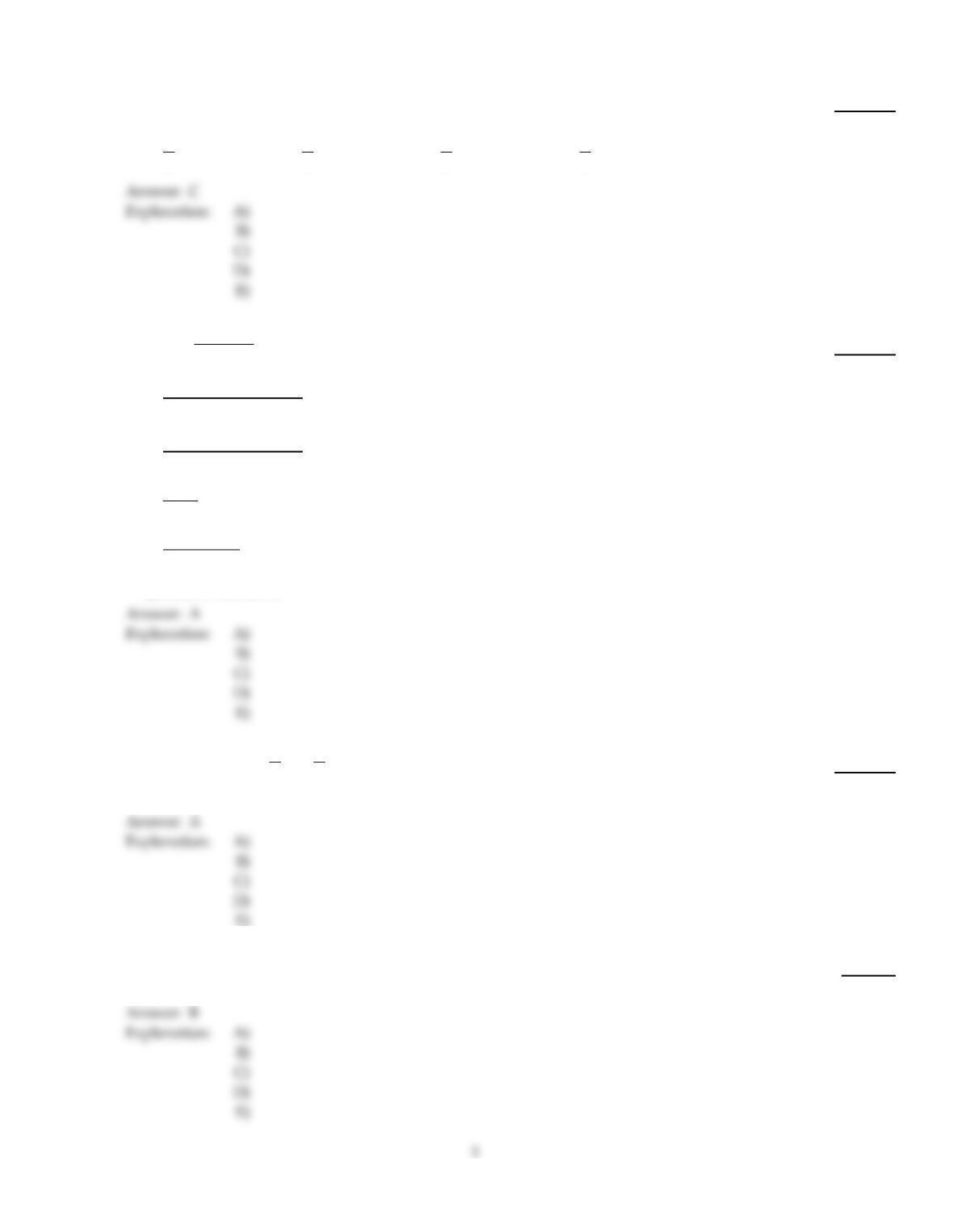
Evaluate:
2
0
1
0
x2y3 dx dy
7)
A)
2
3
B)
5
3
C)
4
3
D)
1
3
E)
1
8)
If f(x, y) =3xy +y2
x2y3+ 9 , then fx(x, y) =
8)
A)
y(27 – 3x2y3– 2xy4)
(x2y3+9)2
B)
y(27 + 9x2y3+ 2xy4)
(x2y3+9)2
C)
3y
2xy3
D)
3x
(x2y3+9)2
E)
none of the above
9)
The function f(x, y) =1
3x3+1
2y2+xy – 6x+ 3 has a relative minimum at
9)
A)
(3, –3).
B)
(–2, 2).
C)
(2, 2).
D)
(–3, 3).
E)
(2, –2).
10)
If f(x, y) =x2y, then fyx(1, 0) =
10)
A)
1.
B)
2.
C)
3.
D)
4.
E)
0.
11)
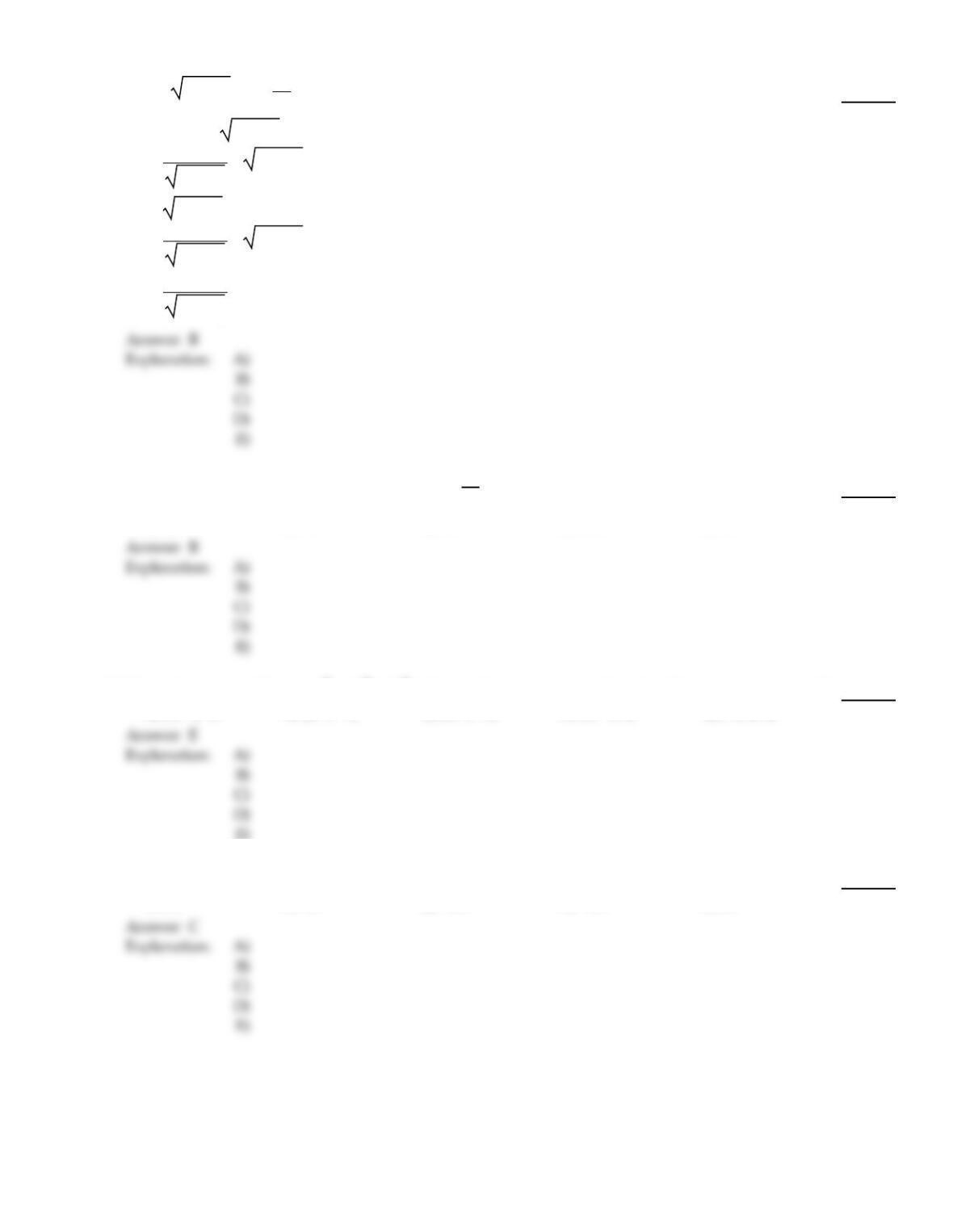
If z=y x2+ 6y, then z
y=
11)
A)
(2x+ 6)y x2+ 6y.
B)
3y
x2+ 6y
+x2+ 6y.
C)
x2+ 6y.
D)
y
x2+ 6y
+x2+ 6y.
E)
3y
x2+ 6y
.
12)
If z= (2x+ 3y)3 and x=r2– 2s and y= 2s–r, then z
s when r= 2 and s= 1 is
12)
A)
92.
B)
96.
C)
84.
D)
104.
E)
88.
13)
The critical point of f(x, y) =x2– 4y2+ 3z2 subject to the constraint x+ 16y– 9z= 36 is
13)
A)
(4, –3, 1)
B)
(3, 1, –4)
C)
(4, 1, –3)
D)
(1, –3, 4)
E)
(–1, 4, 3)
14)
If g(u, v, w) = (u2+ 3v)2(4w– 5), then gwu(–1, 1, 3) =
14)
A)
32.
B)
16.
C)
–64.
D)
–32.
E)
64.
4
15)
If f(x, y, z) =x2yz2+xy2z+xy, then fx(1, 2, 3) =
15)
A)
55.
B)
50.
C)
48.
D)
36.
E)
none of the above
16)
Evaluate:
1
–1
y2
y
(2x+ 3y) dx dy
16)
A)
–11
3
B)
–34
15
C)
–9
16
D)
–4
3
E)
–4
15
17)
If z=ex/y, then z
y=
17)
A)
1
yex/y.
B)
–x
y2ex/y.
C)
x2
yex/y.
D)
x
yex/y.
E)
y
xex/y.
18)
The number of critical points of f(x, y) =x2+x2y+y2– 2y+ 2 is
18)
A)
0.
B)
1.
C)
2.
D)
3.
E)
4.
5
19)
A critical point of f(x, y) = 2x2+ 3y2+ 7 subject to the constraint 2x– 5y= 31 is
19)
A)
(3, –5)
B)
(2, 3)
C)
7
6, 4
3
D)
(–4, 1)
E)
(0, 0)
20)
If f(x, y, z) = (2x+y2+z)3, then 3f
zyx=
20)
A)
3 + 2y
B)
2x+y2+z
C)
0.
D)
24y
E)
6(2x+y2+z)
21)
The number of critical points of f(x, y) =x3+ 3xy2+ 3y2– 15x+ 2 is
21)
A)
0.
B)
1.
C)
2.
D)
3.
E)
4.
22)
For s3t3+ 2r2–s2= 2, the partial derivative t
r evaluated at r = 1, s= 1, t= 1 is
22)
A)
4.
B)
–2.
C)
0.
D)
–4
3.
E)
none of the above
6
23)
For x2+xy +yz +z2= 6, the partial derivative z
y evaluated at x= 1, y= 2, z= 1 is
23)
A)
–1
B)
–3
2
C)
–3
5
D)
–5
2
E)
–1
2
24)
If x2+xy +yz +z2= 6, then z
y=
24)
A)
–x+z
2z
B)
–y+ 3z
y
C)
–x+ 2z
x+ 2y
D)
–x+ 2z
y
E)
–x+z
y+ 2z
SHORT ANSWER. Write the word or phrase that best completes each statement or answers the question.
25)
Find f
x and f
y where f(x, y, z) =4y3
x3+y2.
25)
26)
Use implicit partial differentiation to find z
y from exy + 7x3+ 8z– 19 = 0.
26)
27)
An empirical formula relating the surface are A (in square inches) of an average human
body to the weight w (in pounds) and the height h (in inches) of the person is A(w, h) =
15.64w0.425h0.725. FindAw(w, h). Then find and interpret Aw(105, 64).
27)
7
28)
The Cobb–Douglas production function for a company is given by P= 20l1/3k2/3, where P
is the monthly production value when k is the amount of the company’s capital investment
(in dollars per month) and l is the size of the labor force (in work hours per month). Find
Pll and Plk.
28)
29)
Use implicit partial differentiation to find z
x from ln(xyz) =ey+ 79.
29)
30)
A manufacturer produces products A and B for which the average costs of production are
constant at 3 and 5 (dollars per unit), respectively. The quantities qA, qB of A and B that can
be sold each week are given by the joint–demand functions qA= 10 –pA+pB and qB= 12
+pA– 3pB where pA and pB are the prices (in dollars per unit) of A and B, respectively.
Determine the prices of A and B at which the manufacturer can maximize profit.
30)
31)
If f(x, y) =e–7xy find fy(x, y)
31)
32)
Determine all of the critical points of f(x, y) =x3+ 3x2– 9x+y3– 12y. Also use the second
derivative test to determine, if possible, whether a maximum, minimum or saddle point
occurs at each of these critical points.
32)
33)
Determine the critical points of f(x, y) =x2+xy +y3–y and also determine by the
second–derivative test whether each point corresponds to a relative maximum, to a relative
minimum, to neither, or whether the test gives no information.
33)
8
34)
If f(x, y) =x+ 9
xy2+ 5 find fx(x, y)
34)
35)
If 2x2+ 3y2+ 2z2= 16, find z
y.
35)
36)
If z=exy
2x+ 3y, find z
x.
36)
37)
An empirical formula relating the surface area A (in square inches) of an average human
body to the weight w (in pounds) and the height h (in inches) of the person is A(w, h) =
15.64w0.425h0.725.
Find 2A
wh(155, 66) and 2A
h2(155, 66) .
37)
38)
Use the method of Lagrange multipliers to find the critical points of f(x, y, z) = 4x+ 2y– 4z
subject to the constraint x2+y2+z2=1.
38)
9
39)
The demand function for product A is qA=
10 2pB
pA
, and the demand function for product
B is qB= 20 + 3pA–2pB, where qA and qB are the quantities demanded for A and B,
respectively, and pA and pB are their respective prices. Determine:
(a) the marginal demand for A with respect to pB
(b) the marginal demand for B with respect to pA
(c) whether A and B are competitive, complementary, or neither
39)
40)
Find the equation of the least squares linear regression line of y on x for the data table
below.
x0 2 4
y6 5 1
40)
41)
If z– ln (2x+ 3y) and x=re5; y=ser find
(a) z
r
(b) z
s
41)
42)
If x2y+xz +z2= 4, find z
42)
10
43)
A sporting goods store determines that the optimal quantity of athletic shoes (in pairs) to
order each month is given by the Wilson lot size formula: Q(C, M, s) =2CM
s, where C is
the cost (in dollars) of placing an order, M is the number of pairs sold each month, and s is
the monthly storage cost (in dollars) per pair of shoes. Find Q
C. Then find and interpret
Q
C(100, 500, 3) .
43)
44)
Let f(x, y) =x2e3y+y3ln 2x. Find: 2f
x2, 2f
y2, 2f
yx
44)
45)
To fill an order for 100 units of a product, a firm wishes to distribute the production
between its two plants, Plant 1 and Plant 2. The total cost function is given by
c=f(q1, q2) = 0.5 q2
1+ 2q1+ 32q2+ 500, where q1 and q2 are the number of units produced
at Plants 1
and 2, respectively. How should the output be distributed in order to minimize costs?
45)
46)
A manufacturer of widgets has determined that the production function for a weekly
production of p thousand gross of widgets is p= 1000 + 20l2k3– 5l3– 3k4, where l is the
number of labor hours per week in thousands and k is the amount of capital in thousands
of dollars per week. Determine both of the marginal productivity functions.
46)
47)
If z=x2+ 1
y, find (a) z
x and (b) z
y.
47)
48)
If z= 3x2y3– 4x5y2find z
x
48)
49)
A television manufacturing company makes two types of TV’s. The cost of producing x
units of type A and y units of type B is given by the function C(x, y) = 100 +x3+ 64y3–
96xy. How many units of type A and type B televisions should the company produce to
minimize its cost?
49)
50)
Determine the critical points of f(x, y) =x2+ 2xy +2y2– 4y and also determine by the
second–derivative test whether each point corresponds to a relative maximum, to a relative
minimum, to neither, or whether the test gives no information.
50)
51)
Evaluate:
1
0
lnx
0
eydy dx
51)
52)
If f(x, y) = 4x3y2+ 3x2y4– 7xy2+ 4x– 3y+ 2, find (a) fx(x, y) and (b) fy(x, y).
52)
53)
Use the method of Lagrange multipliers to determine the critical points of f(x, y, z) =x2– 3
y2–z2+ 6 subject to the constraint 5x– 3y+z= 21.
53)
54)
The Cobb–Douglas production function for a company is given by P(k, l) = 20k2/3l1/3
where P is the monthly production value when k is the number of units of capital and l is
the number of units of labor. Suppose that capital costs $150 per unit, labor costs $225 per
unit, and the total cost of capital and labor is limited to $270,000. Use Lagrange multipliers
to write the system of equations you would use to find the number of units of capital and
labor that maximize production.
54)
55)
An empirical formula relating the surface area A (in square inches) of an average human
body to the weight w (in pounds) and the height h (in inches) of the person is A(w, h) =
15.64w0.425h0.725. Find Ah(w, h). Then find and interpret Ah(155, 66)
55)
56)
An empirical formula relating the surface area A (in square inches) of an average human
body to the weight (in pounds) and the height h (in inches) of the person is A(w, h) = 15.64
w0.425h0.725. Find Awh and Aww.
56)
57)
If z= 4xy ln (3x+ 9y)find z
x
57)
58)
If z=x2ey+y2ex where x= 2rs2 and y= ln r2+ ln s2, find z
s.
58)
59)
An empirical formula relating the surface area A (in square inches) of an average human
body to the weight (in pounds) and the height h (in inches) of the person is A(w, h) = 15.64
w0.425h0.725. Find Ahw and Ahh.
59)
60)
If w= z(x2+ 3xy)3, find:
(a) w
x
(b) w
y
(c) w
z
(d) 2w
z2
(e) 2w
xy
60)
61)
Evaluate:
2
1
x2
0
(x+y) dy dx
61)
62)
Find an equation of the least squares linear regression line of y on x for the data in the table
below. Predict the value of y corresponding to x= 1.5.
x 0 1 2
y 0 2 1
Recall a=
n
i=1
x2
i
n
i=1
yi–
n
i=1
xi
n
i=1
xiyi
n
n
i=1
x2
i–
n
i=1
xi
2 and
b=
n
n
i=1
xiyi–
n
i=1
xi
n
i=1
yi
n
n
i=1
x2
i–
n
i=1
xi
2
62)
14
63)
The Cobb–Douglas production function for a company is given by P(k, l) = 70k3/4l1/4
where P is the monthly production value when k is the number of units of capital and l is
the number of units of labor. Suppose that capital costs $450 per unit, labor costs $75 per
unit, and the total cost of capital and labor is limited to $60,000. Use Lagrange multipliers
to write the system of equations you would use to find the number of units of capital and
labor that maximize production.
63)
64)
A television manufacturing company makes two types of TV’s. The cost of producing x
units of type A and y units of type B is given by the function C(x, y) = 120 +x3+ 8y3– 24xy.
How many units of type A and type B televisions should the company produce to
minimize its cost?
64)
65)
The Cobb–Douglas production function for a company is given by P= 70l1/4k3/4, where P
is the monthly production value when k is the amount of the company’s capital investment
(in dollars per month) and l is the size of the labor force (in work hours per month). Find
Pkk and Pkl.
65)
66)
If z=exy and x=rs; y= ln (r+s) find:
(a) z
r
(b) z
s
66)
67)
For the production function P= 5.4l0.741k0.517, find the marginal productivity functions
P
l and P
k.
67)
15
68)
Evaluate:
2
1
y2
0
xdx dy
68)
69)
The Cobb–Douglas production function for a company is given by P(k, l) = 65k0.3l0.7
where P is the monthly production value when k is the number of units of capital and l is
the number of units of labor. Suppose that capital costs $60 per unit, labor costs $140 per
unit, and the total cost of capital and labor is limited to $70,000. Use Lagrange multipliers
to write the system of equations you would use to find the number of units of capital and
labor that maximize production.
69)
70)
Use the method of Lagrange multipliers to determine the critical points of f(x, y) =x+ 2y
subject to the constraint xy = 8.
70)
71)
The Cobb–Douglas production function for a company is given by P(l, k) = 20l1/3k2/3,
where P is the monthly production value when k is the amount of the company’s capital
investment (in dollars per month) and l is the size of the labor force (in work hours per
month). Find 2P
lk(1728, 27,000) and 2P
l2(1728, 27,000) .
71)
72)
If f(x, y) =exy, find:
(a) fx(x, y)
(b) fxx(x, y)
(c) fxy(x, y)
72)
16
73)
If z= 2x2y+ 3xy +y2 where x=r2+ 2rs and y= 2r– 4s, then by means of the chain rule, (a)
find z
s;
(b) evaluate when r= 1 and s= 0.
73)
74)
For ln(xyz) +e =ey+ 1, the partial derivative z
x evaluated at x=e–2, y= 1, z =e3
74)
75)
Evaluate:
1
0
y2
y
1
0
9x2yz2dz dx dy
75)
76)
The demand function for product A is qA= 500 – 25pA+pB, and the demand function for
product B is qB= 250 + 2pA– 10pB, where qA and qB are the quantities demanded for A
and B, respectively, and pA and pB are their respective prices. Determine:
(a) the marginal demand for A with respect to pB
(b) the marginal demand for B with respect to pA
(c) whether A and B are competitive, complementary, or neither
76)
77)
If f(x, y, z) =x2y2+z, find (a) fx(x, y, z), (b) fy(x, y, z), and (c) fz(x, y, z).
77)
78)
Use the method of Lagrange multipliers to find the critical points of f(x, y, z) = 2x+ 4y– 4z
subject to the constraint x2+y2+z2= 9.
78)
79)
Use the method of Lagrange multipliers to determine the critical points of f(x, y) = 4x2+ 2
y2+ 3 subject to the constraint x+ 2y= 9.
79)
17
80)
Let f(x, y) = 3xy3+ 5e3xy. Find: 2f
x2, 2f
y2, 2f
xy
80)
81)
For the production function P= 6l3+ 5l2k+ 6lk2+k3, find the marginal productivity
functions P
l and P
k.
81)
82)
The Cobb–Douglas production function for a company is given by P(k, l) = 163k1/5l4/5
where P is the monthly production value when k is the number of units of capital and l is
the number of units of labor. Suppose that capital costs $105 per unit, labor costs $70 per
unit, and the total cost of capital and labor is limited to $152,250. Use Lagrange Multiplier’s
to write the system of equations you would use to find the number of units of capital and
labor that maximize production.
82)
83)
A company’s production function is given by P= 40Lk – 3L2– 2k2+ 500, where P is the
total output generated by L units of labor and k units of capital. Determine:
(a) the marginal production function with respect to L
(b) the marginal production function with respect to k
83)
84)
The production function for a company’s product is P= 100L+ 50k–L2–k2, where P is the
output that results from L units of labor and k units of capital. The unit costs of labor and
capital are 6 and 3, respectively. If the company wants the total cost of inputs to be 30,
determine the greatest output possible subject to this budget constraint.
84)
18