Microeconomics, 4e (Hubbard/O’Brien)
Chapter 17 The Markets for Labor and Other Factors of Production
17.1 The Demand for Labor
1) In a market economy, the high salaries of some star baseball players such as Adrian Gonzalez,
are determined by
A) team owners, based on the total number of star athletes they plan to hire.
B) advertising companies, based on what they are willing to pay to advertise their products at
baseball games.
C) the interaction of the demand for star athletes and the supply of star athletes.
D) consumers, based on their willingness to watch baseball games.
2) The labor market is considered as one of the more important markets in an economy because
A) most people typically earn the bulk of their income from wages and salaries.
B) most people are concerned that wages determined in the labor market are unfair.
C) the usual market forces do not hold in the labor market.
D) the labor market does not reach an equilibrium.
3) Demand in factor markets differs from demand in product markets in that
A) the demand for a factor of production is difficult to determine.
B) the demand for a factor of production is influenced by workers’ productivity and by the
producers’ expected sales revenues, not by tastes and preferences of consumers.
C) demand for a factor of production is based on the tastes and preferences of firms.
D) demand for a factor of production is based on the tastes and preferences of resource owners.
4) The demand for labor is described as a derived demand because
A) it is derived by workers seeking to earn income to fund the consumption of goods and
services.
B) it is derived by producers seeking to make profits by starting new businesses.
C) it is derived from the demand for products that use labor in the production process.
D) it is derived from government institutions which rely on labor markets for the purpose of
raising tax revenue.

5) Which of the following is not an example of a derived demand?
A) Several of the animated films released between 1999 and 2001 failed to earn a profit, which
caused some companies to stop making these films, thereby decreasing the demand for
animators.
B) Seth Bullock, a personal-injury attorney, complains that he is earning far less now than a few
years ago largely because personal injury cases have been undercut by state laws limiting class–
action suits and payouts on damages.
C) Millicent Manning, the owner of a furniture store, is concerned that her sales have fallen for
the past six months. She attributes this to the downturn in the real estate market.
D) As advancements in medical technology increase the safety and success of laser eye surgery,
the demand for opticians has decreased.
6) Marginal revenue product of labor for a competitive seller is
A) the change in total product from hiring one more worker.
B) equal to the marginal product of labor multiplied by the output price.
C) the output price multiplied by the quantity sold.
D) the marginal revenue of the product multiplied by the output price.

7) Suppose you have worked at a local sandwich shop for six months and now you plan to ask
your manager for a raise. How can you convince your manager that you are worth more money
than you are currently being paid?
A) by threatening to quit if he refuses to give you a raise
B) by demonstrating to your manager the marginal revenue product your employment
contributes to the sandwich shop
C) by explaining to him how difficult it is for you to save enough money to go to college
D) by convincing him that you are a dedicated worker and ready to take on more responsibilities
at the shop
8) Marginal revenue product for a perfectly competitive seller is equal to
A) the output price multiplied by the total product of labor.
B) the output price multiplied by the number workers hired.
C) the change in total revenue that results from hiring another worker.
D) the marginal cost of production.

9) What is the difference between labor’s marginal product and marginal revenue product?
A) The marginal product of labor is the increase in output as a result of hiring an additional
worker while the marginal revenue product of labor is the increase in profit as a result of hiring
an additional worker.
B) The marginal revenue product of labor is the dollar value of hiring an additional worker while
the marginal product of labor is the increase in the firm’s physical output as a result of hiring an
additional worker.
C) The marginal product of labor is the additional labor’s contribution to the firm’s total output
while the marginal revenue product is the additional labor’s contribution to the firm’s total sales
revenue.
D) Labor’s marginal product is a measure of labor’s productivity while labor’s marginal revenue
product is a measure of labor’s ability to sell the firm’s products.
10) What is the difference between a firm’s marginal revenue and its marginal revenue product?
A) Marginal revenue is the change in sales revenue from selling one more unit of output while
marginal revenue product is the profit earned from hiring one more worker.
B) Marginal revenue is the change in sales revenue from selling one more unit of output while
marginal revenue product is the change in total revenue from hiring one more worker.
C) Marginal revenue is the increase in revenue when a firm raises its output price while marginal
revenue product is the increase in marginal product when a firm hires an additional worker.
D) There is no difference between the two terms.
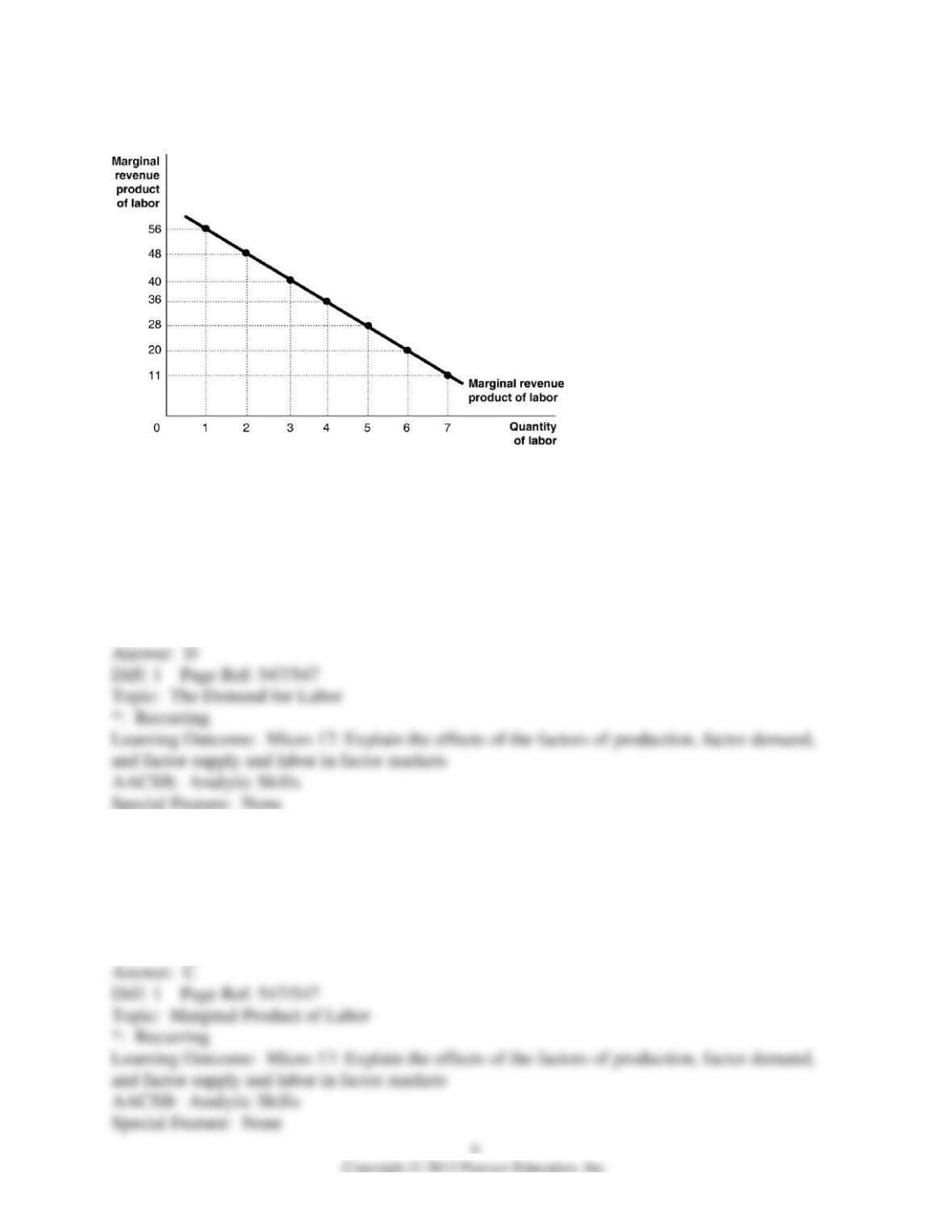
Figure 17-1
Figure 17-1 shows the marginal revenue product for Dale’s Hand-Sewn Doilies, a producer of
linen doilies.
11) Refer to Figure 17-1. If the wage rate is $40, how many workers should Dale hire?
A) 6 units
B) 5 units
C) 4 units
D) 3 units
12) Refer to Figure 17-1. If Dale can sell her doilies at $2 each, what is the marginal product of
the 5th worker?
A) $28
B) 28 doilies
C) 14 doilies
D) $56

13) Refer to Figure 17-1. Suppose the market price of doilies rises to $3. What happens to the
curve given in the diagram?
A) Nothing, because labor’s productivity has not changed.
B) There will be a movement along the curve.
C) The curve shifts to the right.
D) We cannot answer the question without knowing if Dale would want to hire more workers.
14) A firm’s demand for labor curve is also called its
A) marginal revenue product of labor curve.
B) marginal factor cost of labor curve.
C) marginal valuation curve.
D) marginal benefit of labor curve.

Table 17-1
Quantity of
Labor
Output
(units)
1
80
2
170
3
240
4
300
5
350
6
390
7
420
15) Refer to Table 17-1. The marginal product of the fourth unit of labor is
A) 300.
B) 75.
C) 60.
D) 15.
16) Refer to Table 17-1. If the output price is $3, what is the marginal revenue product of the
fifth unit of labor?
A) $1,050
B) $360
C) $210
D) $150

17) Refer to Table 17-1. Suppose the output price is $3. If the firm represented in the table is
maximizing its profit by hiring six workers, what is the wage rate?
A) $120
B) $65
C) $40
D) There is insufficient information to answer the question.
18) Refer to Table 17-1. Suppose the output price is $3. If the wage rate is $90, what is the
profit-maximizing quantity of labor that the firm should hire?
A) 7 units
B) 5 units
C) 4 units
D) 3 units
19) Firms use information on labor’s marginal revenue product to determine
A) how much to produce at each output price.
B) how many workers to hire at each wage rate.
C) how much marginal product to produce at each wage rate.
D) how much labor services to supply at each wage rate.

20) A reason why a perfectly competitive firm’s demand for labor curve slopes downward is that
A) each additional unit of labor hired is less efficient than previously hired units.
B) in the short run, as more labor is hired, labor’s marginal product falls because of the law of
diminishing returns.
C) the extra cost of hiring additional units of labor increases as a firm hires more units of labor.
D) the firm’s demand curve for the product that uses labor is downward sloping.
21) A firm’s primary interest when it hires an additional worker is
A) the cost of hiring the additional worker.
B) how the average output of the firm will be affected by this new worker.
C) the extra revenue the firm realizes from hiring that worker.
D) whether or not the new worker gets along with the firm’s existing workers.
22) The firm’s gain in profit from hiring another worker is
A) the marginal revenue product of the extra worker.
B) the difference between marginal revenue product and the wage of the worker.
C) the extra output of the extra worker.
D) the reduction in costs from hiring another worker.
Table 17-2
Quantity of
Labor
Output of iPods
per Week
Marginal Product
of Labor
Product
Price
(dollars)
Wage
(dollars)
1
8
8
$300
$350
2
15
7
280
350
3
21
6
260
350
4
26
5
240
350
5
30
4
220
350
6
33
3
200
350
7
35
2
180
350
23) Refer to Table 17-2. The firm represented in the diagram
A) has market power in the factor market.
B) has market power in the output market.
C) has market power in both the factor and product market.
D) has no market power in the factor or product market.
24) Refer to Table 17-2. The marginal revenue product of labor from the third unit of labor is
A) $5,460.
B) $1,560.
C) $1,260.
D) $780.

25) Refer to Table 17-2. The marginal profit from hiring the second unit of labor is
A) $4,200.
B) $1,960.
C) $1,800.
D) $1,450.
26) Refer to Table 17-2. What is the profit-maximizing quantity of labor that the firm should
hire?
A) 5 units
B) 4 units
C) 3 units
D) 2 units
27) Suppose a competitive firm pays a wage of $12 an hour and sells its product at $3 per unit.
Assume that labor is the only input. If hiring another worker would increase output by five units
per hour, then to maximize profits the firm should
A) not change the number of workers it currently hires.
B) lay off some of its workers.
C) hire the additional worker.
D) There is not enough information to answer the question.

28) Suppose a competitive firm is paying a wage of $12 an hour and sells its product at $3 per
unit. Assume that labor is the only input. If hiring another worker would increase output by
three units per hour, then to maximize profits the firm should
A) not change the number of workers it currently hires.
B) not hire an additional worker.
C) hire another worker.
D) There is not enough information to answer the question.
29) Suppose a competitive firm is paying a wage of $12 an hour and sells its product at $3 per
unit. Assume that labor is the only input. If the last worker hired increases output by three units
per hour, then to maximize profits the firm should
A) not change the number of workers it currently hires.
B) lay off some of its workers.
C) hire additional workers.
D) There is not enough information to answer the question.
30) Let MP = marginal product, P = output price, and W = wage, then the equation that
represents the condition where a competitive firm would hire another worker is
A) P × MP = W.
B) P × MP < W.
C) P × MP > W.
D) P × W > MP.

31) Let MP = marginal product, P = output price, and W = wage, then the equation that
represents a situation where a competitive firm should lay off some workers to maximize profits
is
A) P × MP = W.
B) P × MP > W.
C) P × MP < W.
D) MP × W = P.
32) If a worker can produce 20 units of output which can be sold for $4 per unit, what is the
maximum wage that firm should pay to hire this worker?
A) $80
B) $80 minus the firm’s profit markup
C) It depends on what the going wage rate is in the labor market.
D) There is insufficient information to answer the question.
33) Marginal revenue product can be calculated using the formula marginal product × output
price
A) only if output price is constant.
B) only if the marginal product of labor is constant.
C) only if the both marginal product of labor and the output price are constant.
D) only if the firm has market power in the labor market

34) An increase in the wage rate causes
A) a rightward shift of the firm’s labor demand curve.
B) a leftward shift of the firm’s labor demand curve.
C) a decrease in the quantity of labor demanded.
D) an increase in labor’s marginal productivity.
35) A decrease in the wage rate causes
A) an increase in the quantity of labor demanded.
B) a rightward shift of the firm’s labor demand curve.
C) a leftward shift of the firm’s labor demand curve.
D) a decrease in labor’s productivity.
36) An increase in a perfectly competitive firm’s demand for labor could be caused by
A) a decrease in the market wage rate.
B) an increase in the market demand for the firm’s product.
C) a decrease in the marginal product of workers.
D) an increase in the quantity of labor supplied.

37) Which of the following will not cause the labor demand curve to shift to the right?
A) an increase in the price of the firm’s product
B) a technological improvement that increases labor productivity
C) an increase in human capital in the labor force
D) an increase in the market wage rate
38) In the legal sector, some practice areas have declined in recent years. For example, personal-
injury and medical-malpractice cases have been undercut by state laws limiting class-action
suits, out-of-state plaintiffs and payouts on damages, and securities class-action litigation has
declined in part because of a buoyant stock market. How does this affect the market for lawyers?
A) The demand for lawyers shifts to the left.
B) The supply of lawyers shifts to the left.
C) The quantity of lawyers demanded decreases and this is represented by a movement along the
demand curve.
D) Both the demand and supply curves decrease.
39) If education reform leads to a more skilled and better trained public, the economy would
experience
A) an increase in human capital.
B) an increase in the supply of labor.
C) an increase in comparable worth.
D) a decrease in compensating differentials.

40) Education reform could lead to a more skilled and better trained public. A more skilled and
better trained public would
A) cause the market supply curve for labor to shift to the right.
B) cause the market demand curve for labor to shift to the right.
C) not shift the market demand curve for labor.
D) cause both the market demand curve for labor and the market supply curve for labor to shift
to the left.
41) Labor demand is considered a derived demand because producers do not demand labor for
itself but only because labor is used to produce output that consumers desire.
42) The marginal product of labor is the increase in output as a result of hiring an additional
worker while the marginal revenue product of labor is the increase in profit as a result of hiring
an additional worker.

43) Technological advancements that increase labor’s productivity shift the labor supply curve to
the right.
44) A profit-maximizing firm should hire workers up to the point where labor’s marginal revenue
product equals the wage rate.
45) What are the five most important variables that cause the market demand curve for labor to
shift?
46) A firm’s labor demand curve is also its marginal revenue product curve. For both the
perfectly competitive firm and the output price maker, the labor demand curve slopes
downwards. However, there is a difference in the reasons why the labor demand curve slopes
downwards. What is this difference?
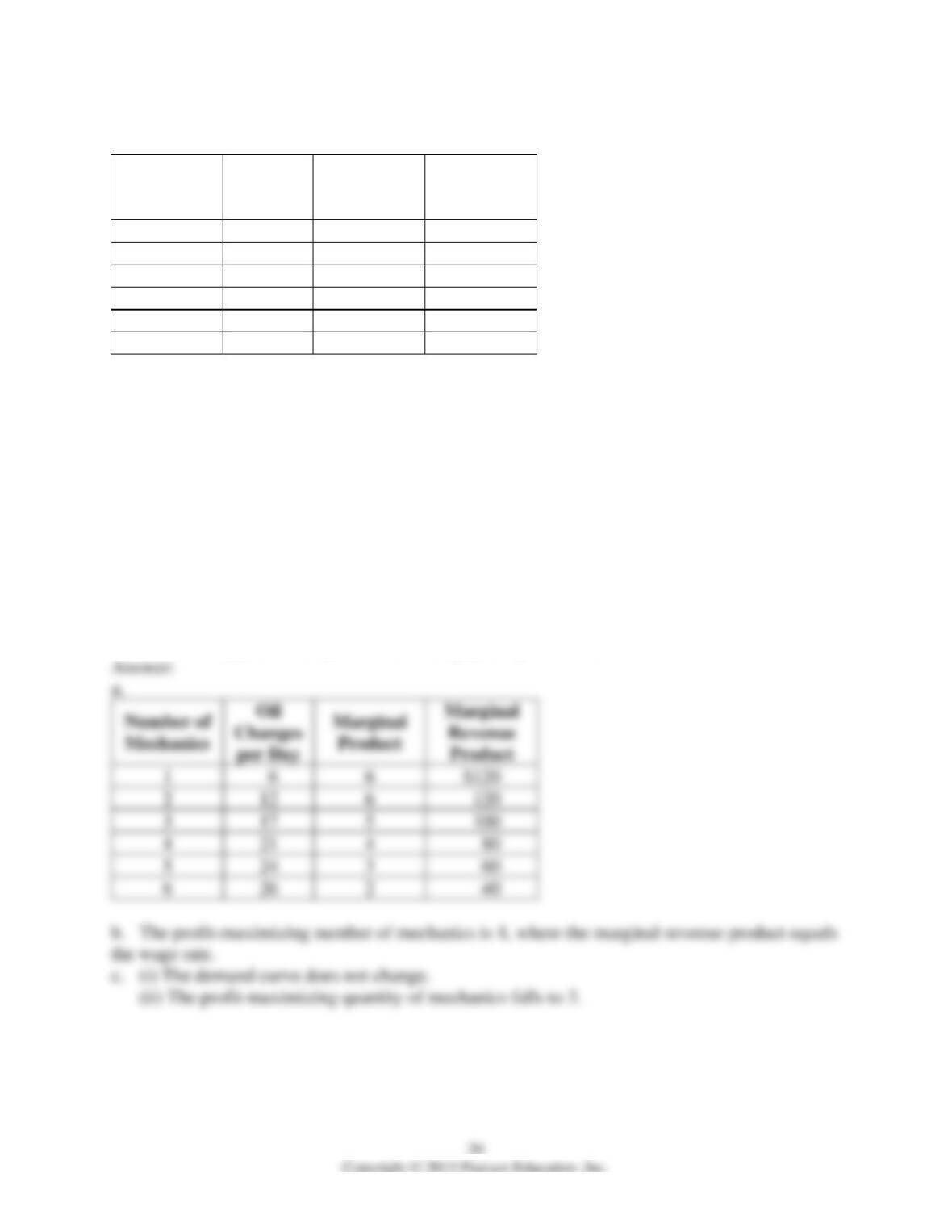
Table 17-3
Number of
Mechanics
Oil
Changes
per Day
Marginal
Product
Marginal
Revenue
Product
1
6
2
12
3
17
4
21
5
24
6
26
47) Refer to Table 17-3. Oil Can Harry’s, a new automobile service shop, is ready to start hiring.
The table above shows the relationship between the number of mechanics the firm hires and the
quantity of oil changes it produces.
a. Suppose the price of an oil change is $20. Complete the table by filling in the values for
marginal product and marginal revenue product.
b. Oil Can Harry’s is an input price-taker. Suppose the wage paid to mechanics is $80 per day.
What is the profit-maximizing number of mechanics?
c. Suppose the wage rate rises to $100 per day.
(i) What happens to the firm’s demand curve for mechanics?
(ii) What happens to the profit-maximizing quantity of mechanics?
d. Suppose the wage rate is $60 per day and the price of haircuts is now $15.
(i) What happens to the firm’s demand curve for mechanics?
(ii) What happens to the profit-maximizing quantity of mechanics?
Number of
Mechanics
Oil
Changes
Marginal
Product
Marginal
Revenue
Product
1
6
6
2
12
6
3
17
5
4
21
4
5
24
3
6
26
2