Chemistry, 7e (McMurry/Fay)
Chapter 17 Thermodynamics: Entropy, Free Energy, and Equilibrium
17.1 Multiple-Choice Questions
1) Which of the following statements is not true?
A) The reverse of a spontaneous reaction is always nonspontaneous.
B) A spontaneous process always moves toward equilibrium.
C) A nonspontaneous process cannot be caused to occur.
D) A highly spontaneous process need not occur rapidly.
2) Which forward reaction is a nonspontaneous process?
A) the expansion of a gas into a vacuum
B) N2(g) + 3 H2(g) ⇌ 2 NH3(g) if PH₂ = PN₂ = 1 atm, PNH₃ = 0, and Kp = 4 × 10⁵
C) 2 NH3(g) ⇌ N2(g) + 3 H2(g) if PNH₃ = 1 atm, PH₂ = PN₂ = 0, and Kp = 2 × 10⁻⁶
D) None of these
3) Classify each of the following processes as spontaneous or nonspontaneous.
I. H2O(l) → H2O(g) T = 25°C, vessel open to atmosphere with 50% relative humidity
II. H2O(s) → H2O(l) T = 25°C, P = 1 atm
A) I and II are both spontaneous.
B) I is spontaneous and II is nonspontaneous.
C) I is nonspontaneous and II is spontaneous.
D) I and II are both nonspontaneous.
4) The reaction A(g) → B(g) is spontaneous under standard conditions. Which of the following statements
must be true?
I. The reaction B(g) → A(g) is nonspontaneous under standard conditions.
II. A(g) will be completely converted to B(g) if sufficient time is allowed.
III. A(g) will be completely converted to B(g) rapidly.
A) none of these
B) I
C) I and II
D) I, II, and III
5) Which of the following processes are spontaneous?
I. dissolving more solute in an unsaturated solution
II. dissolving more solute in a saturated solution
III. dissolving more solute in a supersaturated solution
A) none of these
B) I
C) I and II
D) I, II, and III
6) Which of the following processes is non-spontaneous at standard temperature and pressure?
A) Iron metal, oxygen, and water form rust (Fe2O3).
B) Melting of solid ice to ice water.
C) Diffusion of perfume molecules across a room.
D) A reaction at equilibrium moves to non-equilibrium.
7) Entropy is a measure of
A) free energy.
B) the heat of a reaction.
C) molecular randomness.
D) the rate of a reaction.
8) Without doing any calculations, determine whether the standard entropy change, ΔS° is positive or
negative for each of the following reactions.
reaction 1: C(graphite) + O2(g) → CO2(g)
reaction 2: 2 CO(g) + O2(g) → 2 CO2(g)
A) ΔS° is positive for both reactions.
B) ΔS° is positive for reaction 1 but negative for reaction 2.
C) ΔS° is positive for reaction 2 but negative for reaction 1.
D) ΔS° is negative for both reactions.
9) Without doing any calculations, determine whether the standard entropy change, ΔS° is positive or
negative for each of the following reactions.
reaction 1: S(s, rhombic) + O2(g) → SO2(g)
reaction 2: 2 SO2(g)+ O2(g) → 2 SO3(g)
A) ΔS° is positive for both reactions.
B) ΔS° is positive for reaction 1 but negative for reaction 2.
C) ΔS° is positive for reaction 2 but negative for reaction 1.
D) ΔS° is negative for both reactions.
10) Sodium reacts violently with water according to the equation:
2 Na(s) + 2 H2O(l) → 2 NaOH(aq) + H2(g)
The resulting solution has a higher temperature than the water prior to the addition of sodium. What are
the signs of ΔH° and ΔS° for this reaction?
A) ΔH° is negative and ΔS° is negative.
B) ΔH° is negative and ΔS° is positive.
C) ΔH° is positive and ΔS° is negative.
D) ΔH° is positive and ΔS° is positive.
11) The brown color associated with photochemical smog is due to NO2(g), which is involved in an
equilibrium with N2O4(g) in the atmosphere.
2 NO2(g) ⇌ N2O4(g)
Predict the signs of the enthalpy and entropy change for the forward reaction.
A) The enthalpy change is negative and the entropy change is negative.
B) The enthalpy change is negative and the entropy change is positive.
C) The enthalpy change is positive and the entropy change is negative.
D) The enthalpy change is positive and the entropy change is positive.
12) What is W in Boltzmann’s formula, S = k ln W?
A) a fraction indicating the probability of obtaining a result
B) a random number
C) the number of ways of obtaining the state
D) the work times Avogadro’s number
13) What is the entropy of 105 molecules in 1010 boxes?
A) 1.59 × 10⁻²¹
B) 3.45 × 10⁻²⁰
C) 1.38 × 10⁻¹⁷
D) 3.18 × 10⁻¹⁷
14) An electron in an oxygen p orbital on which of the following would have the highest entropy?
A) CH3CH2OH
B) CH3CH2O–
C) CH3CO2OH
D) CH3CO2–
15) What is k in Boltzmann’s formula, S = k ln W?
A) the degeneracy of the state
B) the equilibrium constant for the process
C) the universal gas constant divided by Avogadro’s number
D) the universal gas constant times Avogadro’s number
16) The entropy change associated with the expansion of one mole of an ideal gas from an initial volume
of Vi to a final volume of Vf at constant temperature is given by the equation, ΔS = R ln (Vf/Vi). What is
the entropy change associated with the expansion of three moles of an ideal gas from an initial volume of
Vi to a final volume of Vf at constant temperature?
A) ΔS = R ln (Vf/Vi)
B) ΔS = 3 mol × R ln (Vf/Vi)
C) ΔS = R ln (Vf × 23/Vi)
D) ΔS = R ln (Vf × 3!/Vi)
17) What is the entropy change associated with the expansion of one mole of an ideal gas from an initial
volume of V to a final volume of V of 2.50V at constant temperature?
A) ΔS = 2.50 R ln (Vf/Vi)
B) ΔS = -2.50 R ln (Vf/Vi)
C) ΔS = R ln 2.50
D) ΔS = –R ln 2.50
18) Predict the sign of ΔS for each of the following processes, which occur at constant temperature.
I. The volume of 2.0 moles of O2(g) increases from 44 L to 52 L.
II. The pressure of 2.0 moles of O2(g) increases from 1.0 atm to 1.2 atm.
A) I: ΔS = negative; II: ΔS = negative
B) I: ΔS = negative; II: ΔS = positive
C) I: ΔS = positive; II: ΔS = negative
D) I: ΔS = positive; II: ΔS = positive
19) Assume a heteronuclear diatomic molecule, AB, forms a one-dimensional crystal by lining up along
the x-axis. Also assume that each molecule can only have one of six possible orientations, corresponding
to atom A facing in either the positive or negative direction along the x–, y-, or z-axis. If the molecules are
arranged randomly in the six directions, the molar entropy at absolute zero should be
A) R ln 6.
B) R ln 66.
C) R ln 6!
D) 0.
20) The Boltzmann formula is S = k ln W. A perfect crystal has a molar entropy of 0 at absolute zero
because
A) W = 0.
B) W = 1.
C) W = NA.
D) k = 1.
21) What is the sign of ΔS for each of the following processes?
I. The separation of gaseous molecules of UF6, into 238UF6 and 235UF6
at constant temperature and pressure.
II. The dissolving of I2(s) in CCl4(l).
A) ΔS is negative for I and negative for II.
B) ΔS is negative for I and positive for II.
C) ΔS is positive for I and negative for II.
D) ΔS is positive for I and positive for II.
22) According to the third law of thermodynamics,
A) energy is conserved in any transformation of matter.
B) the entropy increases for any spontaneous process.
C) the entropy of a perfectly ordered, crystalline substance is zero at 0 Kelvin.
D) the entropy of the universe increases for any spontaneous process.
23) Which of the following statements must be true for the entropy of a pure solid to be zero?
I. The temperature must be 0 K.
II. The solid must be crystalline, not amorphous.
III. The solid must be perfectly ordered.
IV. The solid must be an element.
A) I
B) I and II
C) I, II, and III
D) I, II, III, and IV
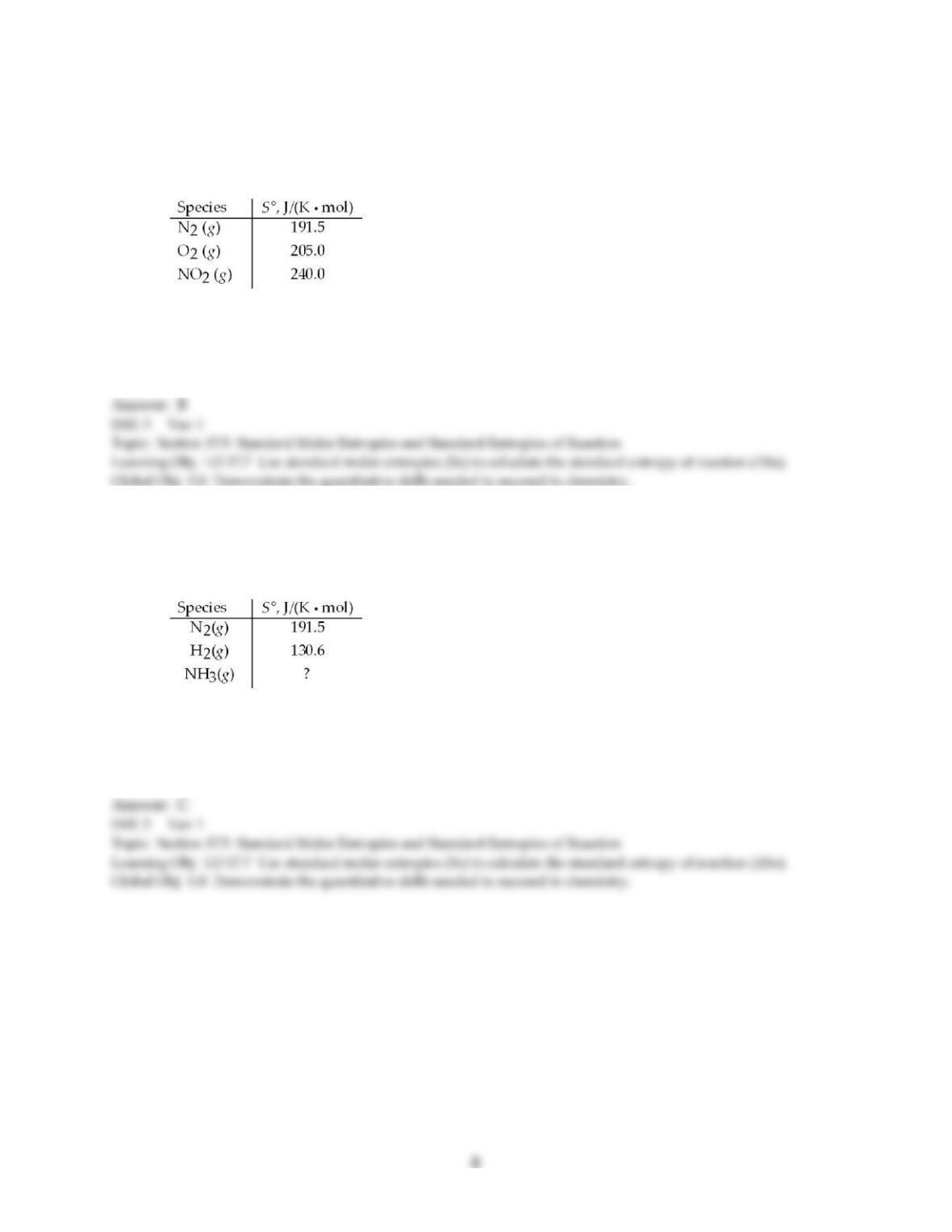
24) Calculate ΔS° for the following reaction.
N2(g) + 2 O2(g) → 2 NO2(g)
A) -156.5 J/K
B) -121.5 J/K
C) 15.5 J/K
D) 636.5 J/K
25) ΔS° = –198.7 J/K for the reaction shown below. Calculate S° for NH3(g).
N2(g) + 3 H2(g) → 2 NH3(g)
A) 61.7 J/K∙mol
B) 123.4 J/K∙mol
C) 192.3 J/K∙mol
D) 384.6 J/K∙mol
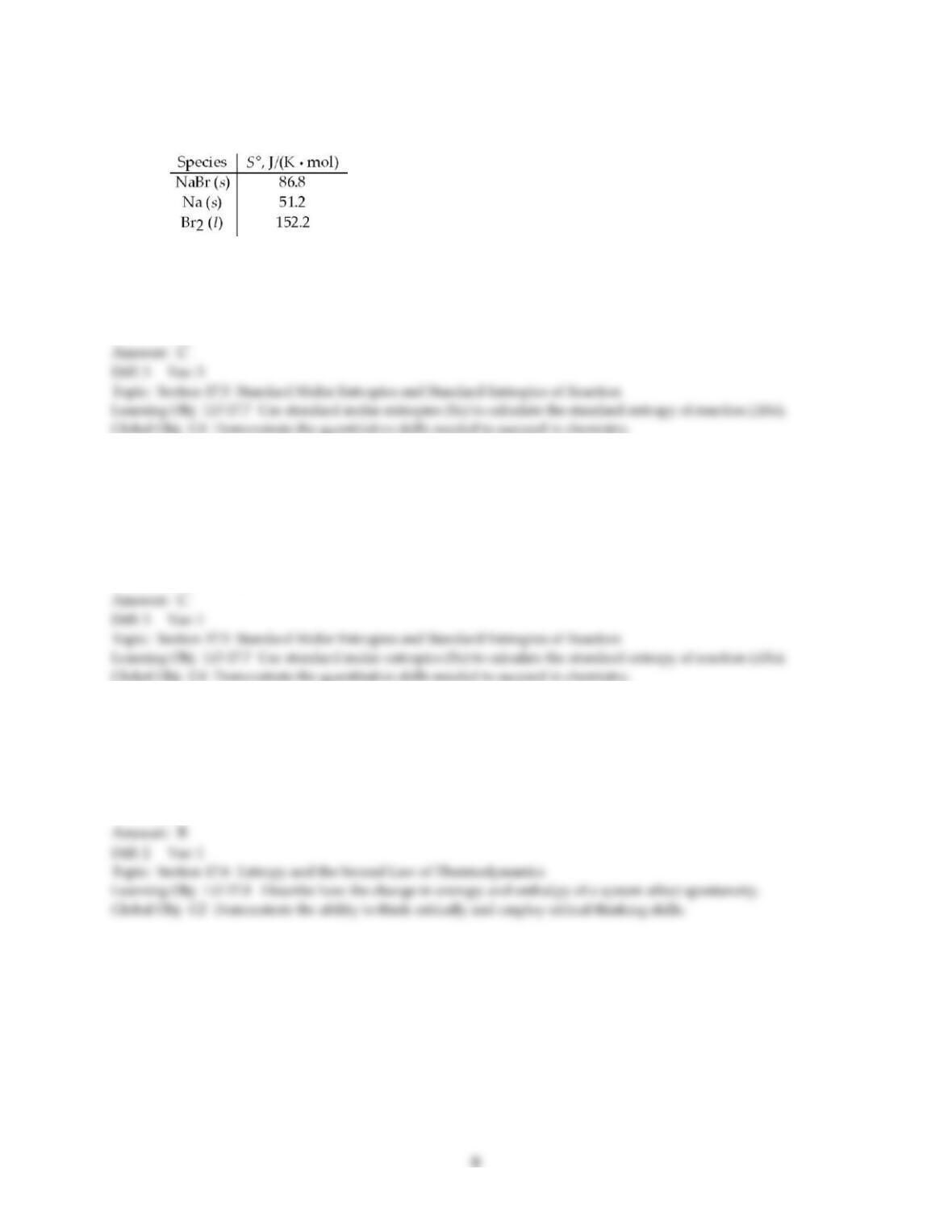
26) Calculate ΔS° for the formation of three moles of solid sodium bromide from the elements at 25°C.
A) -350.1 J/K
B) -243.6 J/K
C) -121.5 J/K
D) 260.4 J/K
27) The standard molar entropy for Br2(g) is 245.46 J/(mol ∙ K) at 25°C. Given that ΔS° = 104.58 J/K for the
dissociation of one mole of Br2(g) into Br(g) at 25°C, find the standard molar entropy for Br(g) at 25°C.
A) 70.44 J/(mol ∙ K)
B) 140.08 J/(mol ∙ K)
C) 175.02 J/(mol ∙ K)
D) 350.04 J/(mol ∙ K)
28) For a process to be at equilibrium, it is necessary that
A) ΔSsys = ΔSsurr.
B) ΔSsys = –ΔSsurr.
C) ΔSsys = 0.
D) ΔSsys = 0 and ΔSsurr = 0.
29) For a spontaneous process
A) energy and entropy are conserved.
B) energy is conserved and the entropy of the system and surroundings increases.
C) the energy of the system and the surroundings decreases and the entropy of the system and
surroundings increases.
D) both the energy and the entropy of the system and surroundings decrease.
30) For the process
CaCO3(calcite) → CaCO3(aragonite) ΔH° = –0.21 kJ, ΔS° = -4.2 J/K
Assuming that the surroundings can be considered a large heat reservoir at 25°C, calculate ΔSsurr and
ΔStotal for the process at 25°C and 1 atm pressure. Is the process spontaneous at 25°C and 1 atm
pressure?
A) ΔSsurr = 4.2 J/K, Δtotal = 0, not spontaneous
B) ΔSsurr = 0.7 J/K, ΔStotal = -3.5 J/K, not spontaneous
C) ΔSsurr = –0.7 J/K, ΔStotal = -4.9 J/K, spontaneous
D) ΔSsurr = –0.7 J/K, ΔStotal = -4.9 J/K, not spontaneous
31) During perspiration,
A) the entropy of the water evaporated decreases and the entropy of the body decreases.
B) the entropy of the water evaporated decreases and the entropy of the body increases.
C) the entropy of the water evaporated increases and the entropy of the body decreases.
D) the entropy of the water evaporated increases and the entropy of the body increases.
32) A hot penny is dropped into cold water inside a polystyrene foam cup. Assuming negligible heat loss
to the atmosphere and the cup,
A) the decrease in entropy of the penny is equal to the increase in entropy of the water.
∣ ΔSpenny ∣ = ∣ ΔSwater ∣
B) the decrease in entropy of the penny is less than the increase in entropy of the water.
∣ ΔSpenny ∣ < ∣ ΔSwater ∣
C) the decrease in entropy of the penny is more than the increase in entropy of the water.
∣ ΔSpenny ∣ > ∣ ΔSwater ∣
D) the entropy of both the penny and the water increases.
33) At constant pressure and temperature, which statement is true?
A) All reactions for which ΔH < 0 are spontaneous.
B) All reactions for which ΔS < 0 are spontaneous.
C) All reactions for which ΔG < 0 are spontaneous.
D) All reactions for which K < 1 are spontaneous.
34) Why is the sign of ΔG rather than the sign of ΔStotal generally used to determine the spontaneity of a
chemical reaction?
A) ΔG can be used for processes that occur under any conditions.
B) ΔG involves thermodynamic functions of the system only.
C) Free energy is easier to understand than entropy.
D) Entropy is based on probability and is therefore less reliable.
35) For the reaction 3 C2H2(g) → C6H6(l) at 25°C, the standard enthalpy change is –631 kJ and the
standard entropy change is -430 J/K. Calculate the standard free energy change at 25°C.
A) 948 kJ
B) -503 kJ
C) -618 kJ
D) -1061 kJ
36) The solubility of manganese(II) fluoride in water is 6.6 g/mL at 40°C and 4.8 g/L at 100°C. Based on
these data, what is the sign of ΔH° and ΔS° for the process below?
MnF2(s) ⇌ Mn2+(aq) + 2 F–(aq)
A) ΔH° is negative but the sign of ΔS° cannot be determined from this information.
B) ΔH° is negative and ΔS° is definitely negative.
C) ΔH° is positive but the sign of ΔS° cannot be determined from this information.
D) ΔH° is positive and ΔS° is definitely negative.
37) At 25°C, ΔH° = 1.895 kJ and ΔS° = -3.363 J/K for the transition
C(graphite) → C(diamond)
Based on these data,
A) graphite cannot be converted to diamond at 1 atm pressure.
B) diamond is more stable than graphite at all temperatures at 1 atm.
C) diamond is more stable than graphite below 290°C and graphite is more stable than diamond above
290°C.
D) graphite is more stable than diamond below 290°C and diamond is more stable than graphite above
290°C.
38) For bromine, ΔH°vap = 30.91 kJ/mol and ΔS°vap = 93.23 JK–1mol-1 at 25°C. What is the normal boiling
point for bromine?
A) 25°C
B) 58°C
C) 124°C
D) 332°C
39) Consider the reaction:
N2(g) + 3 F2(g) → 2 NF3(g) ΔH° = –249 kJ and ΔS° = -278 J/K at 25°C
Calculate ΔG° and state whether the equilibrium composition should favor reactants or products at
standard conditions.
A) ΔG° = -332 kJ; the equilibrium composition should favor products.
B) ΔG° = -332 kJ; the equilibrium composition should favor reactants.
C) ΔG° = -166 kJ; the equilibrium composition should favor products.
D) ΔG° = -166 kJ; the equilibrium composition should favor reactants.
40) Which statement is true about the formation of CaCO3(s) from CaO(s) and CO2(g) at 1.00 atm?
CaO(s) + CO2(g) → CaCO3(s) ΔH° = –178.7 kJ and ΔS° = –150.4 J/K
A) The reaction is spontaneous at all temperatures.
B) The reaction is spontaneous at high temperatures.
C) The reaction is spontaneous at low temperatures.
D) The reaction is not spontaneous at any temperature.
14
41) The signs of ΔG, ΔH, and ΔS at 25°C are shown below for three reactions.
reaction ΔG ΔH ΔS
I. – + +
II. – – +
III. – – –
Which reaction could go in the reverse direction at high temperature?
A) I
B) II
C) III
D) I and II
42) For the evaporation of water during perspiration on a hot, dry day,
A) ΔH is positive and TΔS = ΔH.
B) ΔH is positive and TΔS > ΔH.
C) ΔH is positive and TΔS < ΔH.
D) ΔH is negative and TΔS is positive.
43) For the reaction below ΔG° = +33.0 kJ, ΔH° = +92.2 kJ, and ΔS° = +198.7 J/K. Estimate the temperature
at which this reaction becomes spontaneous.
2 NH3(g) → N2(g) + 3 H2(g)
A) 0.464 K
B) 166 K
C) 298 K
D) 464 K
44) A reaction has ΔH° = 61.9 kJ/mol and ΔS° = 405.4 J/K. Is this reaction spontaneous or nonspontaneous?
At what temperature (if any) can the spontaneity be reversed?
A) nonspontaneous, can be made spontaneous at 153 K
B) nonspontaneous, cannot be made spontaneous at any temperature
C) spontaneous, can be made nonspontaneous at 153 K
D) spontaneous, cannot be made nonspontaneous at any temperature
45) A reaction has ΔH° = –60.9 kJ/mol and ΔS° = 266.6 J/K. Is this reaction spontaneous or
nonspontaneous? At what temperature (if any) can the spontaneity be reversed?
A) nonspontaneous, can be made spontaneous at 228 K
B) nonspontaneous, cannot be made spontaneous at any temperature
C) spontaneous, can be made nonspontaneous at 228 K
D) spontaneous, cannot be made nonspontaneous at any temperature
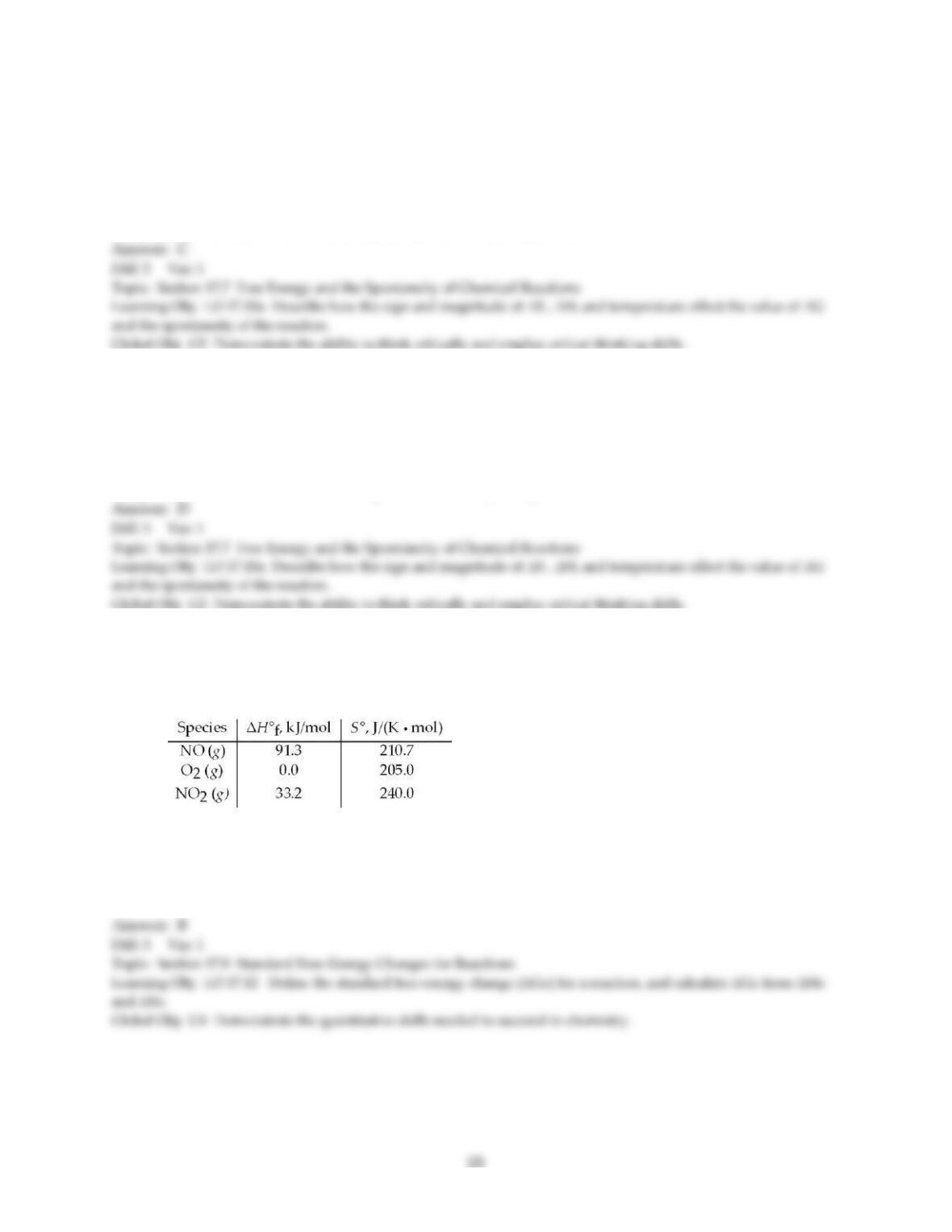
46) Calculate the standard free energy change at 25°C for the reaction
2 NO(g) + O2(g) → 2 NO2(g).
A) -4.7 kJ
B) -72.6 kJ
C) -157.8 kJ
D) -532.6 kJ
47) For any thermodynamic function Y, ΔY° for a reaction refers to the change in Y for the process in
which
A) the mixed reactants at 1 atm go to equilibrium at 1 atm.
B) the separate reactants at 1 atm go to equilibrium at 1 atm.
C) the separate reactants in their standard states are completely converted to separate products in their
standard states.
D) the spontaneous reaction occurs.
48) Which of the following is true?
A) As a reaction at constant temperature and pressure goes to equilibrium, |ΔG| decreases.
B) The larger ΔG°, the faster the reaction.
C) The standard state for solutes is the pure solute at 1 atm.
D) When a reaction reaches equilibrium, ΔG° = 0.
49) For the reaction 3 C2H2(g) → C6H6(l) at 25°C, the standard enthalpy change is –631 kJ and the
standard entropy change is -430 J/K. Calculate the standard free energy change at 25°C?
A) -503 kJ
B) -10,120 kJ
C) 619 kJ
D) -127 kJ
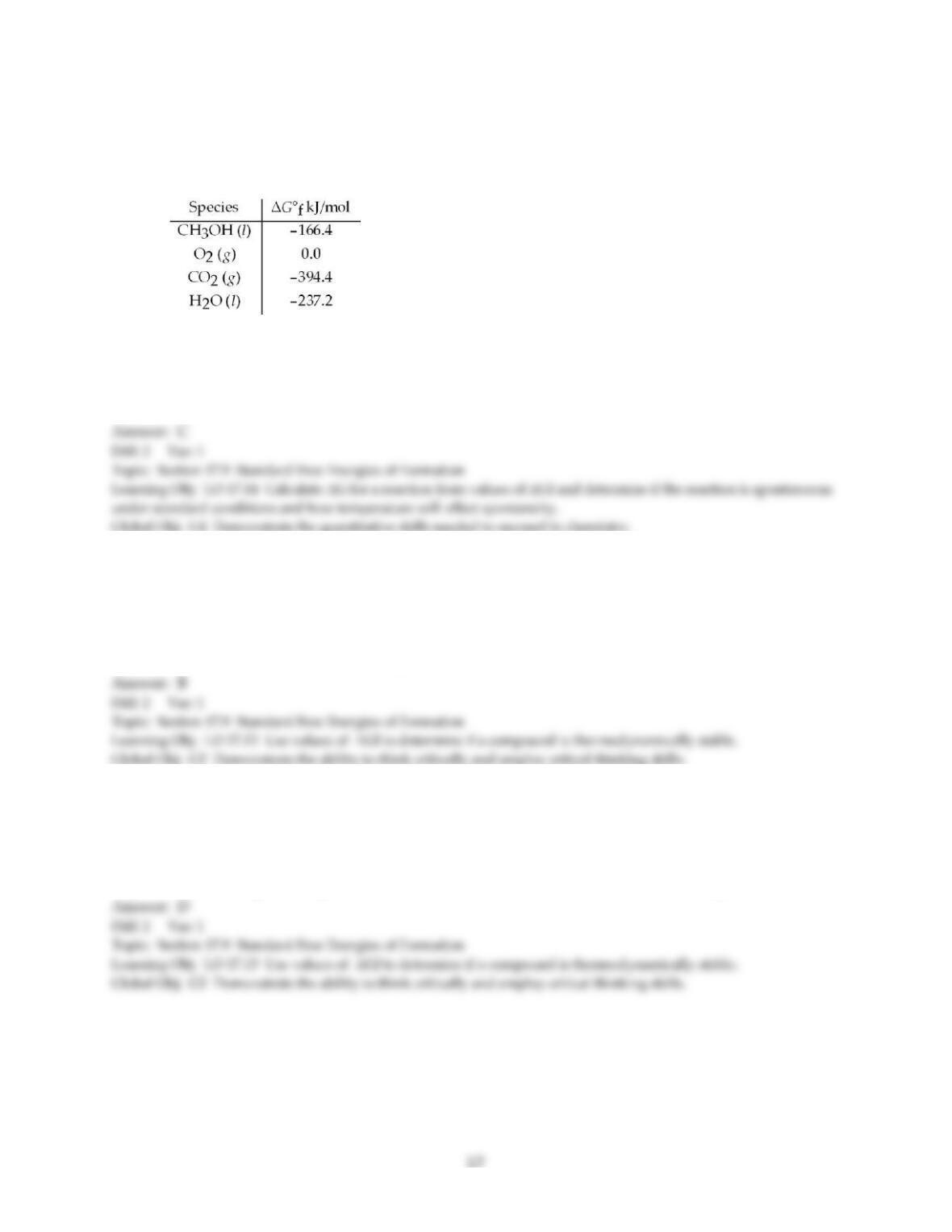
50) Calculate the standard free energy for the reaction given.
2 CH3OH(l) + 3 O2(g) → 2 CO2(g) + 4 H2O(l)
A) -465.2 kJ
B) -797.8 kJ
C) -1404.8 kJ
D) -2069.8 kJ
51) Which is the lowest at 25°C?
A) ΔG°f for H2O (s)
B) ΔG°f for H2O (l)
C) ΔG°f for H2O (g)
D) 1/2ΔG°f for O2 (g) plus ΔG°f for H2O (g)
52) A positive value of ΔG°f for a solid compound at 25°C means the
A) compound cannot exist at 25°C and 1 atm.
B) compound must be a liquid or a gas at 25°C and 1 atm.
C) process of forming the compound from the elements is exothermic.
D) process of forming the compound from the stable elements at 25°C and 1 atm is nonspontaneous.
53) At 25°C, ΔG°f is -620 kJ/mol for SiCl4(g) and –592 kJ/mol for MgCl2(s). Calculate ΔG° for the reaction,
SiCl4(g) + 2 Mg(s) → 2 MgCl2(s) + Si(s) and determine if the reaction is spontaneous at 25°C if the
pressure of SiCl4(g) is 1 atm.
A) ΔG° = 28 kJ; the process is spontaneous.
B) ΔG° = 28 kJ; the process is nonspontaneous.
C) ΔG° = -564 kJ; the process is spontaneous.
D) ΔG° = -564 kJ; the process is nonspontaneous.
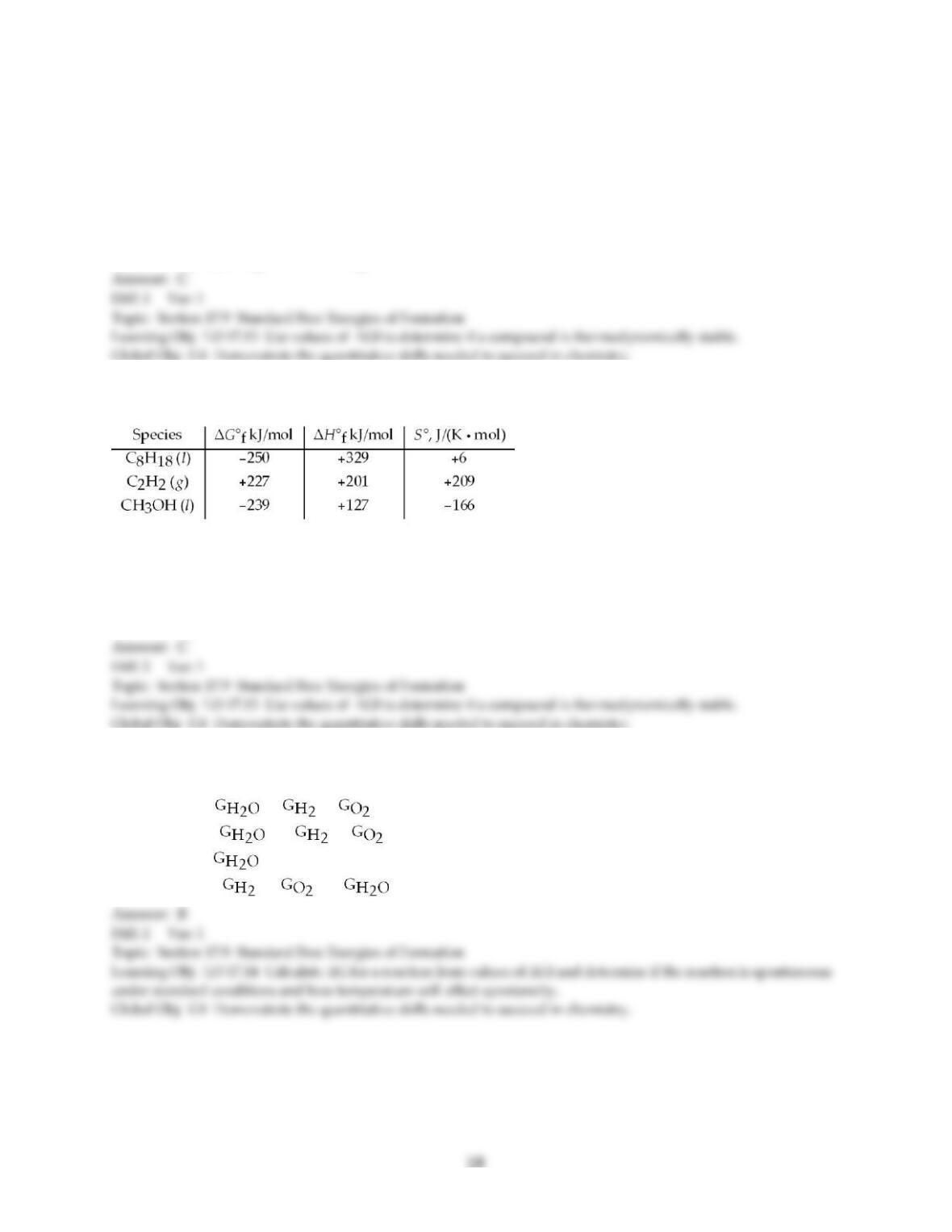
54) Which of the following are unstable with respect to their constituent elements at 25°C?
A) C8H18(l), CH3OH(l)
B) C8H18(l), C2H2(g)
C) C2H2(g)
D) CH3OH(l)
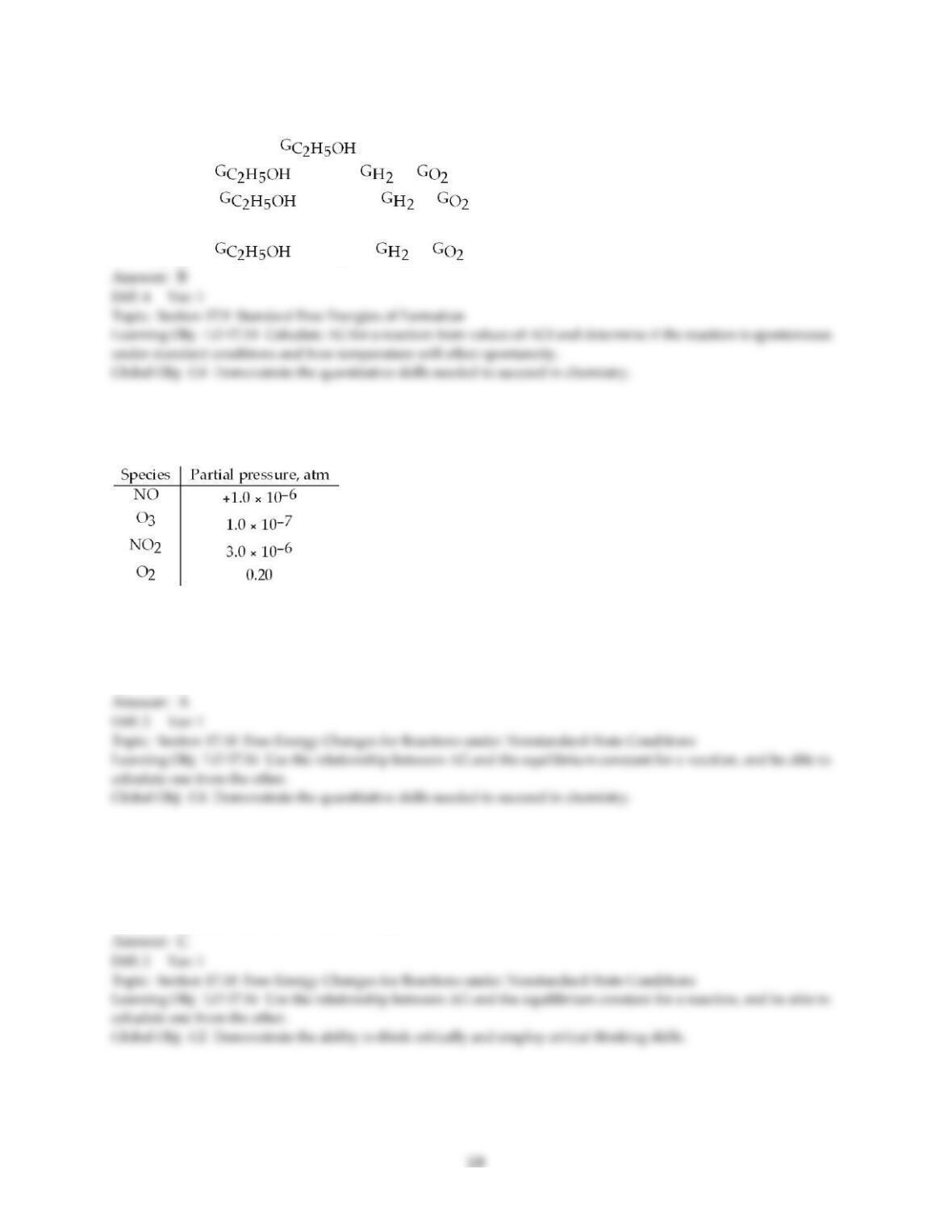
55) Water can be made from elemental hydrogen and oxygen. Which equation can be used to determine
ΔGform from its elemental parts?
A) ΔGform = Δ
– Δ
– Δ
B) ΔGform = 2Δ
– 2Δ
– Δ
C) ΔGform = Δ
– 2ΔGH
– ΔGO
D) ΔGform = 2Δ
+ Δ
– 2Δ
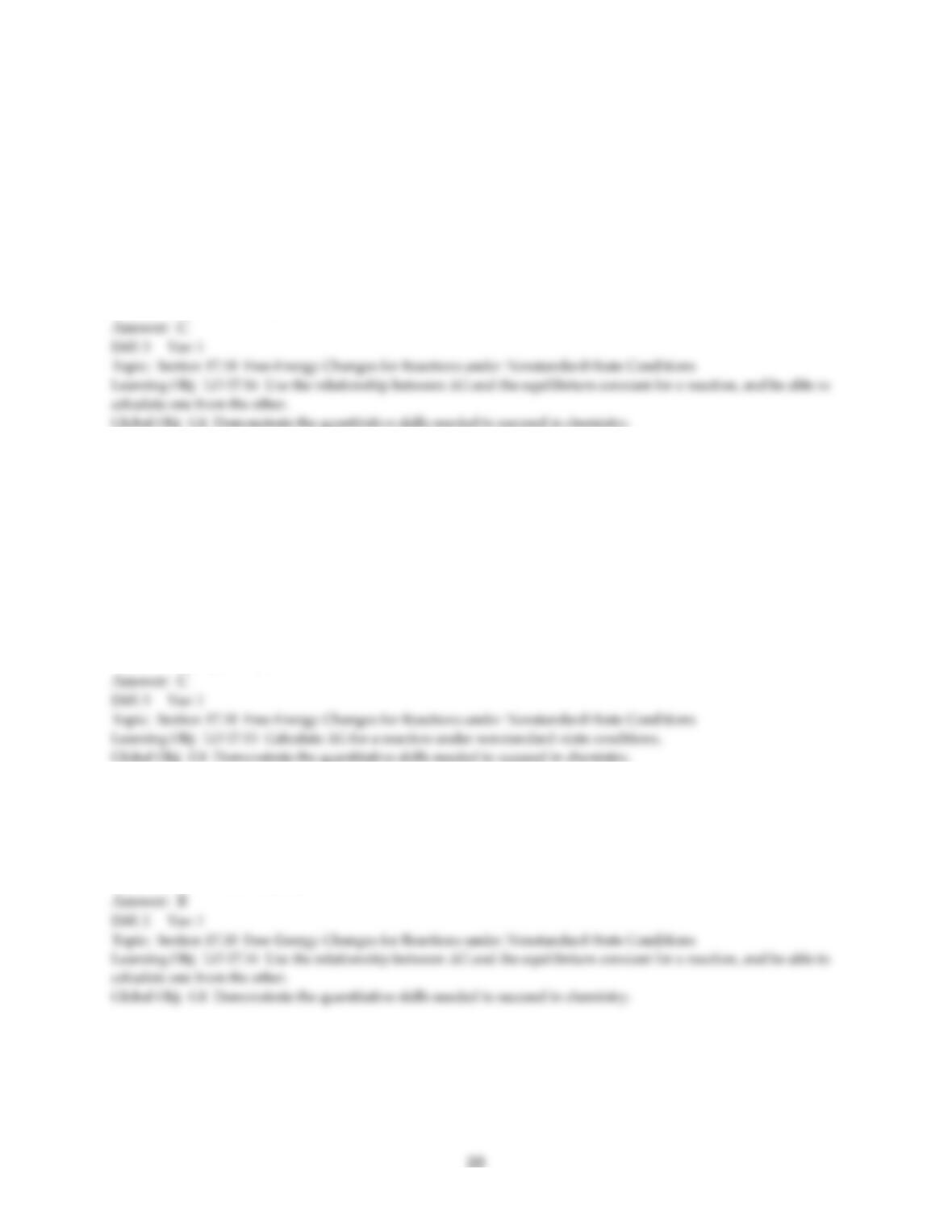
56) Which equation can be used to determine ΔGform for C2H5OH from its elemental parts. Be sure that
the reaction is balanced.
A) ΔGform = Δ
– ΔGC
– Δ
– Δ
B) ΔGform = 2Δ
– 4ΔGC
– 6Δ
– Δ
C) ΔGform = 2ΔGC
+ 6ΔGH
+ ΔGO
D) ΔGform = Δ
– 2ΔGC
– 3Δ
– Δ
57) At 25°C, ΔG° = -198 kJ for the reaction, NO(g) + O3(g) ⇌ NO2(g) + O2(g).
Calculate ΔG under the following conditions:
A) -159 kJ
B) -167 kJ
C) -198 kJ
D) -236 kJ
58) For a reaction at constant temperature, as Q increases
A) ΔG and ΔG° increase.
B) ΔG and ΔG° decrease.
C) ΔG increases, but ΔG° remains constant.
D) ΔG decreases, but ΔG° remains constant.
59) At high temperatures boron carbide vaporizes according to the equation
B4C(s) ⇌ 4 B(g) + C(s)
Which equation describes the relationship between ΔG° and ΔG for this reaction?
A) ΔG = ΔG° + R T ln (pB ∙ [C]/[B4C])
B) ΔG = ΔG° + R T ln pB
C) ΔG = ΔG° + 4 R T ln pB
D) ΔG = ΔG° – 4 R T ln pB
60) At 2600 K, ΔG° = 775 kJ for the vaporization of boron carbide:
B4C(s) ⇌ 4 B(g) + C(s)
Find ΔG and determine if the process is spontaneous if the reaction vessel contains 4.00 mol B4C(s), 0.400
mol of C(s), and B(g) at a partial pressure of 1.0 × 10⁻⁵ atm. At this temperature, R T = 21.6 kJ.
A) ΔG = -270 kJ; spontaneous.
B) ΔG = -270 kJ; nonspontaneous.
C) ΔG = -220 kJ; spontaneous.
D) ΔG = -220 kJ; nonspontaneous.
61) ΔG = ΔG° for a reaction
A) if Q = K.
B) if Q = 1.
C) at STP.
D) at the start of the reaction.