Chapter 17 – Cost behaviour and cost-volume-profit analysis
TRUE/FALSE
1. Cost-volume-profit (CVP) analysis is a technique that examines the interrelationship between cost,
volume and profit at constant activity levels.
2. A dependent variable represents the cost of an activity, while the independent variable represents
the level of the activity.
3. Fixed costs such as rent, rates, and administration salaries are normally also classified as overhead
costs.
4. Fixed costs are constant over all levels of activity.
5. Discounts, increased prices and diminishing returns are all reasons why a variable cost function
will not necessarily behave in a linear fashion.
6. The relevant range of activity relates to the levels of activity that the firm has experienced in past
periods.
7. A firm sells a product for $250. Variable costs are $100 per unit and total fixed costs are $120,000.
The break-even point will be 800 units.
8. To calculate the break-even point, that is, where neither a profit nor a loss is made, the formula
Sx = VCx + FC + P can be used, but only if P is equal to zero.
9. The contribution margin of every unit of goods or services sold after the break-even point has been
reached will contribute to profit.
10. The contribution margin is equal to sales revenue less fixed costs.
11. If the break-even point is 300 units and the contribution margin is $30 per unit, then every unit
sold above 300 will contribute $30 to profit.
12. The contribution margin ratio is equal to the contribution margin divided by sales, and shows the
proportion of each sales dollar available to cover fixed costs and contribute to profit.
1. What will fixed costs do when activity increases but remains within the relevant range of activity?
A.
Increase
B.
Remain the same
C.
Decrease
D.
Display an erratic behaviour
2. Paul’s Ltd is considering increasing its production by 5%. If production increases, what is the most
likely impact on costs?
A.
Administrative wages will increase.
B.
Factory casual labour will increase.
C.
Power costs will decrease.
D.
Depreciation charges will increase.
3. Under the assumptions used in cost-volume-profit analysis, as volume increases:
A.
fixed costs increase in proportion to the increase in volume.
B.
variable costs per unit remain the same.
C.
fixed costs per unit remain the same.
D.
variable costs per unit increase in proportion to the increase in volume.
4. All of the following are assumptions made in cost-volume-profit analysis except:
A.
the cost of materials can change at different levels of volume.
B.
fixed costs are constant over the volume of production being considered.
C.
mixed costs can be separated into their variable and fixed components.
D.
the various components of unit variable cost remain constant during the period of analysis.
5. Unit costs help managers make decisions about:
A.
continuing to offer a product for sale.
B.
resource allocation.
C.
product pricing.
D.
all of the above.
6. A break-even point occurs when:
A.
variable costs equal fixed costs.
B.
sales revenue equals the total of variable and fixed costs of production.
C.
assets equal liabilities.
D.
contribution margin equals all variable costs.
7. The break-even point is the point at which the total contribution margin is equal to total:
A.
sales.
B.
variable costs.
C.
fixed costs.
D.
fixed and variable costs.
8. Able Company sells a product for $50 per unit, its variable costs are $35 per unit and its total fixed
costs are $45,000. What is Able’s break-even point?
A.
900 units.
B.
1286 units.
C.
3000 units.
D.
6000 units.
9. Which of the following shows a combination of costs that would normally be fixed and variable
costs for a production plant?
A.
Costs of building and costs of equipment.
B.
Land purchase costs and costs of equipment.
C.
Cost of building and costs of materials.
D.
Land purchase costs and general manager’s salary.
10. Arches Manufacturing Company provides the following information:
Costs
Direct labour
$16,000
Direct materials
20,000
Direct labour hours
4000
Manufacturing overhead
36,000
Variable selling expenses
12,000
Number of units produced
800
What is the total unit cost of one unit of finished product?
A.
$87
B.
$90
C.
$95
D.
$105
11. Heath Ltd owns and operates a textile manufacturing plant. Garments are sold for $40 each. The
fixed plant and equipment costs are $51,600 per annum. Producing each garment incurs $15 of
labour costs and $7.80 of material costs.
What is the break-even point for Heath Ltd?
A.
1290 garments
B.
1602 garments
C.
2064 garments
D.
3000 garments
12. Heath Ltd owns and operates a textile manufacturing plant. Garments are sold for $40 each. The
fixed plant and equipment costs are $51,600 per annum. Producing each garment incurs $15 of
labour costs and $7.80 of material costs.
To make a profit of $4000, Heath Ltd must produce (to the nearest integer):
A.
1390 garments.
B.
1727 garments.
C.
2224 garments.
D.
3233 garments.
13. Heath Ltd owns and operates a textile manufacturing plant. Garments are sold for $40 each. The
fixed plant and equipment costs are $51,600 per annum. Producing each garment incurs $15 of
labour costs and $7.80 of material costs.
Heath Ltd’s contribution margin per garment is:
A.
$40.
B.
$32.20.
C.
$25.
D.
$17.20.
14. Heath Ltd owns and operates a textile manufacturing plant. Garments are sold for $40 each. The
fixed plant and equipment costs are $51,600 per annum. Producing each garment incurs $15 of
labour costs and $7.80 of material costs.
If Heath Ltd is considering advertising costs of $4300, how many garments must be sold to break
even?
A.
1397 garments
B.
1736 garments
C.
2236 garments
D.
3250 garments
15. Heath Ltd owns and operates a textile manufacturing plant. Garments are sold for $40 each. The
fixed plant and equipment costs are $51,600 per annum. Producing each garment incurs $15 of
labour costs and $7.80 of material costs.
If Heath Ltd’s cost of plant and equipment increases, which of the following is true?
A.
The contribution margin increases.
B.
Variable costs increases.
C.
The break-even point increases.
D.
No change occurs.
16. Jany Ltd produces 20,000 golf balls. Each golf ball sells for $8, and it costs $2000 to produce the
golf balls. The cost of the fixed plant and equipment needed to produce the golf balls is $1500 per
period. The break-even point for Jany Ltd is (to the nearest integer):
A.
190 golf balls.
B.
200 golf balls.
C.
210 golf balls.
D.
220 golf balls.
17. A company has net profit of $10,000, sales price per unit of $25 and fixed costs of $40,000. The
company would like to increase profits by 50%. What percentage increase in sales volume would
be needed to achieve this goal?
A.
20%
B.
10%
C.
12.5%
D.
Answer cannot be determined from the information given.
18. Sweet Things, Inc. had the following results for the year ended 31 December 20X2. Volume was
60,000 units in 20X2.
Sales
$120,000
Direct labour
6000
Direct materials
18,000
Fixed manufacturing overhead
50,000
Variable selling expenses
6000
Fixed administrative expenses
10,000
Net profit
$30,000
If volume increased to 70,000 units, what should Sweet Things, Inc. have expected net profit to be
in 20X3?
A.
$35,000
B.
$45,000
C.
$46,000
D.
$50,000
19. Sweet Things, Inc. had the following results for the year ended 31 December 20X2. Volume was
60,000 units in 20X2.
Sales
$120,000
Direct labour
6000
Direct materials
18,000
Fixed manufacturing overhead
50,000
Variable selling expenses
6000
Fixed administrative expenses
10,000
Net profit
$30,000
What is Sweet Things, Inc.’s break-even sales volume in dollars?
A.
$80,000
B.
$90,000
C.
$100,000
D.
$120,000
20. A company’s current sales are $400,000 at a volume of 10,000 units. Fixed costs are $120,000 and
variable costs are $30 per unit. What is the company’s break-even sales volume in units?
A.
3000
B.
4000
C.
10,000
D.
12,000
21. If fixed costs for a company are $65,000 and variable costs are 20% of sales, what do total sales
need to be to achieve a target net profit of $35,000?
A.
$80,000
B.
$100,000
C.
$125,000
D.
$500,000
22. The point where profit equals the total of fixed and variable costs is called the:
A.
break-even point.
B.
target net income.
C.
margin of safety.
D.
contribution margin.
23. The sales price is $60 per unit, variable costs are $25 per unit, and fixed costs are $175,000. What
level of sales, in units, would achieve a target profit of $350,000?
A.
10,000 units
B.
14,000 units
C.
15,000 units
D.
21,000 units
24. If a company is currently operating at its break-even point, which of the following statements is
true? (Income tax considerations are ignored.)
A.
If fixed costs increase, net profit will decrease by the contribution margin ratio times the
amount of the increase in fixed costs.
B.
If sales increase by 20%, net profit will also increase by 20%, assuming that fixed costs
are not equal to zero.
C.
If variable costs double, net profit will decrease by 50%.
D.
Net profit will increase by the increase in number of units sold times the contribution
margin per unit.
25. Winter Sales, Inc. sells many kinds of winter sports equipment, primarily through telemarketing.
Its sales staff are paid 15% of all sales dollars generated. In order to decrease the uncertainty of this
arrangement for its staff and increase loyalty, the company is considering a change in the method
of payment. The company would like to pay its 100 employees $1000 per month plus 10% of
sales. Using cost-volume-profit analysis, what volume of sales dollars does the company need to
exceed per month to make this new method more profitable for the company than the old method?
A.
$100,000
B.
$1,000,000
C.
$2,000,000
D.
Answer cannot be determined from the information given.
26. On a break-even graph, the break-even point is the point on the graph where the:
A.
revenue line crosses the fixed-cost line.
B.
revenue line crosses the line that represents fixed costs plus variable costs.
C.
revenue line crosses the contribution margin line.
D.
total cost line crosses the contribution margin line.
27. The amount that is available to be contributed to fixed costs after deducting variable expenses from
sales is called the:
A.
profit-volume ratio.
B.
break-even point.
C.
contribution margin ratio.
D.
contribution margin.
28. If a company’s sales price for its product is $40, its variable cost percentage is 30%, its sales are
$200,000, and its fixed costs are $100,000, what will be its contribution margin per unit?
A.
$10
B.
$12
C.
$28
D.
$30
29. Jany Ltd produces 20,000 golf balls. Each golf ball sells for $8, and it costs $2000 to produce the
golf balls. However, Jany Ltd is considering switching to golf clubs, which have a contribution
margin of $10. The cost of the fixed plant and equipment needed to produce the golf balls is
$1500. Jany Ltd expects to sell 1000 golf clubs per period at $100 each. Which of the following is
true?
A.
Golf balls are more profitable per unit than golf clubs.
B.
The contribution margin for golf balls is $2.10 larger than that for golf clubs.
C.
Total revenue from golf clubs will be higher than that from golf balls.
D.
Every golf club sold contributes $2.10 more to the profit than each golf ball.
30. Which of the following situations would be most likely to violate cost-volume-profit assumptions
about variable costs?
A.
As volume doubles, direct labour costs also double.
B.
As volume decreases, per-unit material costs remain constant.
C.
The company’s raw material supplier typically allows volume discounts when larger
amounts of the raw material are purchased.
D.
Fixed costs per unit decrease as volume increases.
31. Which of the following situations would be most likely to violate cost-volume-profit assumptions
about fixed costs?
A.
When production volume increases beyond the capacity of the plant, a second shift will be
added instead of building a new plant.
B.
As volume decreases, per-unit fixed manufacturing overhead remains constant.
C.
The company’s raw material supplier typically allows volume discounts when larger
amounts of the raw material are purchased.
D.
Fixed costs per unit decrease as volume increases.
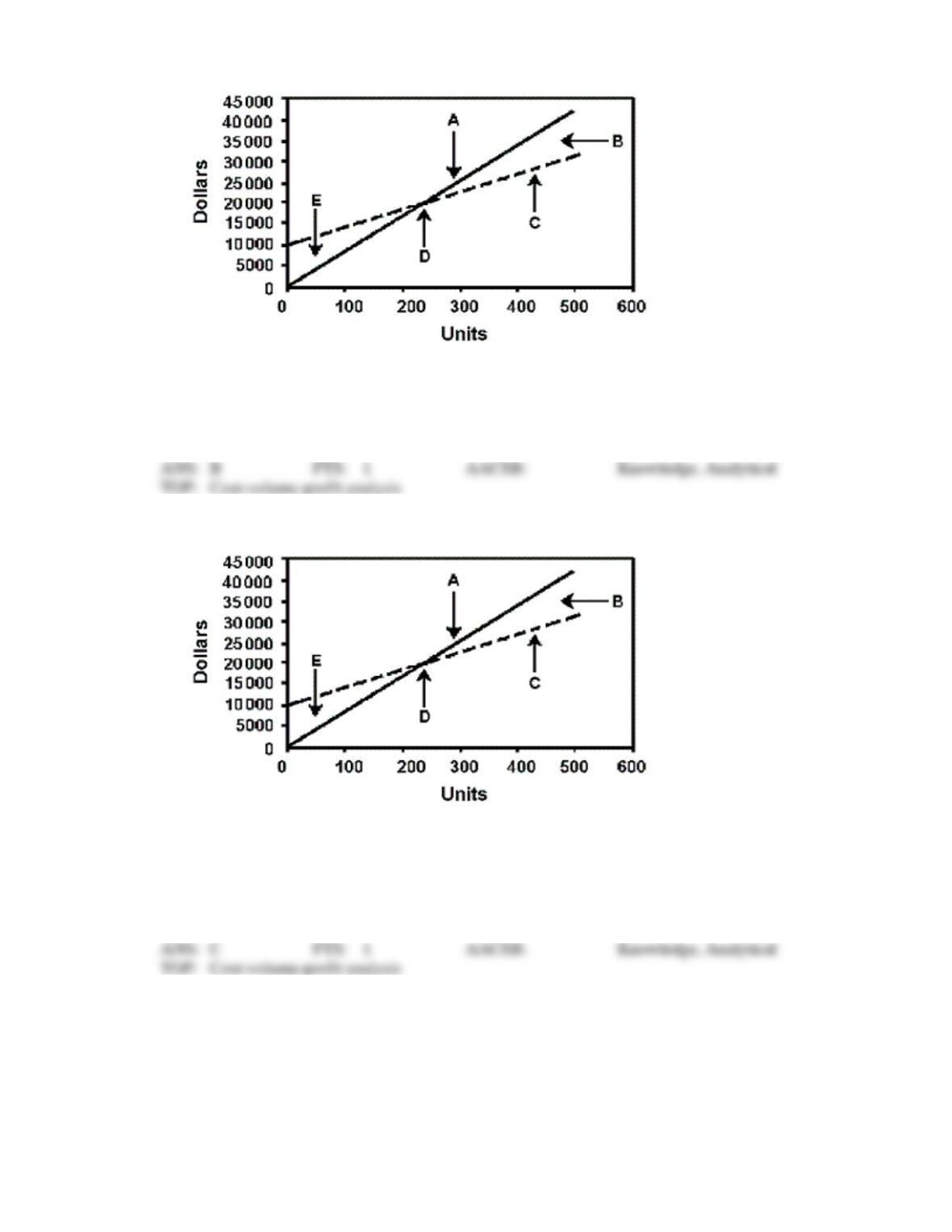
32.
Refer to the graph above. Line A (the solid black line) is:
A.
the cost line.
B.
the revenue line.
C.
the profit line.
D.
the loss line.
33.
Refer to the graph above. Area B (the area between the solid black line and the dashed black line)
is:
A.
the revenue area.
B.
the cost area.
C.
the profit area.
D.
the loss area.
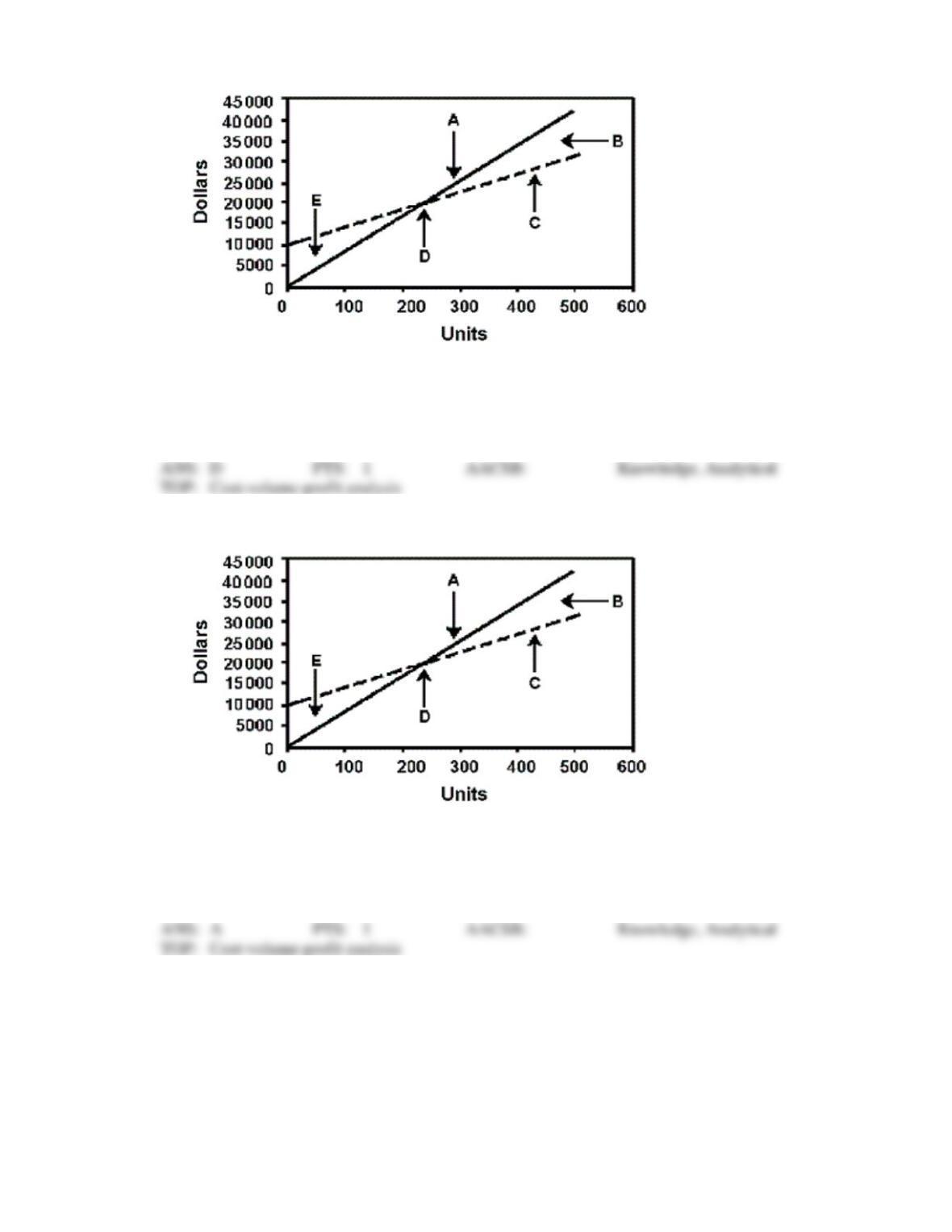
34.
Refer to the graph above. Line C (the dashed black line) is:
A.
the profit line.
B.
the loss line.
C.
the break-even line.
D.
the total cost line.
35.
Refer to the graph above. Point D (the point where the two lines cross) is:
A.
the break-even point.
B.
the contribution margin point.
C.
the firm’s total fixed costs.
D.
none of the above.
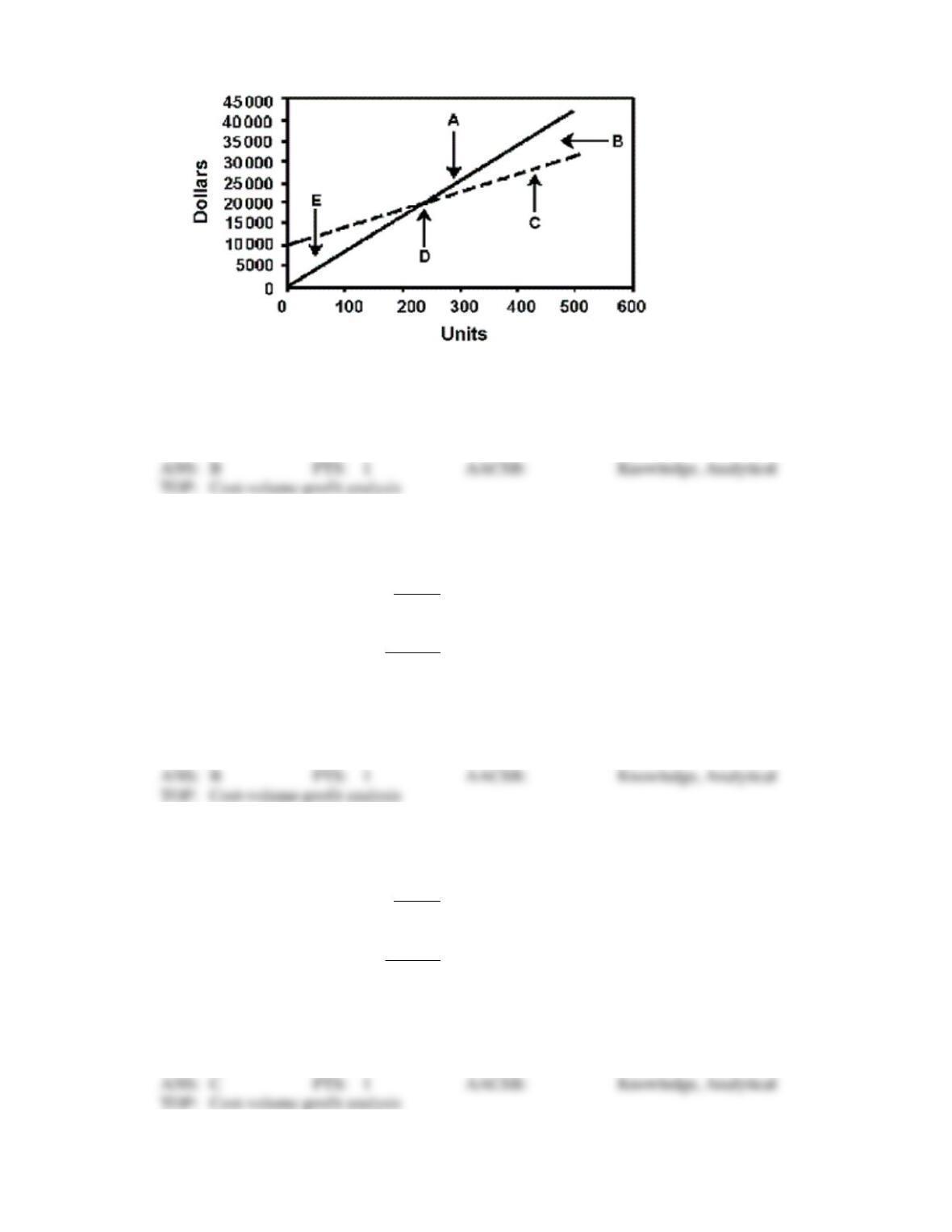
36.
Refer to the graph above. Area E (the area between the two lines) is:
A.
the profit area.
B.
the loss area.
C.
the break-even area.
D.
Answer cannot be determined from the information given.
37. Extra Extra Newspaper Company had the following results in 20X6.
Sales (5000 units)
$100,000
Variable costs
65,000
$35,000
Fixed costs
21,000
Net profit
$14,000
What is Extra Extra’s contribution margin ratio?
A.
10.5%
B.
35%
C.
65%
D.
$35,000
38. Extra Extra Newspaper Company had the following results in 20X6.
Sales (5000 units)
$100,000
Variable costs
65,000
$35,000
Fixed costs
21,000
Net profit
$14,000
What is Extra Extra’s contribution margin per unit?
A.
35 cents
B.
70 cents
C.
$7
D.
$13
39. Extra Extra Newspaper Company had the following results in 20X6.
Sales (5000 units)
$100,000
Variable costs
65,000
$35,000
Fixed costs
21,000
Net profit
$14,000
What is Extra Extra’s breakeven sales in units?
A.
1500 units
B.
1615 units
C.
2000 units
D.
3000 units
40. Extra Extra Newspaper Company had the following results in 20X6.
Sales (5000 units)
$100,000
Variable costs
65,000
$35,000
Fixed costs
21,000
Net profit
$14,000
How many additional units does Extra Extra have to sell to double current profit?
A.
2000 units
B.
3000 units
C.
4000 units
D.
5000 units
SHORT ANSWER
1. Breakeven point analysis is one of the most common uses of cost-volume-profit analysis. What is
the breakeven point and why is it useful for managers to know what it is for their company?
2. List and explain two assumptions about costs and activities that are made in cost-volume-profit
analysis.
3. Explain how the cost-volume-profit (CVP) assumptions about fixed costs may be violated. Give
two examples of situations that may cause these assumptions to be violated.
4. Discuss the concept of the ‘relevant range’ as it applies to cost-volume-profit analysis.
PROBLEM
1. Projected Profit
A company can determine its projected profit by using the following equation:
profit = total income – (total fixed costs + total variable costs)
Based on market research, CSO Corporation feels its product will sell for $200 / unit. At that price,
CSO can sell 150 units per month. Currently, CSO incurs the following costs on a per unit basis:
direct material, $10; direct labour, $60; variable overhead, $20. Its total fixed costs per month are
$3300.
(a)
Refer to Projected Profit. How many units must CSO sell each month to break
even (i.e., to earn neither a profit nor a loss)?
(b)
Refer to Projected Profit. What is CSO’s cost per unit if it produces 600 units
per month?
2. A company had the following results for 2005:
Sales (15,000 units)
$300,000
Variable expenses
180,000
Fixed expenses
80,000
Net profit
$40,000
Answer the following questions independently.
(a)
What are the company’s breakeven sales in dollars?
(b)
What are the company’s breakeven sales in units?
(c)
What is the company’s contribution margin in dollars?
(d)
What is the company’s contribution margin ratio?
(e)
How many additional units must be sold to increase net profit from the current
$40,000 to $100,000?
(a)
$200,000
Breakeven sales dollars = $80,000 fixed costs ÷ 40% contribution margin ratio =
$200,000.
Contribution margin ratio = ($300,000 – $180,000) ÷ $300,000 = .40
(b)
10,000 units
Breakeven sales units = $80,000 fixed costs ÷ $8 contribution margin per unit =
10,000 units.
Contribution margin per unit = ($300,000 – 180,000) / 15,000 = $8 per unit
(c)
$120,000
Contribution margin = Sales – variable costs = $300,000 – $180,000 = $120,000
(d)
40%
Contribution margin ratio = ($300,000 – $180,000) ÷ $300,000 = .40
(e)
7500 units
Additional sales units = Additional profit ÷ contribution margin per unit =
($100,000 – $40,000) ÷ $8 = 7500 units.
15,000 current sales + 7500 additional units = 22,500 units needed for a profit of
$100,000.
CASE
1. In the 1970s the US corporation Lockheed Aircraft Corporation paid USD $12.5 million in ‘fees’
to All Nippon Airways (ANA) to secure the sale of 21 Tristar aircraft. Carl Kochian, the president
of Lockheed at that time, defended his actions with reference to the following:
•
That the figure involved was negligible to Lockheed.
•
The revenue was desperately needed to stabilise the company’s financial situation.
•
Securing the contract saved the jobs of thousands of Lockheed workers and thousands of
dollars for the company’s shareholders.
Bribery was common and expected in Japan in the 1970s. Kochian did not initiate the payment. He
was asked to make the payment.
Required:
Discuss the accounting and ethical issues involved in this case.
•
the figure involved represented an avoidable cost;
•
negligibility acknowledged, there would be an opportunity cost involved; once
•
the expenditure represented an expense, in effect, an indirect expense;
critical issue would be that of transparency, and, therefore, how the expenditure
•
assuming Lockheed’s cost structure did not factor in a margin for such items of
•
the tax deductibility of the expenditure.
•
the tax deductibility of the expenditure;
adverse consequences, for example, for the company’s competitors, specifically,
•
•
There is a cultural dimension to what is acceptable (common practice) business