3) Many firms use odd pricing – charging prices such as $.99 instead of $1.00 and $9.99 instead
of $10.00. One reason for this pricing strategy is that consumers will somehow believe that the
difference in price appears to be greater than it actually is. Researchers conducted consumer
surveys to determine whether this is actually the case. What was the result of these surveys?
A) The surveys found that small differences in price cause small differences in quantity
demanded. There is no evidence that odd pricing makes economic sense.
B) Although the results were not conclusive, there is some evidence that odd pricing makes
economic sense.
C) The surveys found indifference regarding this strategy among most consumers, but hostility
among other consumers. The latter group resented what they viewed as an attempt to fool them
into buying products with odd prices. Researchers concluded that odd pricing is
counterproductive.
D) The survey results were inconclusive because most consumers gave unreliable responses to
the survey questions.
4) When firms price their products by adding a percentage markup to their average costs of
production, this is called
A) average cost pricing.
B) rounding up.
C) break-even pricing.
D) cost-plus pricing.
5) If, at a firm’s projected sales level, the marginal cost is $125, the average cost is $150 and the
markup is 20 percent, then its selling price is
A) $125.
B) $150.
C) $165.
D) $180.
6) If the selling price of a firm’s product is $500 and the estimated average cost of producing this
product is $400, what is the firm’s markup?
A) 15 percent
B) 20 percent
C) 25 percent
D) 40 percent
7) Which of the following is not an advantage of cost-plus pricing?
A) It is easy to calculate.
B) It requires little information.
C) If a firm is selling multiple products, it ensures that the firm’s prices will cover costs that are
difficult to assign to one product.
D) It ensures that the firm will maximize its profits.
8) Which of the following firms is most likely to use cost-plus pricing?
A) A firm that makes one product.
B) A firm that sells one product and has a sizable research and development budget.
C) A firm that makes several products and has a sizable research and development budget, the
cost of which cannot be easily assigned to each product.
D) A firm that makes many products but has a small research and development budget, the cost
of which can be easily assigned to the different product lines.
9) Cost-plus pricing would be consistent with selecting the profit-maximizing price when
A) it results in a price that causes quantity sold to be where marginal revenue equals marginal
cost.
B) a firm has no difficulty estimating its demand curve.
C) consumers value the product beyond its marginal cost.
D) the demand for the firm’s product is unit-elastic.
10) Cost-plus pricing may be a reasonable way to determine price when
A) marginal cost and average fixed cost are roughly equal.
B) marginal cost and average cost are about the same.
C) marginal cost differs significantly from average cost.
D) marginal cost is very low.
11) Book publishers often use a cost-plus pricing strategy. One reason for this is
A) most publishers do not hire economists who can determine the number of books they must
sell to equate marginal cost and marginal revenue.
B) publishers do not want to incur the expense of determining the profit-maximizing strategy.
They prefer cost-plus pricing because of its lower cost.
C) much of the cost of publishing textbooks is difficult to assign to any particular book.
D) bookstores, not publishers, ultimately determine how many books will be produced.
12) Cost-price pricing typically does not result in profit-maximization. As a result, economists
have two views of cost-plus pricing. One of these views is
A) cost-plus pricing is more likely to lead to profit-maximization for large firms than for small
firms.
B) cost-plus pricing is a good way to approximate the profit-maximizing price when marginal
revenue or marginal cost is difficult to determine.
C) cost-plus pricing is more likely to lead to profit-maximization for monopolistically
competitive firms than for oligopoly firms.
D) cost-plus pricing is more likely to result in profit-maximization the more elastic the firm’s
demand curve is.
13) Even though it often does not result in profit maximization, some small firms use a cost-plus
pricing strategy anyway because
A) it is easy to use.
B) they do not understand what marginal revenue and marginal cost mean.
C) it is expensive to hire an economist who can determine what the profit-maximizing price is.
D) they sell several products, each of which sells for a different price. The time and expense
involved in finding the profit-maximizing price for each product are not worth the effort.
14) Though large firms have the knowledge and resources to utilize a better pricing strategy,
many choose to use cost-plus pricing. One reason for this is that
A) large firms do not have to maximize their profits because they face little competition from
other firms.
B) there is less risk of violating antitrust laws if a cost-plus pricing strategy is used rather than a
profit-maximizing pricing strategy.
C) the additional revenue that would result from a profit-maximizing pricing strategy is an
insignificant fraction of the firms’ revenues.
D) firms often adjust the markup they charge to reflect current demand.
15) Which of the following statements about two-part tariffs is false?
A) Because each individual has a different individual demand curve, if there is just one entrance
fee some consumers will be able to reap some consumer surplus.
B) The producer cannot capture the entire consumer surplus because the entrance fee might
discourage some potential consumers even though they would have been willing to pay a lesser
entrance fee.
C) Two-part tariff pricing allows a producer to capture the entire consumer surplus.
D) For two-part tariff pricing to be successful, the producer must be able to identify two distinct
customer groups.
16) Some firms require consumers to pay an initial fee for the right to buy their product and an
additional fee for each unit of the product they purchase. This practice is referred to as
A) odd pricing.
B) dual pricing.
C) a two-part tariff.
D) intertemporal pricing.
17) The Walt Disney Company is in a position to use a two-part tariff by charging for admission
and also charging for rides inside its two theme parks, Disneyland and Disney World. Which of
the following statements regarding Disney’s pricing strategy is true?
A) At one time, admission fees were charged at both parks but all rides were free. Disney has
since changed its pricing policy; it earns higher profits by charging for both admission and rides.
B) At one time, customers had to pay for admission and rides at Disneyland and Disney World.
Disney has since changed its pricing policy; it earns higher profits by charging for admission but
not for rides.
C) At one time, customers had to pay for admission and rides at Disneyland and Disney World.
Disney has since changed its pricing policy; it earns higher profits by charging for rides but not
for admission.
D) At one time, fees for admission and rides at both parks were set at their profit-maximizing
levels. Disney has since changed its pricing policy; it uses a cost-plus pricing strategy for
admission and does not charge for rides.
18) The Walt Disney Company is in a position to use a two-part tariff policy in setting prices for
admission and rides at Disney World. If this strategy resulted in maximum profit, Disney would
convert all consumer surplus into profit. Which of the following explains why Disney does not
maximize its profits from admission and rides?
A) To maximize its profits, Disney would have to know the demand curves of each of its
customers. Since this is not possible, Disney is not able to convert all consumer surplus into
profit.
B) Disney purposely charges less than the profit-maximizing price for admission to Disney
World because it does not want to risk alienating its customers.
C) Disney purposely charges less than the profit-maximizing price for admission to Disney
World in order to earn more profit from sales of food, lodging and other related services.
D) Disney does not charge the profit-maximizing price for admission because it wants to keep
admission affordable for children who will be more likely to visit Disney World when they
become parents.
19) Many golf courses charge members an annual membership fee as well as a fee each time
they golf. One reason for this is
A) golf courses do not want their members to overuse their fairways. Charging for each round of
golf played reduces fairway maintenance costs.
B) charging both fees allows the courses to transfer more consumer surplus into profit than
charging only an admission fee.
C) charging both fees allows the courses to transfer more producer surplus into profit than
charging only an admission fee.
D) research has shown that charging both fees increases the likelihood that golfers will renew
their memberships.
20) Consider a discount retailer such as Costco which uses a two-part tariff pricing strategy. The
Costco membership fee
A) buys the consumer the right to make future purchases at Costco.
B) is a resalable asset to the consumer.
C) is a resalable asset to the producer.
D) is used by Costco to cover its fixed costs of production.
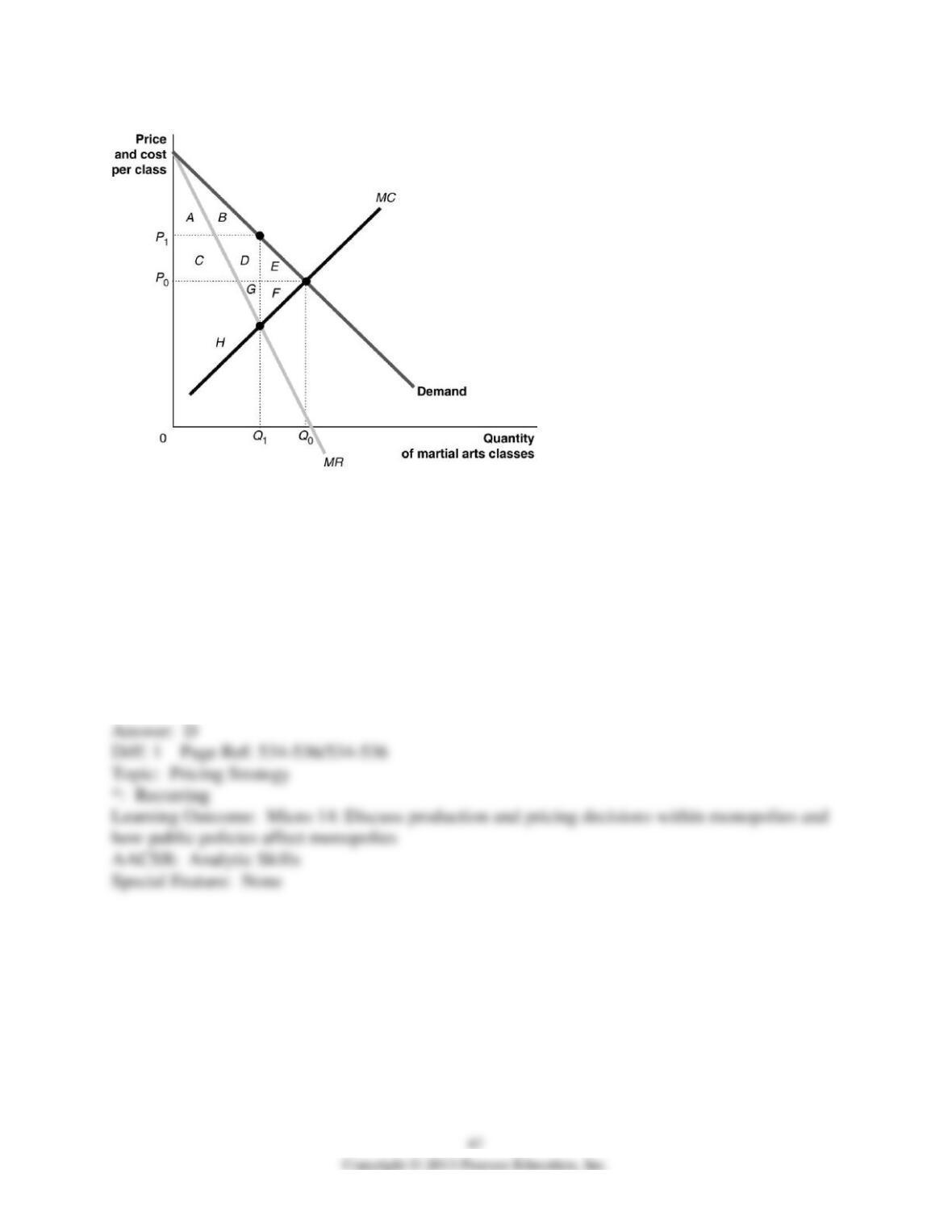
Figure 16-2
Watanabe Sensei operates the only martial arts school in Hartfield. For simplicity, assume that
consumers have identical demand curves and that Sensei knows what this demand curve is.
Figure 16-2 shows this demand curve.
21) Refer to Figure 16-2. If Sensei acts as a monopolist, his profit-maximizing price is
________ and the number of classes sold is ________.
A) P0; Q0
B) P0; Q1
C) P1; Q0
D) P1; Q1
22) Refer to Figure 16-2. If Sensei acts as a monopolist and charges the profit-maximizing price,
what is the consumer surplus received by his customers?
A) the area A + B + C + D
B) the area A + B + C + D + E
C) the area A + B
D) the area A + C + H
23) Refer to Figure 16-2. If Sensei acts as a monopolist and charges the profit-maximizing price,
what is his producer surplus?
A) the area B + D + G
B) the area A + B + C + D + H + G
C) the area C + D + H + G
D) the area A + C + H
24) Refer to Figure 16-2. Sensei’s friend, Marcel, suggests that he charge a one-time
membership fee to use the martial arts school, in addition to a per-class charge. Suppose Sensei
charges the monopoly price for each class and also imposes a one-time membership fee. What is
the maximum amount of revenue from the membership fee he can collect from all his customers?
A) an amount equal to the area A + B
B) an amount equal to the area E + F
C) an amount equal to the area H + G
D) an amount equal to the area A + C + H
25) Refer to Figure 16-2. With a two-part pricing scheme – a monopoly price for classes and a
one-time membership fee – what is the amount of producer surplus Sensei will earn?
A) an amount equal to the area A + B + C + D
B) an amount equal to the area E + F
C) an amount equal to the area A + C + H
D) an amount equal to the area A + B + C + D + H + G
26) Refer to Figure 16-2. Suppose instead of charging the monopoly price for his classes, Sensei
charges the competitive price. What is the competitive price and what is the quantity demanded
at this price?
A) P0, Q1
B) P0, Q0
C) P1, Q0
D) P1, Q1
27) Refer to Figure 16-2. If Sensei charges the competitive price for his classes, what is the
maximum amount of admission fee that he can collect from his customers?
A) the area A + B
B) the area A + B + C + D
C) the area A + B + C + D + E
D) the area A + C + D + G + H
28) Refer to Figure 16-2. With this pricing scheme – a competitive price for the classes and a
one-time membership fee – what amount of producer surplus will Sensei earn?
A) the area A + B + C + D + E.
B) the area E + F.
C) the area H + G + F.
D) the area A + B + C + D + E + F + G + H
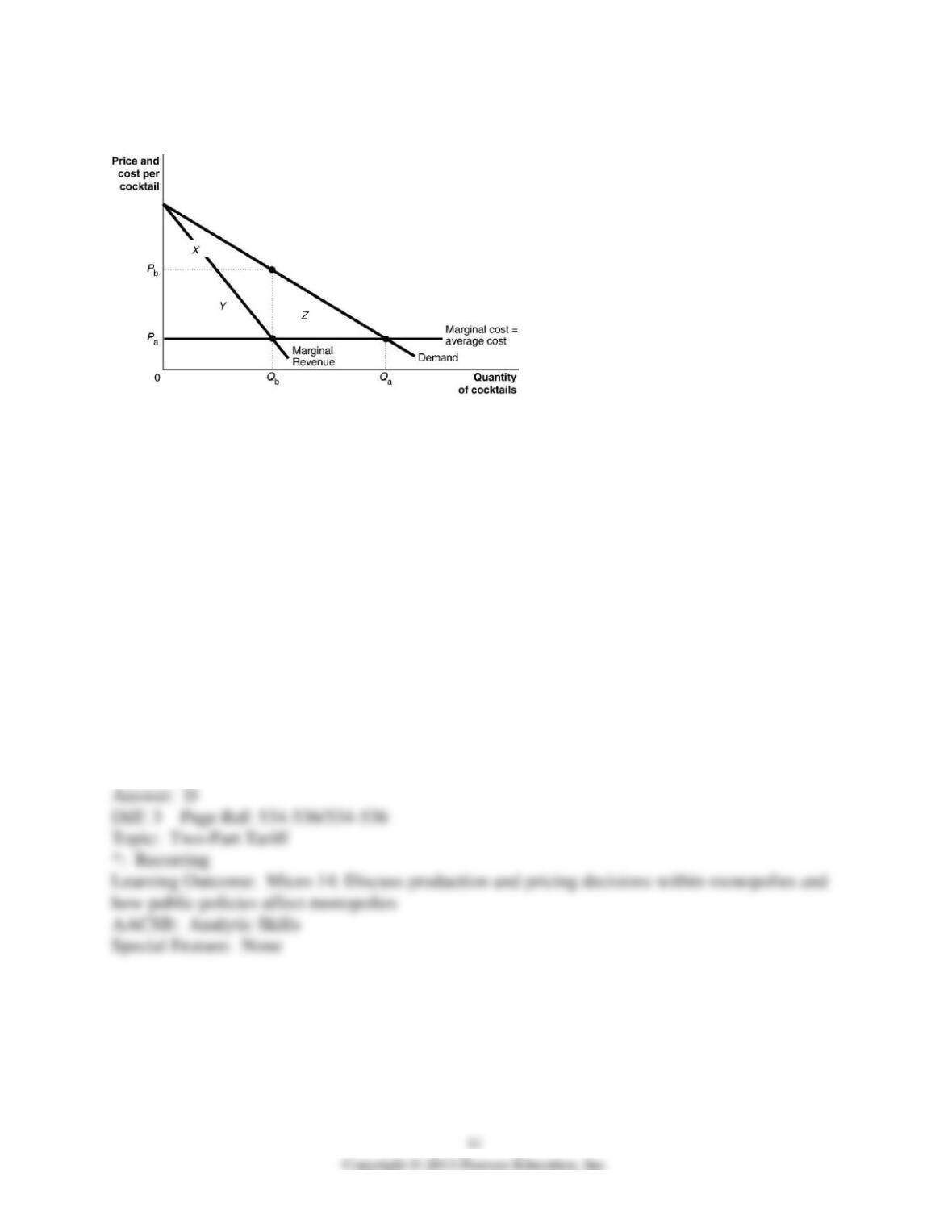
Figure 16-3
The Lizard Lounge is well known for its exotic cocktails. Figure 16-3 shows its estimated
demand curve for cocktails.
29) Refer to Figure 16-3. The owners of the Lizard Lounge are considering the following four
pricing options:
a. A single price scheme where the price of cocktails equals the monopoly price.
b. A single price scheme where the cocktail price equals the competitive price.
c. A two-part tariff: a monopoly price for cocktails and a cover charge that will generate total
revenue equal to the area X.
d. A two-part tariff: a competitive price for cocktails and a cover charge that will generate total
revenue equal to the area X + Y + Z.
Which scheme will earn the largest profit?
A) scheme a
B) scheme b
C) scheme c
D) scheme d
30) Refer to Figure 16-3. The owners of the Lizard Lounge are considering the following four
pricing options:
a. A single price scheme where the cocktail price equals the monopoly price.
b. A single price scheme where the cocktail price equals the competitive price.
c. A two-part tariff: a monopoly price for cocktails and a cover charge that will generate total
revenue equal to the area X.
d. A two-part tariff: a competitive price for cocktails and a cover charge that will generate total
revenue equal to the area X + Y + Z.
Under which scheme are the Lounge customers better off?
A) scheme a
B) scheme b
C) scheme c
D) scheme d
31) Refer to Figure 16-3. The owners of the Lizard Lounge are considering the following four
pricing options:
a. A single price scheme where the cocktail price equals the monopoly price.
b. A single price scheme where the cocktail price equals the competitive price.
c. A two-part tariff: a monopoly cocktail price and a cover charge that will generate total
revenue equal to the area X.
d. A two-part tariff: a competitive cocktail price and whatever cover charge that will generate a
total revenue equivalent to the area X + Y + Z.
Which pricing scheme(s) achieve the economically efficient outcome?
A) schemes a and c
B) scheme b
C) schemes b and d
D) scheme d only
32) Movie theaters often charge different people different prices for admission. Why don’t
theaters charge different prices for popcorn and other food items?
A) Although the elasticity of demand for admission differs among customers, most people have
the same the elasticity of demand for food items.
B) Concession stand personnel are too busy to ensure that different people pay different prices
for food items.
C) Once people are in the theater, concession stands have monopoly power and can charge
everyone the same high prices for food.
D) It is difficult to limit the resale of food items from those who pay low prices to those who
would have to pay high prices from the concession stand.
33) The University of Kansas is using a two-part tariff pricing structure since they require season
ticket holders for Jayhawks football games to purchase ________ to obtain seats in its new
Gridiron Club.
A) tickets to preseason games as well as regular season games
B) sports mortgages in addition to the season tickets
C) a minimum of two season tickets to each home game
D) season tickets for Jayhawks basketball
34) Many new sports stadiums are paid for with public funds, or a combination of public and
private funds. Requiring those who have season tickets for a professional sports team to pay for
equity seat rights in a new stadium which has been paid in full or in part with public funds shifts
more of the burden of paying for a new stadium to ________ rather than ________.
A) the season ticket holders; the general public.
B) the owners of the sports team; the season ticket holders.
C) the city in which the stadium is located; the season ticket holders
D) the general public; the city in which the stadium is located.
35) The Walt Disney Company uses cost-plus pricing to determine the prices it charges for
admission and rides at Disneyland and Walt Disney World.
36) In an optimal two-part tariff pricing schedule, consumer surplus is zero.
37) There is no evidence that odd pricing succeeds in convincing consumers that prices are lower
than they really are.
38) Economists believe that cost-plus pricing may be the best way for a firm to determine its
optimal product price when the firm’s marginal cost and average cost are about the same and
when it is difficult to estimate the product’s demand curve.
39) Firms engage in odd pricing when they charge prices that appear to be less than they really
are; for example, charging a price of $4.95 instead of $5.00 and $.99 instead of $1.00. How have
researchers tried to determine whether odd pricing is successful in convincing consumers that
odd prices are less than they really are?
40) What is cost-plus pricing? Why do some firms use cost-plus pricing even when the firms’
managers have the resources to devise a pricing strategy that would result in greater profits?
41) Why might an amusement park switch from charging admission to the park and charging for
the rides to charging for admission but not charging for the rides?