27) Which of the following pricing strategies allows a firm to earn economic profit?
A) price discrimination
B) charging a price equal to marginal cost
C) charging a price equal to the average total cost of production
D) charging a price equal to the average variable cost of production
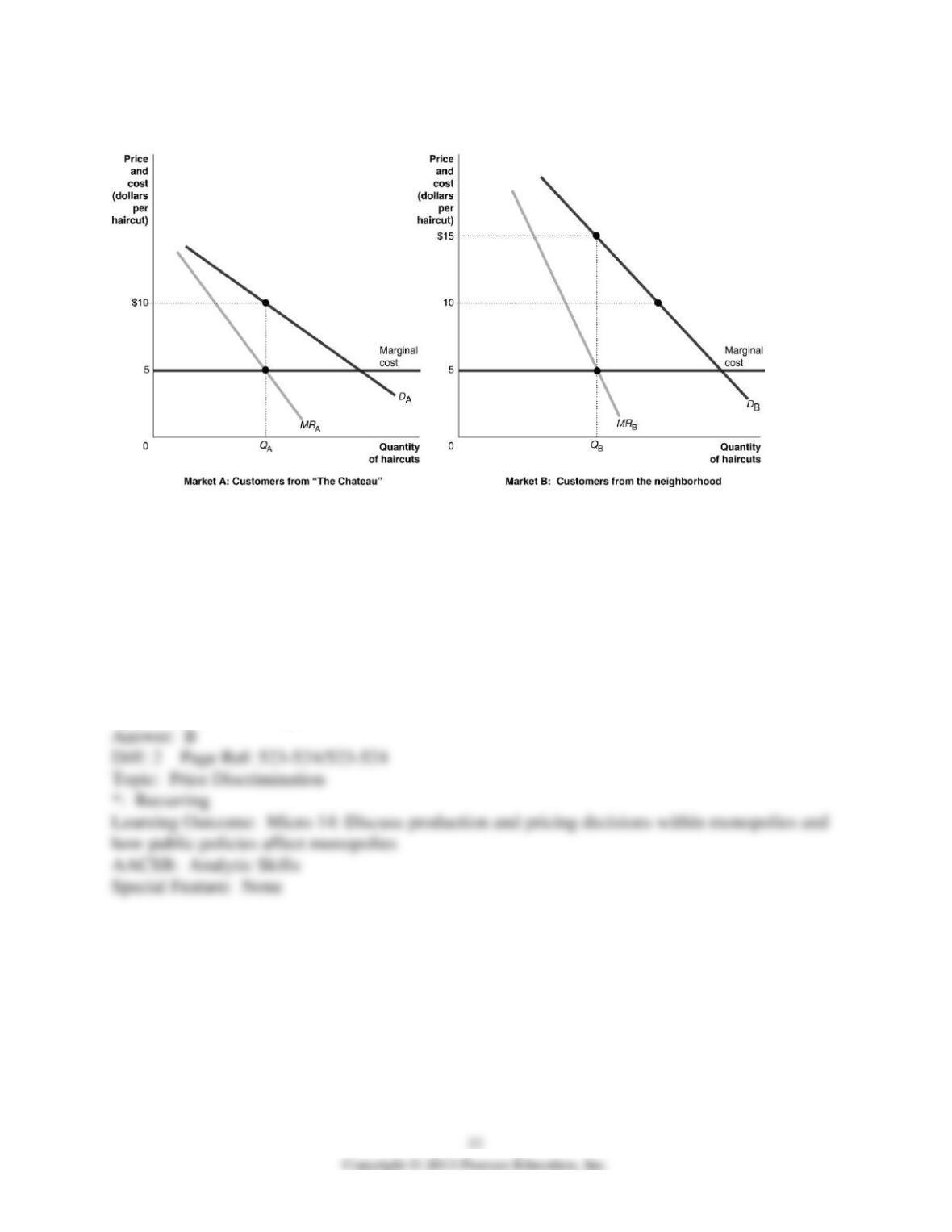
Figure 16-1
Chantal owns a hairdressing salon which caters to two main groups of customers: residents of
“The Chateau,” a retirement community, and other residents in the neighborhood. Figure 16-1
shows the demand curves for the residents of the retirement community, labeled Market A, and
other residents in the neighborhood, labeled Market B. The demand curves are not identical.
28) Refer to Figure 16-1. What prices are charged in the two markets?
A) price in market A = price in market B = $15
B) price in market A = $10; price in market B = $15
C) price in market A = price in market B = $5
D) price in market A = price in market B = $10
29) Refer to Figure 16-1. Which group of customers is likely to have a more elastic demand
curve (more sensitive to price)?
A) the other residents of the neighborhood – market B
B) There is no difference in the elasticity of demand between the two groups.
C) the customers from “The Chateau” – market A
D) There is insufficient information to answer this question.
30) Refer to Figure 16-1. Suppose Chantal practices price discrimination. Which of the
following statements is true?
A) Chantal’s profits will be higher if she has uniform pricing instead of different prices for
different groups of customers.
B) By charging a higher price in market B, Chantal has transferred some of the consumer surplus
from customers in market B to customers in market A.
C) By charging different prices in markets A and B, Chantal can transfer some producer surplus
into economic profit.
D) By charging a higher price in market B, Chantal can convert some consumer surplus into
economic profit.
31) Refer to Figure 16-1. Suppose Chantal charges all her customers a uniform price of $10 for
a haircut. Which of the following statements is true?
A) Chantal is selling more than the profit-maximizing quantity of haircuts in market B.
B) Chantal is selling less than the profit-maximizing quantity of haircuts in market B.
C) Chantal is maximizing revenue in market B.
D) Chantal will earn a greater profit through uniform pricing than if she practices price
discriminates.
32) Assume that a monopolist practices perfect price discrimination. The firm’s marginal revenue
curve will
A) be perfectly elastic.
B) be equal to its demand curve.
C) will be perfectly inelastic.
D) will lie below its demand curve.
33) Assume that a monopolist practices perfect price discrimination. The firm will produce an
output rate
A) that is less than the efficient level of output.
B) that is greater than the efficient level of output.
C) that is equal to the efficient level of output.
D) that converts consumers surplus into a deadweight loss.
34) If a monopolist practices perfect price discrimination,
A) the firm will break even in the long run.
B) consumers surplus will be equal to the deadweight loss.
C) producer surplus will equal consumer surplus.
D) consumer surplus will be zero.
35) Which of the following statements about perfect price discrimination is false?
A) There is no consumer surplus if a firm engages in perfect price discrimination.
B) Perfect price discrimination occurs when the seller charges the highest price each consumer
would be willing to pay for the product.
C) A condition for perfect price discrimination is that it must be costlier to service some
customers than others.
D) For the price-discriminating firm, its marginal revenue curve coincides with its demand
curve.
36) Suppose that a price-discriminating producer divides its market into two segments. If the
firm sells its product at a price of $34 in the market segment with relatively less-elastic customer
demand, the price in the market segment with more-elastic customer demand will be
A) greater than $34.
B) less than $34.
C) less than marginal revenue in that market segment.
D) equal to marginal revenue in that market segment.
37) Publishers practice price discrimination when they sell books at high prices to
A) early adopters.
B) local bookstores.
C) large chain bookstores.
D) online book sellers.
38) The term “early adopters” refers to
A) firms that are the first to implement a new technology that is used to produce new goods or
services.
B) book clubs that are first to recommend best-selling books to their members.
C) consumers who respond quickly to fads, seasonal changes, etc.
D) consumers who are willing to pay high prices to be among the first to own new products.
39) Consumers who will pay high prices to be among the first to own certain new products are
called
A) savvy consumers.
B) naive consumers.
C) gullible.
D) early adopters.
40) Which of the following antitrust laws forbade firms to engage in price discrimination if the
effect would lessen competition or create a monopoly?
A) the Sherman Act
B) the Clayton Act
C) the Robinson-Patman Act
D) the Cellar-Kefauver Act
41) Clarissa Kessler operates a store that sells recorded music. Her business suffered
tremendously when a giant discount store chain opened a store in the area and is able to sell its
products for less than Clarissa’s wholesale cost. Is this evidence of illegal price discrimination on
the part of the discount store chain?
A) Yes, it is clearly a violation of the Robinson-Patman Act.
B) No, because it can be argued that the discount store chain is justified in charging lower prices
because it is a large-volume buyer and is able to purchase recorded music at a lower wholesale
price than Clarissa.
C) Yes, the discount store chain is engaging in predatory pricing.
D) No, even if the price discrimination is based on differences in cost, the law states that it is not
illegal.
Table 16-1
Potential
Customer
Willingness to
Pay (dollars per
hour)
Arun
$8
Bernice
9
Cara
10
Dawn
12
Julie plans to start a pet-sitting service. She surveyed her neighborhood to determine the demand
for this service. Assume that each person surveyed demands only one hour of pet sitting services
per period. Table 16-1 below shows a portion of her survey results.
42) Refer to Table 16-1. If Julie charges $10 per hour, how many hours of pet sitting services
will be purchased and by whom?
A) 2 hours (1 hour by Cara and 1 hour by Dawn)
B) 1 hour by Cara only
C) 1 hour by Dawn only
D) 3 hours (1 hour each by Arun, Bernice and Cara)
43) Refer to Table 16-1. If Julie charges $10 per hour, what is the value of the consumer surplus
received by Dawn?
A) $2
B) $10
C) $12
D) $22
44) Refer to Table 16-1. Suppose Julie’s marginal cost of providing this service is constant at $7
and she charges $7. How many hours will be purchased and what is her total revenue?
A) 5 hours; total revenue = $35
B) 4 hours; total revenue = $28
C) 3 hours; total revenue = $21
D) 2 hours; total revenue = $14
45) Refer to Table 16-1. Suppose Julie’s marginal cost of providing this service is constant at $7
and she charges $7 per hour. What is her marginal revenue?
A) It is $7 for the first hour and starts declining thereafter.
B) It is $7 for the first hour and starts increasing thereafter.
C) It is constant at $7.
D) It coincides with the figures in the table; $12 for the first hour, $10 for the second, $9 for the
third and $8 for the fourth.
46) Refer to Table 16-1. Suppose Julie’s marginal cost of providing this service is constant at $7
and she charges $7. What is the value of the consumer surplus enjoyed by her customers?
A) $39
B) $28
C) $11
D) $0
47) Refer to Table 16-1. Suppose Julie’s marginal cost of providing this service is constant at $7
and she decides to charge each customer according to his or her willingness to pay. What is
Julie’s total revenue and how many hours of service will be purchased?
A) 4 hours and her total revenue = $39
B) 4 hours and her total revenue = $28
C) 1 hour and her total revenue = $7
D) 5 hours and her total revenue = $35
48) Refer to Table 16-1. Suppose Julie’s marginal cost of providing this service is constant at $7
and she decides to charge each customer according to his or her willingness to pay. What is the
value of consumer surplus by her customers?
A) $39
B) $28
C) $11
D) $0
49) Refer to Table 16-1. Suppose Julie’s marginal cost of providing this service is constant at $7
and she charges each customer according to his or her willingness to pay instead of a uniform
price of $7. Which of the following statements is true?
A) Julie is worse off because the demand for her services is reduced.
B) Julie has converted the consumer surplus (from a uniform price) into economic profit.
C) Julie’s customers are better off because their consumer surplus has increased.
D) Julie’s has converted the producer surplus (from a uniform price) into consumer surplus.
50) One requirement for a firm pursuing a price-discrimination strategy is the ability to segment
the market for its product. This means that
A) the firm must set different prices for different regions where the product is sold.
B) the firm must be willing to offer price discounts for senior citizens and children.
C) the firm must be able to divide the market in a way that makes arbitrage impossible.
D) the firm must choose a marketing strategy that appeals to different segments of the economy.
51) A perfectly competitive firm cannot practice price discrimination because
A) a firm that breaks even in the long run cannot afford to engage in yield management.
B) it does not advertise; this prevents the firm from marketing its product to different segments
of the market.
C) each consumer in a perfectly competitive market has the same willingness to pay.
D) the firm can only charge the market price.
52) If price discrimination occurs in a market,
A) the law of one price does not hold.
B) the firm earns arbitrage profits.
C) consumers whose demand for the product sold is more elastic pay higher prices than
consumers whose demand is less elastic.
D) the marginal cost of production is constant.
53) Netflix, an online DVD rental service, engages in price discrimination by
A) charging customers who rent the fewest movies per month a higher rental price than
customers who rent the most movies per month.
B) providing customers who rent the fewest movies per month better service than customers who
rent the most movies per month.
C) charging customers who rent the fewest movies per month a lower rental price than customers
who rent the most movies per month.
D) providing customers who rent the most movies per month better service than customers who
rent the fewest movies per month.
54) Netflix, an online DVD rental service, engages in price discrimination by separating its
customers into two groups: those who have a relatively elastic demand and those who have a
relatively inelastic demand for DVD rentals. Those who have a relatively elastic demand are
customers who
A) pay a monthly subscription fee; customers with a relatively inelastic demand pay for each
DVD they rent.
B) pay for each DVD they rent; customers with a relatively inelastic demand pay a monthly
subscription fee.
C) rent only a few DVDs per month; customers who rent many DVDs per month have a
relatively inelastic demand.
D) rent many DVDs per month; customers who rent only a few DVDs per month have a
relatively inelastic demand.
55) Early adopters are consumers who will pay a high price to be among the first to own new
products.
56) A successful strategy of price discrimination requires that a firm be a price-taker.
57) The airline industry routinely engages in price discrimination across time.
58) A firm that engages in price discrimination must be able to identify the preferences of every
customer it serves.
59) Perfect price discrimination will lead a firm to produce up to the point where price equals
marginal cost, the efficient level of output.
60) The Clayton Act of 1936 outlawed price discrimination that reduced competition.
61) Your text refers to airlines as “The Kings of Price Discrimination.” Why is price
discrimination common in the airline industry?
62) What conditions are required for a firm to use a price discrimination strategy?
63) Are restaurant coupons a form of price discrimination? Why or why not?
64) Kentucky and Montana have identical state gasoline taxes of 27.8 cents per gallon. When
added to the federal gasoline tax of 18.4 cents per gallon, the total tax on one gallon of gasoline
in these two states is 46.2 cents. On December 19, 2011, the average price of one gallon of
regular gasoline was $3.086 in Kentucky and $3.248 in Montana. Briefly explain whether this is
an example of price discrimination. Assume that the gasoline being sold is identical in both
states.
Sources: commonsensejunction.com and gasbuddy.com.
65) What is yield management? How is yield management being used in the airline industry?
66) Draw a graph that shows producer surplus, consumer surplus, and deadweight loss in a
market where the seller practices perfect price discrimination. Be sure to identify the demand
curve, the marginal revenue curve, the marginal cost curve, and the profit maximizing quantity
on the graph.
67) Racial discrimination and other forms of discrimination based on irrelevant factors are
illegal. Can price discrimination be illegal as well?
68) Book publishers use price discrimination routinely, but the form of price discrimination they
use is different from the form used by airlines and other industries. Explain.
16.3 Other Pricing Strategies
1) When a firm charges $4.95 instead of $5.00, what do economists call this pricing strategy?
A) cost-plus pricing
B) indirect pricing
C) odd pricing
D) unusual pricing
2) Odd pricing became common in the late 19th century. Although the origins of odd pricing are
uncertain, several explanations for the practice have been given. Which of the following is one of
these explanations?
A) Odd pricing forced employees to give customers change. This made it more likely that
employees would record sales rather than pocketing their customers’ money.
B) Odd pricing began in an era when it was difficult for owners and managers of firms to
determine the marginal cost of the goods and services they sold. Odd prices were rough estimates
designed to cover costs plus earn firms a profit.
C) Odd pricing was begun in England in the 1700s when America was part of the British Empire.
Members of the British Royal Court were given the task of pricing products. After independence,
merchants in the United States carried on the practice of odd pricing.
D) After the passage of the Sherman Act in 1890, merchants used odd pricing as a means of
avoiding prosecution for antitrust violations.