Name:
Class:
Date:
Chapter 16: Public Goods and Public Choice
a. Area bcde
b. Area ihgl
c. Area dfe
d. Area aglo
e. Area abeg
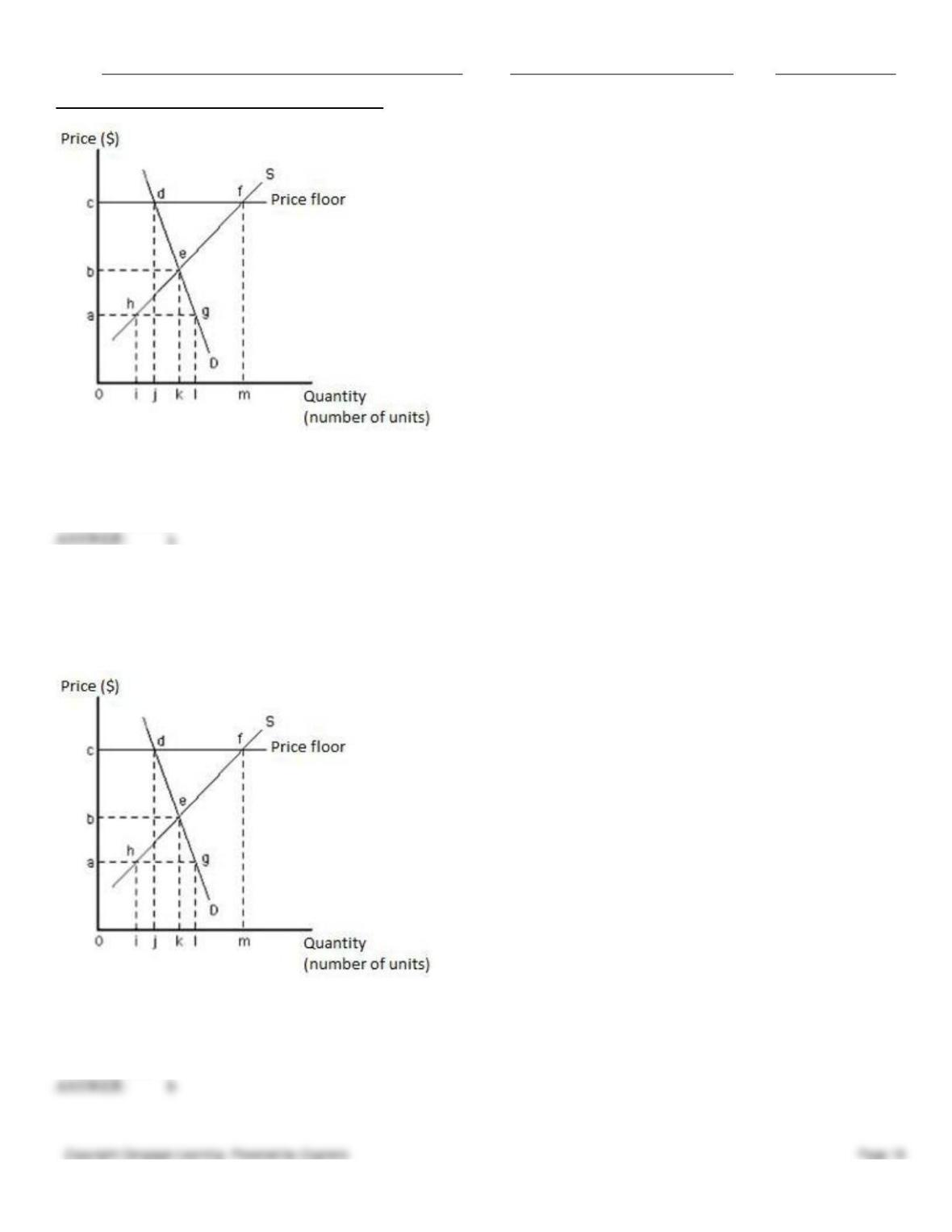
85. The following graph shows the market for a good. Suppose the government introduces a variety of policies that set
floor prices for the good at $c. The quantity of the good demanded by the consumers at the price floor is _____.
Figure 16.3
a. i units
b. j units
c. k units
d. l units
e. m units
Name:
Class:
Date:
Chapter 16: Public Goods and Public Choice
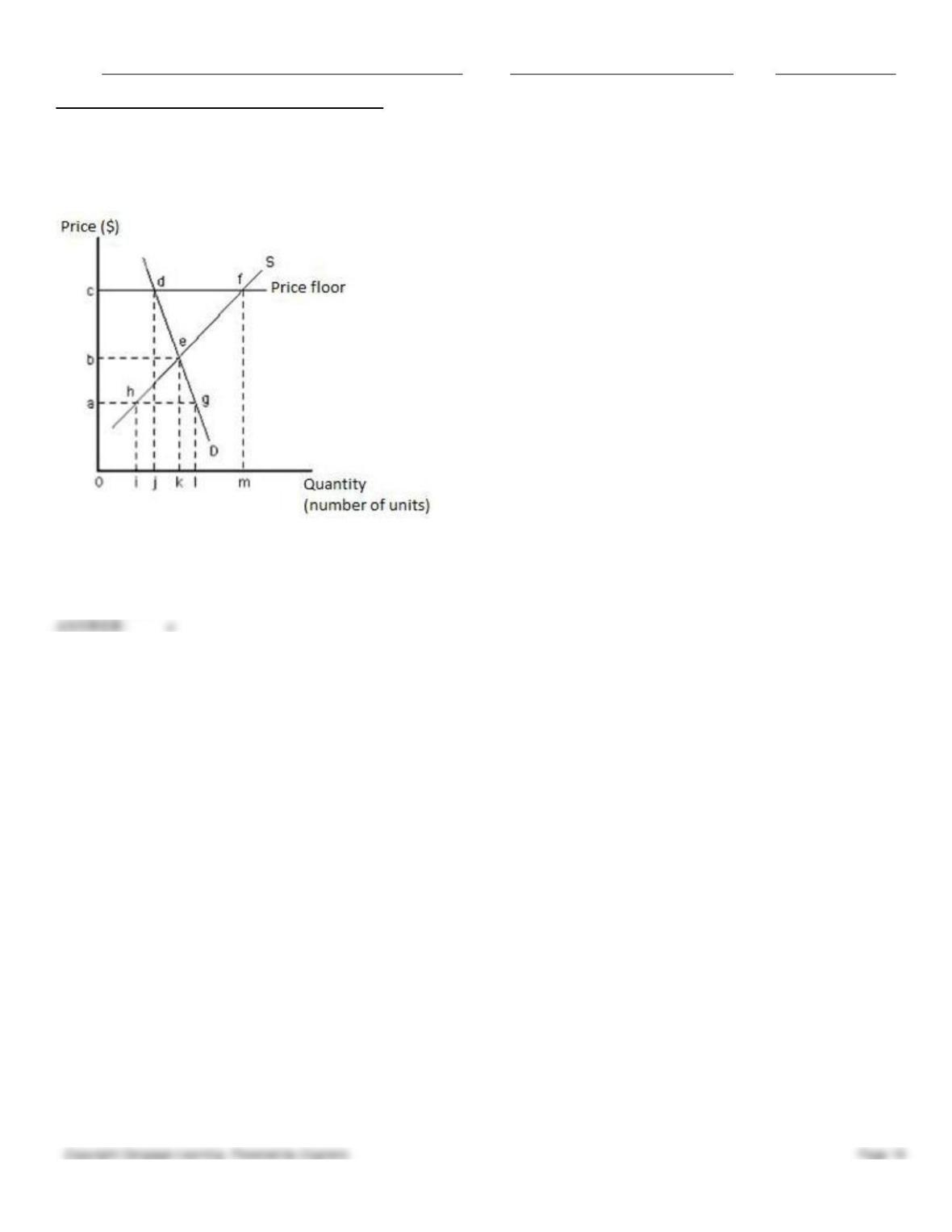
86. The following graph shows the market for a good. Suppose the government introduces a variety of policies that set
floor prices for the good at $c. The quantity supplied at the price floor is _____.
Figure 16.3
a. i units
b. j units
c. k units
d. l units
e. m units
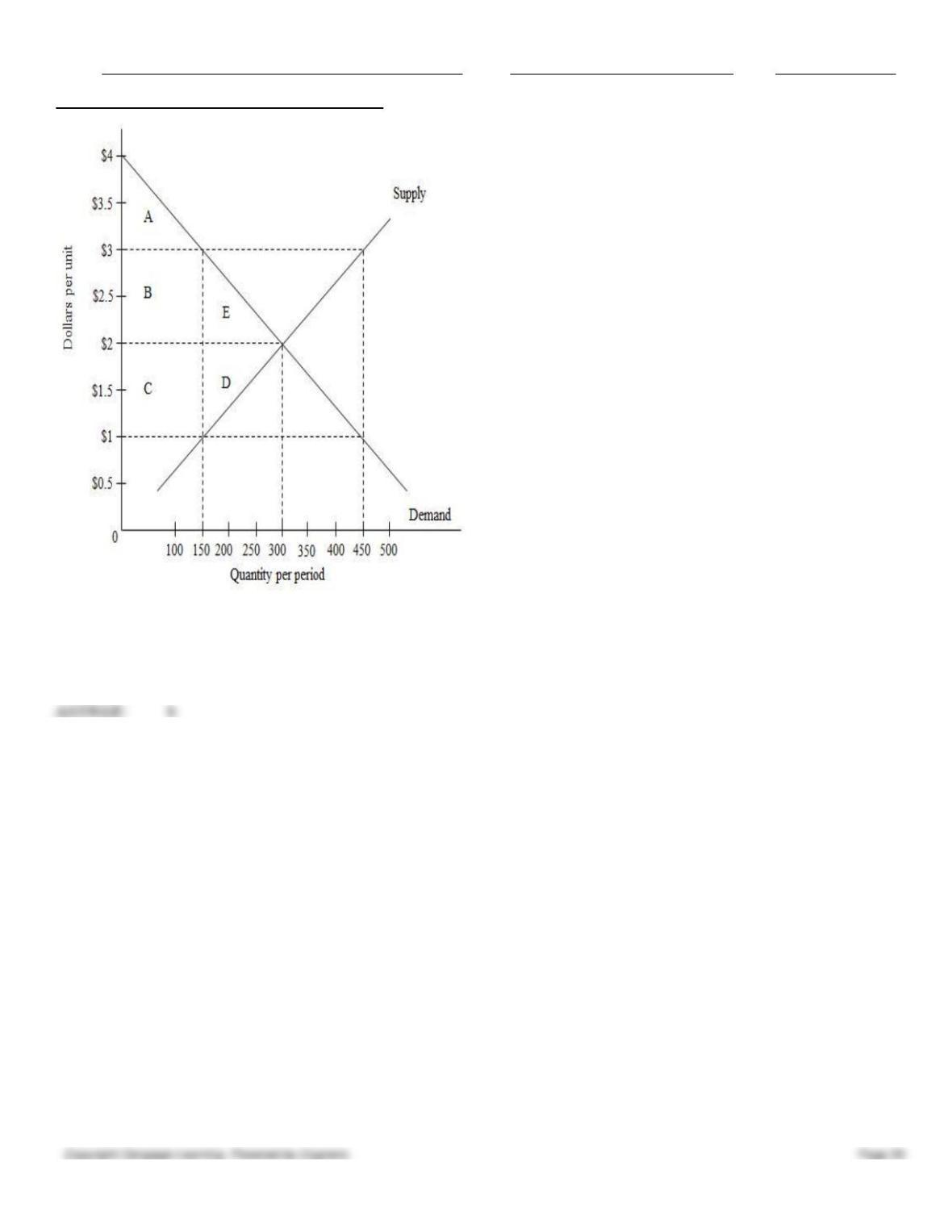
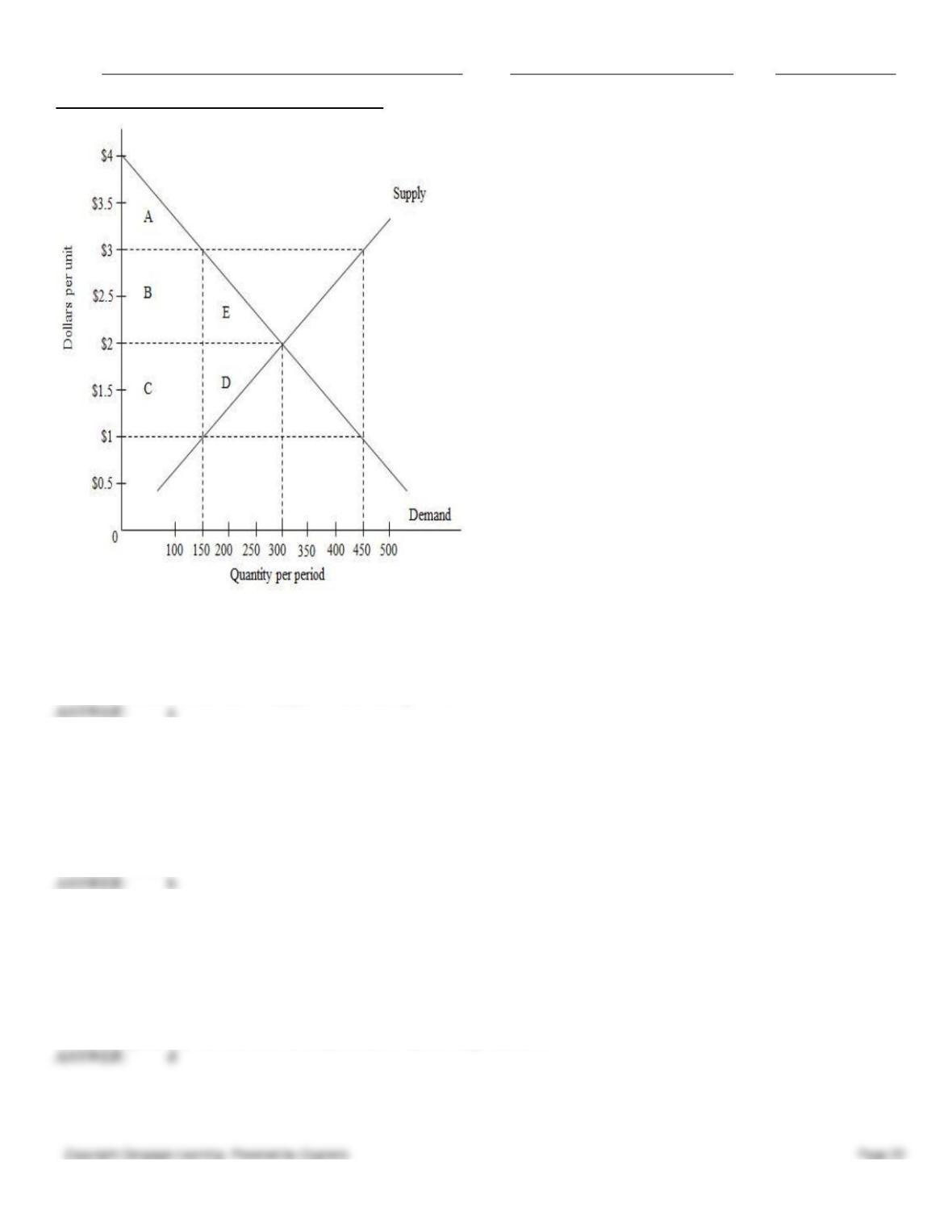
87. The following image shows a market. If there is no government intervention in the market, the consumer surplus is
represented by the area equal to _____.
Figure 16.4
Name:
Class:
Date:
Chapter 16: Public Goods and Public Choice
a. A + B + C
b. A+ B + E
c. B + C + D
d. B + E + D
e. E + D
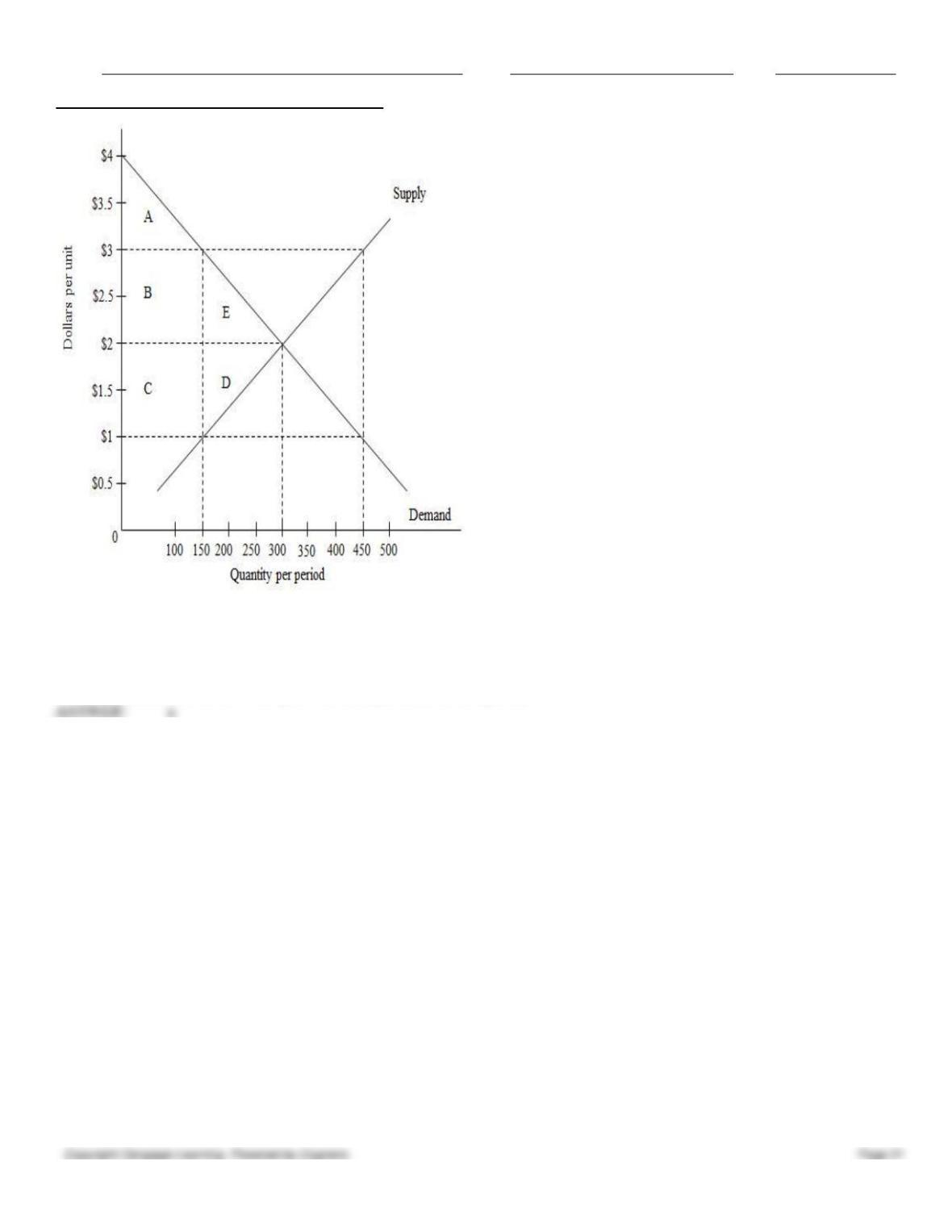
88. The following image shows a market. If the government wants to make a floor price of $3 persist in the market, it
should _____.
Figure 16.4
Name:
Class:
Date:
Chapter 16: Public Goods and Public Choice
a. purchase 300 units of the product at $3 per unit at each period
b. purchase 450 units of the product at $2 per unit at each period
c. sell 300 units of the product at $2 per unit at each period
d. sell 450 units of the product at $3 per unit at each period
e. purchase 150 units of the product at $3 per unit at each period
89. The following image shows a market equilibrium. Suppose the government imposes a price floor of $3 on each unit of
the good sold in the market. Which of the following is true in such a case?
Figure 16.4
Name:
Class:
Date:
Chapter 16: Public Goods and Public Choice
a. The cost to consumer-taxpayers increases by $300.
b. The cost to consumer-taxpayers increases by $600.
c. The cost to consumer-taxpayers decreases by $300.
d. The cost to consumer-taxpayers decreases by $600.
e. The cost to consumer-taxpayers decreases by $150.
90. Payments higher than necessary to call forth a resource are known as _____.
a. profit
b. rents
c. consumer surplus
d. opportunity costs
e. subsidies
91. Direct transfer programs:
a. are generally less efficient and less politically acceptable than subsidy programs.
b. are generally more efficient and more politically acceptable than subsidy programs.
c. are generally less efficient but more politically acceptable than subsidy programs.
d. are generally more efficient but less politically acceptable than subsidy programs.
e. are generally less efficient as they benefit only the large farmers.

Name:
Class:
Date:
Chapter 16: Public Goods and Public Choice
92. An important feature of representative democracy is the incentive and political power it offers interest groups to
increase their income, either through direct transfers or through favorable public expenditures and regulations. Such
benefits are called _____, and the activity that interest groups undertake to elicit these special favors is called _____.
a. profits; profit seeking
b. dividends; portfolio management
c. rents; rent seeking
d. interest; investment
e. real income; income generating
93. Resources employed to persuade government to redistribute income and wealth to special interests are:
a. unproductive because they do nothing to increase total output and usually end up reducing it.
b. productive as they are required to increase total output.
c. efficient as the marginal cost of producing a unit exceeds the marginal benefit to the society.
d. inefficient because the distribution of resources among alternative uses does not match consumer taste.
e. unproductive because they raises the price level in the economy.
94. Which of the following is true of special-interest legislation?
a. The resources used by special-interest groups to persuade elected officials to create legislation to increase their
wealth are productive to society because they increase real output.
b. The resources used by special-interest groups to persuade elected officials to create legislation to increase their
wealth are unproductive to society because they do not increase real output and usually end up reducing it.
c. Special-interest legislation created through rent seeking usually creates widespread benefits for the rest of the
society.
d. Special-interest legislation confers concentrated benefits on one group by imposing concentrated costs on another
group.
e. Special-interest legislation increases inefficiency by bidding up the price of specialized resources.
95. The purpose of a political action committee is to:
a. help elect officials sympathetic to its members’ special interests.
b. help elect officials who will enact fair legislation.
c. raise money for public interest groups.
d. exchange trade secrets.
e. combat the political power of special-interest groups.
96. A lobbyist for the coal industry asks Congress to limit environmental constraints on coal-burning plants. This is an
example of:
a. the median-voter model.
b. rent-seeking.
c. competing-interest legislation.
d. populist legislation.
e. public-interest legislation.
97. Rent seekers are those who:

Name:
Class:
Date:
Chapter 16: Public Goods and Public Choice
a. support the legislation that transfers income to them only when the economy does not suffer.
b. secure special favors from government.
c. reap the benefits of a legislation but prefer to remain rationally ignorant.
d. convert private resources into public resources.
e. aim to make the economy more efficient.
98. The total welfare cost of a monopoly that engages in rent-seeking activities:
a. equals only the portion of lost consumer surplus that is not transferred to the monopolist.
b. includes the use of resources devoted to rent seeking.
c. equals the loss of welfare in the economy due to barriers to entry.
d. equals the total economic profit earned by the monopolist.
e. excludes the use of resources devoted to rent seeking.
99. The hiring of a brilliant tax lawyer by a firm that wants to find tax loopholes:
a. encourages economic efficiency by moving resources away from the government into the private sector.
b. encourages economic efficiency only if the firm’s profit increases.
c. is an example of economic inefficiency caused by devoting resources to wealth redistribution rather than to
production.
d. involves the firm in a zero-sum game against other firms.
e. involves the firm in a zero-sum game against the government.
100. Special-interest groups have little incentive to:
a. earn profits.
b. redistribute wealth.
c. influence government policies.
d. make the economy more efficient.
e. seek regulation beneficial to them.
101. Rent-seeking activity:
a. reduces an economy’s overall efficiency by reducing production.
b. reduces consumer surplus as consumers do not get to maximize their total utility.
c. reduces the profits of firms as their marginal revenue no longer equals their marginal cost.
d. increases economic efficiency by increasing the net average gain of special-interest groups.
e. increases an economy’s allocative efficiency by equating price to the marginal cost of production.
102. Rent-seeking activities by special interest groups result in:
a. greater economic activity by promoting efficiency in government.
b. lower economic activity by diverting resources to less-productive or nonproductive uses.
c. a more equal distribution of income and wealth in the nation.
d. an increase in government revenue through an increase in taxes.
e. greater efficiency in the private economy and increased wealth for society.
Name:
Class:
Date:
Chapter 16: Public Goods and Public Choice
103. Some of the nation’s best minds are occupied with devising schemes to avoid taxes and to transfer income to favored
groups at the expense of market efficiency. This is called:
a. hedging.
b. pork-barrel spending.
c. rent seeking.
d. skimming.
e. profiteering.
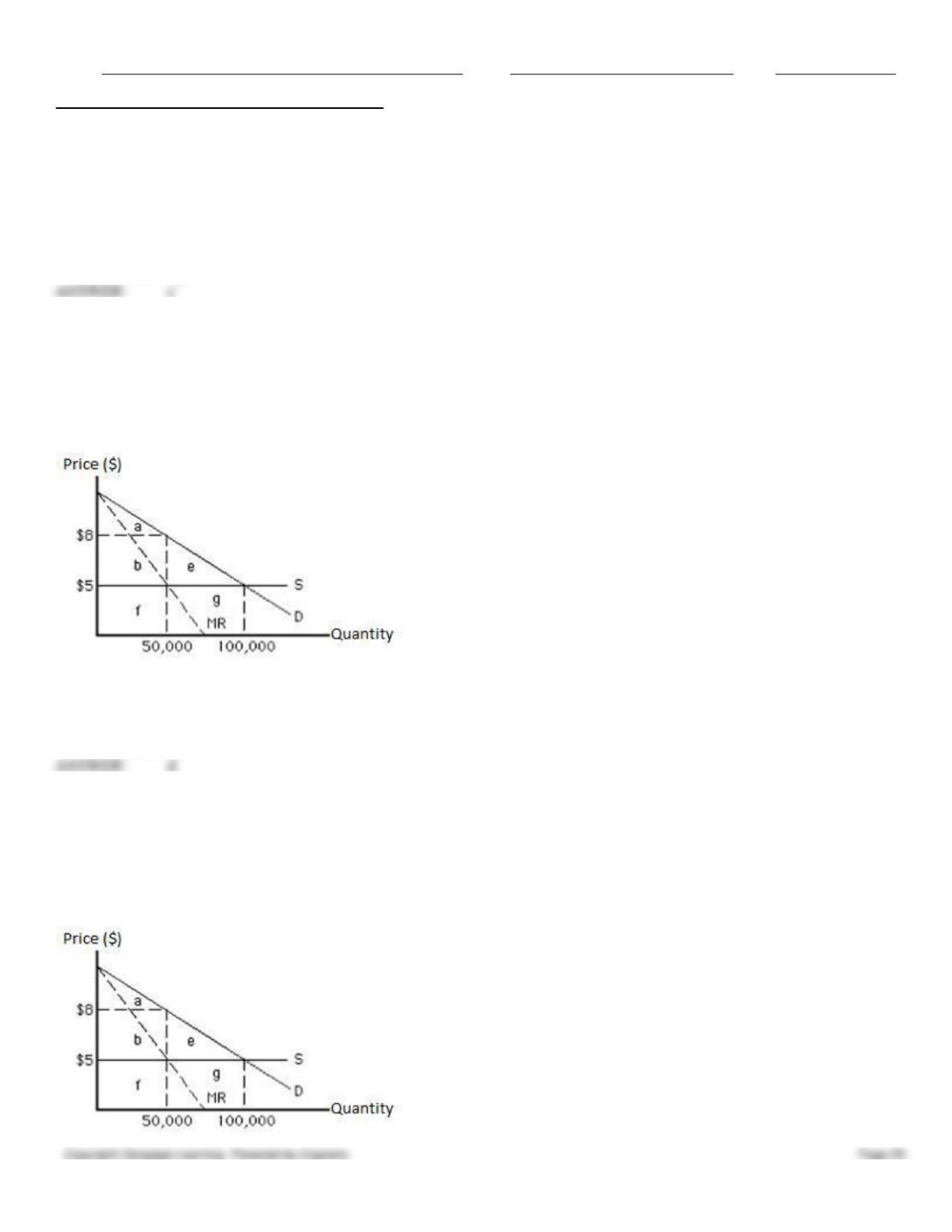
104. The following graph shows the market faced by a monopolist. Suppose the government decides to give monopoly
power to one firm in the industry through an exclusive license. According to the theory of rent seeking, the maximum
amount that the monopolist would spend on rent seeking to get that license is _____.
Figure 16.5
a. $5,00,000
b. $8
c. $2,50,000
d. $1,50,000
e. $75,000
105. The following graph shows the market faced by a monopolist. Suppose the government decides to give monopoly
power to one firm in the industry through an exclusive license. The welfare loss due to monopoly would be equal to the
area _____.
Figure 16.5

Name:
Class:
Date:
Chapter 16: Public Goods and Public Choice
a. a
b. b
c. e
d. f
e. g
106. One goal of a political action committee is to:
a. encourage people to become more active in politics.
b. engage in rent seeking.
c. help raise funds for public-interest groups.
d. to help elect officials who will enact fair legislation.
e. make it easier for legislators to accept the median voter model.
107. Campaign finance reform is usually proposed:
a. as a way of reducing the power of special-interest groups.
b. as a form of rent seeking.
c. by economists as a way of implementing the median voter model.
d. by political action committees.
e. by the Justice Department.
108. A limit on special-interest contributions to national political campaigns:
a. would give challengers an edge over incumbents.
b. is usually supported by special-interest groups as a way of saving money.
c. would involve widespread costs and concentrated benefits.
d. would reduce the extent of rent seeking.
e. is an example of competing-interest legislation.
109. In a(n) _____, all market activity goes unreported either to avoid taxes or because the activity is illegal.
a. natural monopoly
b. collusive oligopoly
c. underground economy
d. representative democracy
e. direct democracy
110. Which of the following transactions is most likely considered part of the informal economy?
a. Tracy accepting only cash payments for the salon services she offers so that she can understate her income
b. Tom holding a garage sale to dispose his old toys and to buy new toys with the money collected from the sale
c. Jonathan converting all his gold possessions into cash
d. Cathy offering to mow the lawn of the neighbor who helped her clean her swimming pool
e. Daisy buying a boat even though the interest paid on a boat loan is not tax deductible

Name:
Class:
Date:
Chapter 16: Public Goods and Public Choice
111. Which of the following correctly distinguishes between tax evasion and tax avoidance?
a. Tax evasion is legal, whereas tax avoidance is illegal.
b. Tax evasion is illegal, whereas tax avoidance is legal.
c. Tax evasion involves taxpayers understating their incomes, whereas tax avoidance involves taxpayers overstating
their incomes.
d. Tax evasion involves taxpayers overstating their incomes, whereas tax avoidance involves taxpayers understating
their incomes.
e. Tax evasion is reported, whereas tax avoidance goes unreported.
112. Which of the following is an example of tax avoidance?
a. Peter moving to a different state to benefit from its lower tax rates
b. Christina understating her income from lawn mowing to reduce her tax bill
c. Joseph claiming inflated deductions to get higher income tax returns
d. Marshall selling commodities in an illegal black market at low prices to reduce his tax bills
e. David taking his family on a European tour financed by his earnings from drug dealing
113. Which of the following is an example of tax evasion?
a. Barry making charitable donations that are eligible for tax deductions
b. Mindy buying municipal bonds as they yield returns free of federal income taxes
c. Martha not reporting the additional income she earns from waiting tables at a restaurant to reduce her taxable
income
d. Bertram claiming his business travel expenses from his company as deductions to reduce his taxable income
e. Daisy moving to a different state to benefit from its low tax rates
114. An underground economy grows more when:
a. government regulations increase.
b. government regulations decrease.
c. government corruption decreases.
d. government spending increases.
e. tax rate decreases.
115. Which of the following would be considered part of the underground economy?
a. Selling subway tokens
b. Tax evasion
c. Personal disposable income
d. Selling alcohol and cigarettes
e. Paying by credit card to avoid writing a check
116. Tax evasion differs from tax avoidance in the sense that evasion:
a. is a rent-seeking activity.
b. can only be done through an accountant.
c. is legal.
d. is illegal.

Name:
Class:
Date:
Chapter 16: Public Goods and Public Choice
e. is encouraged by the Internal Revenue Service.
117. Which of the following is an example of tax evasion?
a. Deducting charitable contributions when figuring income taxes
b. Claiming children’s education expenses as tax exemptions
c. Understating one’s income
d. Converting all gold possessions into cash
e. Selling alcohol and cigarettes
118. A carpenter builds a bookcase for an attorney in exchange for legal services. This transaction is:
a. a means of tax avoidance.
b. likely to be taxed.
c. not part of the economy’s total production.
d. a means of tax evasion.
e. likely to result in double taxation.
119. Officials have estimated the size of the U.S. underground economy to be approximately _____ in 2012.
a. 6 to 8 percent of GDP
b. about $15 trillion
c. 1 percent of GDP
d. $60-80 billion
e. about $2 trillion
120. A tax on productive activity tends to:
a. increase the real gross domestic product of an economy by increasing prices.
b. increase the gross domestic product of an economy by decreasing the opportunity cost of leisure.
c. decrease formal market activity because it lowers the return on such activity.
d. decrease activity in the underground economy because people are afraid of being connected with tax fraud.
e. increase the gross domestic product of an economy by increasing reporting of all market activities.
121. Connor uses means that are legal to arrange his finances so as to pay the least tax possible. He is engaging in:
a. tax evasion.
b. logrolling.
c. tax avoidance.
d. rent seeking.
e. pork-barrel spending.
122. Filing a fraudulent income tax return that understates income or overstates deductions is known as:
a. tax evasion.
b. logrolling.
c. tax avoidance.

Name:
Class:
Date:
Chapter 16: Public Goods and Public Choice
d. rent seeking.
e. profiteering.
123. Suppose Woody wants to buy a boat. Since the interest paid on a boat loan is not tax deductible, he opts for a home
equity loan, the interest on which is still tax deductible. This procedure is an example of _____.
a. tax avoidance
b. tax evasion
c. rational ignorance
d. rent seeking
e. logrolling
124. The underground economy describes:
a. all market activity that goes unreported because the activity itself is illegal.
b. earnings that exceed what the producer would require to supply the product.
c. an economy where a large part of the economic system is controlled by a federal government.
d. all market activity that involves the buying and selling of alcohol and cigarettes.
e. an economy in which people directly decide policy initiatives.
125. Which of the following is a part of the underground economy?
a. Tips reported by a waitress
b. A barber giving a person a haircut in exchange for a meal
c. Income earned through selling shares of stock
d. The portion of a professional athlete’s salary that exceeds his opportunity cost
e. Donations received by a local church in their collection plate on Sunday morning
126. Which of the following activities constitute tax avoidance?
a. Increasing one’s charitable contributions in December
b. Selling illegal drugs on the street
c. Not reporting the tips earned from waiting at tables
d. Selling a condominium
e. Selling alcohol and cigarettes
127. Raising tax rates:
a. provides an added incentive to work.
b. provides less incentive for participation in the underground economy.
c. always increases total tax revenues.
d. leads to less underreporting of income.
e. leads to more underreporting of income.
128. Which of the following is true of bureaus?
a. They are highly sensitive to consumer feedback.

Name:
Class:
Date:
Chapter 16: Public Goods and Public Choice
b. They cover their costs if enough people buy their products.
c. They control the money supply in an economy.
d. They implement the laws created by government.
e. Their ownership is transferable to whomever buys the shares.
129. Bureaus are:
a. special-interest groups that try to influence legislators.
b. government agencies whose activities are financed by appropriations from legislative bodies.
c. competing-interest groups that battle federal agencies.
d. collections of legislators who actively engage in logrolling.
e. elected officials who try to maximize their political support by appealing to the median voter.
130. Which of the following is true of ownership by taxpayers in a government bureau?
a. Ownership in the bureau is easily transferable.
b. Ownership in the bureau can be surrendered but not transferred.
c. Ownership in the bureau cannot be surrendered even if the taxpayer dies.
d. Ownership in the bureau maximizes political support for elected officials.
e. Ownership in the bureau is transferable to whoever buys the shares.
131. _____ are the true owners of government bureaus.
a. Banks
b. Taxpayers
c. Government officials
d. Politicians
e. Retirees
132. Government bureaus:
a. have less incentive to improve consumer satisfaction because they receive less consumer feedback.
b. are keen to improve consumer satisfaction because they receive abundant consumer feedback.
c. are not motivated to eliminate waste because public goods are sold in markets.
d. are not motivated to eliminate waste because public goods are not sold in markets.
e. are motivated only to eliminate any surpluses resulting from higher prices.
133. Identify the correct statement about government bureaus.
a. They have less incentive to eliminate waste and inefficiency.
b. They receive a steady stream of consumer feedback.
c. They earn profits that are distributed among their owners.
d. They produce goods at the lowest cost per unit.
e. They aim to eliminate any excess demand generated in a market.

Name:
Class:
Date:
Chapter 16: Public Goods and Public Choice
134. Which of the following is a crude but efficient mechanism that promotes efficiency in the provision of public goods
by bureaus?
a. Vote with their feet
b. Arbitrage
c. Pork-barrel spending
d. Competing-interest legislation
e. Special-interest legislation
135. A widely held theory of bureaucratic behavior is that government bureaus:
a. seek to maximize their budgets.
b. operate with high profits.
c. sell public goods and services in a market.
d. are more concerned with satisfying consumer demand than are firms.
e. share their losses among members.
136. Budget maximization by bureaus results in:
a. a larger budget than that desired by the median voter.
b. the acquisition of information about public choices and acting specifically on it.
c. the dominance of the preferences of the median, or middle, voter.
d. a smaller budget than that desired by the median voter.
e. the financing of the production of all goods and services in an economy.
137. A government bureau:
a. may be less inclined than a private firm to minimize cost by reducing quality.
b. reports all market activity that goes unreported to evade taxes.
c. shares any profit or loss among its members.
d. sells many different public and private goods and services.
e. maximizes budgets by financing the production of all goods and services in an economy.
138. Private firms and public bureaus differ in that:
a. private firms have more incentive to act on consumer feedback.
b. private firms have less incentive to eliminate waste and inefficiency.
c. private firms are usually financed by government appropriations, while bureaus cover their costs if enough people
buy their products.
d. private firms do not have a profit incentive to satisfy consumer wants but bureaus have a profit incentive to satisfy
consumer.
e. ownership is not transferable in private firms, while ownership is transferable in bureaus.
139. If the managers of a private firm perform poorly, each owner has the option of:
a. closing down the firm.
b. selling his or her share of the firm.
c. managing the firm himself or herself.
d. not paying any taxes on the little profit he or she receives.

Name:
Class:
Date:
Chapter 16: Public Goods and Public Choice
e. selling off some of the equipment of the firm.
140. The basic difference between government bureaus and market firms is that bureaus:
a. have an incentive to maximize profits.
b. can profit from a higher share price.
c. control the money supply in an economy.
d. are more likely to be concerned with the public interest than their own self-interest.
e. are less concerned with satisfying consumer demand.
141. Fire departments receive their revenues from government budgets, but not on a per-fire-extinguished basis. Which of
the following is likely to be true in this case?
a. Elected officials will have the ability to dig into the budget and cut particular items.
b. It will be difficult for department officials to know if too much or too little fire protection is being supplied.
c. Governments will contract directly with private firms to produce public goods and services like firefighting
services because private firms have more incentives to maximize profits than bureaus do.
d. Governments will prefer using public bureaus because bureaus cover their costs by selling goods and services like
firefighting services in the market.
e. Governments will contract directly with private firms to produce public goods and services like firefighting
services because better-trained firefighters will be provided by private firms.
142. Compared to private firms, we should expect public bureaus to:
a. have smaller budgets.
b. be more cost-efficient.
c. be less cost-efficient.
d. be more concerned with adopting new technologies.
e. be more in tune with consumer preferences.
143. Bureaucrats obtain the budget they want by:
a. lowering consumer prices.
b. raising consumer prices.
c. promising to produce more efficiently.
d. threatening legislatures with an all-or-nothing choice.
e. allowing legislators to cut particular items from their budget.
144. In response to the threat of budget cuts, the Connecticut State Department of Recreation proposed shutting down
many state parks and beaches. This is an example of:
a. cost efficiency in bureaus.
b. budget maximizing by bureaus.
c. the median-voter model.
d. logrolling.
e. direct democracy.

Name:
Class:
Date:
Chapter 16: Public Goods and Public Choice
145. Which of the following is true of bureaus?
a. Bureaus are monopoly suppliers of their output to elected officials.
b. Bureaus receive a steady stream of consumer feedback.
c. Bureaus earn profits when taxes increase.
d. Bureaus try to maximize profits.
e. Bureaus aim to minimize costs.
146. Which of the following is not a typical goal of bureaucrats?
a. Increasing the size of their bureaus
b. Gaining prestige
c. Increasing the size of their staffs
d. Increasing their bureaus’ budgets
e. Achieving greater efficiency
147. To purchase goods and services, governments prefer dealing with bureaus rather than private firms because:
a. bureaucrats have less opportunity to reward friends and supporters with jobs than do private business managers.
b. bureaus always produce at the lowest possible cost.
c. bureaus use the market to sell the goods and services they produce.
d. public officials may be better able to control the details of production in bureaus than in private firms.
e. government will not be able to sell the good or service produced by a private firm because of their low quality.
148. Elected officials may choose a public bureau over a private firm to collect garbage because:
a. public bureaus have proven to be more efficient than private firms in garbage collection.
b. the officials can grant political favors by giving people jobs in the public bureau.
c. public bureaus will be more responsive to consumers.
d. public bureaus will perform garbage collection at the lowest possible cost.
e. tax revenue will be higher if the public bureau is in charge of garbage collection.
149. If the quality or quantity of a particular public service is difficult to monitor, a government is more likely to:
a. produce the service itself.
b. contract with private firms to supply the service.
c. take over private corporations and have these nationalized corporations produce the service.
d. refuse to provide the service.
e. raise the price of the service to consumers.
150. A study found that privately operated juvenile correction facilities in Florida had _____ costs but experienced _____
rates of recidivism than state-operated juvenile corrections facilities.
a. lower, higher
b. lower, lower
c. higher, equivalent
d. higher, lower
e. lower, equivalent

Name:
Class:
Date:
Chapter 16: Public Goods and Public Choice