
Exam
Name___________________________________
MULTIPLE CHOICE. Choose the one alternative that best completes the statement or answers the question.
1)
Photosynthesis involves
1)
A)
important reactions within the stems and roots of plants.
B)
a process known as respiration.
C)
the use of sunlight to produce food sugars and oxygen to drive biological processes.
D)
the release of stored carbon dioxide in a process using sunlight.
2)
Together, three natural elements make up 99% of Earth’s biomass. Which of the following is NOT
one of those three elements?
2)
A)
Nitrogen (N)
B)
Oxygen (O)
C)
Hydrogen (H)
D)
Carbon (C)
3)
As chemical pesticides move through the trophic pyramid, they may be amplified at each higher
level in a process called
3)
A)
biomagnification.
B)
trophic cascading.
C)
pyramidal decay.
D)
competitive exclusion.
4)
In coral reefs, clownfish live unharmed among the poisonous tentacles of sea anemones. The sea
anemones protect the clownfish from predation, while the clownfish scare off predators, such as the
butterfly fish, which would otherwise eat the anemones. The clownfish may also provide important
nutrients to the anemones. This arrangement is an example of which symbiotic relationship?
4)
A)
Parasitism
B)
Mutualism
C)
Commensalism
D)
Amensalism

6)
The ability of an ecosystem to recover quickly from a disturbance and return to its original state is
known as
6)
A)
vicariance.
B)
succession.
C)
resilience.
D)
punctuated equilibrium.
7)
A study of the spatial distribution of the coast redwood (Sequoia sempervirens) and the
environmental factors that control that distribution would be an example of a topic studied in
7)
A)
ecology.
B)
biogeography.
C)
plant biology.
D)
pedology.
8)
If a forest fire destroyed the vegetation in an area, but left some vestiges of the previously
functioning community and the soil intact, what type of succession would follow?
8)
A)
Primary
B)
Quaternary
C)
Tertiary
D)
Secondary
9)
When a random occurrence produces altered genetic material and inserts new traits into the
inherited stream, ________ has occurred.
9)
A)
Lamarckian evolution
B)
mutation
C)
vicariance
D)
punctuated equilibrium
5)
5)
A)
B)
C)
D)

10)
The gaseous oxygen in Earth’s early atmosphere was a by–product of
10)
A)
photosynthesis.
B)
volcanic outgassing.
C)
decay of organic matter.
D)
photochemical reactions breaking down ozone (O3) to form oxygen (O2).
11)
The difference between the photosynthetic production of carbohydrates and the respiration loss of
carbohydrates is known as
11)
A)
net primary productivity.
B)
free air CO2 enrichment.
C)
compensation point.
D)
net photosynthesis.
Explanation:
12)
The study of the distribution of plants and animals, the diverse spatial patterns they create, and the
physical and biological processes that produce Earth’s species richness is called
12)
A)
biogeography.
B)
geoarchaeology.
C)
ecology.
D)
biology.
Explanation:
13)
Chlorophyll absorbs only the ________ and ________ wavelengths for photochemical operations.
13)
A)
orange–red; green–yellow
B)
yellow–red; violet–green
C)
orange–red; violet–blue
D)
violet–blue; green–yellow
Explanation:
14)
Photosynthesis converts
14)
A)
heat energy, carbon dioxide, and water into carbohydrates and oxygen.
B)
light energy, carbon dioxide, and water into carbohydrates and oxygen.
C)
heat energy, oxygen, and carbohydrates into carbon dioxide and water.
D)
light energy, oxygen, and carbohydrates into carbon dioxide and water.
Explanation:
Explanation:

15)
An ecosystem is a(n) ________ system in terms of energy, and a(n) ________ system in terms of
matter.
15)
A)
open; closed
B)
closed; closed
C)
open; open
D)
closed; open
16)
Consider a simple food chain in which a grasshopper eats grass, the grasshopper is eaten by a frog,
and the frog is eaten by a snake. Which of the following is NOT correctly matched?
16)
A)
Frogsecondary consumer
B)
Snakeprimary consumer
C)
Grasshopperherbivore
D)
Grassautotroph
17)
Which of the following is the largest carbon sink?
17)
A)
The atmosphere
B)
Dead organic matter
C)
The oceans
D)
Fossil fuels and oil shales
18)
A consumer, such as a bear, that eats both producers (plants) and consumers (animals) is a
18)
A)
carnivore.
B)
detritivore.
C)
omnivore.
D)
herbivore.
19)
Increased foliage cover in parts of Australia has been attributed to which of the following climate
change related phenomena?
19)
A)
Sea level rise
B)
Cloud greenhouse forcing
C)
CO2 fertilization effect
D)
Cloud albedo forcing
20)
Of the total energy intercepted at Earth‘s surface and available for work, only about ________ is
actually fixed by photosynthesis.
20)
A)
1%
B)
5%
C)
10%
D)
15%
21)
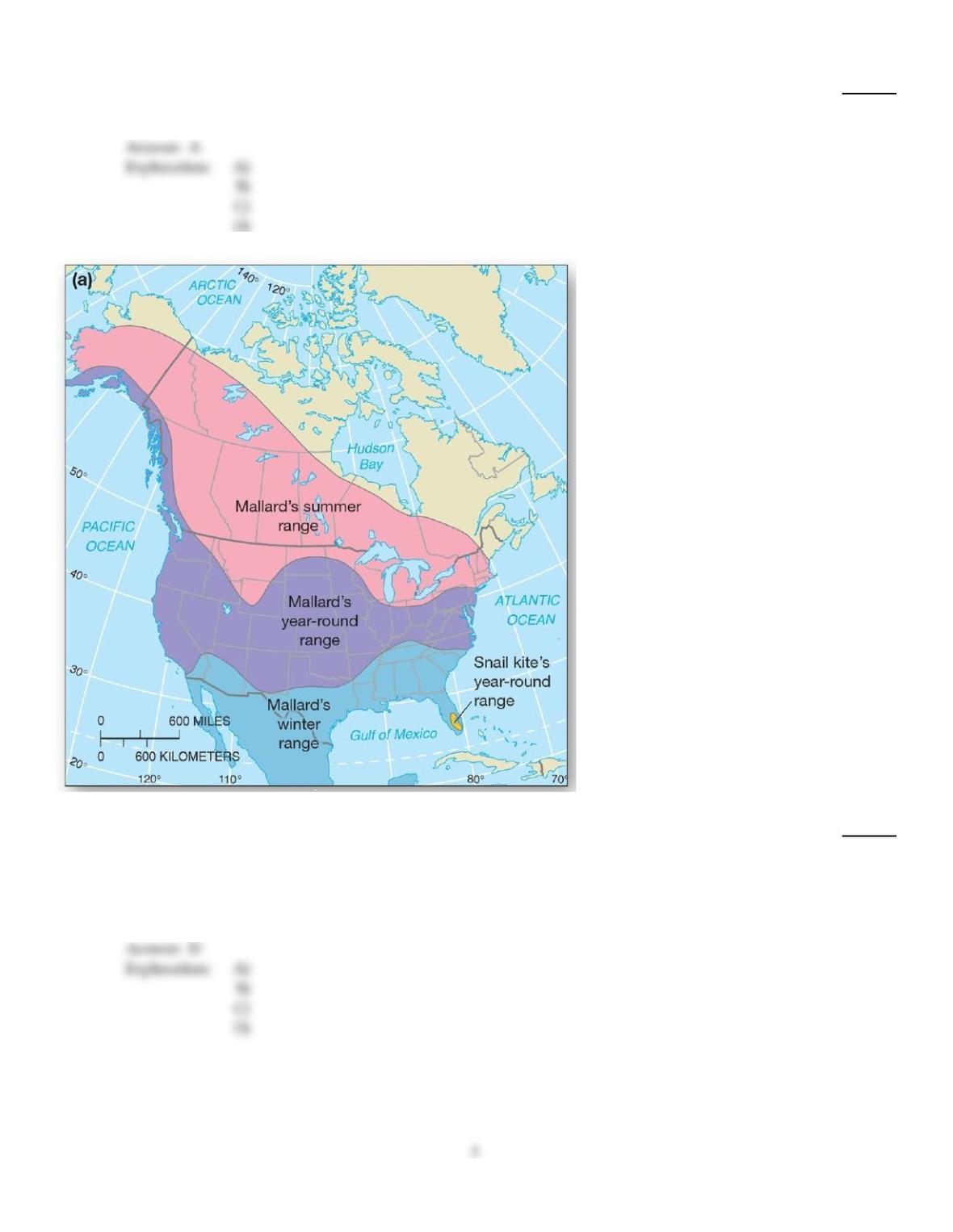
The snail kite (Rostrhamus sociabilis) is a specialist that feeds on only one specific type of snail. By
comparison, the Mallard Duck (Anas platyrhynchos) is a generalist that feeds on diverse food
sources. Whereas the snail kite has a very limited range, the Mallard Duck has a very broad range.
The snail kite’s diet is an example of a(n)
21)
A)
habitat
B)
range of tolerance.
C)
ecological niche.
D)
limiting factor.

22)
How is atmospheric nitrogen converted to a usable form in the biosphere?
22)
A)
Atmospheric nitrogen is completely unavailable to plants and animals and, as a result,
synthetic fertilizers must be used.
B)
Atmospheric nitrogen is directly available to plants and animals.
C)
Bacteria within root nodules of legumes chemically combine the atmospheric nitrogen into
nitrates and ammonia.
D)
It is absorbed into plants via stomata and converted within the plant to a usable form.
23)
A ________ is a complex network of interconnected food chains with multidirectional branches.
23)
A)
food pyramid.
B)
trophic level.
C)
niche order.
D)
food web.
24)
If a lava flow completely denudes a mountain, leaving only bare rock, what type of succession will
follow?
24)
A)
Tertiary
B)
Quaternary
C)
Primary
D)
Secondary
25)
In which of the following terrestrial ecosystems would one tend to find the lowest net primary
productivity?
25)
A)
Tundra
B)
Woodland and shrubland
C)
Cultivated lands
D)
Extreme desert
26)
Energy flows through an ecosystem along an idealized unidirectional pathway called a
26)
A)
niche order.
B)
trophic cascade.
C)
food web.
D)
food chain.

27)
Human caused eutrophication is known as
27)
A)
anthropotrophication.
B)
oligotrophication.
C)
cultural eutrophication.
D)
mesotrophication.
28)
A study of dietary requirements of African bush elephants (Loxodonta africana) in a savanna
environment, and the role the elephants play in that environment, would be an example of a topic
studied in
28)
A)
ecology.
B)
pedology.
C)
plant biology.
D)
biogeography.
29)
Respiration involves
29)
A)
a photochemical reaction involving carbon dioxide and water to produce carbohydrates and
oxygen.
B)
a photochemical reaction involving carbon dioxide and oxygen to produce water and oxygen.
C)
the use of heat energy to react carbon dioxide with water to produce oxygen.
D)
a chemical reaction between carbohydrates and oxygen to produce carbon dioxide, water, and
heat energy.
30)
Which of the following is NOT a biotic component of an ecosystem?
30)
A)
Mineral nutrients
B)
Bacteria
C)
Plants
D)
Animals

31)
A dead zone refers to
31)
A)
terrestrial areas in which excessive nitrogen fertilizer has essentially burned the soil,
preventing plants and microorganisms from living there.
B)
an ecosystem that was cleared of all vegetation for slash and burn agriculture.
C)
hypoxic areas in water bodies that limit marine and aquatic life.
D)
oligotrophic areas in water bodies that cannot support life due to lack of nutrients.
32)
A monocultural agriculture community is ________ vulnerable to disturbance than an area with
high biodiversity.
32)
A)
less
B)
more
C)
equally
33)
A self–sustaining association of living plants and animals and their nonliving physical
environment is termed a(n)
33)
A)
community.
B)
niche.
C)
ecosystem.
D)
ecotone.
34)
A lichen is made up of algae and fungi living together. In this relationship, the alga is the producer
and food source for the fungus and the fungus provides structure and physical support for the alga.
This is an example of which symbiotic relationship?
34)
A)
Parasitism
B)
Mutualism
C)
Commensalism
D)
Amensalism
35)
Which of the following has the highest number of known species?
35)
A)
Bacteria
B)
Insects
C)
Plants
D)
Chordates

36)
In which of the following terrestrial ecosystems would one tend to find the highest net primary
productivity?
36)
A)
Tundra and alpine region
B)
Tropical seasonal forest
C)
Boreal forest
D)
Temperate grassland
37)
The notion that the traits that help a species survive and reproduce are passed along more
frequently than those that do not is known as
37)
A)
natural selection.
B)
punctuated equilibrium.
C)
gradualism.
D)
Lamarckianism.
38)
A black walnut (Juglans nigra) emits a chemical that may kill or inhibit the growth of other nearby
shrubs or trees without harming itself. This is an example of which symbiotic relationship?
38)
A)
Parasitism
B)
Mutualism
C)
Commensalism
D)
Amensalism
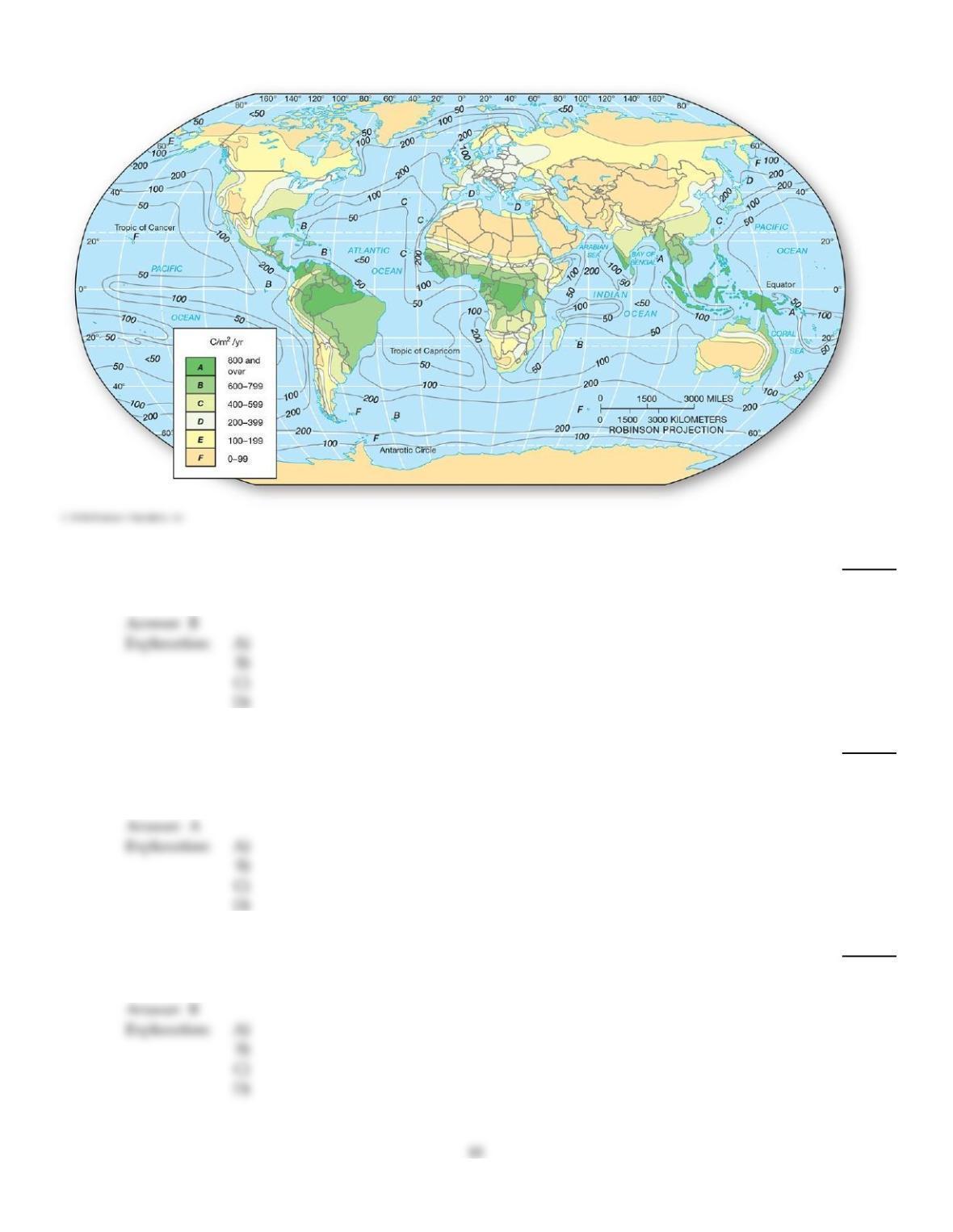
39)
In which of the following areas would one tend to find the highest net primary productivity?
39)
A)
Western Canada
B)
Northern Brazil
C)
Central Australia
D)
Eurasia
40)
The interacting populations of living plants and animals in a particular location are described as
a(n)
40)
A)
community.
B)
metapopulation.
C)
ecosystem.
D)
niche.
41)
The proposition that no two species can occupy the same ecological niche is known as the
41)
A)
symbiosis.
B)
competitive exclusion principle.
C)
ecological niche theory.
D)
trophic pyramid theory.

42)
Today, there are over 270,000 plant species with conductive tissues and material flow systems
known as
42)
A)
cyanobacteria.
B)
blue–green algae.
C)
xeriphytes.
D)
vascular plants.
43)
Epiphytic plants, such as various species of orchids (Orchidaceae), grow upon another plant, using
the plants for physical support, but bringing no harm to the host plant. This is an example of which
symbiotic relationship?
43)
A)
Parasitism
B)
Mutualism
C)
Commensalism
D)
Amensalism
44)
Which of the following is NOT correct regarding nitrogen?
44)
A)
Bacterial action is key to the nitrogen cycle.
B)
Nitrogen is very important to organisms.
C)
The atmosphere contains about 78% nitrogen,
D)
Atmospheric nitrogen is accessible directly to most organisms.
45)
The zonation of flora and fauna along an altitudinal transect similar to that found along latitudinal
transects is an expression of the
45)
A)
altitudinal zonation principle.
B)
altitude–latitude hypothesis.
C)
life zone concept.
D)
vegetation similarity theory.
46)
Which of the following is NOT a measure of biological diversity?
46)
A)
Ecosystem diversity
B)
Genetic diversity
C)
Species diversity
D)
Species diversity, genetic diversity, and ecosystem diversity are all measures of biodiversity.

47)
The first species to colonize previously disturbed or damaged ecosystems are called a(n)
47)
A)
sere.
B)
establishment.
C)
successor.
D)
pioneer community.
48)
The separation of a once continuous population by continental drift is an example of
48)
A)
mutation.
B)
vicariance.
C)
Lamarckian evolution.
D)
punctuated equilibrium.
49)
The net photosynthesis for an entire ecosystem is known as the
49)
A)
net photosynthesis.
B)
compensation point.
C)
net primary productivity.
D)
free air CO2 enrichment.
50)
The gradual nutrient enrichment in water bodies is known as
50)
A)
dystrophication.
B)
oligotrophication.
C)
mesotrophication.
D)
eutrophicatiom.
51)
Only about ________ of the kilocalories in a trophic level is passed to the next trophic level (e.g.
from autotroph to primary consumer).
51)
A)
5%
B)
10%
C)
15%
D)
20%

52)
In food webs, toxic chemicals tend to accumulate and concentrate most in the
52)
A)
autotrophs.
B)
herbivores.
C)
top carnivores.
D)
omnivores.
53)
The specific, unique role that a species performs within a given area is known as a(n)
53)
A)
niche.
B)
ecotone.
C)
habitat.
D)
community.
54)
The openings on the surfaces of plant leaves through which gases move into and out of are known
as
54)
A)
stomata.
B)
guard cells.
C)
chloroplasts.
D)
chlorophyll.
55)
When a community is disturbed to the point that most or all of its species are eliminated, a process
called ________ occurs in which the area undergoes a series of changes in species composition as
newer communities replace older ones.
55)
A)
ecological succession
B)
rejuvenation
C)
mass extinction
D)
patch dynamics
56)
Earth’s biosphere
56)
A)
only includes the biotic components of an ecosystem, with the abiotic components being
considered part of the lithosphere, hydrosphere, or atmosphere, respectively.
B)
extends from the ocean floor to an altitude of approximately 8 km (5 mi) into the atmosphere.
C)
consists of only terrestrial organisms, while the hydrosphere includes aquatic and marine
organisms.
D)
is more a theoretical construct than an observable sphere of study.

57)
The net dry weight of all organic material in an ecosystem is known as
57)
A)
compensation point.
B)
net photosynthesis.
C)
biomass.
D)
net primary productivity.
58)
Studies have shown that ________ biodiversity in an ecosystem leads to ________ long–term
stability and productivity.
58)
A)
less; greater
B)
less; slightly more
C)
greater; greater
D)
greater; less
C
59)
The origin of Earth’s biological diversity is embodied in
59)
A)
the theory of evolution.
B)
ecological succession principle.
C)
competitive exclusion principle.
D)
the life zone concept.
A
60)
The break–even point between the production and consumption of organic material is termed
60)
A)
free air CO2 enrichment.
B)
compensation point.
C)
net photosynthesis.
D)
net primary productivity.
B
61)
Which of the following is INCORRECT regarding the spatial–temporal variability of net primary
productivity?
61)
A)
Net primary productivity is highest in the fall and winter in temperate and high latitude
areas.
B)
Productivity rates are constantly high throughout the year in the tropics.
C)
Productivity rates in deserts is much less than that of tropical regions.
D)
At temperate and high latitudes, the rate of carbon fixing is seasonally variable.
A
C

62)
The environment in which an organism resides or is biologically adapted to live is called a(n)
62)
A)
habitat.
B)
community.
C)
niche.
D)
ecotone.
63)
Currently, approximately ________ of cultivated acreage in the United States and Canada is
planted for animal consumption.
63)
A)
15%
B)
30%
C)
50%
D)
65%
Explanation:
64)
Which of the following is NOT an abiotic component of an ecosystem?
64)
A)
Plants
B)
Sunlight
C)
Mineral nutrients
D)
Precipitation
Explanation:
65)
Autotrophs that dwell in dark caves, wells, or on the ocean floor often depend on which of the
following biogeochemical processes?
65)
A)
Chemosynthesis
B)
Nutrient leaching
C)
Photosynthesis
D)
Nitrogen fixing
Explanation:
66)
Since life arose on Earth, ________ major extinctions have occurred.
66)
A)
one
B)
two
C)
six
D)
ten
Explanation:
Explanation:

67)
Which of the following is NOT considered among the greatest anthropogenic threats to
biodiversity?
67)
A)
Climate change
B)
Introduction of non–native species
C)
Habitat loss
D)
Air, water, and soil pollution
E)
Habitat loss, non–native species, pollution, and climate change all represent threats to
biodiversity.
68)
Chlorophyll reflects predominately ________ wavelengths of visible light.
68)
A)
blue
B)
green
C)
red
D)
indigo
69)
An organism capable of synthesizing its own food solely from carbon dioxide using sunlight or
chemical energy is known as a(n)
69)
A)
secondary consumer.
B)
heterotroph.
C)
primary consumer.
D)
autotroph.
70)
Mistletoe (Phoradendron) infest many taxa of plants, often causing the branches of the host species
to become swollen and distorted and making the trees more susceptible to insect infestations. This
is an example of which symbiotic relationship?
70)
A)
Parasitism
B)
Mutualism
C)
Commensalism
D)
Amensalism

71)
________ refers to the biotic and abiotic characteristics in the environment that determine species
distribution.
71)
A)
Limiting factor
B)
Range of tolerance
C)
Habitat
D)
Ecological niche
72)
From the perspective of energy, which of the following is the most efficient trophic level?
72)
A)
Primary producer
B)
Primary consumer
C)
Secondary consumer
D)
Tertiary consumer
73)
Organisms that share the same feeding level (e.g. primary producers, primary consumers,
secondary consumers, etc.) are said to be at the same
73)
A)
food pyramid.
B)
trophic level.
C)
niche order.
D)
food web.
74)
Approximately how many plant and animal species have been classified?
74)
A)
100,000
B)
1.75 million
C)
3.6 million
D)
111.7 million
75)
75)
A)
B)
C)
D)

76)
Approximately ________ of the light energy arriving at the surface of a leaf is useful to chlorophyll.
76)
A)
5%
B)
10%
C)
25%
D)
50%
77)
Which of the following would NOT be a limiting factor for a plant species?
77)
A)
Soil phosphorus content
B)
Daily precipitation values
C)
Days below freezing
D)
Number of predators
78)
The study of the interrelationships between organisms and their environment is called
78)
A)
pedology.
B)
biology.
C)
ecology.
D)
biogeography.
TRUE/FALSE. Write ‘T’ if the statement is true and ‘F’ if the statement is false.
79)
Increased atmospheric CO2 may lead to increased foliage cover.
79)
80)
Atmospheric nitrogen is readily available to living organisms.
80)
81)
Within a lake, eutrophic conditions predominate in deep, open water.
81)
82)
Species extinctions have occurred throughout Earth’s history, so the recent loss of species is of little
concern.
82)
83)
The term ecology literally means “the study of the household.”
83)

84)
Some harmful chemicals that are long–lived, stable, and soluble in fatty tissues become
increasingly concentrated at each higher trophic level.
84)
85)
Biogeography is the study of the spatial distribution of plants, whereas zoogeography is the study
of the spatial distribution of animals.
85)
86)
As energy moves through trophic levels it increases from lower to higher levels.
86)
87)
Contemporary biogeographic and ecological thinking posits that disturbance constantly disrupts
ecosystems and a community may never reach the stage of climax community.
87)
88)
Plants colonizing bare rock after a volcanic eruption denudes an area is an example of primary
succession.
88)
89)
Hydrogen, oxygen, and carbon together make up more than 99% of Earth‘s biomass.
89)
90)
An altitudinal community assemblage at a given latitude is often similar to an assemblage that
covers a certain range of latitude.
90)
91)
Primary succession is more common than secondary succession.
91)
92)
A leech that sucks blood from an animal is in an example of commensalism.
92)
93)
Approximately half of the cultivated acreage in the United States and Canada is planted for animal
consumption.
93)
94)
Greater biological diversity in an ecosystem leads to greater long–term stability and productivity.
94)

95)
Plants remove a relatively insignificant amount of carbon dioxide from the atmosphere.
95)
96)
The distribution of species is based on both biotic and abiotic factors.
96)
97)
Most of Earth’s organisms have been identified and classified.
97)
98)
An ecosystem is a self–regulating association of living plants and animals and their nonliving
physical environment.
98)
99)
Respiration is essentially the reverse of the photosynthetic process.
99)
100)
A lichen, which is a composite organism consisting of an alga and fungus, is an example of
mutualism.
100)
101)
An orogeny that separates a once continuous population of a species is an example of vicariance.
101)
102)
Of the total energy that is intercepted at Earth‘s surface and available for work, about 25% is fixed
by photosynthesis as carbohydrates in plants.
102)
103)
There is little evidence supporting the contention that synthetic fertilizers disrupt natural
biogeochemical cycles.
103)
104)
Habitat loss, pollution, resource exploitation, climate change, and introduction of non–native
species are among the greatest threats to biodiversity.
104)
105)
A lake classified as euthrophic has high nutrient content.
105)

106)
Bacteria have the largest number of known species among the major categories of living organisms.
106)
107)
Communities are not static, rather they undergo changes over time due to various natural
disturbances.
107)
108)
An ecological niche is essentially the same thing as a habitat.
108)
109)
Different patches across a landscape may be at different successional stages.
109)
110)
According to the competitive exclusion principle, no two species can occupy the same niche.
110)
111)
Addressing and mitigating climate change may become an essential component of species
conservation.
111)
112)
A stable ecosystem is one that is not undergoing change.
112)
113)
A resilient species or ecosystem is one that can recover quickly from disturbance.
113)
114)
Net primary productivity is a measurement of how much each individual plant photosynthesizes.
114)
115)
The term biodiversity encompasses not only the number and variety of different species, but also
genetic variations within a species and the varieties of ecosystems, habitats, and communities in an
area.
115)
ESSAY. Write your answer in the space provided or on a separate sheet of paper.
116)
Describe the main abiotic ecosystem components. Give at least two regional examples of how these elements
combine to form ecosystems.
117)
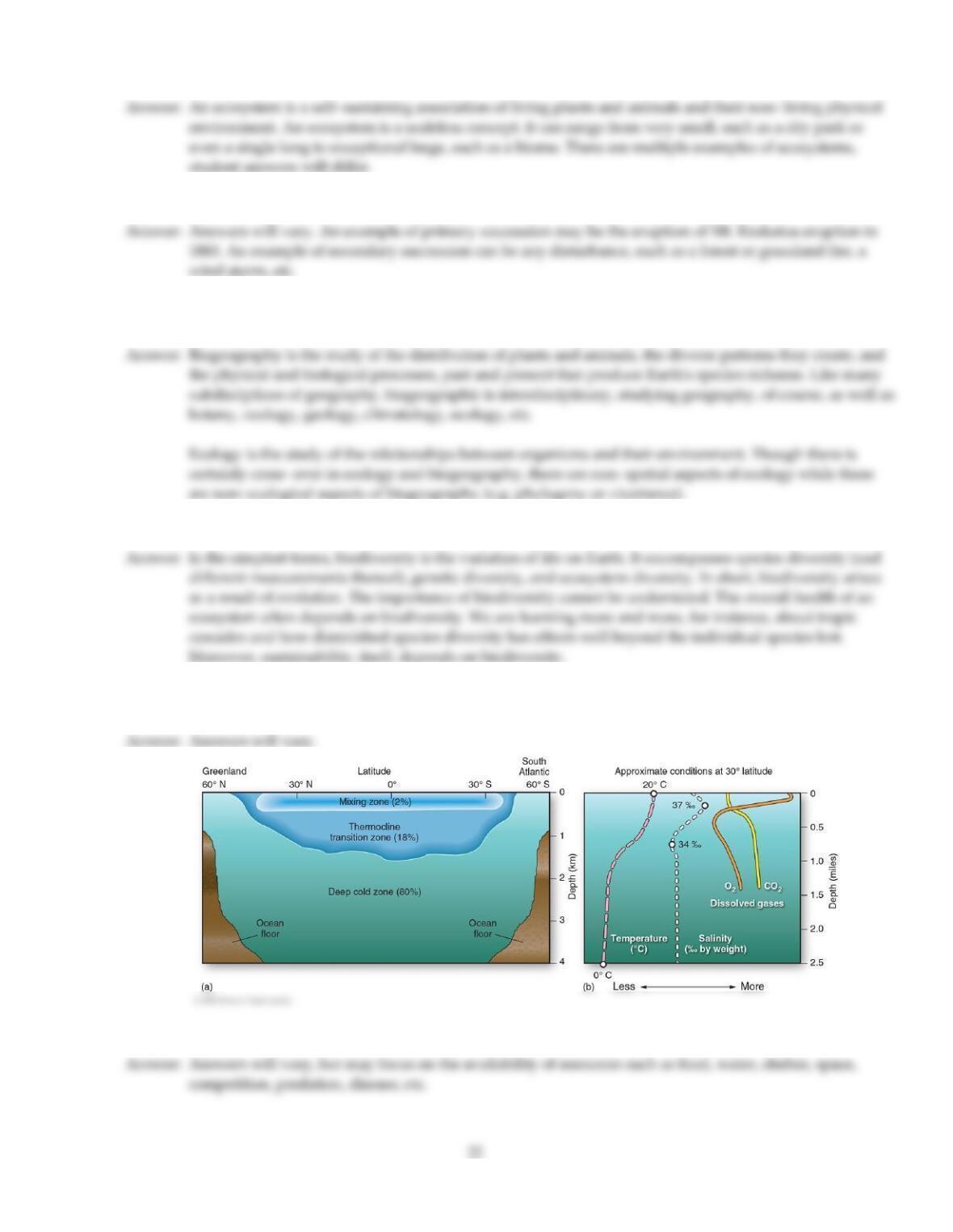
What is an ecosystem? What is the spatial scale of an ecosystem? Provide some examples of an ecosystem.
118)
Provide a hypothetical or a historical example of both primary and secondary succession.
119)
What is biogeography? What subjects do biogeographers study? What is ecology? How does biogeography vary
from ecology?
120)
What is biodiversity? How does it arise? Why is it important?
121)
Using Figure 13.3 as your guide, describe the net primary productivity of the area in which you live. How does
this net primary productivity vary across your state (or equivalent) and broader region?
122)
Using outside sources, describe the limiting factor of an organism and how it affects this organisms distribution.
123)
Consider the ecology of the region in which you live. Which organisms are the primary producers, primary
consumers, secondary consumers, and tertiary consumers?
124)
Using outside sources, provide an example of each of the following symbiotic relationships: mutualism,
parasitism, commensalism, and amensalism.
125)
What are the major threats to biodiversity in the coming decades? Explain your selections.


Answer Key
Answer Key
Testname: C16
26
Answer Key
Testname: C16
27