
Elements of Ecology, 9e (Smith)
Chapter 16 Community Structure
16.1 Short Answer Questions
1) The simplest measure of community structure is a count of the number of species present and
is referred to as species ________.
2) The percentage of individuals in a community that belong to one species is called the relative
________ of that species.
3) A ________ diagram plots each species in a community, beginning with the most abundant
and ending with the least abundant, along the x-axis, with the corresponding value of relative
abundance on the y-axis.
4) ________ index (D) represents the probability that two individuals randomly selected from a
sample will belong to the same species.
5) When a single or a few species are most prevalent in a community, the species are called
________.
6) A species that has a disproportionate impact on a community, relative to its abundance, is
called a(n) ________ species.
7) A straight-line diagram illustrating the flow of food energy from prey to predator is referred to
as a food ________.

8) In a food web diagram, ________ species feed on no other species but are fed upon by others.
9) In a food web diagram, groups of species that derive food energy from a similar source are
called ________ levels.
10) Within a community, a group of species that carries out similar functions or exploits the
same resource is called a(n) ________.
11) In a forest community, the upper layer is called the ________.
12) In a forest community, the layer containing tall shrubs, small trees, and young trees is called
the ________.
13) During the summer, the bottom, cold layer of dense water in a well-stratified lake is called
the ________.
14) In aquatic habitats, the upper zone of water where the availability of light supports
photosynthesis by phytoplankton is called the ________ zone.
15) In aquatic habitats, the bottom zone where decomposition is most active is referred to as the
________ zone.

16) Changes in the physical and biological structures of communities as one moves across the
landscape are referred to as ________.
17) A(n) ________ is a type of community with relatively consistent species composition; a
uniform, general appearance; and a distribution that is characteristic of a particular habitat.
18) The view developed by H. A. Gleason that communities result from similarities in species’
requirements and tolerances for environmental factors is referred to as the ________ concept of
communities.
1) When an ecologist compares the diversity of different communities by counting the number of
species within each community, the measure of diversity being used is called
A) species evenness.
B) species diversity.
C) species richness.
D) relative abundance.
2) In a rank-abundance curve comparing two communities, the community with the greater
species richness is characterized by a
A) lesser length of the curve and a more gradual slope.
B) lesser length of the curve and a steeper slope.
C) greater length of the curve and a more gradual slope.
D) greater length of the curve and a steeper slope.

3) Communities with low evenness will have rank-abundance curves
A) that are very steep.
B) that are 1:1.
C) that are very shallow.
D) that are flat.
4) The relative abundance of a tree with 100 individuals in a community of 1000 would be
A) 10.
B) 1.
C) 0.1.
D) 100.
5) Which of the following has the highest species richness? A community with
A) 34 species of high evenness.
B) 36 species with very low evenness.
C) 35 species of high evenness.
D) 33 species of low evenness.
6) Which of the following values of evenness represents a completely even distribution?
A) 100
B) 10
C) 1
D) 0
7) Which description is true for most communities?
A) All species have approximately equal abundances.
B) All species are rare.
C) All species are common.
D) A few species are common and the remainder are rare.

8) Dominant species tend to be more abundant than other species because they
A) prey upon or parasitize other species.
B) outcompete other species.
C) are preyed upon less than other species.
D) reproduce more rapidly than other species.
9) If you get a Simpson’s index of 1, this means
A) there is only one species in the community.
B) all species are in equal proportions.
C) the calculation is incorrect as this is theoretically impossible.
D) the Shannon index will equal 0.
10) Which is the most dominant species?
A) largest in number
B) highest in relative abundance
C) most relative biomass
D) All of the above can indicate dominance.
11) Which statement best describes a keystone species?
A) a rare or uncommon species that has a strong effect on its community
B) an abundant species that may or may not affect other species
C) a species that takes up a great deal of space in a community
D) a common species that has a strong effect on its community
12) A species that has massive effects on an ecosystem but in proportion to its abundance is a
A) keystone species.
B) basal species.
C) dominant species.
D) top predator.

13) What might be a result of hunting sea otters to extinction for their fur?
A) loss of killer whales
B) loss of sea urchins
C) loss of kelp beds
D) loss of barnacles
14) In the following community, which serves as the keystone species?
A) killer whales
B) sea otters
C) sea urchins
D) kelp bed
15) The species at the top of a food web
A) do not prey on other species and are not subject to predation.
B) do not prey on other species and are subject to predation.
C) prey on other species and are not subject to predation.
D) prey on other species and are subject to predation.
16) Within a food web, herbivores are considered to be
A) basal species.
B) intermediate species.
C) top predators.
D) represented at any level.
17) The total number of observed links in the food web divided by the total number of species is
the
A) connectance.
B) Simpson index.
C) linkage density.
D) mean chain length.
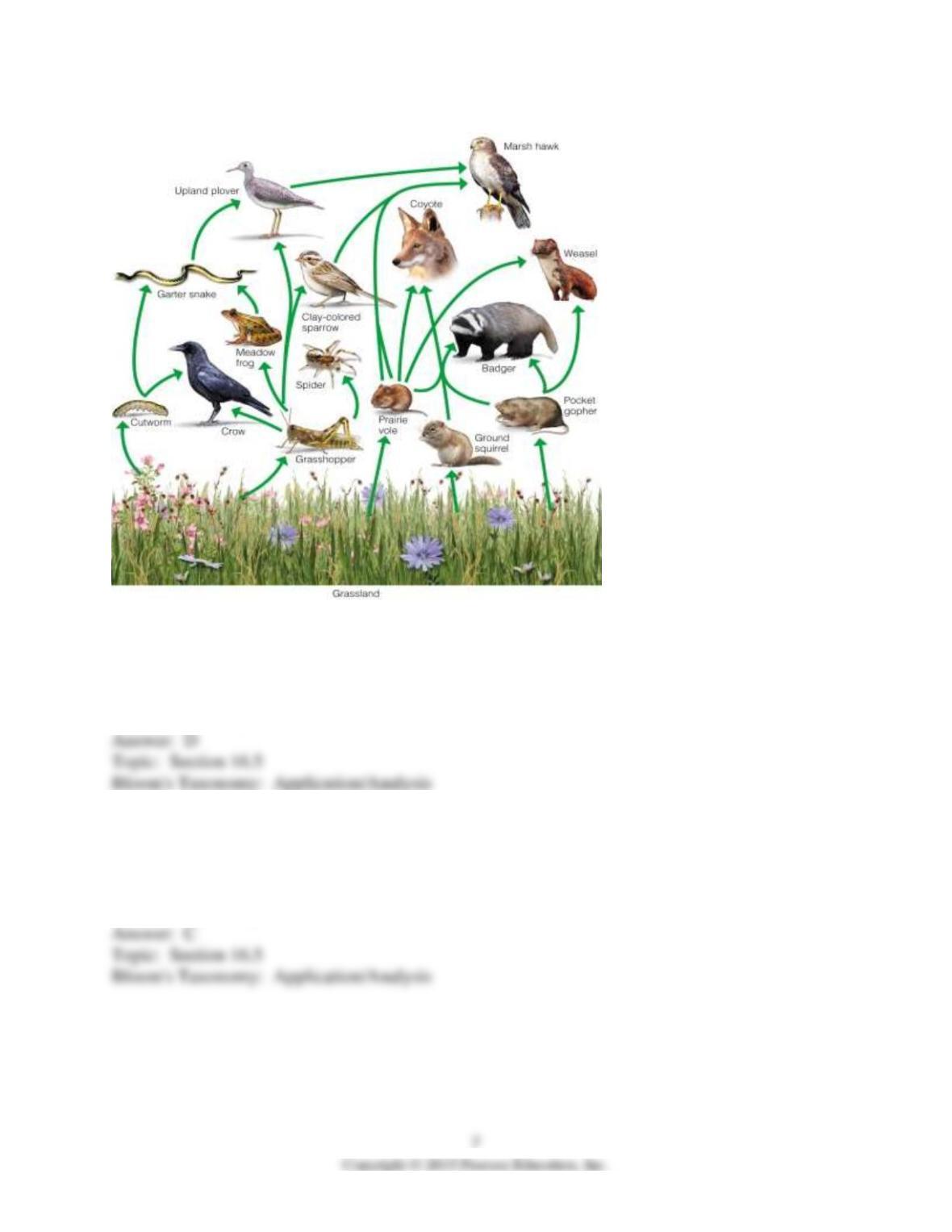
18)
The garter snake in this diagram is an example of a(n)
A) top predator.
B) basal species.
C) herbivore.
D) intermediate species.
19) The greater the number of links in a food chain, the higher the
A) species diversity.
B) number of top predators.
C) connectance.
D) mean chain length.

20) Which of the following groups of species represents a guild?
A) species of birds that feed on nectar
B) species of plants that use the C3 pathway of photosynthesis
C) species of plants that tolerate shade
D) species of plants or animals that are iteroparous
21) Which of the following is considered a guild?
A) mammals
B) coniferous forest
C) top predators
D) insect-feeding birds
22) In a forest community, the layer in which most photosynthesis occurs is the
A) canopy.
B) midstory.
C) understory.
D) forest floor.
23) The layer of a forest in which decomposition takes place and mineral nutrients are released
for reuse by plants is called the
A) canopy.
B) understory.
C) herb layer.
D) forest floor.
24) In a well-stratified lake in summer, the subsurface layer of water, which is characterized by a
steep and rapid decline in temperature with depth, is called the
A) epilimnion.
B) metalimnion.
C) hypolimnion.
D) benthic zone.

25) Which of the following physical structures would a lake possess?
A) photic layer
B) canopy
C) herb layer
D) keystone species
26) Zonation within a community is typically the result of differences in the
A) patterns of predation among species within a community.
B) rates of reproduction among species within a community.
C) patterns of competition among species within a community.
D) physical characteristics of the environment across a spatial gradient.
27) In a sandy beach community, ghost crabs and beach flies occur within
A) the supratidal zone.
B) the intertidal zone.
C) the subtidal zone.
D) any tidal zone.
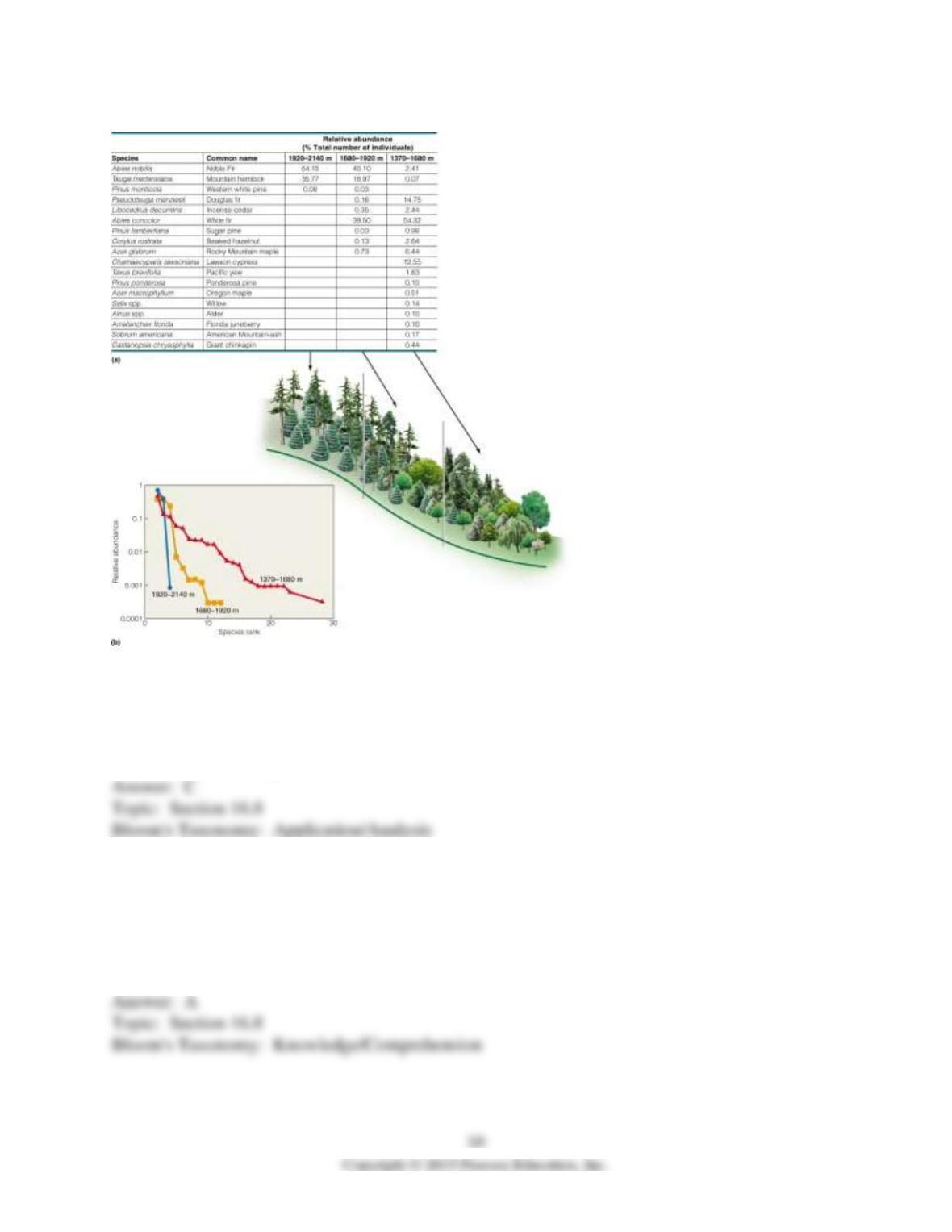
28)
Which elevational gradient has the most species?
A) 1920-2140 m
B) 1680-1920 m
C) 1370-1680 m
D) cannot tell from figure
29) In which of the following zones would you most likely expect to find flounders (a type of
fish)?
A) subtidal
B) intertidal
C) supratidal
D) salt meadow

30) An ecologist samples the abundance of various species along an environmental gradient and
fails to find clusters of species. Instead, peaks of abundance of dominant species are merely
randomly spaced segments along a continuum. This distribution of species supports the
A) unified concept of a community.
B) organismic concept of a community.
C) individualistic or continuum concept of a community.
D) successional concept of a community.
31) An organismic concept of communities was developed by
A) Gleason.
B) Simpson.
C) Shannon.
D) Clements.
32) A key limitation of the coefficient of community is that it lacks the ability to
A) compare relative abundances of each species.
B) calculate the similarity between two communities.
C) know the number of species common between communities.
D) compute a percent similarity value.
33) Which score suggests a high degree of community similarity?
A) 0.9
B) 9
C) 90
D) 900
34) Who was Aldo Leopold?
A) a conservationist
B) a statistician
C) a hunter
D) a marine biologist

35) The goal of restoration ecology is to
A) create the most functional ecosystem.
B) improve productivity in an ecosystem.
C) return the community to its pre-disturbance condition.
D) restore the use of ecosystem services.
16.3 True/False Questions
1) The species within a community interact with one another either directly or indirectly.
2) Among the array of species that make up a community, not all are equally abundant.
3) Most communities have many common species and a few rare species.
4) Dominance is the converse or opposite of diversity.
5) The removal of a keystone species from a community typically results in an increase of
diversity.
6) A food web is more complicated than a food chain.
7) The species within a guild are unlikely to interact with one another.

8) The form and structure of terrestrial communities are defined more by the plants than the
animals present.
9) If a forest canopy is dense and closed, the understory and shrub layers tend to be well
developed.
10) Some aquatic communities are defined by physical features of the abiotic environment rather
than by the dominant organisms.
11) Every community has an associated vertical structure.
12) In a well-stratified lake, the thermocline refers to a steep and rapid decline in temperature
relative to the waters above and below.
13) The aphotic zone of a lake is inhabited primarily by phytoplankton.
14) Species composition does not usually differ much within a local area, such as between a
hilltop and a stream bottomland.
15) The boundaries between communities are usually sharply defined and easily discerned.

16) Ecologists use a variety of useful sampling and statistical techniques for delineating and
classifying communities.
17) The characteristics of a community are generally not dependent on the spatial scale at which
the community is examined because communities are tightly integrated groups of species.
18) The organismic concept views communities as clusters of species associating together as an
interacting, integrated component.
16.4 Essay Questions
1) Explain how ecologists define species diversity. What data must be collected to determine the
diversity of a community?
2) Define a keystone species. Give an example of the changes that may occur within a
community when a keystone species is removed.
3) Draw a diagram of a simple food web with three trophic levels, and describe the difference
between a food chain and a food web.
4) Explain the difference between a guild and a functional type, and discuss why it may be useful
for ecologists to classify species in these ways.
5) Discuss the physical structure of either a forest or a lake, and explain how the physical
structure affects the biological structure.

6) Describe the zonation of a terrestrial or aquatic community, and discuss the factors that cause
zonation to occur.
7) Explain the difference between the organismic concept of communities and the individualistic
continuum concept. Which of these concepts best describes the majority of communities?
Explain your answer.
8) Choose either of the two most common indices of community similarity (Sorenson’s
coefficient of similarity and percent similarity), and explain how it is calculated. For what
purpose might such an index be used?