16
Property Transactions: Capital Gains and Losses
Solutions to Tax Research Problems
16-57 The controlling question is whether a geographical limitation on the exploitation
of a patent is a substantial right. According to the cases cited, it is. Therefore, if
such a limit is imposed capital gain treatment that might be available under §
1235 cannot be preserved.
One way of handling this problem has been to transfer all rights to the patent,
giving the transferee the right to sublease the patent in certain geographic areas,
the transferor having the right to refuse any potential sublessee (e.g., giving the
transferee exclusive rights east of the Rockies and the right to sublease west of the
Rockies, with sublessees subject to G’s approval). This retained right has not been
considered substantial.
Kueneman v. Comm., 628 F.2d 1196 (CA-9, 1980), involved a situation
similar to that stated in the problem, and capital gain treatment was denied. A
similar result was reached in Klein Estate v. Comm., 507 F.2d 617 (CA-7, 1974).
In Rouverol, 42 T.C. 186 (1964) (N.Acq., 1965-2 CB 7), an inventor
transferred all substantial rights to a U.S. patent. Later, under the agreement, some
of the rights were sublet to another company with Rouverol’s approval. The
ability to approve the transfer was not considered “substantial.” For an earlier case
with a similar result, see Rogers, 51 T.C. 927.
Where a transfer limited the transferee to use of the patent within a single
industry, even though it could be applied in another industry, all substantial rights
were not transferred. [See Fawick v. Comm., 71-1 USTC ¶9147, 27 AFTR2d 71-
381, 436 F.2d 655 (CA-6, 1971).]
16-58 A determination must be made as to whether gain is ordinary income or capital
gain on the sale of real property. This determination depends on the taxpayer’s
primary motivation and takes into account such factors as the frequency and
continuity of sales, the holding period, the taxpayer’s intent, the subdivision of the
property and improvement activities. This question focuses on subdivision and
improvement. [Malat v. Riddell, 66-1 USTC ¶9317, 17 AFTR 2d 604, 383 US
569 (USSC, 1966)].
a. This is the sale of a capital asset and would qualify for long-term capital gain
treatment since there was a long holding period, primarily for appreciation,
and a single sale.
b. Subdividing and improving real estate is one of the many factors in
determining whether the property is held for sale to customers in the ordinary

course of a trade or business. Subdividing and making physical changes in the
form of roads and improvements would probably be sufficient to convert this
to an ordinary asset [Houston Endowment, Inc. v. U.S., 79.2 USTC ¶9690, 44
AFTR 2d 79-6074, 606 F.2d 77 (CA-S, 1979) and Biedenharn Realty Co., Inc.
v. U.S. 76-1 USTC ¶9194.37 AFTR 2d 76-679, 526 F.2d 409 (CA-5, 1976)].
c. It is possible that the mere recording of the subdivision plan without making
physical changes would not change the character of the property. If so, the
gain would be long-term capital gain.
d. If recording the subdivision does not change the character, D would recognize
capital gain on the sale to the partnership. The partnership would have
ordinary income when the individual lots are sold, 40 percent of which would
pass through to D. (See §§ 701-704.)
16
Property Transactions: Capital Gains and Losses
Test Bank
True or False
________ 1. A personal automobile (i.e., one that is owned by the taxpayer and
driven for personal purposes) is an example of a capital asset.
________ 2. Undeveloped vacant real estate held exclusively for speculation is
treated as business property and does not qualify as a capital asset.
________ 3. In order for real property to be considered ordinary income property (i.e.,
inventory rather than a capital asset), the taxpayer’s livelihood must be
derived primarily from buying and selling real estate.
________ 4. The gain or loss on the disposition of a sole proprietorship is capital gain
or loss.
________ 5. Casualties and thefts involving personal-use property are treated as
capital gains and losses if the gains exceed the losses from such events
for a particular year.
________ 6. For a capital gain or loss to be considered long-term, the asset must
generally be held more than one year.
________ 7. Both the date of acquisition and the date of sale are included in
determining the holding period for a capital asset.
________ 8. The holding period of like-kind property acquired in a qualifying
exchange begins on the date of the exchange.

________ 9. The holding period of property acquired by gift that is sold at a gain is
always treated as having a long-term holding period.
________ 10. The holding period of stock purchased and sold on a stock exchange
begins and ends with the dates of settlement with the broker.
________ 11. The first step in the capital gain and loss netting process is to combine all
capital gains and all capital losses.
________ 12. A net 15 percent capital gain results when a noncorporate taxpayer has a
15 percent capital gain with no capital loss or a net 15 percent capital
gain to the extent it exceeds net short-term capital losses.
________ 13. A net 15 percent capital gain of a noncorporate taxpayer that would
otherwise fall into the 10 percent bracket for a lower-income individual
will be taxed at 10 percent.
________ 14. A net short-term capital gain (NSTCG) with no further netting, or the
excess of a net short-term capital gain over a net long-term capital loss
(NSTCG — NLTCL) is treated just like ordinary income for tax
computation purposes.
________ 15. Capital losses in excess of the annual limitation for individuals are
carried forward only.
________ 16. The deduction for excess capital losses for individual taxpayers is
limited to the lower of an absolute amount of (a) $3,000 or (b) the
taxable income for the year, before the deduction.
________ 17. A long-term capital loss carryforward is treated as a short-term capital
loss in the carryover year by an individual taxpayer.
________ 18. An employer of the creator of a patent cannot be a “holder” of the patent,
and therefore cannot qualify for long-term capital gain treatment.
________ 19. Gain or loss resulting from lease cancellation payments is treated as
ordinary income.
________ 20. Section 1244 applies to losses, but not gains, resulting from the sale or
exchange of § 1244 stock; therefore, any gain on the disposition of such
stock held for investment is subject to capital gain treatment.
________ 21. When stock becomes worthless, the loss is ordinary because there is no
“sale or exchange” as required for capital loss treatment.
________ 22. In order for a corporation’s stock to qualify as a qualified small business
stock under § 1202, the corporation must be a C corporation and the
gross assets at incorporation must be $20 million or less.

________ 23. The stock of a corporation involved in food processing cannot be
qualified small business stock.
________ 24. A taxpayer can defer gain on the sale of stock traded on a stock
exchange if the proceeds are invested in a specialized small business
investment company within 60 days.
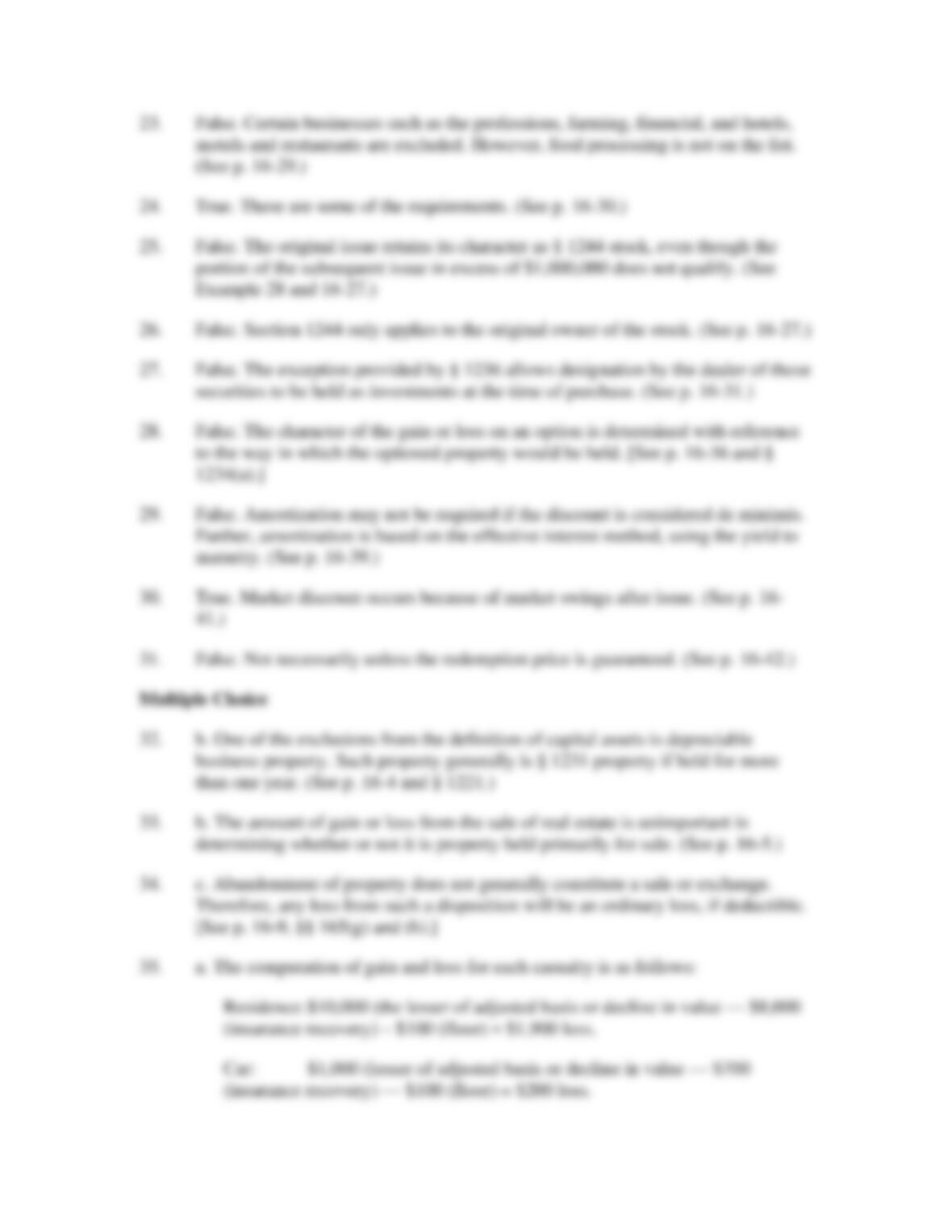
________ 25. FGH, Inc. issued stock to individuals for $800,000 cash in 1980 and
$400,000 in 1987. None of the stock currently qualifies as § 1244 stock
since the paid-in capital of the corporation exceeds $1,000,000.
________ 26. J purchased stock in X Corporation from C, one of the original
shareholders. In C’s hands, the shares were § 1244 stock. The stock will
also be § 1244 stock to J. Both J and C are individuals.
________ 27. Dealers in securities hold stocks and bonds as inventory, not as any other
class of asset.
________ 28. Options to purchase property are always treated as capital assets.
________ 29. Original-issue discount on corporate bonds issued during the current
year must be amortized over the life of the bond using the straight-line
method.
________ 30. Market discount only occurs when there is a purchase of a bond after
issue, not at original issue. The market discount is the excess of the
discount in price over any unamortized original-issue discount.
________ 31. The purchase of an investment from a seller who agrees to buy the
investment back at a speculative market price at the option of the buyer
for three years is a conversion transaction.
Multiple Choice
________ 32. Which of the following assets is not generally considered a capital asset?
a. A personal residence
b. A computer used in a trade or business
c. Chrysler Corporation stock held for investment
d. U.S. Government securities held for investment
________ 33. Which of the following is not an important factor used to determine
whether or not real estate is held primarily for sale?
a. Subdivision and improvement

b. Amount of gain or loss on sale
c. Purpose and manner of acquisition
d. Reason for and method of sale
________ 34. Which of the following dispositions of property is not treated as a sale or
exchange?
a. Securities becoming worthless
b. Transfer of property in satisfaction of debt
c. Abandonment of unencumbered property
d. Gain or loss from personal casualty or theft, if any gains exceed any
losses
________ 35. M had three separate casualties involving personal use property during
the current year:
Fair Market Value
Casualty Property Adjusted Basis Before Casualty After
Casualty
Fire Residence $50,000 $70,000 $60,000
Accident Personal car 10,000 9,000 8,000
Theft Silverware 2,000 7,000 0
M received insurance reimbursement as follows: $8,000 for damages to
home; $700 for repair of car; and $5,000 for theft of silverware. What is
M’s deductible gain (or loss) on each casualty, respectively, before any
percentage limit?
a. $1,900 loss, $200 loss, $3,000 gain
b. $2,000 loss, $300 loss, $3,000 gain
c. $10,000 loss, $1,000 loss, $7,000 loss
d. $10,000 gain, $2,000 loss, $2,000 loss
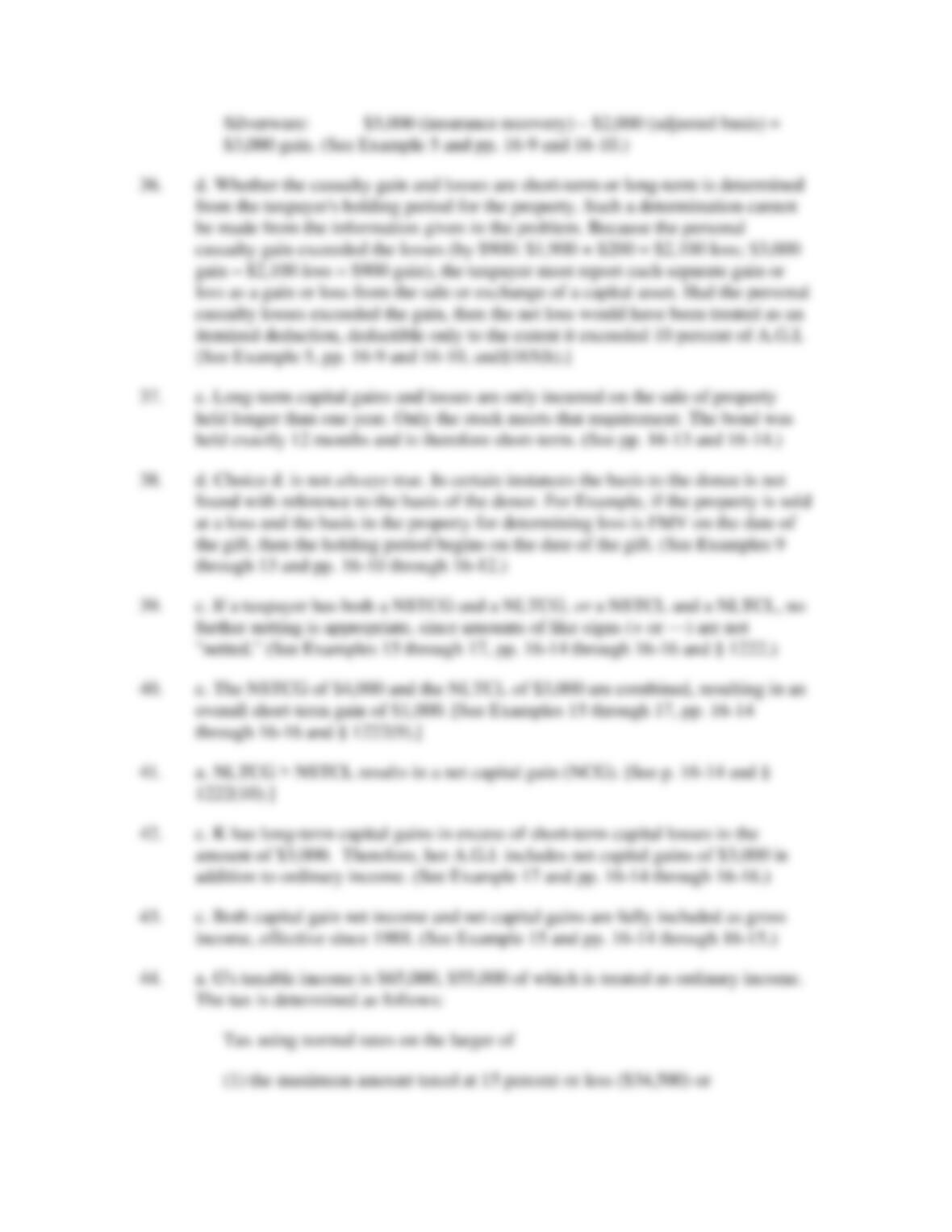
________ 36. M had three separate casualties involving personal use property during
the current year:
Fair Market Value

Casualty Property Adjusted Basis Before Casualty After
Casualty
Fire Residence $50,000 $70,000 $60,000
Accident Personal car 10,000 9,000 8,000
Theft Silverware 2,000 7,000 0
M received insurance reimbursement as follows: $8,000 for damages to
home; $700 for repair of car; and $5,000 for theft of silverware. Which
of the following is not necessarily true concerning M’s gains and losses?
a. M must report each separate gain or loss as a gain or loss from the
sale or exchange of a capital asset.
b. M’s personal casualty gain exceeds her personal casualty losses by
$900.
c. If M’s personal casualty losses had exceeded her gain, then only so
much of the net loss as exceeds 10 percent of A.G.I. could have been
taken as an itemized deduction.
d. M’s personal casualty gains and/or losses are long-term.
________ 37. K sold the following investments during the current year:
Property Date Sold Date Acquired Sales Price Adjusted Basis
X Co. stock 2/3/X2 1/2/X1 $3,200 $1,300
Ybond 2/5/X2 2/5/X1 1,200 1,400
Land 4/5/X2 5/4/X1 4,200 3,400
How much are K’s net long-term capital gain or loss and net short-term
capital gain or loss, respectively, if any?
a. $0 and $2,500
b. $1,700 and $800
c. $1,900 and $600
d. $2,500 and $0
________ 38. Which of the following is not always true in determining the holding
period of capital assets acquired during the current year?

a. The holding period is short-term if property is purchased March 15
and is sold March 15 next year (except for inherited property and
certain property acquired in tax deferral transactions).
b. The holding period begins and ends when title passes, rather than
when settlement is made.
c. The holding period for property acquired from a decedent, may be
long-term even if the property is sold less than one year after it was
acquired by the decedent.
d. The holding period of the donor of a gift is included in the holding
period of the donee.
________ 39. Which of the following is not true of the netting process for capital gains
and losses?
a. Short-term capital gains and losses are combined and result in either
a net short-term capital gain (NSTCG) or a net short-term capital loss
(NSTCL).
b. Long-term capital gains and losses are combined and result in either
a net long-term capital gain (NLTCG) or a net long-term capital loss
(NLTCL).
c. If a taxpayer has both a NSTCG and a NLTCG or both a NSTCL and
a NLTCL, the results are netted in the second stage of the netting
process.
d. If a taxpayer has either a NSTCG and a NLTCL or NSTCL and a
NLTCG, the results are netted in the second stage of the netting
process.
________ 40. For the current year, a taxpayer had a short-term capital gain (STCG) of
$5,000 and a short-term capital loss (STCL) of $1,000. The taxpayer also
had a long-term capital gain (LTCG) of $3,000 and a long-term capital
loss (LTCL) of $6,000. Based upon that information, which of the
following is not true?
a. The taxpayer has a NSTCG of $4,000.
b. The taxpayer has a NLTCL of $3,000.
c. The taxpayer treats the net gain of $1,000 just like ordinary income.
d. The taxpayer cannot combine the NSTCG and NLTCL; therefore,
the NSTCG is treated like ordinary income and the NLTCL is
deductible as a net capital loss (NCL).

________ 41. Which of the following netting processes does not result in a net capital
loss (NCL)? (Assume that all results are positive numbers.)
a. NLTCG > NSTCL
b. NSTCL and NLTCL
c. NSTCL > NLTCG
d. NLTCL > NSTCG
________ 42. K had short-term capital losses of $2,000 and long-term capital gains of
$5,000 during the current year. By what amount is K’s A.G.I. increased
as a result of these transactions?
a. $2,000
b. $2,500
c. $3,000
d. $5,000
________ 43. During the current year, J had long-term capital gains of $3,600 and
short-term capital gains of $3,200. By what amount is J’s A.G.I.
increased?
a. $0
b. $3,200
c. $6,800
d. The increase in J’s A.G.I. cannot be determined from the facts given.
________ 44. G is a single, calendar year, individual taxpayer. She has taxable income
for the year 2011 of $65,000, including a net short-term capital gain of
$5,000 and a net long-term (15 percent) capital gain of $10,000. The
2011 tax schedules for single taxpayers are as follows:
Taxable Income
Over But not Over Tax Liability Of the Amount Over
$ 0 $ 8,500 10% $ 0
8,500 34,500 $850.00 + 15% 8,500
34,500 83,600 4,750.00 + 25% 34,500

83,600 — 17,025.00 + 28% 83,600
G’s federal gross income tax for 2011 is
a. $11,375
b. $9,875
c. $18,200
d. $12,375
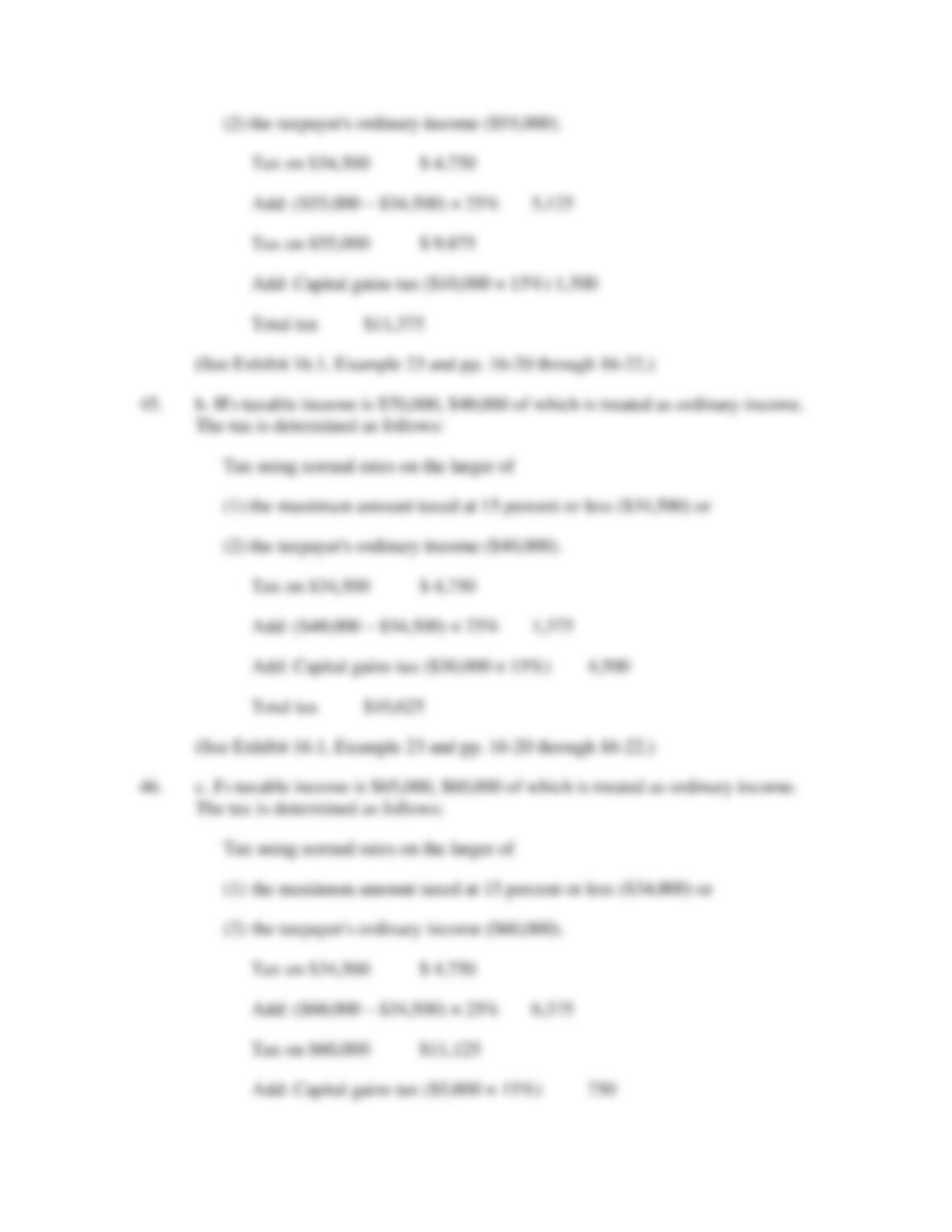
________ 45. H is a single, calendar year, individual taxpayer. She has taxable income
for the year 2011 of $70,000, including a net short-term capital gain of
$5,000 and a net long-term (15 percent) capital gain of $30,000. The
2011 tax schedules for single taxpayers are as follows:
Taxable Income
Over But not Over Tax Liability Of the Amount Over
$ 0 $ 8,500 10% $ 0
8,500 34,500 $850.00 + 15% 8,500
34,500 83,600 4,750.00 + 25% 34,500
83,600 — 17,025.00 + 28% 83,600
H’s federal gross income tax for 2011 is
a. $14,000
b. $10,625
c. $18,125
d. $13,625
________ 46. J is a single, calendar year, individual taxpayer. She has taxable income
for the year 2011 of $65,000, including a net short-term capital loss of
$5,000 and a net long-term (15 percent) capital gain of $10,000. The
2011 tax schedules for single taxpayers are as follows:
Taxable Income
Over But not Over Tax Liability Of the Amount Over
$ 0 $ 8,500 10% $ 0

8,500 34,500 $850.00 + 15% 8,500
34,500 83,600 4,750.00 + 25% 34,500
83,600 — 17,025.00 + 28% 83,600
J’s federal gross income tax for 2011 is
a. $16,875
b. $13,000
c. $11,875
d. $11,375
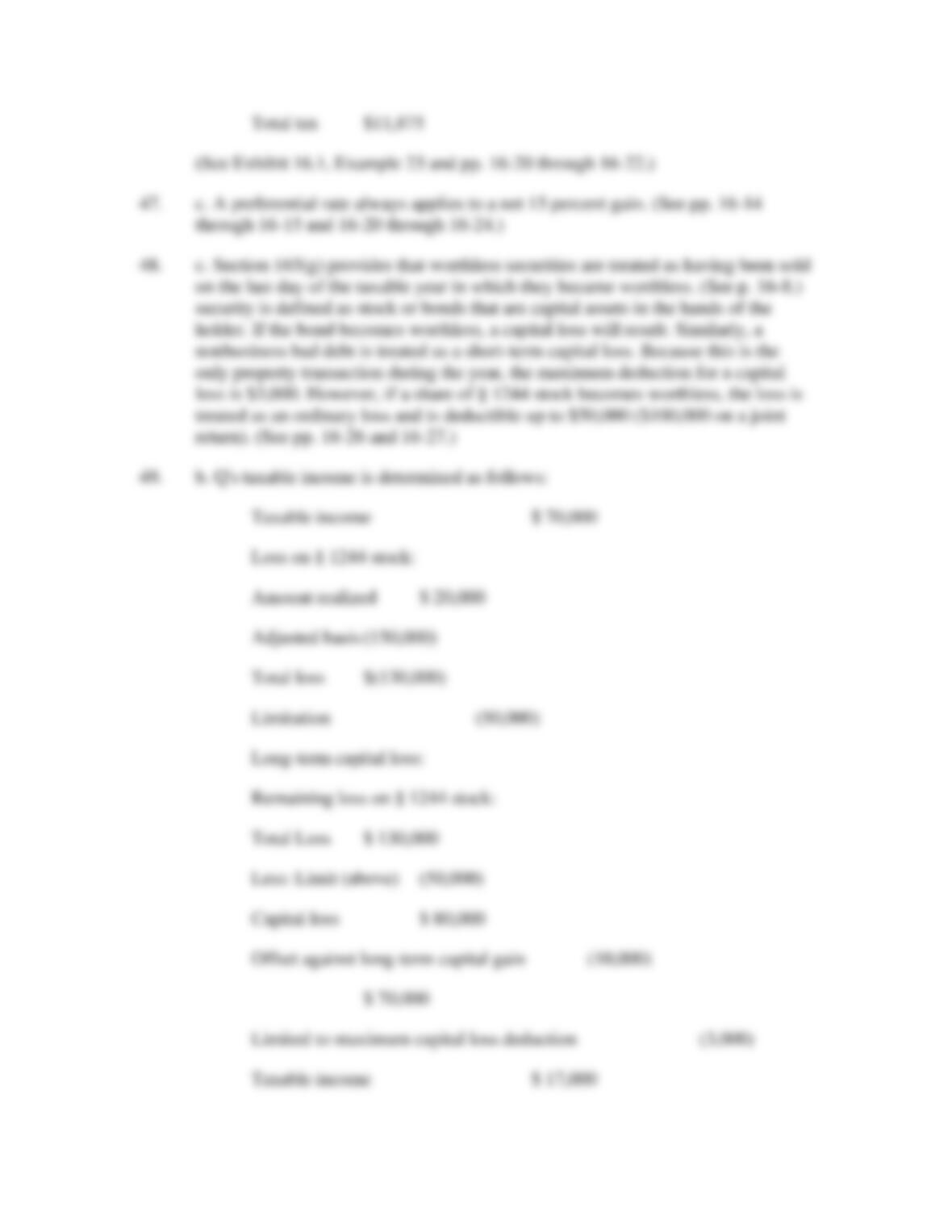
________ 47. K is a single, calendar year, individual taxpayer. A net long-term (15
percent) capital gain of $10,000 is included in K’s taxable income. The
2011 tax schedules for single taxpayers are as follows:
Taxable Income
Over But not Over Tax Liability Of the Amount Over
$ 0 $ 8,500 10% $ 0
8,500 34,500 $850.00 + 15% 8,500
34,500 83,600 4,750.00 + 25% 34,500
83,600 — 17,025.00 + 28% 83,600
Which of the following is not true regarding the taxation of K’s federal
gross income tax for 2011?
a. If K’s taxable income is $70,000, all of the net capital gain is taxed at
15 percent.
b. If K’s taxable income is $20,000, all of the net capital gain is taxed at
0 percent.
c. If K’s taxable income is $40,000, the net capital gain is taxed at the
same rate as it would have been had it been ordinary income.
d. If K’s taxable income is $37,000, the net capital gain is taxed partly
at 15 percent and partly at 0 percent.
________ 48. Dr. T recently called her tax adviser and indicated that one of her
investments had turned sour and now was worthless. Assuming T has no

other property transactions during the year, the best possible tax
treatment could result from a $30,000 loss from holding which of the
following?
a. A worthless bond
b. A worthless nonbusiness debt
c. A worthless share of § 1244 stock
d. Some combination of the above, because the treatment would be the
same in both or all cases
________ 49. Q, who is single, acquired § 1244 stock of XYZ Corporation several
years ago for $150,000. During the current year, Q sold the XYZ stock
for $20,000. Q also realized a $10,000 long-term capital gain during the
year from a separate transaction. Q’s taxable income, excluding both of
these transactions, is $70,000 (after personal and dependency
exemptions). Q’s taxable income including these transactions is how
much?
a. $0
b. $17,000
c. $20,000
d. $67,000
e. None of the above
________ 50. The importance of stock being designated § 1244 stock is which of the
following?
a. Any loss on the stock is deductible as an ordinary loss.
b. It can be sold by the shareholder at a premium because of the
availability of the ordinary loss deduction to the new owner.
c. The first $50,000 of each year’s loss ($100,000 on a joint return) on
the stock may be deducted as an ordinary loss.
d. More than one but less than all of the above are true.
e. All of the above are true.
________ 51. E always had eyes for a deal. When B approached her about his idea of
having his chain of pizza parlors deliver video tapes along with pizzas, E
saw dollar signs. B needed financing, and E gave the corporation

$10,000 in exchange for stock. A summary of the corporation’s balance
sheet after the exchange revealed the following:
Assets $3,000,000
Liabilities 500,000
Retained earnings 1,200,000
Capital stock 800,000
Despite some initial growth based on the idea, the pizza business fell on
hard times due to heavy competition. This year E sold her stock at a
$9,000 loss, her only property transaction (i.e., sales during the year).
This year, E may deduct how much?
a. $0
b. $3,000
c. $9,000
d. $10,000
e. None of the above
________ 52. During the current year, F, an individual, had long-term capital losses of
$2,000 and short-term capital losses of $1,500. If this is the first year F
has experienced capital gains or losses, what amount of these losses may
F deduct this year?
a. $1,750
b. $2,500
c. $3,000
d. $3,500
________ 53. C had a long-term capital loss carryover to the current year of $4,000.
For the current year, she had a short-term capital loss of $2,000 and a
long-term capital gain of $1,000. What is C’s capital loss deduction for
the current year and her carryover to the next year?
a. $3,000 and no carryover
b. $2,500 and no carryover
c. $3,000 and $2,000 short-term loss carryover

d. $3,000 and $2,000 long-term loss carryover
________ 54. Which of the following is not required for a patent to qualify for long-
term capital gain treatment?
a. The transferor must be a holder; holders include the creator of the
patentable technology and certain transferees.
b. All substantial rights to the patent must be sold.
c. The price must be a fixed price.
d. All of the above listed conditions are required.
________ 55. J and K, who file jointly, started a small business in 1985 by investing
$225,000 cash. Their basis in their corporate stock remained at $225,000
until it became worthless during the current year. They have no other
gains and losses for the year. How much may they deduct and what is
the character of their loss?
a. $50,000 ordinary loss, $3,000 capital loss deduction, $172,000 long-
term capital loss carryover
b. $100,000 ordinary loss and no capital loss deduction or carryover
c. $100,000 ordinary loss, $3,000 capital loss deduction, and $122,000
long-term capital loss carryover
d. $225,000 ordinary loss
________ 56. W and Y are married and file a joint return each year. They owned 50
percent of the stock in a small business corporation with total paid-in
capital of $550,000. During the current year, they sold their stock, which
had a basis of $275,000, for $190,000. How is this sale treated on their
return?
a. Ordinary deduction of $50,000 and long-term capital loss of $35,000
b. Ordinary deduction of $85,000
c. Short-term capital loss of $85,000
d. Long-term capital loss of $85,000
________ 57. Which one of the following is not true of securities held by dealers in
securities?
a. Securities are generally held as inventory, with any gains or losses on
their disposition being ordinary in nature.

b. A dealer may designate a particular lot as held for investment, but
the designation must be made on the day the lot is acquired.
c. Once a lot is designated as an investment, losses on its disposition
cannot be treated as ordinary.
d. A dealer can receive capital gain treatment on lots of stock held as
inventory if they are held for more than two years.
________ 58. The sale of subdivided real estate by a non-corporate taxpayer shall not
qualify for § 1237 capital gain treatment if
a. The taxpayer made substantial improvements to the property.
b. The taxpayer has held the property for more than five years.
c. The taxpayer held other real property primarily for sale during the
same tax year.
d. Both a. and c. are true.
________ 59. Which of the following statements is true?
a. The transfer of a trademark will result in a capital gain or loss, even
if the original owner retains the right to disapprove any assignment
of the trademark.
b. A nonbusiness debt is deductible in installments over the years that
the debtor displays a diminishing ability to repay it.
c. A loss from the failure to exercise an option to buy or sell an
investment is treated as a capital loss.
d. Both a. and b. are true.
________ 60. The de minimis amount of discount for a 10-year bond with a face value
of $10,000 is how much?
a. $0
b. $200
c. $250
d. $2,000
________ 61. On July 1, 19X7, T, an investor, purchased a newly issued corporate
bond with a face value of $10,000 bearing 10 percent interest for a term
of 30 years for $9,500. The bond pays interest semi- annually on

December 31 and June 30. During 19X7 T received an interest payment
of $1,000. Assume the bond’s semi-annual yield to maturity is 10.6
percent. The original issue discount will increase T’s interest income of
$500 by how much in 19X7?
a. $0
b. $3.50
c. $5
d. $8.33
________ 62. Which of the following debt instruments are not excluded from original
issue discount (OID) rules?
a. U.S. Savings Bonds
b. Issues not in security (bond) form
c. Bonds with maturity dates no more than one year after their dates of
issue (unless held by accrual basis taxpayers)
d. Nonbusiness loans between individuals of $10,000 or less
________ 63. On September 10, 20X1 (before 2009), C purchased qualified small
business stock for $40,000. Which of the following is true?
a. If the stock is sold for $100,000 on September 11, 20X6, the
maximum tax on the gain is $8,400.
b. If the stock is sold for $35,000 on September 11, 20X8, C may
deduct an ordinary loss of $5,000.
c. If the stock is sold after September 10, 20X8, C can qualify for a 50
percent exclusion and a maximum tax of 28 percent on the remaining
gain for an effective maximum tax of 14 percent on the gain.
d. More than one of the above is true.
________ 64. D purchased an option to acquire 3 acres of real estate for investment for
$15,000 on or before March 15, 20X4. The option cost $2,000. Which of
the following is NOT true?
a. If D allows the option to lapse, she has a long-term capital loss of
$2,000 in the year 20X4.
b. If D exercises the option on March 15, 20X1, the real estate has a
basis of $17,000.
c. If D sells the option for $1,500, she may not deduct the loss.
d. The option is a capital asset to D since the land would be a capital
asset if it were held.
16
Property Transactions: Capital Gains and Losses
Solutions to Test Bank
True or False
16
Property Transactions: Capital Gains and Losses
Comprehensive Problems
Solutions to Comprehensive Problems