
1
Biology: A Guide to the Natural World, 5e (Krogh)
Chapter 16 An Introduction to Evolution: Charles Darwin, Evolutionary Thought, and
the Evidence for Evolution
1) The theory of natural selection states that:
A) individuals that live the longest are best adapted and selected for survival in the next
generation.
B) individuals that mutate in response to their environment will survive at the expense of those
individuals who are genetically stable.
C) only the largest and strongest individuals survive.
D) the best-adapted individuals survive and reproduce, contributing the most genes to the next
generation.
2) What determines which traits will be passed on to the next generation in the greatest
frequency?
A) acquired characteristics
B) mutations
C) common descent with modification
D) natural selection
3) A population of deer was threatened with overpopulation until cheetahs were imported. After
a couple of years, there were fewer deer, but the average running speed of the deer had increased.
This is an example of:
A) natural selection.
B) mutation.
C) inheritance of acquired characteristics.
D) genetic drift.
4) Evolution can be used to explain all of the following except:
A) the appearance of antibiotic-resistant strains of bacteria.
B) the separate creation of each species.
C) common characteristics of related species.
D) constant change in populations of organisms.
5) Which of the following is the most important force in shaping evolution?
A) biological research

B) random events
C) natural selection
D) the fixity of species
6) What core theme unites all of biology?
A) natural selection
B) ecology
C) evolution
D) genetics
7) What mechanism did Charles Darwin discover as the driving force behind evolution?
A) the inheritance of acquired characteristics
B) common descent with modification
C) natural selection
D) artificial selection
8) In Charles Lyell’s Principles of Geology, what idea had a significant impact on Charles
Darwin’s thinking?
A) Organisms change form over generations.
B) A series of catastrophes wiped out life in given areas.
C) Populations produce more individuals than can survive.
D) Geological forces that are still operating act to change the Earth’s surface.
9) Who is credited with first providing conclusive evidence of species extinction?
A) Charles Lyell
B) Georges Cuvier
C) Alfred Russel Wallace
10) Who believed that species evolve by passing acquired characteristics to offspring?
A) Jean-Baptiste de Lamarck
B) Charles Lyell
C) Alfred Russel Wallace

11) Who believed the species on Earth changed over time as a result of periodic great
catastrophes?
A) Jean-Baptiste de Lamarck
B) Georges Cuvier
C) Alfred Russel Wallace
D) Charles Lyell
12) Charles Darwin was influenced by three scientists of his time: Charles Lyell, Jean-Baptiste
de Lamarck, and Georges Cuvier. What common theme from their work inspired Darwin’s
theory of evolution through natural selection?
A) Early embryos of a variety of organisms share characteristics.
B) Traits were inherited through blending.
C) The newly formed Earth was hot and humid.
D) The world is not static; it is constantly changing.
13) The long neck of a giraffe has developed over a long period of time because giraffes have
needed to stretch their necks to reach food high in trees, and that quality has been passed on
through the generations. This view of evolution would correspond with the ideas of:
A) Jean-Baptiste de Lamarck.
B) Charles Lyell.
C) Georges Cuvier.
D) Alfred Russel Wallace.

14) Darwin was influenced by an essay on human population and food supply written by:
A) Charles Lyell.
B) Alfred Russel Wallace.
C) Joshua Beagle.
D) Thomas Malthus.
15) Charles Darwin and Alfred Russel Wallace both realized that most species produce many
more offspring than is necessary to maintain a constant population. What might be the fate of the
excess individuals?
A) The more favorable forms survive and reproduce, but the others do not.
B) They mutate and then are able to adapt to new environments.
C) They evolve to take advantage of natural resources.
16) Many commercial pesticides become less effective after two to three years because:
A) pests with resistant genes will survive and reproduce.
B) new pests invade the area.
C) pests without resistant genes will ignore any plant coated with pesticide.
D) the chemicals mutate.
17) The publication date of Darwin’s Origin of Species was:
A) 1900.
B) 1869.
C) 1809.
D) 1859.

18) Long before Charles Darwin, Jean-Baptiste de Lamarck understood all of the following ideas
about evolution except that:
A) there is variation in populations.
B) natural selection is the primary cause of evolution.
C) evolution leads to adaptation.
D) species change over time.
19) The longer two populations are kept from interbreeding, the:
A) more they will differ from one another in adaptations.
B) more recessive alleles will be expressed.
C) greater the chance one will go extinct.
D) greater the mutation rate will be.
20) For natural selection to occur, there must be competition for resources, competition for
survival, or different reproductive success. Why is this so?
A) The struggle of competition makes individuals stronger.
B) Populations evolve to preserve the species and don’t change unless they must.
C) Without competition, there is no pressure to mutate.
D) Natural selection acts on the different abilities of individuals to survive and pass on their
genes to the next generation.
21) Darwin found that many different species of finches were found on the Galapagos Islands
and nowhere else. The finches were related to a species found on the mainland of South
America. From this he concluded:
A) ancestral species originated on the Galapagos Islands and some migrated to the mainland.
B) separate acts of creation put some species on the islands and some on the mainland.
C) an ancestral species migrated from the mainland and diverged over time into separate species
on the islands.
D) an ancestral species migrated to both South America and the Galapagos Islands from Europe
and then diverged into separate species.

22) Both Charles Darwin and Alfred Russel Wallace were influenced by Thomas Malthus’s
writings on:
A) population growth.
B) giraffe neck length.
C) genetics.
D) uniformitarianism.
23) Who is the co-discoverer of the principle of natural selection along with Charles Darwin?
A) Charles Lyell
B) Jean-Baptiste de Lamarck
C) Georges Cuvier
D) Alfred Russel Wallace
24) Pharyngeal slits are present in the embryos of organisms as diverse as fish, chickens, and
humans. Why would organisms as different as these have similar embryonic structures?
A) The organisms shared a common ancestor whose embryos had pharyngeal slits.
B) The pharyngeal slits is an acquired characteristic that just happens to look similar in different
species.
C) The organisms shared a common ancestor, which did not have the slits, but natural selection
created similar changes in the embryos over time.
D) The pharyngeal slits develop into gills because all species need to survive in a water
environment at some point in their life cycle.
25) The major weakness of Charles Darwin’s theory during his lifetime was the:
A) fact that populations do not promote competition but rather promote sharing.
B) lack of a mechanism to explain how traits were passed to offspring intact when most believed
inheritance worked through blending.
C) fact that, at certain points in embryonic development, diverse species all have structures
known as pharyngeal gill slits.
D) lack of variation in natural populations.

26) Even though nineteenth-century scientists came to accept the fact of evolution, what was
required for natural selection to be accepted as the driving force of evolution?
A) the realization that Jean-Baptiste de Lamarck’s theory was correct
B) the development of a better understanding of the blending process of inheritance
C) the development of modern genetics
D) the development of more sophisticated tools for dating fossils
27) The convergence of evolutionary biology with genetics produced the unified evolutionary
theory known as:
A) polygenic inheritance.
B) common descent with modification.
C) the modern synthesis.
D) the origin of species.
28) In science, a theory is:
A) something that is always true.
B) a general set of principles supported by evidence.
C) a concept that you try to prove experimentally.
D) a guess based on previous observations.
29) Natural selection is regarded as a theory because:
A) it has not been tested.
B) other equally acceptable scientific mechanisms for evolution exist.
C) it has been tested and found to be untrue.
D) it is a general principle, supported by a wide variety of evidence.

30) The half-life of a radioactive isotope is 10,000 years. This isotope and its breakdown product
do not normally occur together before molten rock cools and becomes solid. You analyze a
volcanic rock and find 25 percent of the original amount of radioactive isotope remains, and 75
percent has decayed to its daughter element. How long ago did the rock solidify?
A) 2,500 years ago
B) 50,000 years ago
C) 10,000 years ago
D) 20,000 years ago
31) Evidence that supports the theory of evolution is found in studies of:
A) molecular biology.
B) ancient manuscripts.
C) organs that show similar functions.
D) blending inheritance.
32) Scientists have been able to date objects from nearly the formation of the Earth using:
A) homologous features.
B) comparative morphology.
C) genetic clocks.
D) radiometric dating.
33) If you are studying the physical forms that organisms take, you are studying:
A) polygenic inheritance.
B) morphology.
C) comparative embryology.
D) vestigial characters.

34) The limbs of animals such as whales, cats, bats, and humans contain the same set of bones
organized in similar ways yet have dissimilar functions. These structures are said to be:
A) vestigial.
B) morphological.
C) homologous.
D) polygenic.
35) Modern whales have bones that are remnants of a pelvis and legs that serve no function. This
would be an example of a/an:
A) homologous structure.
B) vestigial character.
C) polygenic character.
D) analogous structure.
36) Comparison of gene sequences among species has revealed:
A) humans and yeast shared a recent common ancestor.
B) the greater the similarities in gene sequences, the more recently two species shared a common
ancestor.
C) the greater the differences in gene sequences, the more recently two species shared a common
ancestor.
D) humans and snakes are more closely related than humans and pigs.
37) The ultimate source of genetic differences among species is:
A) mutation.
B) natural selection.
C) the inheritance of acquired characteristics.
D) polygenic inheritance.

38) Which of the following does not provide evidence for evolution?
A) molecular biology
B) radiometric dating
C) the inheritance of acquired characteristics
D) the fossil record
E) comparative morphology
Refer to the scenario below and then answer the following question(s).
In a fossil bed, you discover the preserved bones of a winged animal mixed in with the bones of
small rodents. The small rodents are known from other fossils to have lived about two million
years ago, but they are now extinct.
39) What can you conclude from the fact that the bones of the winged animal are found in the
same fossil bed as the rodent bones?
A) The winged animal is closely related to the small rodents.
B) Because it has bones, the winged animal is either a bird or a bat.
C) The winged animal lived at the same time as the small rodents.
D) The winged animal interacted with the small rodents when they were both alive, for example,
the winged animal may have preyed on the rodents.
40) You examine the fossilized remains of the winged animal. Impressions in the surrounding
rock suggest that the wings may have been covered with tiny hairs, which suggests that the
animal is likely to have been a mammal. When you examine the remains of the wings, which of
the following observations would be most surprising?
A) The animal appears to have five digits in each forelimb.
B) Several of the digits (“finger” bones) are extremely long, and look as if they supported a thin
membrane.
C) The animal’s wings appear to be much larger than those of any known bat.
D) The animal appears to have two upper arm bones.

41) After considerable effort, you are able to collect and analyze DNA from the winged animal.
You obtain the nucleotide sequence of the cytochrome c oxidase gene. When you compare this
sequence to the sequence of the same gene in a bat, a rodent, a shrew, and a human, you find the
following numbers of differences:
winged animal-bat 11 differences
winged animal-rodent 14 differences
winged animal-shrew 15 differences
winged animal-human 9 differences
Which hypothesis does this data support?
A) Of the mammals tested, the winged animal is probably most closely related to shrews.
B) Of the mammals tested, the winged animal is probably most closely related to humans.
C) Of the mammals tested, the winged animal is probably most closely related to rodents.
D) The winged animal is probably most closely related to bats, because bats also have wings.
42) John Endler’s experiment with guppies demonstrates which of the following in regard to
evolution through natural selection?
A) Male guppies can change color depending on their environment.
B) There is one optimal set of traits for each species.
C) The reproductive success a trait imparts depends on the environmental context.
D) Bigger and brighter is always better.
43) Scientists may compare similar genes in different species and determine what percentage of
base pairs is identical. From this, it can be estimated how long ago the two species shared a
common ancestor. The validity of this conclusion depends on an important assumption. This
assumption is that:
A) mutations occur at a fairly constant rate in all evolutionary lines.
B) all living things use the same genetic code.
C) the gene codes for a functional protein.
D) both species belong to the same kingdom.

44) The various lines of evidence for evolution together support the core principles of evolution
because:
A) they are internally consistent and agree with each other.
B) they only occasionally are falsified.
C) they are internally consistent even though they don’t agree with each other.
D) scientists ignore the inconsistencies and choose the best lines of evidence to support their
opinions.
45) Animals use auricular muscles to swivel their ears to home in on sounds. Humans have
auricular muscles but we can’t turn our ears. So why do humans have auricular muscles?
A) People who can wiggle their ears due to auricular muscles have a reproductive advantage.
B) They are still needed to help us swallow and retract our tongue.
C) They are vestigial structures we inherited from mammalian ancestors
D) They are needed in the development of the human embryo but not in the adult.
46) Before Darwin, most scientists believed that species of organisms were fixed and
unchanging.
47) Charles Lyell’s publication on human population growth was important to Charles Darwin
developing the theory of evolution.
48) The most important concept that Charles Darwin brought to the discussion of evolution was
that natural selection was the driving force behind the change that occurred in organisms over
time.
49) Charles Darwin published his theory of evolution through natural selection immediately after
returning from his trip on the HMS Beagle.
50) A small group of finches on the Galapagos Islands was very important to Darwin in helping
him to develop the theory of evolution.

51) Charles Darwin usually gets more credit for the theory of evolution than Alfred Russel
Wallace because Darwin thought of the idea first and published a mass of evidence in its support.
52) Alfred Russel Wallace developed his theory of natural selection about 20 years after Darwin.
53) The human embryo goes through a period of time with gill slits, an inheritance from an
ancient ancestor.
54) The so-called modern synthesis of evolution brought together the evidence for evolution and
the ideas of genetics.
55) In science, theories are well established and thus are not “theoretical” in the everyday usage
of the word.
56) There are fossils of dinosaurs and humans that lived at the same time in the past.

Match the following.
A) evidence for evolution from the existence of vestigial characters
B) experimental evidence for evolution
C) evidence for evolution from homologous structures
D) supportive evidence for evolution from radiometric dating
E) evidence for evolution from gene modification
57) Measuring the decay of radioactive elements suggests that the Earth is about 4.6 billion years
old.
Topic: Section 16.8
Skill: Knowledge/Comprehension
58) Ostriches have wings but do not fly, and humans have auricular muscles even though we
cannot swivel our ears.
Topic: Section 16.8
Skill: Knowledge/Comprehension
59) The number of nucleotide differences between cytochrome c oxidase genes in different
species is related to how recently the two species shared a common ancestor.
Topic: Section 16.8
Skill: Knowledge/Comprehension
60) Male guppies evolve brighter coloration when they are placed in a predator-free environment
and less-brilliant colors when they are placed in an environment with predators.
Topic: Section 16.8
Skill: Knowledge/Comprehension
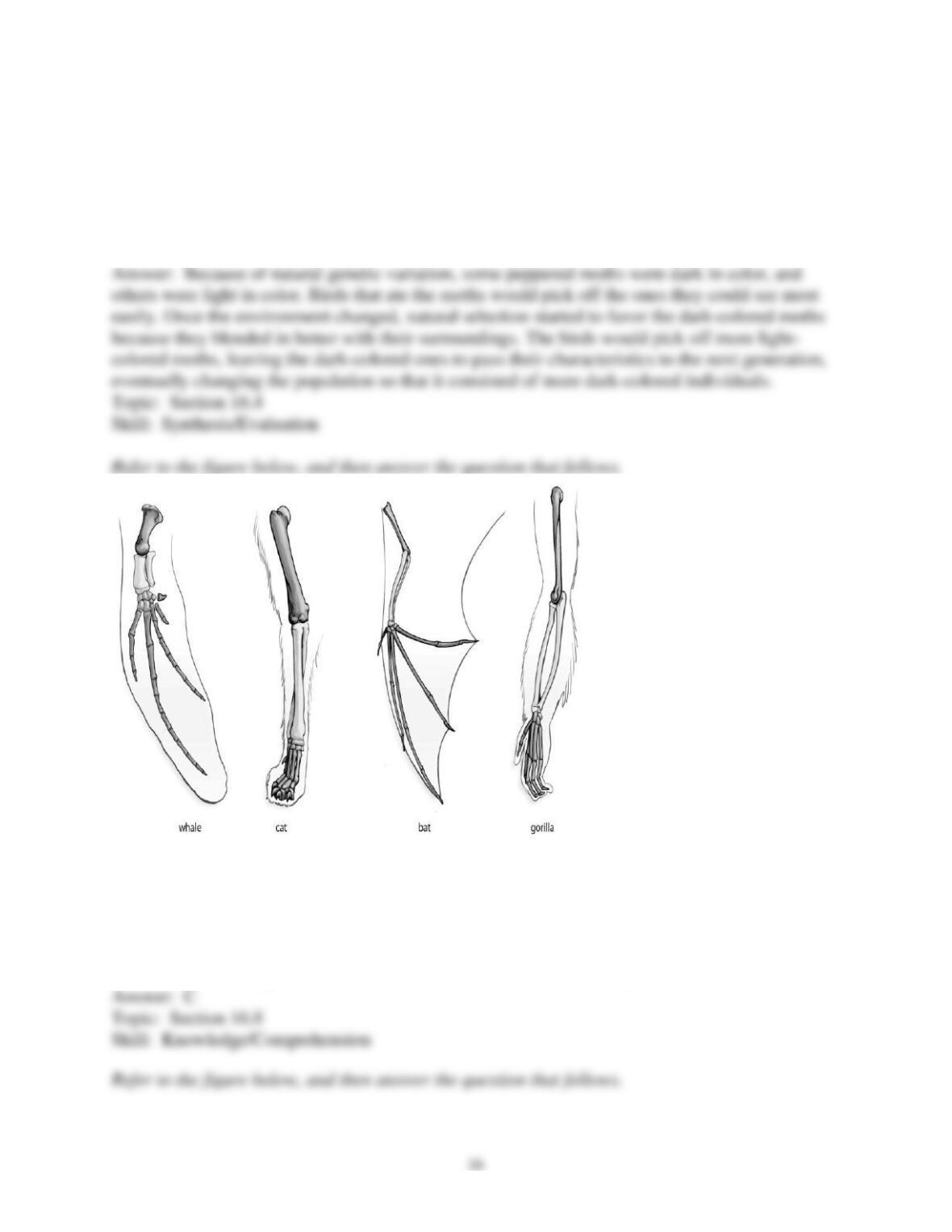
61) Whales, cats, bats, and gorillas all have similar sets of forelimb bones despite the fact that
these forelimbs are used for extremely different functions.
Topic: Section 16.8
Skill: Knowledge/Comprehension
62) The use of radioactive elements to date geological specimens is called ________.
63) Darwin studied a small group of finches on the ________ during his round-the-world trip.
64) Instead of being trained as a biologist, Charles Darwin actually received a ________ degree.
65) The length of time that Darwin’s round-the-world voyage took was about ________.
66) The scientist in Darwin’s time who championed the idea of the inheritance of acquired
characteristics was ________.
67) A population of grasshoppers in the Kansas prairie has two color phenotypes, green and
brown. Typically the prairie receives adequate water to maintain healthy green grass. Assume a
bird that eats grasshoppers moves into the prairie. How will this affect the natural selection of
grasshoppers? How might this change in a drought year?
68) Male guppies that have colorful spots on them are chosen more often by female guppies for
mating. Males can have from one to six spots. The more spots they have the more females are
attracted to them. However, bright spots also make the males more vulnerable to predators. In a
pond with predators, male guppies have an average of 3.2 spots. Predict what would happen to
the average spot number on the males over the generations if you removed all predators from the
pond. Using natural selection, explain your answer.
69) A well-known example of natural selection in action is the change in the peppered moth
population in England in the nineteenth century. The moths blended in with their light-colored
natural surroundings, but with increasing industrialization in England, smoke began to pollute
the foliage and darken the trees and rocks. Eventually, populations that were once mostly light
colored became mostly dark colored. Using natural selection, propose a hypothesis that would
explain why the moth population changed over time from mostly light colored to mostly dark
colored.
70) The forelimb of the common ancestor of whales, cats, bats, and gorillas would have had how
many digits?
A) one
B) three
C) five
D) The number of digits cannot be determined from the information given.
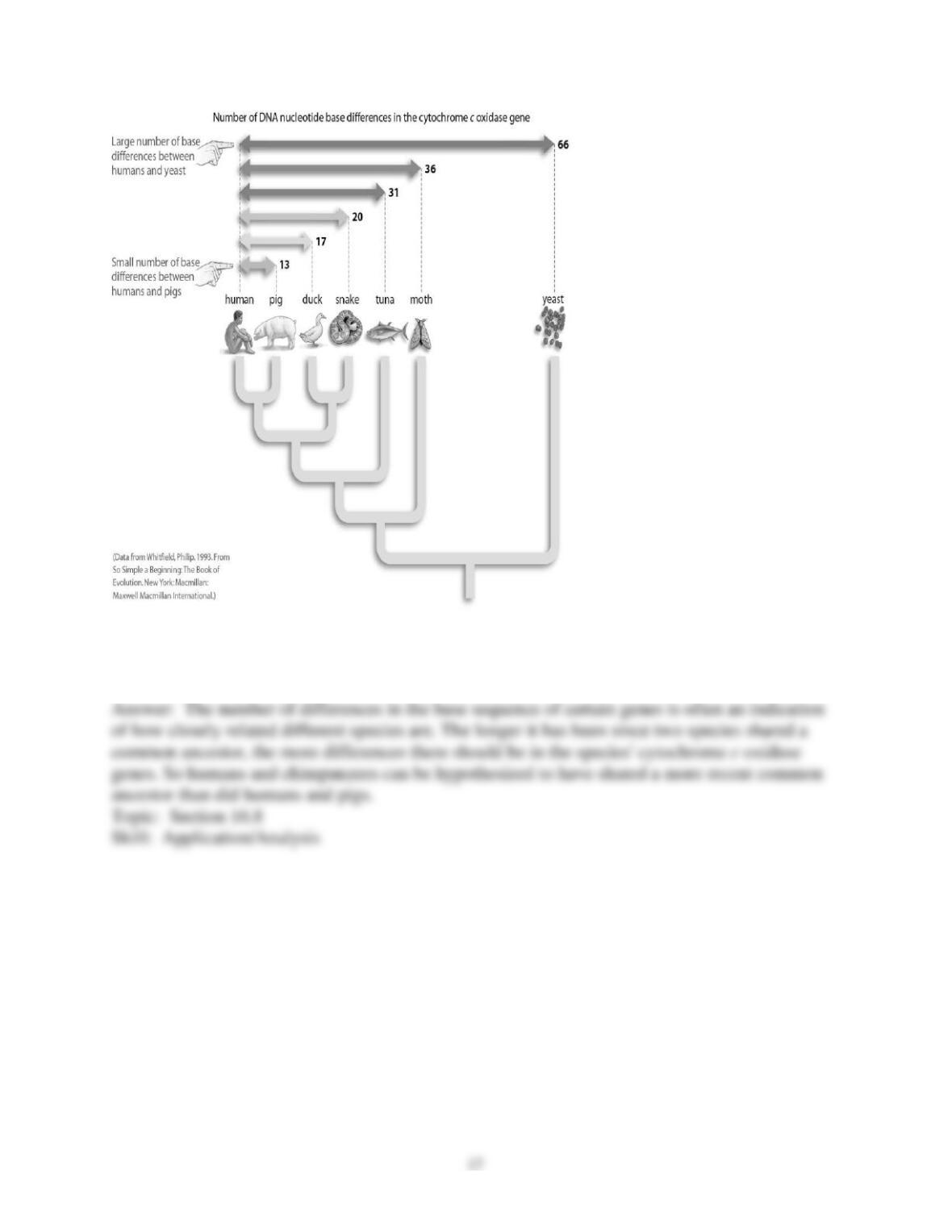
71) There are fewer differences in the base sequence of the cytochrome c oxidase gene between
humans and chimpanzees than there are between humans and pigs. What evolutionary
relationship can you hypothesize from this?