C) We can use MM Proposition I to derive an explicit relationship between leverage and the equity cost of
capital.
D) The total market value of the firm’s securities is equal to the market value of its assets, whether the firm
is unlevered or levered.
57) Which of the following statements is FALSE?
A) The levered equity return equals the unlevered return, plus an extra “kick” due to leverage.
B) By holding a portfolio of the firm’s equity and its debt, we can replicate the cash flows from holding its
levered equity.
C) The cost of capital of levered equity is equal to the cost of capital of unlevered equity plus a premium
that is proportional to the market value debt–equity ratio.
D) If a firm is unlevered, all of the free cash flows generated by its assets are available to be paid out to its
equity holders.
58) Which of the following statements is FALSE?
A) If we can identify a comparison firm whose assets have the same risk as the project being evaluated,
and if the comparison firm is levered, then we can use its equity cost of capital as the cost of capital for
the project.
B) We can calculate the cost of capital of the firm’s assets by computing the weighted average of the firm’s
equity and debt cost of capital, which we refer to as the firm’s weighted average cost of capital.
C) The portfolio of a firm’s equity and debt replicates the returns we would earn if the firm were
unlevered.
D) When evaluating any potential investment project, we must use a discount rate that is appropriate
given the risk of the project‘s free cash flow.
59) Which of the following statements is FALSE?
A) With no debt, the WACC is equal to the unlevered equity cost of capital.
B) With perfect capital markets, a firm’s WACC is dependent of its capital structure and is equal to its
equity cost of capital only if the firm is unlevered.
C) As the firm borrows at the low cost of capital for debt, its equity cost of capital rises, but the net effect is
that the firm’s WACC is unchanged.
D) Although debt has a lower cost of capital than equity, leverage does not lower a firm’s WACC.
60) Which of the following statements is FALSE?
A) Holding cash has the opposite effect of leverage on risk and return.
B) We use the market value of the firms’ net debt when computing its WACC and unlevered beta to
measure the cost of capital and market risk of the firm’s business assets.
C) Since the WACC does not change with the use of leverage, the value of the firm’s free cash flow
evaluated using the WACC does not change, and so the enterprise value of the firm does not depend
on its financing choices.
D) Even if the firm’s capital structure is more complex, the WACC is calculated by computing the
weighted average cost of only the firm’s debt and equity.
61) Which of the following statements is FALSE?
A) The unlevered beta measures the market risk of the firm’s business activities, ignoring any additional
risk due to leverage.
B) If a firm holds $1 in cash and has $1 of risk–free debt, then the interest earned on the cash will equal the
interest paid on the debt. The cash flows from each source cancel each other, just as if the firm held no
cash and no debt.
C) The unlevered beta measures the market risk of the firm without leverage, which is equivalent to the
beta of the firm’s assets.
D) When a firm changes its capital structure without changing its investments, its levered beta will remain
unaltered, however, its asset beta will change to reflect the effect of the capital structure change on its
risk.
62) The following equation:
X = rE + rD
can be used to calculate all of the following EXCEPT:
A) the cost of capital for the firm’s assets.
B) the levered cost of equity.
C) the unlevered cost of equity.
D) the weighted average cost of capital.
63) Which of the following equations would not be appropriate to use in a firm with risky debt?
A)
βE = βU + (βU – βD)
B)
βU = βE+ (βU – βD)
C)
βE = βU + βU
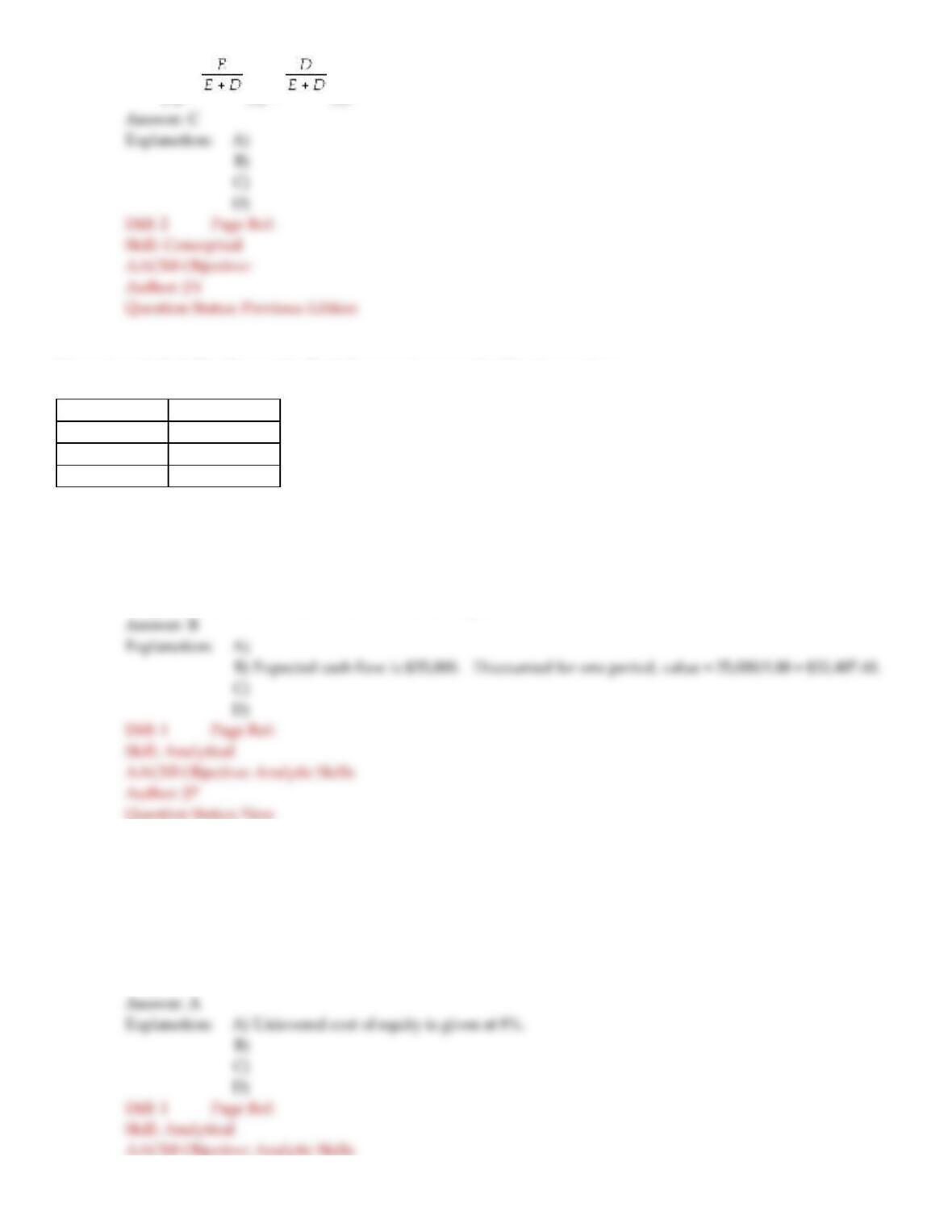
D)
βU = βE + βD
Use next year’s Cash Flow Forecast for Blank Company to answer the following questions:
Demand
Cash Flow
Weak
$25,000
Expected
$35,000
Strong
$45,000
64) Suppose Blank Company has only one project, as forecast above, and an unlevered cost of equity of 8%.
What is the value of the company?
A) $23,148.15
B) $32,407.40
C) $41,666.67
D) Cannot be determined with the information given.
65) Suppose Blank Company has only one project, as forecast above, and an unlevered cost of equity of 8%. If
the company uses no leverage, what is expected return to equity holders?
A) 8.0%
B) 11.6%
C) 9.33%
D) 30.0%
66) Suppose Blank Company has only one project, as forecast above, and an unlevered cost of equity of 8%. If
the company borrows $10,000 at 5% to make the investment, what is expected return to equity holders?
A) 8.0%
B) 11.6%
C) 9.33%
D) 30.0%
67) Suppose Blank Company has only one project, as forecast above, and an unlevered cost of equity of 8%. If
the company borrows $10,000 at 5% to make the investment, what is the return to equity holders if demand
is weak?
A) 8.0%
B) –37.5%
C) –58.6%
D) –35.3%
68) Suppose Blank Company has only one project, as forecast above, and an unlevered cost of equity of 8%. If
the company borrows $10,000 at 5% to make the investment, what is the return to equity holders if demand
is strong?
A) 8.0%
B) 54.0%
C) 28.6%
D) 38.0%
TRUE/FALSE. Write ‘T’ if the statement is true and ‘F’ if the statement is false.
69) In general, the gain to investors from the tax deductibility of interest payments is referred to as the interest
rate tax shield.
MULTIPLE CHOICE. Choose the one alternative that best completes the statement or answers the question.
70) Suppose a project financed via an issue of debt requires five annual interest payments of $10 million each
year. If the tax rate is 30% and the cost of debt is 6%, what is the value of the interest rate tax shield?
A) $11.35 million
B) $12.21 million
C) $13.20 million
D) $12.64 million
71) Suppose a project financed via an issue of debt requires six annual interest payments of $20 million each
year. If the tax rate is 30% and the cost of debt is 8%, what is the value of the interest rate tax shield?
A) $31.35 million
B) $27.74 million
C) $23.20 million
D) $32.64 million
72) Suppose a project financed via an issue of debt requires five annual interest payments of $20 million each
year. If the tax rate is 30% and the cost of debt is 5%, what is the value of the interest rate tax shield?
A) $32.35 million
B) $22.25 million
C) $25.98 million
D) $22.67 million
73) A firm requires an investment of $30,000 and borrows $20,000 at 7%. If the return on equity is 15% and the
tax rate is 30%, what is the firm’s WACC?
A) 8.27%
B) 9.13%
C) 10.4%
D) 8.91%
74) A firm requires an investment of $20,000 and borrows $10,000 at 8%. If the return on equity is 20% and the
tax rate is 30%, what is the firm’s WACC?
A) 11.4%
B) 12.8%
C) 12..1%
D) 13.2%
75) A firm requires an investment of $30,000 and borrows $10,000 at 6%. If the return on equity is 15% and the
tax rate is 30%, what is the firm’s WACC?
A) 11.4%
B) 12.3%
C) 7.8%
D) 10.1%
SHORT ANSWER. Write the word or phrase that best completes each statement or answers the question.
76) What are some implications of market imperfections?
77) How does the interest paid by a firm affect its value to investors?
78) What effect does debt have on a firm’s weighted average cost of capital?
TRUE/FALSE. Write ‘T’ if the statement is true and ‘F’ if the statement is false.
79) A firm that does not have trouble meeting its debt obligations is said to be in financial distress.
80) The direct costs of bankruptcy are estimated to be far greater, as a percent of assets, than the indirect costs of
MULTIPLE CHOICE. Choose the one alternative that best completes the statement or answers the question.
81) A bankruptcy process is complex, time–consuming, and costly. The costs of bankruptcy include
A) dividend payments.
B) raw material costs.
C) costs of hiring legal experts, appraisers, and auctioneers.
D) taxes.
82) Aside from direct costs of bankruptcy, a firm may also incur other indirect costs such as
A) loss of customers and loss of suppliers.
B) loss of interest receipts.
C) loss of dividend receipts.
D) increase in raw material costs.
SHORT ANSWER. Write the word or phrase that best completes each statement or answers the question.
83) What are direct costs of financial distress?
84) What are indirect costs of financial distress?
TRUE/FALSE. Write ‘T’ if the statement is true and ‘F’ if the statement is false.
85) The presence of financial distress costs can explain why firms choose debt levels that are too low to exploit
the interest tax shield.
86) Differences in the magnitude of financial distress costs and volatility of cash flows across industries do not
impact the choice of leverage.
MULTIPLE CHOICE. Choose the one alternative that best completes the statement or answers the question.
87) The tradeoff theory of optimal capital structure weighs the benefits of debt against the costs of
A) financial distress.
B) interest payments.
C) dividend reinvestment.
D) input factors.
88) The Tradeoff Theory suggests:
A) the firm should choose a debt level where the tax savings from increasing leverage are just offset by the
increased probability of incurring the costs of financial distress.
B) with higher costs of financial distress, it is optimal for the firm to choose higher leverage.
C) differences in the magnitude of financial distress costs and the volatility of cash flows cannot explain
the differences in the use of leverage across industries.
D) there is no rational explanation for why firms choose debt levels that are too low to fully exploit the
debt tax shield.
89) One of the factors that determines the present value (PV) of financial distress costs is
A) costs of unpaid interest arrears.
B) loss of dividend payments.
C) probability of financial distress.
D) employee compensation.
90) Firms in industries such as real estate tend to have ________ distress costs because of a large proportion of
tangible assets.
A) high
B) low
C) unexpected
D) varying
91) The probability of financial distress depends on the
A) likelihood that a firm will be unable to meet its debt commitments.
B) chance that a firm’s raw material costs will increase.
C) likelihood of dividend payments.