
Chapter 16—Investment Banking and the Public Sale of Equity Securities
MULTIPLE CHOICE
1. The group of investment banking firms that purchase new securities directly from an issuing firm to
resell to investors is known as the:
a.
Bulge bracket firms
b.
Selling group
c.
Underwriting Syndicate
d.
Market Marker Group
e.
Specialists Group
2. Large, well-known public companies can issue approved securities anytime during a two year period
by using a(n):
a.
Shelf registration
b.
Subchapter S registration
c.
Underwriting syndicate
d.
Secondary market registration
e.
“Red Herring” registration
3. A firm-commitment contract with an investment banker can best be described as:
a.
a contract to sell a new issue of securities to the investment banking firm which bids the
highest cash price.
b.
a negotiated arrangement with an investment banker in which the investment banker buys
the new shares from the issuing firm then resells the shares to investors.
c.
an arrangement with an investment banker in which the investment banker agrees to sell as
many shares as possible at an agreed upon cash price.
d.
a direct placement to current stockholders at a firm cash price.
e.
an offer from an investment banker to determine if there are enough investors willing to
commit to purchasing shares.
4. __________ tends to be the most profitable line of business for prestigious investment banks and
enjoys the highest visibility.
a.
Trading
b.
Asset management
c.
Corporate finance
d.
a and b
e.
All of the above
5. The __________ forms the basis for federal regulation of the sale of new securities by requiring
issuers to fully disclose all relevant information to potential investors.
a.
Securities and Exchange Commission Act of 1934
b.
Securities Act of 1933
c.
Gramm-Leach-Bliley Act of 1944
d.
Glass-Steagall Act
e.
None of the above

6. The __________ is the primary disclosure document for a security offering.
a.
registration statement
b.
prospectus
c.
supplemental disclosure
d.
all of the above
e.
none of the above
7. The __________ allows the underwriting syndicate to purchase an additional allocation of securities
following the initial distribution.
a.
Securities Act of 1944
b.
prospectus
c.
lockup agreement
d.
Green Shoe option
e.
none of the above
8. Which of the following is an advantage of an IPO to an American entrepreneur?
a.
new capital for the company
b.
publicly traded stock for use in acquisitions
c.
listed stock for use as a compensation vehicle
d.
personal wealth and liquidity
e.
all of the above
9. On average stock prices usually __________ when firms announce plans to conduct SEOs.
a.
rise 4%
b.
fall 3%
c.
fall 10%
d.
rise 8%
e.
fall 23%
10. Investment banking (IB) groups affiliated with large commercial banks tend to __________, while
unaffiliated IB groups __________.
a.
be included in the “bulge bracket”; are more likely to be involved in arranging syndicated
loans
b.
earn higher fees when occupying the lead manager’s position in IPOs; usually receive less
than average underwriting spreads
c.
arrange large volumes of syndicated loans; are more dominant in securities underwriting
and M&As
d.
form large underwriting syndicates; rarely use a book-building process to assess share
demand
e.
charge higher spreads on debt issues than equity issues; charge higher spreads for SEOs
than IPOs
11. The largest source of revenue for investment banks is:

a.
dealer fees
b.
security underwriting
c.
trading revenues
d.
asset management
e.
M&A advisory work
12. For firms with more than $150 million in outstanding common stock, __________ are commonly used
for debt issues in order to save time and money.
a.
shelf registrations (Rule 415)
b.
Rule 144A offerings
c.
secondary offerings
d.
rights offerings
e.
reverse LBOs
13. Firms can take advantage of reduced registration requirements if they sell a private placement of
securities in __________.
a.
shelf registrations (Rule 415)
b.
Rule 144A offerings
c.
secondary offerings
d.
rights offerings
e.
reverse LBOs
14. Which of the following specialized initial public offerings results in the formation of a legally separate
firm?
a.
tracking stocks
b.
equity carve-outs
c.
spin-offs
d.
a and b
e.
b and c
15. Which of the following describes a securities offering in which an existing shareholder sells a large
block of stock to new investors?
a.
primary offering
b.
equity carve-out
c.
secondary offering
d.
negotiated offering
e.
none of the above
16. Mason is frustrated with his recent IPO investments. He believes that IPOs, on average, are
underpriced by 15%, yet his average return is only half that. In addition, of the five offerings he
recently applied to purchase, Mason was allowed to participate in only two. Mason calculated the
returns on the five IPO offerings to be 5%, 10%, 10%, 15%, and 35%. The mean return on these
investments would be __________; the median return would be __________; and Mason is feeling the
effects of __________.
a.
20%; 10%; clustering

b.
20%; 15%; “hot-issue markets”
c.
15%; 10%; “hot-issue markets”
d.
15%; 10%; the winner’s curse
e.
10%; 15%; the winner’s curse
17. Sure-Profit is executing an IPO in which 20 million shares will be offered at a price of $10 per share.
The underwriting fee is 7%, and the shares are expected to sell for $13 per share by the end of trading
on the first day. The cost of this issue to Sure-Profit includes __________ in underwriting fees and
__________ resulting from underpricing.
a.
$18.2 million; $70 million
b.
$18.2 million; $60 million
c.
$14 million; $60 million
d.
$14 million; $30 million
e.
$7 million; $30 million
18. More-Money needs to raise $10 million, and management has decided to issue new equity. Currently,
More-Money common stock is selling for $49 per share. Costs of this issue will include a 5%
underwriting spread as well as $241,000 in other expenses. If the new shares sell at the current price,
how many shares will More-Money need to sell in order to raise the desired capital?
a.
230,742
b.
220,000
c.
219,205
d.
209,000
e.
204,082
19. Rights-Now intends to raise $1.6 million through a rights offering. Currently, 200,000 shares are
outstanding which have been trading between $42 and $45 per share. The subscription price for the
rights has been set at $40 per share. If the offering is fully subscribed, how many rights are needed to
purchase a share at $40?
a.
12
b.
10
c.
8
d.
5
e.
4
20. A qualified institutional buyer __________, while an accredited investor __________.
a.
is a large firm responsible for underwriting debt shelf registration issues; is an individual
or institution meeting the requirements for Rule 144A exemption
b.
maintains assets exceeding $100 million and can freely trade privately placed securities
according to Rule 144A; is an individual or institution meeting certain income and wealth
requirements that allow participation in private placements
c.
meets certain income requirements in order to participate in shelf registration procedures;
maintains assets in excess of $100 million and is allowed to underwrite Rule 415 issues

d.
holds more than $150 million in common stock and qualifies for Rule 415 issues; is an
individual or institution allowed to file a “master registration statement” know as shelf
registration
e.
is an individual or institution meeting the requirements for Rule 144A exemption; meets
certain income requirements in order to participate in shelf registration procedures
21. Share issue privatizations:
a.
almost without exception, have been the largest share offerings in a country’s history
b.
have transformed many national IPO markets
c.
dramatically increase national stock market trading volume and liquidity
d.
are the most important aspect of privatization programs
e.
all of the above
22. Which of the following is not a benefit of going public?
a.
Stock price emphasis
b.
New capital
c.
Stock for use as a compensation vehicle
d.
Personal wealth and liquidity
23. Given that the mean return for IPOs is much higher than the median return, one can conclude
a.
Large IPOs are less underpriced than smaller offerings
b.
IPO markets are prone to fads
c.
The average is skewed by outliers
d.
This is evidence of the “winner’s curse”
24. Why do foreign firms prefer using ADRs instead of listing stock on one of the American Exchanges
(the NYSE for example)?
a.
Foreign firms want to pay dividends in dollars
b.
Foreign firms prefer the strong market regulations in the United States
c.
Foreign firms acquire a US banking sponsor
d.
Foreign firms avoid US financial disclosure requirements
25. The research on the investment performance of IPOs indicates
a.
High returns when purchased on the offer, lower short-term returns when purchased on the
secondary market, mixed research results for long-term investors purchasing on the
secondary market
b.
High returns when purchased on the offer, lower short-term returns when purchased on the
secondary market, high long-term returns for investors purchasing on the secondary
market
c.
High returns when purchased on the offer, high short-term returns when purchased on the
secondary market, high long-term returns for investors purchasing on the secondary
market
d.
High returns when purchased on the offer, high short-term returns when purchased on the
secondary market, mixed research results for long-term returns for investors purchasing on
the secondary market

26. Which of the following is not a financial theory explanation for the underpricing in IPOs?
a.
Firms want to create excess demand for its shares
b.
Firms want to create higher future valuations
c.
Firms want to avoid the winner’s curse
d.
Firms want to create high initial returns
MATCHING
Match the following terms with their best description:
a.
negotiated offer
b.
competitively bid offer
c.
co-managers
d.
best-efforts arrangements
e.
firm-commitment
f.
underwriting syndicate
1. investment banks bid for the business
2. participating banks in underwriting
3. investment banker makes no guarantee about success of offering
4. investment banker agrees to underwrite the issue
5. negotiate terms with one investment bank
6. make investment banks cooperating to distribute an issue
Match the following terms with their best descriptions:
a.
due diligence
b.
registration statement: Part I
c.
registration statement: Part II
d.
red herring
e.
primary offering
7. distribute to all prospective investors
8. search out and disclose all relevant information
9. standard legal disclaimer listed on cover of a preliminary prospectus
10. supplemental disclosure filed only with the SEC
11. sale of newly issued shares

Match the following terms with their best descriptions:
a.
Green Shoe Option
b.
Book Building
c.
Prospectus
d.
Tracking Stock
e.
Preemptive Right
12. Equity claims based on the earnings of wholly owned subsidiaries of diversified firms
13. Ability of existing shareholders to purchase a pro rata portion of new stock issues
14. Primary disclosure document for a security offering filed with the SEC
15. Ability of underwriting group to sell up to an additional 15% more shares than originally planned
16. Process used to assess demand by underwriters who ask prospective investors to reveal their level of
interest in buying the issue being offered
SHORT ANSWER
1. List two of the drawbacks of a firm going public through issuing new common stock shares.
2. How do investment banks earn revenue in trading and asset management?
3. Why do lead underwriters often prefer to issue securities with several co-managers?

4. Discuss the underwriting spread.
5. Rich Corporation is doing an IPO, which has an underwriting spread of r%. If Rich Corporation wants
to net $a million from the sale of common stock, how much common stock must it sell to the
underwriter?
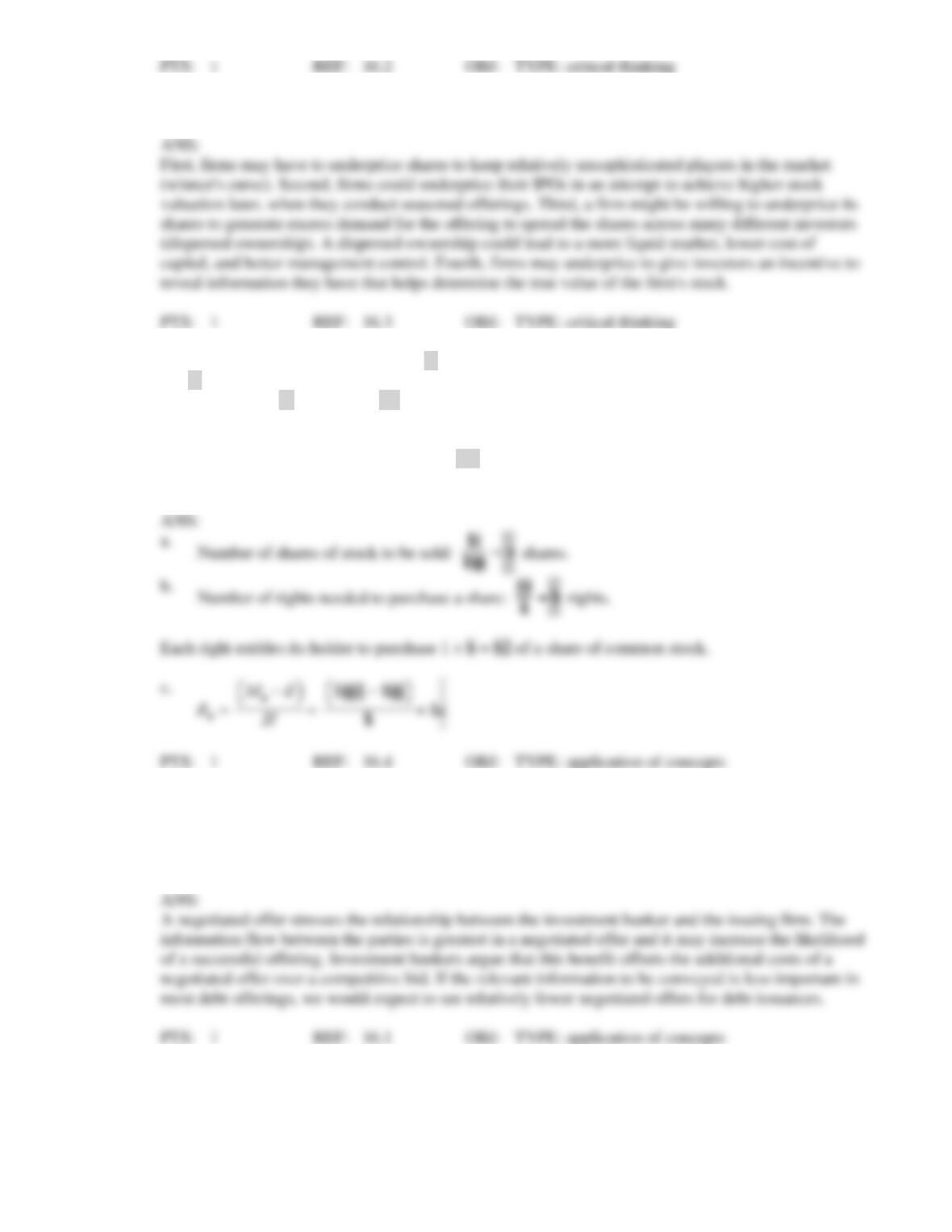
6. G.M. Johnson Enterprises is going to use a rights offering for new common stock shares in order to
raise $cs. The firm’s investment banker has recommended a $pr per share subscription price. The
current stock price is $csp per share and there are so shares outstanding.
a.
How many new shares will need to be issued?
b.
How many rights will it take to get one new share?
c.
What is the value of one right?
d.
What is the value of the stock when it is trading ex rights?
e.
Assume you currently have $cash cash and rights2 shares of the stock. If you were to exercise
half of your rights and sell the other half, show how this would affect both your cash and
stock accounts. How does your total worth differ from before the offering?
d.

7. Corporations electing to sell new securities to investors often utilize investment banking firms to assist
with the process. What services do investment banking firms provide corporations issuing new
securities?
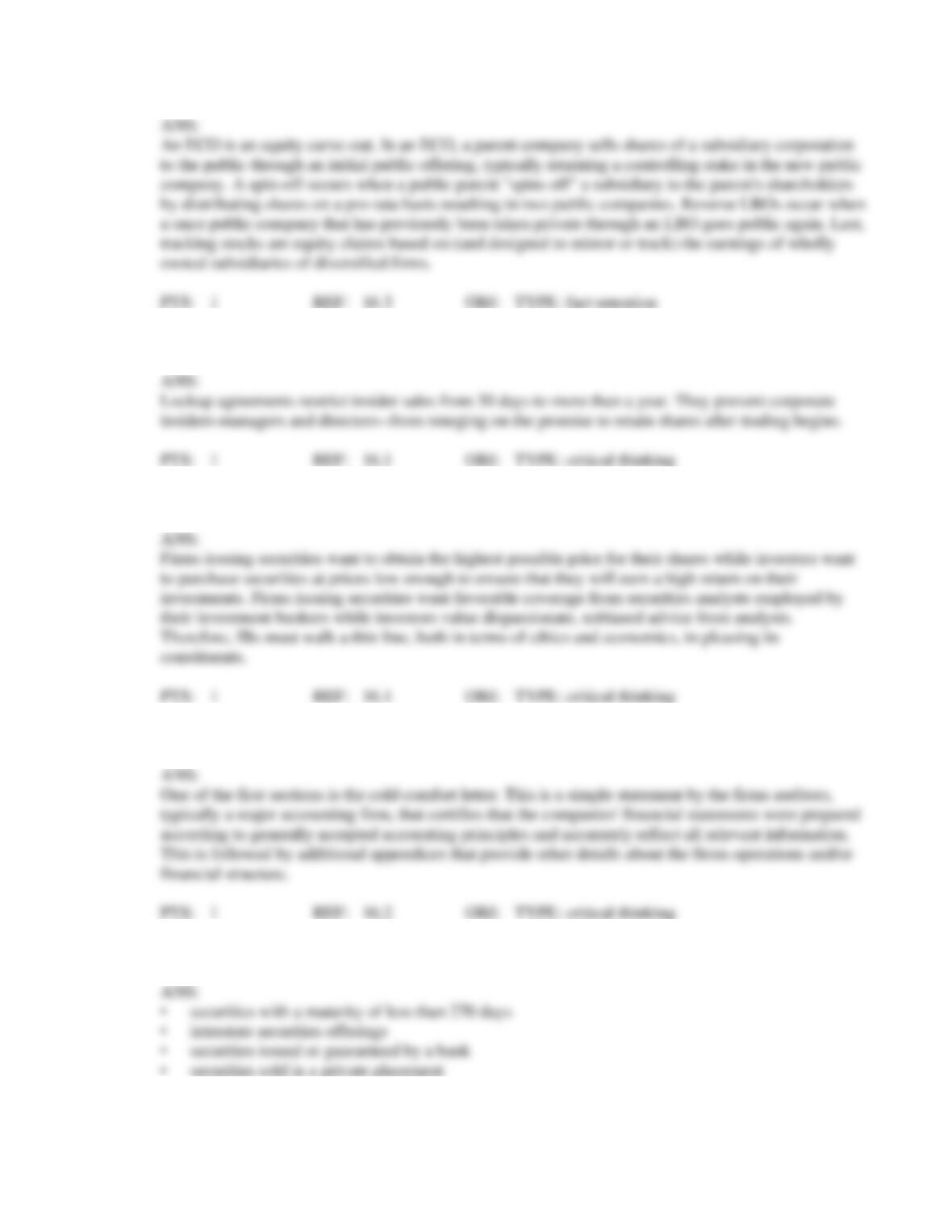
8. Assume that Paddington, Corp. of London wants to establish an American Depository Receipt (ADR)
program for its shares on the New York Stock Exchange. Paddington’s shares are trading on the
London exchange at £l per share, and the U.S. dollar / pound exchange rate is $dpp / £. Paddington
wishes to establish an ADR program worth about $adr0 million. Paddington has asked the Bank of
New York to handle the issue.
a.
How many shares will the Bank of New York purchase?
b.
If each ADR will represent sb shares of Paddington, how many ADRs will be created to list
on the NYSE?
c.
At what price will the ADRs be sold to American investors on the NYSE?
d.
If the price of Paddington decreases by £decr, at what price should the ADR trade?
e.
Assume instead of the price of Paddington changing, the exchange rate goes to $er / £. At
what price should the ADRs trade?
$adr = $dpp / £ £l / share Number of shares to purchase
Number of share to purchase = a
£l / share $dpp / £ sb shares / ADR = $c
new price of ADR = $c – $d1 = $d
£l / shares $er / £ sb shares / ADR = $e / ADR
9. There are four types of specialized initial public offerings: ECOs, Spin-offs, reverse LBOs, and
tracking stocks. Describe each of these types of specialized IPOs.
10. What is the purpose of a lockup agreement?
11. Identify the systemic conflicts of interest faced by investment bankers.
12. What might you find in the appendix of an offering prospectus?
13. Under what conditions can securities be exempt from federal registration?
14. Identify the possible explanations for the underpricing phenomenon.
15. The KG Corporation intends to raise $r0 million through a right offering. If KG Corporation currently
has cs shares outstanding and the investment banker has recommended setting the subscription price
for the rights at $sp per share ($cm below the current market price).
a.
How many shares of stock must be sold?
b.
How may rights are needed to purchase a share?
c.
If KG’s stock is currently selling for $sp1, what is the value of a right when the stock is trading
ex rights?
16. Intuitively, most believe a competitive offer will result in lower cost for a firm than a negotiated offer.
Empirically, most equity offers occur through negotiated offers. Discuss why a negotiated offer may
be a better mechanism for a firm to place an equity instrument in contrast to a competitive offer. Do
you expect this same logic to extend to debt offerings?
17. Discuss how the costs of equity issuance as measured by the underwriting spread change with the
proceeds raised. In particular, will the costs be uniformly increasing or decreasing?
18. Fixed-price offers are quite common in international markets. What is a fixed-price offer and why do
fixed-price offers lead to greater spreads than book building?
19. Explain how insider ownership can be used as an important signal of firm quality. Why are lockup
agreements important in making this signal credible?
20. Suppose short-term interest rates are not considerably lower than longer-term rates. We often observe
firms issuing debt called commercial paper with just less than 270 days to maturity, and then re-issuing
new debt again with just less than 270 days to maturity when the original debt retires. Why would a
firm follow this strategy rather than simply issuing longer-term debt from the outset?
21. The market for IPOs often is heavily over-subscribed. This means that not all investors who demand
an IPO actually get the share allocation, even if they are willing to pay the offer price. Describe the
winner’s curse phenomena as it relates to retail investors in an IPO.

22. Eye-Half-Mi-Rites Inc. is issuing rights to raise $ir0 million. The company’s s shares trade between $t1
and $t2 per share. Eye-Half-Mi-Rites’ investment banker (IB) has recommended setting a subscription
price of $sp per share. At this price, the IB believes the offering will be fully subscribed.
a.
Given this information, how many rights will be required to purchase one share?
b.
If Eye-Half-Mi-Rites is selling with rights at a price of $bp per share, how much is each right
worth in the marketplace?
a.
Given the information provided, the number of shares per right will be a1.
underpricing (which on average is about 15 percent)
ESSAY
1. Describe how the historical separation of commercial and investment banking activities in the U.S. has
given rise to different investment banking firms specializing in different activities.
2. There are many benefits to going public. Firms can raise substantial sums of capital for their company,
use traded stock as a means of payment in later mergers and acquisitions, use listed stock as a
compensation method for employees, and it also allows original owners to divest themselves of their
holdings of a single firm in their personal portfolios over time. In a concise essay discuss the major
drawbacks to going public.
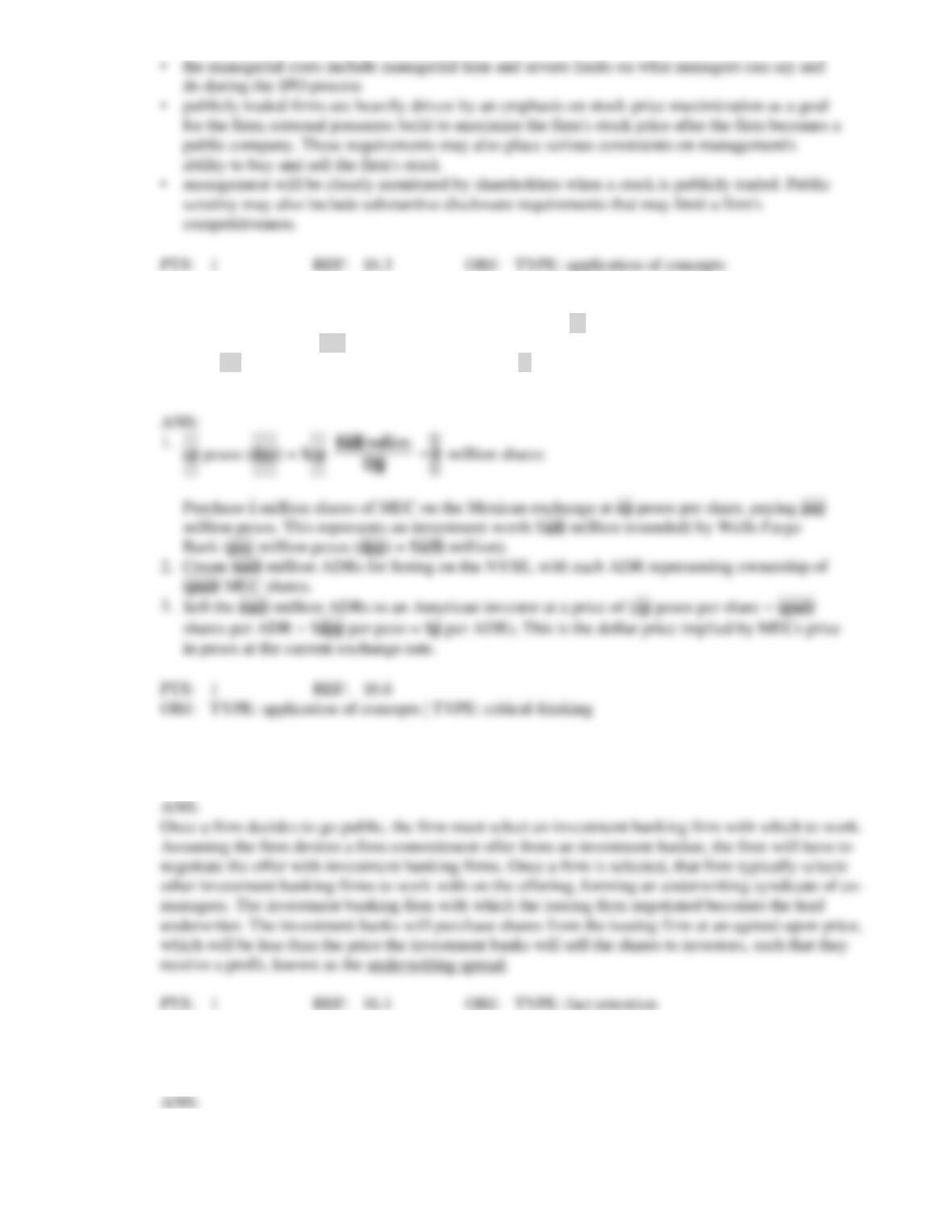
3. Mexico Exports Corporation (MEC) is going to establish an ADR program for its shares on the NYSE.
Its shares are currently trading on the Mexico exchange for ep pesos per share and the U.S. dollar /
peso exchange rate is $dpp / peso. If MEC asks Wells Fargo Bank to establish an ADR program worth
almost $adr million and has a target price of about $tp a share for the NYSE, what would their ADR
program look like?
4. Discuss the sale of new common stock to the general public with the help of an investment banker
from the initial decision to the actual sale to investors under a firm-commitment offering.
5. List and describe the empirical patterns observed in the tendency for initial public offerings to be
underpriced.