Cost Accounting: A Managerial Emphasis, 6e
Chapter 16 – Revenue and Customer Profitability Analysis
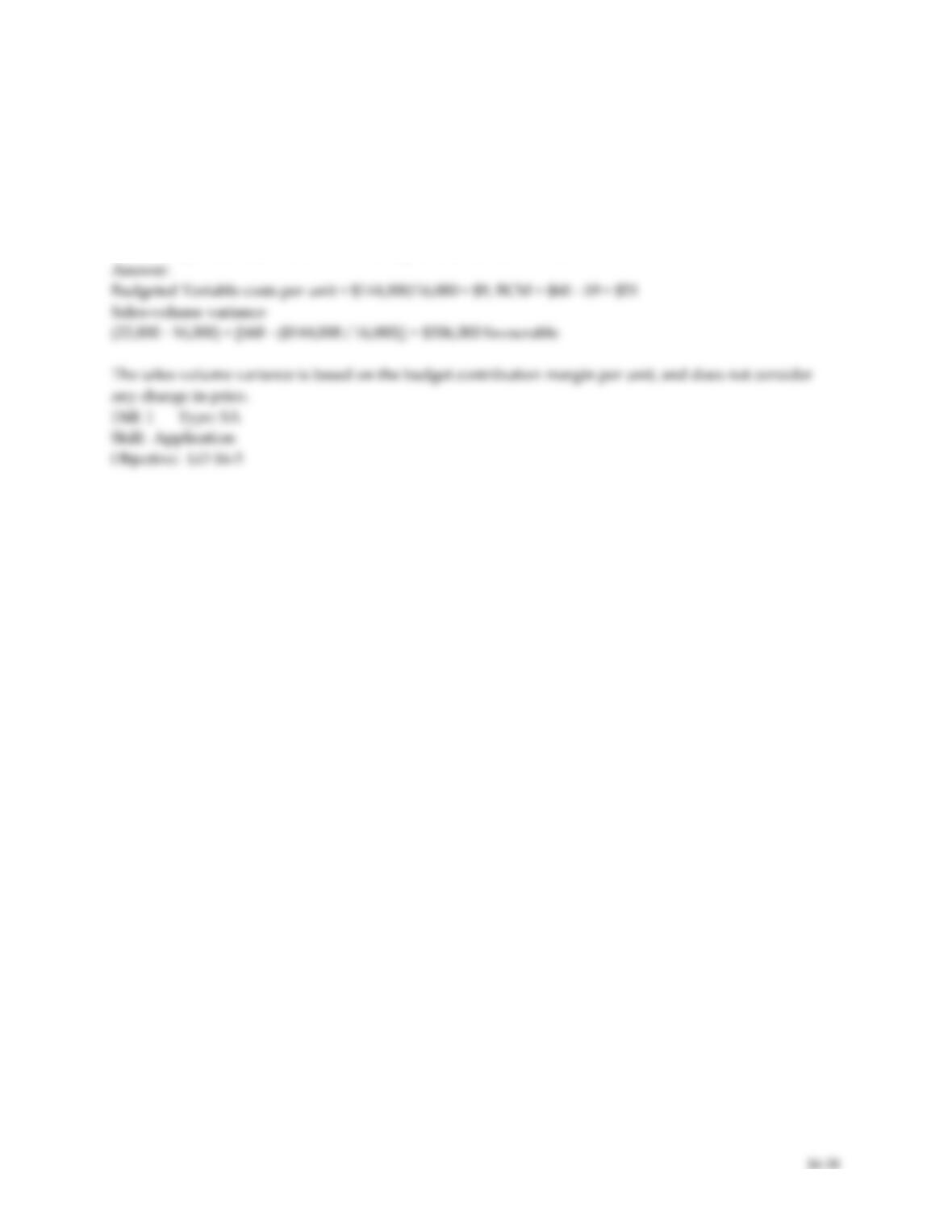
49) Big Products sells only one product. Last year it sold 22,000 items when the budget was 16,000 items.
The increased sales were due in part to reduced selling prices averaging $52. The budgeted selling price
was $60. Total variable costs were budgeted at $144,000 .
Required:
Compute the contribution margin sales-volume variance. Why doesn’t the contribution sales volume
variance equal the difference between budgeted and actual revenue?
Cost Accounting: A Managerial Emphasis, 6e
Chapter 16 – Revenue and Customer Profitability Analysis
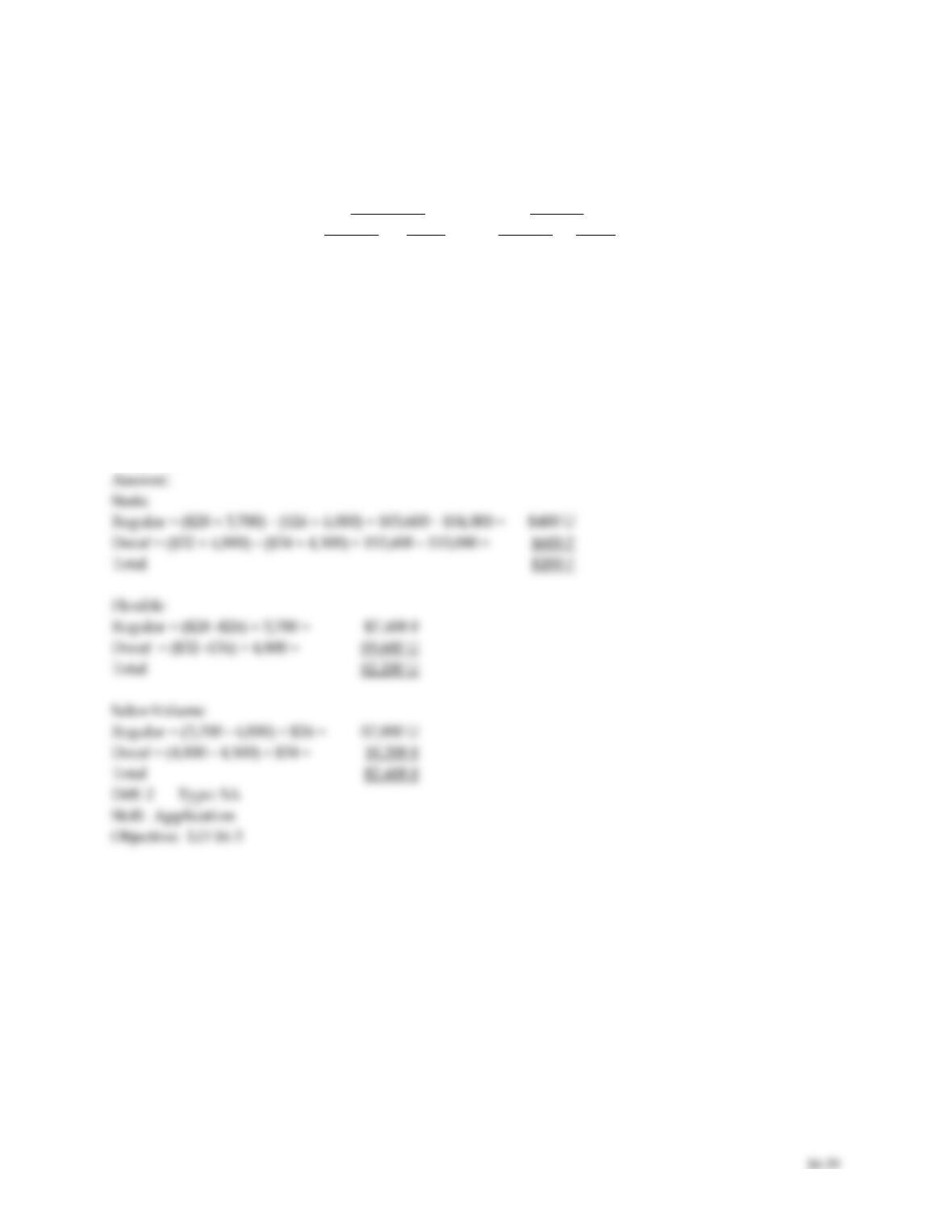
50) Columbia Coffee Inc. sells two types of coffee, Regular and Decaf. The monthly budget for Canadian
coffee sales is based on a combination of last year’s performance, a forecast of industry sales, and the
company’s expected share of the Canadian market. The following information is provided for March:
Budgeted Actual
Regular Decaf Regular Decaf
Price per kilogram $50 $60 $52 $60
Variable cost per kilogram 24 26 24 28
Contribution margin $26 $34 $28 $32
Sales (in kg) 4,000 4,500 3,700 4,800
Budgeted fixed costs are $58,000. Actual fixed costs are $62,000.
Required:
Calculate the static-budget, flexible-budget and sales-volume variances for contribution margin, for the
company for March.
Cost Accounting: A Managerial Emphasis, 6e
Chapter 16 – Revenue and Customer Profitability Analysis
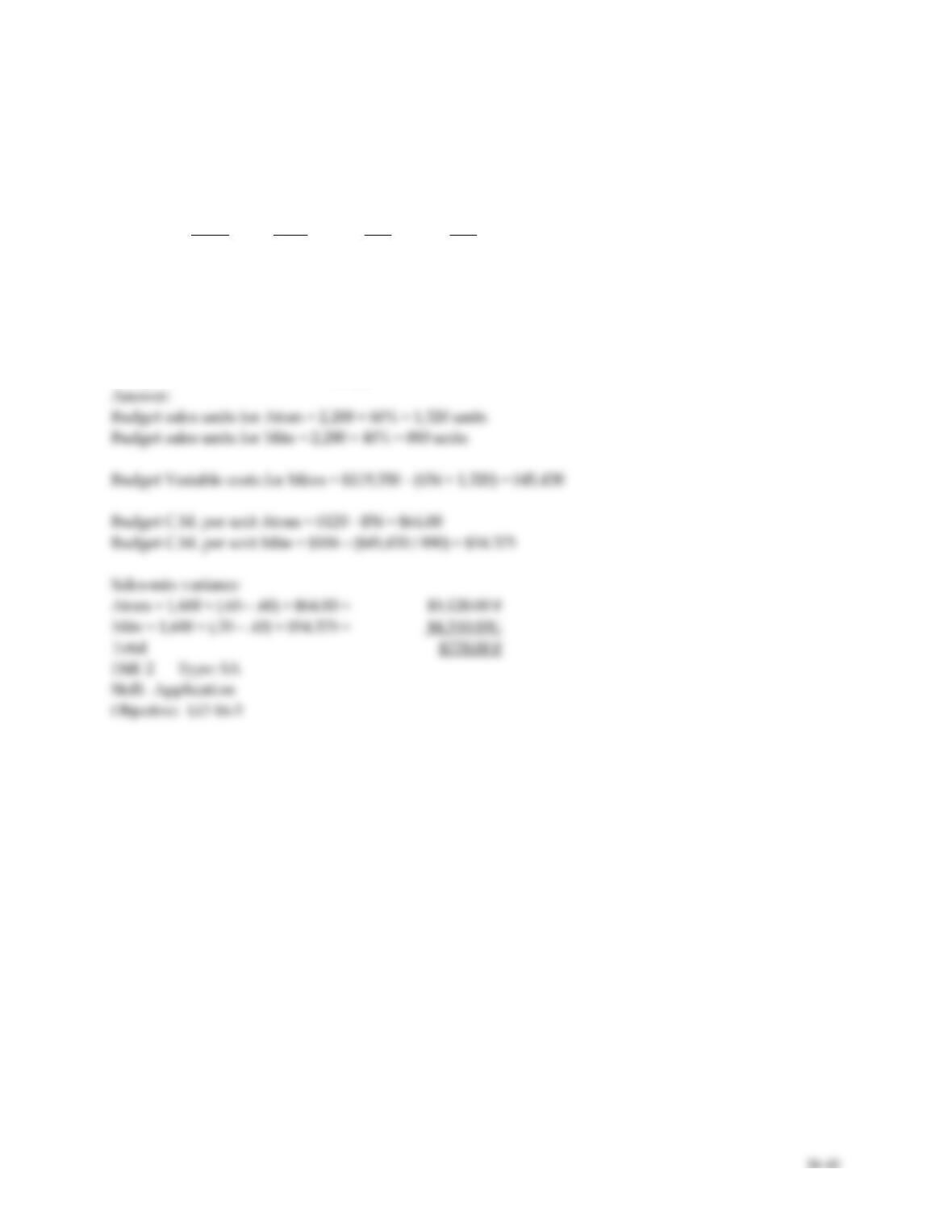
51) A sporting goods division sells two types of juvenile skates; Atom and Mite. The following data are
from the division’s August results. Actual sales were 1,600 items, and the budget was 2,200 items.
Actual Budget Actual Budget
Sales Sales Sales Sales
Price Price Mix Mix
Atom $115 $120 65% 60%
Mite 99 106 35% 40%
Variable costs per unit (pair) were budgeted at $56 for the Atom skates, and $119,350 in total.
Required:
Compute the sale-mix variance by type of skate, and in total.
Cost Accounting: A Managerial Emphasis, 6e
Chapter 16 – Revenue and Customer Profitability Analysis
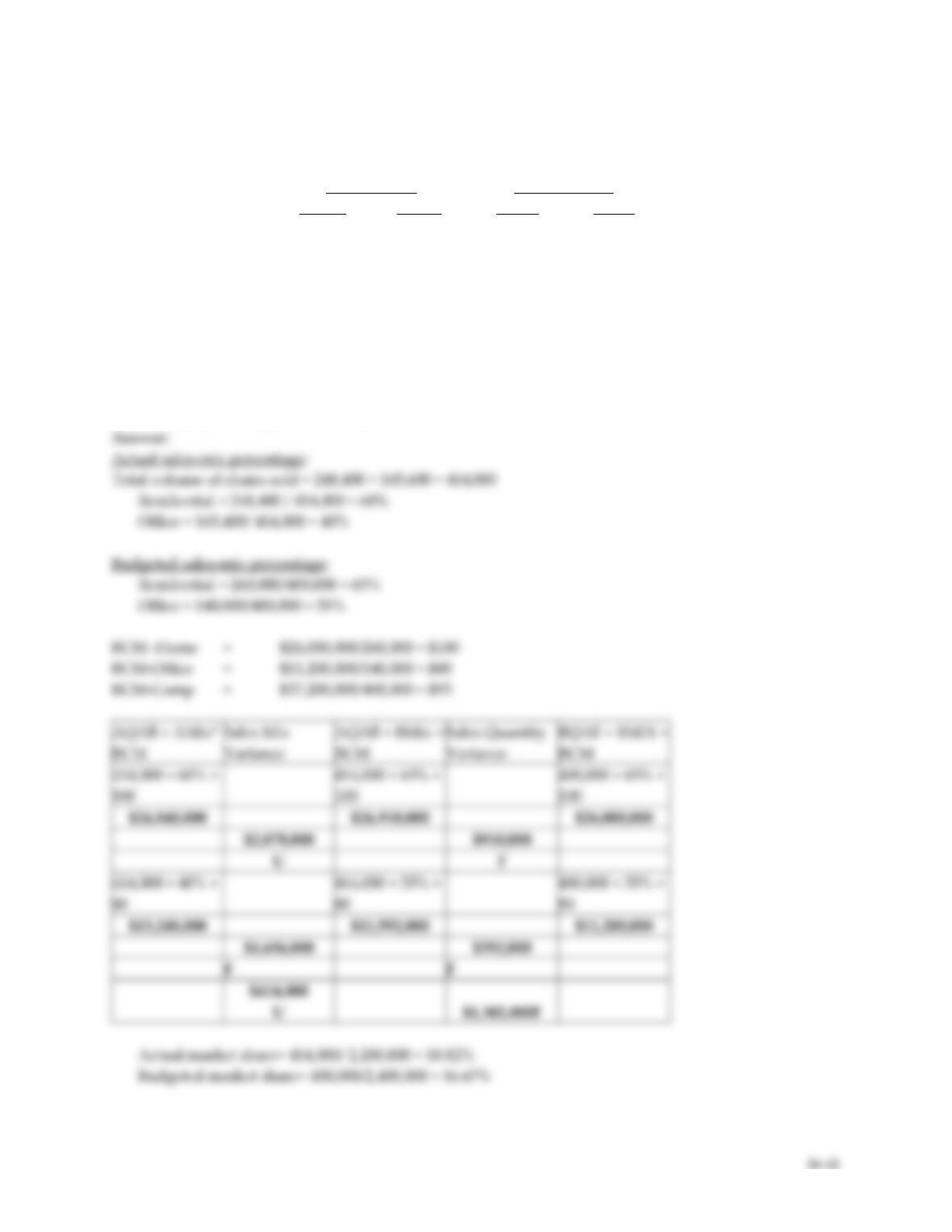
52) The Chair Company manufactures two modular types of chairs; one for the residential (home)
market, and the other for the office market. Budgeted and actual operating data for the past year are:
Static Budget Actual Results
Home Office Home Office
Number of chairs sold 260,000 140,000 248,400 165,600
Contribution margin $26,000,000 $11,200,000 $22,356,000 $13,248,000
The industry volume for residential and office chairs of the type sold by the Chair company had been
estimated at 2,400,000. Actual industry volume for the year was 2,200,000 chairs.
Required:
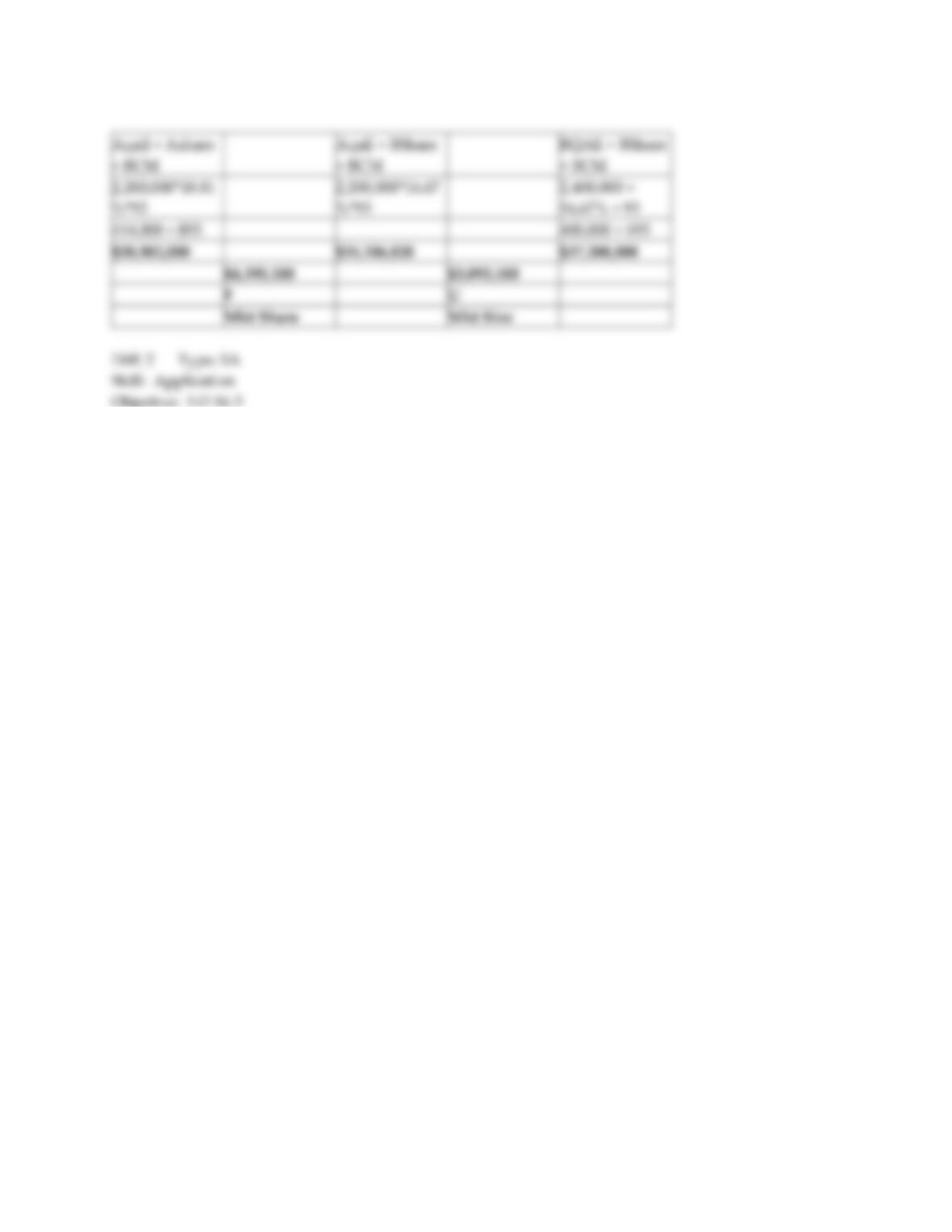
1. Compute the sale-mix variance and the sales– quantity variance by type of chair, and in total.
2. Compute the market-share variance and market-size variances. (Calculate actual and budgeted
market share percentages to two decimal places.)
Cost Accounting: A Managerial Emphasis, 6e
Chapter 16 – Revenue and Customer Profitability Analysis
16–42
Objective: LO 16-3
Cost Accounting: A Managerial Emphasis, 6e
Chapter 16 – Revenue and Customer Profitability Analysis
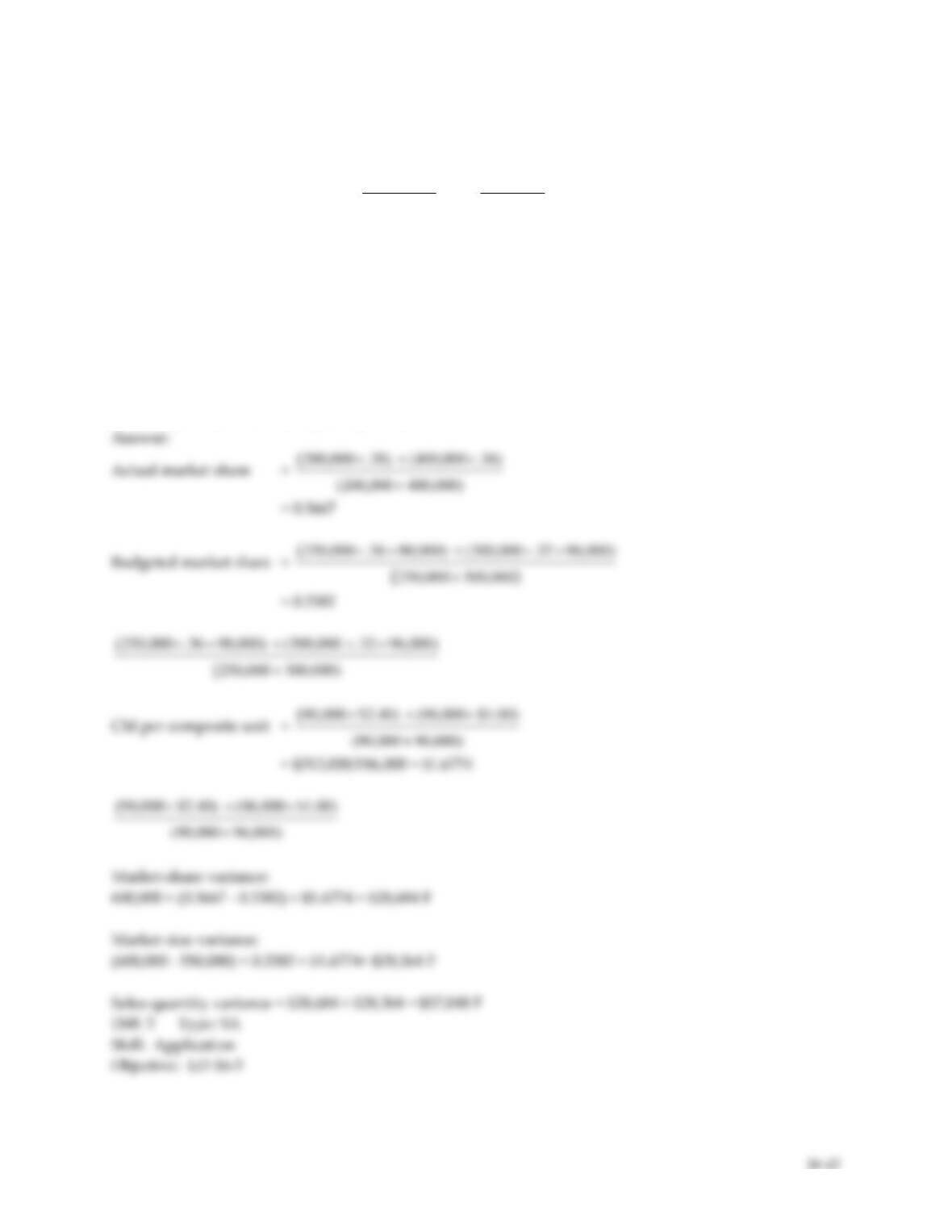
53) Better Printing sells hardcover and softcover books. For January the following information is
available:
Hardcover Softcover
Actual market size 200,000 400,000
Budgeted market size 250,000 300,000
Actual market share 38% 36%
Budgeted market share 36% 32%
Budgeted Cont. Margin $2.40 $1.00
Actual average selling price $14.00 $6.50
Required:
1. Compute the market-share variance and market-size variance. (Round intermediate calculations to
four decimal places)
2. Compute the total sales-quantity variance .
Cost Accounting: A Managerial Emphasis, 6e
Chapter 16 – Revenue and Customer Profitability Analysis
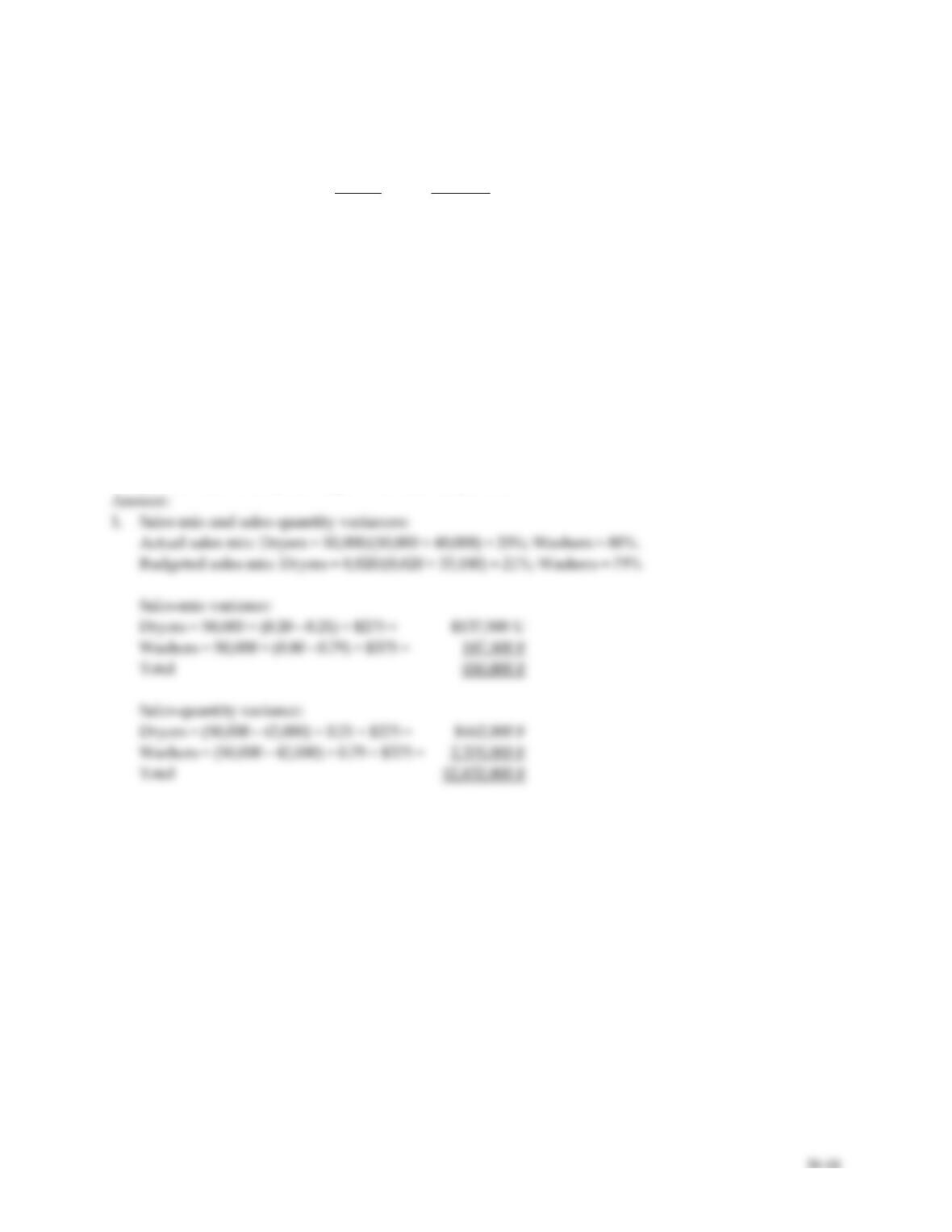
54) Bob’s Appliances manufactures industrial dryers and washers. During February the following data
are available:
Dryers Washers
Actual units sold 10,000 40,000
Budgeted sales 8,820 33,180
Actual selling price $700 $900
Budgeted selling price $710 $930
Budgeted market share 25% 24%
Actual market share 20% 25%
Budget cont. margin /unit $275 $375
Required:
Determine the following:
1. Sales-mix and sales-quantity variances
2. Market-share and market-size variances (for calculation purposes round combined actual and
budgeted market share percentages to six decimal places.)
Cost Accounting: A Managerial Emphasis, 6e
Chapter 16 – Revenue and Customer Profitability Analysis
55) The Omega Corporation manufactures two types of vacuum cleaners: the ZENITH for commercial
building use and the House-Helper for residences. Budgeted and actual operating data for the year are as
follows:
Static Budget ZENITH House-Helper Total
Number sold 15,000 60,000 75,000
Contribution margin $3,750,000 $12,000,000 $15,750,000
Actual Results ZENITH House-Helper Total
Number sold 16,500 38,500 55,000
Contribution margin $6,200,000 $10,200,000 $16,400,000
Required:
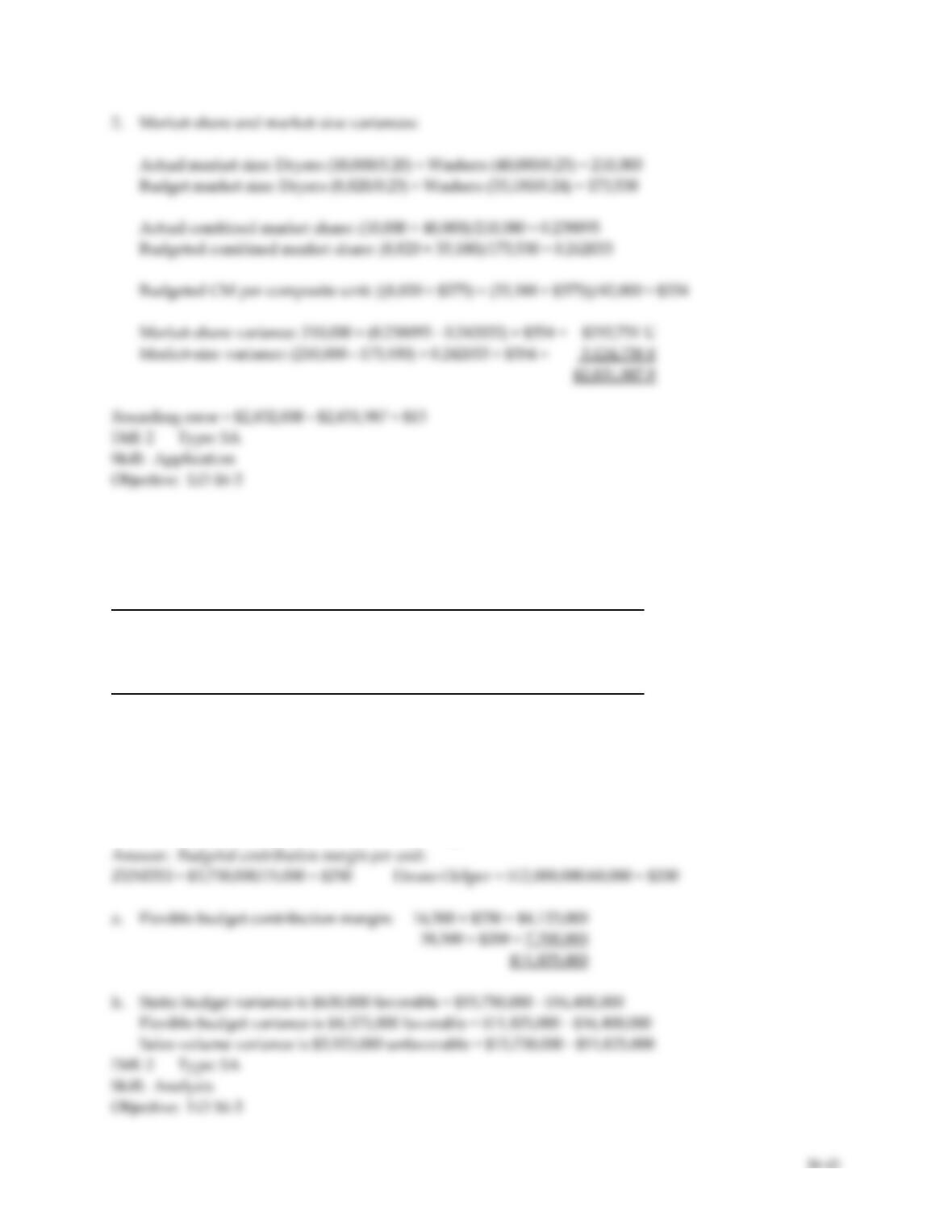
a. Calculate the contribution margin for the flexible budget.
b. Determine the total static-budget variance, the total flexible-budget variance, and the total sales-
volume variance in terms of the contribution margin.
Cost Accounting: A Managerial Emphasis, 6e
Chapter 16 – Revenue and Customer Profitability Analysis
56) The Omega Corporation manufactures two types of vacuum cleaners: the ZENITH for commercial
building use and the House-Helper for residences. Budgeted and actual operating data for the year are as
follows:
Static Budget ZENITH House-Helper Total
Number sold 15,000 60,000 75,000
Contribution margin $3,750,000 $12,000,000 $15,750,000
Actual Results ZENITH House-Helper Total
Number sold 16,500 38,500 55,000
Contribution margin $6,200,000 $10,200,000 $16,400,000
Required:
Compute the sales-mix variance and the sales-quantity variance by type of vacuum cleaner, and in total.
(in terms of the contribution margin)
Cost Accounting: A Managerial Emphasis, 6e
Chapter 16 – Revenue and Customer Profitability Analysis
57) The Omega Corporation manufactures two types of vacuum cleaners, the ZENITH for commercial
building use and the House-Helper for residences. Budgeted and actual operating data for the year are as
follows:
Static Budget ZENITH House-Helper Total
Number sold 15,000 60,000 75,000
Contribution margin $3,750,000 $12,000,000 $15,750,000
Actual Results ZENITH House-Helper Total
Number sold 16,500 38,500 55,000
Contribution margin $6,200,000 $10,200,000 $16,400,000
Prior to the beginning of the year, a consulting firm estimated the total volume for vacuum cleaners of the
Zenith and House-Helper category to be 300,000 units, but actual industry volume was only 275,000
units.
Required:
Compute the market-share variance and market-size variance in terms of the contribution margin.
Cost Accounting: A Managerial Emphasis, 6e
Chapter 16 – Revenue and Customer Profitability Analysis
58) The measures used to compute market size and share are debated intensely in the television industry,
but generally, a TV station’s ability to charge premium prices for airtime increases as its audience size
increases. Explain how the sales and market variances might be relevant in this situation.
59) Various Product Company is a manufacturer of numerous products which are similar and are
processed on the same assembly line. The production manager has decided that she will require all
product managers and assembly line managers to be responsible for their own operations. The
accounting information system is a large complex system that can provide specialized reporting when
needed. It also has room for new, permanent applications.
Required:
Discuss how the production manager can expand the reporting responsibilities of these managers.
Cost Accounting: A Managerial Emphasis, 6e
Chapter 16 – Revenue and Customer Profitability Analysis
60) Comment on why marketing managers generally find the market-share variance is more controllable
than the market- size variance.
16.4 Generate a customer profitability profile.
1) Customer-profitability analysis examines how individual customers, or groupings of customers, differ
in their profitability.
2) Customer-specific costs are costs that are traceable or allocated to individual customers.
3) ________ examine(s) how customers differ in their profitability.
A) Customer-profitability analysis
B) Customer revenue analysis
C) Customer-cost hierarchy
D) Price discounting
E) Customer-price hierarchy
4) Customer specific costs are costs that
A) are traceable to or allocated to individual customers.
B) are not traceable to individual customers.
C) are the same as customer support costs.
D) would not include cost of goods sold.
E) would not include selling-related costs.
Cost Accounting: A Managerial Emphasis, 6e
Chapter 16 – Revenue and Customer Profitability Analysis
5) The data for a paint manufacturing company for February are as follows:
Customer-
Litres List specific
Sold Price Costs
Customer 1 50,000 $9.00 $20,000
Customer 2 55,000 $9.00 $20,000
Customer 3 20,000 $9.00 $9,000
Customer 4 15,000 $9.00 $4,000
Customer 5 40,000 $9.00 $19,000
Price discount policy:
$0.25 discount per gallon in excess of 20,000 gallons (up to 40,000)
$0.35 discount per gallon in excess of 40,000 gallons
Required:
Prepare a report showing the customer-specific contribution. Present one column for customer-specific
contribution and a second column showing customer-specific contribution as a percentage of customer
revenue net of discounts (round percentages to two decimal places).
Cost Accounting: A Managerial Emphasis, 6e
Chapter 16 – Revenue and Customer Profitability Analysis
6) Harry’s Electronics manufactures electronic parts. Data for two of the company’s customers is as
follows:
Customer 1 Customer 2
Revenues at list price $220,000 $220,000
Units sold 40,000 50,000
Unit list price $5.50 $4.40
Cost of goods per unit $2.90 $2.90
Sales discounts 20,000 30,000
Customer-specific costs
Order-taking $1,800 $2,250
Product-handling $14,000 $17,500
Delivery $4,200 $5,250
Required:
Prepare a Customer-Profitability Analysis.
1) Managers find customer-profitability analysis useful because it frequently highlights how vital a small
set of customers is to total profitability.
2) Revenue shedding refers to the strategy of providing price discounts on a long-term basis to specific
customers.
Cost Accounting: A Managerial Emphasis, 6e
Chapter 16 – Revenue and Customer Profitability Analysis
3) A policy of dropping any customer that is currently unprofitable will eliminate, in the short run, all of
the costs assigned to it.
4) Analyzing whether to add or drop a customer is an application of relevant costing analysis.
5) Allocated corporate costs are irrelevant when analyzing whether to drop a customer.
6) Which of the following statements is true?
A) Managers often find the bar chart presentation to be the most accurate way to analyze customer
profitability.
B) Managers find customer-profitability analysis useful because it frequently highlights how vital a small
set of customers is to total profitability.
C) Managers find customer-profitability analysis useful because when a customer is ranked in the loss
category, they can focus their resources on this type of customer.
D) The 80/20 rule means that 80% of the customers provide 80% of the profit and 20% of the customers
provide the remainder.
E) Managers can ensure that low profitability customers receive high priority.
7) Which of the following is NOT a factor that managers should consider in deciding how to allocate
resources across customers?
A) short-run and long-run customer profitability
B) customer retention likelihood
C) economic forecasts
D) customer growth potential
E) increases in overall demand from having well-known customers
Cost Accounting: A Managerial Emphasis, 6e
Chapter 16 – Revenue and Customer Profitability Analysis
8) Each division manager for a paint manufacturer is provided with a customer profitability analysis for
the past year. The managers use the analysis to determine how best to allocate the company’s resources
within their division, and when a customer is a “loss customer,” that customer is dropped.
Required:
Advise (briefly) the managers on their strategy of focusing only on profitabilty over the year, in terms of
improving the bottom line of their respective divisions. Include at least three other factors that managers
should consider in deciding how to allocate resources across customers.
9) What actions might be taken with an unprofitable customer?
Cost Accounting: A Managerial Emphasis, 6e
Chapter 16 – Revenue and Customer Profitability Analysis
10) Customer profitability analysis is used by companies to identify the most valuable customers.
Required
a. What are some of the metrics that can be used to assess customer profitability?
b. What are some of the challenges companies face in customer profitability analysis?
c. What are some of the ethical issues raised by customer profitability analysis?