151. At the beginning of the year Grey Corporation estimated the following:
Assembly Department
Packaging Department
Overhead
$ 840,000
$ 210,000
Direct labor hours
80,000
4,000
Machine hours
20,000
12,000
Grey uses departmental overhead rates. In the assembly department , overhead is applied on direct labor hours. In the packaging department,
overhead is applied on the basis of machine hours. Actual data for the month of April are as follows:
Assembly Department
Packaging Department
Overhead
$ 42,759
$ 20,400
Direct labor hours
4,000
300
Machine hours
1,000
1,200
Required:
A.) Calculate the predetermined overhead rate for the assembly and packaging departments.
B.) Calculate the overhead applied to production in each department for the month of April.
C.) Calculate how much each department’s overhead is overapplied/underapplied.
152. A company has two departments that all goods pass through, machining and assembly. Machining
overhead is applied based on machine hours and assembly overhead is applied based on direct labor hours. Data
on each department is as follows:
Machining
Assembly
Budgeted overhead
$75,000
$40,000
Budgeted direct labor hours
5,000
10,000
Budgeted machine hours
25,000
1,000
Actual overhead
$75,400
$39,200
Actual direct labor hours
5,203
9,980
Actual machine hours
25,040
850
A.
Calculate the overhead rate for each department.
B.
What is each department’s applied overhead?
C.
Calculate each department’s overhead variance. Specify whether it is overapplied or underapplied.
153. Elf Company produces ornamental trees and uses normal costing. Elf applies overhead based on direct
labor hours. The following data are provided:
Budgeted
Actual
Overhead
$400,000
$392,000
Machine hours
20,000
18,000
Direct labor hours
16,000
17,840
Direct materials cost
$521,000
Direct labor cost
$410,000
Units produced
10,000
A.
Calculate applied overhead.
B.
Calculate the unit cost.
A.
Predetermined OH rate = $400,000/16,000 = $25 per direct labor hour
$25 ´ 17,840 = $446,000 applied overhead
B.
Unit cost = ($521,000 + $410,000 + $446,000)/10,000 = $137.70 per ornamental tree
A.
Machining OH rate = $75,000/25,000 = $3 per machine hour
Assembly OH rate = $40,000/10,000 = $4 per direct labor hour
B.
Machining applied OH = $3 ´ 25,040 = $75,120
Assembly applied OH = $4 ´ 9,980 = $39,920
C.
Machining OH variance = $75,400 – $75,120 = $280 underapplied
Assembly OH variance = $39,920 – $39,200 = $720 overapplied
154. Pribil Farm Equipment is a job-order costing manufacturer that uses a plantwide overhead rate based on
direct labor hours. Estimations for the year include $420,000 in overhead and 30,000 direct labor hours. Pribil
worked on five jobs in March. Data are as follows:
Job 89
Job 90
Job 91
Job 92
Job 93
Balance, 3/1
$23,110
$18,240
$ 9,510
$ 0
$ 0
Direct materials
13,000
17,210
22,900
15,240
8,210
Direct labor cost
$8,075
$11,500
$16,250
$9,750
$4,860
Direct labor hours
1,615
2,300
3,250
1,950
972
By March 31, Jobs 89 and 91 were completed and sold. The rest of the jobs remained in process.
A.
Calculate the plantwide overhead rate.
B.
Calculate the Work in Process on March 31.
C.
Calculate the cost of goods sold for March.
D.
Assume Pribil marks up cost by 40%. What is the selling price of Jobs 89 and 91?
Job 90
Job 92
Job 93
Balance, 3/1
$18,240
Direct materials
17,210
15,240
8,210
Direct labor cost
11,500
9,750
4,860
Overhead
32,200
27,300
13,608
Total
$79,150
$52,290
$26,678
D.
Job 89: $66,795 ´ 1.4 = $93,513
Job 91: $94,160 ´ 1.4 = $131,824
155. Fowler Company is a job-order costing company that produces customized bicycles. During the month of
October, Fowler had three jobs in process, Jobs 3, 4, & 5. By the end of the month all three jobs had been
completed, with Job 3 being sold for $435. The following costs belong to each job:
Job 3
Job 4
Job 5
Direct materials
$ 80
$ 75
$ 85
Direct labor
100
110
95
Applied overhead
120
132
114
Total
$300
$317
$294
A.
Overhead is applied based on direct labor dollars. What is the overhead rate?
B.
What rate does Fowler use to price its jobs?
C.
What is the gross margin on Job 3?
156. Feline Company uses a normal job-order costing system. Currently, a plantwide overhead rate based on
direct labor is used. Lola Katz, the plant manager, has heard that departmental overhead rates can offer
significantly better cost assignments than a plantwide rate can offer. Some jobs spend most of their time in
Department A, while others spend most of their time in Department B. Feline has the following data for its two
departments for the coming year:
Department A
Department B
Expected overhead cost
$75,000
$33,000
Expected direct labor hours
30,000
24,000
A.
Compute the plantwide overhead rate.
B.
Compute the departmental overhead rates. (Carry out your answers to 3 decimal places.)
C.
Which overhead rate would you recommend and why?
A.
$108,000/54,000 = $2 per direct labor hour
B.
Dept. A = $75,000/30,000 = $2.50 per direct labor hour
Dept. B = $33,000/24,000 = $1.375 per direct labor hour
A.
$120/$100 = 1.20 = 120% of direct labor cost (This was using Jobs 3, Job 4 & 5 result in the same answer.)
B.
$435/$300 = 1.45 Fowler prices its jobs at cost plus 45%.
C.
$435 – $300 = $135
157. What are the three steps of overhead application?
1.
Calculate the predetermined overhead rate.
2.
Apply overhead to production throughout the year.
3.
Reconcile the difference between the total actual overhead incurred during the year and the total overhead applied to production.
158. Jocarro Company has a job costing system. The following items appeared in the Work-in-Process account
during February of the current year:
February 1 balance
$ 20,000
Materials placed into production
?
Direct labor (4,000 hours)
$120,000
Plantwide overhead applied
$ 96,000
Cost of goods manufactured
$400,000
February 28 balance
$ 16,000
Jocarro applies overhead to production on the basis of direct labor hours. Job XX, the only job in process on February 28, has been charged $10,600
materials cost and has 100 labor hours of direct labor time assigned to it.
Required:
A.
Determine the predetermined plantwide overhead rate for Jocarro Company.
B.
Determine the amounts of materials, direct labor, and plantwide overhead included in the February 28 work in process.
C.
Determine the amount of materials placed into production during February.
B.
Costs assigned to Job XX:
Materials
$10,600
Direct labor (100 ´ $30*)
3,000
Plantwide overhead applied (100 ´ $24)
2,400
Work in process, February 28
$16,000
* $120,000/4,000 = $30 per hour
X = $180,000
159. Reed Incorporated uses a job-order costing system and a predetermined overhead rate based on machine
hours.
At the beginning of the year, the company estimated manufacturing overhead for the year would be $240,000
and machine hours would be 8,000.
The following information pertains to December of the current year:
Job 10
Job 11
Job 12
Total
Work-in-process, Dec. 1
$16,000
$26,000
$38,000
$80,000
December production activity:
Materials requisitioned
$ 4,000
$ 4,800
$ 7,200
$16,000
Direct labor cost
$ 2,400
$ 3,600
$ 4,000
$10,000
Machine hours
400
700
900
2,000
Labor hours
120
180
200
500
Actual manufacturing overhead cost incurred in December was $61,000.
Required:
A.
Compute the predetermined overhead application rate.
B.
Determine the total cost associated with each job.
C.
If Jobs 10 and 12 were completed, prepare the journal entry to move the cost.
D.
If Job 10 was delivered to customers that paid $50,000 cash, prepare the journal entries.
E.
What is the gross margin for Job 10?
F.
What is the cost assigned to ending work in process?
G.
Assuming no beginning finished goods what is the cost assigned to ending finished goods?
H.
How much was overhead over/underapplied?
160. Ski Company produces various types of snow skis. Estimated overhead for the year was $720,000 and
estimated direct labor hours were 240,000. During the month of June, 17,400 direct labor hours were worked,
$50,400 of direct materials were used and the average wage was $12 per hour. In June, 15,000 pairs of skis
were produced.
A.
Calculate the predetermined overhead rate.
B.
Calculate the overhead applied to production for June.
C.
Calculate the unit cost for each pair of skis.
161. Wisteria Company provided the following data:
Budgeted overhead
$80,000
Budgeted direct labor hours
10,000
Actual overhead
$86,000
Actual direct labor hours
10,860
A.
What is applied overhead?
B.
What is the overhead variance? Is it overapplied or underapplied?
A.
$8 ´ 10,860 = $86,880.
B.
$86,880 – $86,000 = $880 overapplied
162. Budgeted overhead is $60,000, budgeted direct labor hours are 3,000, actual overhead is $64,000, and
direct labor hours are 3,230. Unadjusted cost of goods sold is $135,670.
A.
Calculate the overhead variance.
B.
What is adjusted cost of goods sold?
163. Figure 5-13.
During February, Alexander, Inc., worked on two jobs with the following data:
Job 12
Job 13
Units in each order
100
200
Units sold
100
—-
Materials requisitioned
$ 2,480
$ 1,970
Direct labor hours
820
1,166
Direct labor cost
$12,300
$17,490
Overhead is assigned on the basis of direct labor hours at a rate of $12. During February, Job 12 was completed and transferred to finished goods. Job
13 is the only unfinished job at the end of the month.
Refer to Figure 5-13.
A.
Calculate the per-unit cost of Job 12.
B.
Calculate the ending balance in the work-in-process account.
Unit cost = ($ 2,480 + $12,300 + $9,840)/100 = $246.20 per unit
B.
Ending WIP = Job 13 = $1,970 + $17,490 + $13,992 = $33,452
A.
$64,600 – $64,000 = $600 overapplied
B.
$135,670 – $600 = $135,070
164. Figure 5-13.
During February, Alexander, Inc., worked on two jobs with the following data:
Job 12
Job 13
Units in each order
100
200
Units sold
100
—-
Materials requisitioned
$ 2,480
$ 1,970
Direct labor hours
820
1,166
Direct labor cost
$12,300
$17,490
Overhead is assigned on the basis of direct labor hours at a rate of $12. During February, Job 12 was completed and transferred to finished goods. Job
13 is the only unfinished job at the end of the month.
Refer to Figure 5-13.
A.
Prepare the journal entries for requisitioning all materials used during the month.
B.
Prepare the journal entries for direct labor for the month. Assume the workers have not been paid yet.
165. Figure 5-13.
During February, Alexander, Inc., worked on two jobs with the following data:
Job 12
Job 13
Units in each order
100
200
Units sold
100
—-
Materials requisitioned
$ 2,480
$ 1,970
Direct labor hours
820
1,166
Direct labor cost
$12,300
$17,490
Overhead is assigned on the basis of direct labor hours at a rate of $12. During February, Job 12 was completed and transferred to finished goods. Job
13 is the only unfinished job at the end of the month.
Finished Goods
$24,620
Work in Process
$24,620
Cost of Goods Sold
$24,620
Finished Goods
$24,620
Accounts Receivable
$39,392
Sales
$39,392
A.
Work in Process
$4,450
Raw Materials
$4,450
B.
Work in Process
$29,790
Wages Payable
$29,790

166. If actual overhead for the year is $33,451 and applied overhead is $32,000, is the overhead variance
overapplied or underapplied? Prepare the journal entry necessary to reconcile overhead. Assume the variance is
immaterial.
Actual overhead is more than applied overhead so the overhead variance of $1,451 is underapplied. The journal
entry would be:
167. The following information was taken from the job cost sheet for Job 101 for Scott Manufacturing
Company:
Date started:
July 5
Date completed:
August 21
Direct
Direct
Factory
Job
Date
materials
labor
overhead
Total
July 5
$3,000
July 15
$ 900
$450
July 17
1,500
July 22
1,350
675
August 1
1,500
August 21
600
300
Job 101 was sold on account on August 25 for 160% of its cost.
Required:
A.
Prepare the journal entries to record the costs incurred for Job 101 in the current year for direct materials, direct labor, and factory
overhead.
B.
Prepare the journal entry to record the completion of Job 101.
C.
What is the predetermined factory overhead rate for Scott?
D.
Prepare the journal entries to record the sale of Job 101.
Work in Process
6,000
Raw Materials
6,000
Work in Process
2,850
Wages Payable
2,850
Work in Process
1,425
Overhead Control
1,425
B.
Finished Goods
10,275
Work in Process
10,275
C.
$1,425/$2,850 = 50% of direct labor costs
Accounts Receivable
16,440
Sales
16,440
Cost of Goods Sold
10,275
Finished Goods
10,275
168. Brady Corporation has estimated overhead to be $250,000 for the year based on an estimated amount of
direct labor hours of 40,000. Actual direct labor hours for the year are 41,500 and actual overhead is $258,900.
Required:
A.) Calculate the predetermined overhead rate.
B.) Calculate how much overhead has been applied.
C.) Calculate the overhead variance.
D.) Assuming that the variance is immaterial, prepare the journal entry to close the variance.
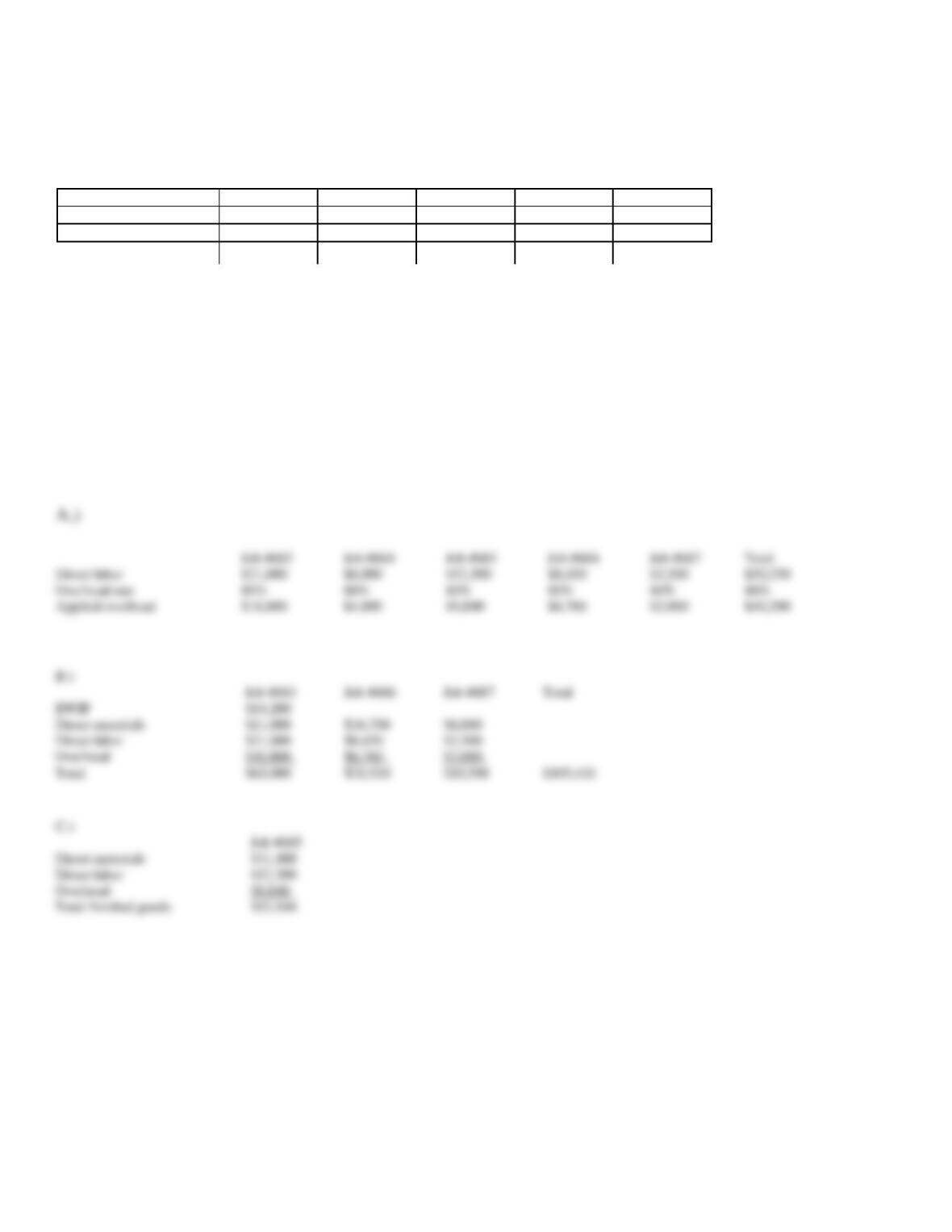
169. Figure 5-14
Deluxe Design Company makes custom furniture. On December 1, there were two jobs in process, Job 683,
with a cost of $14,200 and Job 684 with a cost of $23,500. Jobs 685, 686, and 687 were started during the
month of December. Data on costs added during the month are as follows:
Job #683
Job #684
Job #685
Job #686
Job #687
Direct materials
$11,000
$8,000
$31,400
$16,700
$6,000
Direct labor
$21,000
$6,000
$12,300
$8,450
$2,500
Overhead is applied to production at the rate of 80% of direct labor cost. Job 685 was completed on December 17. Job 684 was completed on
December 21 and the client was billed at cost plus 45%. All other jobs remained in process.
Refer to Figure 5-14.
Required:
A.) Determine the amount of overhead to apply to each job for the period.
B.) Calculate the cost of work-in-process at the end of the month.
C.) Calculate the cost of finished goods, assuming that finished goods inventory on December 1st was zero.
Job #683
Job #684
Job #685
Job #686
Job #687
Total
Direct labor
$21,000
$6,000
$12,300
$8,450
$2,500
$50,250
Overhead rate
80%
80%
80%
80%
80%
80%
Applied overhead
$16,800
$4,800
$9,840
$6,760
$2,000
$40,200
Job #683
Job #686
Job #687
Total
BWIP
$14,200
Direct materials
$11,000
$16,700
$6,000
Direct labor
$21,000
$8,450
$2,500
Overhead
$16,800
$6,760
$2,000
Total
$63,000
$31,910
$10,500
$105,410
Job #685
Direct materials
$31,400
Direct labor
$12,300
Overhead
$9,840
Total finished goods
$53,540
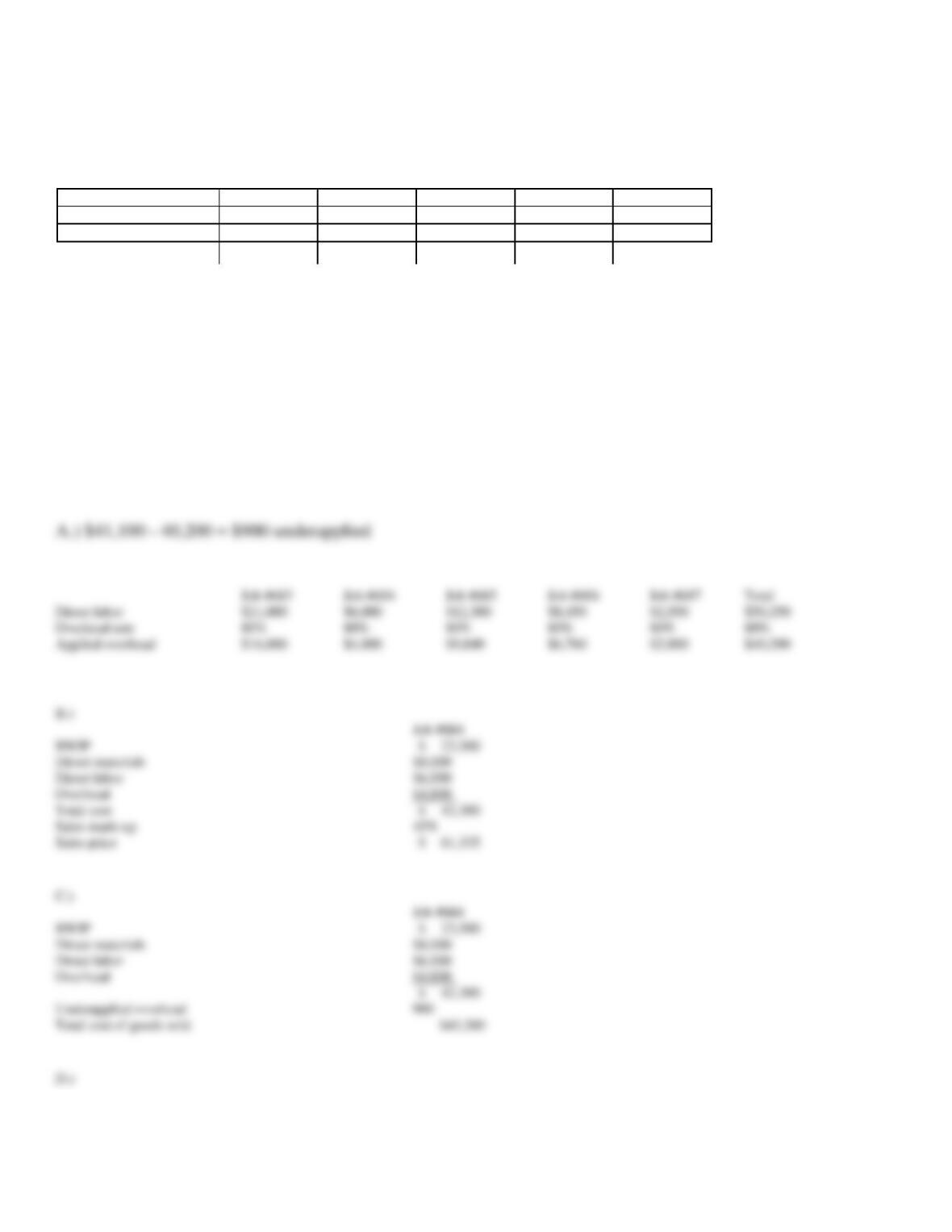
170. Figure 5-14
Deluxe Design Company makes custom furniture. On December 1, there were two jobs in process, Job 683,
with a cost of $14,200 and Job 684 with a cost of $23,500. Jobs 685, 686, and 687 were started during the
month of December. Data on costs added during the month are as follows:
Job #683
Job #684
Job #685
Job #686
Job #687
Direct materials
$11,000
$8,000
$31,400
$16,700
$6,000
Direct labor
$21,000
$6,000
$12,300
$8,450
$2,500
Overhead is applied to production at the rate of 80% of direct labor cost. Job 685 was completed on December 17. Job 684 was completed on
December 21 and the client was billed at cost plus 45%. All other jobs remained in process.
Refer to Figure 5-14
Required:
A.) The actual overhead for December was $41,100, calculate the variance.
B.) Calculate the sales price for Job #684.
C.) Calculate the adjusted cost of goods sold for the month of December.
D.) If selling and administrative expenses for the month totaled $5,600, what is the company’s operating income for December?
Job #683
Job #684
Job #685
Job #686
Job #687
Total
Direct labor
$21,000
$6,000
$12,300
$8,450
$2,500
$50,250
Overhead rate
80%
80%
80%
80%
80%
80%
Applied overhead
$16,800
$4,800
$9,840
$6,760
$2,000
$40,200
Job #684
BWIP
$ 23,500
Direct materials
$8,000
Direct labor
$6,000
Overhead
$4,800
Total cost
$ 42,300
Sales mark-up
45%
Sales price
$ 61,335
Job #684
BWIP
$ 23,500
Direct materials
$8,000
Direct labor
$6,000
Overhead
$4,800
$ 42,300
Underapplied overhead
Total cost of goods sold
$43,200
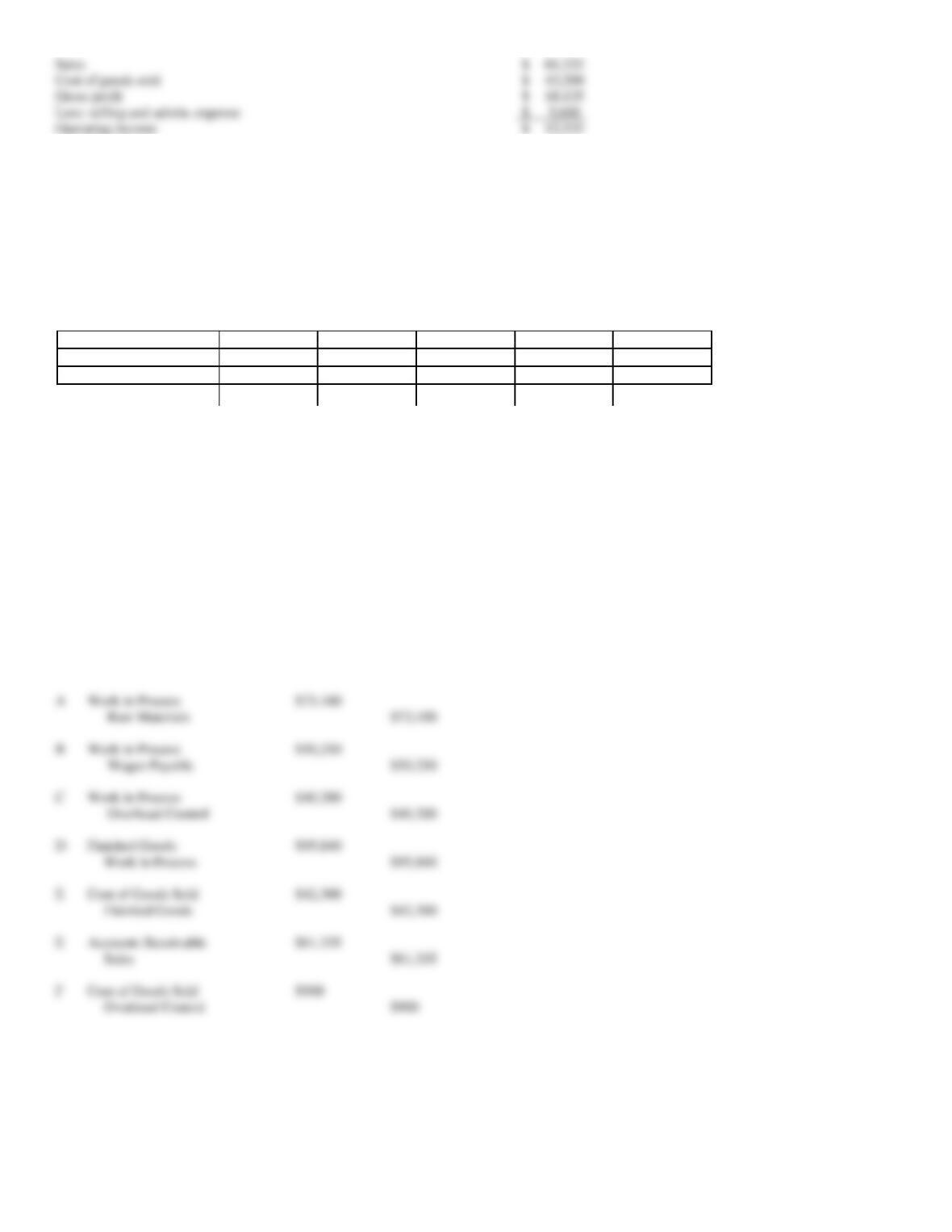
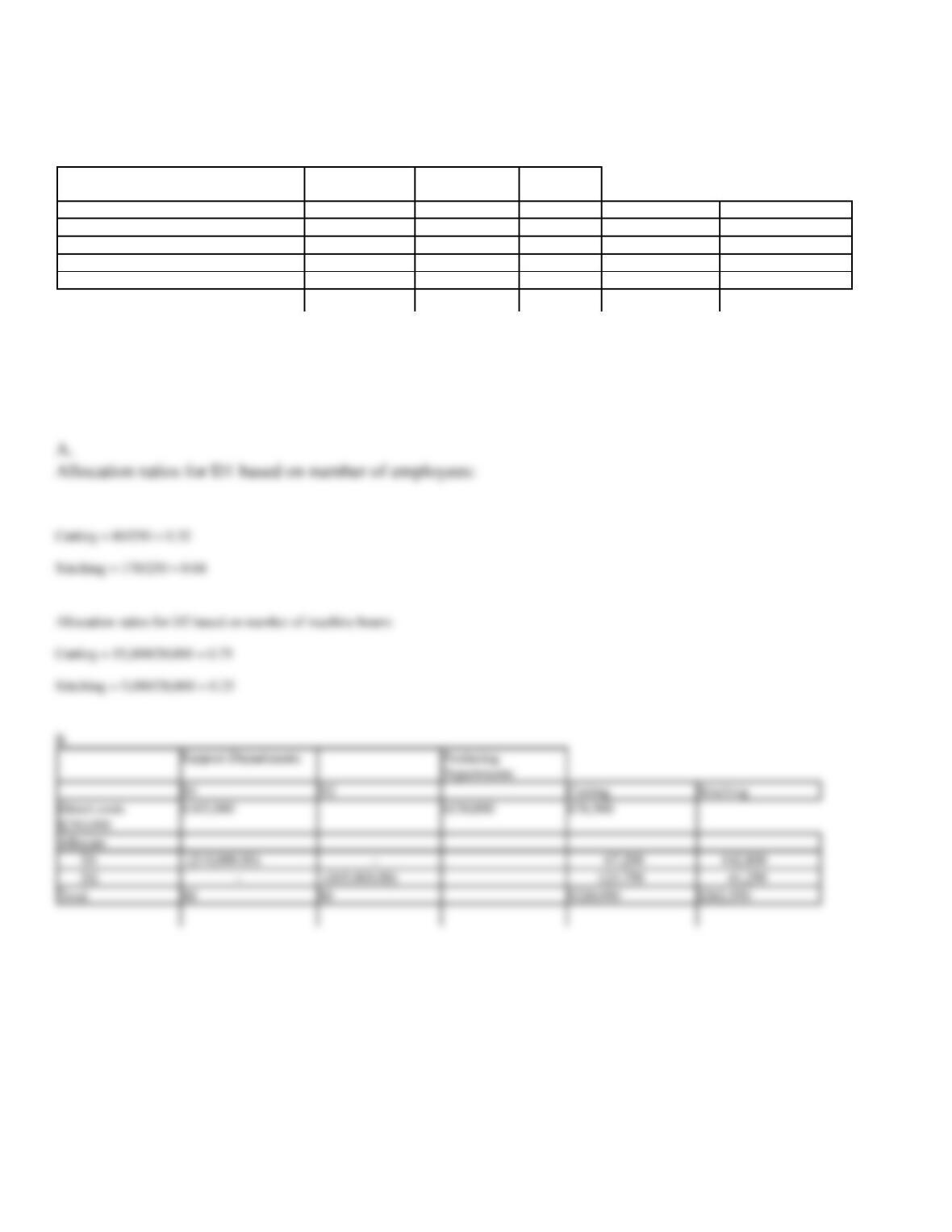
171. Figure 5-14
Deluxe Design Company makes custom furniture. On December 1, there were two jobs in process, Job 683,
with a cost of $14,200 and Job 684 with a cost of $23,500. Jobs 685, 686, and 687 were started during the
month of December. Data on costs added during the month are as follows:
Job #683
Job #684
Job #685
Job #686
Job #687
Direct materials
$11,000
$8,000
$31,400
$16,700
$6,000
Direct labor
$21,000
$6,000
$12,300
$8,450
$2,500
Overhead is applied to production at the rate of 80% of direct labor cost. Job 685 was completed on December 17. Job 684 was completed on
December 21 and the client was billed at cost plus 45%. All other jobs remained in process.
Refer to Figure 5-14.
Prepare the journal entries to record the following:
A.) Requisitioning of raw materials
B.) Direct labor costs
C.) Applied overhead
D.) Transfer to finished goods
E.) Sale of finished goods (assume sale was made on account)
F.) Closing underapplied/overapplied variance (all variances are immaterial)
A
Work in Process
$73,100
Raw Materials
$73,100
B
Work in Process
$50,250
Wages Payable
$50,250
Overhead Control
$40,200
D
Finished Goods
$95,840
E
Cost of Goods Sold
$42,300
Finished Goods
$42,300
E
Accounts Receivable
$61,335
Sales
$61,335
Overhead Control
$900
Sales
$ 61,335
Cost of goods sold
$ 43,200
Less: selling and admin. expense
$ 5,600
Operating income
$ 12,535
172. Bower Company manufactures a product in a factory that has two producing departments, Cutting and
Stitching, and two support departments, D1 and D2. The activity driver for D1 is number of employees, and
the activity driver for D2 is number of machine hours. The following data pertain to Bower:
Support
Departments
Producing
Departments
D1
D2
Cutting
Stitching
Direct costs
$210,000
$165,000
$130,000
$78,500
Normal activity:
Number of employees
–
40
80
170
Machine hours
800
–
15,000
5,000
Required:
A. Calculate the cost assignment ratios to be used under the direct method for departments D1 and D2.
B. Allocate the support department costs to the producing departments by using the direct method.
Cutting = 80/250 = 0.32
Stitching = 170/250 = 0.68
Cutting = 15,000/20,000 = 0.75
Stitching = 5,000/20,000 = 0.25
D1
D2
Cutting
Stitching
Direct costs
$165,000
$130,000
$78,500
Allocate
D1
(210,000.00)
–
67,200
142,800
D2
–
(165,000.00)
123,750
41,250
Total
$0
$0
$320,950
$262,550
173. There are two major types of companies: those that use a job-order costing system and those that use
process-costing systems.
A.
Explain the differences between the two types of companies.
B.
List 3 examples of each type of company.
174. Consider two costing systems, normal costing and actual costing.
A.
Which costing system do most firms use to assign costs to units of product or service? What does this costing system include?
B.
What is the other costing system? What does this costing system include?
B.
The other costing system is the actual costing system. It includes actual direct materials, actual direct labor, and actual overhead.
175. You Decide