
Exam
Name___________________________________
MULTIPLE CHOICE. Choose the one alternative that best completes the statement or answers the question.
1)
Which galaxy, as observed, has aged the most since it was born?
1)
A)
a very distant galaxy
B)
a nearby galaxy
C)
The distance of a galaxy doesn’t matter.
2)
Which of the following is not one of the three major categories of galaxies?
2)
A)
globular galaxies
B)
spiral galaxies
C)
elliptical galaxies
D)
irregular galaxies
A
3)
Which of the following features is not a feature of central dominant galaxies?
3)
A)
They often have multiple galactic nuclei near their centers.
B)
They’re found in clusters of galaxies.
C)
They are thought to form by the merger of several smaller galaxies.
D)
They are often spiral galaxies.
D
4)
What makes white–dwarf supernovae very good standard candles for distance measurements?
4)
A)
They are very bright, so they can be used to determine the distances to galaxies billions of
light–years away.
B)
They should all have approximately the same luminosity.
C)
We have had several occur close to us in the Milky Way, so we have been able to determine
their luminosities very accurately.
D)
They occur so frequently that we can use them to measure the distances to virtually all
galaxies.
E)
both A and B
E
B

5)
Hubble’s “constant” is constant in
5)
A)
space.
B)
time.
C)
space and time.
D)
our Galaxy, but it is different in others.
6)
According to the theory that active galactic nuclei are powered by supermassive black holes, the
high luminosity of an active galactic nucleus primarily consists of ________.
6)
A)
intense radiation emitted by the black hole itself
B)
light emitted by hot gas in an accretion disk that swirls around the black hole
C)
the combined light of thousands of young, high–mass stars that orbit the black hole
D)
radio waves emitted from radio lobes found on either side of the galaxy we see in visible light
7)
What is main–sequence fitting?
7)
A)
a method for determining the distance to a star cluster by assuming that its main sequence
should line up with the main sequence on a standard H–R diagram
B)
a method for determining the age of a star cluster
C)
the way we construct an H–R diagram by plotting the surface temperatures and luminosities
of stars
D)
a way of forcing stars to fit into a standard main sequence, even when they have some
unusual characteristics
8)
The unusually bright centers found in some galaxies are called ________.
8)
A)
starbursts
B)
active galactic nuclei
C)
supermassive black holes
D)
halos

9)
We can study how galaxies evolve because ________.
9)
A)
galaxies are transparent to visible light
B)
we are really smart astronomers
C)
we can watch as they interact in real time
D)
the farther away we look, the further back in time we see
10)
Most active galactic nuclei are found at large distances from us, with relatively few nearby. What
does this imply?
10)
A)
The jets seen in many active galactic nuclei must cause them to move far away from us.
B)
Active galactic nuclei tend to become less active as they age.
C)
Active galactic nuclei can form only at large distances from the Milky Way.
D)
Supermassive black holes existed only when the universe was young, and no longer exist
today.
11)
How is the energy that powers radio galaxies, quasars, and other active galactic nuclei produced?
11)
A)
by nuclear fusion near a central black hole
B)
by matter that has been converted to pure energy by interacting with the jets shot out by a
central black hole
C)
by magnetic fields that trap and accelerate charged particles, which then radiate large
amounts of energy
D)
by matter–antimatter annihilation near a central black hole
E)
by gravity, which converts the potential energy of matter falling toward a central black hole
into kinetic energy, which is then converted to thermal energy by collisions among the
particles of matter

12)
Which characteristic is not generally true of a starburst galaxy?
12)
A)
The observed features of the starburst are thought to be caused by the presence of a
supermassive black hole in the galaxy’s center.
B)
The observed features that cause us to classify it as a “starburst” must be only temporary
phenomena in the galaxy’s history.
C)
Supernovae occur so frequently that their effects combine to drive a galactic wind that blows
material into intergalactic space.
D)
Its rate of star formation is many times higher than the rate of star formation in the Milky
Way.
13)
Which of the following statements is not an assumption used in models of galaxy formation?
13)
A)
Gas contracted to form the disks of galaxies before any stars were born.
B)
The universe is expanding.
C)
The universe started out filled almost uniformly with hydrogen and helium.
D)
Some regions in the universe were slightly more dense than others.
A
14)
Does Hubble’s law work well for galaxies in the Local Group? Why or why not?
14)
A)
No, because galaxies in the Local Group are gravitationally bound together.
B)
Yes, it works so well that we have never detected any measurable deviations from its
predictions.
C)
No, because Hubble did not know the Local Group existed when he discovered his law.
D)
No, because we do not know the precise value of Hubble’s constant.
A
15)
Which of the following types of protogalactic clouds is most likely to form an elliptical galaxy?
15)
A)
a dense cloud with quite a bit of angular momentum
B)
a dense cloud with very little angular momentum
C)
a low–density cloud with quite a bit of angular momentum
D)
a very low–density cloud with very little angular momentum
E)
a very massive cloud with any density and a lot of angular momentum
B
A

16)
Which of the following cannot be true of the very first stars formed in the universe?
16)
A)
Some may have formed in large clusters.
B)
Some may have had rocky planets around them.
C)
Some may still exist in the Milky Way today.
D)
Some may have all exploded as supernovae by now.
E)
Some may have formed singly, in isolation from one another.
17)
If an object doubles its luminosity in 10 hours, how large can the emitting source of light be?
17)
A)
about 10 light–years across
B)
about 10 light–hours across
C)
about 10 parsecs across
D)
varies depending on how luminous the object is
E)
varies depending on how far away the object is
18)
Using the technique of main–sequence fitting to determine the distance to a star cluster requires that
________.
18)
A)
we use ultraviolet and X–ray telescopes
B)
we have a well–calibrated period–luminosity relation for Cepheid variable stars
C)
we have telescopes powerful enough to allow us to identify the spectral types of
main–sequence stars of many masses in the cluster
D)
the cluster be near enough for us to measure the parallax of its stars

19)
All of the following observations are real. Which one does not support the theory that active
galactic nuclei are powered by accretion disks around massive black holes?
19)
A)
Spectra of active galactic nuclei show that clouds of gas are orbiting a central object at very
high speed.
B)
The most luminous active galactic nuclei have huge redshifts.
C)
X–ray emission from active galactic nuclei can vary significantly in times as short as a few
days.
D)
The total luminosity of an active galactic nucleus can be as high as about 10 billion times that
of the Sun.
20)
When we use an analogy that represents the expanding universe with the surface of an expanding
balloon, what does the inside of the balloon represent?
20)
A)
the entire universe
B)
the center of the universe
C)
regions of the universe beyond the Milky Way Galaxy
D)
The inside of the balloon does not represent any part of our universe.
21)
How do astronomers use the Hubble Constant (H0) to estimate the age of the universe?
21)
A)
The age of the universe is about 600 million times H0.
B)
The inverse of H0 is the approximate age of the universe.
C)
They do not. The age of the universe is unknowable.
22)
What two quantities did Edwin Hubble compare for a sample of galaxies to discover the expansion
of the universe?
22)
A)
velocity and temperature
B)
velocity and distance
C)
age and distance
D)
luminosity and temperature
E)
luminosity and distance

23)
Which of the following is not a strong argument for the theory that some large elliptical galaxies
formed as the result of galaxy collisions?
23)
A)
Some ellipticals have stars and gas that rotate opposite to the rest of the galaxy.
B)
Elliptical galaxies dominate the population in dense galaxy clusters.
C)
Computer simulations predict that the product of a galaxy collision is generally an elliptical
galaxy.
D)
Galaxy collisions are common and most galaxies in the universe are elliptical.
E)
Some elliptical galaxies are surrounded by shells of stars.
24)
Why should galaxy collisions have been more common in the past than they are today?
24)
A)
Galaxies were closer together in the past because the universe was smaller.
B)
Galaxies were more active in the past and therefore would have collided with each other
more frequently.
C)
Galaxy collisions shouldn’t have been more common in the past than they are now.
D)
Galaxies were much bigger in the past because they had not contracted completely.
E)
Galaxies attracted each other more strongly in the past because they were more massive; they
had not yet turned most of their mass into stars and light.
25)
Why are collisions between galaxies more likely than collisions between stars within a galaxy?
25)
A)
Galaxies travel through space much faster than stars.
B)
Relative to their sizes, galaxies are closer together than stars.
C)
Galaxies are much larger than stars.
D)
Galaxies have higher redshifts than stars.

26)
I observe a galaxy that is 100 million light years away. Which of the following do I see?
26)
A)
the light from the galaxy as it is today, and it is blueshifted
B)
the light from the galaxy as it is today, and it is redshifted
C)
the light from the galaxy as it was 100 million years ago, and it is redshifted
D)
the light from the galaxy as it was 100 million years ago, and it is blueshifted
E)
Nothing: the galaxy lies beyond the cosmological horizon.
27)
Why are Cepheid variables important?
27)
A)
Cepheids variables are a type of irregular galaxy, much more common in the early universe.
Therefore they help to understand how galaxies formed.
B)
Cepheids variables are supermassive stars that are on the verge of becoming supernovae.
Therefore they allow us to choose candidates to watch if we hope to observe a supernova.
C)
Cepheid variables are stars that vary in brightness because they harbor a black hole.
Therefore, they provide direct evidence for black holes.
D)
Cepheids variables are pulsating stars whose pulsation periods are directly related to their
true luminosities. Therefore they can be used as distance indicators.
28)
How do observations of galaxies at different distances help us learn about galaxy evolution?
28)
A)
Observations of the most distant galaxies will allow us to observe the birth of galaxies.
B)
We can observe the evolution of a single galaxy over time.
C)
We can see what our galaxy used to look like over time, helping us theorize about the
physical processes that led to its current appearance.
D)
Observations of different distances show galaxies of different ages and therefore different
stages of evolution.
E)
We can observe galaxies at different distances merge, helping us learn how mergers affect
evolution.
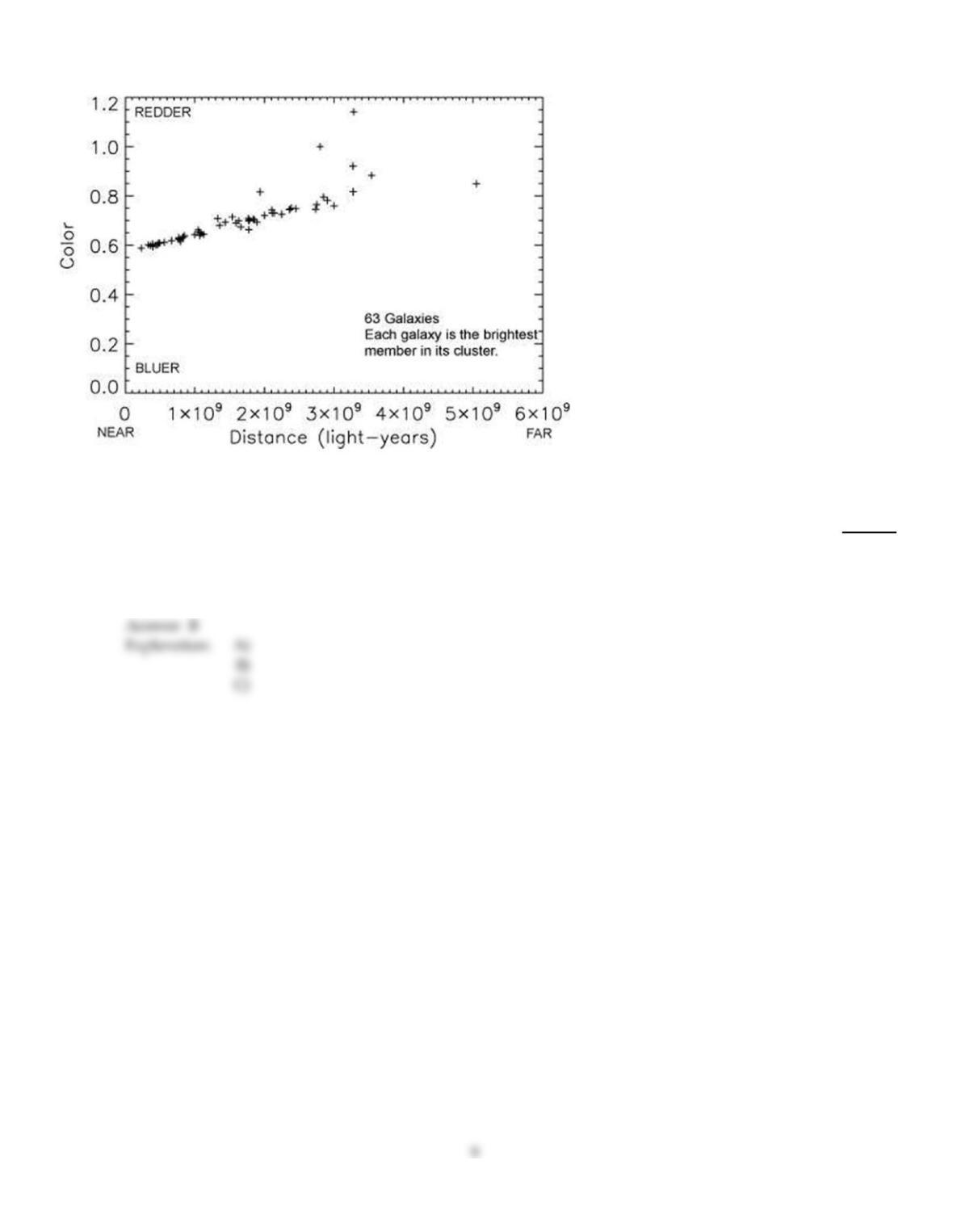
Adapted from a subset of galaxy data presented in O’Dea, C. P. et al. 2008, ApJ, 681, 1035 for pedagogical purposes only.
29)
Use the graph above showing data for the brightest galaxies in clusters of galaxies to answer the
following questions. Which statement describes this graph?
29)
A)
There is no trend because there are some exceptions.
B)
The more distant the galaxy, the redder it is, but there are some exceptions.
C)
The more distant the galaxy, the bluer it is, but there are some exceptions.
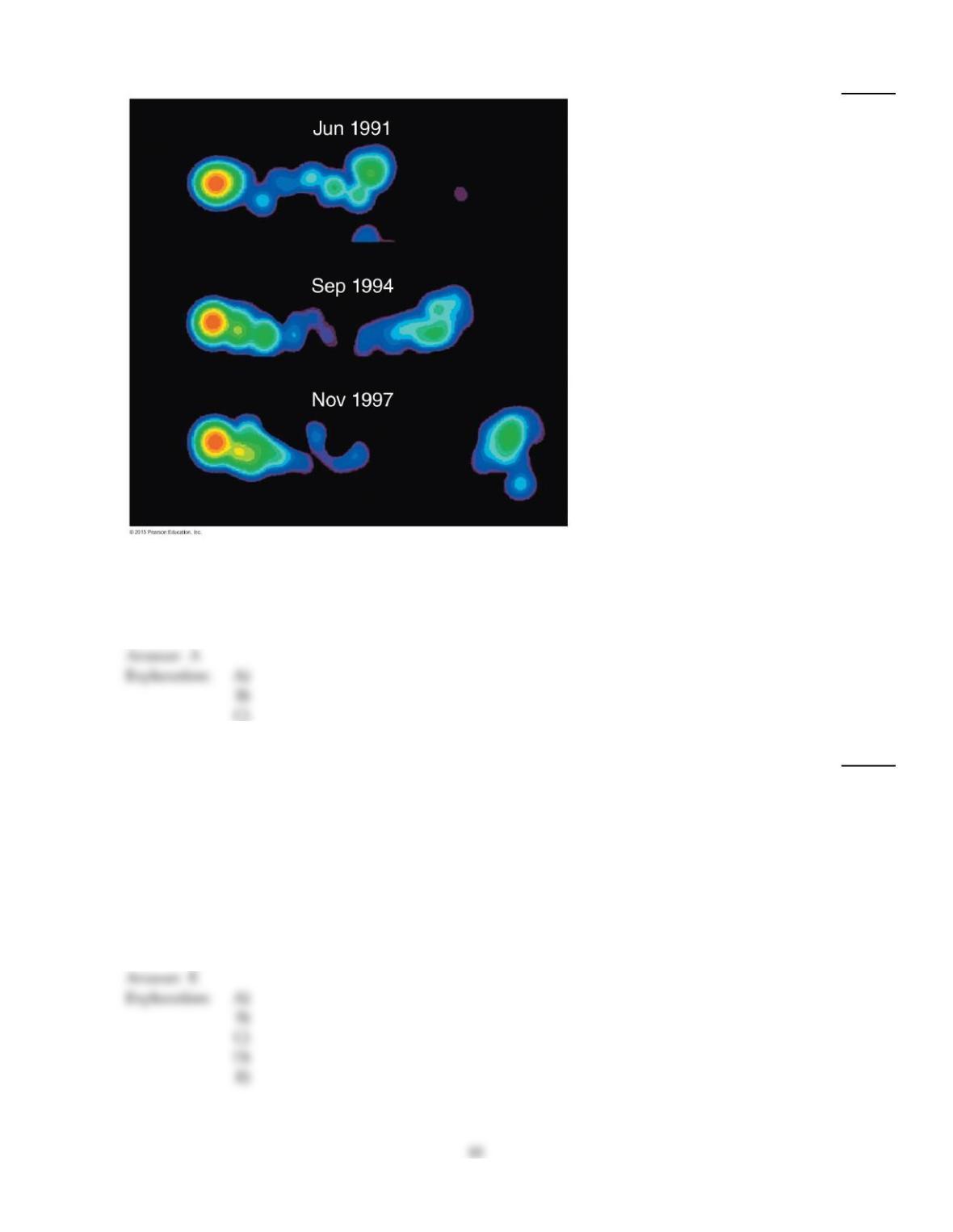
30)
What can be inferred about the distance traveled by the blob of plasma shown moving in this figure
at almost the speed of light?
30)
A)
It moved several light years between 1991 and 1997.
B)
It could only have moved a small fraction of a light year between 1991 and 1997.
C)
There is not enough information to tell anything about the distance traveled by the plasma.
31)
What evidence supports the idea that a collision between two spiral galaxies might lead to the
formation of a single elliptical galaxy?
31)
A)
the fact that elliptical galaxies dominate the galaxy populations at the cores of dense clusters
of galaxies
B)
observations of giant elliptical galaxies at the center of dense clusters that may have grown by
consuming other galaxies
C)
observations of some elliptical galaxies with stars and gas clouds in their cores that orbit
differently from the other stars in the galaxy
D)
observations of some elliptical galaxies surrounded by shells of stars that probably formed
from stars stripped out of smaller galaxies
E)
all of the above

32)
What is a standard candle?
32)
A)
a class of objects that we know all have exactly the same luminosity
B)
a unit of luminosity used by astronomers
C)
an object for which we can easily measure its apparent brightness
D)
any star for which we know its exact apparent brightness
E)
an object for which we are likely to know its true luminosity
33)
Which of the following is evidence for supermassive black holes in active galaxies?
33)
A)
quasars emitting approximately equal power at all wavelengths from infrared to gamma rays
B)
rapid changes in the luminosity of the galaxy nucleus
C)
the discovery of powerful jets coming from a compact core
D)
the very high speeds of gas orbiting around the galactic nucleus
E)
all of the above
34)
Which of the following types of galaxies appear reddest in color?
34)
A)
irregulars
B)
spirals
C)
lenticulars
D)
ellipticals
35)
Where are the X–rays produced that are emitted by quasars and other active galactic nuclei?
35)
A)
in the hot gas in an accretion disk around a central black hole
B)
in fast–moving jets of electrons that are ejected from the active galactic nucleus
C)
in an ionization nebulae of interstellar gas surrounding the accretion disk
D)
in dust grains in molecular clouds that encircle the active galactic nucleus
E)
all of the above

36)
What is the most accurate way to determine the distance to a nearby galaxy?
36)
A)
Hubble’s law
B)
radar ranging
C)
Cepheid variables
D)
main sequence fitting
E)
stellar parallax
37)
Compared to spiral galaxies, elliptical galaxies are
37)
A)
redder and rounder.
B)
redder and flattened.
C)
always much smaller.
D)
bluer and rounder.
E)
bluer and flattened.
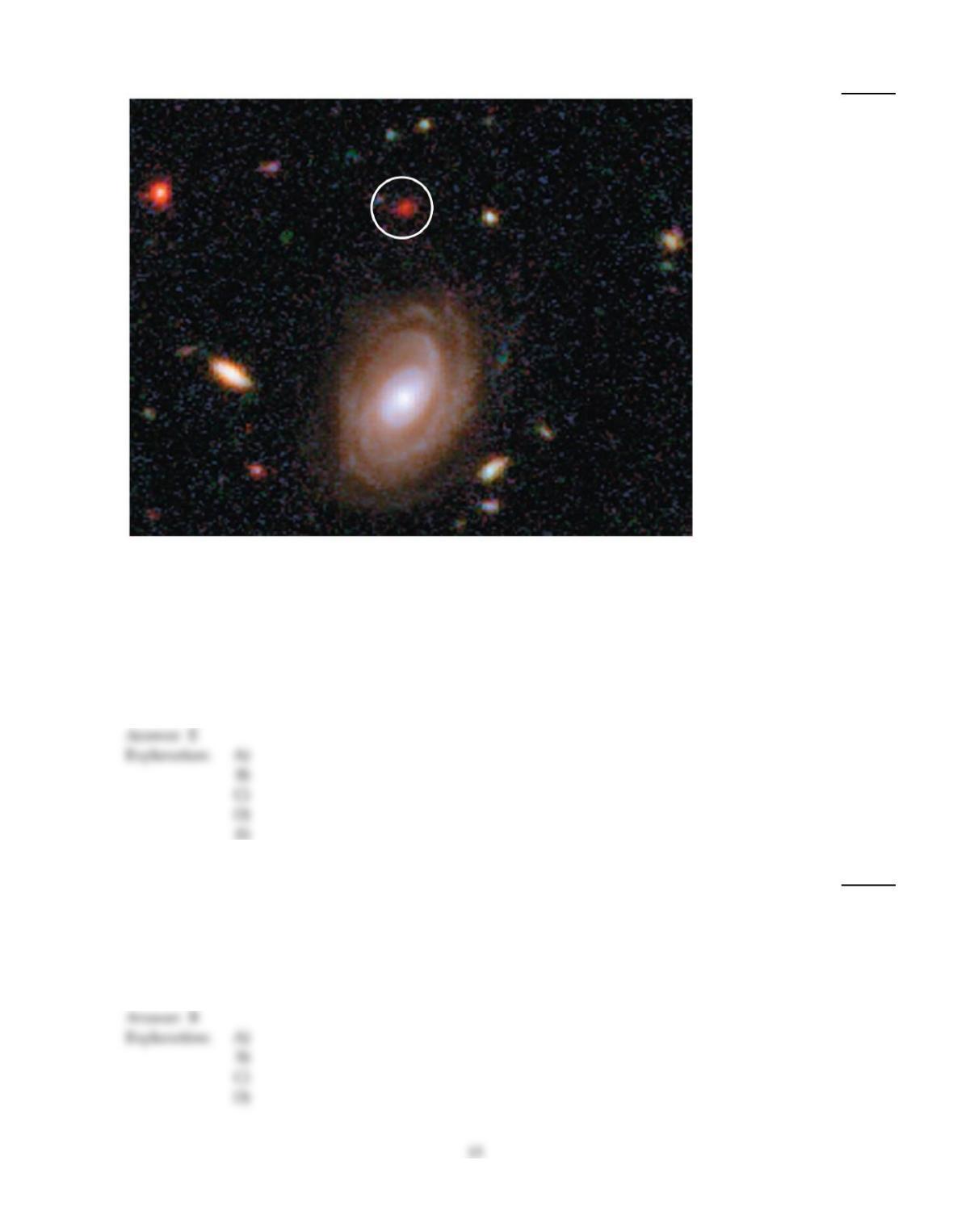
38)
In this picture, we are seeing light from the circled elliptical galaxy (HUDF–JD2) from when the
universe was only about 800 million years old. The spiral galaxy below it is much closer. Why does
HUDF–JD2 appear a deep red, compared to the whitish color of the nearby spiral?
38)
A)
Thick dust from active star formation blocks all the blue light, only letting red light escape.
B)
Even at this young age, the galaxy contains few high mass blue stars.
C)
At such a large distance, all the light emitted by it is very redshifted.
D)
A and B
E)
B and C
39)
In a photo like the Hubble Deep Field (Figure 16.1 in your textbook), we see galaxies in many
different stages of their lives. In general, which galaxies are seen in the earliest (youngest) stages of
their lives?
39)
A)
the galaxies that are the reddest in color
B)
the galaxies that are farthest away
C)
the galaxies that have the most hot, young O and B stars
D)
the galaxies that are nearest to us

40)
In 1924, Edwin Hubble proved that the Andromeda Galaxy lay far beyond the bounds of the Milky
Way, thus putting to rest the idea that it might have been a cloud within our own galaxy. How was
he able to prove this?
40)
A)
He was the first person ever to look through a telescope at the object we now call the
Andromeda Galaxy.
B)
He found that the universe is expanding, and therefore concluded that Andromeda must lie
outside our own galaxy.
C)
He was able to measure the parallax of the Andromeda Galaxy.
D)
By observing individual Cepheid variable stars in Andromeda and applying the
period–luminosity relation
41)
Suppose we observe a source of X–rays that varies substantially in brightness over a period of a
few days. What can we conclude?
41)
A)
The X–ray source must have a strong, rapidly varying magnetic field.
B)
The X–ray source can be no more than a few light–days in diameter.
C)
We must be seeing the rapid orbit of two stars in a binary system.
D)
The X–ray source must be a quasar.
E)
The X–ray source must contain a black hole with an accretion disk.
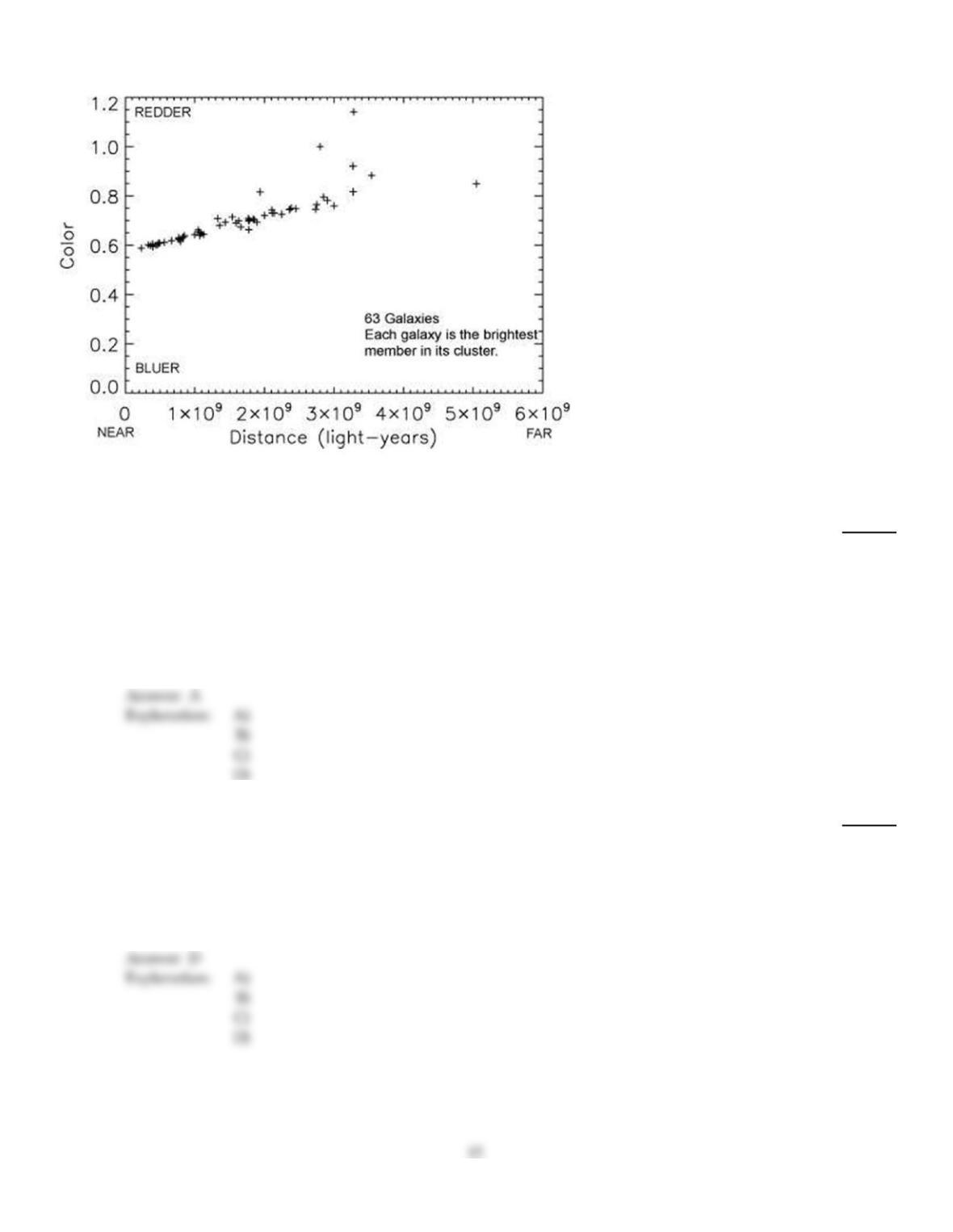
Adapted from a subset of galaxy data presented in O’Dea, C. P. et al. 2008, ApJ, 681, 1035 for pedagogical purposes only.
42)
Use the graph above showing data for the brightest galaxies in clusters of galaxies to answer the
following question. You find a cluster of galaxies, but you do not know how far away it is. The
brightest galaxy’s infrared color is 0.65. Given the data for brightest galaxies in the graph above,
your best estimate for the distance is
42)
A)
1 × 10⁹ (1 billion) light years.
B)
4 × 10⁹(4 billion) light years.
C)
2.5 × 10⁹ (2.5 billion) light years.
D)
It is impossible to say since there are exceptions.
43)
What is the best way to determine a galaxy’s redshift?
43)
A)
Find the color of the galaxy, and estimate its distance based on how red the galaxy is.
B)
Find the galaxy’s apparent distance, and look up the redshift based on Hubble’s Law.
C)
Measure the magnitude of the galaxy, estimate its distance, and calculate its redshift using
Hubble’s Law.
D)
Take a spectrum of the galaxy, and measure the difference in wavelength of spectral lines
from the wavelengths of those same lines as measured in the laboratory.

44)
How does a lenticular galaxy differ from a normal spiral galaxy?
44)
A)
It is flatter in shape.
B)
It has no spiral arms.
C)
It has an elongated bulge resembling a bar more than a sphere.
D)
It has no gas or dust.
E)
It has no bulge.
45)
What does Hubble’s law tell us?
45)
A)
The longer the period of a Cepheid variable, the greater its luminosity.
B)
For every force, there is an equal and opposite reaction force.
C)
The more distant a galaxy, the faster it is moving away from us.
D)
The faster a spiral galaxy’s rotation speed, the more luminous it is.
C
46)
What is a Cepheid variable?
46)
A)
a bright source of variable X–ray emission, thought to harbor a supermassive black hole
B)
a type of galaxy that varies in its light output
C)
a main–sequence star of spectral type B5
D)
a type of very luminous star that makes an excellent standard candle
D
47)
Dr. X believes that the Hubble constant is H0 = 20 km/s/Mly while Dr. Y believes it is H0 = 24
km/s/Mly. Which statement below automatically follows?
47)
A)
Dr. X believes that the universe is expanding, but Dr. Y does not.
B)
Dr. X believes that the universe has a much higher density than Dr. Y believes.
C)
Dr. X believes that the universe is older than Dr. Y believes.
D)
Dr. X believes that the Andromeda Galaxy (a member of our Local Group) is moving away
from us at a slower speed than Dr. Y believes.
E)
Dr. X believes that the universe will someday stop expanding, while Dr. Y believes it will
expand forever.
C
B

48)
Which of the following is not true of quasars?
48)
A)
Quasars were more common in the past.
B)
The light produced by quasars comes from an accretion disk surrounding a supermassive
black hole.
C)
Some quasars are more than a thousand times more luminous than the Milky Way.
D)
Some quasars can change their brightness on the timescale of hours.
E)
Quasars are powered by the intense production of large numbers of stars that can only be
sustained for a relatively short time.
49)
Why can’t we see past the cosmological horizon?
49)
A)
We do not have big enough telescopes.
B)
Every galaxy in the entire universe (not just the observable universe) exists within the
cosmological horizon, so there’s nothing to see beyond it.
C)
The cosmological horizon is infinitely far away, and we can’t see to infinity.
D)
Beyond the cosmological horizon, we would be looking back to a time before the universe
was born.
50)
What evidence tells us that quasars are the centers of distant galaxies?
50)
A)
Quasars are extremely luminous.
B)
Rapid variations in quasar luminosity tell us that they must be quite small in size.
C)
Images and spectra show quasars to be embedded at the centers of distant galaxies.
D)
All quasars have large redshifts.
51)
What is the most accurate way to determine the distance to a nearby star?
51)
A)
Cepheid variables
B)
stellar parallax
C)
Hubble’s law
D)
radar ranging
E)
main–sequence fitting
52)
Why is the Hyades Cluster important for building up a catalog of the true luminosities of
main–sequence stars?
52)
A)
It is an extremely bright star cluster.
B)
It is close enough to us that the distance to its stars can be found by stellar parallax.
C)
It’s a cluster that has been photographed over many decades, so we know how the stars vary
in brightness.
D)
It contains many Cepheid variable stars that can be used to determine its distance.
E)
It is an old globular cluster whose age we can determine very accurately by measuring its
main–sequence turn–off point.
53)
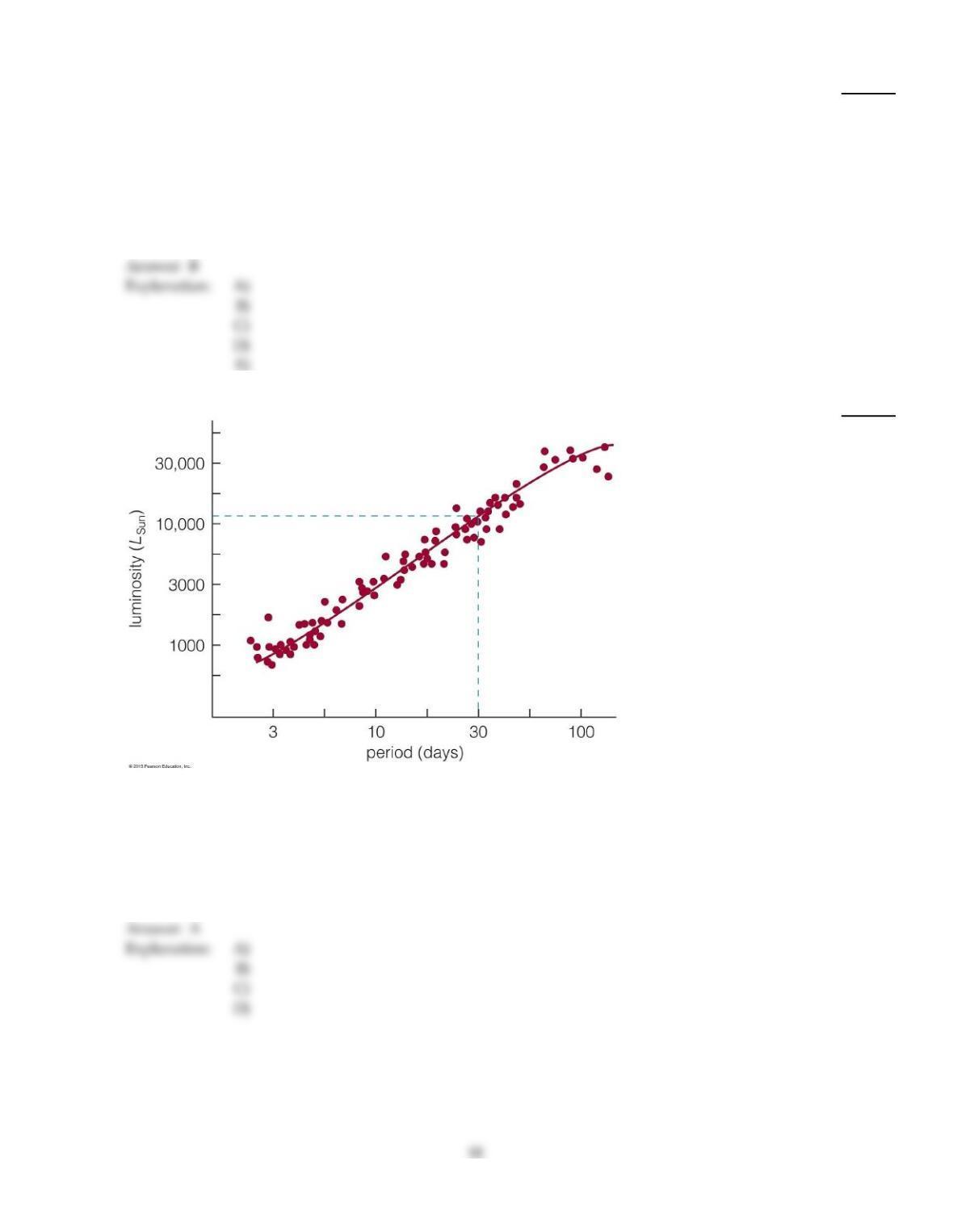
This figure shows the Cepheid period–luminosity relation. A Cepheid star with a period of 30 days
has the same apparent brightness as a nearby G2 star. How many times further away is the Cepheid
star?
53)
A)
The Cepheid star is 100 times further away than the nearby G2 star.
B)
The Cepheid star is 10,000 times further away than the nearby G2 star.
C)
The Cepheid star is 10 times further away than the nearby G2 star.
D)
The Cepheid star is actually a factor of 10 times closer than the nearby G2 star.

54)
Why do elliptical galaxies appear yellow or red?
54)
A)
They contain no hot, young blue stars
B)
They contain only massive–stars that have progressed to the red–giant stage
C)
They have very little dust or cool gas, and thus have little ongoing star formation
D)
A and B
E)
A and C
55)
A star that is known to be 10,000 times brighter than the sun has the same apparent brightness as a
nearby G2 star. How many times further away is the bright star?
55)
A)
The bright star is 10,000 times further away than the nearby G2 star.
B)
The bright star is 100 times further away than the nearby G2 star.
C)
The bright star is 10 times further away than the nearby G2 star.
D)
The bright star is actually a factor of 10 times closer than the nearby G2 star.
56)
Which of the following is not a piece of evidence supporting the conclusion that active galactic
nuclei are powered by accretion disks around massive black holes?
56)
A)
Radio observations sometimes show long jets of material that can extend millions of
light–years out from the galactic center.
B)
The total amount of radiation coming from the galactic center can, in some cases, exceed 100
times the total luminosity of the Milky Way Galaxy.
C)
Infrared observations show that many stars are forming near the centers of active galaxies.
D)
Spectral lines from the galactic center indicate that clouds of gas are orbiting a central object at
very high speed.
E)
Observed radiation from the galactic center can vary significantly in brightness in times as
short as a few days.
57)
Most large galaxies in the universe are
57)
A)
spiral or lenticular.
B)
abnormal.
C)
elliptical.
D)
irregular.

58)
Which of the following phenomena is probably not related to the presence of a supermassive black
hole?
58)
A)
the presence of globular clusters in the halos of galaxies
B)
the huge jets seen emerging from the centers of some galaxies
C)
the radio emission from radio galaxies
D)
quasars
59)
Which of these statements about Hubble’s classification scheme for galaxies is false?
59)
A)
It represents an evolutionary sequence for galaxies (e.g., type SBa galaxies slowly turn into
type SBb).
B)
Low numbered elliptical galaxies are rounder than high numbered elliptical galaxies.
C)
It includes two broad types of spiral galaxies.
D)
Sc galaxies have smaller bulges and more dusty gas than Sa galaxies.
60)
Approximately how many stars does a dwarf elliptical galaxy have?
60)
A)
less than a billion
B)
1 trillion
C)
10 billion
D)
100 billion
E)
less than a million
61)
If we represent the Milky Way Galaxy as the size of a grapefruit, the distance to the Andromeda
Galaxy would be about
61)
A)
3 km.
B)
3 m.
C)
30 m.
D)
3 cm.
E)
300 km.

62)
How did Edwin Hubble measure the distance to the Andromeda Galaxy?
62)
A)
He measured its parallax.
B)
He applied main–sequence fitting to star clusters in Andromeda.
C)
He measured its redshift and applied Hubble’s Law.
D)
He applied the period–luminosity relation to Cepheid variables in Andromeda.
E)
He detected white dwarf supernovae in Andromeda.
63)
Which of the following gives the two main assumptions of theoretical models of galaxy evolution?
63)
A)
Hydrogen and helium filled all of space, and certain regions of the universe were slightly
denser than others.
B)
The universe was composed originally only of hydrogen, and all the other elements came
from stars.
C)
The beginning of the universe is modeled after a supernova explosion, and all elements were
produced by this exploding star.
D)
Hydrogen and helium filled all of space, and the entire universe had exactly the same density
everywhere.
E)
The universe has always been expanding, and denser areas contracted to form the first stars.
64)
Scale the Milky Way down to the size of a compact disc. Which of the following best describes the
size, shape, and distance of the Andromeda Galaxy on the same scale?
64)
A)
a compact disk about the length of a football field away
B)
a grapefruit about 1 kilometer away
C)
a compact disk a few meters away
D)
a grapefruit a few meters away
E)
a pecan nut about 1 centimeter away
65)
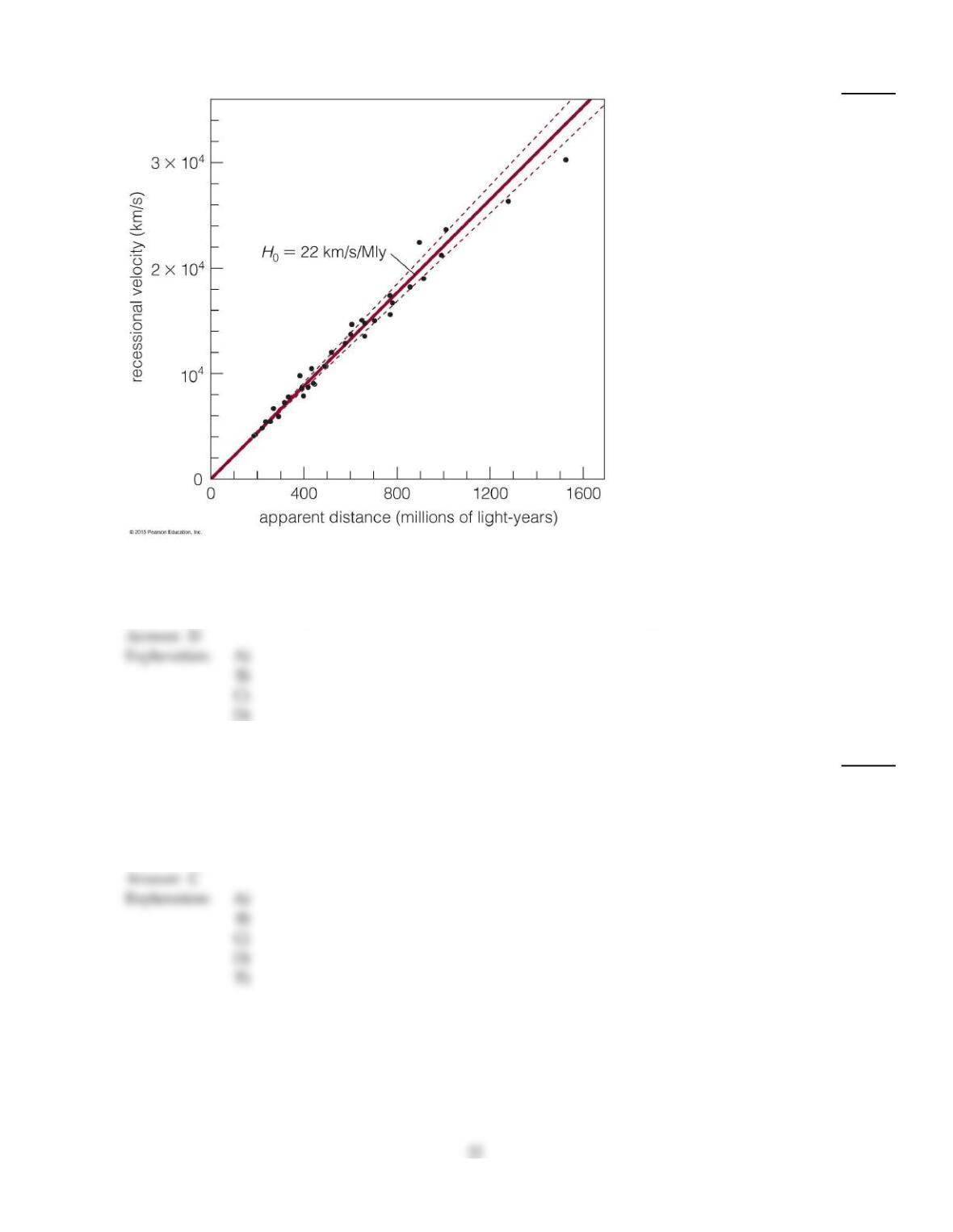
This figure shows Hubble’s law. If a galaxy is observed to be moving away from us at 30,000 km/s,
how far away is it?
65)
A)
about 900 million light–years
B)
about 30,000 light–years
C)
about 5000 million light–years
D)
about 1400 million light–years
66)
What is Hubble’s law?
66)
A)
The faster a spiral galaxy’s rotation speed, the more luminous it is.
B)
The recession velocity of a galaxy is inversely proportional to its distance.
C)
The recession velocity of a galaxy is directly proportional to its distance.
D)
The faster a spiral galaxy’s rotation speed, the less luminous it is.
E)
The luminosity of the Cepheid variable star is directly proportional to its pulsation period.

67)
In the 1960s, Maarten Schmidt determined that quasars were very distant objects by
67)
A)
determining how luminous they were.
B)
determining their redshifts.
C)
determining how small the source of light was from its luminosity variations.
D)
determining their parallax angles.
E)
discovering that they were embedded in distant galaxies.
68)
If we say that a galaxy has a lookback time of 1 billion years, we mean that ________.
68)
A)
it was 1 billion light–years away when the light left the galaxy
B)
it is now 1 billion light–years away
C)
its light traveled through space for 1 billion years to reach us
D)
it is 400 million years old
C
69)
Current understanding holds that a galaxy’s type (spiral, elliptical, or irregular) ________.
69)
A)
may either be a result of the mass of the protogalactic cloud that formed it or the result of the
heavy element abundance in that cloud
B)
is always determined by the angular momentum of the protogalactic cloud that formed it
C)
is determined by whether the galaxy is located in a cluster where collisions are likely or
outside a cluster where collisions are less likely
D)
may either be the result of conditions in the protogalactic cloud that formed it or the result of
later interactions with other galaxies
D
70)
Why can’t we see past the cosmological horizon?
70)
A)
The cosmological horizon is infinitely far away, and we can’t see to infinity.
B)
We do not have detectors sensitive enough.
C)
Beyond the cosmological horizon, we are looking back to a time before the universe had
formed.
D)
The universe extends only to this horizon.
E)
We do not have telescopes big enough.
C
B

71)
Based on current estimates of the value of Hubble’s constant, how old is the universe?
71)
A)
12 to 15 billion years old
B)
more than 20 billion years old
C)
8 to 12 billion years old
D)
4 to 8 billion years old
E)
15 to 20 billion years old
72)
Based on counting the number of galaxies in a small patch of the sky and multiplying by the
number of such patches needed to cover the entire sky, the total number of galaxies in the
observable universe is estimated to be approximately
72)
A)
100 billion.
B)
1 billion.
C)
1 trillion.
D)
10 billion.
E)
100 million.
A
73)
A standard candle is ________.
73)
A)
another name for a main–sequence star
B)
another name for a barred–spiral galaxy
C)
a light source of known luminosity
D)
a 7–cm–long wax candle
C
74)
Why is a dense cloud more likely to produce an elliptical galaxy than a spiral galaxy?
74)
A)
The thickness of the dense cloud prevents a disk from forming.
B)
The higher gas density forms stars more efficiently, so all the gas is converted into stars before
a disk can form.
C)
The more frequent collisions between particles randomize the particle orbits.
D)
The higher density of gas has a stronger force of gravity, and therefore the cloud collapses
more quickly.
E)
The force of gravity can pull the material into a more spherical shape.
B
A

75)
What is the most accurate way to determine the distance to a very distant galaxy?
75)
A)
Cepheid variables
B)
Stellar parallax
C)
Hubble’s law
D)
main–sequence fitting
E)
white dwarf supernova
76)
The observed relationship between the masses of central black holes and the bulge masses of
galaxies implies that ________.
76)
A)
the black hole will eventually suck in the rest of the galaxy
B)
the biggest galaxies have the most luminous quasars
C)
quasars were more common 10 billion years ago than they are today
D)
galaxy formation and supermassive black hole formation must be related somehow
77)
According to current understanding, what is a quasar?
77)
A)
a very large galaxy thought to be formed by the merger of several smaller galaxies, typically
found in the center of a galaxy cluster
B)
any object with an extremely large redshift
C)
a galaxy with an unusually high rate of star formation
D)
an active galactic nucleus that is particularly bright
78)
The mass of a supermassive black hole thought to power a typical bright active galactic nucleus is
roughly ________.
78)
A)
3 solar masses
B)
10 solar masses
C)
1 billion solar masses
D)
1 trillion solar masses

79)
Ming measures a recession velocity of 2000 km/sec for a galaxy. About how far away is that galaxy
if the Hubble constant is 20 km/sec/million light years? (Hint: be sure to check the units in your
calculation.)
79)
A)
100 light years
B)
100 million light years
C)
40 billion light years
D)
40 thousand light years
80)
Why should galaxy collisions have been more common in the past than they are today?
80)
A)
Galaxies were much bigger in the past since they had not contracted completely.
B)
Galaxies were more active in the past and therefore would have collided with each other
more frequently.
C)
Galaxies were closer together in the past because the universe was smaller.
D)
Galaxies attracted each other more strongly in the past because they were more massive; they
had not yet turned most of their mass into stars.
C
81)
Which of the following is true about irregular galaxies?
81)
A)
They have well defined spiral arms.
B)
They have significant spheroidal component.
C)
They are composed solely of old stars.
D)
They were more common when the universe was younger.
E)
They have reddish colors.
D
82)
Which of the following processes slowed the collapse of protogalactic clouds?
82)
A)
the conversion of gravitational potential energy into kinetic and thermal energy as the cloud
collapsed
B)
the formation of the first generation of stars
C)
the radiating away of thermal energy
D)
the pull of gravity of the mass of the cloud material
E)
the shock waves from the exploding supernovae of the earliest stars
E
B

83)
According to the theory that active galactic nuclei are powered by supermassive black holes, the
energy released as light comes from ________.
83)
A)
gravitational potential energy released by matter that is falling toward the black hole
B)
matter–antimatter annihilation occurring just outside the event horizon of the black hole
C)
nuclear fusion in the accretion disk surrounding the black hole
D)
jets emerging from the accretion disk
84)
Most active galactic nuclei are at large distances from us; relatively few nearby galaxies harbor
active galactic nuclei. What does this imply?
84)
A)
Massive black holes existed only when the universe was young and no longer exist today.
B)
Active galactic nuclei tend to become less active as they age.
C)
The jets seen in many active galactic nuclei must cause them to move far away from us.
D)
Active galactic nuclei can form only at large distances from the Milky Way.
85)
What does cosmological redshift do to light?
85)
A)
makes it slow down
B)
stretches its wavelength
C)
makes it brighter
D)
makes all light infrared
86)
Why do we believe that starburst galaxies represent a temporary stage in galaxy evolution?
86)
A)
We don’t see any nearby starburst galaxies.
B)
We observe starbursts to last only a few years at a time.
C)
Such galaxies form stars at such a high rate that they would have consumed all their gas long
ago if they had always been forming stars at this high rate.
D)
All starburst galaxies look like normal spiral galaxies, aside from the starbursts.

87)
Which of the following is an important starting assumption in models of galaxy formation?
87)
A)
Some regions in the universe start out denser than others.
B)
Black holes form first, seeding the formation of galaxies.
C)
All galaxies start out as spiral galaxies.
D)
Galaxies form first, then black holes.
88)
Which of the following is a consequence of Hubble’s Law?
88)
A)
The more distant a galaxy is from us, the faster it moves away from us.
B)
The Big Bang
C)
The closer a galaxy is to us, the faster it moves away from us.
D)
All galaxies are moving away from us equally fast.
E)
More distant galaxies appear younger.
89)
Which types of galaxies have a clearly defined spheroidal component?
89)
A)
irregulars only
B)
ellipticals only
C)
spirals only
D)
lenticulars only
E)
all but irregulars
90)
A quasar’s spectrum is hugely redshifted. What does this large redshift tells us about the quasar?
90)
A)
the size of the quasar‘s central, supermassive black hole
B)
the composition of the quasar
C)
the type of host galaxy in which the quasar resides
D)
the distance to the quasar

91)
Based on the number of galaxies visible in the Hubble Deep Field (Figure 16.1 in your textbook),
the estimated number of galaxies in our observable universe is about ________.
91)
A)
Infinity
B)
50,000
C)
100 billion
D)
100 million
92)
Collisions between galaxies typically unfold over a period of ________.
92)
A)
several days
B)
hundreds of millions of years
C)
thousands of years
D)
several months
93)
Suppose that we look at a photograph of many galaxies. Assuming that all galaxies formed at about
the same time, which galaxy in the picture is the youngest?
93)
A)
the one that is reddest in color
B)
the one that is closest to us
C)
the one that is bluest in color
D)
the one that appears smallest in size
E)
the one that is farthest away
94)
Suppose we observe a Cepheid variable in a distant galaxy. The Cepheid brightens and dims with a
regular period of about 10 days. What can we learn from this observation?
94)
A)
We can learn the distance to the galaxy.
B)
Under the rules of the International Astronomical Union, we will be entitled to naming rights
for the galaxy.
C)
It will allow us to calculate the rotation rate of the galaxy.
D)
It will allow us to determine the mass of the galaxy.

95)
How was Edwin Hubble able to use his discovery of Cepheids in Andromeda to prove that the
“spiral nebulae” were actually galaxies external to the Milky Way?
95)
A)
As a Cepheid is a type of luminous galaxy, Hubble’s discovery of Cepheids in Andromeda
proved that it was a separate galaxy from the Milky Way.
B)
There are no Cepheids in the Milky Way, so his discovery proved that Andromeda had to be
in another galaxy.
C)
He used main–sequence fitting to determine the distances to the Cepheids. He showed that
Andromeda was far outside the Milky Way Galaxy.
D)
From the period–luminosity relation for Cepheids, he was able to determine the distance to
Andromeda. He showed that it was far outside the Milky Way Galaxy.
E)
He measured the parallaxes of the Cepheids in Andromeda to determine their distances. He
showed that Andromeda was far outside the Milky Way Galaxy.
96)
What is a central dominant galaxy?
96)
A)
a giant elliptical galaxy at the center of a dense cluster
B)
a giant spiral galaxy that exerts large tidal forces on other nearby galaxies
C)
a galaxy around which many other smaller galaxies orbit
D)
a hypothesized galaxy type that no longer exists but once dominated the structure of the
universe
E)
a spiral galaxy from which many smaller galaxies form when it is stripped apart by tidal
forces
97)
Why are white dwarf supernovae more useful than massive star supernovae for measuring cosmic
distances?
97)
A)
White dwarf supernovae follow a period–luminosity relation, while massive supernovae do
not.
B)
White dwarf supernovae all have roughly the same true peak luminosity, while massive
supernovae come in a wide range of peak luminosities.
C)
White dwarf supernovae are much more common than massive star supernovae.
D)
We can see only white dwarf supernovae in distant galaxies, not massive star supernovae.

98)
What two observable properties of a Cepheid variable are directly related to one another?
98)
A)
its luminosity and its mass
B)
its mass and its distance
C)
the period between its peaks of brightness and its distance
D)
the period between its peaks of brightness and its luminosity
99)
In a uniformly expanding universe, which statement best describes the situation as viewed from an
observer in Galaxy C (not the Milky Way Galaxy)?
99)
A)
Galaxy C observer sees all other galaxies moving away from itself.
B)
Galaxy C observer sees all galaxies moving away from the Milky Way Galaxy.
C)
Galaxy C observer sees some galaxies moving away, some moving towards itself.
100)
The disk component of a spiral galaxy includes which of the following parts?
100)
A)
bulge
B)
globular clusters
C)
spiral arms
D)
halo
E)
all of the above
101)
What is the major difference between an elliptical galaxy and a spiral galaxy?
101)
A)
There are no dwarf spiral galaxies, but there are dwarf ellipticals.
B)
An elliptical galaxy lacks a disk component.
C)
Elliptical galaxies are not as big as spiral galaxies.
D)
A spiral galaxy contains mostly younger stars.
E)
A spiral galaxy has a spherical halo.

102)
One possible explanation for a galaxy’s type invokes the angular momentum of the protogalactic
cloud from which it formed. Suppose a galaxy forms from a protogalactic cloud with a lot of
angular momentum. Assuming its type has not changed due to other interactions, we‘d expect this
galaxy to be ________.
102)
A)
a spiral galaxy
B)
a torn and incoherent galaxy
C)
an elliptical galaxy
D)
an irregular galaxy
103)
Given that white dwarf supernovae are such good standard candles, why don’t we use them to
measure the distance to all galaxies?
103)
A)
They can occur only in spiral galaxies, not elliptical galaxies.
B)
We would, but we don’t have enough telescopes.
C)
They are rare events, so we have observed them in only a tiny fraction of all galaxies.
D)
We cannot see them beyond a distance of about 100 million light–years.
104)
How many more stars does a starburst galaxy form, in one year, than the Milky Way?
104)
A)
about a hundred
B)
about a thousand
C)
about ten
D)
a few
E)
about the same, but it does so for much longer
105)
The most basic difference between elliptical galaxies and spiral galaxies is that ________.
105)
A)
elliptical galaxies lack anything resembling the halo of a spiral galaxy
B)
elliptical galaxies have a spheroidal component (of stars distributed spherically about the
galactic center), and spiral galaxies do not
C)
elliptical galaxies lack anything resembling the disk of a spiral galaxy
D)
elliptical galaxies are very old and spiral galaxies are very young

106)
Although the entire universe may be much larger than our observable universe, we can see only
within our observable universe. The “boundary” of our observable universe is called ________.
106)
A)
the Hubble Deep Field
B)
the lookback time
C)
the Big Bang
D)
the cosmological horizon
107)
Current estimates place the age of the universe at about ________.
107)
A)
10 million years
B)
14 billion years
C)
4 1/2 billion years
D)
10 billion years
108)
Which of the following is not a good reason why white–dwarf supernovae are good standard candles
for distance measurements?
108)
A)
All white–dwarf supernovae have similar light curves, which makes them easy to distinguish
from massive–star supernovae.
B)
White–dwarf supernovae are common enough that we detect several every year.
C)
All white–dwarf supernovae involve the explosion of stars of nearly the same mass.
D)
White–dwarf supernovae occur only among young and extremely bright stars.
E)
White–dwarf supernovae are so bright that they can be detected even in very distant galaxies.
109)
Which types of galaxies have a clearly defined disk component?
109)
A)
spirals and lenticulars
B)
lenticulars only
C)
ellipticals only
D)
irregulars only
E)
spirals only

110)
Hubble’s galaxy classification diagram (the “tuning fork”) ________.
110)
A)
shows how galaxies evolve from one form to another
B)
explains active galactic nuclei
C)
relates galaxies according to their shapes, but not according to any evolutionary status
D)
suggests the existence of black holes
111)
Cosmological redshift is the result of ________.
111)
A)
the expansion of the universe
B)
the high speeds at which galaxies move within clusters
C)
very old, red stars in distant galaxies
D)
supermassive black holes
112)
Which statement below correctly describes the relationship between expansion rate and age for the
universe?
112)
A)
The faster the rate of expansion, the younger the age of the universe.
B)
The faster the rate of expansion, the older the age of the universe.
C)
Age is independent of the expansion rate.
113)
The distinguishing feature of a starburst galaxy is ________.
113)
A)
the presence of an unusually large number of binary star systems containing X–ray bursters
B)
a very large luminosity compared to the total luminosity of the Milky Way
C)
strong radio emission from “lobes” of material well outside the visible boundaries of the
galaxy
D)
a rate of star formation that may be 100 or more times greater than that in the Milky Way

114)
Recall that a raisin cake is sometimes used to imagine how an expanding universe behaves.
Suppose you are in a uniformly expanding raisin cake, sitting on Raisin A, looking at Raisin B, 2 cm
away from you. Raisin B is moving away from you at 1 cm/sec. At the same time, you observe
another Raisin C, which is moving away from you at 3 cm/sec. How far away is Raisin C from
Raisin A?
114)
A)
6 cm
B)
3 cm
C)
2/3 cm
D)
3/2 cm
E)
impossible to say
115)
Which of the following statements is an explanation, not an observation?
115)
A)
Stars can shine brightly for millions of years.
B)
More distant galaxies are moving away from us faster than nearby galaxies.
C)
All planets orbit the Sun in the same direction and in nearly the same plane.
D)
Stars shine with energy generated by nuclear fusion in their cores.
116)
Molly measures a Hubble constant of 20 km/sec/million light–years. Sam measures a Hubble
constant of 25 km/sec/million light–years. All other assumptions being the same, which person
would estimate a LARGER age to the universe?
116)
A)
Sam
B)
Molly
C)
They both would measure the same age.
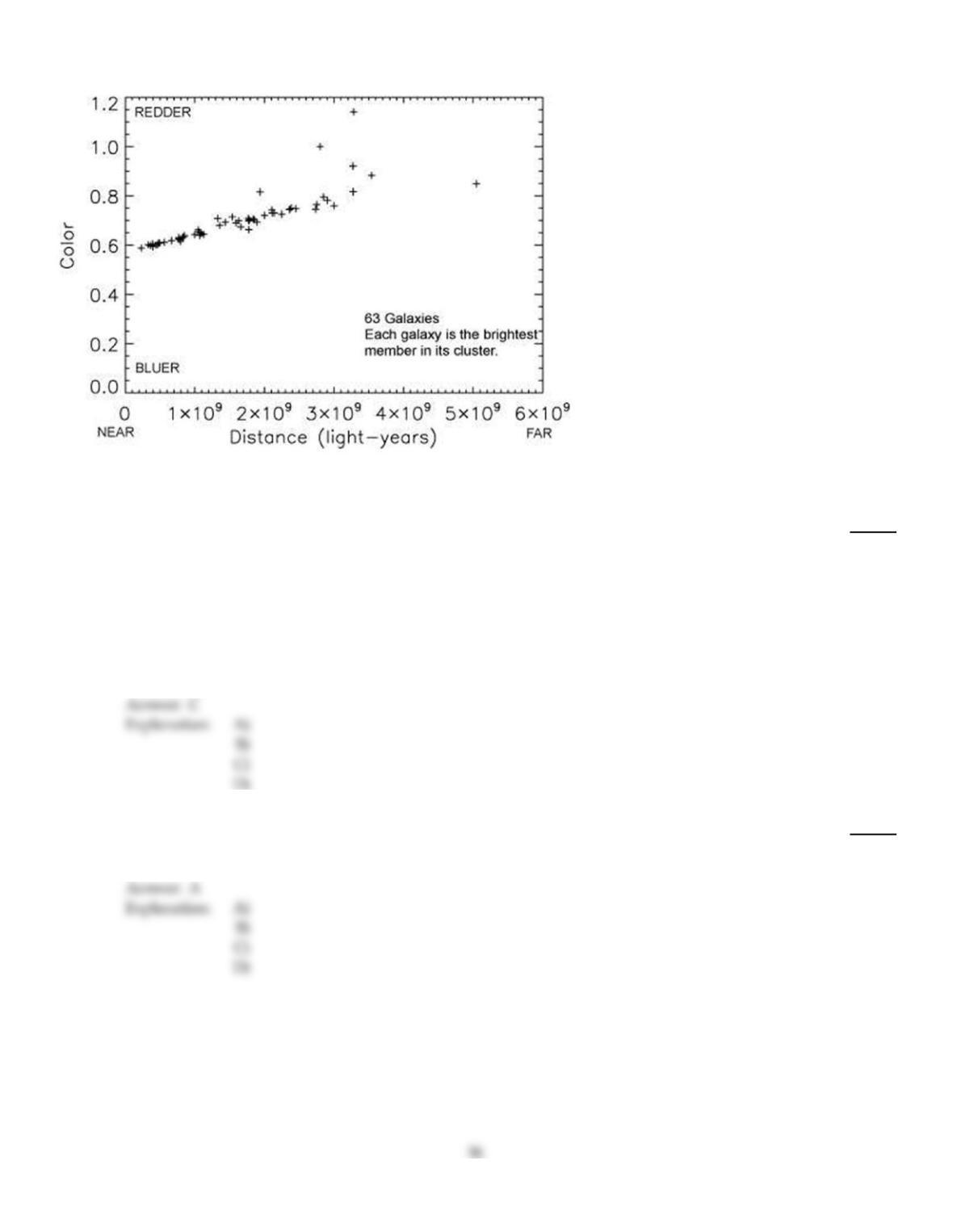
Adapted from a subset of galaxy data presented in O’Dea, C. P. et al. 2008, ApJ, 681, 1035 for pedagogical purposes only.
117)
Use the graph above showing data for the brightest galaxies in clusters of galaxies to answer the
following question. If new studies show that the exceptions are a class of galaxies with
extraordinarily bright centers, which conclusion is not justified based on the plot and the findings of
these new studies?
117)
A)
Bright nuclei are more common in cluster galaxies that are farther away.
B)
Bright nuclei were more common long ago, since the light from more distant galaxies has
been traveling much longer.
C)
Bright nuclei are caused by supermassive black holes surrounded by hot gas.
D)
Galaxies appear redder the farther away they are.
118)
Which of the following types of galaxies have a disk and spheroidal component but lack spiral
arms?
118)
A)
lenticulars
B)
ellipticals
C)
irregulars
D)
all of the above
119)
What is a quasar?
119)
A)
a star–like object that actually represents a bright patch of gas in the Milky Way
B)
the name given to the largest objects in the Kuiper Belt
C)
the extremely bright center of a distant galaxy, thought to be powered by a supermassive
black hole
D)
a very large galaxy thought to be formed by the merger of several smaller galaxies, resulting
in a quick burst of star formation
E)
another name for very bright stars of spectral type O
120)
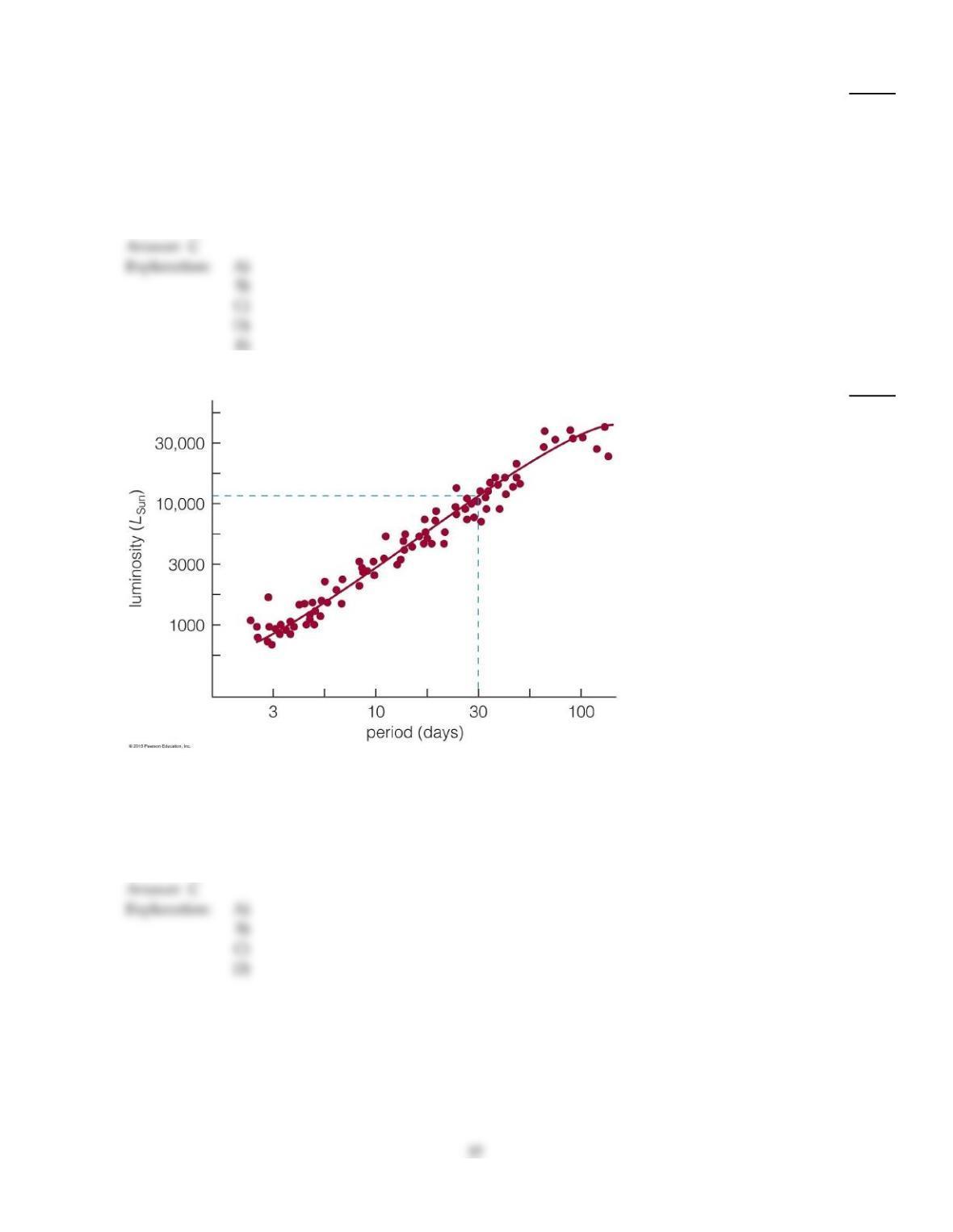
This figure shows the Cepheid period–luminosity relation. What is the approximate luminosity of a
Cepheid star that varies in brightness on a 10 day cycle?
120)
A)
about 30,000 times the luminosity of the sun
B)
about 1000 times the luminosity of the sun
C)
about 3000 times the luminosity of the sun
D)
about 10,000 times the luminosity of the sun

121)
Suppose that Hubble’s constant were 20 kilometers per second per million light–years. How fast
would we expect a galaxy 100 million light–years away to be moving? (Assume the motion is due
only to Hubble’s law.)
121)
A)
toward us at 2,000 km/s
B)
away from us at 2,000 km/s
C)
away from us at 20,000 km/s
D)
away from us at 200 km/s
122)
Interactions among galaxies also are thought to influence a galaxy’s type in at least some cases.
Which of the following does not support the idea that interactions can shape galaxies?
122)
A)
the presence of features, such as “tails” extending out of galaxies, bridges between galaxies,
and rings of stars around galaxies
B)
the fact that more distant galaxies have larger redshifts
C)
computer modeling of collisions between galaxies
D)
the fact that galaxies with distorted appearances are more common at great distances than
nearby
123)
Suppose we observe a source of X–rays that varies substantially in brightness over a period of a
few days. What can we conclude?
123)
A)
The X–ray source must have a strong, rapidly varying magnetic field.
B)
The X–ray source is a quasar.
C)
The X–ray source contains a black hole with an accretion disk.
D)
The X–ray source is no more than a few light–days in diameter.
124)
Recall that Hubble’s law is written v = H0d, where v is the recession velocity of a galaxy located a
distance d away from us, and H0 is Hubble’s constant. Suppose H0 = 20 km/s/Mly. How fast would a
galaxy 1000 Mly distant be receding from us?
124)
A)
0.20 times the speed of light
B)
50 km/s
C)
20 km/s
D)
20,000 km/s
E)
20 Mly/s
125)
What is the current limit to distances we can measure via parallax, until the results of the new Gaia
mission become available?
125)
A)
about 100,000 light years
B)
about 100 light years
C)
about 10,000 light years
D)
about 1000 light years
126)
Telescopes designed to study the earliest stages in galactic lives should be optimized for
observations in ________.
126)
A)
radio waves
B)
infrared light
C)
X–rays
D)
visible light
127)
Which of the following phenomena are not thought to be results of collisions or other interactions
between galaxies?
127)
A)
the presence of very large, central dominant galaxies in clusters of galaxies
B)
the fact that spiral galaxies have both disk and halo components
C)
starbursts
D)
the fact that elliptical galaxies are more common in clusters of galaxies than outside clusters
SHORT ANSWER. Write the word or phrase that best completes each statement or answers the question.
128)
Explain why galaxy–galaxy interactions are far more common than star–star interactions.
128)
129)
Summarize the links in the distance chain that allow us to estimate distances to the farthest
reaches of the universe.
129)
130)
How does a starburst end? What might happen to the galaxy afterwards?
130)
131)
How are the jets produced by radio galaxies similar to those produced by protostars?
131)
132)
Briefly explain why white–dwarf supernovae are useful for measuring cosmic distances.
132)
133)
How does the age of the universe depend on the value of Hubble’s constant, and why?
133)
134)
Why does the merger of two spiral galaxies often trigger starbursts?
134)
135)
Explain how we can estimate that there are about 50–100 billion galaxies in the observable
universe.
135)
136)
How do quasars produce so much energy in such a small volume?
136)
137)
Recall that Hubble’s law is written v = H0d, where v is the recession velocity of a galaxy
located a distance d away from us, and H0 is Hubble’s constant. Suppose H0 = 20
km/s/Mly. How fast would a galaxy located 1375 Mly distant be receding from us? Show
all work clearly, and state your final answer with a complete sentence. Give the speed both
in units of kilometers per second and as a percentage of the speed of light.
v = H0d =20km/s
Mly (1375 Mly)
= 27,500 km
s
=0.09c
137)
138)
How are jets thought to be produced by active galaxies?
138)
139)
Give several observations supporting the idea that the high redshifts of quasars really do
imply great distances.
139)
140)
Explain individual galaxies or clusters of galaxies do not expand in size despite the overall
expansion of the universe implied by Hubble’s Law.
140)
141)
List at least three qualities that make an astronomical object a good standard candle.
141)
TRUE/FALSE. Write ‘T’ if the statement is true and ‘F’ if the statement is false.
142)
There are more large spiral galaxies than there are large elliptical galaxies.
142)
143)
A protogalactic cloud with slow star formation is more likely to form a spiral galaxy than an
elliptical galaxy.
143)
144)
Distant galaxies are more likely to be irregular in shape than galaxies closer to the Milky Way.
144)

145)
Elliptical galaxies are more likely to be found in clusters than spiral galaxies.
145)
146)
Stars continue to form in the halo of our Galaxy today.
146)
147)
The collision of two spiral galaxies will likely result in a single giant spiral galaxy.
147)
148)
All spiral galaxies have both a disk and spheroidal component to their stellar populations.
148)
149)
Galaxy mergers take hundreds of millions of years to complete.
149)
150)
Massive–star supernovae and white–dwarf supernovae work equally well as standard candles for
measuring cosmic distances.
150)
151)
Spiral galaxies have more gas, dust, and young stars than elliptical galaxies.
151)
152)
Galaxy collisions were more common in the past.
152)
153)
Quasars radiate most of their energy as radio emission.
153)
154)
A lenticular galaxy is another name for an elongated elliptical galaxy.
154)
155)
A protogalactic cloud with very little angular momentum is more likely to form an elliptical galaxy
than a spiral galaxy.
155)
156)
The larger the value of Hubble‘s constant, the more rapid the expansion of the universe and the
smaller (and hence younger) our estimate for the age of the universe.
156)
157)
The black hole mass at the center of a galaxy is generally larger in galaxies with larger central
bulges.
157)
ESSAY. Write your answer in the space provided or on a separate sheet of paper.
158)
Supermassive Black Holes: A Scientific Theory? Summarize all of the available evidence that active galaxies are
powered by supermassive black holes. Do your best to assemble enough evidence that this explanation should be
considered a scientific theory in the sense outlined at the end of Section 3.4 (The Nature of Science) of Chapter 3.
Do you think astronomers have met this challenge?
159)
The Redshift Controversy: The early debate on whether or not quasar redshifts were correctly interpreted by
Hubble’s Law (to indicate that quasars lay at enormous distances) is an excellent example of how a scientific
debate was (reasonably) quickly settled by appeals to the observational evidence. Outline all of the
observational evidence that quasars are indeed associated with the nuclei of distant galaxies and, therefore,
their redshifts can be correctly interpreted using Hubble’s Law.
160)
Does It Matter What the Universe Expands Into? A natural question of anyone who meets Hubble’s Law for the
first time is to ask what exactly the universe is expanding into. This is often further motivated by the analogy of
an inflating balloon universe, where two–dimensional galaxies ride along on the surface of the balloon. Imagine
that you live in one of these balloon–borne galaxies. Your universe is the surface of the balloon. You can move
along the surface, but you can never exist above or below it. Now one of your two–dimensional friends asks
what your (balloon) space is expanding into. Do you need to answer this question, or can the expansion you
experience be completely described without reference to an unseen, third–dimension? Imagine someone argues
that question “what is the universe expanding into?” does not even need an answer! Would you agree or
disagree? Explain. If you disagree, would there be any way to gather scientific evidence to answer this question?
161)
Building new telescopes: With current telescopes, we can see galaxies as they existed 1 billion years after the Big
Bang. Discuss innovations that could be made with new telescopes in order to see even further.
Answer Key
Testname: C16
Answer Key
Testname: C16
Answer Key
Testname: C16
Answer Key
Testname: C16

Answer Key
Testname: C16
49