106. Ring Company designs and builds jewelry. During June it had applied overhead of $120,000. Overhead is
applied at the rate of 75% of direct labor cost. Direct labor wages average $20 per hour.
How many direct labor hours did Ring Company have for the month of June?
107. Bryant Company designs and builds fancy dining room tables for individual customers. On July 1, there
were two jobs in process: Job 391 with a beginning balance of $21,700 and Job 392 with a beginning balance of
$8,790. Overhead costs are applied by using a rate of 70% of direct labor costs. Both jobs are unfinished on July
31. Data on July costs for both jobs are as follows:
Job 391
Job 392
Direct materials
$5,100
$ 9,200
Direct labor cost
2,700
11,000
What is the total of the work-in-process account at July 31?
108. Ending Work-in-Process for Lee’s Carpentry was $64,000 for January. Direct labor and direct materials
together for the month were $39,000. Direct labor was twice as much as direct materials. The overhead rate is
70% of direct labor. No jobs were finished during the month. What was beginning Work-in-Process?
109. Wright’s Construction builds custom houses for individual buyers. On June 1, it had one job started with a
beginning Work-in-Process of $56,000. During June the job was finished and sold. Direct labor for the job in
June was $75,000 and direct materials used were $57,000. Overhead is computed at a rate of 65% of direct
labor. There is a markup of 35% on all sales. What was the selling price of the house?
110. Wright Corporation had the following information available for December of the current year:
Work in Process, December 1
$20,000
Materials placed into production, December
27,500
Direct labor, December
37,500
Plantwide overhead rate is 150% of direct labor costs. Job cost sheets had the following balances:
Job Z1
$32,500
Job Z2
55,000
Job Z3
35,000
Job Z4
18,750
Jobs Z3 and Z4 were not completed at the end of December. What is the balance in work-in process for Wright at the end of December?
111. Figure 5-4.
Hill Company uses job-order costing. At the end of the month, the following data was gathered:
Job #
Total Cost
Complete?
Sold?
803
$611
yes
yes
804
$423
yes
no
805
$805
no
no
806
$682
yes
yes
807
$525
yes
no
808
$250
no
no
809
$440
yes
yes
810
$773
yes
no
811
$267
no
no
812
$341
no
no
Hill’s selling price is cost plus 50% for each of its products.
Refer to Figure 5-4. What is the total in the work-in-process account?
112. Figure 5-4.
Hill Company uses job-order costing. At the end of the month, the following data was gathered:
Job #
Total Cost
Complete?
Sold?
803
$611
yes
yes
804
$423
yes
no
805
$805
no
no
806
$682
yes
yes
807
$525
yes
no
808
$250
no
no
809
$440
yes
yes
810
$773
yes
no
811
$267
no
no
812
$341
no
no
Hill’s selling price is cost plus 50% for each of its products.
Refer to Figure 5-4. What is the total in Finished Goods?
113. Figure 5-4.
Hill Company uses job-order costing. At the end of the month, the following data was gathered:
Job #
Total Cost
Complete?
Sold?
803
$611
yes
yes
804
$423
yes
no
805
$805
no
no
806
$682
yes
yes
807
$525
yes
no
808
$250
no
no
809
$440
yes
yes
810
$773
yes
no
811
$267
no
no
812
$341
no
no
Hill’s selling price is cost plus 50% for each of its products.
Refer to Figure 5-4. What is Cost of Goods Sold for the month?
114. Figure 5-4.
Hill Company uses job-order costing. At the end of the month, the following data was gathered:
Job #
Total Cost
Complete?
Sold?
803
$611
yes
yes
804
$423
yes
no
805
$805
no
no
806
$682
yes
yes
807
$525
yes
no
808
$250
no
no
809
$440
yes
yes
810
$773
yes
no
811
$267
no
no
812
$341
no
no
Hill’s selling price is cost plus 50% for each of its products.
Refer to Figure 5-4. What is the selling price of Job 806?
115. Figure 5-5.
Brillant Design Company makes custom chairs for individual customers. On October 1, there was one job in
process, Job 243, with a cost of $1,300. Jobs 244, 245, and 246 were started during the month of October. Data
on costs added during the month are as follows:
Job 243
Job 244
Job 245
Job 246
Direct Materials
$8,400
$2,300
$5,550
$9,200
Direct Labor
$3,100
$980
$2,200
$5,010
Overhead is applied to production at the rate of 70% of direct labor cost. Job 245 was completed on October 14 and the client was billed at cost plus
55%. All other jobs remained in process.
Refer to Figure 5-5. Calculate the balance in Work-in-Process on October 31.
116. Figure 5-5.
Brillant Design Company makes custom chairs for individual customers. On October 1, there was one job in
process, Job 243, with a cost of $1,300. Jobs 244, 245, and 246 were started during the month of October. Data
on costs added during the month are as follows:
Job 243
Job 244
Job 245
Job 246
Direct Materials
$8,400
$2,300
$5,550
$9,200
Direct Labor
$3,100
$980
$2,200
$5,010
Overhead is applied to production at the rate of 70% of direct labor cost. Job 245 was completed on October 14 and the client was billed at cost plus
55%. All other jobs remained in process.
Refer to Figure 5-5. What is the price of Job 245?
117. Figure 5-5.
Brillant Design Company makes custom chairs for individual customers. On October 1, there was one job in
process, Job 243, with a cost of $1,300. Jobs 244, 245, and 246 were started during the month of October. Data
on costs added during the month are as follows:
Job 243
Job 244
Job 245
Job 246
Direct Materials
$8,400
$2,300
$5,550
$9,200
Direct Labor
$3,100
$980
$2,200
$5,010
Overhead is applied to production at the rate of 70% of direct labor cost. Job 245 was completed on October 14 and the client was billed at cost plus
55%. All other jobs remained in process.
Refer to Figure 5-5. If selling and administrative expense for the month of October equaled $ 2,000, what is operating income for the month of
October?
118. Figure 5-6.
Stutz, Inc. designs and builds basketball gymnasiums. Each gymnasium is custom-built to individual customers’
specifications. Stutz uses job-order costing to keep track of its costs. In February it worked on three jobs. Data
for these jobs are as follows:
Job 175
Job 178
Job 179
Balance 2/1
$13,790
$ 0
$ 0
Direct Materials
16,200
8,500
30,500
Direct Labor Cost
23,300
7,600
45,000
Machine Hours
400
300
2,000
Overhead is applied to jobs at the rate of $25 per machine hour. By February 28, Job 178 is the only one unfinished. The balance of Finished Goods
on February 1 is $94,000 (consisting of Job 177). Jobs 177 and 179 are sold during February. Stutz sells its product at cost plus 40%.
Refer to Figure 5-6. Calculate the balance in Work-in-Process on February 28.
119. Figure 5-6.
Stutz, Inc. designs and builds basketball gymnasiums. Each gymnasium is custom-built to individual customers’
specifications. Stutz uses job-order costing to keep track of its costs. In February it worked on three jobs. Data
for these jobs are as follows:
Job 175
Job 178
Job 179
Balance 2/1
$13,790
$ 0
$ 0
Direct Materials
16,200
8,500
30,500
Direct Labor Cost
23,300
7,600
45,000
Machine Hours
400
300
2,000
Overhead is applied to jobs at the rate of $25 per machine hour. By February 28, Job 178 is the only one unfinished. The balance of Finished Goods
on February 1 is $94,000 (consisting of Job 177). Jobs 177 and 179 are sold during February. Stutz sells its product at cost plus 40%.
Refer to Figure 5-6. Calculate the balance of Finished Goods at February 28.
120. Figure 5-6.
Stutz, Inc. designs and builds basketball gymnasiums. Each gymnasium is custom-built to individual customers’
specifications. Stutz uses job-order costing to keep track of its costs. In February it worked on three jobs. Data
for these jobs are as follows:
Job 175
Job 178
Job 179
Balance 2/1
$13,790
$ 0
$ 0
Direct Materials
16,200
8,500
30,500
Direct Labor Cost
23,300
7,600
45,000
Machine Hours
400
300
2,000
Overhead is applied to jobs at the rate of $25 per machine hour. By February 28, Job 178 is the only one unfinished. The balance of Finished Goods
on February 1 is $94,000 (consisting of Job 177). Jobs 177 and 179 are sold during February. Stutz sells its product at cost plus 40%.
Refer to Figure 5-6. What is Cost of Goods Sold for February?
121. Figure 5-6.
Stutz, Inc. designs and builds basketball gymnasiums. Each gymnasium is custom-built to individual customers’
specifications. Stutz uses job-order costing to keep track of its costs. In February it worked on three jobs. Data
for these jobs are as follows:
Job 175
Job 178
Job 179
Balance 2/1
$13,790
$ 0
$ 0
Direct Materials
16,200
8,500
30,500
Direct Labor Cost
23,300
7,600
45,000
Machine Hours
400
300
2,000
Overhead is applied to jobs at the rate of $25 per machine hour. By February 28, Job 178 is the only one unfinished. The balance of Finished Goods
on February 1 is $94,000 (consisting of Job 177). Jobs 177 and 179 are sold during February. Stutz sells its product at cost plus 40%.
Refer to Figure 5-6. What is sales revenue for February?
122. Figure 5-7.
Laudermilk produces dairy equipment. Most of its jobs have a number of units per job. The company has two
different departments through which all jobs pass. Overhead is applied using a plantwide rate of $13 per direct
labor hour. Direct labor wages average $8 an hour. Data for Job #3 for the year is:
Direct materials
$40,000
Direct labor costs
Dept. A
60,000
Dept. B
12,000
Machine hours used
Dept. A
200
Dept. B
2,400
Units produced
20,000
Refer to Figure 5-7. Compute the total cost of Job #3.
123. Figure 5-7.
Laudermilk produces dairy equipment. Most of its jobs have a number of units per job. The company has two
different departments through which all jobs pass. Overhead is applied using a plantwide rate of $13 per direct
labor hour. Direct labor wages average $8 an hour. Data for Job #3 for the year is:
Direct materials
$40,000
Direct labor costs
Dept. A
60,000
Dept. B
12,000
Machine hours used
Dept. A
200
Dept. B
2,400
Units produced
20,000
Refer to Figure 5-7. Compute the cost per unit.
124. Figure 5-8.
John’s Water Slides makes custom water slides for hotels. On September 1, there were three jobs in process,
Jobs 812, 813, and 814. Two more jobs were started during September, Jobs 815 and 816. By September 30,
Jobs 812, 814, and 816 were finished. The following data has been collected:
Job 812
Job 813
Job 814
Job 815
Job 816
9/1 Balance
$615
$830
$ 945
—
—
Direct materials
750
235
1,280
$200
$915
Direct labor
420
115
560
320
875
Overhead is applied at the rate of 120% of direct labor cost. Jobs are sold at cost plus 60%. Selling and administrative expenses for September totaled
$2,950. By September 30, Jobs 812 were 816 are sold, but the customer who ordered Job 814 decided he did not want the slide so it is still in the
warehouse.
Refer to Figure 5-8. Calculate the ending balance in Work-in-Process as of September 30.
125. Figure 5-8.
John’s Water Slides makes custom water slides for hotels. On September 1, there were three jobs in process,
Jobs 812, 813, and 814. Two more jobs were started during September, Jobs 815 and 816. By September 30,
Jobs 812, 814, and 816 were finished. The following data has been collected:
Job 812
Job 813
Job 814
Job 815
Job 816
9/1 Balance
$615
$830
$ 945
—
—
Direct materials
750
235
1,280
$200
$915
Direct labor
420
115
560
320
875
Overhead is applied at the rate of 120% of direct labor cost. Jobs are sold at cost plus 60%. Selling and administrative expenses for September totaled
$2,950. By September 30, Jobs 812 were 816 are sold, but the customer who ordered Job 814 decided he did not want the slide so it is still in the
warehouse.
Refer to Figure 5-8. What is the ending balance of Finished Goods if the beginning balance was $0?
126. Figure 5-8.
John’s Water Slides makes custom water slides for hotels. On September 1, there were three jobs in process,
Jobs 812, 813, and 814. Two more jobs were started during September, Jobs 815 and 816. By September 30,
Jobs 812, 814, and 816 were finished. The following data has been collected:
Job 812
Job 813
Job 814
Job 815
Job 816
9/1 Balance
$615
$830
$ 945
—
—
Direct materials
750
235
1,280
$200
$915
Direct labor
420
115
560
320
875
Overhead is applied at the rate of 120% of direct labor cost. Jobs are sold at cost plus 60%. Selling and administrative expenses for September totaled
$2,950. By September 30, Jobs 812 were 816 are sold, but the customer who ordered Job 814 decided he did not want the slide so it is still in the
warehouse.
Refer to Figure 5-8. What is the selling price of Job 816?
127. Figure 5-8.
John’s Water Slides makes custom water slides for hotels. On September 1, there were three jobs in process,
Jobs 812, 813, and 814. Two more jobs were started during September, Jobs 815 and 816. By September 30,
Jobs 812, 814, and 816 were finished. The following data has been collected:
Job 812
Job 813
Job 814
Job 815
Job 816
9/1 Balance
$615
$830
$ 945
—
—
Direct materials
750
235
1,280
$200
$915
Direct labor
420
115
560
320
875
Overhead is applied at the rate of 120% of direct labor cost. Jobs are sold at cost plus 60%. Selling and administrative expenses for September totaled
$2,950. By September 30, Jobs 812 were 816 are sold, but the customer who ordered Job 814 decided he did not want the slide so it is still in the
warehouse.
Refer to Figure 5-8. What is the cost of goods sold for September?
128. Figure 5-8.
John’s Water Slides makes custom water slides for hotels. On September 1, there were three jobs in process,
Jobs 812, 813, and 814. Two more jobs were started during September, Jobs 815 and 816. By September 30,
Jobs 812, 814, and 816 were finished. The following data has been collected:
Job 812
Job 813
Job 814
Job 815
Job 816
9/1 Balance
$615
$830
$ 945
—
—
Direct materials
750
235
1,280
$200
$915
Direct labor
420
115
560
320
875
Overhead is applied at the rate of 120% of direct labor cost. Jobs are sold at cost plus 60%. Selling and administrative expenses for September totaled
$2,950. By September 30, Jobs 812 were 816 are sold, but the customer who ordered Job 814 decided he did not want the slide so it is still in the
warehouse.
Refer to Figure 5-8. What is John’s operating income for the month of September?
129. Figure 5-9.
Warwick Company has the following transactions for the month of September:
Purchased materials on account for $220,384.
Materials requisitioned for $91,562.
Direct labor for the month was incurred (but not yet paid) of $69,000
Actual overhead for the month was $41,000. It has not been paid yet (Charge to various payables)
Overhead is applied to production at the rate of 65% of direct labor.
Jobs totaling $42,500 were transferred from Work-in-Process to Finished Goods.
Jobs costing $23,000 were sold.
Balances at the beginning of the month were:
Materials
22,760
Work-in-Process
0
Finished Goods
10,040
Refer to Figure 5-9. Calculate the Ending Balance of Raw Materials.
130. Figure 5-9.
Warwick Company has the following transactions for the month of September:
Purchased materials on account for $220,384.
Materials requisitioned for $91,562.
Direct labor for the month was incurred (but not yet paid) of $69,000
Actual overhead for the month was $41,000. It has not been paid yet (Charge to various payables)
Overhead is applied to production at the rate of 65% of direct labor.
Jobs totaling $42,500 were transferred from Work-in-Process to Finished Goods.
Jobs costing $23,000 were sold.
Balances at the beginning of the month were:
Materials
22,760
Work-in-Process
0
Finished Goods
10,040
Refer to Figure 5-9. What is the ending balance in Work-in-Process?
131. Figure 5-9.
Warwick Company has the following transactions for the month of September:
Purchased materials on account for $220,384.
Materials requisitioned for $91,562.
Direct labor for the month was incurred (but not yet paid) of $69,000
Actual overhead for the month was $41,000. It has not been paid yet (Charge to various payables)
Overhead is applied to production at the rate of 65% of direct labor.
Jobs totaling $42,500 were transferred from Work-in-Process to Finished Goods.
Jobs costing $23,000 were sold.
Balances at the beginning of the month were:
Materials
22,760
Work-in-Process
0
Finished Goods
10,040
Refer to Figure 5-9. What is the correct journal entry to record actual overhead for the month?
132. Figure 5-9.
Warwick Company has the following transactions for the month of September:
Purchased materials on account for $220,384.
Materials requisitioned for $91,562.
Direct labor for the month was incurred (but not yet paid) of $69,000
Actual overhead for the month was $41,000. It has not been paid yet (Charge to various payables)
Overhead is applied to production at the rate of 65% of direct labor.
Jobs totaling $42,500 were transferred from Work-in-Process to Finished Goods.
Jobs costing $23,000 were sold.
Balances at the beginning of the month were:
Materials
22,760
Work-in-Process
0
Finished Goods
10,040
Refer to Figure 5-9. What is the journal entry to record applied overhead for the month?
133. Figure 5-9.
Warwick Company has the following transactions for the month of September:
Purchased materials on account for $220,384.
Materials requisitioned for $91,562.
Direct labor for the month was incurred (but not yet paid) of $69,000
Actual overhead for the month was $41,000. It has not been paid yet (Charge to various payables)
Overhead is applied to production at the rate of 65% of direct labor.
Jobs totaling $42,500 were transferred from Work-in-Process to Finished Goods.
Jobs costing $23,000 were sold.
Balances at the beginning of the month were:
Materials
22,760
Work-in-Process
0
Finished Goods
10,040
Refer to Figure 5-9. What is the ending balance of Finished Goods?
134. Figure 5-10.
The King Corporation manufactures custom-made furniture. The following data pertains to Job X4A:
Direct materials placed into production
$9,000
Direct labor hours worked
300 hours
Direct labor rate per hour
$ 15
Machine hours worked
100 hours
Plantwide overhead rate is $22.50 per machine hour.
Refer to Figure 5-10. One-half of Job X4A was sold for $10,000. What is the total amount of costs assigned to Job X4A?
135. Figure 5-10.
The King Corporation manufactures custom-made furniture. The following data pertains to Job X4A:
Direct materials placed into production
$9,000
Direct labor hours worked
300 hours
Direct labor rate per hour
$ 15
Machine hours worked
100 hours
Plantwide overhead rate is $22.50 per machine hour.
Refer to Figure 5-10. Job X4A consists of 500 units. One-half of Job X4A was sold for $10,000. What is the cost per unit for Job X4A?
136. When the work-in-process account is debited for direct labor, what account is usually credited?
137. When overhead is debited to Overhead Control, what is the credit?
138. Which of the following accounts is debited when goods are sold?
139. What account is credited when goods are sold?
140. What type of event would cause two separate journal entries to be made?
141. When purchasing raw materials on account, what type of accounts would increase?
142. When a job costing $5,000 is completed, the following journal entry is made:
143. On April 9 of the current year, Job XX4 was completed. The job cost sheet showed a total of $4,000 in
direct materials and $6,000 in direct labor at a rate of $20 per direct labor hour. Plantwide overhead is applied at
$30 per direct labor hour. The debit to Finished Goods Inventory to record the completion of Job XX4 is
144. At the beginning of the year, Fluman Corporation estimates overhead will be $150,000. If the actual
overhead for the year is $152,000 and the applied overhead for the year is $143,000, what is the journal entry
needed to reconcile the overhead variance? Assume that the overhead variance is immaterial.
145. Figure 5-11.
Olson Corporation constructs new homes. Assume that Olson uses a job costing system. During May of the
current year, the following transactions occurred:
Olson purchased $4,500 of lumber on account.
Olson used $3,750 of lumber in production and incurred 50 hours of direct labor hours at $15 per hour.
Depreciation of $1,500 on equipment used to build new houses was recorded.
A house that was completed last period at a cost of $150,000 was sold for $180,000 in cash.
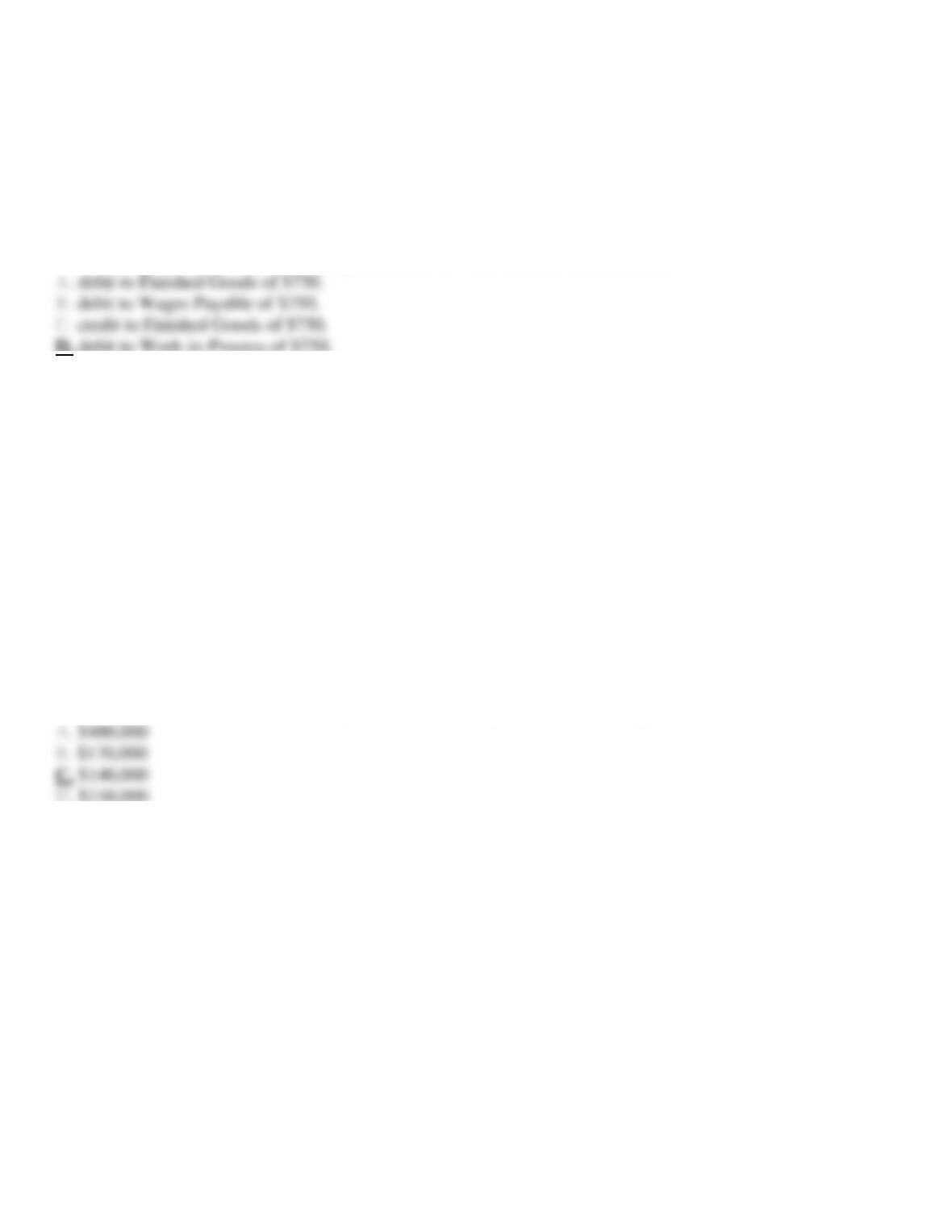
Refer to Figure 5-11. The journal entry to record the requisition of lumber for Olson would include a
146. Figure 5-11.
Olson Corporation constructs new homes. Assume that Olson uses a job costing system. During May of the
current year, the following transactions occurred:
Olson purchased $4,500 of lumber on account.
Olson used $3,750 of lumber in production and incurred 50 hours of direct labor hours at $15 per hour.
Depreciation of $1,500 on equipment used to build new houses was recorded.
A house that was completed last period at a cost of $150,000 was sold for $180,000 in cash.
Refer to Figure 5-11. The journal entry to record labor for Olson would include a
147. Figure 5-12.
Walter Company uses a job-order costing system to account for product costs. The following information
pertains to the current year:
Materials placed into production
$140,000
Indirect labor
40,000
Direct labor (10,000 hours)
160,000
Depreciation of factory building
60,000
Other plantwide overhead
100,000
Increase in work-in-process inventory
30,000
Plantwide overhead rate is $18 per direct labor hour.
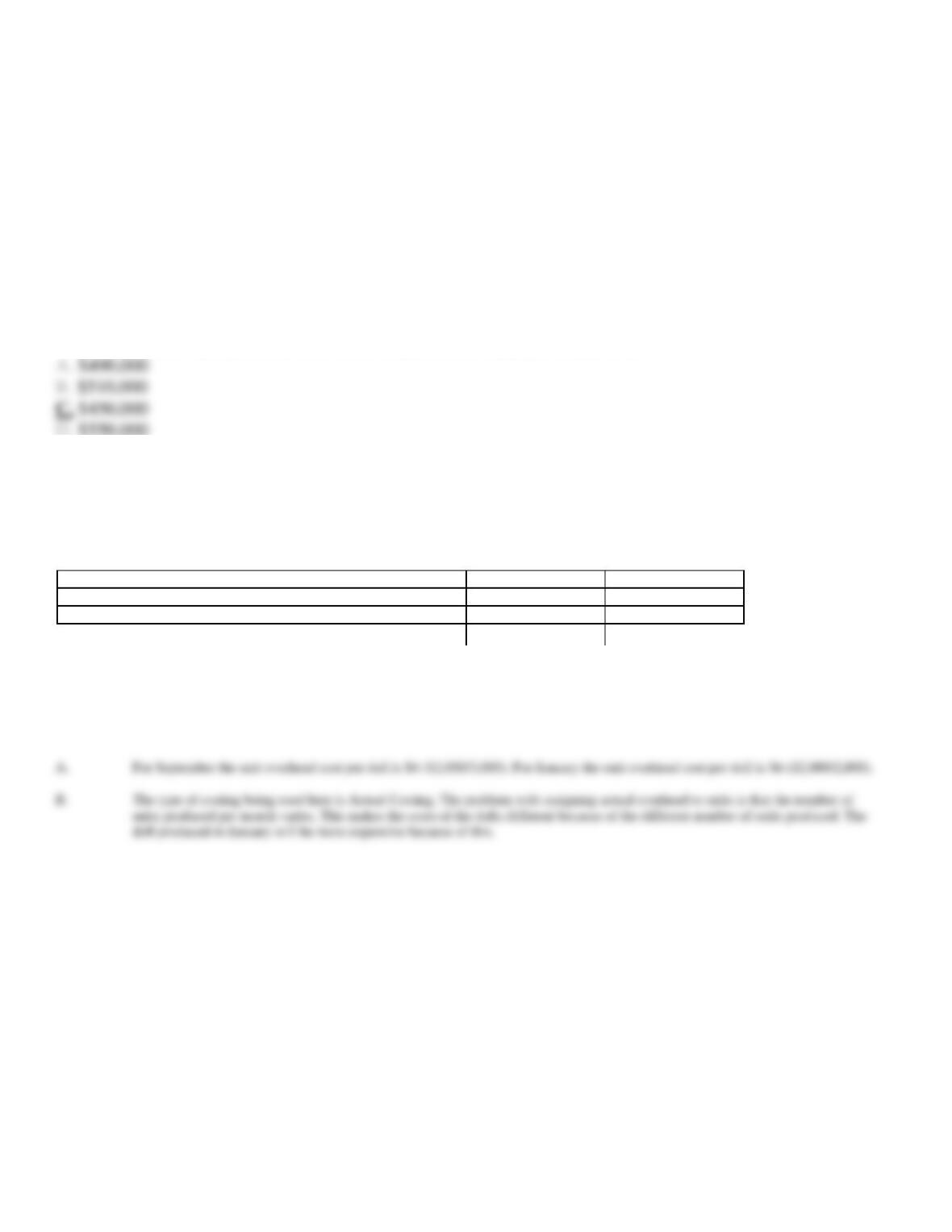
Refer to Figure 5-12. What is the total amount credited to Materials Inventory for Walter in the current year?
148. Figure 5-12.
Walter Company uses a job-order costing system to account for product costs. The following information
pertains to the current year:
Materials placed into production
$140,000
Indirect labor
40,000
Direct labor (10,000 hours)
160,000
Depreciation of factory building
60,000
Other plantwide overhead
100,000
Increase in work-in-process inventory
30,000
Plantwide overhead rate is $18 per direct labor hour.
Refer to Figure 5-12. What is the total amount debited to Finished Goods Inventory in the current year?
149. McElligott Doll Company had the following overhead costs and production for two months. The dolls are
identical to each other.
September
January
Actual overhead
$12,000
$12,000
Number of dolls
3,000
2,000
A.
What is the overhead cost per doll per month?
B.
What type of costing is McElligott using? What is the main issue with using this type of costing?
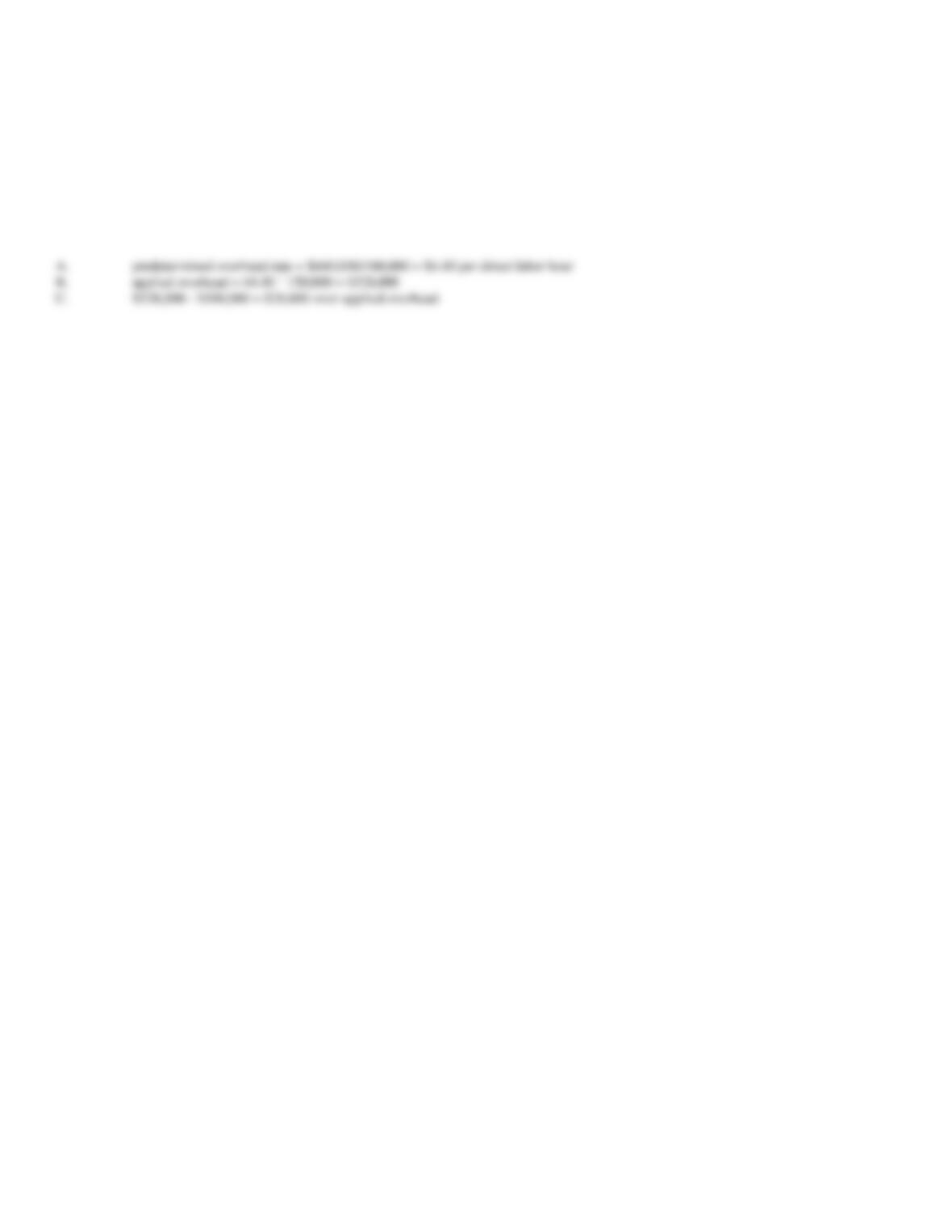
For September the unit overhead cost per doll is $4 (12,000/3,000). For January the unit overhead cost per doll is $6 (12,000/2,000).
150. Williams Incorporated estimated overhead to be $440,000 and direct labor hours to be 100,000 for the
year. Actual direct labor ended up being 120,000 hours. Actual overhead for the year amounted to $500,000.
A.
What is the predetermined overhead rate?
B.
What is the applied overhead for the year?
C.
What is the amount of under- or over-applied overhead at the end of the year?
A.
predetermined overhead rate = $440,000/100,000 = $4.40 per direct labor hour
B.
applied overhead = $4.40 ´ 120,000 = $528,000
C.
$528,000 – $500,000 = $28,000 over-applied overhead