Cost Accounting: A Managerial Emphasis, 6e
Chapter 16 – Revenue and Customer Profitability Analysis
Chapter 16 Revenue and Customer Profitability Analysis
16.1 Select a method and allocate revenue from a product bundle to its distinct
components.
1) Revenue allocation occurs where revenues can be identified with an individual product (service,
customer, and so on) in an economically feasible (cost-effective) way.
2) Revenue tracing results in a more accurate assignment of revenues to products, than does revenue
allocation.
3) A bundled product is a package of two or more products or services, sold for a single price, where the
individual components of the bundle may also be sold as separate items, each with their own stand-alone
prices.
4) The stand-alone revenue allocation method pertains to products that cannot be bundled together.
5) An example of a bundled product is when a resort hotel charges a single price for lodging, food, and
recreational activities.
6) Revenue allocation is required to determine the profitability of individual items within a bundled
product.
Cost Accounting: A Managerial Emphasis, 6e
Chapter 16 – Revenue and Customer Profitability Analysis
7) The stand-alone method may use selling price or unit costs to allocate revenues.
8) Under the incremental revenue-allocation method, there is an incentive to be the first-ranked user.
9) It is most appropriate to base revenue allocation on the number of physical units when individual
products in the bundle are of unequal value.
10) When allocating the revenues between a bundled product offering, there are only two methods which
can be used: 1) the stand-alone revenue-method and 2) the incremental revenue-allocation method.
11) The stand-alone revenue allocation method is a weighted average method.
12) The incremental revenue-allocation method uses product-specific information pertaining to products
in the bundle to determine the weights used to allocate the bundled revenues to those individual
products.
Cost Accounting: A Managerial Emphasis, 6e
Chapter 16 – Revenue and Customer Profitability Analysis
13) The first-ranked product is termed the incremental product in the incremental revenue-allocation
method.
14) ________ is a package of two or more products or services, sold for a single price, where the
individual components of the package may also be sold as separate items, each with their own stand–
alone price.
A) A revenue product
B) A byproduct
C) A bundled product
D) A joint product
E) A product package
15) ________ occurs where revenues, related but not traceable to individual products (service, customer,
and so on), are assigned to those individual products.
A) Revenue tracing
B) Revenue allocation
C) A bundled product
D) Joint product costing
E) Revenue shedding
16) Which of the following statements is true?
A) Joint product allocation results in more accurate assignment of revenues to products than does
revenue allocation.
B) Revenue allocation results in more accurate assignment of revenues to products than does revenue
tracing.
C) Revenue tracing results in more accurate assignment of revenues to products than does revenue
allocation.
D) Revenue allocation results in more accurate assignment of revenues to products than does joint
product allocation.
E) Joint product allocation results in more accurate assignment of revenues to products than does
revenue tracing.
Cost Accounting: A Managerial Emphasis, 6e
Chapter 16 – Revenue and Customer Profitability Analysis
17) Which of the following statements is true?
A) The two main classes of revenue allocation methods are the step-up method and the incremental
method.
B) The stand-alone revenue allocation method ranks the individual products in a bundle and then uses
this ranking to allocate the bundled revenues to these individual products.
C) A bundled product is a package of two or more products or services, sold for multiple prices.
D) The issues discussed with revenue tracing and sales returns do not apply to cost tracing.
E) The two main classes of revenue allocation methods are the stand-alone method and the incremental
method.
18) ________ uses product-specific information pertaining to products in the bundle to determine the
weights used to allocate the bundled revenues to those individual products.
A) The stand-alone revenue allocation method
B) The averaging approach
C) The incremental revenue-allocation method
D) The joint production costing method
E) The weighted averaging approach
19) ________ ranks the individual products in a bundle and then uses this ranking to allocate the bundled
revenues to these individual products.
A) The stand-alone revenue allocation method
B) The averaging approach
C) The incremental revenue-allocation method
D) The joint production costing method
E) The weighted averaging approach
Cost Accounting: A Managerial Emphasis, 6e
Chapter 16 – Revenue and Customer Profitability Analysis
Use the information below to answer the following question(s).
John’s Video Game Outlet encounters revenue-allocation decisions with its bundled product sales. Here,
two or more of the video games are sold as a single package. Managers at John’s are keenly interested in
individual product-profitability figures. Information pertaining to its three bundled products and the
stand-alone prices of its individual products is as follows:
Stand-Alone Sales Price
Package
Game A
Game B
Game C
Packaged
Price
Package 1
$25
$30
N/A
$44
Package 2
25
N/A
$45
56
Package 3
25
30
45
76
The unit manufacturing costs are $3.60, $4.00, and $5.00 for games A, B, and C, respectively.
20) Calculate the allocation of packaged price for Game A in Package 1, using selling prices as the base.
A) $14.00
B) $20.00
C) $30.00
D) $25.00
E) $35.00
21) Calculate the allocation of packaged price Game A in Package 3, using selling prices as the base.
A) $34.20
B) $30.00
C) $25.00
D) $22.80
E) $19.00
Cost Accounting: A Managerial Emphasis, 6e
Chapter 16 – Revenue and Customer Profitability Analysis
22) Calculate the revenue allocation for Game A in Package 1, using physical units as the base.
A) $12.57
B) $13.97
C) $20.84
D) $22.00
E) $23.16
23) Calculate the allocation of packaged price for Game A in Package 1, using unit costs as the base.
A) $12.57
B) $13.97
C) $20.84
D) $22.00
E) $23.16
24) To give more weight to the product that most likely drives the sales of the bundled product, the
revenue allocation should be weighted using
A) selling prices.
B) unit costs.
C) physical units.
D) stand-alone product revenues.
E) total product costs.
Cost Accounting: A Managerial Emphasis, 6e
Chapter 16 – Revenue and Customer Profitability Analysis
Answer the following questions using the information below:
Elmo’s Educational Software Outlet sells two or more of the video games as a single package. Managers
are keenly interested in individual product-profitability figures. Information pertaining to three bundled
products and the stand-alone prices is as follows:
Stand-Alone
Selling Price
Cost
Package
Packaged
Price
Reading Fun
$50
$7.20
1. Reading Fun & Math Fun
$88
Math Fun
$60
$8.00
2. Reading Fun & Analysis
$112
Analysis
$90
$10.00
3. All three
$152
Assume Reading Fun is the primary product, followed by Math Fun, and then Analysis.
25) Using the stand-alone method with selling price as the weight for revenue allocation, what amount of
revenue will be allocated to Reading Fun in the first package (Reading Fun & Math Fun)?
A) $40
B) $44
C) $38
D) $50
E) $22
26) Using the incremental method for revenue allocation, what amount of revenue will be allocated to
Reading Fun in the first package (Reading Fun & Math Fun)? Assume Reading Fun is the primary
product, followed by Math Fun, and then Analysis.
A) $40
B) $44
C) $38
D) $50
E) $28
Cost Accounting: A Managerial Emphasis, 6e
Chapter 16 – Revenue and Customer Profitability Analysis
27) Using the stand-alone method with selling price as the weight for revenue allocation, what amount of
revenue will be allocated to Math Fun in the package that contains all three products?
A) $48.25
B) $60.00
C) $45.60
D) $50.67
E) $33.60
28) Using the incremental method, what amount of revenue will be allocated to Math Fun in the package
that contains all three products?
A) $48.25
B) $60.00
C) $45.60
D) $50.67
E) $90.00
Cost Accounting: A Managerial Emphasis, 6e
Chapter 16 – Revenue and Customer Profitability Analysis
Answer the following questions using the information below:
The Appliance Store sells a refrigerator and a freezer as a single package for $1,000. Other data are in the
chart below.
Refrigerator
Full-size Freezer
Packaged Price
Selling price
$825
$375
$1,000
Manufacturing cost per unit
$620
$180
Stand-alone product revenues
$1,225,000
$775,000
29) Using the stand-alone method with selling price as the weight for revenue allocation, what amount
will be allocated to the refrigerator?
A) $500.00
B) $825.00
C) $687.50
D) $625.00
E) $375.00
30) Using the stand-alone method with stand-alone product revenues as the weight for revenue
allocation, what amount will be allocated to the refrigerator?
A) $687.50
B) $612.50
C) $625.00
D) $825.00
E) $505.31
31) Using the stand-alone method with manufacturing cost per unit as the weight for revenue allocation,
what amount will be allocated to the refrigerator?
A) $500.00
B) $612.50
C) $620.00
D) $775.00
E) $687.50
Cost Accounting: A Managerial Emphasis, 6e
Chapter 16 – Revenue and Customer Profitability Analysis
32) Using the stand-alone method with physical units as the weight for revenue allocation, what amount
will be allocated to the refrigerator?
A) $500.00
B) $20.00
C) $775.00
D) $825.00
E) $687.50
33) Give examples of bundled products for each of the following industries:
a. Resort hotel
b. Bank
c. Restaurant
d. Computer store
e. Gasoline service station/convenience store
f. Software manufacturer
Cost Accounting: A Managerial Emphasis, 6e
Chapter 16 – Revenue and Customer Profitability Analysis
34) Max’s DVD Store encounters revenue-allocation decisions with its bundled product sales. Here, two
or more of the DVDs are sold as a single package. Managers at Max’s are keenly interested in individual
product-profitability figures. Information pertaining to its three bundled products and the stand-alone
selling prices of its individual products is as follows:
Stand-Alone
Selling Price
Cost
Package
Packaged
Price
New Releases
$15
$2.00
New & Old
$20
Older Releases
$10
$1.50
New & Classics
$17
Classics
$8
$1.25
All three
$25
Required:
a. With selling prices as the weights, allocate the $25 packaged price of “All Three” to the three videos
using the stand-alone revenue-allocation method.
b. Allocate the $25 packaged price of “All Three” to the three types of videos using the incremental
revenue-allocation method. Assume New Releases is the primary product, followed by Older Releases,
and then Classics.
Cost Accounting: A Managerial Emphasis, 6e
Chapter 16 – Revenue and Customer Profitability Analysis
35) Roper’s Cablevision encounters revenue-allocation decisions with its bundled product sales. Here,
two or more of its services are sold as a single package. Managers at Roper’s are keenly interested in
individual product-profitability figures. Information pertaining to its three bundled products and the
stand-alone prices of its individual products is as follows:
Stand-Alone Sales Price
Packaged
Package Basic Sports Lifestyle TV Classics Price
Sp. & Lifestyle $20 $15 N/A $30
Sports & Classics 20 N/A $15 30
All three 20 15 15 40
The unit variable costs are estimated at $4.00, $3.00, and $2.50 for Sports, Lifestyle, and TV Classics,
respectively. In all cases, Sports is considered to be the primary product.
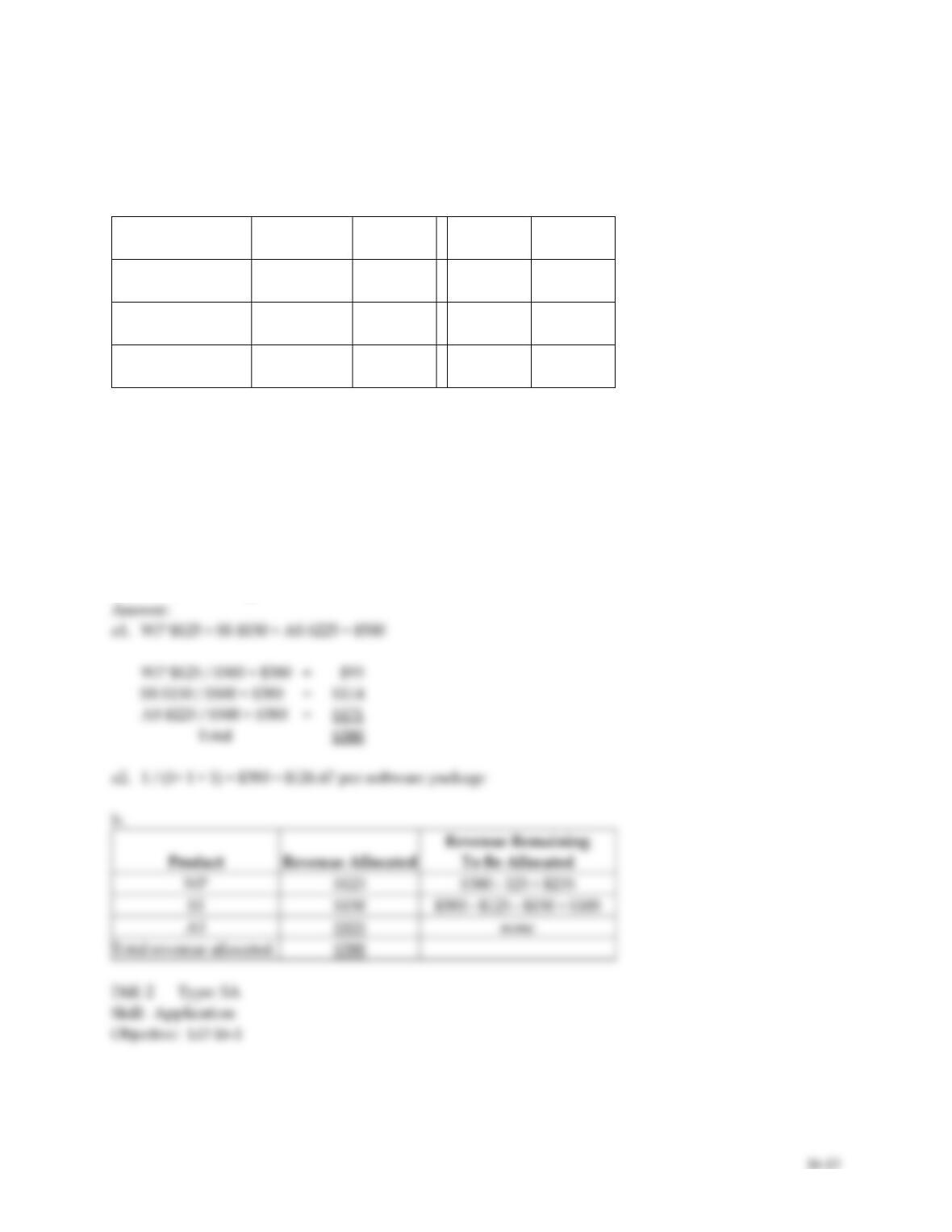
Required:
a. Allocate the bundled revenue to each product in the ‘Sports & Classics’ bundle, using selling prices as
the base.
b. What is the allocated revenue to the Sports in each bundle, using the incremental revenue-allocation
method?
Cost Accounting: A Managerial Emphasis, 6e
Chapter 16 – Revenue and Customer Profitability Analysis
36) Software For You encounters revenue-allocation decisions with its bundled product sales. Here, two
or more units of the software are sold as a single package. Managers at Software For You are keenly
interested in individual product-profitability figures. Information pertaining to its three bundled
products and the stand-alone selling prices of its individual products is as follows:
Stand-Alone
Selling Price
Cost
Package
Packaged
Price
Word Processing
(WP)
$125
$18
WP & SS
$220
Spreadsheet
(SS)
$150
$20
WP & AS
$280
Accounting Software
(AS)
$225
$25
All three
$380
Required:
a. Using the stand-alone revenue-allocation method, allocate the $380 packaged price of “All Three” to
the three software products
1. with selling prices as the weights.
2. based on physical units.
b. Allocate the $380 packaged price of “All Three” to the three software products using the incremental
revenue-allocation method. Assume Word Processing is the primary product, followed by Spreadsheet,
and then Accounting Software.

Cost Accounting: A Managerial Emphasis, 6e
Chapter 16 – Revenue and Customer Profitability Analysis
37) Software For You encounters revenue-allocation decisions with its bundled product sales. Here, two
or more of the programs are sold as a single package. Managers at Software For You are keenly interested
in individual product-profitability figures. Information pertaining to its three bundled products and the
stand-alone prices of its individual products is as follows:
Stand-Alone Sales Price
Word Spread- Accounting
Processing Sheet Software Package
Package (WP) (SS) (AS) Price
Package A $125 $150 N/A $220
Package B 125 N/A $225 280
Package C 125 150 225 380
The unit inventory costs is $18, $20, and $25 for WP, SS, and AS, respectively. Assume AS is the primary
product, followed by SS, then WP.
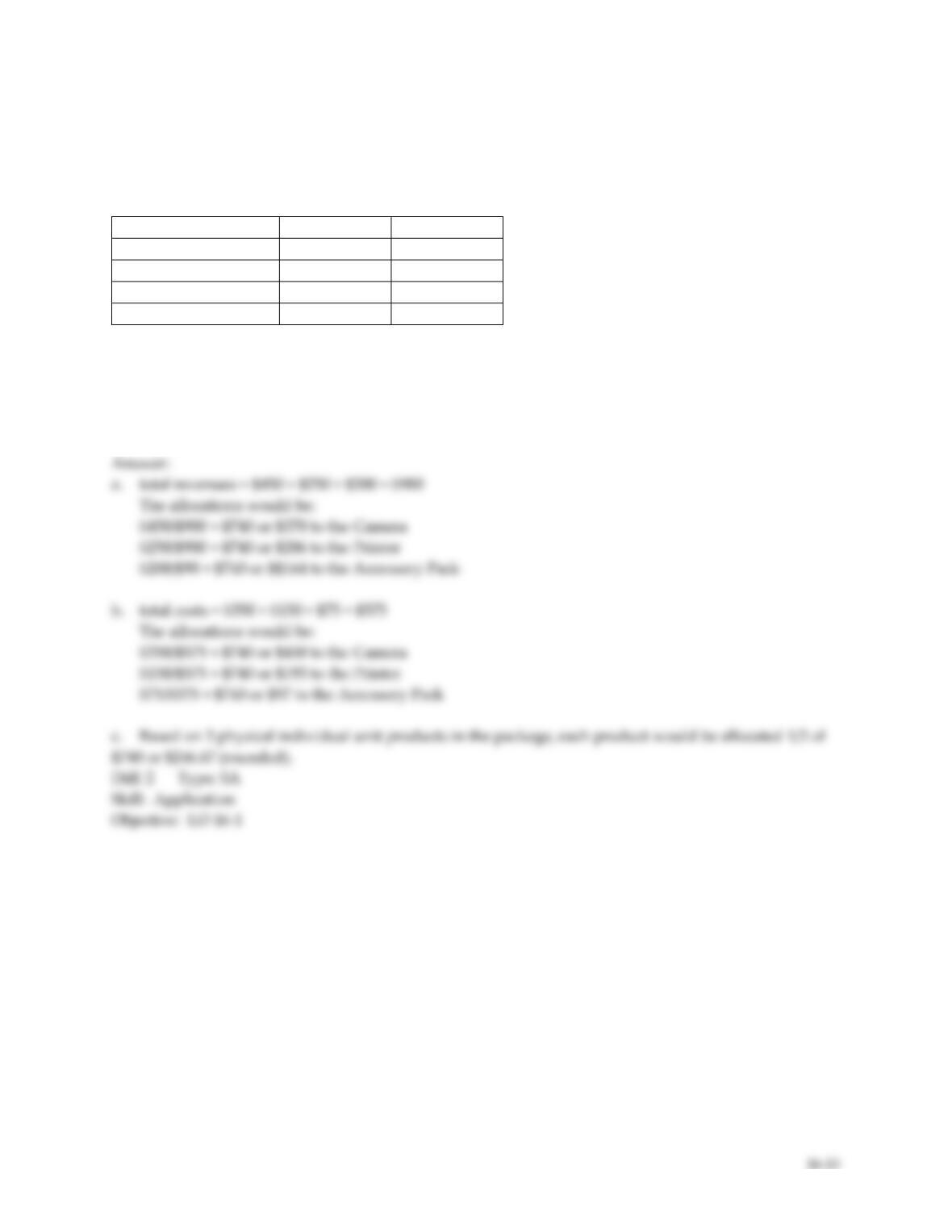
Required:
Allocate the bundle revenue to each product in Package C, using inventory unit costs as the weighting
factor.
Cost Accounting: A Managerial Emphasis, 6e
Chapter 16 – Revenue and Customer Profitability Analysis
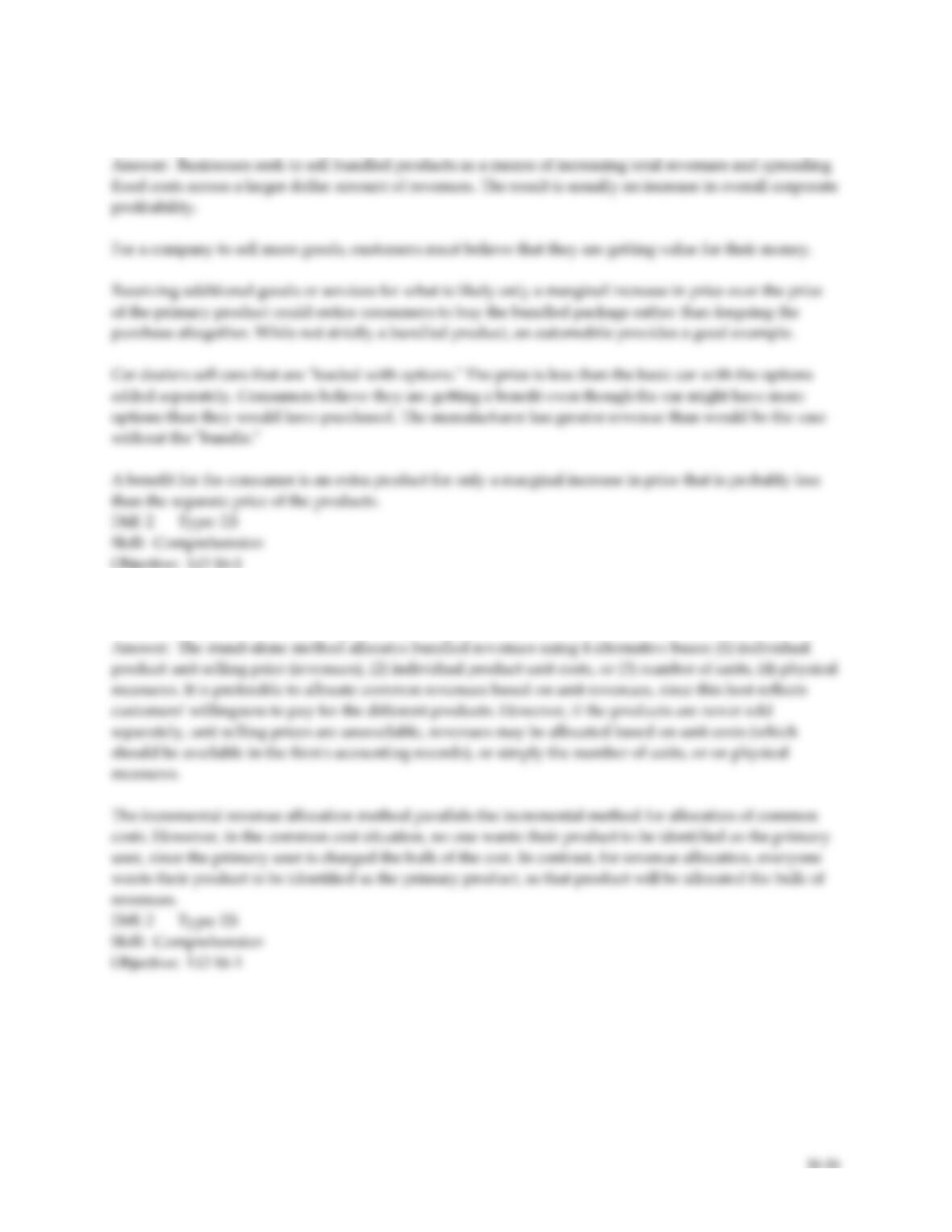
38) Easton Photography Ltd. sells cameras and related equipment. It often packages these into bundles
for sale to consumers. Currently it is offering the following “package” deal– a camera, a photo printer,
and a camera accessory pack that includes battery recharger, case and various lens adapters. The package
deal is selling for $740. The individual prices and costs of these components are as follows:
Component
Selling Price
Unit Cost
Camera
$450
$350
Printer
$250
$150
Accessory Pack
$200
$75
Total
Required:
Allocate the revenue among the products under each of the following:
a. Unit selling prices
b. Unit costs
c. Physical units
Cost Accounting: A Managerial Emphasis, 6e
Chapter 16 – Revenue and Customer Profitability Analysis
39) Why would businesses want to sell bundled products? What benefits, if any, are there for the
consumer?
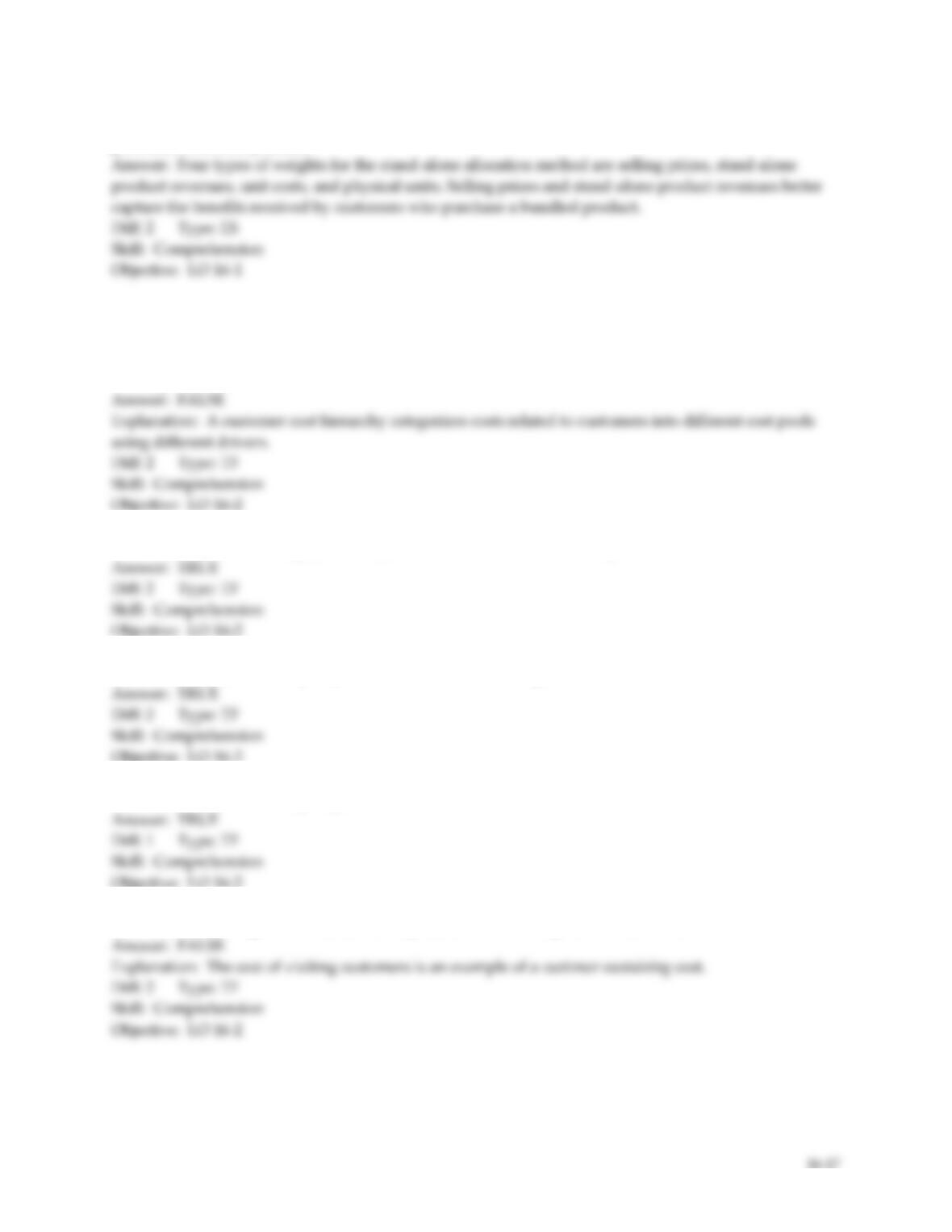
40) Describe and discuss the two methods of allocating the revenues of a bundled package to the
individual products in that package. Describe any special problems associated with the method.
Cost Accounting: A Managerial Emphasis, 6e
Chapter 16 – Revenue and Customer Profitability Analysis
41) Under the stand-alone method, which weights better capture the benefits received by customers who
purchase a bundled product?
16.2 Apply an ABC system to allocate costs when the customer is the cost object.
1) A customer cost hierarchy categorizes costs related to customers into different cost pools on the basis
of using only one cost driver.
2) An activity-based costing system may focus on customers rather than products.
3) A customer cost hierarchy may include customer-sustaining costs.
4) A customer cost hierarchy may include distribution-channel costs.
5) The cost of visiting customers is an example of a customer output unit-level cost.
Cost Accounting: A Managerial Emphasis, 6e
Chapter 16 – Revenue and Customer Profitability Analysis
6) In general, distribution-channel costs are more easily influenced by customer actions than customer
batch-level costs.
7) If one of four distribution channels is discontinued, corporate-sustaining costs such as general
administration costs will most likely be reduced by 25%.
8) To more accurately assess customer profitability, corporate-sustaining costs should be allocated.
9) Costs incurred to process orders would MOST likely be classified as a
A) customer output unit-level cost.
B) customer batch-level cost.
C) customer-sustaining cost.
D) corporate-sustaining cost.
E) distribution-channel cost.
10) Top management and general administration costs would MOST likely be classified as a
A) customer output unit-level cost.
B) customer batch-level cost.
C) customer-sustaining cost.
D) corporate-sustaining cost.
E) distribution-channel cost.
Cost Accounting: A Managerial Emphasis, 6e
Chapter 16 – Revenue and Customer Profitability Analysis
11) The cost of visiting customers would MOST likely be classified as a
A) customer output unit-level cost.
B) customer batch-level cost.
C) customer-sustaining cost.
D) corporate-sustaining cost.
E) distribution-channel cost.
12) Costs incurred to handle each unit sold would MOST likely be classified as a
A) customer output unit-level cost.
B) customer batch-level cost.
C) customer-sustaining cost.
D) corporate-sustaining cost.
E) distribution-channel cost.
13) The cost of the manager of a retail distribution channel would MOST likely be classified as a
A) customer-sustaining cost.
B) distribution-channel cost.
C) customer batch-level cost.
D) corporate-sustaining cost.
E) customer output unit-level cost.
14) Which item is NOT a category in the customer cost hierarchy?
A) customer output unit-level costs
B) customer batch-level costs
C) distribution-channel costs
D) corporate-sustaining costs
E) product-sustaining cost
Cost Accounting: A Managerial Emphasis, 6e
Chapter 16 – Revenue and Customer Profitability Analysis
15) ________ categorizes costs related to customers into different cost pools on the basis of either different
classes of cost drivers or different degrees of difficulty in determining the cause-and-effect (or benefits-
received) relationships.
A) Customer-profitability analysis
B) Customer revenues
C) Customer cost hierarchy
D) Price discounting
E) Zero sum game
16) 24-hour customer service not traceable to an individual customer is an example of what type of cost?
A) corporate sustaining costs
B) distribution channel costs
C) customer sustaining costs
D) customer specific costs
E) warranty costs
17) The president’s salary, interest on corporate debt and corporate donations are all examples of what
type of costs?
A) customer support costs
B) corporate sustaining costs
C) customer specific costs
D) distribution channel costs
E) sales costs