Chapter 16: Retained Earnings and Earnings Per Share
46. On January 1, a corporation had 15,380 shares of common stock outstanding. On August 1, it sold an additional 5,000
shares. During the year, dividends of $4,800 and $56,000 were declared and paid on the common and preferred stock,
respectively. Net income for the year was $250,000. What was the basic earnings per share for the year (rounded to
the nearest cent)?
a.
$16.26
b.
$14.32
c.
$11.11
d.
$10.83
c
1
Moderate
ACCT.WHAL.16.16.4 – LO: 16.4
United States – BUSPORG: Analytic
United States – OH – Default City – AICPA: FN-Measurement
Bloom’s: Analyzing
47. On January 1, 2016, a corporation had 10,380 shares of common stock outstanding, and on June 1, it reacquired 6,000
shares. Despite a net loss for the year of $180,000, the company declared and paid cash dividends of $24,000 and
$28,000 on common and preferred stock, respectively. What was the earnings per share for 2016?
a.
($33.72)
b.
($30.23)
c.
($22.10)
d.
($18.60)
b
1
Moderate
ACCT.WHAL.16.16.4 – LO: 16.4
United States – BUSPORG: Analytic
United States – OH – Default City – AICPA: FN-Measurement
Bloom’s: Analyzing
48. On January 1, 2016, Laura Corporation had 18,000 shares of common stock outstanding, and reacquired 2,000 shares
on July 1. The company earned net income of $110,800 and paid a cash dividend on its preferred stock of $36,000.
What was the basic earnings per share for the year?
a.
$4.40
b.
$5.54
c.
$3.74
d.
$4.68
a
1
Moderate
ACCT.WHAL.16.16.4 – LO: 16.4
United States – BUSPORG: Analytic
United States – OH – Default City – AICPA: FN-Measurement
Bloom’s: Analyzing
49. On January 1, 2016, Samuel Company had 21,000 shares of common stock outstanding and issued an additional 4,500
shares on May 1. The company declared and paid a cash dividend of $45,000 and earned $375,000 net income. What
was the basic earnings per share for the year?
a.
$15.63
b.
$13.75
c.
$17.86
d.
$12.50
a
1
Moderate
ACCT.WHAL.16.16.4 – LO: 16.4
United States – BUSPORG: Analytic
United States – OH – Default City – AICPA: FN-Measurement
Bloom’s: Analyzing
50. Common shares outstanding are increased as a result of a stock dividend or stock split. For purposes of calculating the
earnings per share, when is the stock dividend or stock split considered to have occurred?
a.
at the beginning of the earliest comparative period for which earnings per share information is presented
b.
at the end of the earliest comparative period for which earnings per share information is presented
c.
at the beginning of the year declared
d.
as of the date of declaration
a
1
Moderate
ACCT.WHAL.16.16.4 – LO: 16.4
United States – BUSPROG: Reflective Thinking – BUSPROG: Analytic
United States – OH – Default City – AICPA: FN-Decision Modeling
Bloom’s: Understanding
51. On January 1, a corporation had 25,000 shares of common stock outstanding. An additional 10,000 shares were issued
on July 1, and on November 1, the company declared a 2-for-1 stock split. What is the denominator in the earnings
per share calculation?
a.
35,000
b.
56,000
c.
60,000
d.
50,000
c
1
Moderate
ACCT.WHAL.16.16.4 – LO: 16.4
United States – BUSPORG: Analytic
United States – OH – Default City – AICPA: FN-Measurement
Bloom’s: Analyzing
52. On January 1, James Corporation had 60,000 shares of common stock outstanding. On March 1, the company
reacquired 12,000 shares, and it declared a 10% stock dividend on October 1. What is the denominator in the earnings
per share calculation?
a.
44,200
b.
40,800
c.
55,000
d.
60,000
c
1
Moderate
ACCT.WHAL.16.16.2 – LO: 16.2
United States – BUSPORG: Analytic
United States – OH – Default City – AICPA: FN-Measurement
Bloom’s: Analyzing
53. On January 1, Buchanan Corporation had 50,000 shares of common stock outstanding. On April 1, the company
declared a 20% stock dividend, and on August 1, the company had a 3-for-1 stock split. On December 1, the company
issued an additional 6,000 shares. What is the denominator in the earnings per share calculation?
a.
186,000
b.
180,500
c.
180,000
d.
173,000
b
1
Moderate
ACCT.WHAL.16.16.4 – LO: 16.4
United States – BUSPORG: Analytic
United States – OH – Default City – AICPA: FN-Measurement
Bloom’s: Analyzing
54. For which one of the following components is earnings per share information required to be presented on the income
statement?
a.
discontinued operations
b.
operating income
c.
income from continuing operations
d.
cumulative effect of a change in accounting principle
c
1
Moderate
ACCT.WHAL.16.16.4 – LO: 16.4
United States – BUSPROG: Reflective Thinking – BUSPROG: Analytic
United States – OH – Default City – AICPA: FN-Decision Modeling
Bloom’s: Understanding
55. Which one of the following statements concerning earnings per share amounts is true?
a.
Earnings per share related to discontinued operations must be reported on the income statement.
b.
Earnings per share related to extraordinary items must be reported on the income statement.
c.
Earnings per share related to continuing operations must be reported on the income statement.
d.
Earnings per share related to the cumulative effect of a change in accounting principle must be reported on the
income statement.
c
1
Moderate
ACCT.WHAL.16.16.4 – LO: 16.4
United States – BUSPROG: Reflective Thinking – BUSPROG: Analytic
United States – OH – Default City – AICPA: FN-Decision Modeling
Bloom’s: Understanding
56. In calculating earnings per share, a company uses the treasury stock method when
a.
it needs to value the cash received for a convertible bond.
b.
it recognizes the assumed impact of exercising outstanding warrants.
c.
it develops a methodology to handle the premium paid on exercised share options.
d.
it needs to value treasury stock repurchased during the year.
b
1
Moderate
ACCT.WHAL.16.16.4 – LO: 16.4
United States – BUSPROG: Reflective Thinking – BUSPROG: Analytic
United States – OH – Default City – AICPA: FN-Decision Modeling
57. When a corporation has a loss from continuing operations, the basic earnings per share is
a.
greater than the diluted earnings per share.
b.
less than the diluted earnings per share.
c.
equal to the diluted earnings per share.
d.
not reported.
c
1
Easy
ACCT.WHAL.16.16.5 – LO: 16.5
United States – BUSPROG: Reflective Thinking – BUSPROG: Analytic
United States – OH – Default City – AICPA: FN-Decision Modeling
Bloom’s: Remembering
58. When a corporation has contingently issuable common stock for which the conditions have not been met for issuance,
the shares are included in
a.
basic earnings per share.
b.
diluted earnings per share.
c.
both basic and diluted earnings per share calculations.
d.
neither basic nor diluted earnings per share calculations.
b
1
Moderate
ACCT.WHAL.16.16.5 – LO: 16.5
United States – BUSPROG: Reflective Thinking – BUSPROG: Analytic
United States – OH – Default City – AICPA: FN-Decision Modeling
Bloom’s: Understanding
59. The potential dilutive effect of the exercise of share options or warrants will affect which of the following when
calculating diluted earnings per share?
a.
the earnings per share numerator
b.
the earnings per share denominator
c.
both the numerator and the denominator of earnings per share
d.
neither the numerator nor the denominator of earnings per share
b
1
Easy
ACCT.WHAL.16.16.5 – LO: 16.5
United States – BUSPROG: Reflective Thinking – BUSPROG: Analytic
Bloom’s: Remembering
60. Which statement best reflects the issues associated with the computation of diluted earnings per share?
a.
Diluted earnings per share represent the potential impact of all shares of common stock.
b.
When presenting comparative financial statements, the impact of convertible bonds must be included for both
years.
c.
Common stock options are considered dilutive when the average market price is greater than the option price.
d.
The impact on the denominator is always the determinate of whether or not to use diluted earnings per share.
c
1
Moderate
ACCT.WHAL.16.16.5 – LO: 16.5
United States – BUSPROG: Reflective Thinking – BUSPROG: Analytic
Bloom’s: Understanding
61. Dual presentation of the basic and diluted earnings per share amounts is
a.
required for corporations with simple capital structures.
b.
optional for corporations with simple capital structures.
c.
optional for corporations of any structure.
d.
required for corporations with complex capital structures.
d
1
Easy
ACCT.WHAL.16.16.5 – LO: 16.5
United States – BUSPROG: Reflective Thinking – BUSPROG: Analytic
United States – OH – Default City – AICPA: FN-Decision Modeling
Bloom’s: Remembering
62. Smith Corporation had 30,000 shares of common stock outstanding during the year. In addition, there were
compensatory share options to purchase 3,000 shares of common stock at $20 a share outstanding the entire year. The
average market price for the common stock during the year was $36 a share. The unrecognized compensation cost (net
of tax) relating to these options was $4 a share. What is the denominator to compute the diluted earnings per share?
a.
31,000
b.
31,333
c.
31,667
d.
33,000
a
1
Moderate
ACCT.WHAL.16.16.5 – LO: 16.5
United States – BUSPORG: Analytic
United States – OH – Default City – AICPA: FN-Measurement
Bloom’s: Analyzing
63. Under the treasury stock method, the number of shares of common stock assumed to be reacquired is determined by
using the
a.
ending market price of the stock.
b.
average market price of the stock.
c.
beginning market price of the stock.
d.
par value of the stock.
b
1
Easy
ACCT.WHAL.16.16.5 – LO: 16.5
United States – BUSPORG: Analytic
United States – OH – Default City – AICPA: FN-Decision Modeling
Bloom’s: Analyzing
64. The assumed conversion of convertible debt and preferred stock in diluted earnings per share calculations affects
a.
the numerator only.
b.
the denominator only.
c.
both the numerator and denominator.
d.
neither the numerator nor the denominator.
c
1
Easy
ACCT.WHAL.16.16.5 – LO: 16.5
United States – BUSPROG: Reflective Thinking – BUSPROG: Analytic
United States – OH – Default City – AICPA: FN-Decision Modeling
Bloom’s: Remembering
65. Under the if-converted method, the impact of various convertible securities on the diluted earnings per share
calculation are ranked from
a.
the least dilutive impact to the most dilutive impact.
b.
the most dilutive impact to the least dilutive impact.
c.
the least number of assumed shares issued to the most.
d.
the most number of assumed shares issued to the least.
b
1
Easy
ACCT.WHAL.16.16.5 – LO: 16.5
United States – BUSPROG: Reflective Thinking – BUSPROG: Analytic
United States – OH – Default City – AICPA: FN-Decision Modeling
Bloom’s: Remembering
66. The following convertible securities will have a dilutive impact on earnings per share:
(1)
10% convertible preferred stock with dividends of $7,000 declared during the year and
shares convertible into 2,500 common shares
(2)
6% convertible bonds with interest expense (net of taxes) of $8,000 and convertible into
3,500 common shares
(3)
8% convertible bonds with interest expense (net of taxes) of $5,000 and convertible into
1,600 common shares
What is the appropriate ranking of items 1, 2, and 3 above to indicate their impact on diluted earnings per share
calculations from most dilutive to least dilutive?
a.
1, 2, 3
b.
3, 1, 2
c.
2, 1, 3
d.
1, 3, 2
c
1
Moderate
ACCT.WHAL.16.16.5 – LO: 16.5
United States – BUSPROG: Reflective Thinking – BUSPROG: Analytic
United States – OH – Default City – AICPA: FN-Measurement
Bloom’s: Understanding
67. In the determination of the diluted earnings per share, convertible securities are
a.
included if they are dilutive.
b.
included whether they are dilutive or not.
c.
included if they are antidilutive.
d.
not included.
a
1
Easy
ACCT.WHAL.16.16.5 – LO: 16.5
United States – BUSPROG: Reflective Thinking – BUSPROG: Analytic
United States – OH – Default City – AICPA: FN-Decision Modeling
Bloom’s: Remembering
68. Interest expense on convertible bonds that are dilutive is included in the numerator of the diluted earnings per share
calculation at an amount equal to interest expense times
a.
the yield rate.
b.
the yield rate minus the stated rate.
c.
the tax rate.
d.
one minus the tax rate.
d
1
Easy
ACCT.WHAL.16.16.5 – LO: 16.5
United States – BUSPROG: Reflective Thinking – BUSPROG: Analytic
United States – OH – Default City – AICPA: FN-Decision Modeling
Bloom’s: Remembering
69. The two defined sections of stockholders’ equity under IFRS are
a.
conditional capital and other equity.
b.
earned capital and retained earnings.
c.
contributed capital and retained earnings.
d.
share capital and other equity.
d
1
Easy
ACCT.WHAL.16.16.4 – LO: 16.4
United States – BUSPROG: Reflective Thinking – BUSPROG: Analytic
United States – OH – Default City – AICPA: FN-Decision Modeling
Bloom’s: Remembering
70. Differences exist between IFRS and GAAP in the reporting of EPS. Which of the following areas is not an area of
difference?
a.
adjustment in options calculations for unrecognized compensation cost
b.
treatment of unvested contingently issued shares
c.
treatment of dividends in arrears for convertible preferred stock
d.
treatment of contracts that may be settled in shares or for cash
c
1
Moderate
ACCT.WHAL.16.16.4 – LO: 16.4
United States – BUSPROG: Reflective Thinking – BUSPROG: Analytic
United States – OH – Default City – AICPA: FN-Decision Modeling
Bloom’s: Understanding
71. Specific EPS disclosure is regularly reported for extraordinary items under
Chapter 16: Retained Earnings and Earnings Per Share
IFRS
GAAP
I.
yes
no
II.
no
yes
III.
yes
yes
IV.
no
no
a.
I
b.
II
c.
III
d.
IV
b
Easy
ACCT.WHAL.16.16.4 – LO: 16.4
United States – BUSPROG: Reflective Thinking – BUSPROG: Analytic
United States – OH – Default City – AICPA: FN-Decision Modeling
Bloom’s: Remembering
72. During 2016, Oddie Corp. had net income of $300,000. Included in net income was after-tax interest expense of
$20,000 on convertible bonds. The $200,000 face value of convertible bonds can be converted into common stock at
the rate of 200 shares per $1,000 bond. Prior to the conversion, there were 400,000 shares of common stock
outstanding. What is the amount of fully diluted earnings per share?
a.
$0.636
b.
$0.727
c.
$0.750
d.
not determinable because the bonds are not dilutive
b
1
Challenging
ACCT.WHAL.16.16.5 – LO: 16.5
United States – BUSPORG: Analytic
United States – OH – Default City – AICPA: FN-Measurement
Bloom’s: Analyzing
73. During 2016, Penny Co. had net income of $200,000 including after-tax interest expense of $30,000 on convertible
bonds. The $300,000 face value of convertible bonds can be converted into common stock at the rate of 300 shares
per $1,000 bond. Prior to the conversion, there were 400,000 shares of common stock outstanding. What is the
amount of fully diluted earnings per share?
a.
$0.500
b.
$0.469
c.
$0.408
d.
not determinable because the bonds are not dilutive
b
1
Challenging
ACCT.WHAL.16.16.5 – LO: 16.5
United States – BUSPORG: Analytic
United States – OH – Default City – AICPA: FN-Measurement
Bloom’s: Analyzing
74. Tulip Corp. has $1,000,000, 6%, nonconvertible bonds due in 2017 and $1,500,000, 3%, convertible bonds due in
2018. The basic earnings per share are $1.25 and the diluted earnings per share are $1.18. Based upon this
information, Tulip must disclose
a.
basic earnings per share because the convertible bonds are not dilutive.
b.
basic earnings per share and dilutive earnings per share because the convertible bonds are dilutive.
c.
basic earnings per share, and the convertible bonds must be disclosed in the stockholders’ equity section of the
balance sheet.
d.
basic earnings per share and dilutive earnings per share, and the convertible bonds must be disclosed in the
stockholders’ equity section of the balance sheet.
b
1
Challenging
ACCT.WHAL.16.16.5 – LO: 16.5
United States – BUSPORG: Analytic
United States – OH – Default City – AICPA: FN-Measurement
Bloom’s: Analyzing
75. Which one of the following indicators is intended to show the potential impacts of possible future events on a
corporation’s performance?
a.
basic earnings per share
b.
dividend yield
c.
diluted earnings per share
d.
price/earnings ratio
c
1
Easy
ACCT.WHAL.16.16.5 – LO: 16.5
United States – BUSPROG: Reflective Thinking – BUSPROG: Analytic
United States – OH – Default City – AICPA: FN-Decision Modeling
Bloom’s: Remembering
76. Reporting diluted earnings per share is required for which type of corporate capital structure?
a.
simple
b.
complex
c.
diluted
d.
Complicated
b
1
Easy
ACCT.WHAL.16.16.5 – LO: 16.5
United States – BUSPROG: Reflective Thinking – BUSPROG: Analytic
United States – OH – Default City – AICPA: FN-Decision Modeling
Bloom’s: Remembering

77. Below is a list of key terms:
a.
deficit
b.
restriction
c.
date of record
d.
potential common shares
e.
ex-dividend date
f.
liquidating dividends
g.
if-converted method
h.
appropriation
i.
scrip dividend
j.
simple capital structure
Required:
Match the appropriate key term with the correct definition below.
______
1)
investors listed on the stockholders’ ledger will receive dividends
______
2)
not enough cash to pay a dividend, a promissory note is issued
______
3)
common stock outstanding and possibly nonconvertible preferred stock
______
4)
It is the assumption that all convertible stocks or bonds have been converted
into common stock at the beginning of the earliest reporting period
______
5)
negative retained earnings
______
6)
return of capital rather than a distribution of earnings
______
7)
stock stops selling with dividends attached
______
8)
unavailable for dividends
1)
2)
3)
4)
6)
7)
8)

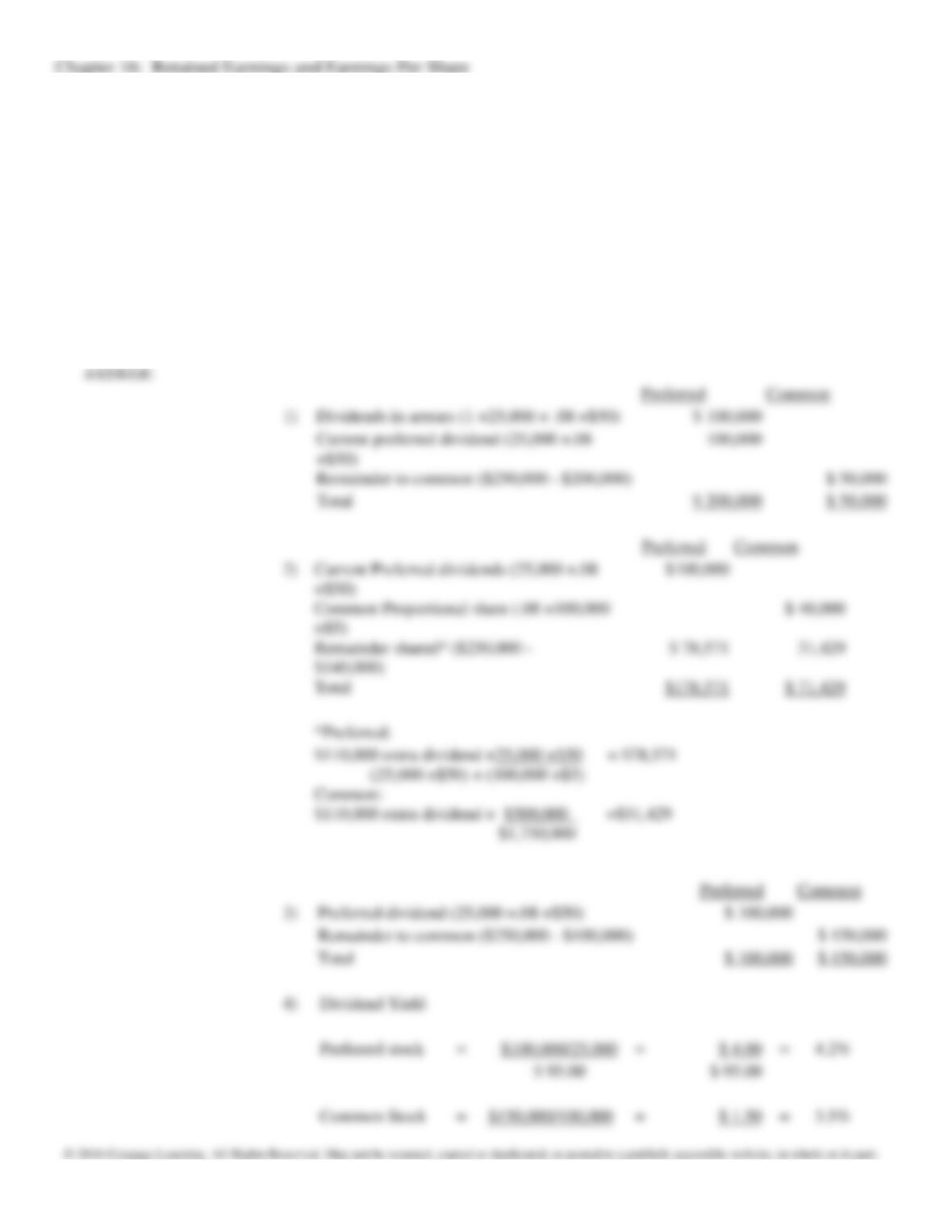
78. The Mark Company has $250,000 to pay dividends. The company has 25,000 shares of 8%, $50 par, preferred stock
and 100,000 shares of $5 par common stock outstanding. The common stock is currently selling for $43 per share and
the preferred stock is selling for $95 per share on the stock market.
Required:
Determine the amount of dividends to be paid for each class of stock in each of the independent situations.
1) Preferred stock is nonparticipating and cumulative; dividends are in the arrears for 1 year at the beginning of the
year.
2) Preferred stock is fully participating and cumulative.
3) Preferred stock is nonparticipating and noncumulative.
4) Compute the dividend yield on the preferred stock and common stock for number 3.


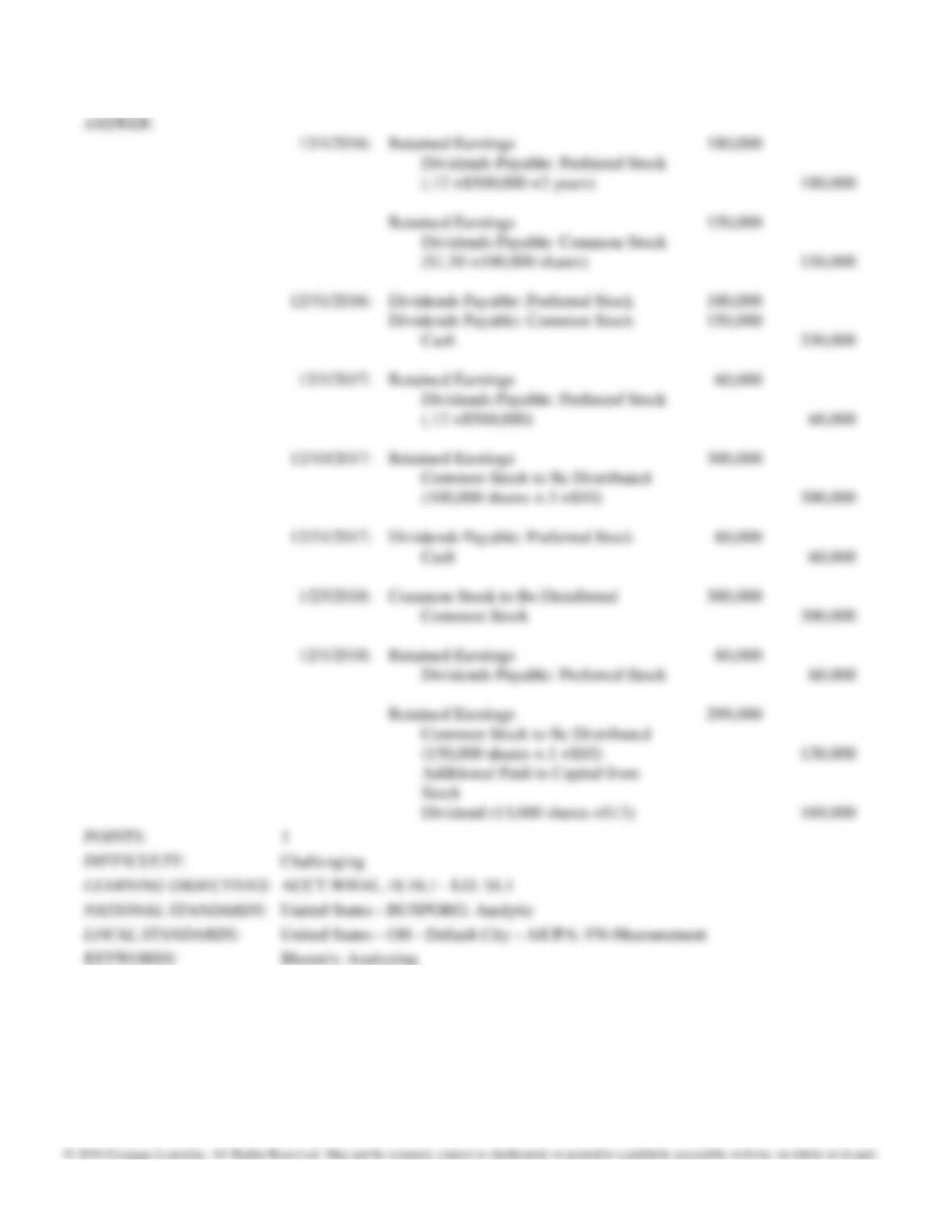
79. The Annapolis Corporation’s stockholders’ equity accounts have the following balances as of January 1, 2016:
12% preferred stock, cumulative, $50 p
(10,000 shares issued and outstanding)
$ 500,000
Common stock, $10 par (100,000 shares issued and outstanding)
1,000,000
Additional paid-in capital: common
1,000,000
Retained earnings
3,750,000
Total stockholders’ equity
$6,250,000
Annapolis engaged in the following dividend transactions during 2016, 2017, and 2018:
2016:
Dividends are in arrears for 2014 and 2015. On December 1, 2016, the annual cash
dividend plus the dividends in arrears were declared on the preferred stock. In addition,
a $1.50 per share dividend was declared on the common stock. The dividends were paid
on December 31, 2016.
2017:
On December 1, 2017, the annual cash dividend on the preferred stock was declared.
The dividend was paid on December 31, 2017.
On December 10, a 30% stock dividend was declared on the common stock,
distributable on January 25, 2018. The market price per share for the common stock on
December 10, 2017, was $28.
2018:
On January 25, 2018, the stock dividend declared on December 10, 2017, was issued.
On December 1, the annual cash dividend on the preferred stock was declared; it is
payable on January 15, 2019.
In addition, on December 1, a 10% stock dividend was declared on the common stock,
distributable on January 20, 2019. The market price per share for the common stock on
December 1, 2018, was $23.
No other stock transactions took place during 2016, 2017, or 2018.
Required:
Prepare the entries to record the dividend transactions for 2016, 2017, and 2018. (Do not record any transactions for
2019.)
Chapter 16: Retained Earnings and Earnings Per Share