Chapter 16: Retained Earnings and Earnings Per Share
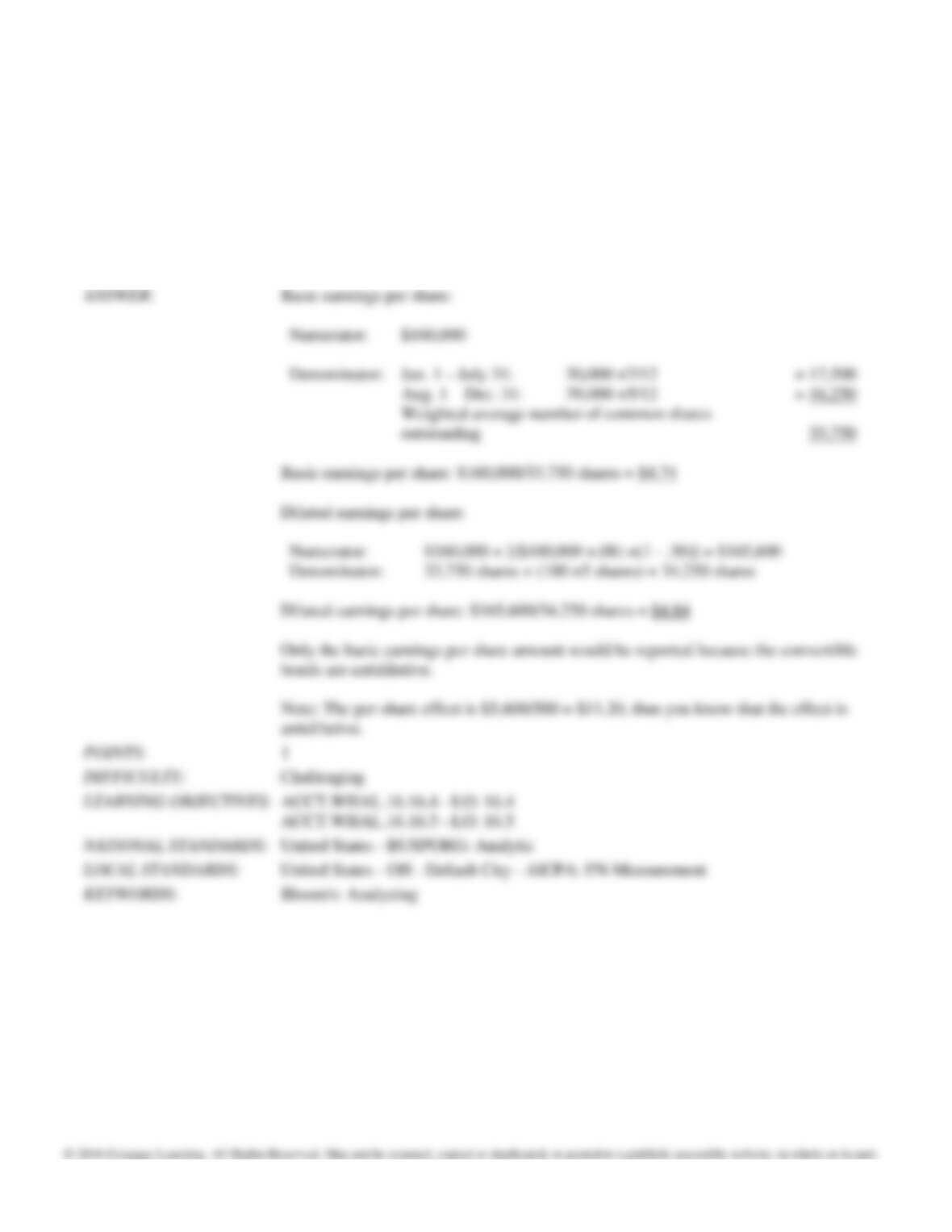
93. Daniel Company had 30,000 shares of common stock outstanding on January 1 and issued an additional 9,000 on
August 1 of 2016. The company also has $100,000 of 8% convertible bonds outstanding during the year. Each $1,000
bond is convertible into 5 shares of common stock. Daniel had after-tax net income for the year of $160,000, and the
tax rate was 30%.
Required:
Compute the appropriate earnings per share amount(s) to be reported on Daniel Company’s 2016 income statement,
and explain your answer.
94. During 2016, Stewart, Inc. had the following convertible securities outstanding:
A.
$220,000 of 10%, $100 par, cumulative preferred stock. Each share is convertible into 5
shares of common stock.
B.
$200,000 of 9.5% convertible bonds. Each $1,000 bond is convertible into 45 shares of
common stock.
C.
$100,000 of 8% convertible bonds. Each $1,000 bond is convertible into 32 shares of
common stock.
D.
$150,000 of 11%, $100 par, cumulative preferred stock. Each share is convertible into 5
shares of common stock.
Stewart, Inc. has an income tax rate of 40%. Its reported net income for 2016 was $88,000, and it had 22,000 shares of
common stock outstanding all year.
Required:
Calculate basic and diluted earnings per share for Stewart.
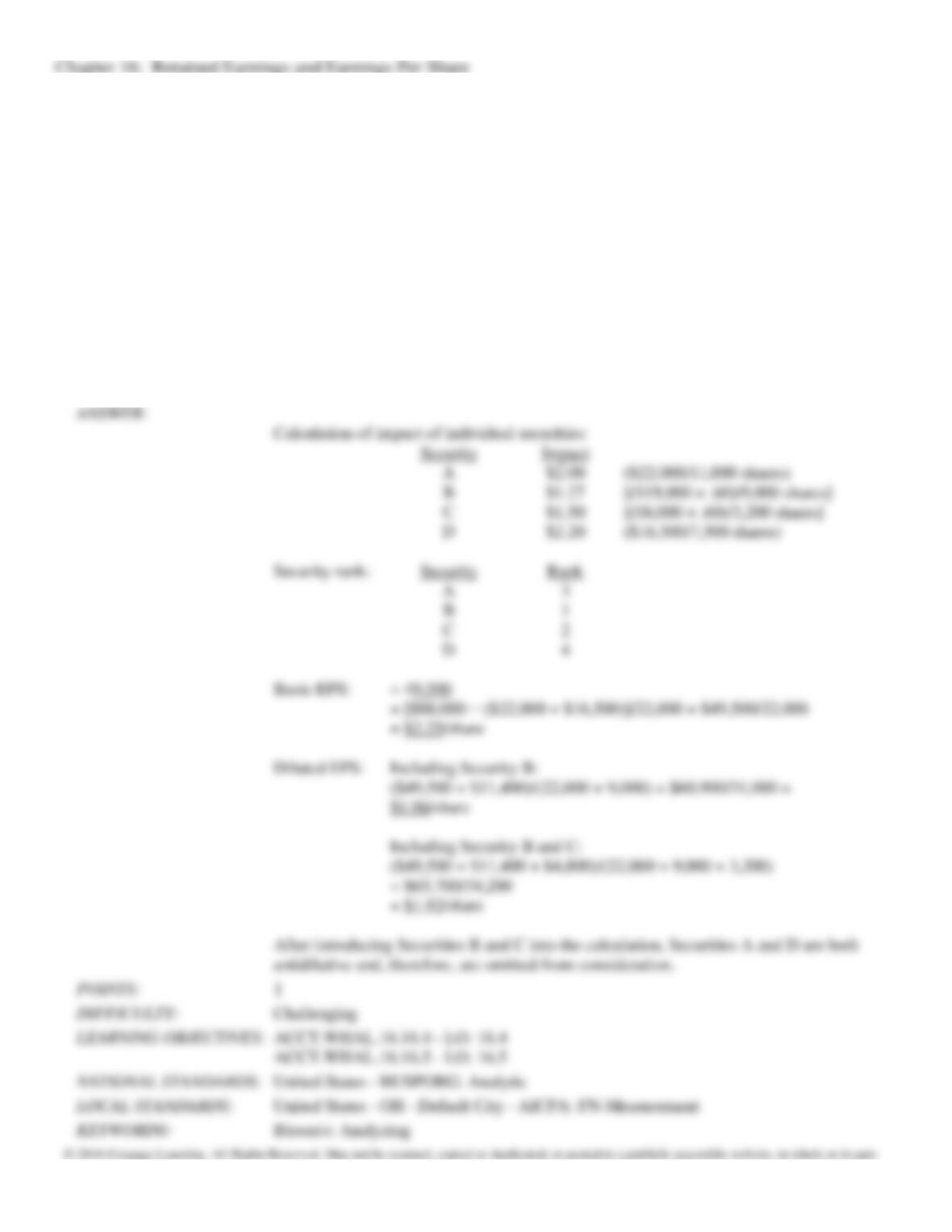
Calculation of impact of individual securities:
($22,000/11,000 shares)
[($19,000 × .60)/9,000 shares]
[($8,000 × .60)/3,200 shares]
($16,500/7,500 shares)
Security rank:
Basic EPS:
= 49,500
= [$88,000 − ($22,000 + $16,500)]/22,000 = $49,500/22,000
= $2.25/share
Diluted EPS:
Including Security B:
($49,500 + $11,400)/(22,000 + 9,000) = $60,900/31,000 =
$1.96/share
Including Security B and C:
($49,500 + $11,400 + $4,800)/(22,000 + 9,000 + 3,200)
= $65,700/34,200
Challenging
ACCT.WHAL.16.16.4 – LO: 16.4
ACCT.WHAL.16.16.5 – LO: 16.5
95. During 2016, Sanders, Inc. had the following convertible securities outstanding:
A.
$220,000 of 10%, $100 par, convertible preferred stock. Each share is convertible into 5
shares of common stock.
B.
$200,000 of 9.5% convertible bonds. Each $1,000 bond is convertible into 45 shares of
common stock.
C.
$100,000 of 8% convertible bonds. Each $1,000 bond is convertible into 32 shares of
common stock.
D.
$150,000 of 11%, $100 par, convertible preferred stock. Each share is convertible into 5
shares of common stock.
Sanders, Inc. has an income tax rate of 40%.
Required:
a.
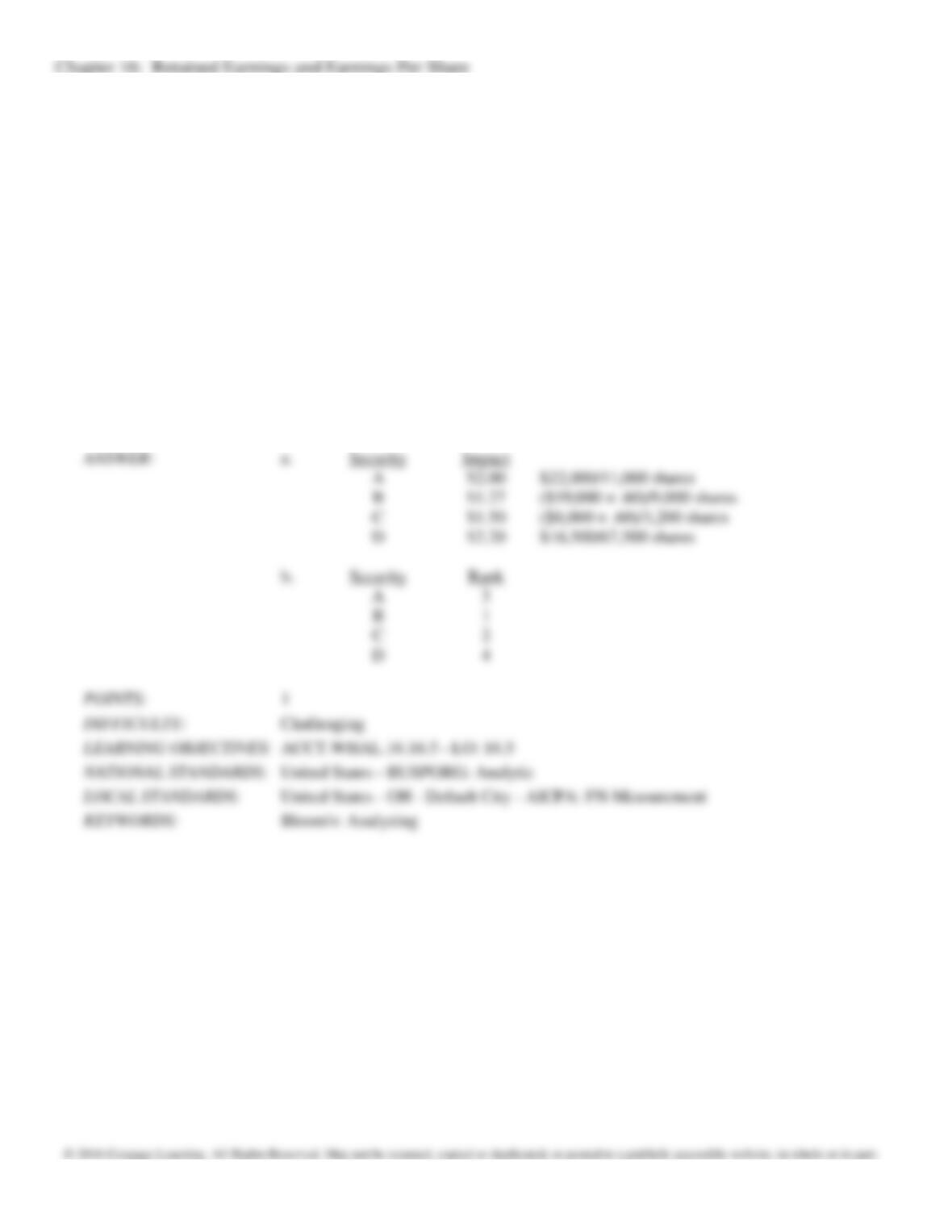
Prepare a schedule that lists the impact of the assumed conversion of each convertible
security on diluted earnings per share.
b.
Prepare a ranking of the order in which the securities would be included in the diluted
earnings per share calculations.
b.
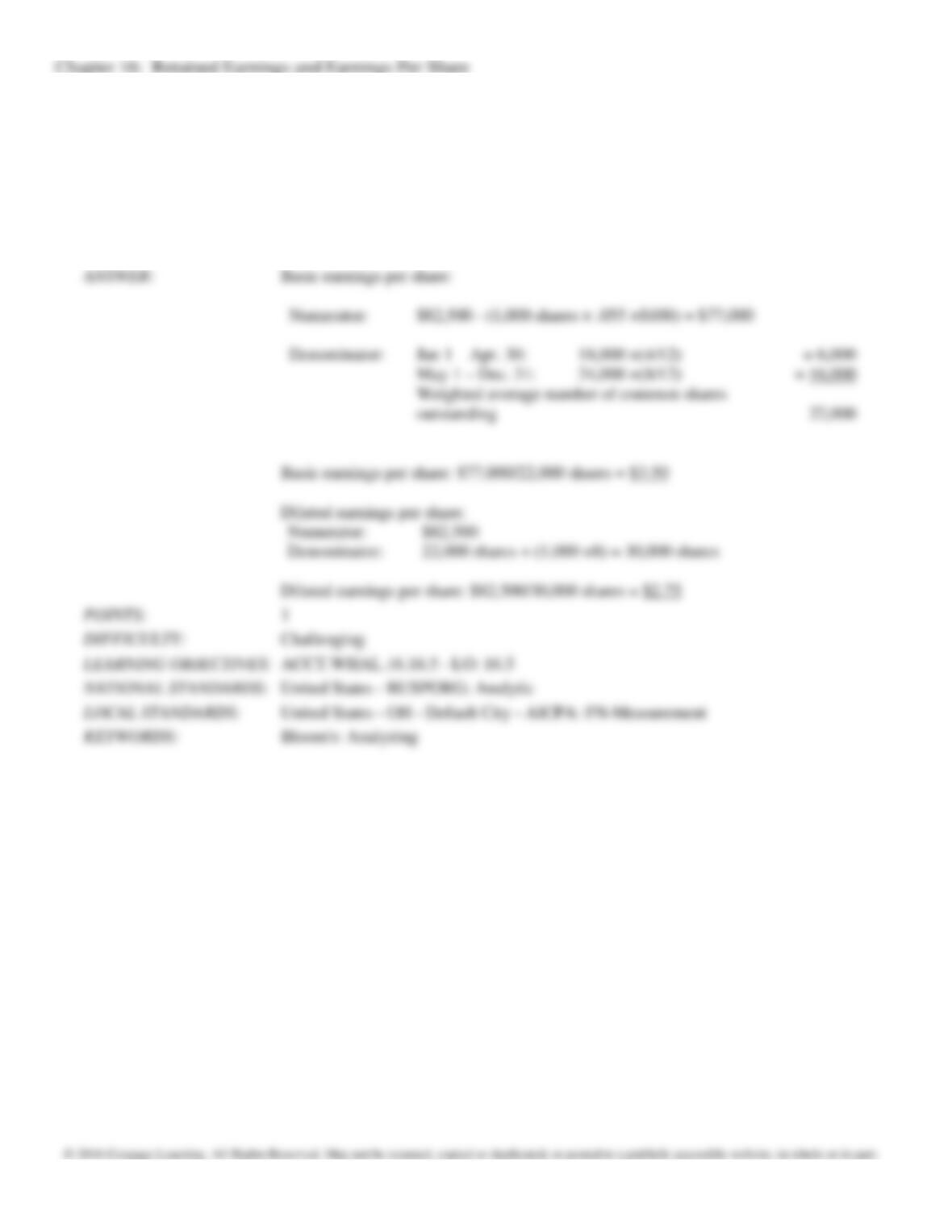
96. Green Thumb, Inc. had 18,000 shares of common stock outstanding on January 1. An additional 6,000 shares were
issued on May 1. The company also had 1,000 shares of 5.5%, $100 par, convertible preferred stock outstanding
during the year. Each share is convertible into 8 shares of common stock. Net income for the year was $82,500.
Required:
Compute the appropriate earnings per share amount(s) that would appear on the Green Thumb’s income statement.
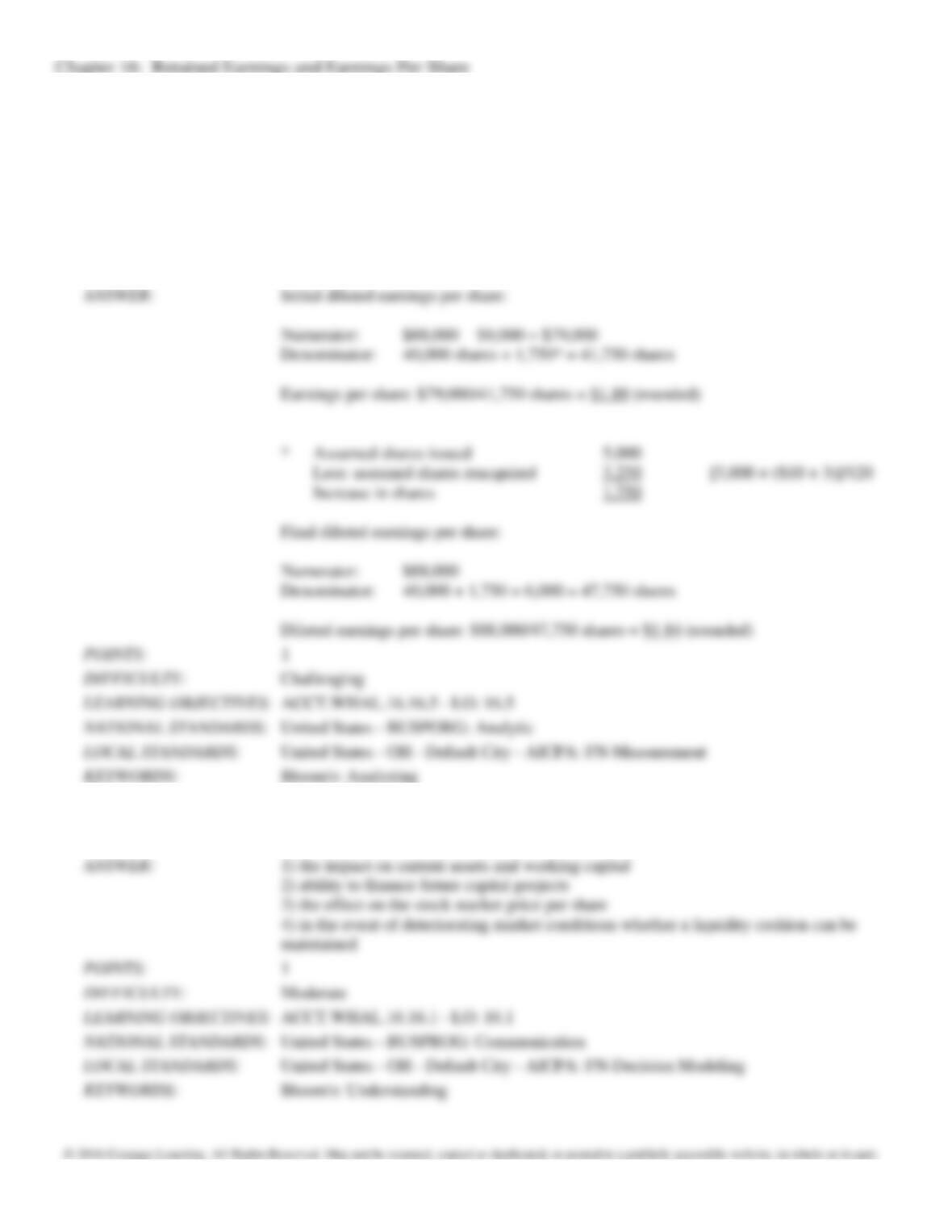
97. Robertson Company had 40,000 shares of common stock outstanding during 2016 and compensatory share options to
purchase 5,000 shares of common stock at $10 a share plus a $3 a share unrecognized compensation cost (net of tax).
The average market price is $20 a share. The company also had 7% convertible preferred stock on which dividends of
$9,000 were declared. Each preferred share is convertible into 6,000 common shares. Robertson’s after-tax net income
was $88,000, and the tax rate was 40%.
Required:
Compute 2016 diluted earnings per share for Robertson Company.
98. List 4 factors that management may consider prior to declaring a dividend.
99. List the 5 types of dividends.
100. What is a restriction of retained earnings and why would it be necessary?
101. Why might prior period adjustment become necessary and how are they accounted for?
102. What three items rarely affect retained earnings?
103. Other Comprehensive Income or loss might include what four items?
104. Describe the two types of corporate capital structures.
105. What is the basic earnings per share calculation? What is the weighted average shares calculation?
106. What are the steps necessary to compute diluted earnings per share?
107. When reporting basic and diluted earnings per share, companies are required to include a schedule or note identifying
and reconciling the numerators and denominators used in their calculations. What other information must be included
in the schedule or note in the financial statements?
108. The board of directors of the Theater Visions Corporation is trying to establish the dividends policy for 2016 for the
company. The board has asked you, the vice president of finance, to attend the meeting in order to get your input.
You were asked to discuss and evaluate stock dividends from the perspective of (1) the stockholders, and (2) the
issuing corporation’s viewpoint.
Required:
a.
Discuss the disadvantages associated with stock dividends from the stockholder’s
perspective.
b.
Discuss the advantages associated with a stock dividend from the issuing
corporation’s viewpoint.
c.
For financial accounting purposes, explain how the cost of a stock dividend is
measured at the date of declaration.
109. When the basic and diluted earnings per share amounts are disclosed on the income statement, additional disclosures
are made in the footnotes.
Required:
Describe the information contained in the footnotes disclosure concerning the basic and diluted earnings per share.
110. Corporations with complex capital structures are required to report both the basic and diluted earnings per share
amounts. In order to compute the diluted earnings per share, potential common shares must be considered.
Required:
List the sequence of steps necessary to include potential common shares in the diluted earnings per share calculation.
111. IFRS and GAAP are similar in regard to computing earnings per share components. However, the calculation of the
impact from the exercise of options differs.
Required:
a.
Describe the difference in treatment of unrecognized compensation cost relating to
options in the calculation of EPS.
b.
Explain why the IFRS approach will systematically result in lower reported diluted
EPS.
112. When computing diluted earnings per share, a company may use the if-converted method and the treasury stock
method.
Required:
Describe when and why a company would use each method.