350 Chapter 16 Managing Short-Term Liabilities (Financing)
34. Picard Orchards requires a $100,000 annual loan in order to pay laborers to tend and harvest its
fruit crop. Picard borrows on a discount interest basis at a simple annual rate of 11 percent. If
Picard must actually receive $100,000 net proceeds to finance its crop, then what must be the face
value of the note?
a.
$111,000
b.
$100,000
c.
$112,360
d.
$89,000
e.
$108,840
35. Viking Farms harvests crops in roughly 90-day cycles based on a 360-day year. The firm receives
payment from its harvests sometime after shipment. Due in part to the firm’s rapid growth, it has
been borrowing to finance its harvests using 90-day bank notes on which the firm pays 12 percent
discount interest. If the firm requires $60,000 in proceeds from each note, what must be the face
value of each note?
a.
$61,856
b.
$67,531
c.
$60,000
d.
$68,182
e.
$67,423
Chapter 16 Managing Short-Term Liabilities (Financing) 351
36. Suppose you borrow $2,000 from a bank for one year at a stated annual interest rate of 14
percent, with interest prepaid (a discounted loan). Also assume that the bank requires you to
maintain a compensating balance equal to 20 percent of the initial loan value. What effective
annual interest rate are you being charged?
a.
14.00%
b.
8.57%
c.
16.28%
d.
21.21%
e.
28.00%
37. Wentworth Greenery harvests its crops four times annually and receives payment for its crop 90
days after it is picked and shipped. However, the firm must plant, irrigate, and harvest on a near
continual schedule. The firm uses 90-day bank notes to finance its operations. The firm arranges
an 11 percent discount interest loan with a 20 percent compensating balance four times annually.
What is the effective annual rate of these discount loans?
a.
11.00%
b.
15.94%
c.
11.46%
d.
13.75%
e.
12.72%
38. Inland Oil arranged a $10,000,000 revolving credit agreement with a group of small banks. The
firm paid an annual commitment fee of one-half of one percent of the unused balance of the loan
commitment. On the used portion of the loan, Inland paid 1.5 percent above prime for the funds
actually borrowed on an annual simple interest basis. The prime rate was at 9 percent for the year.
If Inland borrowed $6,000,000 immediately after the agreement was signed and repaid the loan at
the end of one year, what was the total dollar cost of the loan agreement for one year?
a.
$560,000
b.
$650,000
c.
$540,000
d.
$900,000
e.
$675,000
352 Chapter 16 Managing Short-Term Liabilities (Financing)
39. C+ Notes’ business is booming, and it needs to raise more capital. The company purchases
supplies from a single supplier on terms of 1/10, net 20, and it currently takes the discount. One
way of getting the needed funds would be to forgo the discount, and C+’s owner believes she
could delay payment to 40 days without adverse effects. As an alternative, C+ could borrow from
its bank at a rate of 12 percent, annual compounding, but with discount interest. Additionally, the
bank would require a compensating balance of 20 percent of the loan amount. What is the
difference between the EARs of the two financing sources?
a.
4.83%
b.
5.25%
c.
7.60%
d.
9.44%
e.
12.12%
40. Your firm buys on credit terms of 2/10, net 45, and it always pays on day 45. If you calculate that
this policy effectively costs your firm $157,500 each year, what is the firm’s average accounts
payable balance?
a.
$1,234,000
b.
$75,000
c.
$157,500
d.
$625,000
e.
$750,000
Chapter 16 Managing Short-Term Liabilities (Financing) 353
41. Suppose the credit terms offered to your firm by your suppliers are 2/10, net 30 days. Out of
convenience, your firm is not taking discounts, but is paying after 20 days, instead of waiting
until day 30. You point out that the approximate cost of not taking the discount and paying on day
30 is around 37 percent. But since your firm is not taking discounts and is paying on day 20, what
is the effective annual percentage cost (not approximate) of your firm’s current practice, using a
360-day year?
a.
36.7%
b.
105.4%
c.
73.4%
d.
43.6%
e.
106.9%
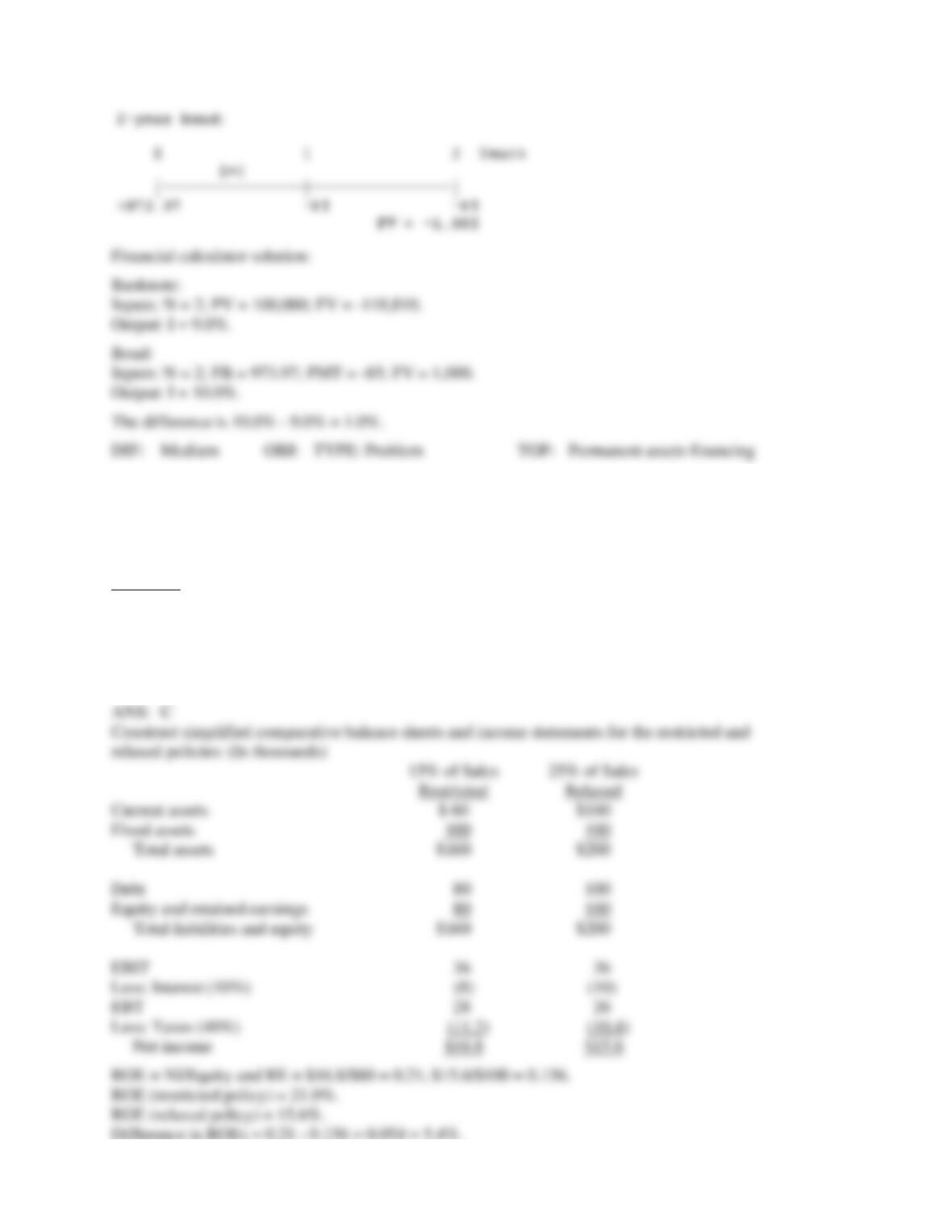
42. Wicker Corporation is determining whether to support $100,000 of its permanent current assets
with a bank note or a short-term bond. The firm’s bank offers a two-year note where the firm will
receive $100,000 and repay $118,810 at the end of two years. The firm has the option to renew
the loan at market rates. As an alternative, the firm can sell its own 8.5 percent annual coupon
bonds, with $1,000 face value and 2-year maturity, at a price of $973.97. Comparing the cost of
the two alternatives, how many percentage points lower is the interest rate on the less expensive
debt instrument?
a.
0%; the rates are equal.
b.
1.2%
c.
1.0%
d.
1.8%
e.
0.6%
354 Chapter 16 Managing Short-Term Liabilities (Financing)
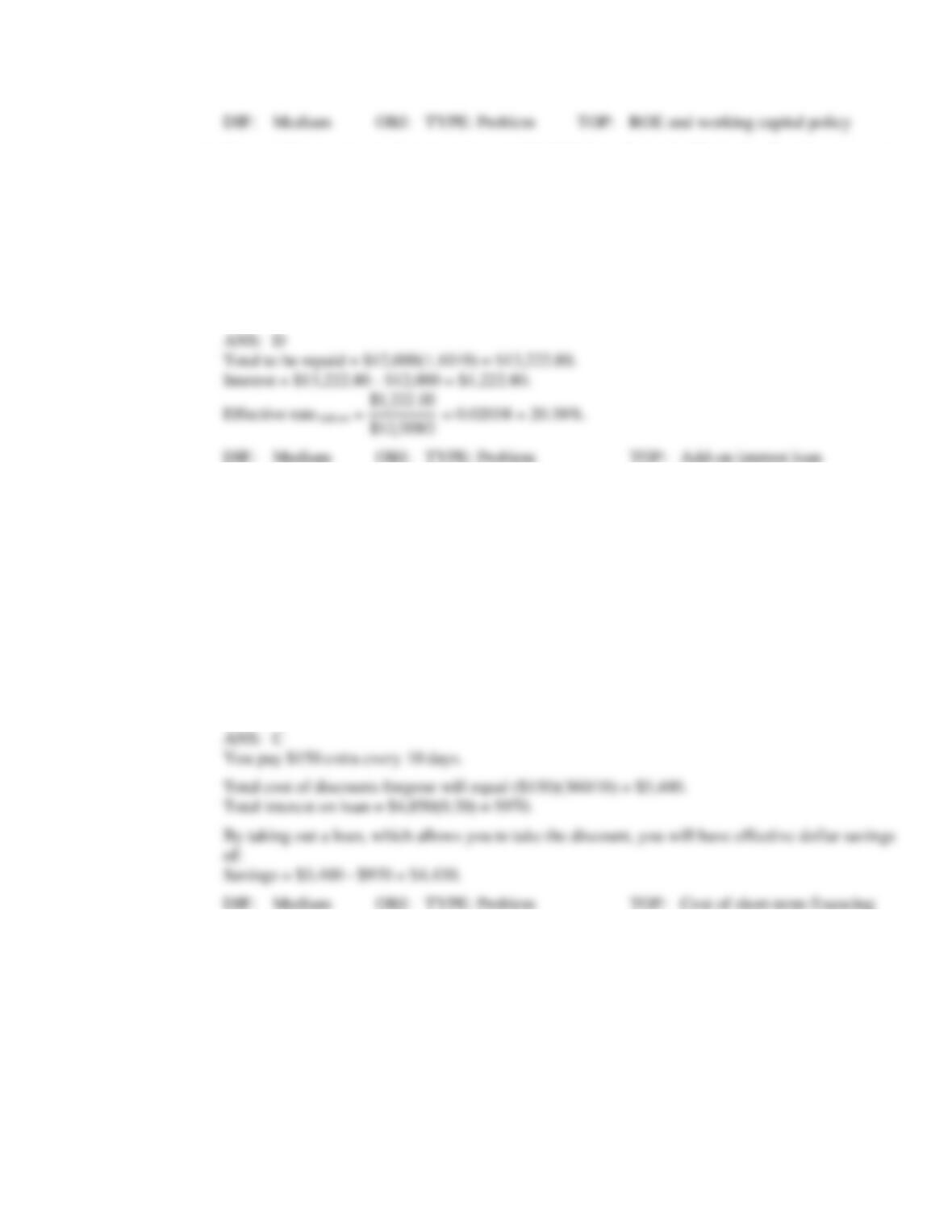
43. Jarrett Enterprises is considering whether to pursue a restricted or relaxed current asset
investment policy. The firm’s annual sales are $400,000; its fixed assets are $100,000; debt and
equity are each 50 percent of total assets. EBIT is $36,000, the interest rate on the firm’s debt is
10 percent, and the firm’s tax rate is 40 percent. With a restricted policy, current assets will be 15
percent of sales. Under a relaxed policy, current assets will be 25 percent of sales. What is the
difference in the projected ROEs between the restricted and relaxed policies?
a.
0%; the ROE’s are equal.
b.
6.2%
c.
5.4%
d.
1.6%
e.
3.8%
Chapter 16 Managing Short-Term Liabilities (Financing) 355
44. Coverall Carpets Inc. is planning to borrow $12,000 from the bank. The bank offers the choice of
a 12 percent discounted interest loan or a 10.19 percent add-on, one-year installment loan,
payable in 4 equal quarterly payments. What is the approximate effective rate of interest on the
10.19 percent add-on loan?
a.
5.095%
b.
10.19%
c.
12.00%
d.
20.38%
e.
30.57%
45. Every 10 days you receive $5,000 worth of raw materials from your suppliers. The credit terms
for these purchases are 3/20, net 30, and thus far you have been paying on the 30th day after each
delivery because you are short of cash. You have been contemplating taking out a one-year bank
loan for $4,850 (97 percent of the invoice amount). If the effective annual interest rate on this
loan is 20 percent, what will be your net dollar savings over the year by borrowing and then
taking the discount? That is, what is the difference between the dollars saved if you take the
discount and the dollars spent on interest expense for the loan?
a.
$650
b.
$1,240
c.
$4,430
d.
$2,645
e.
-$820
46. Assume that Sunshine Products Inc. has an agreement with Shady Finance Company to factor its
receivables. Shady charges a flat commission of 2 percent of the receivables factored, plus 6
percent a year interest on the outstanding balance. It also deducts a reserve of 10 percent for
returned and damaged materials. Interest and commission are paid in advance. No interest is
charged on the reserve or the commission. If the average level of outstanding receivables is
$700,000, and if they are turned over 4 times a year (hence the commission is paid 4 times a
year), then what is the effective quarterly interest rate charged by Shady for this arrangement?
a.
6.05%
b.
3.83%
c.
7.52%
d.
9.31%
356 Chapter 16 Managing Short-Term Liabilities (Financing)
e.
10.56%
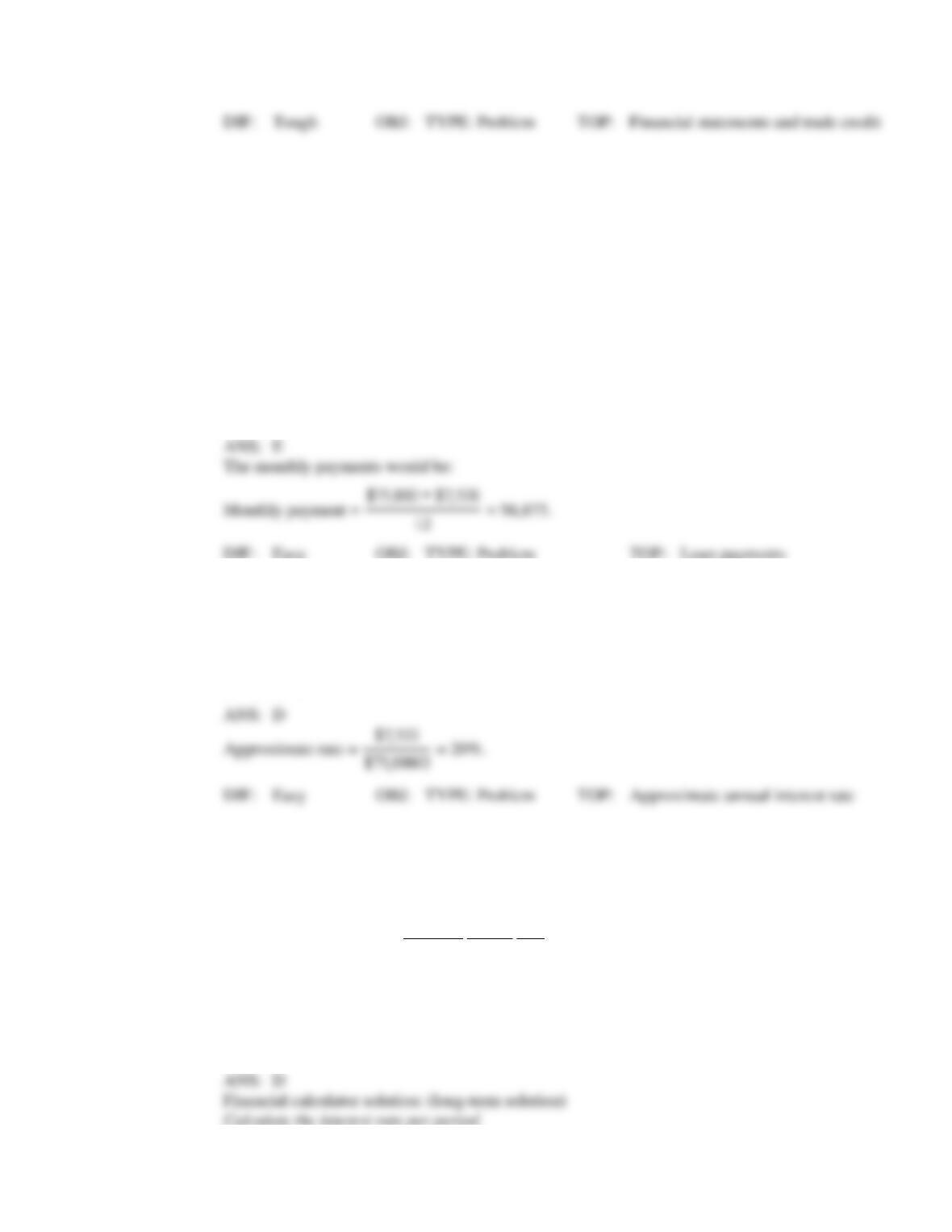
47. Quickbow Company currently uses maximum trade credit by not taking discounts on its
purchases. Quickbow is considering borrowing from its bank, using notes payable, in order to
take trade discounts. The firm wants to determine the effect of this policy change on its net
income. The standard industry credit terms offered by all its suppliers are 2/10, net 30 days, and
Quickbow pays in 30 days. Its net purchases are $11,760 per day, using a 360-day year. The rate
on the notes payable is 10 percent and the firm’s tax rate is 40 percent. If the firm implements the
plan, what is the expected change in Quickbow’s net income?
a.
-$23,520
b.
-$32,160
c.
+$23,520
d.
+$37,728
e.
+$62,880
Chapter 16 Managing Short-Term Liabilities (Financing) 357
Exhibit 16-1
You have just taken out a loan for $75,000. The stated (simple) interest rate on this loan is 10
percent, and the bank requires you to maintain a compensating balance equal to 15 percent of the
initial face amount of the loan. You currently have $20,000 in your checking account, and you
plan to maintain this balance. The loan is an add-on installment loan which you will repay in 12
equal monthly installments, beginning at the end of the first month.
48. Refer to Exhibit 16-1. How large are your monthly payments?
a.
$6,250
b.
$7,000
c.
$7,500
d.
$5,250
e.
$6,875
49. Refer to Exhibit 16-1. What is the approximate annual interest rate on this loan?
a.
10.00%
b.
16.47%
c.
18.83%
d.
20.00%
e.
24.00%
Financial Calculator Section
The following question(s) may require the use of a financial calculator.
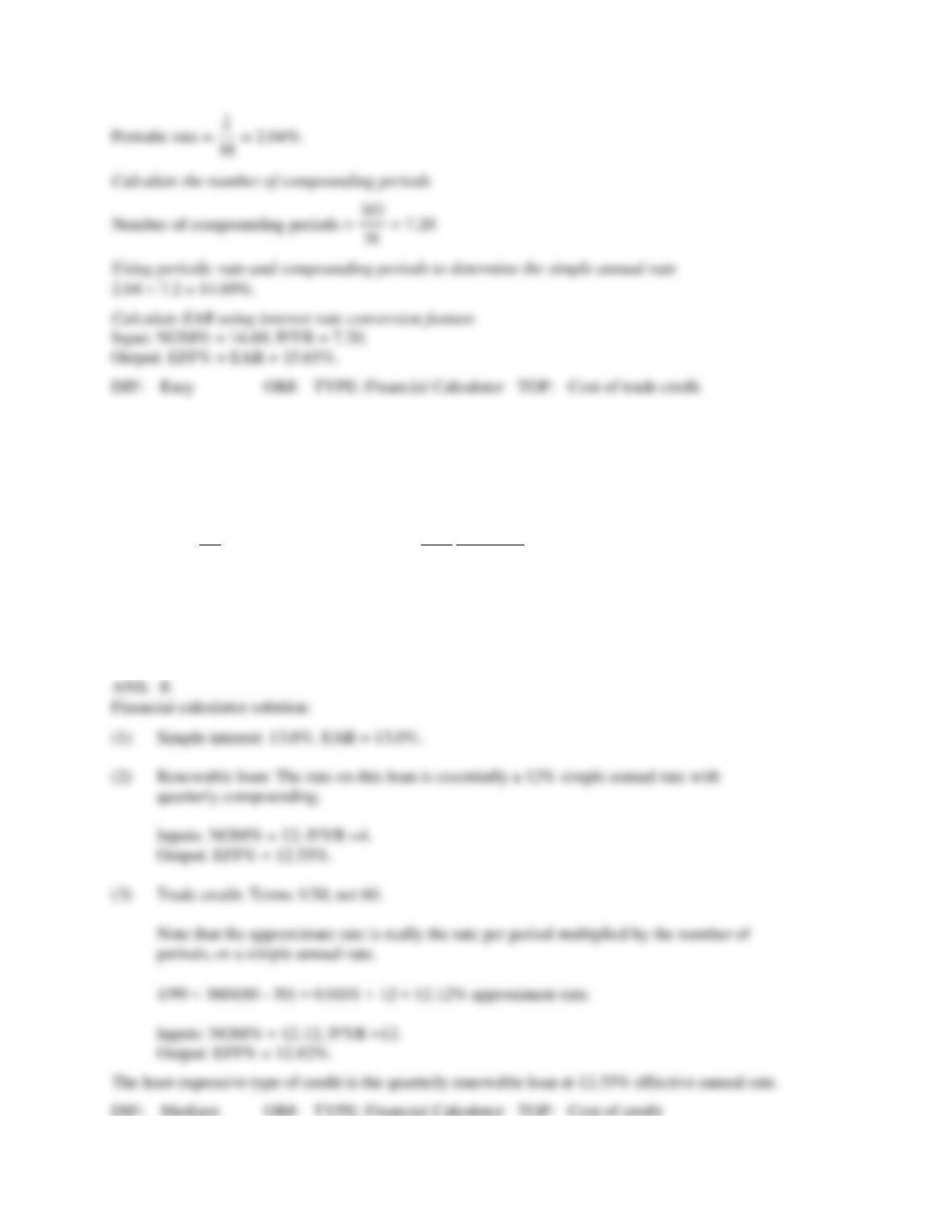
50. A firm is offered trade credit terms of 2/8, net 45. The firm does not take the discount, and it pays
after 58 days. What is the effective annual cost of not taking this discount? (Note: Do not use the
approximate cost.)
a.
21.63%
b.
13.35%
c.
22.95%
d.
15.65%
e.
18.70%
358 Chapter 16 Managing Short-Term Liabilities (Financing)
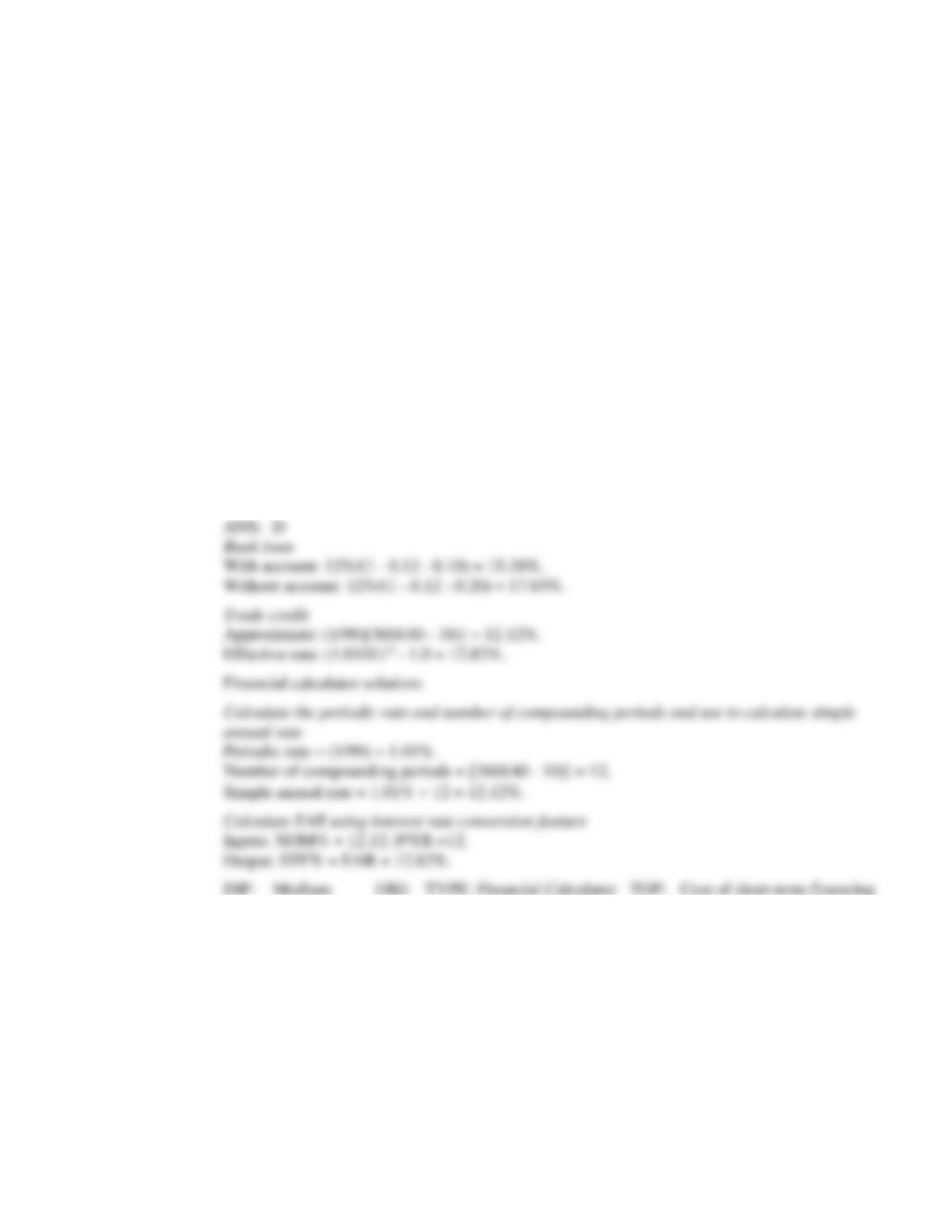
51. The Lasser Company needs to finance an increase in its working capital for the coming year.
Lasser is reviewing the following three options: (1) The firm can borrow from its bank on a
simple interest basis for one year at 13 percent. (2) It can borrow on a 3-month, but renewable,
loan at a 12 percent simple rate. The loan is a simple interest loan, completely paid off at the end
of each quarter, then renewed for another quarter. (3) The firm can increase its accounts payable
by not taking discounts. Lasser buys on credit terms of 1/30, net 60 days. What is the effective
annual cost (not the approximate cost) of the least expensive type of credit, assuming 360 days
per year?
a.
13.0%
b.
12.82%
c.
11.46%
d.
12.12%
e.
12.55%
Chapter 16 Managing Short-Term Liabilities (Financing) 359
52. Judy’s Fashions Inc. purchases supplies from a single supplier on terms of 1/10, net 20. Currently,
Judy takes the discount, but she believes she could extend the payment to 40 days without any
adverse effects if she decided not to take the discount. Judy needs an additional $50,000 to
support an expansion of fixed assets. This amount could be raised by making greater use of trade
credit or by arranging a bank loan. The banker has offered to loan the money at 12 percent
discount interest. Additionally, the bank requires an average compensating balance of 20 percent
of the loan amount. Judy already has a commercial checking account at this bank which could be
counted toward the compensating balance, but the required compensating balance amount is
twice the amount that Judy would otherwise keep in the account. Which of the following
statements is most correct?
a.
The cost of using additional trade credit is approximately 36 percent.
b.
Considering only the explicit costs, Judy should finance the expansion with the bank loan.
c.
The cost of expanding trade credit using the approximation formula is less than the cost of
the bank loan. However, the true cost of the trade credit when compounding is considered
is greater than the cost of the bank loan.
d.
The effective cost of the bank loan is decreased from 17.65 percent to 15.38 percent
because Judy would hold a cash balance of one-half the compensating balance amount
even if the loan were not taken.
e.
If Judy had transaction balances that exceeded the compensating balance requirement, the
effective cost of the bank loan would be 12.00 percent.
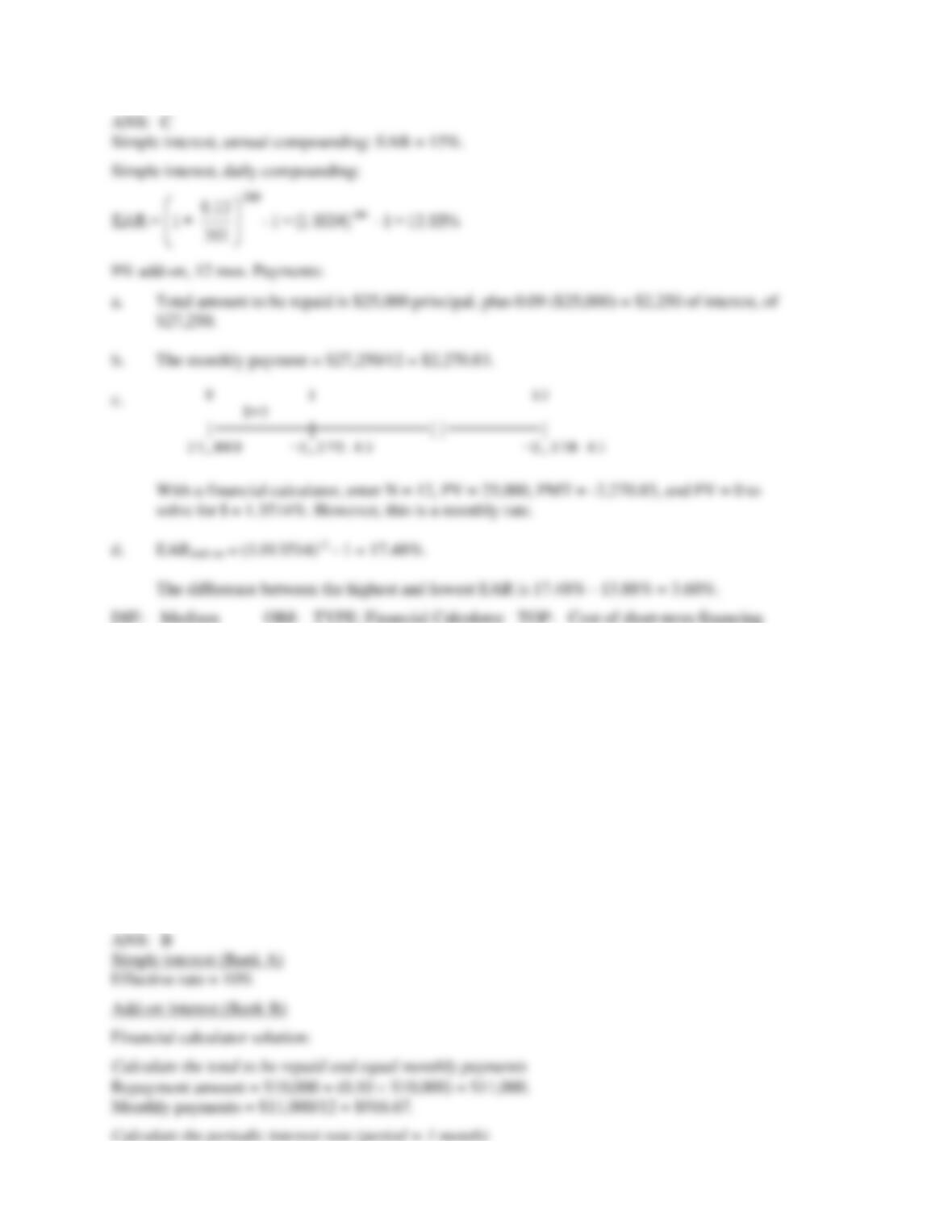
53. You need to borrow $25,000 for one year. Your bank offers to make the loan, and it offers you
three choices: (1) 15 percent simple interest, annual compounding; (2) 13 percent simple interest,
daily compounding (360-day year); (3) 9 percent add-on interest, 12 end-of-month payments. The
first two loans would require a single payment at the end of the year, the third would require 12
equal monthly payments beginning at the end of the first month. What is the difference between
the highest and lowest effective annual rate?
a.
1.12%
b.
2.48%
c.
3.60%
d.
4.25%
e.
5.00%
360 Chapter 16 Managing Short-Term Liabilities (Financing)
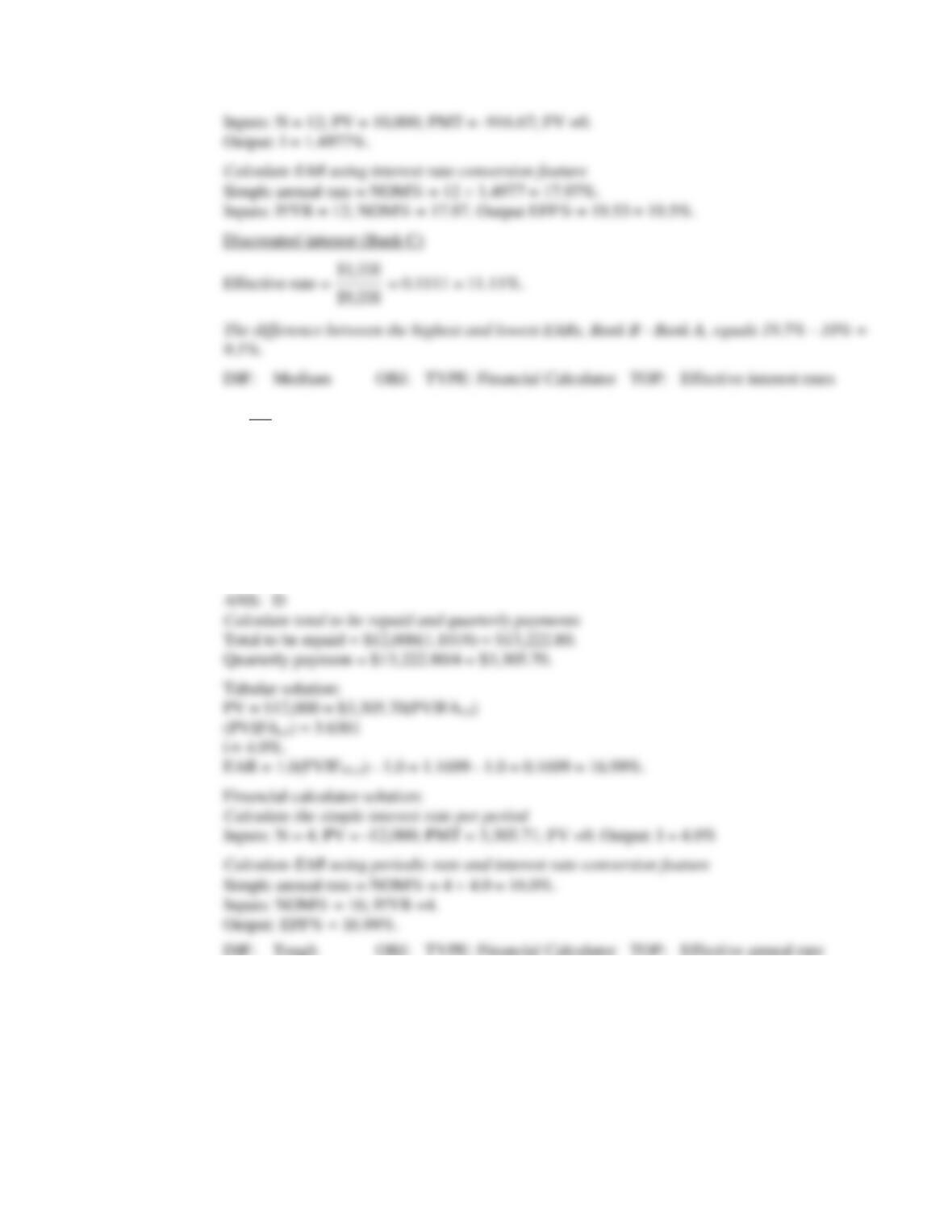
54. You go to three different banks to borrow $10,000 for one year. Each says it will lend you the
money at 10 percent, but their terms differ as follows:
Bank A:
Simple interest
Bank B:
Add-on interest
Bank C:
Discounted interest
Banks A and C require a single payment at the end of the year. Bank B requires 12 equal monthly
payments beginning at the end of the first month. What is the difference between the highest and
lowest effective annual rate in this case?
a.
13.0%
b.
9.5%
c.
9.0%
d.
8.5%
e.
8.0%
Chapter 16 Managing Short-Term Liabilities (Financing) 361
55. Do not use the approximation formula for this problem. Coverall Carpets Inc. is planning to
borrow $12,000 from the bank. The bank offers the choice of a 12 percent discounted interest
loan or a 10.19 percent add-on, one-year installment loan, payable in 4 equal quarterly payments.
What is the effective rate of interest on the 10.19 percent add-on loan?
a.
9.50%
b.
10.19%
c.
15.22%
d.
16.99%
e.
22.05%