126. Prepare the journal entries for the following events. (Assume that purchases and expenses are credited to
cash.)
a.
Raw materials purchased
$30,000
b.
Direct materials used
25,000
c.
Indirect materials used
3,500
d.
Wages payable-direct
30,000
e.
Wages payable-indirect
6,000
f.
Selling and administrative expenses
16,000
g.
Other manufacturing overhead costs
12,500
h.
Manufacturing overhead applied
20,000
i.
Work-in-process completed
60,000
j.
Finished goods sold
67,500
127. Prepare the journal entries for the following events in a dress manufacturing organization.
a.
Purchased 400 yards of fabric on account costing $4 per yard.
b.
Placed 50 yards of fabric into production
c.
50 hours of labor at $10 per hour were used to produce the shirts.
d.
Overhead costs of $350 were incurred for the plant manager’s salary.
e.
Overhead costs were allocated at the rate of $6 per direct labor hour.
f.
Work was completed on the shirts. All of the shirts were transferred out.
g.
All of the shirts were sold at a total price of $1,200.
a.
Raw materials inventory
30,000
Cash
30,000
b.
Work-in-process inventory
25,000
Raw materials inventory
25,000
c.
Manufacturing overhead
3,500
Indirect materials inventory
3,500
d.
30,000
Wages payable
30,000
e.
Manufacturing overhead
6,000
Wages payable
6,000
f.
Selling and administrative expense
16,000
Cash
16,000
g.
Manufacturing overhead
12,500
Cash
12,500
h.
20,000
Manufacturing overhead
20,000
i.
Finished Goods inventory
60,000
60,000
j.
Cost of Goods Sold
67,500
Finished Goods inventory
67,500
128. Clibon Manufacturing Company uses a job order costing system. All relevant information for the products
completed in July is provided below:
Beginning work-in-process
$ 3,000
Direct materials cost
$12,500
Direct labor cost
$ 9,000
Direct labor hours
750
Units produced
500
Actual manufacturing overhead
$ 7,000
Predetermined overhead rate
75%
of direct labor cost
Units sold
400
a.
How much manufacturing overhead will be applied for the month of July?
b.
By how much will the overhead be over- or underapplied?
c.
Prepare the journal entries to transfer costs for direct materials used, direct labor, and applied manufacturing overhead to the appropriate
inventories as the products are worked on, completed, and sold.
d.
Assuming that over/underapplied overhead is closed directly to cost of goods sold, calculate cost of goods sold for July.
a.
Raw materials inventory
1,600
b.
200
Raw materials inventory (50 ´ $4)
500
Wages payable (50 ´ $10)
d.
Manufacturing overhead
350
Salaries payable
350
e.
300
Manufacturing overhead (50 ´ $6)
Finished goods inventory
1,000
g.
Accounts receivable
1,200
Sales revenue
Cost of goods sold
1,000
Finished goods inventory
129. Wieland Company uses a job order costing system. Thus, management must establish a predetermined
overhead rate for applying manufacturing overhead. During the past three months, the following data have been
accumulated:
April
May
June
Direct labor hours
20,000
26,000
35,000
Machine hours
50,000
25,000
15,000
Direct materials costs
$200,000
$125,000
$175,000
Total budgeted manufacturing overhead
$ 40,000
$ 35,000
$ 25,000
In good form, prepare a schedule of predetermined overhead rates for each of the three years assuming the rate is based on:
a.
Direct labor hours (round to the nearest cent)
b.
Machine hours (round to the nearest cent)
c.
Direct materials costs
a.
$9,000 ´ 75% = $6,750
underapplied
c.
28,250
Wages Payable
9,000
($9,000 ´ 75%)
Finished Goods Inventory
31,250
Cost of Goods Sold
25,000
Add: Underapplied overhead
250
Cost of goods sold reported for July
$25,250
130. Washington Company has two independent divisions and uses a job order costing system. Washington
made the following estimates at the beginning of the year:
Division 1
Division 2
Direct labor hours
50,000
35,000
Machine hours
75,000
50,000
Direct labor costs
$600,000
$250,000
Total budgeted manufacturing overhead
$ 90,000
$ 70,000
Manufacturing overhead is applied on the basis of machine hours in Division 1 and on the basis of labor hours in Division 2. During the current
month, one job was completed (no jobs were in process at the beginning or end of the month). The following information is available for the
completed job:
Division 1
Division 2
Direct materials used
$12,000
$5,000
Direct labor costs
$10,000
$8,000
Direct labor hours
4,500
3,000
Machine hours
7,000
4,000
Using the information above, compute the following items:
a.
The predetermined overhead rate for each division.
b.
The amount of manufacturing overhead to be applied to the job.
c.
The total cost of the job.
d.
The amount of over- or underapplied manufacturing overhead for the month, assuming that actual manufacturing overhead for Division 1
and Division 2 was $9,000 and $5,000, respectively.
April
May
June
Direct labor hours
¸20,000
¸26,000
¸35,000
Predetermined overhead rate
April
May
June
Total budgeted manufacturing overhead
$40,000
$35,000
$25,000
Machine hours
¸50,000
¸25,000
¸15,000
Predetermined overhead rate
$ .80/hr
April
May
June
c.
Total budgeted manufacturing overhead
$ 40,000
$ 35,000
$ 25,000
Direct materials costs
¸200,000
¸125,000
¸175,000
Predetermined overhead rate
20%
28%
14.3%
131. Abe’s Automobile Manufacturing Company reported the following information for 2012:
Beginning work-in-process inventory
$910,000
Beginning raw materials inventory
332,000
Ending work-in-process inventory
787,000
Ending raw materials inventory
420,000
Raw materials purchased
683,000
Direct labor
651,000
Applied manufacturing overhead
450,000
Division 1:
Machine hours
¸75,000
Predetermined overhead rate
Division 2:
Total budgeted manufacturing overhead
$70,000
Direct labor hours
¸35,000
Predetermined overhead rate
Division 1:
Actual machine hours
7,000
Predetermined overhead rate
´$1.20
Applied manufacturing overhead
$8,400
Division 2:
Actual direct labor hours
3,000
Predetermined overhead rate
´$2.00
Applied manufacturing overhead
$6,000
Division 1
Division 2
Total
Direct materials
$12,000
$ 5,000
$17,000
Direct labor
10,000
8,000
18,000
Manufacturing overhead
8,400
6,000
14,400
Total cost of job
$30,400
$19,000
$49,400
Division 1
Division 2
Total
Actual manufacturing overhead
$ 9,000
$ 5,000
$14,000
Applied manufacturing overhead
8,400
6,000
14,400
Underapplied (overapplied)
$ 600
$(1,000)
$ (400)
manufacturing overhead
underapplied
overapplied
overapplied
Prepare a Cost of Goods Manufactured Schedule, in good form, for Abe’s Automobile Manufacturing Company for 2012.
132. Use the following information to prepare a cost of goods manufactured schedule for Bellevue Company for
the year ended December 31, 2012:
Ending raw materials inventory
$40,800
Ending work-in-process inventory
52,800
Depreciation-factory
16,800
Direct labor
84,000
Indirect labor
10,000
Indirect materials
14,400
Insurance-factory
18,000
Beginning work-in-process inventory
64,800
Beginning raw materials inventory
36,000
Payroll taxes-factory
16,800
Raw materials purchased
76,800
Predetermined overhead rate
85%
of direct labor cost
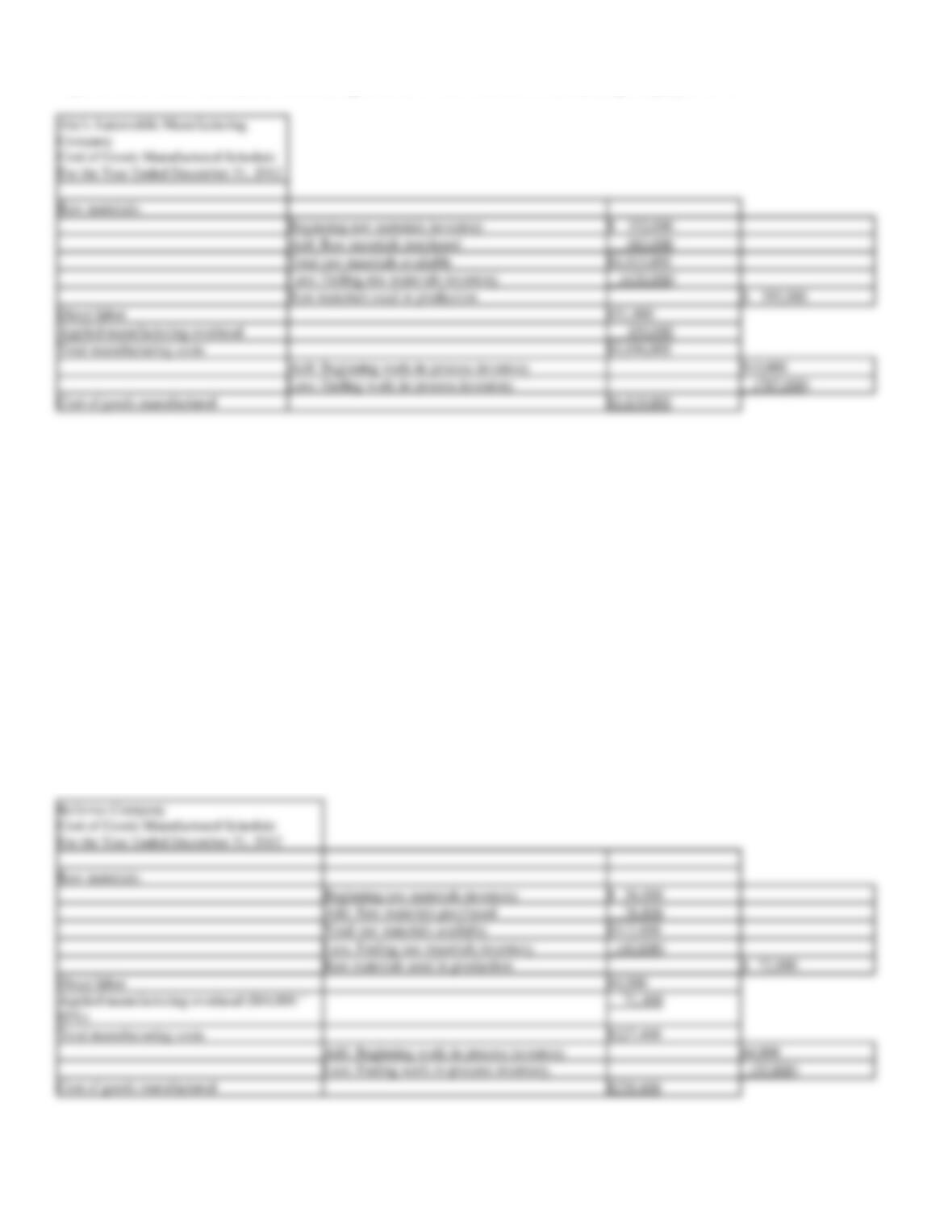
Raw materials:
Beginning raw materials inventory
$ 36,000
Add: Raw materials purchased
76,800
Total raw materials available
$112,800
Less: Ending raw materials inventory
(40,800)
Raw materials used in production
$ 72,000
Direct labor
84,000
Total manufacturing costs
$227,400
Add: Beginning work-in-process inventory
64,800
Raw materials:
Beginning raw materials inventory
$ 332,000
Add: Raw materials purchased
683,000
Total raw materials available
$1,015,000
Less: Ending raw materials inventory
(420,000)
Raw materials used in production
$ 595,000
Direct labor
651,000
Applied manufacturing overhead
450,000
Total manufacturing costs
$1,696,000
Add: Beginning work-in-process inventory
910,000
Cost of goods manufactured
$1,819,000
133. Prepare the journal entries for the following transactions in a transportation company:
a.
Purchased supplies costing $2,000 for cash.
b.
Used supplies costing $700.
c.
Incurred and paid 3,000 hours of direct labor and 1,000 hours of indirect labor. The average hourly wage rate for both direct and indirect
labor is $10.
d.
Received and paid an insurance bill of $750.
e.
Made monthly rent payment of $2,500.
f.
Applied overhead at $5 per direct labor hour.
g.
All work-in-process services was moved to cost of services and customers were billed at a rate of $22 per direct labor hour.
h.
Closed all over- or underapplied overhead to Cost of Services.
a.
Supplies
2,000
Cash
b.
700
Supplies
c.
30,000
Wages payable
Overhead
10,000
Wages payable
Overhead
Cash
e.
Overhead
2,500
Cash
15,000
Overhead
g.
Accounts receivable
66,000
Service revenue
Cost of services
45,700
h.
Overhead
1,750
Cost of services
134. Seven Peaks Inc. produces German sausage. The company uses process costing. All raw materials are
added at the beginning of the mixing process. The following information relates to July operations and the
work-in-process inventory account for Seven Peaks’ final processing department:
Beginning work-in-process:
500 pounds; 70% complete; $350 in direct materials;
$700 in conversion costs
Ending work-in-process:
350 pounds; 50% complete
Current month:
5,500 pounds of sausage were started and completed;
$12,000 raw materials were requisitioned;
$3,000 incurred in conversion costs
a.
Compute the equivalent units of production for both direct materials and conversion costs.
b.
Compute the total production cost per pound for the month.
135. Seven Peaks Inc. produces German sausage. The company uses process costing. All raw materials are
added at the beginning of the mixing process. The following information relates to July operations and the
work-in-process inventory account for Seven Peaks’ final processing department:
Beginning work-in-process:
500 pounds; 70% complete; $350 in direct materials;
$700 in conversion costs
Ending work-in-process:
350 pounds; 50% complete
Current month:
5,500 pounds of sausage were started and completed;
$12,000 raw materials were requisitioned;
$3,000 incurred in conversion costs
a.
Compute the costs transferred out for the month.
b.
Compute the total costs in ending work-in-process inventory.
a.
Equivalent Units of Production
Direct Materials Costs
Conversion Costs
Physical
Percent
Equivalent
Percent
Equivalent
Units
Done
Units
Done
Units
Beginning work-in–
process
0
30%
Started and completed
5,500
100%
5,500
100%
5,500
Ending work-in-process
100%
350
50%
175
Equivalent units of
production
5,850
5,825
Transferred out
6,000
b.
Product Costs Per Unit
Costs
Units
Unit
Current Period
Direct materials costs
$12,000
5,850
$2.05
Conversion costs
3,000
5,825
.52
Total
$15,000
$2.57
136. UniCom Manufacturing Company uses FIFO process costing. At the beginning of August, there were 500
units in beginning work-in-process that were 40% complete. In Process 1 all direct materials are added at the
beginning of the process. The costs for the 500 units include $1,500 for direct materials and $2,000 for direct
labor and conversion costs. During August, an additional 2,000 units entered Process 1. Costs incurred during
August include $6,200 for direct materials and $19,200 for conversion costs. There were 200 units only 70%
complete by the end of the month.
Prepare a production cost report for the month of August.