Chapter 16: Strategic Performance Measurement
Learning Questions
True /
False
Multiple Choice
Matching
Exercises
Short
Answer
Problems
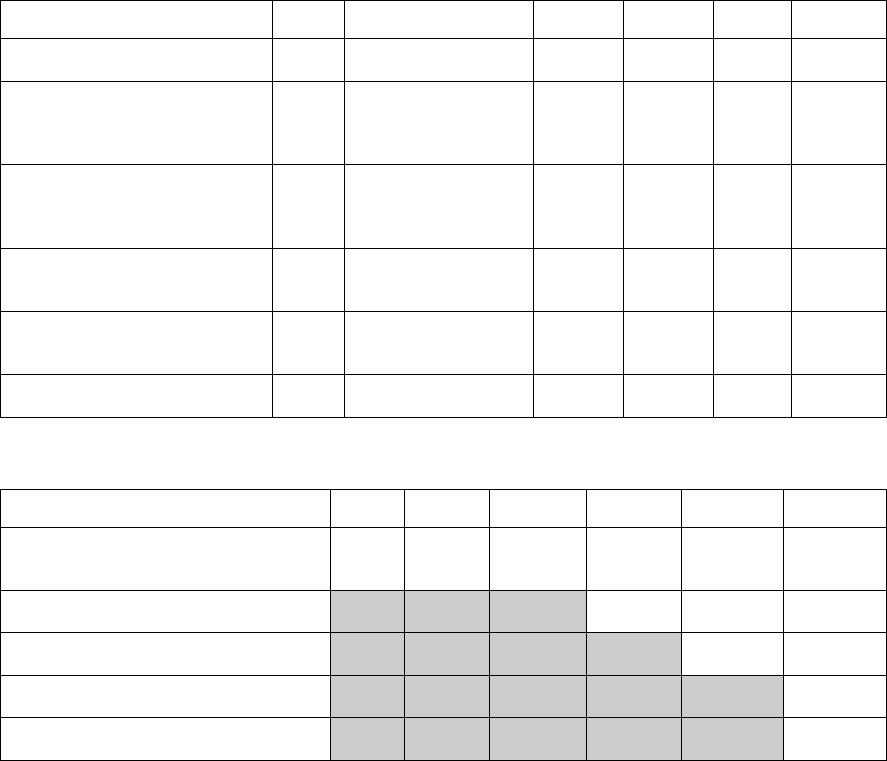
1. What is strategic decision
making?
1-5
1-9
S: 64
2
4
4
2. How are financial and
nonfinancial measures used
to evaluate organizational
performance?
6-8
10–15
W: 80
1
2, 3
1
3. What is a balanced
scorecard?
9-15
16, 18-41
S: 66-69, 73-76
W: 79, 81, 83-86, 88,
89, 94
1, 2, 3
2, 5, 6,
7, 8
1, 2, 3, 4
4. How is a balanced scorecard
implemented?
16–18
43–51
S: 70-72, 77, 78
W: 90–93
3
3
5. What are the strengths and
weaknesses of the balanced
scorecard?
19–24
17, 42, 52-63
S: 65
W: 82, 87, 95
3, 9
6. What is the future direction
of cost accounting?
10
S: Questions from the study guide
W: Questions from web quizzes on the student web site
Level of Complexity*
True /
False
Multiple
Choice
Matching
Exercises
Short
Answer
Problems
Foundation: Repeat or paraphrase
information; Reason to single correct
solution; Perform computations; etc.
All
All
All
2
Step 1: Identify the problem, relevant
information, and uncertainties
1, 2, 3, 4
1, 2, 3, 4
3
Step 2: Explore interpretations and
connections
5, 6, 7, 8,
9, 10
1, 2, 3, 4
Step 3: Prioritize alternatives and
implement conclusions
Step 4: Envision and direct strategic
innovation
*Based on level in Steps for Better Thinking (Exhibit 1.10, textbook p. 16):
Note: Step 1, 2, 3, and 4 questions in this test bank are intentionally open-ended and subjective, giving students the
opportunity to demonstrate skills such as judgment, reasoning, identification of uncertainties, identification or analysis of
pros and cons, and so on. Therefore, student answers may not exactly match those shown in the solutions.

16-2 Cost Management
True / False
1. Part of strategic decision making is periodically clarifying organizational vision and core
competencies.
2. The nature of an organization’s strategies influences the types of performance objectives managers
establish.
3. Stakeholders in the strategic decision making process include suppliers, customers, and the
community.
4. An organization’s core competencies can include productivity, reputation, and regulatory advantages.
5. Successful organizations communicate their vision, strategies, goals, and objectives to upper-level
employees.
6. Well-run organizations evaluate performance based only on financial measures because they are more
objective than nonfinancial measures.
7. Managers should focus on finding the “one best measure” of performance based on the type of
responsibility center they manage.
8. Nonfinancial measures are typically not objective enough to serve as effective performance measures.
10. The purpose of a balanced scorecard is to translate organizational vision and strategies into
performance objectives that can be monitored over time.
11. A balanced scorecard often contains four perspectives: customer, financial, internal business process,
and learning and growth.
12. The basis of a balanced scorecard is continuous strategic analysis from as many perspectives as
possible.
13. The balanced scorecard’s financial perspective is focused primarily on measures of economic and
accounting profits.
14. The internal business process perspective in a balanced scorecard concentrates principally on
employees.
15. Learning and growth measures, if incorporated in a balanced scorecard, cannot focus on employees.
16. The first step in implementing a balanced scorecard is developing measures for each of the
perspectives.
17. In implementing a balanced scorecard, managers should establish performance targets after analyzing
the first set of scorecard data.
18. Once balanced scorecard measures have been chosen, they should not be changed for at least five
years.
19. One of the balanced scorecard’s biggest advantages is the small amount of time and money involved
in its implementation.
20. Balanced scorecard initiatives are sometimes seen as temporary fads by employees.
21. The balanced scorecard links short-term and long-term performance objectives to organizational
vision and strategies.
22. Lack of senior management support is one of the major causes for failed balanced scorecard
initiatives.
23. Balanced scorecards, when properly implemented, can guide managers in making more effective
decisions.
24. Balanced scorecards can improve communication and consensus throughout an organization.

Chapter 16: Strategic Performance Measurement 16-3
Multiple Choice
1. Which of the following is a synonym for an organization’s vision?
a. Purpose and ideology
b. Core competencies
c. Organizational strategies
d. Operating plans
2. Components of organizational strategy include
a. Short-term financing
b. Actual operations
c. Financial structure
d. Comparing actual results to the budget
3. An organization’s operating plans include all of the following except
a. Specific performance objectives
b. Actual operations
c. Short-term financing
d. Short-term resource allocation
4. An organization’s core competencies are related to its strengths relative to competitors. Those
strengths can include
I. Productivity and skills
II. Reputation and legal rights
III. Mission and core purpose
a. I and II only
b. II and III only
c. I and III only
d. I, II, and III
5. FPM Corporation’s strategic plan includes the following statement: “We deliver high-quality and
timely service to our internal and external customers.” That statement is best described as a(n)
a. Mission statement
b. Specific performance objective
c. Operating plan
d. Strategy
6. Managers consider a few general strategy types in their decision making processes, including
I. Cost leadership
II. Product differentiation
III. Target costing
a. I and II only
b. II and III only
c. I and III only
d. I, II, and III
7. Which of the following best describes the relationship between strategies and operating plans?
a. Operating plans form the basis for strategies.
b. Operating plans are the same as strategies.
c. Strategies lead to operating plans.
d. Strategies and operating plans are unrelated to one another.
16-4 Cost Management
8. An organizational vision is concerned with creating value for stakeholders, including
I. The community and society
II. Employees and suppliers
III. Customers and owners
a. I and II only
b. II and III only
c. I and III only
d. I, II, and III
9. Which of the following are inputs to the development of organizational strategy?
a. Organizational vision and operating plans
b. Operating plans and core competencies
c. Actual operations and operating plans
d. Organizational vision and core competencies
10. Managers have traditionally relied on which of the following measures to evaluate performance?
a. Qualitative factors
b. Financial measures
c. Nonfinancial measures
d. Core competencies
11. Nonfinancial measures include
I. Cost variances
II. Defect rates
III. Customer satisfaction surveys
a. I and II only
b. II and III only
c. I and III only
d. I, II, and III
12. Analysis of the gaps between actual operations and performance objectives can be used to
I. Compensate employees
II. Prepare financial statements
III. Improve future strategies
a. I and II only
b. I and III only
c. II and III only
d. I, II, and III
13. Financial measures used for organizational evaluation can pertain to
I. Divisions
II. Product lines
III. Departments
a. I and II only
b. II and III only
c. I and III only
d. I, II, and III
14. Which of the following statements about performance evaluation is true?
a. Nonfinancial measures are less useful than financial measures because they are not as objective
b. Financial measures are less useful than nonfinancial measures because they are biased
c. A combination of financial and nonfinancial measures gives a more useful picture of
organizational performance than either one alone
d. Only one or two nonfinancial performance measures should be used
Chapter 16: Strategic Performance Measurement 16-5
15. Financial and nonfinancial indicators are used to assess organizational performance and effectiveness
under which of the following approaches?
a. Balanced budget
b. Balanced scorecard
c. Variance analysis
d. Proforma financial statement
16. The primary aim of the balanced scorecard is to
a. Put less emphasis on financial measures because they are too narrowly focused
b. use performance indicators that are highly objective
c. Translate elements of a company’s strategic plan into measurable performance indicators
d. Provide a truthful basis for evaluating managers’ performance
17. The balanced scorecard approach to performance evaluation
I. Is less time consuming and expensive than other approaches
II. Helps managers integrate strategies across divisions and functions
III. Assists managers in predicting possible future problems
a. I and III only
b. I and II only
c. II and III only
d. I, II, and III
18. The perspectives in a typical balanced scorecard include all of the following except
a. Qualitative
b. Financial
c. Customer
d. Learning and growth
19. The perspectives in a balanced scorecard
a. Can be adapted to an individual organization’s priorities
b. Cannot be changed because of copyright restrictions
c. Include qualitative and quantitative
d. Are externally focused only in for-profit organizations
20. The balanced scorecard’s perspectives
a. Are linked through careful managerial analysis
b. Are not linked in any meaningful way
c. Are a relatively unimportant part of the scorecard
d. Are exclusively focused on internal measures in not-for-profit organizations
21. Which of the following measures would most likely be found in the financial perspective of the
balanced scorecard?
a. Change in market share
b. Training days per employee
c. Residual income
d. Percent capacity utilization
22. Which of the following measures would most likely be found in the learning and growth perspective
of the balanced scorecard?
a. Change in market share
b. Training days per employee
c. Residual income
d. Percent capacity utilization
16-6 Cost Management
23. Which of the measures below would most likely be found in the customer perspective of the balanced
scorecard?
a. Change in market share
b. Training days per employee
c. Residual income
d. Percent capacity utilization
24. Which of the following measures would most likely be found in the internal business process
perspective of the balanced scorecard?
a. Change in market share
b. Training days per employee
c. Residual income
d. Percent capacity utilization
25. Which of the following measures would least likely be included in a balanced scorecard’s financial
perspective?
a. Customer satisfaction rating
b. Percent of sales from return customers
c. Average revenue per customer
d. Increase in sales by geographic region
26. Which of the following measures would least likely be included in a balanced scorecard’s customer
perspective?
a. Customer satisfaction rating
b. revenue growth by product line
c. Total operating income by product line
d. Percent of repeat sales
27. Which of the following measures would least likely be included in a balanced scorecard’s internal
business process perspective?
a. Percent change in throughput time
b. Customer satisfaction rating
c. Percent capacity utilization
d. Average waiting time per customer
28. Which of the following measures would least likely be included in a balanced scorecard’s learning
and growth perspective?
a. Number of patent applications for new products
b. Average training cost per employee
c. Percent of revenue from new products
d. Rank in customer surveys
29. The internal business process perspective in a balanced scorecard is often broken down into its value
chain components. Those components include all of the following except the
a. Innovation cycle
b. Operations cycle
c. Post-sales service cycle
d. Budget cycle
30. Steps in the innovation cycle of the value chain include
a. Delivering products and services
b. Designing products and services
c. Building products and services
d. Providing customer service
Chapter 16: Strategic Performance Measurement 16-7
31. Steps in the operations cycle of the value chain include
a. Identifying customer preferences
b. Designing products and services
c. Building products and services
d. Providing customer service
32. Steps in the post-sales service cycle of the value chain include
a. Identifying customer preferences
b. Designing products and services
c. Building products and services
d. Providing customer service
33. The steps and cycles in the value chain are most closely associated with which balanced scorecard
perspective?
a. Financial
b. Customer
c. Internal business process
d. Learning and growth
34. Which of the following statements is true?
I. Traditionally, internal operations were monitored to improve financial performance
II. In the balanced scorecard approach, monitoring for improvement is not valued
III. Managers believe that monitoring performance measures related to an organizations’
learning and growth should lead to improvements in financial performance
a. I and II only
b. II and III only
c. I and III only
d. I, II, and III
35. The measures in a balanced scorecard are guided by
a. Vision and strategy
b. Budget plans
c. Stockholders
d. The board of directors
Use the following information for the next 3 questions.
Adoption Associates Inc. (AAI) is a multi-city, not-for-profit corporation. Its mission is to promote adoption
of domestic and international children. Since its opening in 2001, it has facilitated the adoption of 98 U.S.-
born infants and 145 international children.
36. Which of the following statements is true?
a. Because AAI is a not-for-profit organization, it cannot use the balanced scorecard effectively
b. AAI’s balanced scorecard may include more than four perspectives
c. AAI’s balanced scorecard should include only financial, customer, internal business, and learning
and growth perspectives
d. Financial measures are irrelevant in AAI’s balanced scorecard because it is a not-for-profit
organization
37. “Percent of funding received from clients” would most likely be a measure in which perspective of
AAI’s balanced scorecard?
a. Innovation perspective
b. Financial perspective
c. Internal business process perspective
d. Employee development perspective
16-8 Cost Management
38. Upon completion of an adoption process, AAI’s clients complete a questionnaire regarding their
experience. The results of that questionnaire would most likely be summarized and reported as a part
of which of the following perspectives?
a. Customer
b. Internal business process
c. Learning and growth
d. Nonfinancial
Use the following information for the next 5 questions.
National Bank of California (NBOC) is the fourth largest commercial bank in California, and one of the 35
largest in the United States. NBOC assets total $46.1 billion, loans of $26 billion, and total deposits of $35.5
billion. It provides online, telephone, and traditional banking and investment services to both individuals and
businesses in the U.S. and abroad. NBOC’s mission is to create an exceptional customer experience by
providing solutions through leading technologies, offering a wide selection of financial products and services,
and leveraging experience to meet customers’ needs.
39. “Percent change in dollars spent on information technology” is most likely used in which
perspective?
a. Information technology
b. Financial
c. Customer
d. Internal business process
40. Which of the following measures is least likely to be included in the financial perspective of NBOC’s
balanced scorecard?
a. Prime rate
b. Total loans outstanding
c. Profit margin
d. Total demand deposits
41. Internal business process measures on NBOC’s balanced scorecard would likely include
I. Average wait time per customer
II. Training and development costs per internal employee
III. Cost per customer served
a. I and II only
b. I and III only
c. II and III only
d. I, II, and III
42. All of the following measures could be included in a balanced scorecard for NBOC. Which is the
most subjective?
a. Revenue growth
b. Employee turnover
c. Leadership competence
d. Quality improvement costs incurred
43 NBOC could develop a balanced scorecard for
I. The organization as a whole
II. Individual branches
III. Domestic branches only
IV. International branches only
a. I, II, and III only
b. II, III, and IV only
c. I, II, and IV only
d. I, II, III, and IV
Chapter 16: Strategic Performance Measurement 16-9
44. The steps for implementing a balanced scorecard
a. Are different in for-profit and not-for-profit organizations.
b. Should be customized for individual organizations.
c. Should not vary if the implementation is to be effective.
d. begin with developing measures in each perspective.
45. The balanced scorecard implementation process begins with
a. Selecting an implementation team.
b. Developing measures for each perspective.
c. Hiring an outside consultant.
d. Clarifying organizational vision.
46. Following are some of the steps in implementing a balanced scorecard. Which one of these steps
would be performed before the others?
a. Collect and analyze scorecard data.
b. Communicate and refine measures.
c. Establish performance targets and action plans.
d. Develop performance measures and objectives.
47. In which order should the following steps be taken in implementing a balanced scorecard?
1. Develop links among the objectives of the organization, divisions, departments, and
individuals.
2. Provide feedback to employees and others.
3. Establish action plans and specific performance targets
a. 1, 2, 3
b. 2, 1, 3
c. 3, 2, 1
d. 1, 3, 2
48. Following are some of the steps in implementing a balanced scorecard. Which one of these steps
would be performed last?
a. Investigate variances and reward employees.
b. Collect and analyze scorecard data to monitor performance.
c. Clarify organizational vision and strategies.
d. Establish action plans.
49. The first step in implementing a balanced scorecard is to clarify organizational vision, core
competencies, and strategies. The vision
a. Provides an overall direction for the organization
b. Is another name for the organization’s strengths and weaknesses
c. Provides an explicit plan for daily operations
d. Should explicitly incorporate all core competencies
50. The first step in implementing a balanced scorecard is to clarify organizational vision, core
competencies, and strategies. The strategies
a. Are the core competencies of the organization
b. Are most effectively developed in a decentralized organization
c. Provide guidance for achieving the vision
d. Should explicitly incorporate all core competencies
51. Each perspective of the balanced scorecard normally contains
a. A single, comprehensive measure to limit information overload
b. The same number of measures as the other perspectives
c. Four to seven performance measures
d. Either input measures or outcome measures, but not both
16-10 Cost Management
52. Strengths of the balanced scorecard can typically be summarized in three groups. Which of the
following is not one of them?
a. Communication and linkages
b. Guidance for improvements
c. Motivation
d. Cost
53. Strengths of the balanced scorecard related to communication and linkages include
I. Encouraging clarification of vision and strategies
II. Improving organizational consensus
III. Selecting measures that reflect the only strengths of the organization
a. I and II only
b. I and III only
c. II and III only
d. I, II, and III
54. Balanced scorecard projects can motivate
I. Employee effort
II. Achievement of organizational strategies
III. Managers to ignore biases and uncertainties
a. I and III only
b. II and III only
c. I and II only
d. I, II, and III
55. One of the strengths of the balanced scorecard is its ability to provide guidance for improvements.
Those improvements can be related to
I. Cost reductions
II. Employee morale
III. Decision making
a. I and II only
b. I and III only
c. II and III only
d. I, II, and III
56. In terms of motivation, one of the balanced scorecard’s strengths is
a. Improved financial performance
b. Aligning individual goals with organizational strategies
c. Convincing managers that the scorecard is more than a temporary fad
d. Having generally-defined objectives to increase motivation
57. Weaknesses of the balanced scorecard include all of the following except
a. Expensive and time-consuming implementation
b. Inability to clarify vision and strategies
c. Lack of employee support
d. Doubt about links among the perspectives
58. The balanced scorecard may be inappropriate for
a. Compensating employees
b. Motivating employees
c. Generating improved financial performance
d. Improving communication

Chapter 16: Strategic Performance Measurement 16-11
59. Which of the following is an implementation mistake related to the balanced scorecard?
a. Beginning by clarifying organizational vision
b. Linking objectives to strategies
c. Defining objectives in too general a manner
d. Integrating vision and strategies into operations in a more complete manner
60. Common biases associated with balanced scorecard projects include
I. Resistance to change from individuals
II. The balanced scorecard process being viewed as a temporary fad
III. Periodic performance reviews
a. I and II only
b. I and III only
c. II and III only
d. I, II, and III
61. The balanced scorecard approach has been criticized for not capturing core values related to
a. Relations with regulators or approaches to the environment
b. Customer satisfaction
c. Shareholder returns
d. Employee attitudes
62. Formulaic approaches for using balanced scorecard results
a. Are an excellent idea because of their objectivity
b. Can lead to suboptimal decisions
c. Are aligned with the overall purpose of the balanced scorecard
d. Ensure that all employees are treated fairly
63. How is organizational learning related to the balanced scorecard?
a. Organizational learning is only important in the learning and growth perspective
b. Only learning organizations can be successful in scorecard implementation
c. The balanced scorecard can improve organizational learning
d. Both are important, but they are unrelated
Multiple Choice from Study Guide
s64. Suppose an organization’s strategic goals include the development of unusual, high-quality products.
Which of the following would best support this strategy?
a. Offering products at a lower cost than competitors
b. Offering products that are similar to competitors
c. Advertising campaigns that make customers aware of how the company’s products differ from
competitors
d. Targets to achieve massive production cost reductions
s65. The balanced scorecard will be least beneficial when
a. It is considered a stand-alone performance measurement system
b. It is considered a strategic management system
c. It leaves the hands of upper-level management
d. Targets are easy to understand
s66. The balanced scorecard’s financial perspective is immediately supported by which other perspective?
a. Learning and growth
b. Innovation
c. Internal business processes
d. Customer
16-12 Cost Management
s67. The balanced scorecard’s customer perspective is immediately supported by which other perspective?
a. Learning and growth
b. Innovation
c. Internal business processes
d. Financial
s68. The balanced scorecard’s internal business processes perspective is immediately supported by which
other perspective?
a. Learning and growth
b. Innovation
c. Customer
d. Financial
s69. Which of the balanced scorecard’s perspectives has three subcategories?
a. Learning and growth
b. Internal business processes
c. Customer
d. Financial
s70. The balanced scorecard emphasizes linkages between the organization’s vision and its operations.
The vision links down to
a. Strategic goals
b. Strategic objectives
c. Measures
d. Employees
s71. The balanced scorecard emphasizes linkages between the organization’s vision and its operations.
Strategic objectives link down to
a. Strategic goals
b. Strategic objectives
c. Measures
d. Employees
s72. The balanced scorecard emphasizes linkages between the organization’s vision and its operations.
Strategic goals link down to
a. Strategic goals
b. Strategic objectives
c. Measures
d. Employees
s73. Midwestern Manufacturing has a strategic objective to become the highest quality manufacturer in its
industry. Which of the following measures would best monitor progress toward this objective?
a. Customer satisfaction ratings
b. Number of defective units produced
c. Defect rate per 100 units produced
d. Employee training in quality control
s74. Rex Retailers is using the measure “percent increase in market share”. This measure is most likely
associated with which of the balanced scorecard perspectives?
a. Financial
b. Customer
c. Internal business processes
d. Learning and growth

Chapter 16: Strategic Performance Measurement 16-13
s75. Max Manufacturing is using the measure “number of steps in production”. This measure is most
likely associated with which of the balanced scorecard perspectives?
a. Financial
b. Customer
c. Internal business processes
d. Learning and growth
s76. Stanley’s Shoe Company is using the measure “number of employee suggestions”. This measure is
most likely associated with which of the balanced scorecard perspectives?
a. Financial
b. Customer
c. Internal business processes
d. Learning and growth
s77. For a company using the traditional 4 perspectives of the balanced scorecard, an appropriate total
number of measures is
a. 4 – 5
b. 6 – 10
c. 11 – 15
d. 16 – 20
s78. The first step in implementing a balanced scorecard is to
a. Choose the performance measures to be used
b. Communicate the strategic plan to the organization
c. Clarify the organizational vision
d. Create the performance reward scheme for employees that meet their targets
Multiple Choice from Web Quizzes (Available on Student Web Site)
w79 The financial perspective analyzes
a. The economic impact of operations and decisions
b. Aspects of operations that cannot be measured in dollars
c. Market share
d. Defects rates
w80 Nonfinancial measures provide information about
a. The economic impact of operations and decisions
b. Aspects of operations that cannot be measured in dollars
c. The dollar value of a particular cost containment strategy
d. The operating margin
w81 The customer perspective analyzes
a. The economic impact of operations and decisions
b. Learning and growth in organizations
c. The role that customers play in an organization’s success
d. Internal business processes that relate to customers
w82 An advantage of the balanced scorecard is
a. The organizational dialogue that takes place about vision, strategies, goals, and objectives
b. It is rarely time consuming
c. It is easy to determine the measures and weights for the measures in compensation contracts
d. The benefits always exceed the costs
16-14 Cost Management
w83 The four perspectives of a balanced scorecard are
a. Economic, non-economic, community, and social responsibility
b. Financial, customer, internal business processes, and learning and growth
c. Cost centers, revenue centers, profit centers, and investment centers
d. Financial, nonfinancial, accounting, and non-accounting
w84 Internal business processes focus on the following areas
a. Operations
b. Customer satisfaction
c. Learning and growth
d. Financial
w85 An example of an internal business process is
a. Surveying customer satisfaction
b. The accounting cycle
c. Implementing a balanced scorecard
d. Emphasizing employee training
w86 A measure that might be appropriate for the learning and growth perspective is
a. Market share
b. Employee turnover and training rates
c. ROI
d. Customer retention rates
w87 A disadvantage with the balanced scorecard is
a. Employees throughout the organization have a better understanding of how their efforts affect
operations
b. Rewards are provided for activities that should lead to long-term success
c. Benchmarks for internal business processes can be set using industry averages
d. Managers may choose measures for their most successful current activities
w88 Post-sales service includes
a. Providing warranty work for the product
b. Designing the product
c. Manufacturing the product
d. Determining customer preferences
w89 An important part of post-sales service in a hospital is
a. Admitting the patient in a timely manner
b. Collecting money due for services provided
c. Coordinating lab tests for the patient
d. Scheduling nurses for each hospital shift
w90 With the balanced scorecard, an organization’s vision and strategy are related to
a. The performance objectives chosen for each perspective
b. The ideas of the top management team
c. Whether they succeed financially
d. The most current business practices
w91 Once the vision has been clarified and strategies have been developed
a. Management tells each department exactly how to implement the scorecard
b. A process of communication begins between subunits and management to develop local
performance measures that relate to the overall strategy
c. Each subunit uses the same performance measures
d. A few subunits develop measures for all of the other subunits

Chapter 16: Strategic Performance Measurement 16-15
w92 For the balanced scorecard, accountants track
a. Only financial performance
b. Only nonfinancial performance
c. Neither financial nor nonfinancial performance
d. Both financial and nonfinancial performance
w93 Which of the following would be developed earliest when implementing a balanced scorecard?
a. Core competency
b. Marketing campaign
c. Mission statement or vision
d. List of performance measures
w94 (CPA) Which of the following is not one of the typical four perspectives of the balanced scorecard?
a. Investment in resources perspective
b. Customer perspective
c. Learning and growth perspective
d. Financial perspective
w95 (CPA) The balanced scorecard has been adopted by many corporations. Which of the following best
describes the balanced scorecard?
a. Strategy that meets management’s objectives
b. Diagram illustrating cause and effect relationships
c. Table of key actions to achieve strategic objectives
d. Framework for strategic performance measurement and management
Matching
1. Several examples of performance measures are listed below. Indicate which measures are financial
(F) and which are nonfinancial (N).
____ 1. Number of warranty claims for defective products
____ 2. Training and development hours per employee
____ 3. Sales growth
____ 4. Return on sales
____ 5. Profit margin
____ 6. Market share
____ 7. Fixed overhead volume variance
____ 8. Employee turnover
____ 9. Customer satisfaction rating
____ 10. Cost of abnormal spoilage

16-16 Cost Management
2. Several examples of organizational decisions and characteristics are listed below on the left, and parts
of the management decision making process are listed on the right. Match the lettered items on the
right with the appropriate item on the left. Each numbered item has only one correct answer, and
each lettered item may be used only once.
____ 1. Short-term financing
____ 2. Collecting receivables
____ 3. Organizational structure
____ 4. Financial structure
____ 5. Purpose and ideology
A. Organizational vision
B. Core competencies
C. Organizational strategies
D. Operating plans
E. Actual operations
3. A typical balanced scorecard implementation involves the steps listed below. Number the steps in
their correct order (1 through 7).
____ Analyze perspectives to develop performance objectives and measures
____ Clarify vision, core competencies and strategies
____ Collect and analyze scorecard data to monitor performance
____ Communicate, link throughout the organization, and refine
____ Establish performance targets and action plans
____ Investigate variances and reward employees
____ Provide feedback and refine balanced scorecard
Exercises
1. Several potential balanced scorecard measures are listed below. Place an X in the appropriate
column(s) according to the most relevant perspective.
Financial
Customer
Internal
Business
Process
Learning
and Growth
Number of projects
completed within budget
Customer satisfaction rating
Direct materials usage
variance
Employee satisfaction rating
Number of employees with
written training plans
Profit margin
Percent of projects
completed on time
Return on assets
Time to develop and get new
products to market
Training and development
hours per employee

Chapter 16: Strategic Performance Measurement 16-17
2. Following is information for last period for Miracle Rest Resort:
Resort occupancy rate 82%
Percent repeat customers 55%
Revenue from operations $5,132,200
Operating costs $4,866,445
Pretax profits $265,755
Tax rate 20%
Cost of capital 7%
Required rate of return 10%
Average assets $5,135,100
a. Select two measures that could be used for the financial perspective of the balanced scorecard and
provide their calculations for Miracle Rest Resort.
b. Identify two nonfinancial measures. Link each one to a balanced scorecard perspective and
explain your choice.
3. The managers of Realistic Video Games Company, a large software company, are concerned about
the ability of their research and development department to develop profitable new video games. It
often takes over a year to develop an idea and program the software for a new game. Once a new
game has been developed and patented, it takes 3 to 4 months of testing for potential software
problems with different types of operating systems and 6 to 12 months of market testing and refining.
Employees currently participate in profit sharing plans, but the managers want to also give bonuses to
improve performance. The managers have developed a balanced scorecard and would like to use it in
the compensation package.
a. Explain why monitoring and rewarding nonfinancial performance might be particularly important
for Realistic.
b. List one potential objective for Realistic’s learning and growth perspective.
c. List one performance measure for the objective you picked in part (b).
4. Accountants R Us is a placement firm for accounting professionals. It has been in business for over
fifty years and operates over 500 offices in major cities throughout the United States. Its balance
sheet shows $600 million in assets, financed 40% with debt and 60% with equity. Annual profits
have increased 1.5% each year for the last ten years. The company is organized into ten geographic
divisions, including (but not limited to): Northeast, Great Lakes, Rocky Mountain, and South
Central. The company’s web site states: “We stand for fairness, professionalism, and skill, and are
recognized as the world’s leading provider of temporary and permanent accounting professionals.
We have access to the latest technologies and value our reputation with our 100,000 clients, all across
the U.S.” In the coming year, Accountants R Us managers want to: increase the client base by 5%,
open at least 5 new offices (including a first international office in Mexico), and boost the profit
margin from 3% to 4.5%.
The elements of the strategic decision making process are listed below. Based on the preceding
narrative, give one example of each element for Accountants R Us.
a. Organizational vision
b. Core competencies
c. Organizational strategies
d. Operating plans
e. Actual operations
Short Answer
1. Describe nonfinancial performance measures and explain how they are similar to and different from
financial performance measures.
16-18 Cost Management
2. List the four typical balanced scorecard perspectives and give an example of an objective for each
perspective. (Note: This question asks for objectives, not measures.)
3. List two strengths and two weaknesses of the balanced scorecard approach.
4. What are operating plans, and how are they linked to organizational strategies?
5. The manager of a car dealership has asked you to gather performance measures regarding the
customer perspective. Her objective is to have a high proportion of satisfied customers to increase
repeat business. List two possible measures you could recommend, and explain your choices.
6. Explain why focusing on the internal business process perspective could lead to improved financial
performance.
7. Would the learning and growth perspective be relevant in an organization that develops software?
Explain your reasoning.
8. As part of a class on consulting, your team has been asked to evaluate the operations of the local
public high school. List one objective for each of the four perspectives and one performance measure
that you might recommend to the principal of the high school for a balance scorecard.
9. Explain why a company could implement a balanced scorecard successfully, but see no
improvements in profitability.
10. Identify one general way in which cost accounting is likely to change in the next ten years. Explain
why you believe this change will occur.
Problems
1. Hoshi is the chair of the Accounting Department at Big City College. The college has recently
developed a balanced scorecard for its operations and is encouraging departments to do the same. For
each perspective, develop one objective and one performance measure that Hoshi might use in a first
draft of a balanced scorecard for the Accounting Department (the academic unit, not the accounting
function for the college).
Objectives
Performance Measures
Financial
perspective
Customer
perspective
Internal business
process perspective
Learning and
growth perspective
Chapter 16: Strategic Performance Measurement 16-19
2. The Forest Park Highlands (FPH) is a small amusement park in St. Louis, Missouri. Although much
smaller in scale, its operations are similar to major U.S. amusement parks such as Disneyland, Six
Flags, Coney Island, and Universal Studios. FPH’s mission is to provide a full day’s family
entertainment at reasonable prices in a relaxed, friendly environment.
FPH’s president, Corky Nono, has asked you to lead a team of FPH employees in developing a
balanced scorecard for the park. In the space below, suggest one objective and one performance
measure for each perspective that FPH could incorporate in its balanced scorecard.
Objectives
Performance Measures
Financial
perspective
Customer
perspective
Internal business
process perspective
Learning and
growth perspective
3. Jessica is a recent graduate of State University’s business school entrepreneurship program. The
business plan that she created before she graduated was for a business developing websites for
individuals and commercial businesses. Friends and family provided funding for the start-up, and she
has been in business for the last two and a half years.
Jessica had learned about the balanced scorecard in her accounting classes and has been applying
some of the techniques. Her vision for this business is to provide clients with high quality websites
that receive a relatively high numbers of hits. Recently, word-of mouth advertising had led to more
requests for websites with creative animated graphics. As part of her balanced scorecard, she tracked
the following measures over the last two years for her individual clients:
20×1 20×2
Average revenue per individual client $2,000 $1,500
Average time from start to finish (business days) 10 days 13 days
Average site ranking on top two search engines 15 21
Total revenue $80,000 $78,000
Total labor cost $20,000 $22,000
Utilities cost (electricity and phone) $2,100 $2,400
Number of individual clients 40 52
Employee turnover 1 0
a. Classify each performance measure according to one of the four balanced scorecard perspectives.
Explain your reasoning.
b. Analyze the change in each performance measure from 20X1 to 20X2. Give one possible reason
for the change.
4. Bad Debt Collections is in the process of developing a balanced scorecard. Its clients are small local
businesses. The company receives a percentage of all bad debts collected.
Determine whether each of the following measures would be relevant for the internal business
process perspective in the balanced scorecard, and explain your reasoning.
a. Number of phone calls per completed collection
b. Number of repeat clients
c. Cycle time per collection (average time from receiving account to collecting it)
d. Hours of employee training
e. Number of accounts designated as uncollectible after collection efforts
f. Average cost per collection

16-20 Cost Management
Answers
True / False
Multiple Choice
Chapter 16: Strategic Performance Measurement 16-21
Matching
Exercises
16-22 Cost Management
Short Answer
Chapter 16: Strategic Performance Measurement 16-23
16-24 Cost Management
Chapter 16: Strategic Performance Measurement 16-25
Problems
16-26 Cost Management