90. Most product distribution to consumers follows which of the following channels?
91. Raw Materials Inventory is only found in:
92. Ideally, inventory costs for a merchant should include:
93. When inventory is sold, a merchant records a debit to:
94. Turco Consulting is providing consulting services to a client. For this consulting assignment, Turco used
$500 in supplies and 175 hours of consulting time. Turco charges clients $200 per hour and pays its consultants
$115 per hour. Turco assigns overhead to jobs based on a rate of $50 per labor hour. The overhead assigned to
this consulting service is:
95. Turco Consulting is providing consulting services to a client. For this consulting assignment, Turco used
$500 in supplies and 175 hours of consulting time. Turco charges clients $200 per hour and pays its consultants
$115 per hour. Turco assigns overhead to jobs based on a rate of $50 per labor hour. The entry to record the cost
of this service when billed would include a:
96. A company that produces expensive customized machines would probably use which of the following
methods of product costing?
97. A company that produces bottles for a soft drink bottling company would probably use which of the
following methods of product costing?
98. Which of the following companies is most likely to use job order costing?
99. Which of the following types of companies would be LEAST likely to use a process costing system?
100. Which of the following does NOT need to exist for process costing to be appropriate?
101. Which of the following is NOT a necessary step when using a process costing system?
102. In a process costing system, units to be accounted for in a process are equal to the:
103. In process cost accounting:
104. In a process costing system, to determine the amount of work actually done in a period, you must be sure
to include:
105. Conversion costs consist of:
106. Information on a production cost report is used to transfer costs and units of output from one
manufacturing center to another in a(n):
107. Berry Corporation began making scented body lotion in March of the current year. There is only one
process in the manufacture of this product, and in March the costs of production were $24,600 for materials and
$35,730 for processing. During the month, 12,300 pints of materials were placed in production. At the end of
March, 1,250 pints of materials were still being processed and were 70% complete. Assume that all materials
were added at the beginning of the production process. Given this information, the number of equivalent units
for the conversion costs is:
108. Berry Corporation began making scented body lotion in March of the current year. There is only one
process in the manufacture of this product, and in March the costs of production were $24,600 for materials and
$35,730 for processing. During the month, 12,300 pints of materials were placed in production. At the end of
March, 1,250 pints of materials were still being processed and were 70% complete. Assume that all materials
were added at the beginning of the production process. Given this information, the number of equivalent units
for materials is:
D. 11,000
109. Berry Corporation began making scented body lotion in March of the current year. There is only one
process in the manufacture of this product, and in March the costs of production were $24,600 for materials and
$35,730 for processing. During the month, 12,300 pints of materials were placed in production. At the end of
March, 1,250 pints of materials were still being processed and were 70% complete. Assume that all materials
were added at the beginning of the production process. Given this information, the total cost of goods
transferred to Finished Goods Inventory was:

110. Department 1 of a two-department production process shows:
Units
Beginning work-in-process
20,000
Ending work-in-process
80,000
Total units to be accounted for
200,000
How many units were transferred to Department 2?
111. During January, the Farnell Furniture Company produced 30,000 high-quality furniture sets: 7,500 from
the January 1 work-in-process inventory and 22,500 from units started during the month. The January 30 work-
in-process inventory consisted of 7,000 units 50% complete as to direct materials and 40% finished as to
conversion costs. The January 1 inventory of work-in-process was 50% finished as to direct materials and
conversion costs. The number of conversion cost equivalent units processed in January was:
112. During January, the Farnell Furniture Company produced 30,000 high-quality furniture sets: 7,500 from
the January 1 work-in-process inventory and 22,500 from units started during the month. The January 30 work-
in-process inventory consisted of 7,000 units 50% complete as to direct materials and 40% finished as to
conversion costs. The January 1 inventory of work-in-process was 50% finished as to direct materials and
conversion costs. The number of units started in production during January was:
113. The last department in a production process shows the following information at the end of the period:
Units
Beginning work-in-process
600
Started
1,800
Ending work-in-process
400
How many units have been transferred to finished goods during the period?
114. In production, 100 units in a process that are 30% complete are referred to as:
115. A department adds all raw materials at the very beginning of the process and incurs conversion costs
evenly throughout the process. For the month of March, there were no units in the beginning work-in-process
inventory; 5,000 units were started in March, and there were 1,500 units that were 60% complete in the ending
work-in-process inventory at the end of March. What were the equivalent units of production for conversion
costs for the month of March?
116. Assume the following information for April:
Beginning work-in-process inventory
10,000 units, 40% finished
Started into production
58,000 units
Ending work-in-process inventory
8,000 units, 30% finished
If material is added at the beginning of production and conversion is incurred uniformly, what is the number of equivalent units processed for
conversion costs for April?

117. A department adds all raw materials at the beginning of the process and incurs conversion costs uniformly
throughout the process. For the month of July, there was no beginning work-in-process inventory; 18,000 units
were completed and transferred out; and there were 10,000 units in the ending work-in-process inventory that
were 40% complete. During July, $308,000 materials costs and $286,000 conversion costs were charged to the
department.
The product cost per unit of production for materials and conversion costs for the month of July was:
Material Conversion
118. Assume the following information for November:
Direct materials
$30,100
Direct labor
$15,450
Factory overhead
$ 7,100
Units started and completed
3,000
Units in ending work-in-process inventory (30% completed)
800
Assuming uniform application of materials and conversion costs, and no beginning work-in-process inventory, what is the unit cost of production for
November?
119. Hopple Company uses a FIFO process costing system. Costs in beginning inventory include $9,600 for
materials and $8,000 for conversion costs. The following costs were incurred in January for the Dyeing
Department:
Direct materials
$48,000
Direct labor
60,000
Factory overhead
44,000
Material is added at the beginning of the process and conversion costs are incurred evenly throughout the process. If equivalent units are 3,200 for
materials and 2,800 for conversion, what is the total product cost per unit for a unit completed during January?

120. Exhibit 16-4
Timothy Company uses FIFO process costing. Material is added initially while conversion is added evenly
throughout the process. The following information is available for the month just ended:
Beginning work-in-process
7,000 units, 40% complete
Started into process
86,000 units
Ending work-in-process
6,000 units, 50% complete
Refer to Exhibit 16-4. How many equivalent units of material will be used in calculating product cost per unit?
121. Exhibit 16-4
Timothy Company uses FIFO process costing. Material is added initially while conversion is added evenly
throughout the process. The following information is available for the month just ended:
Beginning work-in-process
7,000 units, 40% complete
Started into process
86,000 units
Ending work-in-process
6,000 units, 50% complete
Refer to Exhibit 16-4. How many equivalent units of conversion will be used in calculating product cost per unit?
122. Exhibit 16-5
Adam Company uses the FIFO method in its process costing system. The following information for the
Assembly Department was obtained from the accounting records for September (all materials are added at the
beginning of the process):
Number of Units
Percent Completed
Work in process inventory, Sept. 1
60,000
15%
Started during the month
270,000
Work in process inventory, Sept. 30
40,000
20%
Materials
Labor and Overhead
Beginning work in process inventory
$15,000
$ 18,000
Cost added during the month
$54,000
$606,900
Refer to Exhibit 16-5. What was the amount of costs transferred out for September?
123. Exhibit 16-5
Adam Company uses the FIFO method in its process costing system. The following information for the
Assembly Department was obtained from the accounting records for September (all materials are added at the
beginning of the process):
Number of Units
Percent Completed
Work in process inventory, Sept. 1
60,000
15%
Started during the month
270,000
Work in process inventory, Sept. 30
40,000
20%
Materials
Labor and Overhead
Beginning work in process inventory
$15,000
$ 18,000
Cost added during the month
$54,000
$606,900
Refer to Exhibit 16-5. What was the cost of ending work-in-process inventory?
124. Exhibit 16-5
Adam Company uses the FIFO method in its process costing system. The following information for the
Assembly Department was obtained from the accounting records for September (all materials are added at the
beginning of the process):
Number of Units
Percent Completed
Work in process inventory, Sept. 1
60,000
15%
Started during the month
270,000
Work in process inventory, Sept. 30
40,000
20%
Materials
Labor and Overhead
Beginning work in process inventory
$15,000
$ 18,000
Cost added during the month
$54,000
$606,900
Refer to Exhibit 16-5. How much did the total costs per unit increase or decrease in September compared to August?
125. Post the following cost data to the appropriate T-accounts to trace the flow of costs from the time they are
incurred until the product is completed and sold. (Assume that purchases and expenses are credited to Cash.)
a.
Raw materials purchased
$30,000
b.
Raw materials used-direct
25,000
c.
Raw materials used-indirect
3,500
d.
Wages payable-direct
30,000
e.
Wages payable-indirect
6,000
f.
Selling and administrative expenses
16,000
g.
Other manufacturing overhead costs
12,500
h.
Manufacturing overhead applied
20,000
i.
Work-in-process completed
60,000
j.
Finished goods sold
67,500
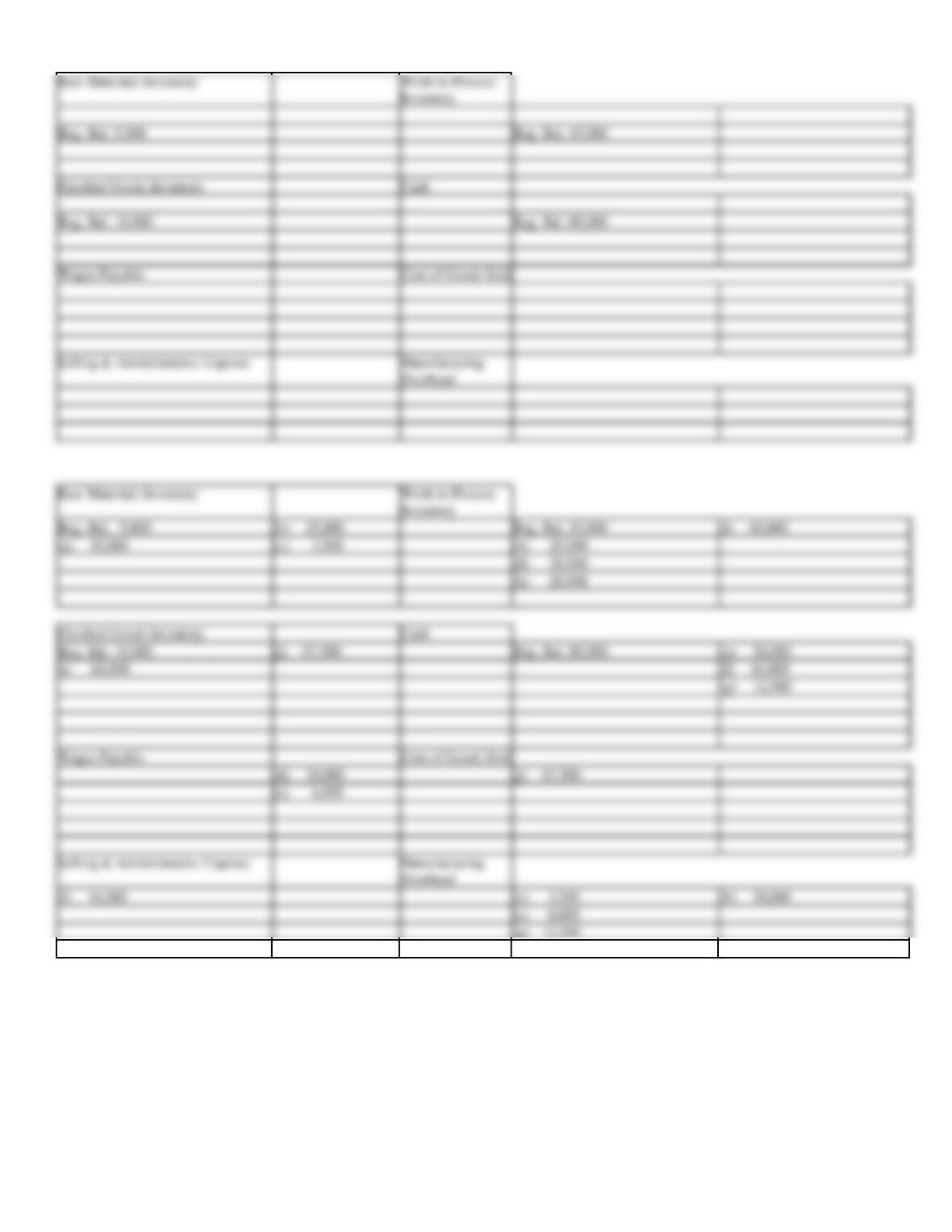
Beg. Bal. 5,000
Beg. Bal. 15,000
Finished Goods Inventory
Cash
Beg. Bal. 10,000
Beg. Bal. 80,000
Wages Payable
Cost of Goods Sold
Beg. Bal. 5,000
(b) 25,000
Beg. Bal. 15,000
(i) 60,000
(a) 30,000
(c) 3,500
(b) 25,000
(h) 20,000
Finished Goods Inventory
Cash
Beg. Bal. 10,000
(j) 67,500
Beg. Bal. 80,000
(a) 30,000
(i) 60,000
Wages Payable
Cost of Goods Sold
(d) 30,000
(j) 67,500
(e) 6,000
(c) 3,500
(h) 20,000
(g) 12,500