Fundamentals of Corporate Finance 3e Test Bank
Chapter: 16 Capital Structure Policy
1.
A higher fraction of debt indicates a lower degree of financial leverage.
A)
True
B)
False
2.
Minimizing the cost of a firm’s financing activities also maximizes the overall value of the
firm.
A)
True
B)
False
Ans:
A
3.
When calculating free cash flow, it is important to include interest and principal payments.
A)
True
B)
False
Ans:
B
Fundamentals of Corporate Finance 3e Test Bank
4.
M&M Proposition 1 assumes that the mix of debt and equity that a firm chooses does not affect
real investment policy.
A)
True
B)
False
Ans:
A
AICPA: Industry/Sector Perspective
5.
The enterprise value of a firm is the value of equity minus the value of debt.
A)
True
B)
False
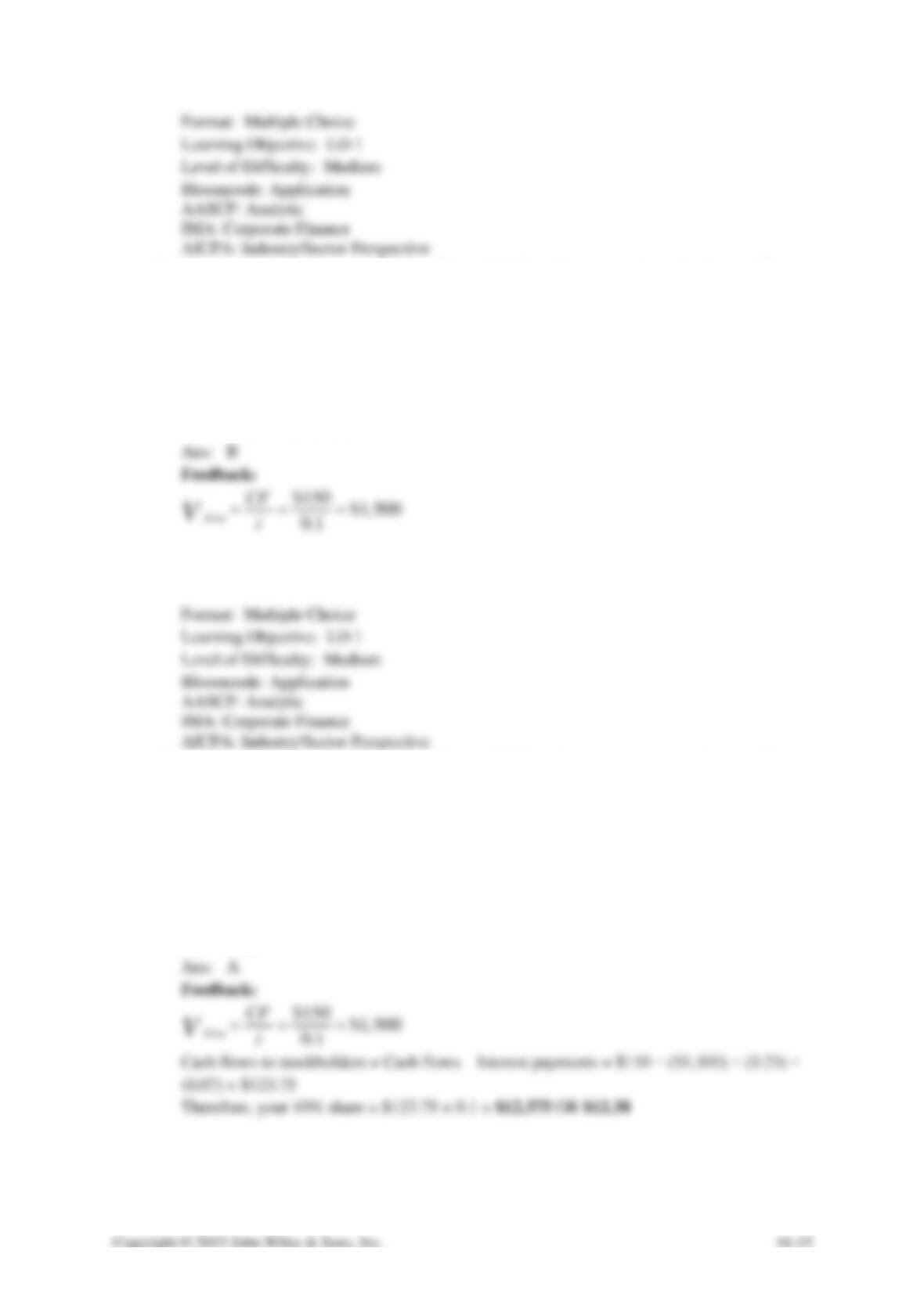
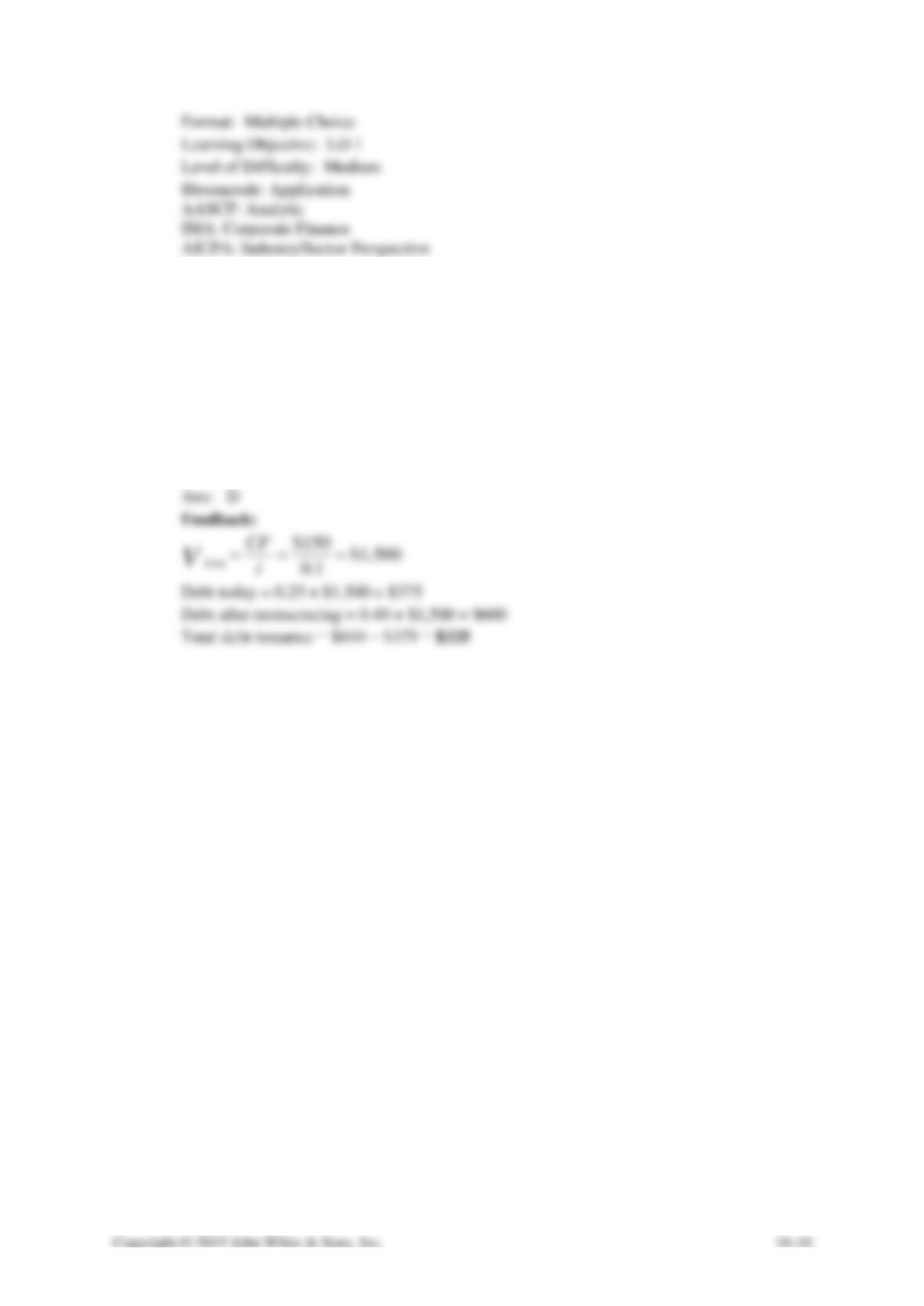
Ans:
B
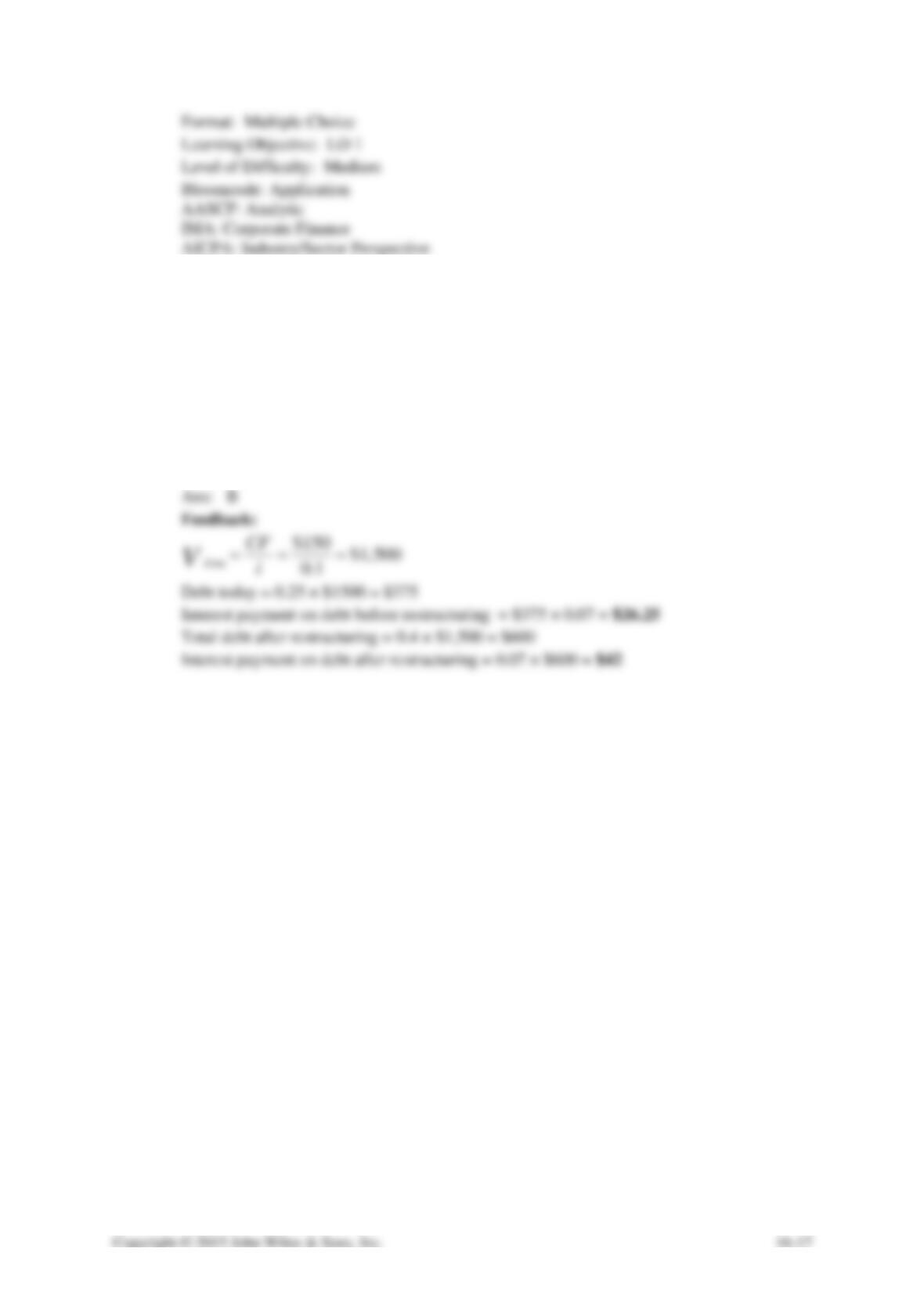
AICPA: Industry/Sector Perspective
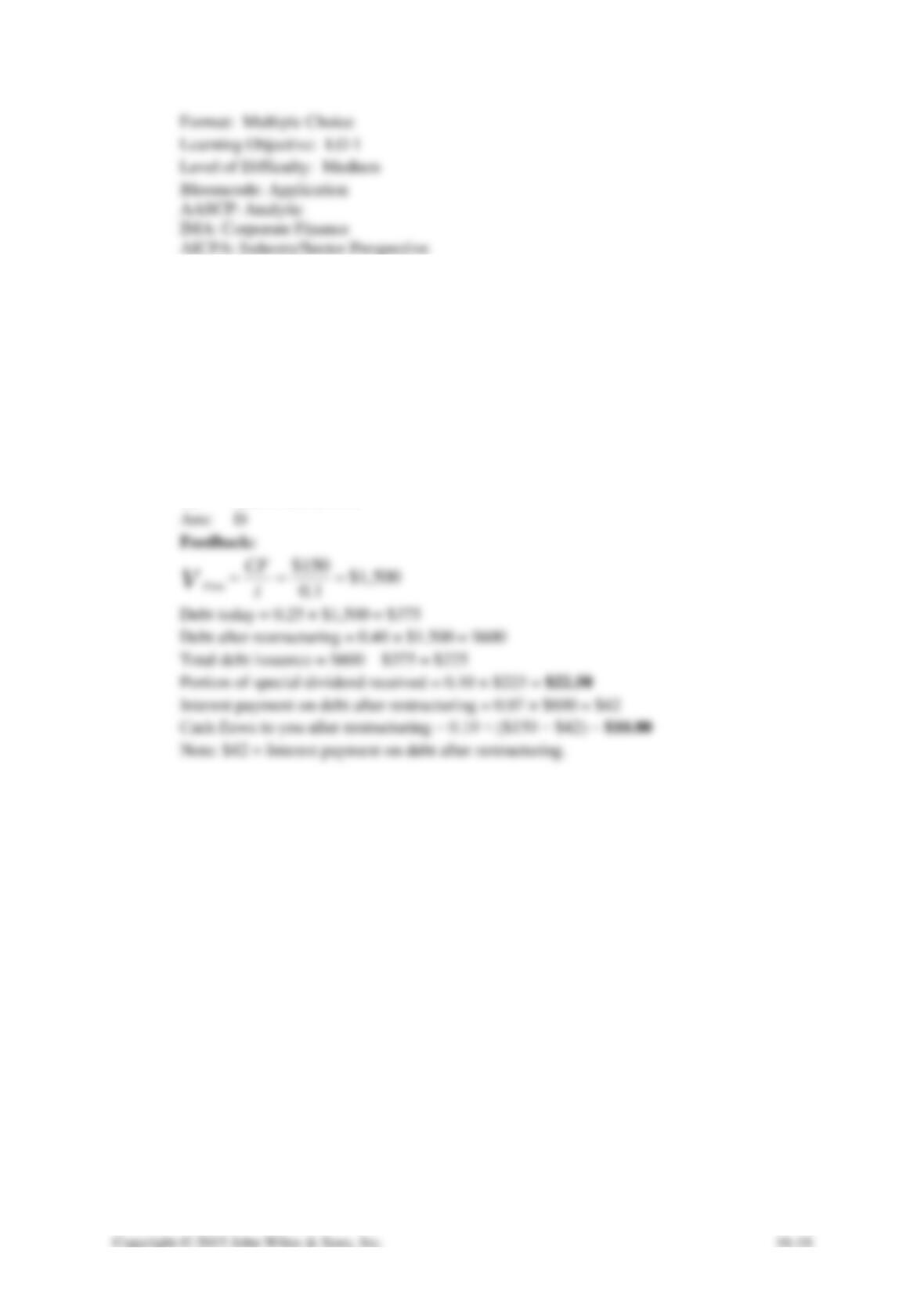
6.
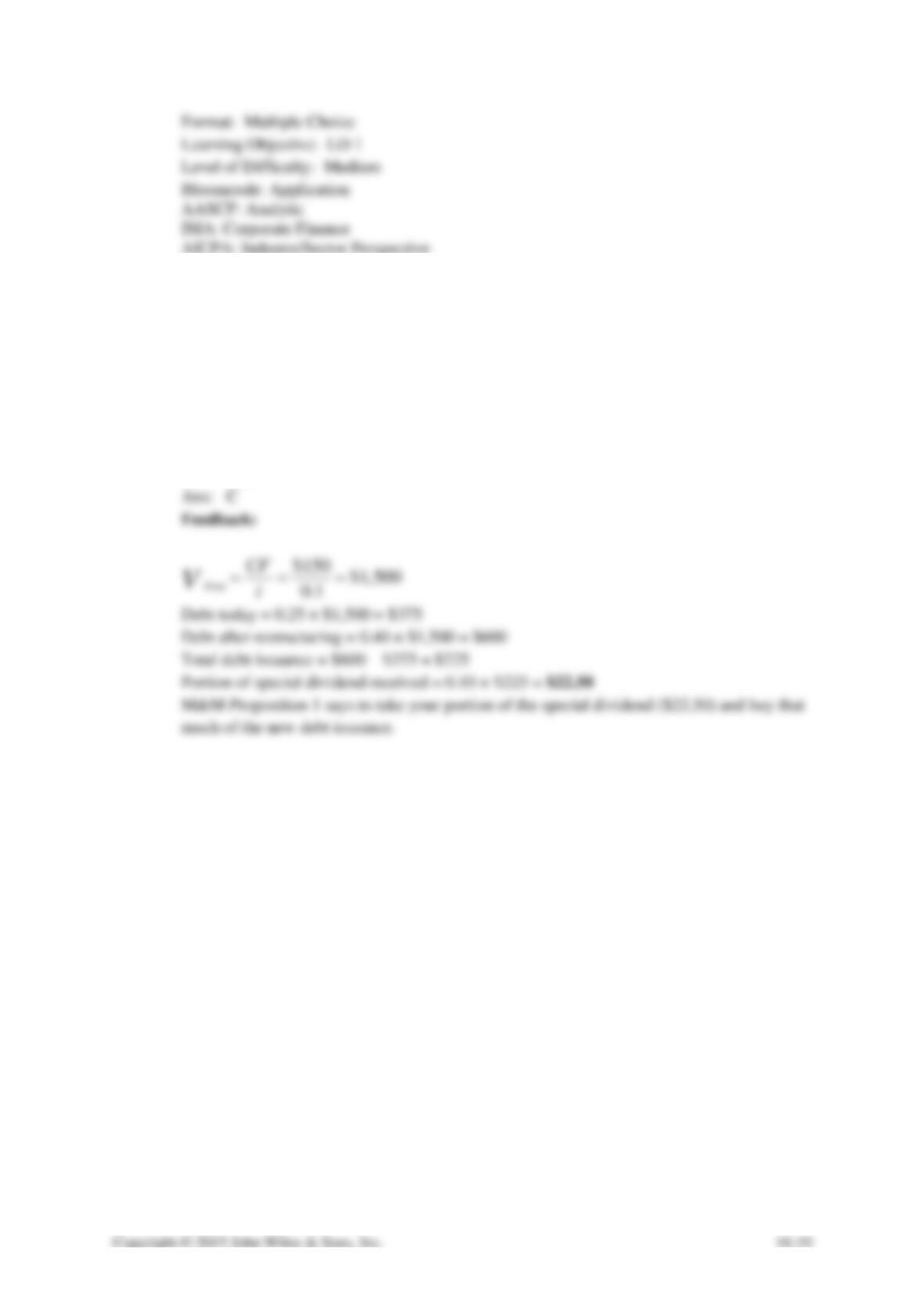
A financial restructuring can change the value of a firm’s real assets, such as plant and
equipment.
A)
True
B)
False
Ans:
B
Fundamentals of Corporate Finance 3e Test Bank
7.
M&M Proposition 2 states that the required rate of return on a firm’s common stock is directly
related to the debt-to-equity ratio.
A)
True
B)
False
Ans:
A
8.
M&M Proposition 1 states that the capital structure of a firm does not affect the required rate of
return on a firm’s assets, while M&M Proposition 2 shows that the required rate of return on
firm’s equity does change with capital structure decisions.
A)
True
B)
False
Ans:
A
9.
Under the M&M assumptions with taxes, the value of a firm with debt is the value of the firm
without debt plus the present value of the interest tax shield.
A)
True
B)
False
Ans:
A
Fundamentals of Corporate Finance 3e Test Bank
10.
With no debt, the WACC is the cost of equity plus the required rate of return on the firm’s
underlying assets.
A)
True
B)
False
Ans:
B
AICPA: Industry/Sector Perspective
11.
If a firm has debt and pays taxes, the present value of the tax shield is the amount of debt
outstanding times the tax rate.
A)
True
B)
False
Ans:
A
AICPA: Industry/Sector Perspective
12.
Issuing debt is less expensive than issuing stock.
A)
True
B)
False
Ans:
A

Fundamentals of Corporate Finance 3e Test Bank
AICPA: Industry/Sector Perspective
13.
Bankruptcy and agency costs both act as limits on the amount of debt in the capital structure.
A)
True
B)
False
Ans:
A
AICPA: Industry/Sector Perspective
14.
Direct-bankruptcy costs are considered transactions costs and occur when a firm must navigate
the bankruptcy process.
A)
True
B)
False
Ans:
A
AICPA: Industry/Sector Perspective
15.
When a firm gets closer to financial distress causing expected bankruptcy costs to increase,
lenders will often charge the firm a lower interest rate in order to reduce the chance of an actual
bankruptcy occurring.
A)
True
B)
False
Ans:
B

Fundamentals of Corporate Finance 3e Test Bank
16.
Direct bankruptcy costs are considered small when compared to indirect costs.
A)
True
B)
False
Ans:
A
AICPA: Industry/Sector Perspective
17.
Indirect bankruptcy costs include changes in customer and supplier behavior that negatively
affect the firm.
A)
True
B)
False
Ans:
A
AICPA: Industry/Sector Perspective
18.
Unlike direct bankruptcy costs, indirect costs are not considered transaction costs.
A)
True
B)
False
Ans:
B
Fundamentals of Corporate Finance 3e Test Bank
19.
Indirect bankruptcy costs will often increase when a firm is in financial stress and it may even
push the company into bankruptcy.
A)
True
B)
False
Ans:
A
AICPA: Industry/Sector Perspective
20.
More debt in a firm’s capital structure provides managers with an incentive to maximize cash
flows, but also makes them want to take on negative NPV projects.
A)
True
B)
False
Ans:
B
AICPA: Industry/Sector Perspective
21.
Dividends reduce the value of lender claims, and this is why bondholders often limit a firm’s
ability to distribute cash to equity holders.
A)
True
B)
False
Ans:
A
Fundamentals of Corporate Finance 3e Test Bank
22.
Borrowing money and paying out a special dividend to shareholders is an example of the asset
substitution problem.
A)
True
B)
False
Ans:
B
AICPA: Industry/Sector Perspective
23.
When a firm is in financial distress, stockholders would like to overinvest in positive NPV
projects.
A)
True
B)
False
Ans:
B
24.
Without debt in the capital structure, there are no asset substitution or underinvestment
problems.
A)
True
B)
False
Ans:
A
Fundamentals of Corporate Finance 3e Test Bank
25.
The trade-off theory of capital structure states that leverage is increased until the marginal cost
of debt is equal to the marginal benefit.
A)
True
B)
False
Ans:
A
AICPA: Industry/Sector Perspective
26.
Under the pecking order theory, debt is factually the cheapest source of funds due to the
interest tax shield.
A)
True
B)
False
Ans:
B
AICPA: Industry/Sector Perspective
27.
Firms have a difficult time selling equity when it is in financial distress.
A)
True
B)
False
Ans:
A

Fundamentals of Corporate Finance 3e Test Bank
28.
Industries with large amounts of tangible assets typically use little debt.
A)
True
B)
False
Ans:
B
29.
More profitable firms have less debt, which supports the trade-off theory.
A)
True
B)
False
Ans:
B
30.
Managers often focus on cash flows, but reported accounting earnings are a better indicator of a
firm’s economic health.
A)
True
B)
False
Ans:
B
Fundamentals of Corporate Finance 3e Test Bank
31.
An operating lease is treated like a purchase for accounting purposes.
A)
True
B)
False
Ans:
B
AICPA: Industry/Sector Perspective
32.
A firm’s capital structure is the mix of financial securities used to finance its activities and can
include all of the following except,
A)
common stock.
B)
bonds.
C)
equity options.
D)
preferred stock.
Ans:
C
AICPA: Industry/Sector Perspective
33.
The optimal capital structure of a firm
A)
minimizes the cost of financing the firm’s projects.
B)
minimizes interest payments to creditors.
C)
maximizes overall value of the firm.
D)
Both A and C.
Ans:
D
Fundamentals of Corporate Finance 3e Test Bank
34.
M&M Proposition 1 assumes all of the following except that,
A)
there are no taxes.
B)
there are no costs to acquire information.
C)
there are no transactions costs.
D)
the real investment policy of a firm is affected by its capital structure decisions.
Ans:
D
35.
A firm’s enterprise value is given as:
A)
the value of equity plus the value of debt.
B)
the value of equity minus the value of debt.
C)
the value of equity minus the value of debt plus the value of future projects.
D)
None of the above.
Ans:
A
36.
A financial restructuring
A)
will not change the value of a firm’s real assets under M&M Proposition 1.
B)
includes financial transactions that change the capital structure of the firm.
C)
means that a firm has issued equity to retire debt.
D)
Both A and B.
Ans:
D
Fundamentals of Corporate Finance 3e Test Bank
37.
The weighted average cost of capital (WACC) includes
A)
the required return on equity and required return on underlying firm assets.
B)
the cost of any long term debt and the cost of equity.
C)
the cost of any long term debt and required return on underlying firm assets.
D)
None of the above.
Ans:
B
38.
M&M Proposition 2 states that the cost of a firm’s common stock is directly related to
A)
the debt-to-equity ratio.
B)
the required rate of return on the firm’s underlying assets.
C)
the return of the market index.
D)
Both A and B.
Ans:
D
39.
According to M&M Proposition 2, the cost of a firm’s equity
A)
increases with the increase of debt-to-equity ratio.
B)
decreases with the decrease of debt-to-equity ratio.
C)
increases with the increase of cost of debt.
D)
decreases with increase of required rate of return on the firm’s underlying assets.
Ans:
A
Fundamentals of Corporate Finance 3e Test Bank
AICPA: Industry/Sector Perspective
40.
Financial risk
A)
refers to the effect that a firm’s financing decisions have on the riskiness of the cash
flows that the stockholders will receive.
B)
increases a firm’s business risk.
C)
decreases a firm’s business risk.
D)
is related to how debt affects the business decisions of a firm.
41.
Which of the following is a reason financial policy might matter?
A)
Firms must pay corporate income taxes.
B)
Capital structure choices can affect firm’s real investment decisions, such as R&D and
PP&E.
C)
Information or transaction costs.
D)
All of the above
Ans:
D
Fundamentals of Corporate Finance 3e Test Bank
42.
Dynamo Corp. produces annual cash flows of $150 and is expected to exist forever. The
company is currently financed with 75 percent equity and 25 percent debt. Your analysis tells
you that the appropriate discount rates are 10 percent for the cash flows, and 7 percent for the
debt. You currently own 10 percent of the stock. How much is Dynamo worth today?
A)
$1,765
B)
$1,500
C)
$2,143
D)
None of the above
Ans:
B
43.
Dynamo Corp. produces annual cash flows of $150 and is expected to exist forever. The
company is currently financed with 75 percent equity and 25 percent debt. Your analysis tells
you that the appropriate discount rates are 10 percent for the cash flows, and 7 percent for the
debt. You currently own 10 percent of the stock. How much are your cash flows today?(Round
the answer to two decimal places.)
A)
$12.38
B)
$15
C)
$4.50
D)
$150
Ans:
A
Fundamentals of Corporate Finance 3e Test Bank
AICPA: Industry/Sector Perspective
44.
Dynamo Corp. produces annual cash flows of $150 and is expected to exist forever. The
company is currently financed with 75 percent equity and 25 percent debt. Your analysis tells
you that the appropriate discount rates are 10 percent for the cash flows, and 7 percent for the
debt. You currently own 10 percent of the stock. If Dynamo wishes to change its capital
structure from 75 percent to 60 percent equity and use the debt proceeds to pay a special
dividend to stockholders, how much debt should they issue?
A)
$321
B)
$375
C)
$600
D)
$225
Fundamentals of Corporate Finance 3e Test Bank
AICPA: Industry/Sector Perspective
45.
Dynamo Corp. produces annual cash flows of $150 and is expected to exist forever. The
company is currently financed with 75 percent equity and 25 percent debt. Your analysis tells
you that the appropriate discount rates are 10 percent for the cash flows, and 7 percent for the
debt. You currently own 10 percent of the stock. How much does Dynamo currently pay as
interest, and how much will it have to pay after the restructuring in the prior problem,
assuming that the cost of debt is constant?
A)
$42 and $26.25
B)
$26.25 and $42
C)
$160 and $37.50
D)
$37.50 and $60
Fundamentals of Corporate Finance 3e Test Bank
46.
Dynamo Corp. produces annual cash flows of $150 and is expected to exist forever. The
company is currently financed with 75 percent equity and 25 percent debt. Your analysis tells
you that the appropriate discount rates are 10 percent for the cash flows, and 7 percent for the
debt. You currently own 10 percent of the stock. If Dynamo wishes to change its capital
structure from 75 percent to 60 percent equity, how much of the special dividend do you
receive, and how much do you receive in regular dividends per annum after the restructuring as
per the M&M Proposition 1?
A)
$15 and $60
B)
$60 and $15
C)
$10.80 and $22.50
D)
$22.50 and $10.80
Ans:
D
Fundamentals of Corporate Finance 3e Test Bank
AICPA: Industry/Sector Perspective
47.
Dynamo Corp. produces annual cash flows of $150 and is expected to exist forever. The
company is currently financed with 75 percent equity and 25 percent debt. Your analysis tells
you that the appropriate discount rates are 10 percent for the cash flows, and 7 percent for the
debt. You currently own 10 percent of the stock. If Dynamo wishes to change its capital
structure from 75 percent to 60 percent equity, what transaction do you need to take in order to
undo the restructuring according to M&M Proposition 1?
A)
Sell $22.50 of stock
B)
Sell $10.80 worth of stock
C)
Buy $22.50 worth of debt
D)
Buy $10.80 worth of debt
Fundamentals of Corporate Finance 3e Test Bank
48.
Dynamo Corp. produces annual cash flows of $150 and is expected to exist forever. The
company is currently financed with 75 percent equity and 25 percent debt. Your analysis tells
you that the appropriate discount rates are 10 percent for the cash flows, and 7 percent for the
debt. You currently own 10 percent of the stock. If Dynamo wishes to change its capital
structure from 75 percent to 60 percent equity, according to M&M Proposition 1, what are the
interest payments that you receive after you undo the restructuring, and what are your total
cash flows?(Do not round intermediate calculation. Round the final answer to two decimal
places.)
A)
$1.58 and $12.38
B)
$23.55 and $75
C)
$1.125 and $12.38
D)
None of the above
Ans:
A