
Exam
Name___________________________________
MULTIPLE CHOICE. Choose the one alternative that best completes the statement or answers the question.
1)
________ refers to the “bouncing” mode of sand transport in a windstorm or stream.
1)
A)
Ventifaction
B)
Deflation
C)
Saltation
D)
Siltation
2)
How is desert pavement formed?
2)
A)
Groundwater in an alluvial fan evaporates, leaving behind a surface layer of hard–baked
mud.
B)
Runoff and deflation carry off the silt and clay, leaving coarser particles behind.
C)
Alluvial fans are eroded to form inselbergs with rocky surfaces.
D)
Deflation removes the coarse fragments leaving behind a layer of loess.
3)
________ dunes result from persistent, onshore winds in certain coastal areas.
3)
A)
Parabolic
B)
Diabolic
C)
Staroid
D)
Barchanoid
4)
Which of the following characteristics would suggest recent, fault uplift of a desert mountain
range?
4)
A)
flat, upland surfaces, steep slopes and small alluvial fans
B)
steep playas with extensive, bedrock alluvial fans and numerous sand dunes
C)
inselbergs, extensive pediments and flat valley floors
D)
extensive pediments and bajadas and small, deep playas

5)
Which one of the following is determined by the angle of repose for dry sand?
5)
A)
slope of an alluvial fan
B)
inclination angle of a dune slip face
C)
longitudinal dune gradient angle
D)
a vertical cut bank in loess
6)
Rainshadow deserts are common in ________.
6)
A)
Europe north of the Alps
B)
the dry valleys of eastern California and Nevada
C)
north central Africa
D)
vast, dry, steppe lands like the Great Plains
B
7)
________ dunes are long, high, sand dunes parallel with the prevailing wind direction.
7)
A)
Transversal
B)
Longitudinal
C)
Transducinal
D)
Latitudinal
B
8)
Loess deposits in the central United States ________.
8)
A)
accumulated from flooding of the Mississippi River
B)
were originally deposited as barchanoid dunes and later redeposited by glaciers
C)
originated as rock flour in Pleistocene glacial streams and rivers
D)
blew in from the dry areas in the Great Plains and southwestern desert areas
C
9)
Inselbergs are ________.
9)
A)
blowouts cut from bedrock in mountainous areas
B)
bedrock hills in a highly eroded desert landscape
C)
lithified rock formed by cementation of wind–deposited, dune sands
D)
insulated icebergs floating in a hot spring
B
B

10)
All of the following statements concerning dry lands are true EXCEPT ________.
10)
A)
precipitation totals are low; dew points are lower in the summer than winter
B)
evaporation potential exceeds actual precipitation
C)
wind is the dominant agent of erosion and sediment transport
D)
storms are infrequent and rainfall amounts are highly variable
11)
Desert and steppe lands cover about what percentage of Earth’s land area?
11)
A)
66%
B)
10%
C)
3%
D)
30%
12)
Which one of the following is the one best measure of the wetness or dryness of a region?
12)
A)
total annual precipitation
B)
percentage of precipitation that falls during the summer months
C)
mean annual temperature
D)
difference between annual precipitation and evaporation potential
13)
Which one of the following is a low–latitude desert characterized by high atmospheric pressures
and descending air masses (not rain shadow deserts)?
13)
A)
Gobi Desert, China and Mongolia
B)
Atacama Desert in Chile, South America
C)
Sahara Desert; northern Africa
D)
desert valleys of the Great Basin, United States
14)
A ________ is formed by abrasion of rocks by windblown sand.
14)
A)
playa
B)
pediment
C)
ventifact
D)
desert pavement

15)
Which one of the following statements is TRUE?
15)
A)
Rainshadow deserts occur on the windward side of a mountain when air masses are forced to
rise upwards.
B)
Desert landscapes are monotonous, relatively flat areas covered to various depths with sand.
C)
Deserts and dry lands are concentrated in areas of ascending air masses and relatively low
atmospheric pressures.
D)
Despite infrequent rainfalls, erosional and depositional features of running water are
important in desert landscapes.
16)
What mature, desert landscape feature consists of coalesced alluvial fans?
16)
A)
balda
B)
bahia
C)
baja
D)
bajada
17)
A ________ is a crescent–shaped dune whose tips point downwind.
17)
A)
transverse
B)
barchan
C)
parabarcal
D)
star
18)
Most dry lands lie between ________ degrees north and south of the equator.
18)
A)
0 and 5
B)
40 and 50
C)
20 and 30
D)
5 and 10
19)
Which one of the following concerning desert lands is FALSE?
19)
A)
Running water has little effect on shaping the landscape.
B)
Wind erosion and deposition are important processes.
C)
Most desert areas are characterized by descending wind patterns.
D)
Less than 30 percent is covered with dunes and drifting sand.

20)
Which one of the following statements is CORRECT?
20)
A)
Saline sediments and evaporites are common in inselbergs and pediments of desert
landscapes.
B)
Alluvial fans typically rim desert valleys; playas form in the lowest, interior parts of the
valleys.
C)
Inselbergs are low, circular depressions on gently sloping pediments and bajadas.
D)
Playas are typically covered with gravel–sized desert pavement and loess deposits.
21)
Desertification has been particularly well documented over the past 50 years in ________.
21)
A)
the steppe lands of southern Russia, Ukraine, and Kazakhstan
B)
the Sahel along the southern margin of the Sahara Desert
C)
the Empty Quarter of the Arabian Peninsula
D)
the Dust Bowl states of the Great Plains
22)
Which one of the following statements about sand dunes is correct?
22)
A)
In a sand dune, the more gently inclined strata lie parallel to the slip face.
B)
Sand is blown up the slip face and rolls down the more gently sloping flank of the dune.
C)
A dune migrates in the direction of inclination of the slip face.
D)
The more gently sloping surface is the leeward slope of the dune.
23)
Deposition of glacial rock flour from blowing winds is responsible for ________.
23)
A)
star steppes
B)
deflation ventifacts
C)
loess deposits
D)
blowout pavement

24)
Which one of the following will effectively limit further deflation in a given area?
24)
A)
desert pavement
B)
a hanging valley
C)
the repose level
D)
sea level
25)
Which of the following best describes the climatic factors that cause low latitude deserts like the
Sahara in Africa?
25)
A)
Cool, dry air aloft is descending; surface winds are blowing toward the equator.
B)
Warm, humid air aloft is descending; surface winds blow away from the equator.
C)
Cool, dry air at the surface is rising causing winds to blow away from the equator.
D)
Warm, humid air is rising; surface winds are calm.
26)
Assume that the central slip face of a barchan dune slopes downhill toward the east. What is the
direction of the prevailing wind?
26)
A)
south to north
B)
west to east
C)
north to south
D)
east to west
27)
How are sand grains transported by the wind?
27)
A)
by deflation of abraded desert pavement
B)
by being picked up in swirling dust clouds and carried to distant blowouts
C)
high in the moving air column as suspended load
D)
by saltation in the first few meters above the land surface
28)
Which one of the following would probably not affect the size and depth of a blowout?
28)
A)
a rise in sea level
B)
type and density of vegetation
C)
areas of desert pavement
D)
the near surface water table

SHORT ANSWER. Write the word or phrase that best completes each statement or answers the question.
29)
Deposits of windblown silt are called ________.
29)
Word Analysis. Examine the words and/or phrases for each question below and determine the relationship among the
majority of words/phrases. Choose the option that does not fit the pattern.
30)
a. arroyo b. wadi c. inselberg d. nullah
30)
31)
a. ventifact b. alluvial fan c. playa d. inselberg
31)
32)
________ are rocks with one or more flat surfaces abraded by windblown sand.
32)
Word Analysis. Examine the words and/or phrases for each question below and determine the relationship among the
majority of words/phrases. Choose the option that does not fit the pattern.
33)
a. barchan dune b. star dune c. transverse dune d. parabolic
dune
33)
34)
________ dunes are long, sand ridges that develop at right angles to the prevailing wind
direction.
34)
Word Analysis. Examine the words and/or phrases for each question below and determine the relationship among the
majority of words/phrases. Choose the option that does not fit the pattern.
35)
a. sand dune b. deflation c. blowout d. desert
pavement
35)
36)
________ is the skipping and bouncing transport of sand in blowing wind and running
water.
36)
37)
The low, bedrock ridges and peaks of a highly eroded, basin and range, desert landscape
are called ________.
37)

38)
A(n) ________ is an intermittent lake on the floor of a desert basin.
38)
39)
________ dunes form in areas where the prevailing wind directions change with the
seasons.
39)
40)
The leeward slope of a sand dune is also known as the ________.
40)
41)
________ are solitary, crescent–shaped dunes whose tips face downwind.
41)
42)
________ describes the complex, internal stratification or bedding in a sand dune.
42)
43)
In dry lands, ________ is the covering of coarse particles left on the surface after the finer
particles are carried away by wind and running water.
43)
TRUE/FALSE. Write ‘T’ if the statement is true and ‘F’ if the statement is false.
44)
Ventifacts are wind–abraded blowouts exceeding one kilometer in diameter.
44)
45)
Running water is an important erosional agent in many arid lands despite infrequent rainfalls.
45)
46)
The loess in western China was derived from windblown, glacial rock flour.
46)
47)
Loess consists mainly of silt–sized particles.
47)
48)
A playa is an intermittent lake on the floor of a desert valley.
48)

49)
Sand is transported by saltation in running water and blowing winds.
49)
50)
Deserts between 30 and 45 degrees of latitude are more extensive in the southern hemisphere than
in the northern hemisphere.
50)
51)
Intermittent streams in dry areas of the western United States are called washes.
51)
52)
Saltation refers to evaporation of shallow, muddy waters from a playa lake.
52)
53)
Inselbergs and small, steep, alluvial fans are characteristic of recently faulted, basin and range
terrain in dry lands.
53)
54)
Bajadas develop from coalescence of alluvial fans along fronts of mountain ranges in arid lands.
54)
55)
Windblown loess, like sand, typically accumulates as mound–like dunes.
55)
56)
Sand dunes cover more than 50 percent of most desert lands.
56)
57)
In North America, loess deposits are found mainly in the dry to semiarid lands of southwestern
United States and northern Mexico.
57)
58)
The steeper, leeward slope of a sand dune is called the slip face.
58)
59)
About one–third of the Earth‘s land areas have arid to semiarid climates.
59)
60)
Steppes are the driest of the true desert lands.
60)

61)
Blowouts are broad, shallow depressions excavated by deflation.
61)
MATCHING. Choose the item in column 2 that best matches each item in column 1.
Match the sand dune with the appropriate description.
62)
linear sand ridges at right angles to the
prevailing wind direction
B)
63)
complexly shaped dunes formed in
response to different, seasonal, wind
directions
64)
single, crescent–shaped dune with the
tips pointing downwind
65)
multiple, connected, crescent–shaped
coastal dunes with the tips pointing
toward the beach
66)
linear sand ridges parallel to the
prevailing wind direction
67)
sand ridges at right angles to
prevailing winds with
crescent–shaped slip faces pointing
downwind
A)
longitudinal
C)
barchanoid
E)
parabolic
62)
63)
64)
65)
66)
67)
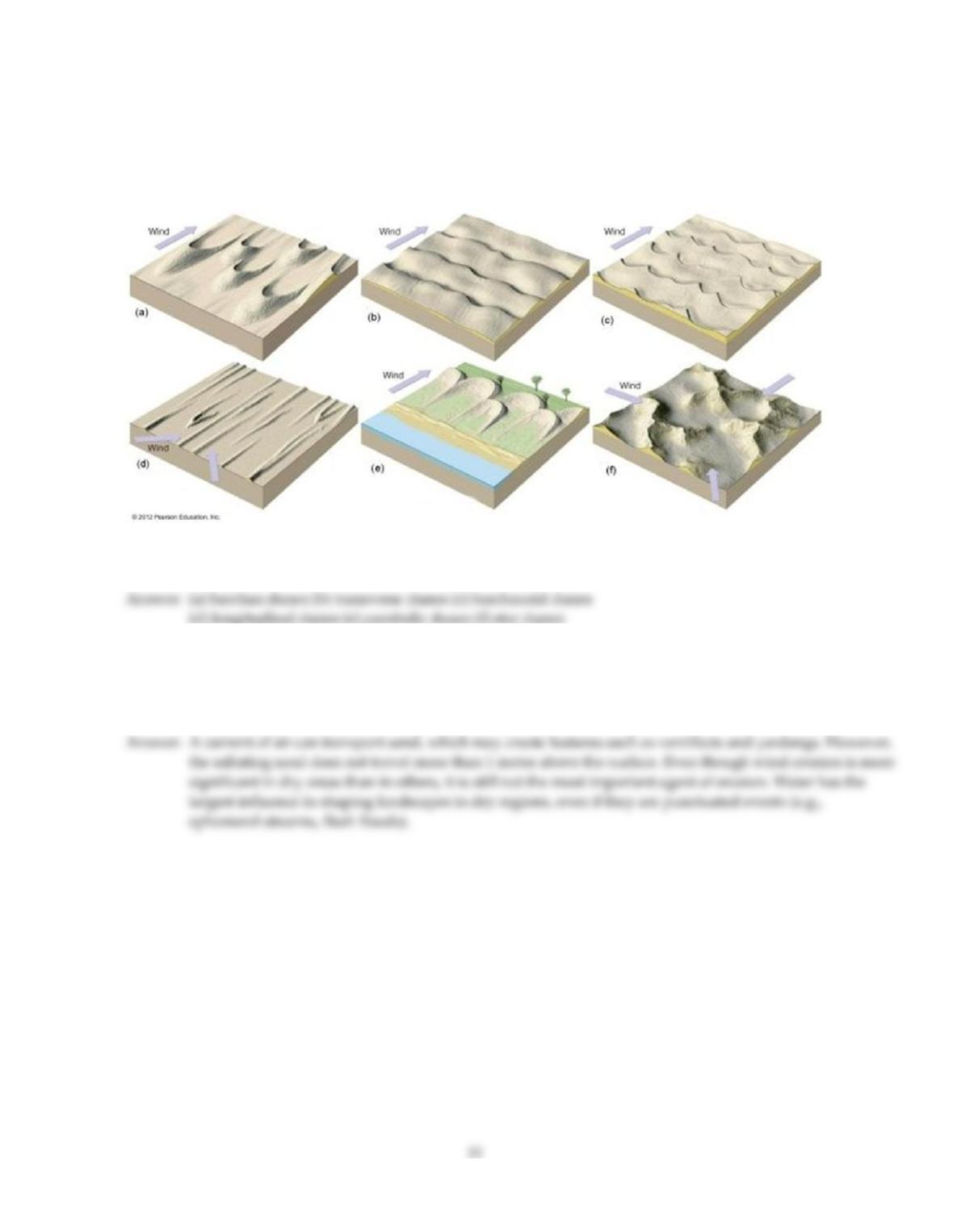
ESSAY. Write your answer in the space provided or on a separate sheet of paper.
Critical thinking and discussion questions. Use complete sentences, correct spelling, and the information presented in
chapter 16 to answer the questions below.
68)
On the blank spaces provided, write the name of the type of dunes shown in the illustration with the
corresponding letter.
(a) ________ (d) ________
(b) ________ (e) ________
(c) ________ (f) ________
69)
Wind is included along with gravity, water, and ice as an agent of erosion. In many national parks and other
areas of natural beauty, statements are often made that credit wind as having sculpted the landscape. Briefly
discuss the importance of wind as an agent of erosion and explain why such statements are probably
geologically inaccurate.

Answer Key
Testname: C16

Answer Key
Testname: C16
13