CHAPTER 16—SOLID AND HAZARDOUS WASTE
MULTIPLE CHOICE
1. Electronic waste
a.
Is the fastest growing solid waste problem in the world
b.
May contain valuable metals that could be recycled
c.
Primarily ends up in landfills
d.
Two of the above are correct
e.
All of the above are correct
2. The International Basel Convention bans the transfer of hazardous waste from developed to
developing countries. The United States
a.
is the only industrialized nation that has not ratified this convention
b.
has enthusiastically embraced this convention
c.
is the author of this convention
d.
has revised and improved this convention
e.
none of these answers
3. The banning of TV set and computer disposal in landfills by 35 states in the U.S. is expected to
a.
cause interstate smuggling of e-waste
b.
be regulated by the federal government
c.
be voted down by consumers during the next general election
d.
set the stage for an emerging highly profitable e-recycling industry
e.
none of these answers
4. E-waste is a source of which of the following pollutants of air and water?
a.
atrazine
b.
DDT
c.
arsenic
d.
polyvinylchloride (PVC)
e.
all of these answers
5. Garbage produced directly by households and businesses accounts for ____ of the solid waste
produced in the United States.
a.
less than 2%
b.
5%
c.
10%
d.
15%
e.
20%
6. Hazardous or toxic waste is waste that
a.
threatens human health or the environment
b.
is dangerously corrosive
c.
is dangerously chemically reactive
d.
all of these
e.
none of these answers
7. Which category most accurately describes waste such as food wastes, cardboard, cans, bottles, yard
wastes, furniture, plastics, metal, glass, and e-waste?
a.
e-waste
b.
municipal waste
c.
solid waste
d.
industrial waste
e.
municipal solid waste
8. The top three U.S. producers of hazardous waste, in order, are
a.
the film industry, the computer industry, and the military
b.
the military, the mining industry, and the chemical industry
c.
the agricultural industry, the military, and the mining industry
d.
the military, the chemical industry, and the mining industry
e.
transportation industries (air and boat travel), the mining industry, and the military
9. In an integrated waste management approach, which of the following strategies should be given top
priority?
a.
incinerate
b.
reuse
c.
reduce
d.
refuse
e.
recycle
10. An integrated waste management approach for industrial enterprises
a.
eliminates unnecessary packaging
b.
makes a product require frequent replacement
c.
uses more material
d.
encourages built-in obsolescence
e.
all of these answers
11. Which of the following choices describe an input approach to the problem of waste production?
a.
reduce packaging and materials for new products
b.
compost food scraps
c.
purchase fewer household items
d.
all of these answers
e.
reduce packaging and materials for new products and purchase fewer household items
12. The first priority of integrated waste management is
a.
recycling materials
b.
using biodegradable material
c.
creating more durable products
d.
reducing the amount of materials used
e.
Both c and d
13. Which of the three Rs are preferred because they are input approaches to waste management?
a.
reducing and recycling
b.
reducing and repurposing
c.
reducing and reconstituting
d.
reducing and reusing
e.
reducing and incinerating
14. At the checkout counter, an environmentalist is most likely to say
a.
“Plastic please”
b.
“Paper please”
c.
“I brought my own bag.”
d.
“I want a cardboard box, please.”
e.
“Either plastic or paper.”
15. Which of the following statements is false?
a.
It is more economical to have consumers separate trash before pickup than to use
materials-recovery facilities.
b.
Glass, iron, and aluminum can be recovered from solid wastes.
c.
Source separation involves consumers separating trash into categories like glass, paper,
and metal.
d.
Source separation is more costly and energy intensive.
e.
Materials-recovery facilities need a steady diet of garbage to be financially successful.
16. Source separation differs from materials-recovery facilities in all but which of the following?
a.
It has lower start-up costs.
b.
It yields cleaner and more valuable recyclables.
c.
It produces less air and water pollution.
d.
It provides fewer jobs per unit of material recycled.
e.
It saves more energy per unit of material recycled.
17. Which of the following are types of waste that a homeowner can recycle in their backyard as part of a
composting project?
a.
hedge trimmings
b.
food scraps
c.
grass clippings
d.
discarded paints and stains
e.
all of these except discarded paints and stains
18. Critics of recycling are most likely to claim:
a.
It isn’t worth the effort.
b.
There is no solid-waste problem.
c.
Incineration is the safest and most efficient way to dispose of solid wastes.
d.
It doesn’t make sense to recycle if it costs more than sending wastes to a landfill or an
incinerator.
e.
There is abundant landfill space in all areas.
19. Obstacles to recycling include
a.
lack of inclusion of environmental costs in market prices
b.
tax breaks for mining virgin materials
c.
lack of large, steady markets for recycled materials
d.
all of these answers
e.
none of these answers
20. Only about 7% of ______ products are recycled in the United States because there are so many
different types that can be difficult to separate.
a.
glass
b.
plastic
c.
paper
d.
aluminum
e.
cardboard
21. You are the vice-president of a transportation company. You are presenting a proposal to the company
president and owners that involves recycling of the tires that are removed from company vehicles and
turning them into a rubberized playground material to be sold to schools and parks. Your proposal is
based on
a.
closed-loop recycling
b.
preconsumer recycling
c.
postconsumer recycling
d.
secondary recycling
e.
primary recycling
22. What is a law that has been enacted in Bangladesh, China, France, Italy and the city of San Francisco,
California, USA?
a.
A tax has been levied on the use of plastic shopping bags.
b.
A tax has been levied on the use of water bottled in disposable plastic containers.
c.
Plastic shopping bags have been banned.
d.
Customers who recycle at curbside get a discount on garbage pick-up.
e.
None of these answers.
23. Components of a modern, state-of-the-art landfill include
a.
probes to detect methane gas
b.
plastic liners on the bottom of the landfill
c.
storage and treatment of leachate
d.
groundwater monitoring wells
e.
all of these answers
24. A 2007 report by the Nuclear Information and Resource Service, a nonprofit organization, indicates
that:
a.
Nuclear waste facilities do not track the dispersal of radioactivity from their dump sites.
b.
Weapons grade nuclear waste is carefully monitored after it has been disposed of in
sanitary landfills.
c.
Fortunately, no radioactive materials have ever been deposited by any methods other than
safe methods.
d.
Radioactive hospital wastes go to standard sanitary landfills.
e.
Radioactive materials from facilities operated by the U.S. Department of Energy have
been deposited in regular landfills.
25. Sanitary landfills typically have problems with
a.
rodents and insects
b.
odor
c.
open, uncovered garbage
d.
traffic, noise, and dust
e.
spread of disease
26. Of the two types of dumps utilized for solid waste, open dumps
a.
are rare in developed countries
b.
cover wastes with clay or plastic foam
c.
have little odor
d.
are vermin free
e.
none of these answers
27. Many concerned citizens oppose using incinerators to burn waste because
a.
It undermines waste reduction strategies like reduce and reuse
b.
They must burn a lot of trash to maintain profitability
c.
Incineration encourages waste
d.
They emit pollutants
e.
All of these answers
28. A very comprehensive and effective hazardous-waste collection and detoxification program is in
a.
France
b.
Denmark
c.
Norway
d.
Yugoslavia
e.
the United States
29. Bioremediation
a.
involves training bacteria to eat new foods
b.
results in the production of low-level hazardous wastes
c.
involves the use of bacteria and enzymes to destroy hazardous substances
d.
is widely accepted as the best way to cut hazardous wastes
e.
does not exist
30. Phytoremediation
a.
involves the use of plants to remove contaminants from polluted soil and water
b.
involves the use of microscopic filter-feeding organisms to filter contaminants from water
c.
has been shown to be ineffective in the long term
d.
is too costly to be practical
e.
all of these answers
31. The first priority in dealing with hazardous wastes is
a.
to collect them
b.
to produce less of it
c.
to use bioremediation
d.
to store it effectively
e.
all of these answers
32. Hazardous waste deposited in ponds or lagoons
a.
may evaporate into the atmosphere
b.
may enter groundwater when there are no liners or when liners leak
c.
may contaminate surface water
d.
all of these answers
e.
none of these answers
33. The least-used method of dealing with liquid and solid hazardous waste is ____ because of the ____.
a.
bioremediation, expense
b.
surface impoundment, construction costs
c.
secure hazardous waste landfills, expense
d.
deep-well disposal, ineffectiveness
e.
deep-well disposal, high cost
34. Phytoremediation is a form of bioremediation that
a.
is essentially the same, but more costly
b.
involves the use of photosynthetic bacteria
c.
produces more air pollution and is thus not as helpful
d.
involves the use of plants
e.
can only work on toxic metal leachate
35. When hazardous wastes are injected into deep underground wells:
a.
They always contaminate the groundwater.
b.
Leaks or spills can occur at the surface.
c.
We are utilizing another output approach that encourages waste production.
d.
Both leaks and spills can occur at the surface and we are utilizing another output approach
that encourages waste production.
e.
All of these answers.
36. The Superfund program paid
a.
to identify and clean up hazardous-waste dump sites
b.
to monitor hazardous wastes
c.
for testing for lead in paint, water, and air samples
d.
the doctors’ bills and lawyers’ fees for pollution events
e.
all of these answers
37. All of the following are true about the Superfund program except
a.
The program is now broke.
b.
Superfund expired in 1995.
c.
All of the sites originally listed as a severe threat to human health were cleaned up.
d.
In November 2010, nearly 1,300 sites were listed as Superfund sites.
e.
Taxpayers rather than polluters are now paying for cleanups.
38. Approximately 9 million childhood lead poisonings were prevented in the United States between 1976
and 2007 primarily because of
a.
a ban on the use of lead-based paints and leaded gasoline
b.
a ban on the use of lead in car batteries
c.
a ban on the use of lead in pencils
d.
a ban on the use of transfused blood contaminated with lead
e.
all of these answers
39. Exposure to lead continues to cause unsafe levels in children in the United States. The source(s) of this
lead is
a.
peeling lead-based paint in houses
b.
Lead leaching from old water pipes
c.
Coal burning power plants
d.
Waste incinerators
e.
all of these answers
40. The idea that everyone is entitled to protection from environmental hazards regardless of race, gender,
age, national origin, income, social class, or any political factor is called
a.
environmental racism
b.
environmental sustainability
c.
environmental policy
d.
environmental justice
e.
none of these answers
41. In 1992, the ___________ banned the shipment of hazardous materials from developed to developing
countries.
a.
United States EPA
b.
UNEP
c.
the United Arab Emirates
d.
the European Union
e.
Basel Convention
42. Which of the following countries has passed a law that states all chemicals that are persistent and can
accumulate in living tissue will be banned by the year 2020?
a.
the United States
b.
France
c.
China
d.
Norway
e.
Sweden
43. In 2000, delegates from 122 countries completed a global treaty to control 12 persistent organic
pollutants (POPs), which include
a.
DDT
b.
ozone
c.
chlorofluorocarbons
d.
methane gas
e.
mercury
44. Which of the following statements is correct?
a.
We should view hazardous wastes as wasted resources.
b.
We should view solid wastes as materials we should not be producing in the first place.
c.
We should view solid wastes and hazardous wastes as being the same thing.
d.
We should view hazardous wastes as something we should not be producing in the first
place.
e.
None of these answers are correct.
TRUE/FALSE
1. Less use of energy will produce less waste but more pollution.
2. Composting and source-separation recycling are both effective in reducing waste.
3. Both solid waste and hazardous waste disposal today compromise the environment.
4. Most scientists think that waste management should be the last priority for dealing with material use
and solid waste.
5. Reusing products can be a health hazard for the poor in developing countries who dismantle products
to extract usable parts.
6. The products of composting can be used to slow soil erosion, retain water, and improve crop yields.
7. Countries in which governments offer increased subsidies and tax breaks for reusing and recycling
materials are more environmentally sustainable than those that do not.
8. In primary recycling, waste products are converted into different products.
9. The best and cheapest ways to deal with solid and hazardous wastes are waste reduction and pollution
prevention.
10. Restructuring urban transportation systems is a good idea from the perspective of reducing energy use,
but it would have no effect on resource use and waste production.
11. Plastic shopping bag use is taxed in Ireland and Scotland.
12. Closed-loop recycling is the same as secondary recycling.
13. The recycling of plastic bottles to make fleece fabric for clothing is a type of secondary recycling.
14. The availability of oil and petrochemicals effectively stalled the development of bioplastic.
15. Perpetual storage should be the last resort for dealing with hazardous wastes.
16. Once lead was eliminated from gasoline, the problem of unsafe blood levels of lead in young children
ceased in the United States.
17. In the natural world, where humans are not dominant, there is essentially no waste.
COMPLETION
1. ____________________ are chemical substances that persist in the environment and accumulate in the
fatty tissues of humans and other organisms.
2. Tires being shredded and converted into surfacing for public roads is an example of
____________________.
3. ____________________ are inefficient because they are expensive to build, they discharge toxic
emissions, and they can produce a toxic ash.
4. The ____________________ approach to recycling saves energy, provides jobs, and educates people
about how to reduce waste.
5. Contaminated water that leaks from landfills is called ____________________.
6. The top priority in dealing with hazardous waste should be the same as the top priority for solid waste,
and that is ____________________.
7. The pricing of hazardous materials used in the U.S. and most countries does not include their
____________________.
8. The type of waste produced by mines, agriculture, and industries that supply people with goods and
services is called ____________________.
9. Hospital medical waste is a type of ____________________.
10. In the United States, enough ____________________ are used each year so that, if linked end to end,
they would reach to the moon and back seven times.
11. Online sites such as ____________________ link people who want to reuse belongings.
12. ____________________ is a form of recycling that mimics nature’s recycling of nutrients.
13. A method of dealing with solid waste that causes a low amount of water pollution, but a high amount
of air pollution, is ____________________.
14. The use of bacteria and enzymes to convert toxic or hazardous substances to harmless compounds is
called ____________________.
15. According to the EPA, all impoundment liners eventually ____________________.
MATCHING
Match the items listed below with the appropriate choice
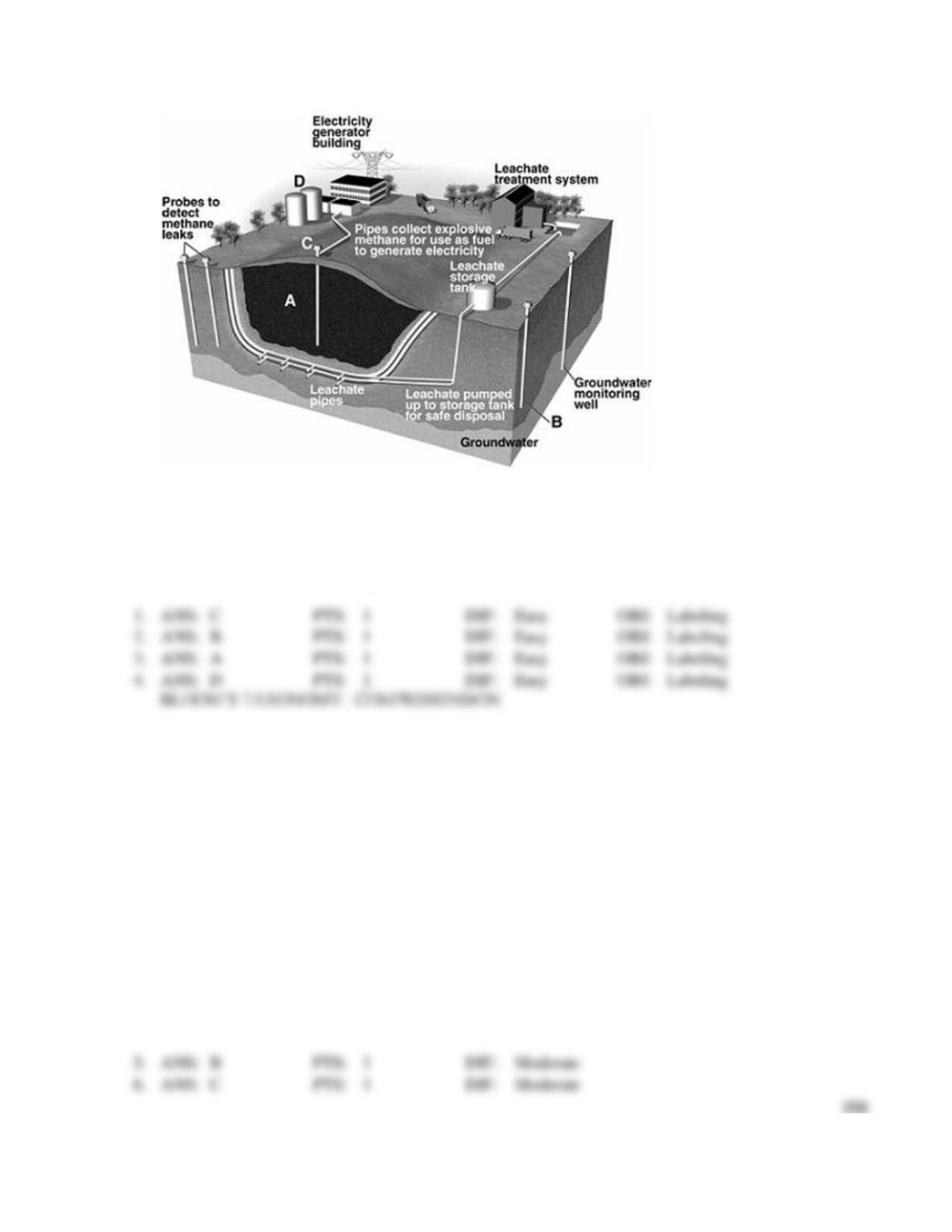
1. Which area is a methane gas recovery well?
2. Which area represents monitoring wells?
3. Which area contains compacted solid wastes?
4. Which area is a methane storage area?
Considering the priorities suggested by the U.S. National Academy of Sciences for integrated waste
management, match the priority level with the appropriate action below.
a.
first priority
c.
third priority
b.
second priority
5. Buy soft drinks in glass containers.
6. Incinerate waste.
7. Use less garden pesticides.
8. Bury waste in landfills.
9. Change industrial processes to eliminate use of harmful chemicals.
10. Compost your vegetable scraps.
11. Make cars that last longer.
12. Buy foods such as grains and dried fruits in bulk.
13. Treat waste with bioremediation.
14. Repair an old bicycle and donate it to a children’s group.
SHORT ANSWER
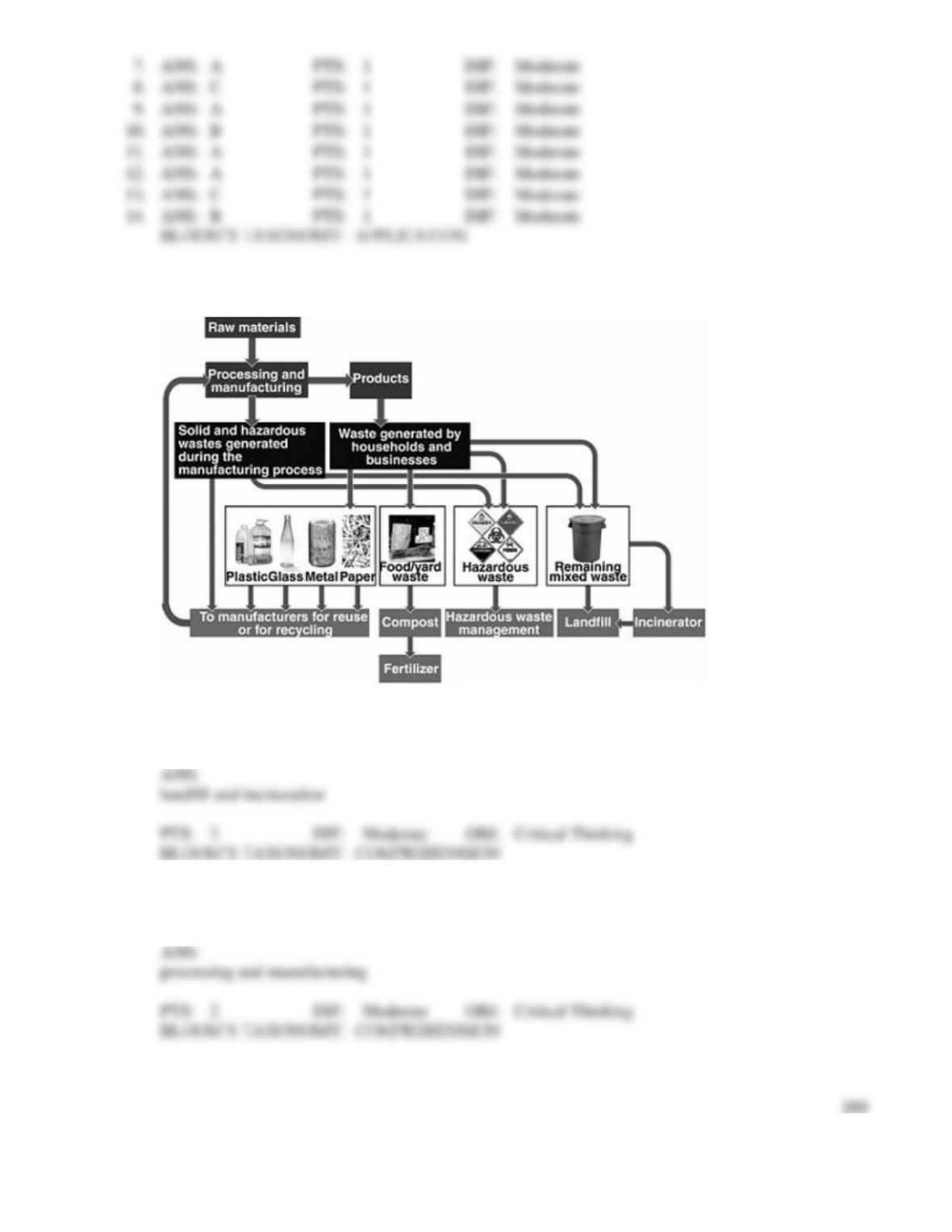
1. Which areas in the diagram represent processes that most countries rely on for dealing with solid waste
management?
2. The First Priority in an integrated solid waste management program can be most effectively applied in
which area of the diagram?
3. The Second Priority of an integrated solid waste management program comes into play in which
processes in the diagram?
4. Explain to a friend what the term environmental justice means. Include in your explanation some
specific examples of environmental injustice.
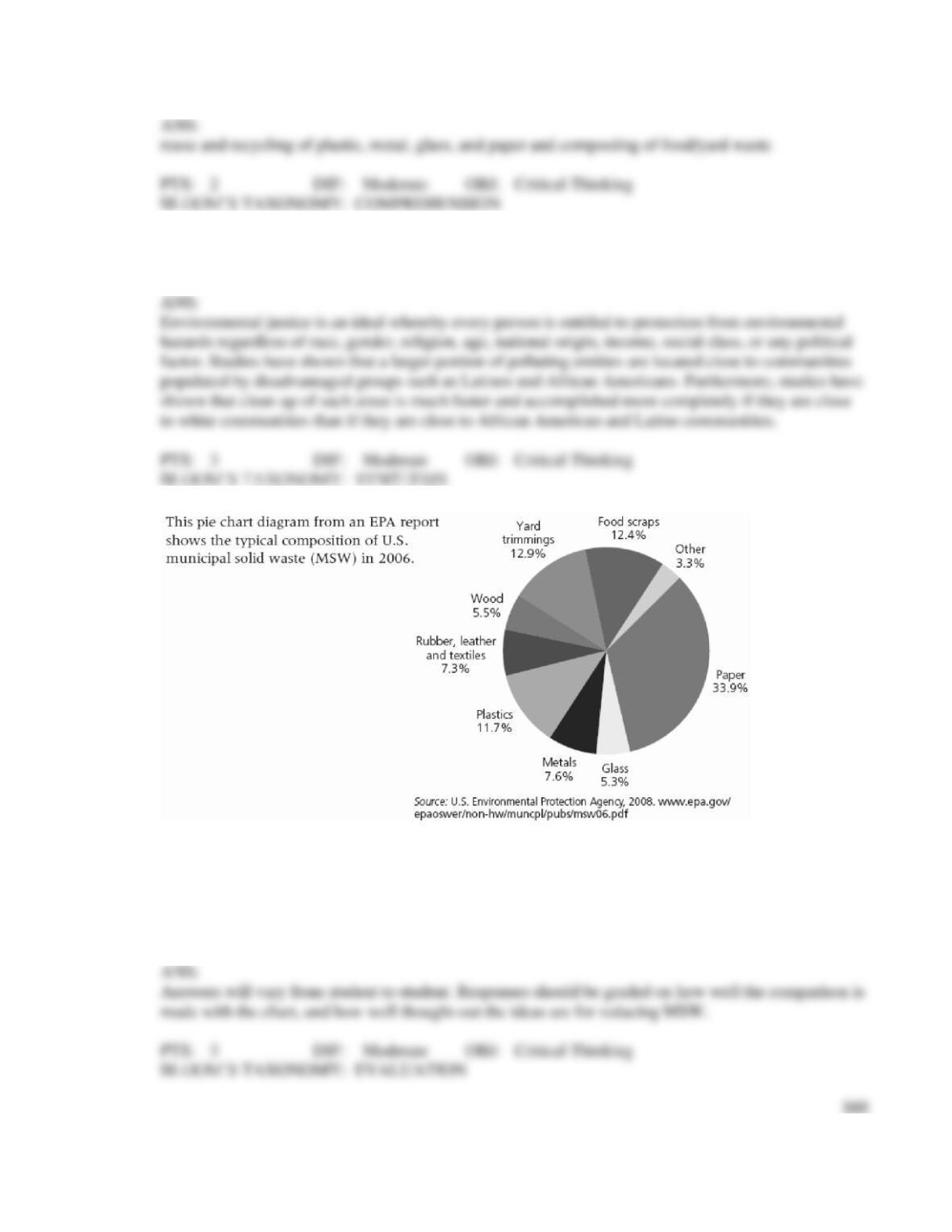
5. The pie chart above shows the typical content of municipal solid waste (MSW) in the U.S. This chart
represents an average amount, based on the year 2006. Think about the three largest categories in this
chart, and then think about your own MSW. Are your largest categories the same as shown here? Are
they different? Why? What can you do to cut down on the three largest categories of MSW that you
personally generate?
ESSAY
1. Compare and contrast the First Priority and the Last Priority in an integrated waste management plan.
2. Briefly explain the advantages and disadvantages of phytoremediation as a method of removing or
detoxifying hazardous wastes.
3. List the three key principles environmental scientists urge us to understand and live by in order to
make the change to a low-waste society.
4. Although great strides have been made in reducing lead poisoning in children in the United States,
there are still at least 310,000 children in our country with unsafe blood levels of lead. What should be
done to prevent this problem from continuing to harm our children?
5. You are planning a course of study that will result in a degree in microbiology. You also wish to work
in a job that allows you to help solve our environmental challenges. Based on the discussion in this
chapter about the issue of dealing with our waste problem, what type of work might you do?