Chapter 16: Cost-Volume-Profit Analysis
121. Bugatti, Inc. decided to institute an advertising campaign that would cost $75,000. Variable costs will remain at $15
per unit. Bugatti is currently selling 100,000 units of its product at $25 per unit. The marketing department is
estimating that there will be a 10 percent increase in sales volume. With all else remaining the same, what will be
the result of this decision?
a. An increase in sales of $25,000
b. A decrease in operating income of $75,000
c. An increase in operating income of $25,000
d. none of the above
122. Symbiosis Company had the following information:
Activity Driver
Units sold
Unit Variable Cost
$ 20
Level of Activity Driver
—
Setups
1,000
80
Engineering hours
60
2,000
Other data:
Total fixed costs (traditional)
$800,000
Total fixed costs (ABC)
$400,000
Unit selling price
$40
What is the break-even point in units using ABC?
a. 15,000 units
b. 45,000 units
c. 30,000 units
d. 75,000 units
Chapter 16: Cost-Volume-Profit Analysis
123. Symbiosis Company had the following information:
Activity Driver
Units sold
Unit Variable Cost
$ 20
Level of Activity Driver
—
Setups
1,000
80
Engineering hours
60
2,000
Other data:
Total fixed costs (traditional)
$800,000
Total fixed costs (ABC)
$400,000
Unit selling price
$40
How many units need to be sold to produce a before-tax profit of $120,000 using ABC?
a. 36,000 units
b. 51,000 units
c. 21,000 units
d. 81,000 units
124. Symbiosis Company had the following information:
Activity Driver
Units sold
Unit Variable Cost
$ 20
Level of Activity Driver
—
Setups
1,000
80
Engineering hours
60
2,000
Other data:
Total fixed costs (traditional)
$800,000
Total fixed costs (ABC)
$400,000
Unit selling price
$40
Suppose Symbiosis could reduce setup costs by $500 per setup and could reduce the number of engineering hours
needed to 1,216.66 hours. How many units must be sold to break even in this case?
a. 30,000 units
b. 25,050 units
c. 11,250 units
d. 25,650 units
Chapter 16: Cost-Volume-Profit Analysis
125. Fantasmas Incorporated had the following information:
Activity Driver
Units sold
Unit Variable Cost
$20
Level of Activity Driver
—
Setups
1,200
60
Engineering hours
52
1,500
Other data:
Total fixed costs (traditional)
$600,000
Total fixed costs (ABC)
$360,000
Unit selling price
$60
What is the break-even point in units using ABC?
a. 6,325 units
b. 8,500 units
c. 12,750 units
d. 19,125 units
126. Fantasmas Incorporated had the following information:
Activity Driver
Units sold
Unit Variable Cost
$20
Level of Activity Driver
—
Setups
1,200
60
Engineering hours
52
1,500
Other data:
Total fixed costs (traditional)
$600,000
Total fixed costs (ABC)
$360,000
Unit selling price
$60
Suppose Fantasmas could reduce setup costs by $300 per setup and could reduce the number of engineering hours
needed to 1,400 hours. How many units must be sold to break even in this case?
a. 7,243 units
b. 24,340 units
c. 12,170 units
d. 8,554 units
Chapter 16: Cost-Volume-Profit Analysis
127. Fantasmas Incorporated had the following information:
Activity Driver
Units sold
Unit Variable Cost
$20
Level of Activity Driver
—
Setups
1,200
60
Engineering hours
52
1,500
Other data:
Total fixed costs (traditional)
$600,000
Total fixed costs (ABC)
$360,000
Unit selling price
$60
How many units need to be sold to produce a before-tax profit of $80,000 using ABC?
a. 8,350 units
b. 12,800 units
c. 15,580 units
d. 14,750 units
Chapter 16: Cost-Volume-Profit Analysis
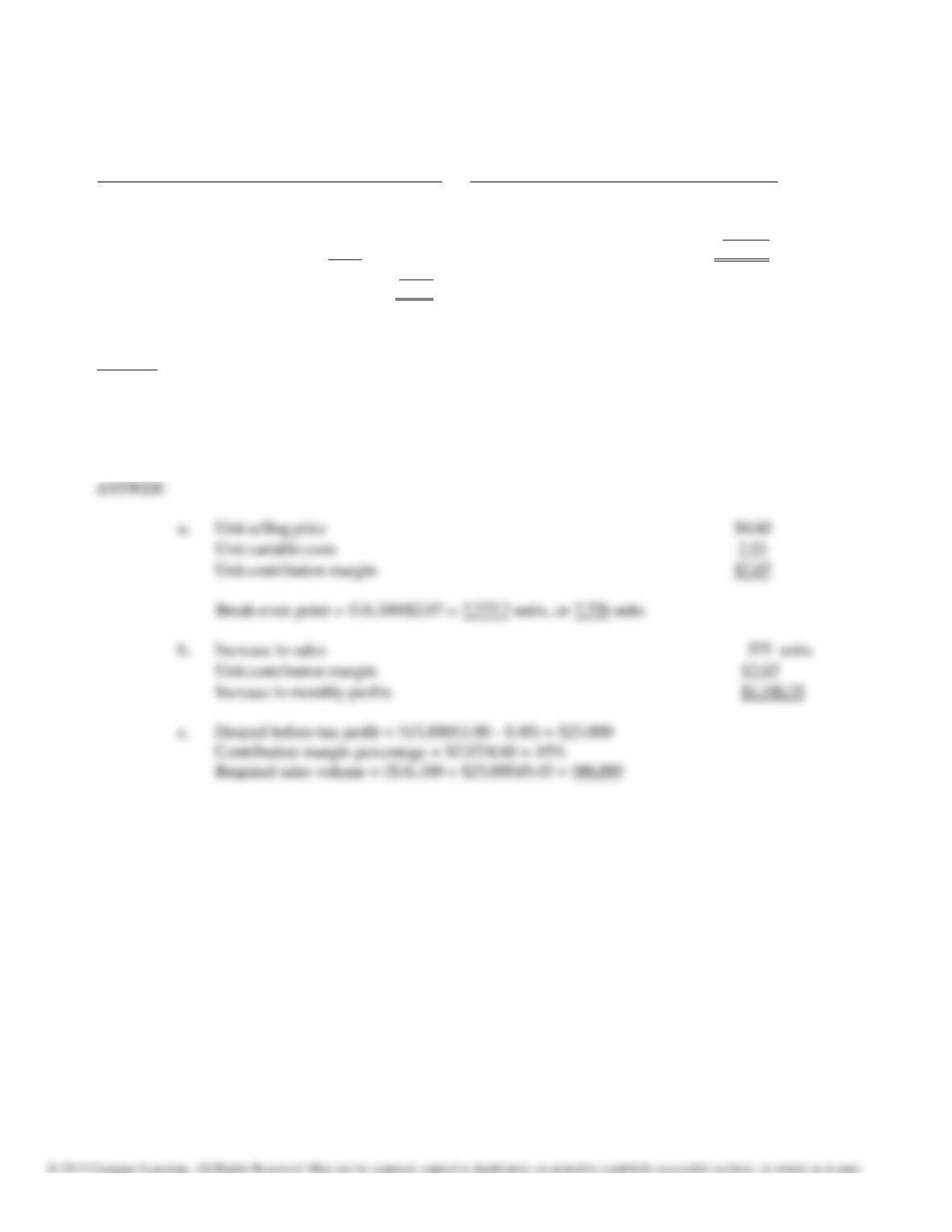
128. The Barrister Mug Company manufactures plastic mugs that sell to wholesalers for $4.60 each. Variable and fixed
costs are as follows:
Variable Costs per Unit
Fixed Costs per Month
Manufacturing:
Direct materials
$0.69
Factory overhead
$ 9,200
Direct labor
0.81
Selling and adm.
6,900
Factory overhead
0.57
$2.07
Total
$16,100
Selling and adm.
0.46
Total
$2.53
Barrister Mug produced and sold 11,500 cups during April 2016. There were no beginning or ending inventories.
Required:
a. Determine Barrister Mug‘s monthly break–even point in units.
b. If monthly sales increase by 575 cups, what will be the change in monthly profits?
c. If Barrister Mug is now subject to an income tax of 40 percent, what dollar sales volume is
required to earn a monthly after-tax net income of $13,800?
Chapter 16: Cost-Volume-Profit Analysis
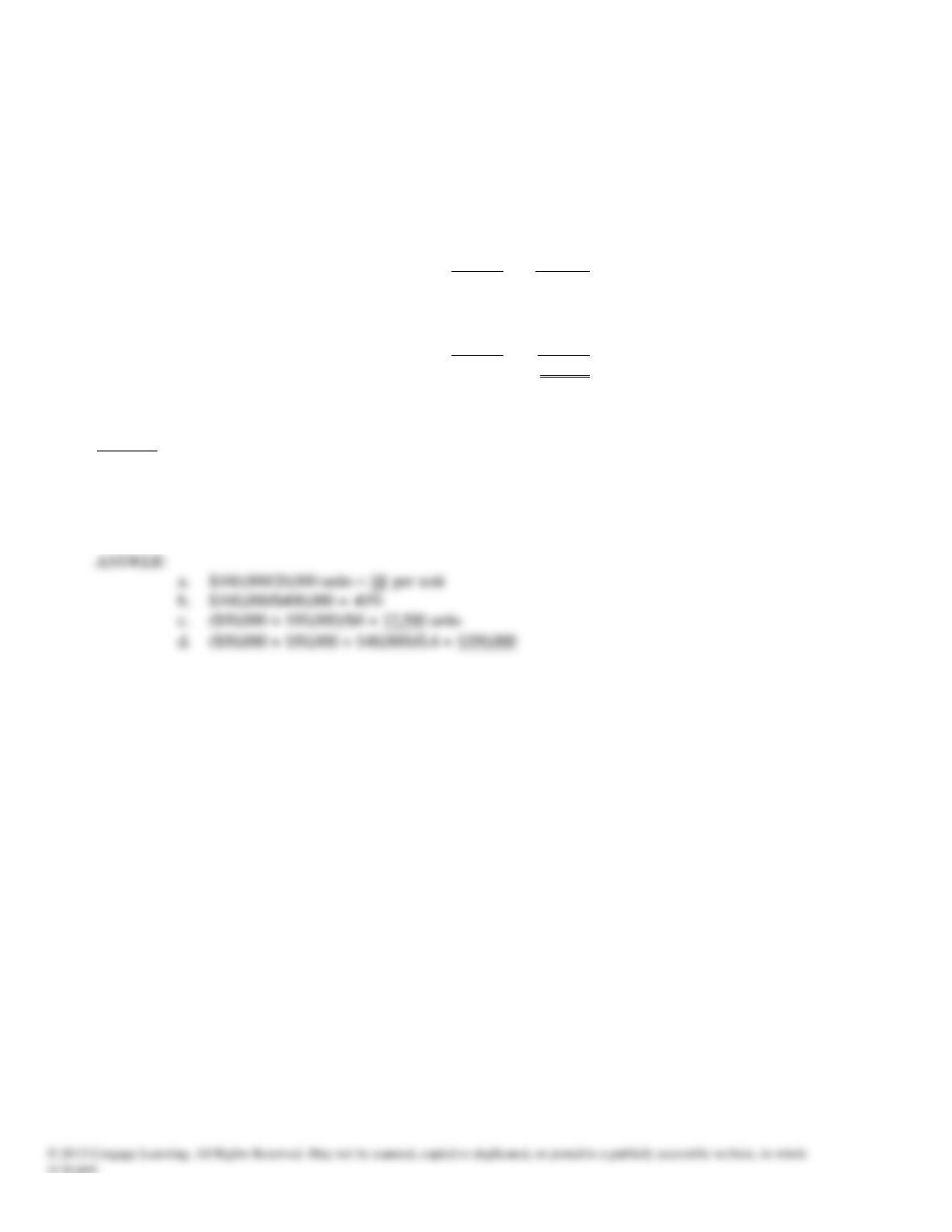
129. The Leonardo Company had the following functional income statement for the month of July 2016:
Sales ($20 × 20,000 units)
$400,000
Costs of goods sold:
Direct materials
$ 60,000
Direct labor
40,000
Variable factory overhead
120,000
Fixed factory overhead
50,000
270,000
Gross profit
$130,000
Selling and administrative expenses:
Variable
$ 20,000
Fixed
50,000
70,000
Operating income
$60,000
There were no beginning and ending inventories.
Required:
a. Calculate the contribution margin per unit.
b. Calculate the contribution margin ratio.
c. What is the break-even point in units?
d. What is the amount of sales in dollars needed to obtain a before–tax profit of $40,000?
Chapter 16: Cost-Volume-Profit Analysis
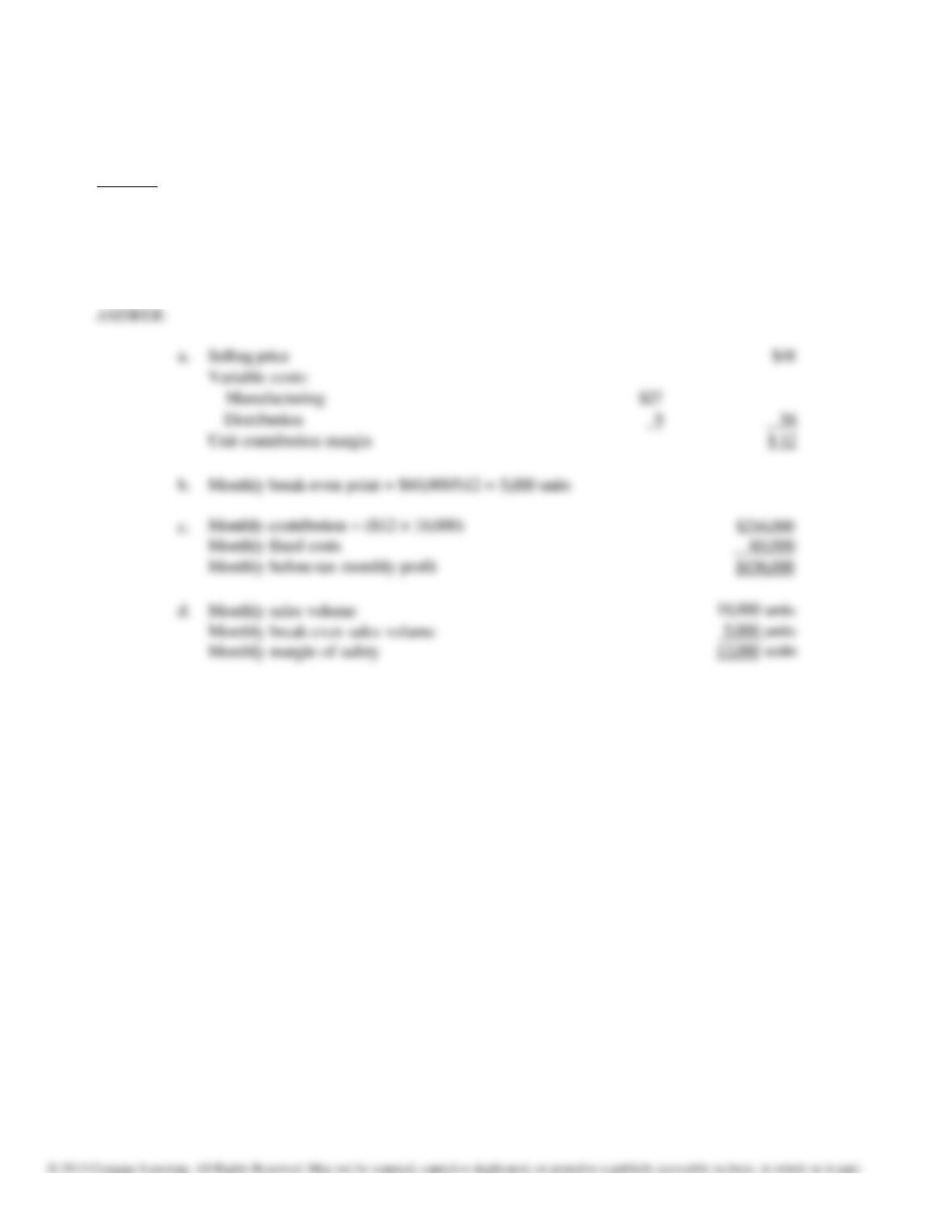
130. At a price of $48, the estimated monthly sales of a product are 18,000 units. Variable costs include manufacturing
costs of $27 and distribution costs of $9. Fixed costs are $60,000 per month.
Required:
Determine each of the following values:
a. Unit contribution margin
b. Monthly break-even unit sales volume
c. Before-tax monthly profit
d. Monthly margin of safety in units
Chapter 16: Cost-Volume-Profit Analysis
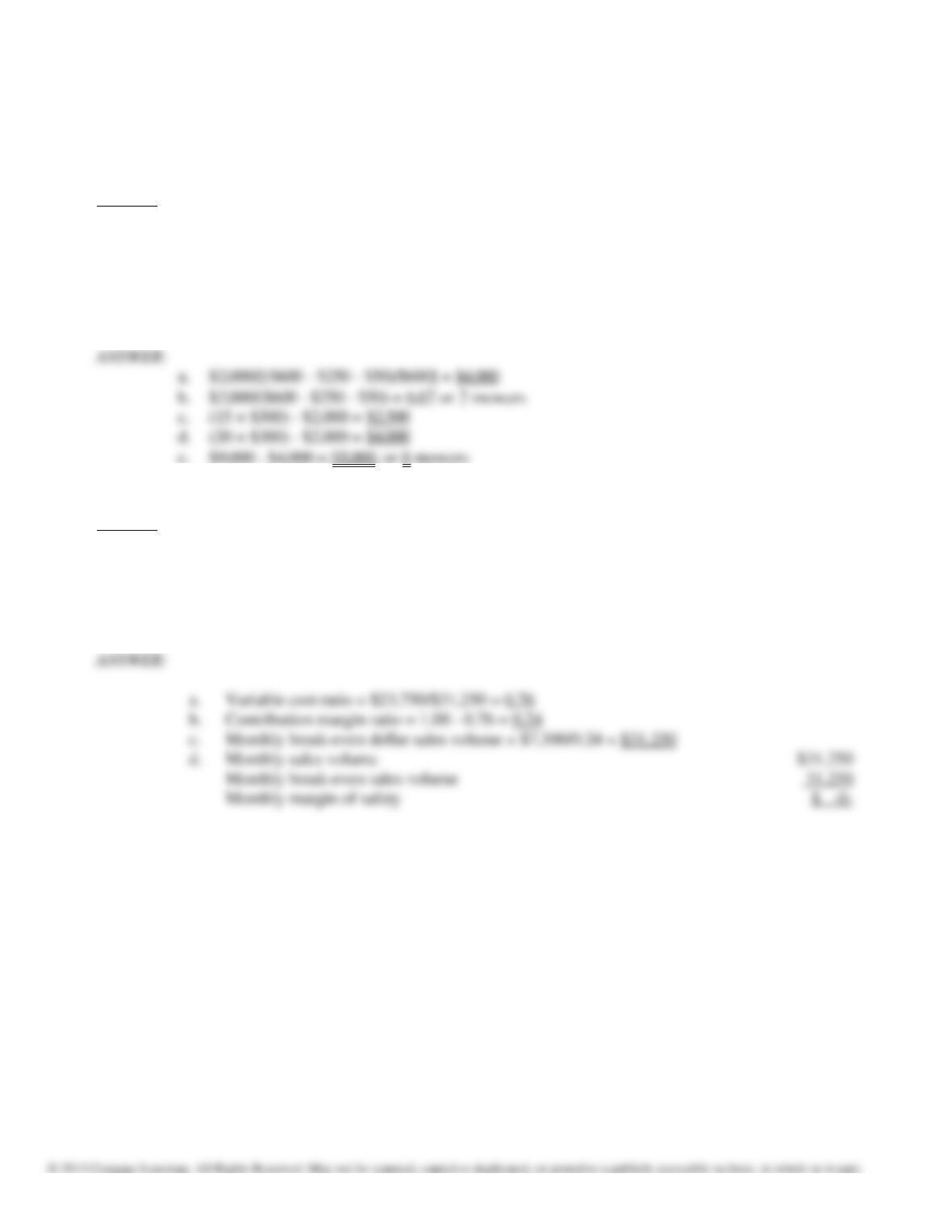
131. ChowMein Company is the exclusive Montana distributor of lawn mowers for a small manufacturing company. It
sells only one model at $600 per unit and for which ChowMein pays $250. ChowMein‘s other variable costs amount
to $50 per unit. Fixed costs are $2,000. In April, ChowMein sold 15 lawn mowers and it sold 20 in May.
Required:
Calculate the following values:
a. Monthly break–even point in sales dollars
b. Monthly break–even point in units
c. Monthly income for April
d. Monthly income for May
e. Margin of safety for April
132. At a monthly volume of $31,250, a company incurs variable cost of $23,750 and fixed costs of $7,500.
Required:
Determine each of the following values:
a. Variable cost ratio
b. Contribution margin ratio
c. Monthly break–even dollar sales volume
d. Monthly margin of safety in dollars
Chapter 16: Cost-Volume-Profit Analysis
133. The Old Towne Manufacturing Company produces the following three products:
Saws
Knives
Measuring Tapes
Selling price per unit
$40
$16
$50
Variable costs per unit
28
12
30
Contribution per unit
$12
$ 4
$20
Fixed costs are $76,000 per year.
50% of all sales in units are Saws, 30 percent are Knives, and 20 percent are Measuring Tapes..
Required:
Calculate the following values:
a. Break–even point in total units
b. Number of Saws that will be sold at break-even
c. Total sales in units to obtain a before–tax profit of $19,000
Chapter 16: Cost-Volume-Profit Analysis
134. Randolph Plumbing Company has the following information for 2016:
Selling price per unit
$10
Variable costs per unit
$7
Fixed costs
Required:
$1,500
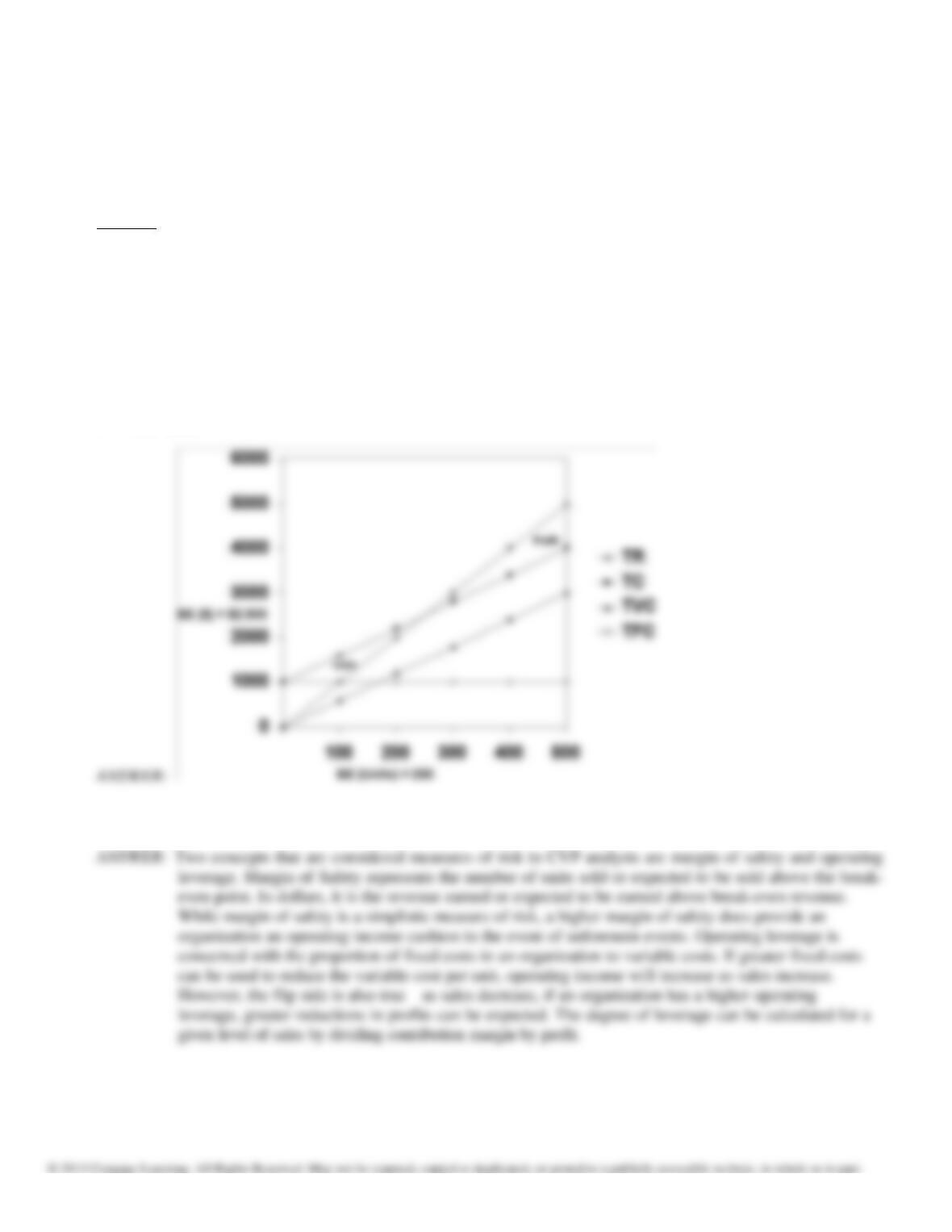
Prepare a profit-volume graph identifying the following items:
a. Profit line
b. Intersection of profit line and vertical axis
c. Break-even point
d. Profit area
e. Loss area
Chapter 16: Cost-Volume-Profit Analysis
135. Breadline Corporation has the following information for 2016:
Selling price per unit
$10
Variable costs per unit
$6
Fixed costs
Required:
$1,000
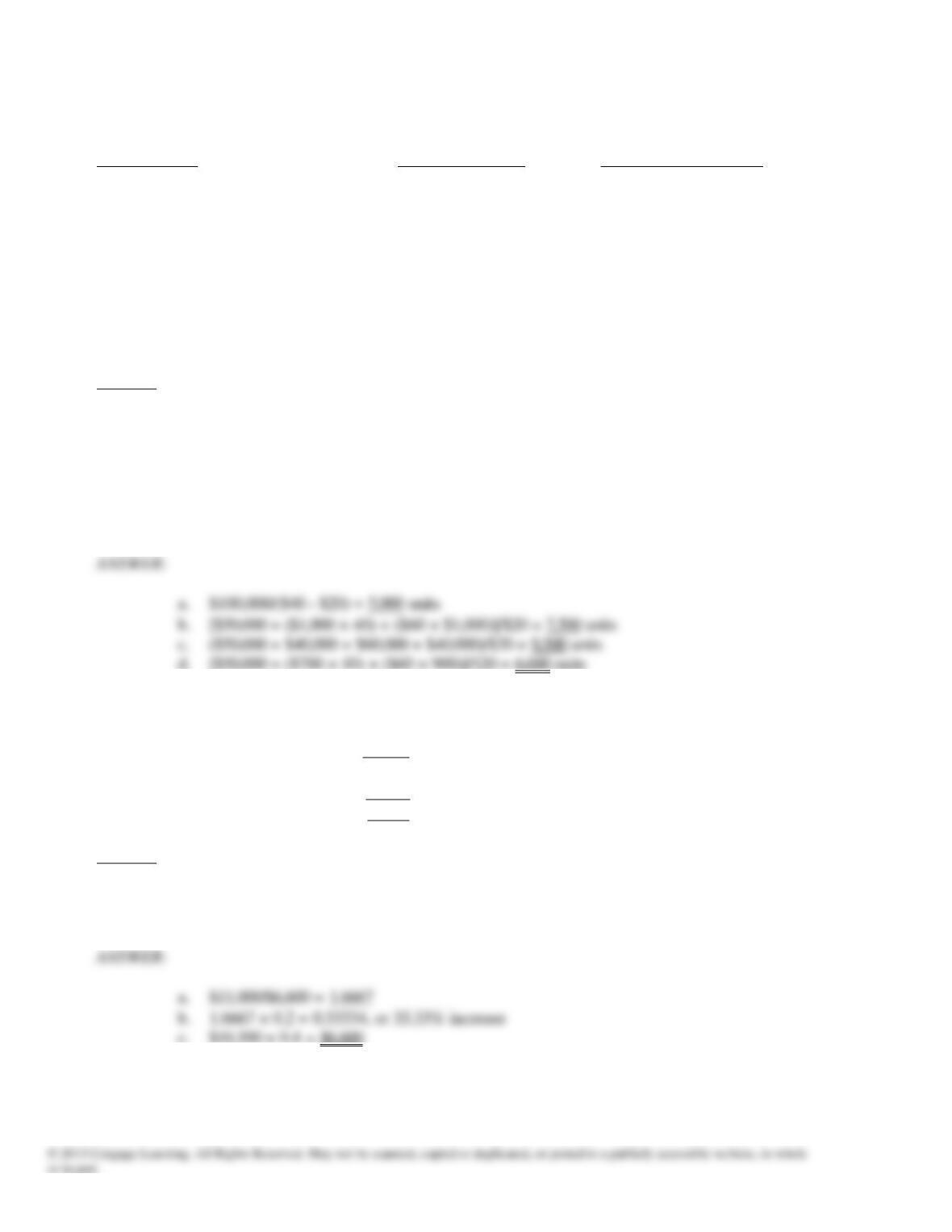
Prepare a cost–volume-profit graph identifying the following items:
a. Total costs line
b. Total fixed costs line
c. Total variable costs line
d. Total revenues line
e. Break–even point in sales dollars
f. Break–even point in units
g. Profit area
h. Loss area
136. In the Cost-Volume-Profit analysis, what are two ways management can deal with risk and uncertainty?
Chapter 16: Cost-Volume-Profit Analysis
137. Gigondas Incorporated had the following information:
Activity Driver
Units sold
Unit Variable Cost
$20
Level of Activity Driver
—
Setups
1,000
40
Engineering hours
60
1,000
Other data:
Total fixed costs (traditional)
$100,000
Total fixed costs (ABC)
$50,000
Unit selling price
Required:
$40
a. Calculate the break-even point in units using the traditional approach to CVP analysis.
b. Calculate the break-even point in units using the activity-based costing approach to CVP
analysis.
c. Calculate the number of units using the activity-based costing approach, that must be sold to
earn a before-tax profit of $40,000.
d. Suppose Gilbert could reduce setup costs by $300 per setup and could reduce the number of
engineering hours needed to 900. How many units must be sold to break even in this case?
138. Peyton Place Corporation had the following income statement for 2016:
Sales
$27,500
Variable expenses
16,500
Contribution margin
$11,000
Fixed expenses
4,400
Operating income
$6,600
Required:
a. Calculate the operating leverage ratio.
b. If sales increase by 20 percent, what will be the percentage change in income?
c. If sales increase by $16,500, how much will income increase?