CHAPTER 16—MANAGING SHORT-TERM LIABILITIES (FINANCING)
TRUE/FALSE
1. If a firm is offered credit terms of 2/10, net 30, it is in the firm’s financial interest to pay as early
during the discount period as possible.
2. Trade credit can be separated into two components: free trade credit, which involves credit
received after the discount period ends, and costly trade credit, which is the cost of discounts not
taken.
3. As a rule, managers should try to always use the free component of trade credit but should use the
costly component only after comparing its costs to the costs of similar credit from other sources.
4. Trade credit is an inexpensive source of short-term financing if no discounts are offered.
5. When deciding whether or not to take a trade discount, the cost of borrowing funds should be
compared to the cost of trade credit to determine if the cash discount should be taken.
6. The calculated cost of trade credit is reduced by paying late.
7. The calculated cost of trade credit for a firm that buys on terms of 2/10, net 30, is lower (other
things held constant) if the firm pays in 40 days than if it pays in 30 days.
8. One of the disadvantages of not taking trade credit discounts when offered is that the firm’s
investment in accounts payable rises.
9. Trade credit and accrual accounts are always costless sources of spontaneous financing for the
firm.
10. A firm is said to be extending net trade credit when its accounts receivable are less than its
accounts payable.
11. When a firm has accounts payable that are greater than the level of its receivables, the firm is
actually receiving net trade credit.

Chapter 16 Managing Short-Term Liabilities (Financing) 339
12. “Stretching” accounts payable is a widely accepted and costless financing technique.
13. Short-term financing might be riskier than long-term financing because, during periods of tight
credit, the firm might not be able to rollover (renew) its debt.
14. One of the advantages of short-term debt financing is that firms can expand or contract their
short-term credit more easily than their long-term credit.
15. Short-term loans generally are obtained faster than long-term loans because when lenders
consider long-term loans they insist on a more thorough evaluation of the borrower’s financial
health and because the loan agreement is more complex.
16. A line of credit and a revolving credit agreement are similar except that a line of credit creates a
legal obligation for the bank.
17. A promissory note is the document signed when a bank loan is executed and it specifies financial
aspects of the loan. The separate indenture note will specify items such as collateral and other
terms and conditions.
18. The maturity of most bank loans is short-term. Bank to business loans are frequently 90-day notes
which are often rolled over, or renewed, at the end of their maturity.
19. A line of credit can be either a formal or informal agreement between borrower and bank
regarding the maximum amount of credit the bank will extend to the borrower subject to certain
conditions.
20. Under a revolving credit agreement the risk to the firm of being unable to obtain funds when
needed is lower than with a line of credit.
21. Assume a firm takes out a discounted loan with its local bank. By the very nature of a discount
loan, a compensating balance requirement will exist, and this will lead to a higher effective rate
on this loan versus the loan’s simple, or stated, rate.
22. On a 1-year loan for $10,000, a firm would be better off borrowing at a rate of 9.5 percent
discounted interest than 9 percent simple interest.
23. Many firms borrow by using banker’s acceptances (i.e., getting a bank to guarantee the firm’s
debt) when they are too small or too risky to use the commercial paper market.
340 Chapter 16 Managing Short-Term Liabilities (Financing)
24. The risk of default on pledged accounts receivable is borne by the lender to whom the receivables
are pledged.
25. Factoring involves the outright sale of accounts receivable.
26. When a firm factors its accounts receivable, the factor normally performs the functions of risk
bearing, credit checking, and lending.
27. The pledging of receivables differs from factoring in that, under pledging, the lender normally has
recourse against the borrower.
28. Accounts receivable financing, especially the factoring of accounts, is a very flexible source of
funds. Once the factoring procedure has been established, funds from this type of financing will
automatically increase as the firm increases its sales.
29. Liabilities such as wages and taxes that increase spontaneously with operations are called
accruals.
30. Trade credit is seldom used by firms and is an insignificant component of short-term debt for
most firms.
31. A promissory note is a document specifying the terms and conditions of a loan, including the
amount, interest rate, and repayment schedule.
32. A compensating balance is an arrangement in which a bank agrees to lend up to a specified
maximum amount of funds during a designated period.
33. A commitment fee is a fee charged on unused balance of a revolving credit agreement to
compensate the bank for guaranteeing that the funds will be available when needed by the
borrower.
34. A bank with fluctuating deposit liabilities in a static community will tend to follow creative
banking practices when approving loans.
35. Commercial paper is a type of secured promissory issued by large, strong financial firms.

Chapter 16 Managing Short-Term Liabilities (Financing) 341
36. The factor (lender) purchasing accounts receivable from borrower has recourse against the
borrower if the accounts receivable can not be collected.
37. The uniform commercial code is a system of standards that simplifies procedures for establishing
loan security.
38. Long-term loan agreements always contain provisions, or covenants, which constrain the firm’s
future actions. Short-term credit agreements are just as restrictive in order to protect the interests
of the lender.
39. A firm constructing a new manufacturing plant and financing it with short-term loans that are
scheduled to be converted to bonds when the plant is completed, would want to separate the
construction loan from other current liabilities associated with working capital management.
40. If a firm fails to take trade credit discounts it may cost the firm money, but generally such a
policy has a negligible effect on the firm’s income statement and no effect on the firm’s balance
sheet.
41. If a firm is involuntarily “stretching” its accounts payable then this is one sign that it is
undercapitalized; that is, that it needs more working capital for operations.
42. A firm that “stretches” its accounts payable rather than paying on net terms is actually increasing
its calculated cost of credit given that it already does not take discounts when offered, other
things held constant.
43. If one of your firm’s customers is “stretching” its accounts payable, this may be a nuisance but
does not represent a real financial cost to your firm as long as the firm periodically pays off its
entire balance.
44. The prime rate charged by big money center banks can vary greatly (for example, as much as 2 to
4 percentage points) across banks due to banks’ ability to differentiate themselves and because
particular banks develop particular clienteles, such as mainly making loans to small firms.
45. A revolving credit agreement is a formal line of credit usually used by large firms. The firm will
pay a fee on the unused balance of the committed funds to compensate the bank for the
commitment to extend those funds.
46. When a firm pledges its accounts receivable, if a customer that purchased goods from the firm
does not pay, the selling firm must take the loss.

342 Chapter 16 Managing Short-Term Liabilities (Financing)
47. Firms having difficulty borrowing short-term funds from banks can raise short-term funds by
issuing commercial paper.
MULTIPLE CHOICE
1. Firms generally choose to finance temporary assets with short-term debt because
a.
Matching the maturities of assets and liabilities reduces risk.
b.
Short-term interest rates traditionally have been more stable than long-term interest rates.
c.
A firm that borrows heavily long-term is more apt to be unable to repay the debt than the
firm that borrows heavily short-term.
d.
The yield curve traditionally has been downward sloping.
e.
Sales remain constant over the year, and financing requirements also remain constant.
2. Which of the following statements concerning commercial paper is false?
a.
Commercial paper generally is written for terms less than 270 days.
b.
Commercial paper generally carries an interest rate below the prime rate.
c.
Commercial paper is sold to money market mutual funds, as well as to other financial
institutions and nonfinancial corporations.
d.
Commercial paper can be issued by virtually any firm so long as it is willing to pay the
going interest rate.
3. Small, undercapitalized firms
a.
Are generally users of net trade credit.
b.
Are major users of banker’s acceptances.
c.
Generally do not issue commercial paper.
d.
Typically have a high cost of debt capital.
e.
Are described by all of the above statements.
4. Inventory financing can take the form of a
a.
Blanket lien.
b.
Trust receipt.
c.
Warehouse receipt.
d.
All of the above.
e.
Answers a and b above.

Chapter 16 Managing Short-Term Liabilities (Financing) 343
5. Which of the following is not a common type of short term financing?
a.
Commercial paper.
b.
Accruals.
c.
Trade credit.
d.
Corporate bonds.
e.
Bank loans.
6. Accruals are generally considered __________ debt since __________ interest is paid on
accruals.
a.
adjustable rate; varying amounts of
b.
expensive; high rates of
c.
cheap; low rates of
d.
free; no
e.
fixed; a constant low rate of
7. Seagar Corporation provides monofilament fishing line to its customers. Seagar gives its
customers a three percent discount if the invoice payment is paid within 10 days of the billing
date. If the discount is not taken then the balance must paid in full within 45 days of the billing
date. Any unpaid balances over 45 days beyond the billing date will be assessed a five percent
penalty every 30 days, beginning 46 days after the billing date. Seagar is said to sell on credit
with terms of what?
a.
5/30, net 45
b.
3/45, net 60
c.
3/10, net 45
d.
3/10, net 30
e.
5/10, net 30
8. Financial managers should always use the free component of the trade credit, but they should use
the costly component only after analyzing this source of financing to make sure
a.
that it is greater than the cost of funds for the firm.
b.
that it has a maturity less than the average collection period.
c.
that it is less than the cost of funds for the firm.
d.
that the default risk inherent in accepting this trade credit is low.
e.
that firms offering the trade credit does not issue commercial paper.
9. Under the terms of trade found in most industries, the costly component of trade credit
a.
is relatively cheap, thus financially strong firms forego the cash discount.
b.
is relatively expensive, thus financially strong firms will take the cash discount.
c.
is relatively expensive, thus financially strong firms forego the cash discount.
d.
is relatively cheap, thus financially strong firms will take the cash discount.
e.
is relatively cheap, thus most financially strong firms don’t consider the terms of trade.

344 Chapter 16 Managing Short-Term Liabilities (Financing)
10. A document specifying the terms and conditions of a bank loan, including the amount, interest
rate, repayment schedule, and any other terms or conditions of the loan is a
a.
compensating balance.
b.
commitment fee.
c.
commercial paper.
d.
trade credit.
e.
promissory note.
11. An arrangement in which a bank agrees to lend up to a specified maximum of funds as needed
over a specified time period is a
a.
compensating balance.
b.
line of credit.
c.
commercial paper.
d.
trade credit.
e.
promissory note.
12. An important difference between revolving credit and a general line of credit is
a.
that a bank has a legal obligation to honor a general line of credit.
b.
that a bank receives a commitment fee for guaranteeing the funds under a general line of
credit.
c.
the commitment fees on a general line of credit are generally higher than the commitment
fees on a revolving line of credit.
d.
that a bank has a legal obligation to honor a revolving line of credit.
e.
that there are no differences between a general line of credit and a revolving line of credit.
13. Which of the following aspects is not important to business when choosing a bank?
a.
Willingness to assume risk.
b.
Advice and counsel.
c.
Loyalty to customers.
d.
Size of the bank.
e.
All of the above are important to businesses when choosing a bank.
14. Which of the following is not one of primary purchasers of commercial paper?
a.
Other businesses.
b.
Insurance companies.
c.
Pension funds.
d.
Individual investors.
e.
Banks.

Chapter 16 Managing Short-Term Liabilities (Financing) 345
15. A loan that is backed by collateral is a(n) __________ loan.
a.
senior
b.
amortized
c.
subordinate
d.
commercial
e.
secured
16. Which of the following functions does the factor (lender) purchasing accounts receivable
normally perform?
a.
Credit checking.
b.
Lending.
c.
Risk bearing.
d.
All of the above.
e.
None of the above.
17. The three main working capital strategies discussed in the text, aggressive, conservative, and
moderate, differ primarily in the
a.
Relative amount of short-term debt used.
b.
Minimum level of permanent current assets.
c.
Relative amount of long-term debt versus equity used to finance permanent current assets.
d.
Average level of temporary current assets.
e.
Amount of trade credit used.
18. Which of the following statements is correct?
a.
Under normal conditions, a firm’s expected ROE probably would be higher if it financed
with short-term than with long-term debt, but the use of short-term debt would probably
increase the firm’s risk.
b.
Conservative firms generally use no short-term debt and thus have zero current liabilities.
c.
A short-term loan can usually be obtained more quickly than a long-term loan, but the cost
of short-term debt is likely to be higher than that of long-term debt.
d.
If a firm that can borrow from its bank buys on terms of 2/10, net 30, and if it must pay by
Day 30 or else be cut off, then we would expect to see zero accounts payable on its
balance sheet.
e.
If one of your firm’s customers is “stretching” its accounts payable, this may be a nuisance
but does not represent a real financial cost to your firm as long as the firm periodically
pays off its entire balance.

346 Chapter 16 Managing Short-Term Liabilities (Financing)
19. Which of the following statements is correct?
a.
Under normal conditions the shape of the yield curve implies that the interest cost of short-
term debt is greater than that of long-term debt, although short-term debt has other
advantages that make it desirable as a financing source.
b.
Flexibility is an advantage of short-term credit but this is somewhat offset by the higher
flotation costs associated with the need to repeatedly renew short-term credit.
c.
A short-term loan usually can be obtained more quickly than a long-term loan but the
penalty for early repayment of a short-term loan is significantly higher than for a long-
term loan.
d.
Statements about the flexibility, cost, and riskiness of short-term versus long-term credit
are dependent on the type of credit that actually is used.
e.
Short-term debt is often less costly than long-term debt and the major reason for this is
that short-term debt exposes the borrowing firm to much less risk than long-term debt.
20. Which one of the following aspects of banks is considered most relevant to businesses when
choosing a bank?
a.
Convenience of location.
b.
Competitive cost of services provided.
c.
Size of the bank’s deposits.
d.
Experience of personnel.
e.
Loyalty and willingness to assume lending risks.
21. Which of the following statements is correct?
a.
In a factoring arrangement, the factor always performs three functions: (1) credit checking,
(2) lending, and (3) receivables collection.
b.
The pledging of accounts receivable involves a transfer of the risk associated with
accounts receivable from the borrower to the lender.
c.
In a factoring arrangement, the seller can select various combinations of credit checking,
lending, and risk bearing the factor performs by changing provisions in the factoring
agreement.
d.
In a factoring agreement, the factor would not perform the credit checking and risk taking
functions without performing the lending function, because the former are required before
the factor can lend to the seller.
e.
The financing of accounts receivable involves an agreement which is informal and non–
binding, which makes it difficult for the factor to protect itself.
22. Which of the following statements is correct?
a.
The factoring of accounts receivable consists of a series of individual cycles as opposed to
a continuous process.
b.
Once a factoring agreement is in force, funds from this source are spontaneous in the sense
that an increase in sales will automatically generate additional credit from the factor.
c.
One of the main disadvantages of pledging or factoring is the significant lack of flexibility.

Chapter 16 Managing Short-Term Liabilities (Financing) 347
d.
One disadvantage of factoring is that it reduces the need of the selling firm to maintain a
credit department.
e.
The cost of pledging and factoring generally is very low and the risk bearing fee is
incorporated into the interest rate charged on the unpaid balance of the funds advanced by
the factor, which is usually one half of one percent above the prime rate.
23. Which of the following statements is correct?
a.
An inventory blanket lien gives the lending institution a lien against all of the borrower’s
inventories. However, the borrower must maintain a base inventory as collateral equal to
the level that existed when the loan was granted.
b.
A disadvantage of trust receipt financing is the requirement that a trust receipt be issued
for specific goods. As a result of this inconvenience, warehousing has become popular as a
method of securing loans with inventory.
c.
The fixed costs of a field warehousing arrangement are relatively small and, thus, many
small firms make such arrangements.
d.
The use of inventory financing, especially field warehouse financing, as a source of funds
for firms has the advantage of small fixed costs but the disadvantage of a lack of
spontaneous growth of funds as inventories increase.
24. All else equal, a firm that purchases raw materials on credit will have an __________ in trade
credit with a given __________ in purchases.
a.
decrease; no change
b.
no change; decrease
c.
increase; increase
d.
increase; decrease
e.
decrease; increase
25. Which of the following economic conditions are banks likely to lower the interest rates charge on
loans of all types?
a.
The Fed restricting the money supply.
b.
Strong demand for bank loans.
c.
Lower inflation.
d.
Answers a and b.
e.
None of the above.
26. Most secured short-term business borrowings involves the use of __________ as collateral.
a.
real estate
b.
marketable securities
c.
equipment
d.
inventory
e.
None of the above.
348 Chapter 16 Managing Short-Term Liabilities (Financing)
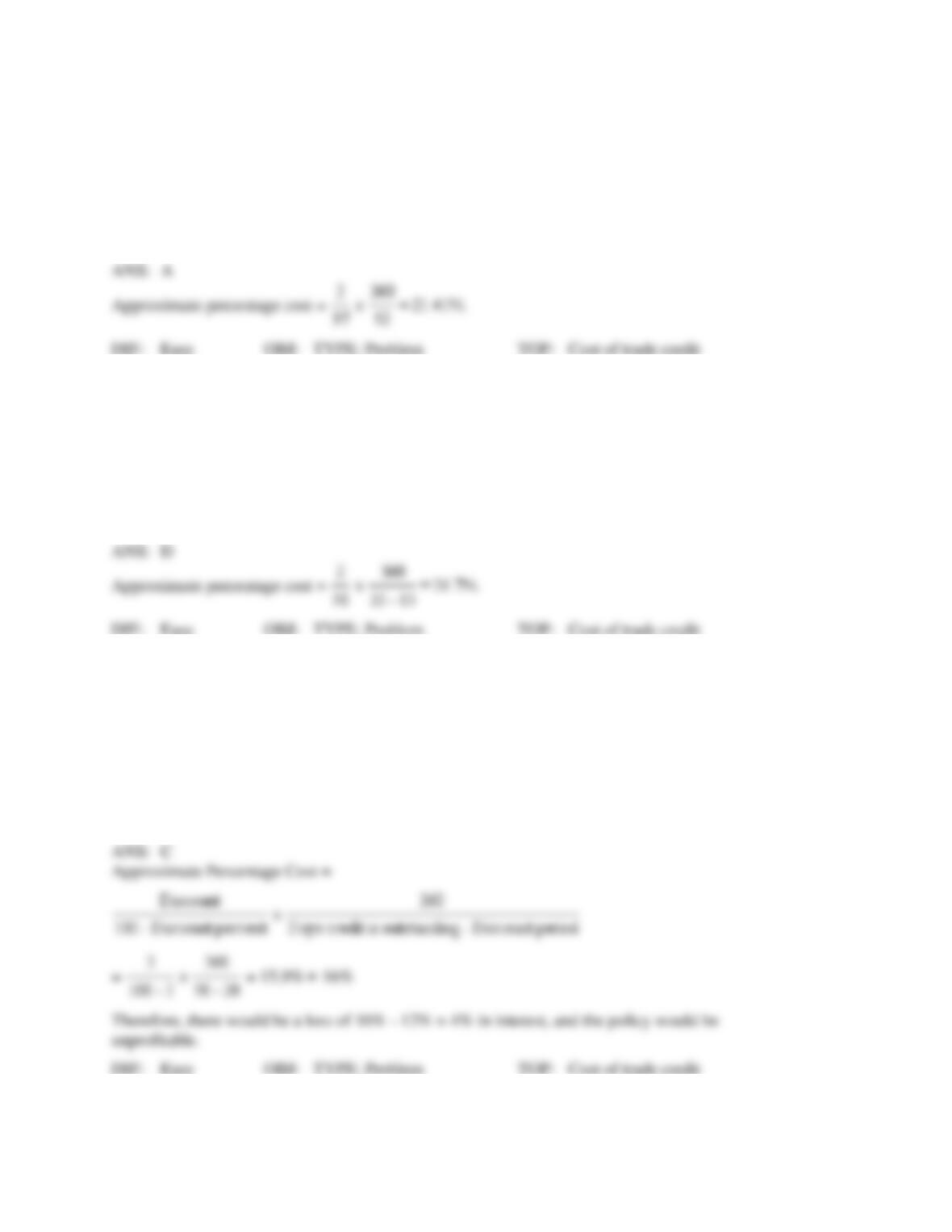
27. A firm is offered trade credit terms of 3/15, net 45. The firm does not take the discount, and it
pays after 67 days. What is the approximate annual cost of not taking the discount?
a.
21.41%
b.
22.07%
c.
22.95%
d.
23.48%
e.
24.52%
28. Dixie Tours Inc. buys on terms of 2/15, net 30. It does not take discounts, and it typically pays 35
days after the invoice date. Net purchases amount to $720,000 per year. What is the approximate
percentage cost of its non-free trade credit?
a.
17.2%
b.
23.6%
c.
26.1%
d.
36.7%
e.
50.6%
29. In this problem, use the approximation formula to find the cost of trade credit. A firm’s payments
policy calls for stretching payments to its supplier, who sells on terms of 3/20, net 60. Payment is
made in 90 days, and the cash saved is invested in a money market mutual fund paying 12 percent
interest. This policy is __________ because the firm has a net __________.
a.
Profitable; gain of about 9 percent on the funds involved.
b.
Profitable; gain of about 12 percent on the funds involved.
c.
Unprofitable; loss of about 4 percent on the funds involved.
d.
Unprofitable; loss of about 9 percent on the funds involved.
e.
Insufficient information to solve.
Chapter 16 Managing Short-Term Liabilities (Financing) 349
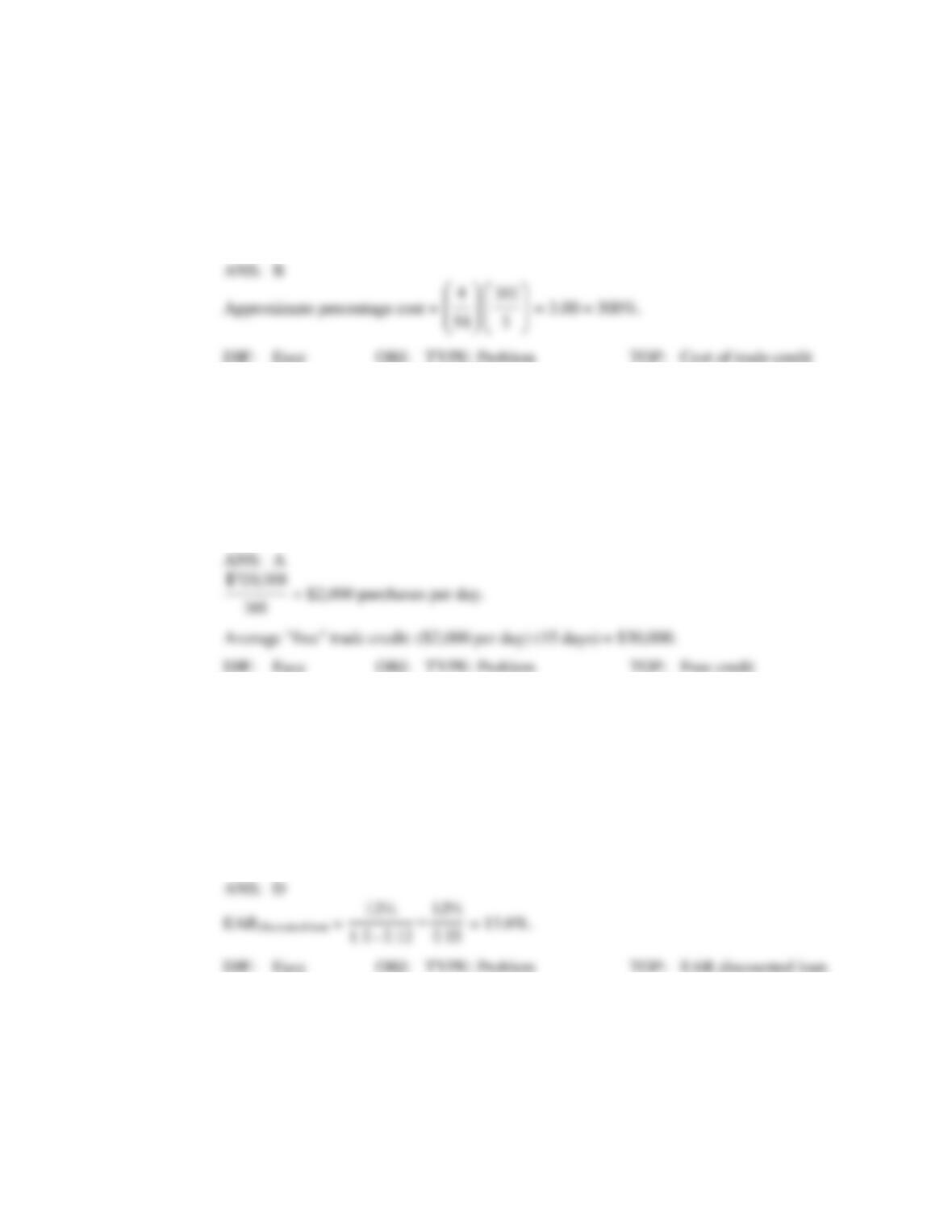
30. Your company has been offered credit terms on its purchases of 4/30, net 90. What will be the
approximate cost of trade credit if your company pays on the 35th day after receiving the invoice?
a.
30%
b.
300%
c.
3%
d.
87%
e.
156%
31. Phillips Glass Company buys on terms of 2/15, net 30. It does not take discounts, and it typically
pays 30 days after the invoice date. Net purchases amount to $720,000 per year. On average, how
much “free” trade credit does Phillips receive during the year?
a.
$30,000
b.
$40,000
c.
$50,000
d.
$60,000
e.
$70,000
32. Coverall Carpets Inc. is planning to borrow $12,000 from the bank. The bank offers the choice of
a 12 percent discounted interest loan or a 10.19 percent add-on, one-year installment loan,
payable in 4 equal quarterly payments. What is the effective rate of interest on the 12 percent
discounted loan?
a.
10.7%
b.
12.0%
c.
12.5%
d.
13.6%
e.
14.1%
33. If you borrow $2,000 from a bank for one year at a stated annual interest rate of 14 percent, but
interest is prepaid (a discounted loan), then what is your effective annual rate?
a.
14.00%
b.
8.57%
c.
16.28%
d.
21.21%
e.
28.00%