Cost Accounting: A Managerial Emphasis, 6e
Chapter 16 – Revenue and Customer Profitability Analysis
18) Lynnwood Ltd. is reviewing two of its customers using ABC analysis. It has identified the following
customer related activities and their rates:
Activity
Cost Driver
Rate
Sales
# of visits
$450
Order processing
# of orders
$125
Product handling
# of units
$12
Special shipping
# of shipments
$500
The company has the following information regarding Enbright Ltd. and Jackson Inc.:
Activity
Enbright Ltd.
Jackson Inc.
# of visits
9
6
# of orders
18
24
Product handling
650
380
Special shipping
15
30
Sales for Enbright and Jackson are $280,000 and $148,000 respectively. The gross margins on these sales
are the same at 52%.
Required:
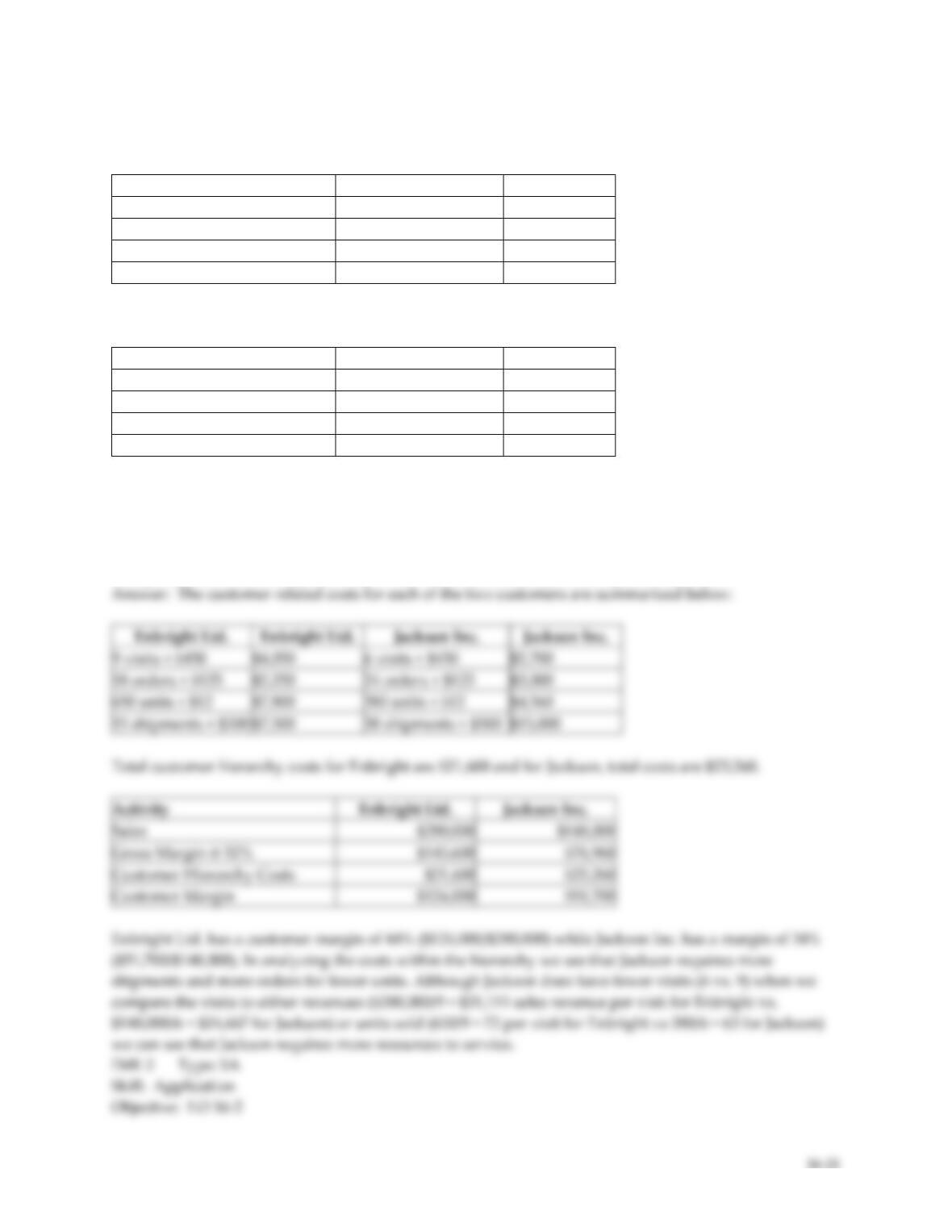
Using Customer ABC Analysis, analyze the relative profitability of Enbright and Jackson.
9 visits ∗ $450
$4,050
6 visits ∗ $450
$2,700
18 orders ∗ $125
$2,250
24 orders ∗ $125
$3,000
650 units ∗ $12
$7,800
380 units ∗ $12
$4,560
15 shipments ∗ $500
$7,500
30 shipments ∗ $500
$15,000
Activity
Sales
Gross Margin @ 52%
Customer Hierarchy Costs
Customer Margin
Cost Accounting: A Managerial Emphasis, 6e
Chapter 16 – Revenue and Customer Profitability Analysis
19) Clarke Industries collects information on two customers for the past year:
Langley Soldar
Supply Inc.
Revenues $1,492,000 $640,000
Cost of goods sold $1,164,000 $486,000
Number of in-stock orders 14 4
Number of out-of-stock orders 12 24
Clarke estimates the following activity-based costs:
Cost of processing and delivering an in-stock order $1,200
Cost of processing and delivering an out-of-stock order $3,500
An in-stock order is an order for which all the items included are in inventory at the time the order is
received.
Required:
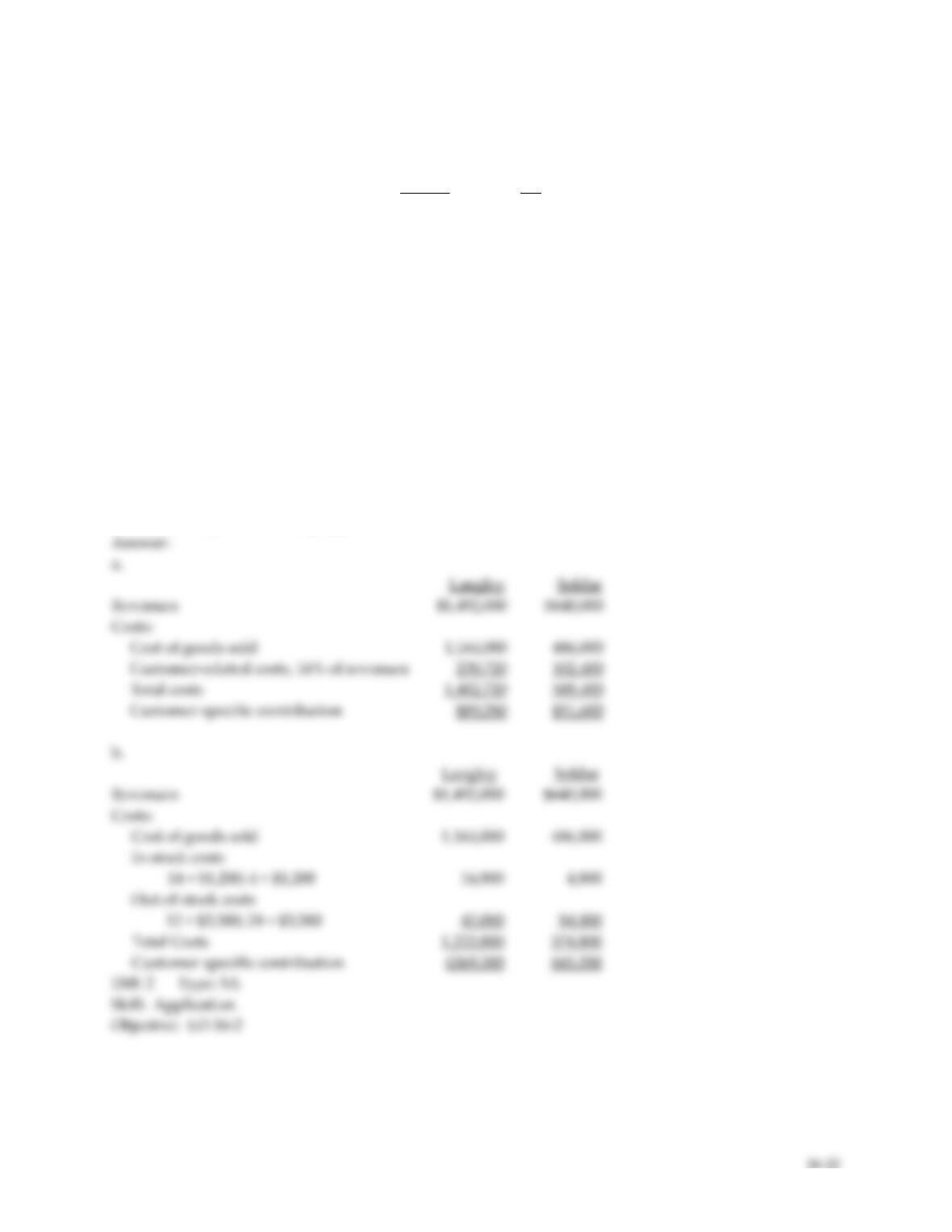
Compute the customer specific contribution of each customer for the year using:
a. 16% of revenues as the allocation rate for customer-related costs.
b. The activity based costing approach.
Cost Accounting: A Managerial Emphasis, 6e
Chapter 16 – Revenue and Customer Profitability Analysis
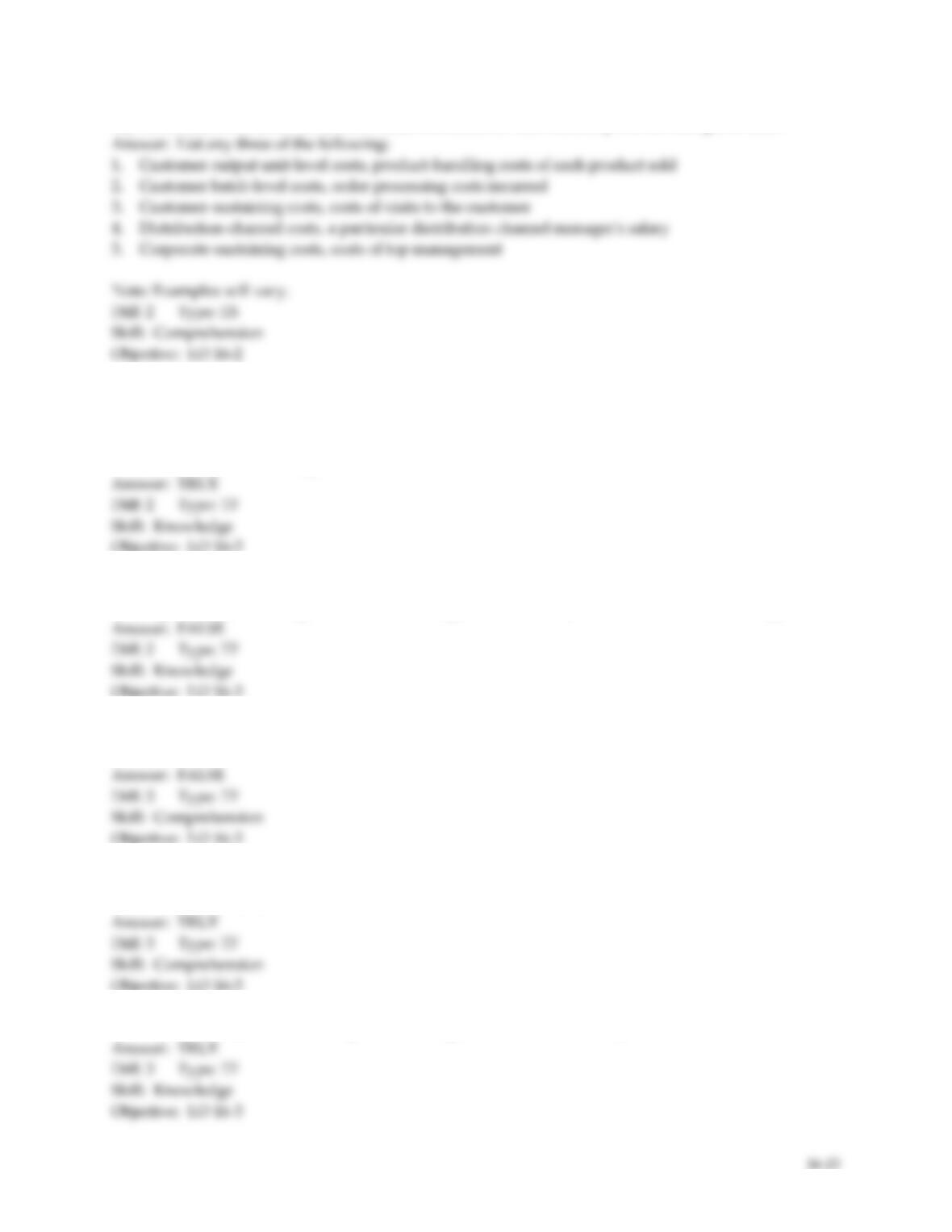
20) List at least three different levels of costs in a customer-cost hierarchy and an example of each.
16.3 Calculate and interpret four levels of revenue variance analyses.
1) The static-budget variance for revenues is the difference between the actual revenues and the budgeted
revenues from the static budget.
2) The sales-mix variance is the difference between two amounts: (1) the budgeted amount based on
actual quantities sold of all products and the budgeted mix, and (2) the amount in the static budget.
3) The sales-quantity variance can be unfavourable if both the market-share and market-size variances are
favourable.
4) The sales-volume variance is favourable assuming the sales-mix variance and the sales-quantity
variances are favourable.
5) The purpose of price discounting is to encourage increases in customer purchases.
Cost Accounting: A Managerial Emphasis, 6e
Chapter 16 – Revenue and Customer Profitability Analysis
6) Companies that only record the invoice price can usually track the magnitude of price discounting.
7) The market-size variance is the difference between two amounts: (1) the budgeted amount at budgeted
mix based on the actual market size in units and the actual market share, and (2) the budgeted amount at
budgeted mix based on actual market size in units and the budgeted market share.
8) Additional insight can be gained by dividing the sales-mix variance into the flexible-budget variance
and the sales-volume variance.
9) A favorable sales-mix variance arises when the actual sales-mix percentage is less than the budgeted
sales-mix percentage.
10) A composite unit is a hypothetical unit with weights based on the mix of individual units.
11) The sales-mix variance can be explained in terms of the budgeted contribution margin per composite
unit of the sales mix.
Cost Accounting: A Managerial Emphasis, 6e
Chapter 16 – Revenue and Customer Profitability Analysis
12) The sales-quantity variance is favorable when budgeted unit sales exceed actual unit sales.
13) The market-share variance is caused solely by the actual market share being different than the
budgeted market share.
14) A favorable market-size variance results with a decrease in market size.
15) A difficulty with the market share and market size variances is that accurate measures of market
share and market size often do not exist.
16) Customer revenues are calculated independently from price discounts.
17) Price discounting is the reduction of selling prices below listed levels in order to encourage an
increase in purchases by customers.
Cost Accounting: A Managerial Emphasis, 6e
Chapter 16 – Revenue and Customer Profitability Analysis
18) Which of the following is one of the items that are important to managers when analyzing sales–
volume variance information?
A) the static-budget variance
B) the flexible-budget variance
C) direct materials price variance
D) the sales-mix variance
E) direct labour efficiency variance
19) Which of the following is not a sales related variance?
A) sales volume variance
B) sales quantity variance
C) market size variance
D) direct materials yield variance
E) market share variance
20) The sales-volume variance plus or minus the static budget amount results in
A) the fixed-budget amount.
B) the flexible-budget amount.
C) an unfavourable/favourable variance.
D) the variable-budget amount.
E) a static budget variance.
Cost Accounting: A Managerial Emphasis, 6e
Chapter 16 – Revenue and Customer Profitability Analysis
Use the information below to answer the following question(s).
Special Tea Products (STP) has an exclusive contract with Tea Distributors. Two brands of Teas are
imported, Strong and Mild, and sold to retail outlets. The monthly budget for the contract is based on a
combination of last year’s performance, a forecast of general industry sales, and the company’s expected
share of the Canadian market for imported Tea. The following information is provided for the month of
May:
Budgeted
Strong
Mild
Actual
Strong
Mild
Price per kg
$2.00
$3.00
$2.50
$2.50
Variable cost /kg
1.00
1.50
1.00
2.00
Cont. margin
$1.00
$1.50
$1.50
$0.50
Sales (in kg)
2,000
1,500
1,700
1,800
Budgeted fixed costs are $1,750. Actual fixed costs are $2,000.
21) What is the static budget variance (contribution margin) for Mild Tea?
A) $2,250 U
B) $2,250 F
C) $900 U
D) $1,350 F
E) $1,350 U
22) What is the STP sales-volume variance (contribution margin) for Strong tea?
A) $600 favourable
B) $600 unfavourable
C) $900 favourable
D) $900 unfavourable
E) $300 unfavourable
Cost Accounting: A Managerial Emphasis, 6e
Chapter 16 – Revenue and Customer Profitability Analysis
23) What is the STP total static-budget variance for revenues?
A) $50 favourable
B) $250 favourable
C) $50 unfavourable
D) $250 unfavourable
E) $800 unfavourable
24) What is the STP total flexible-budget variance for revenues?
A) $50 favourable
B) $50 unfavourable
C) $900 favourable
D) $800 favourable
E) $250 unfavourable
25) What is the STP total sales-volume variance (contribution margin) for May?
A) $300 favourable
B) $300 unfavourable
C) $150 favourable
D) $150 unfavourable
E) $750 unfavourable
Cost Accounting: A Managerial Emphasis, 6e
Chapter 16 – Revenue and Customer Profitability Analysis
26) What is the STP total sales-quantity variance for revenues?
A) $0
B) $150.00 unfavourable
C) $150.00 favourable
D) $300.00 unfavourable
E) $450.00 favourable
27) What is the STP total sales-mix variance for contribution margin?
A) $0
B) $150 unfavourable
C) $150 favourable
D) $300 favourable
E) $450 favourable
28) If the market-size variance is $650 F, the sales-mix variance is $500 F, the flexible budget variance is
$9,250 F, and the static budget variance is $8,000 U, which of the following is true?
A) The market share variance is $18,400 U.
B) The sales volume variance is $17,250 F.
C) The sales-quantity variance is $18,400 U.
D) The sales volume variance is $17,750 U.
E) The market share variance is $17,250 U.
Cost Accounting: A Managerial Emphasis, 6e
Chapter 16 – Revenue and Customer Profitability Analysis
29) Fresh Bread Company sells a special mix of wheat bread. If the expected output equals the actual
output, the sales-volume variance
A) will be negative.
B) will be positive.
C) will be favourable.
D) will be unfavourable.
E) will be zero.
30) The difference between (the budgeted contribution margin for the budgeted sales mix and budgeted
volume) and (the budgeted contribution margin for the budgeted sales mix and the actual volume) is the
A) sales mix variance.
B) sales quantity variance.
C) sales-volume variance.
D) market size variance.
E) market share variance.
31) The sales-volume variance for revenue is the
A) (actual sales quantity in units divided by budgeted individual product selling price per unit) times
(budgeted sales quantity in units).
B) (budgeted contribution margin per unit) times (actual unit sales plus static budget unit sales).
C) (actual sales quantity in units plus budgeted sales quantity in units) divided by (budgeted individual
product selling price per unit).
D) (budgeted sales quantity in units divided by budgeted individual selling price per unit) times (actual
sales quantity in units).
E) (budgeted individual product selling price per unit) times (actual sales quantity in units less budgeted
sales quantity in units).
Cost Accounting: A Managerial Emphasis, 6e
Chapter 16 – Revenue and Customer Profitability Analysis
32) A company sells two products: radios and speakers. The expected sales for radios were 1,500 units;
2,000 were sold. The budgeted selling price for radios was $15.00; however, the actual selling price was
$13.00. The expected sales for speakers were 4,600 units; 5,000 were sold. The budgeted selling price for
speakers was $7.50; however, the actual selling price was $9.00. Budgeted and actual variable costs were
$4.00 per unit for the radios and $2.00 per unit for the speakers. What is the contribution margin sales–
volume variance for the period?
A) $2,200 unfavourable
B) $2,200 favourable
C) $4,500 favourable
D) $7,700 favourable
E) $7,700 unfavourable
33) The sales-quantity variance arises because
A) the mix of individual products actually sold differs from the budgeted mix.
B) the total quantity of units actually sold differs from the static budget.
C) the total quantity of units expected to be sold differs from the static budget.
D) the mix of budgeted products sold differs from the actual product mix.
E) the budgeted sales in units cannot be achieved unless the price is decreased
34) Which of the following actually calculates the sales-quantity variance?
A) (actual units of all products sold) times (actual sales mix percentage minus budgeted sales mix
percentage) times (budgeted contribution margin per unit)
B) (actual sales quantity in units minus static-budget sales quantity in units) times (budgeted contribution
margin per unit)
C) (actual units of all products sold minus budgeted units of all products sold) times (budgeted sales-mix
percentage) times (budgeted contribution margin per unit)
D) (actual units of all products sold minus budgeted units of all products sold) times (budgeted sales-mix
percentage) times (actual contribution margin per unit)
E) (actual units of all products sold) times (actual sales mix percentage minus budgeted sales mix
percentage) times (actual contribution margin per unit)
Cost Accounting: A Managerial Emphasis, 6e
Chapter 16 – Revenue and Customer Profitability Analysis
35) Metal Cabinet Company manufactures two and four drawer filing cabinets. The actual units sold
(5,000) equalled the expected units to be sold for both products. The four drawer cabinets constitute 66
percent of the budgeted sales mix. The selling price is $30 for four drawer cabinets and $15 for two
drawer cabinets. What is the sales-quantity variance?
A) $0
B) $25,500
C) $49,500
D) $99,000
E) $101,500
Use the information below to answer the following question(s).
Teddy Bear Company sold a total of 30,000 stuffed tigers and lions. During August the following
information was gathered:
Tigers
Lions
Actual selling price
$7.50
$10.50
Budgeted selling price
$5.50
$10.50
Actual sales mix
69%
31%
Budgeted sales mix
75%
25%
Actual variable costs
$5.00
$6.50
Budgeted variable costs
$4.75
$7.25
Budgeted unit sales
30,000
10,000
36) What is the total sales-mix variance?
A) $21,600 favourable
B) $13,750 favourable
C) $13,750 unfavourable
D) $4,500 unfavourable
E) $4,500 favourable
Cost Accounting: A Managerial Emphasis, 6e
Chapter 16 – Revenue and Customer Profitability Analysis
37) What is the total sales-quantity variance?
A) $21,600 favourable
B) $13,750 favourable
C) $13,750 unfavourable
D) $4,500 favourable
E) $4,500 unfavourable
38) What is the total sales-volume variance?
A) $9,250 favourable
B) $9,250 unfavourable
C) $26,100 favourable
D) $7,850 unfavourable
E) $7,850 favourable
39) When the actual mix of products sold shifts in favour of the high-contribution-margin product,
A) the total sales-mix variance is unfavourable.
B) the total sales-mix variance is favourable.
C) the total sales-volume variance is unfavourable.
D) the total sales-volume variance is favourable.
E) the total sales volume is more favourable (or less unfavourable).
Cost Accounting: A Managerial Emphasis, 6e
Chapter 16 – Revenue and Customer Profitability Analysis
40) A company sells three different types of satellite dishes in Ontario, but sells only (type 1) in Alberta.
Available data are that the budgeted sales mix percentage in Ontario is .35(type 1), and .25(type 2). The
contribution margins per unit are $200 (1), $120 (2), and $140(3).
Required:
Calculate the budgeted contribution margin per composite unit for the budgeted mix for Ontario and
Alberta respectively.
A) $156 and $70
B) They are the same in both provinces.
C) $156 and $114
D) $156 and $200
E) $114 and $70
41) The (the difference between the actual market size in units and the budgeted market size in units)
times (the budgeted market share) times (budgeted contribution margin per composite unit for the
budgeted mix) is called the
A) budgeted market-size variance.
B) budgeted market-share variance.
C) market-share variance.
D) market-size variance.
E) sales quantity variance.
Cost Accounting: A Managerial Emphasis, 6e
Chapter 16 – Revenue and Customer Profitability Analysis
Use the information below to answer the following question(s).
Remote Company manufactures remote control devices for electronic equipment. The following
information was collected during June:
Actual market size (units)
20,000
Budgeted market size (units)
22,500
Actual market share
34%
Budgeted market share
32%
Budgeted selling price
$12.00
Actual selling price
$10.50
Budgeted cont. margin per unit
$4.00
Actual cont. margin per unit
$3.00
42) What is the company’s market-share variance?
A) $1,600 unfavourable
B) $1,600 favourable
C) $2,560 favourable
D) $1,200 unfavourable
E) $1,200 favourable
43) What is the company’s market-size variance?
A) $4,800 favourable
B) $3,200 favourable
C) $2,400 favourable
D) $2,400 unfavourable
E) $3,200 unfavourable
Cost Accounting: A Managerial Emphasis, 6e
Chapter 16 – Revenue and Customer Profitability Analysis
Answer the following questions using the information below:
Zorro Company manufactures remote control devices for garage doors. The following information was
collected during June:
Actual market size (units) 10,000
Actual market share 32%
Actual average selling price $10.00
Budgeted market size (units) 11,000
Budgeted market share 30%
Budgeted average selling price $11.00
Budgeted contribution margin per
composite unit for budgeted mix $5.00
44) What is the market-size variance?
A) $500 U
B) $1,500 U
C) $1,600 F
D) $1,000 F
E) $1,500 F
45) What is the market-share variance?
A) $1,000 F
B) $1,100 F
C) $500 U
D) $1,500 U
E) $1,000 U
Cost Accounting: A Managerial Emphasis, 6e
Chapter 16 – Revenue and Customer Profitability Analysis
46) What is the sales-quantity variance?
A) $1,500 U
B) $1,000 F
C) $500 U
D) $2,500 U
E) $500 F
47) If the market-size variance is $400 U and the sales-mix variance is $700 F, and the market share
variance is $300 F, we know that which of the following is true?
A) The sales-quantity variance is $100 U.
B) The sales volume variance is $600 F.
C) The sales-quantity variance is $100 U, and the sales volume variance is $600 F.
D) The sales volume variance is $600 U.
E) The sales volume variance is $600 F, and the sales-quantity variance is $100 F.
48) Which of the following is the best reason(s) for a company to give a price discount to customer?
A) gave discount in the past
B) increase sales person bonus
C) name recognition of the customer and volume purchases
D) to enable cost tracing to a specific customer
E) to enable cost tracing to a specific product