Chapter 16: Statement of Cash Flows
Chapter 16: Statement of Cash Flows
159.
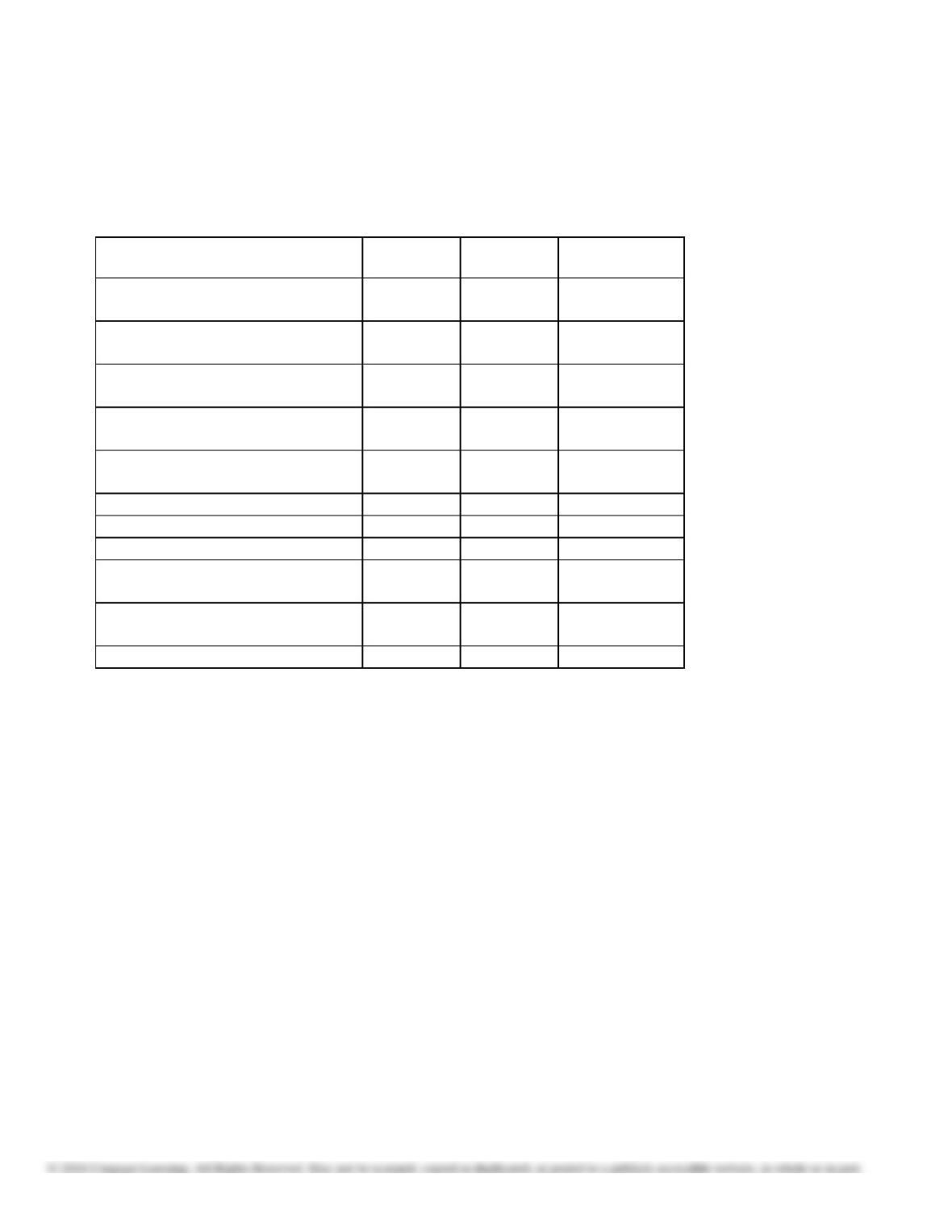
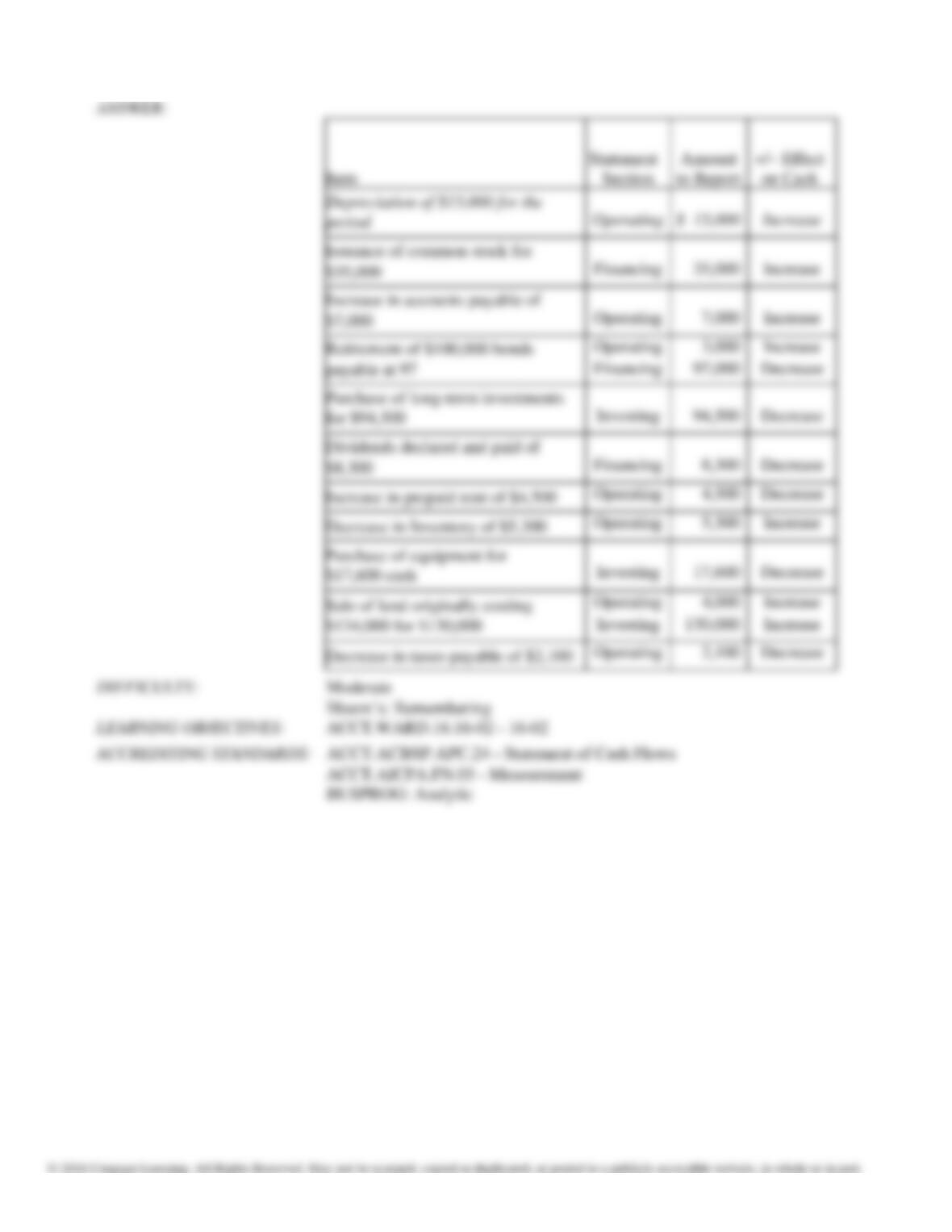
Complete each of the columns on the table below, indicating in which section each item would be reported on
the
statement of cash flows (operating, investing, or financing), the amount that would be reported, and whether
the
item would create an increase or decrease in cash. For item that affect more than one section of the
statement,
indicate all affected. Assume the indirect method of reporting cash flows from operating activities.
The first item has been completed as an example.
Statement
Amount
+/– Effect
Item
Section
to Report
on Cash
Depreciation of $15,000 for the
period
Operating
$15,000
Increase
Issuance of common stock for
$35,000
Increase in accounts payable of
$7,000
Retirement of $100,000 bonds
payable
at 97
Purchase of long-term investments for
$94,500
Dividends declared and paid of $8,300
Increase in prepaid rent of $4,500
Decrease in Inventory of $5,300
Purchase of equipment for $17,600
cash
Sale of land originally costing
$134,000 for $130,000
Decrease in taxes payable of $2,100
Chapter 16: Statement of Cash Flows
Chapter 16: Statement of Cash Flows
160.
Balances of the current asset and current liability accounts at the end and beginning of the year are as follows:
End
Beginning
Cash
$ 62,000
$73,000
Accounts receivable (net)
75,000
60,000
Inventories
54,000
47,000
Accounts payable (merchandise creditors)
43,000
37,000
Salaries payable
2,800
3,800
Sales (on account)
210,000
Cost of merchandise sold
70,000
Operating expenses other than depreciation
67,000
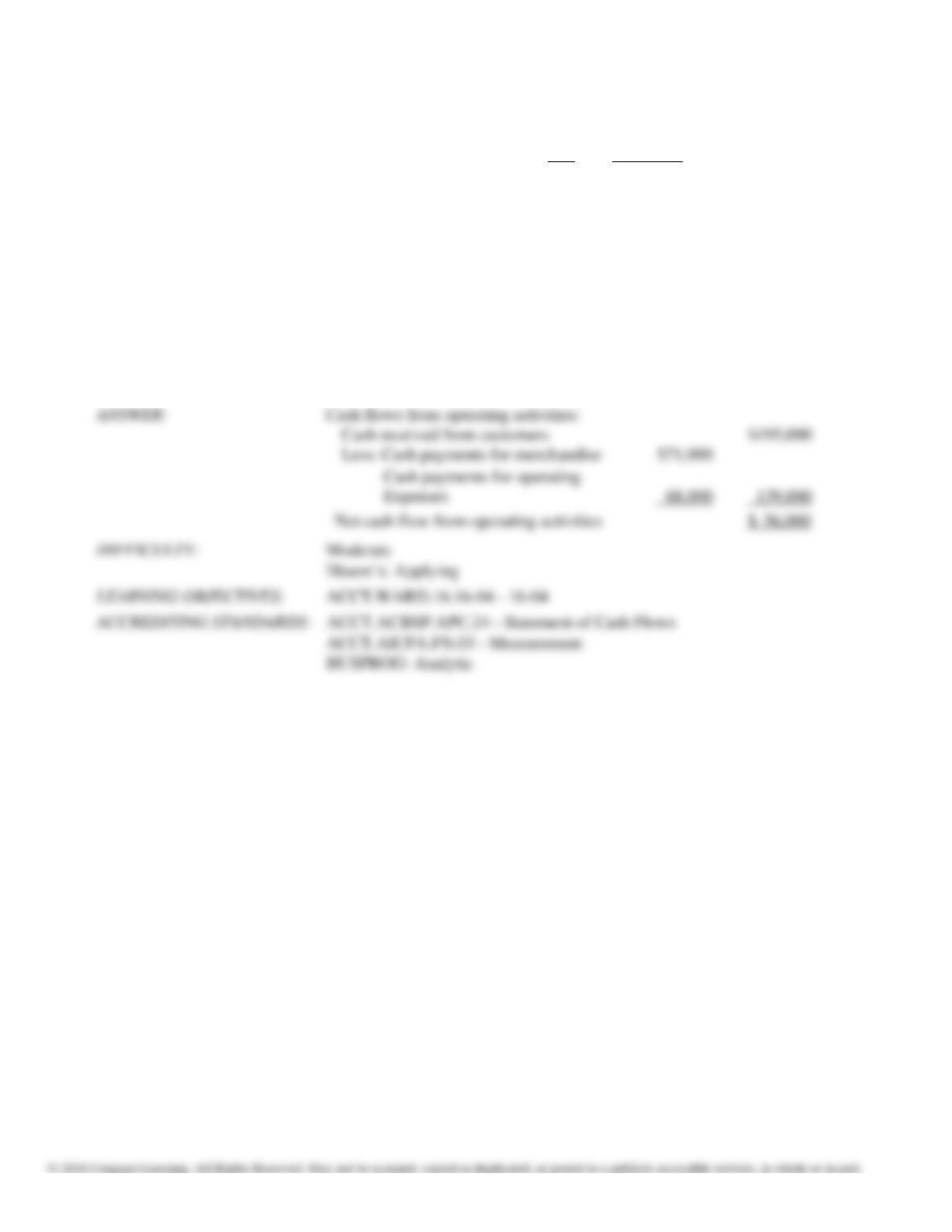
Use the direct method to prepare the cash flows from operating activities section of a statement of cash flows.
Chapter 16: Statement of Cash Flows
161.
The comparative balance sheet of ConnieJo Company, for December 31, Years 1 and 2 ended December 31
appears below in condensed form:
Cash
Year 2
$ 45,000
Year 1
$ 53,500
Accounts receivable (net)
51,300
58,000
Inventories
147,200
135,000
Investments
0
60,000
Equipment
493,000
375,000
Accumulated depreciation—equipment
(113,700)
(128,000)
$622,800
$553,500
Accounts payable
$ 61,500
$ 42,600
Bonds payable, due Year 4
0
100,000
Common stock, $10 par
250,000
200,000
50,000
160,900
$553,500
$623,000
348,500
$274,500
100,000
$174,500
Paid-in capital in excess of par—common stock
75,000
Retained earnings
236,300
$622,800
The income statement for the current year is as follows:
Sales
Cost of merchandise sold
Gross profit
Operating expenses:
Depreciation expense
$ 24,700
Other operating expenses
75,300
Income from operations
Other income:
Gain on sale of investment
$ 5,000
Other expense:
Interest expense
12,000
(7,000)
Income before income tax
$167,500
Income tax
64,100
Net income
$103,400
Additional data for the current year are as follows:
(a)
Fully depreciated equipment costing $39,000 was scrapped, no salvage,
and
equipment was purchased for $157,000.
(b)
Bonds payable for $100,000 were retired by payment at their face amount.
(c)
5,000 shares of common stock were issued at $15 for cash.
(d)
Cash dividends declared were paid $28,000.
(e)
All sales are on account.
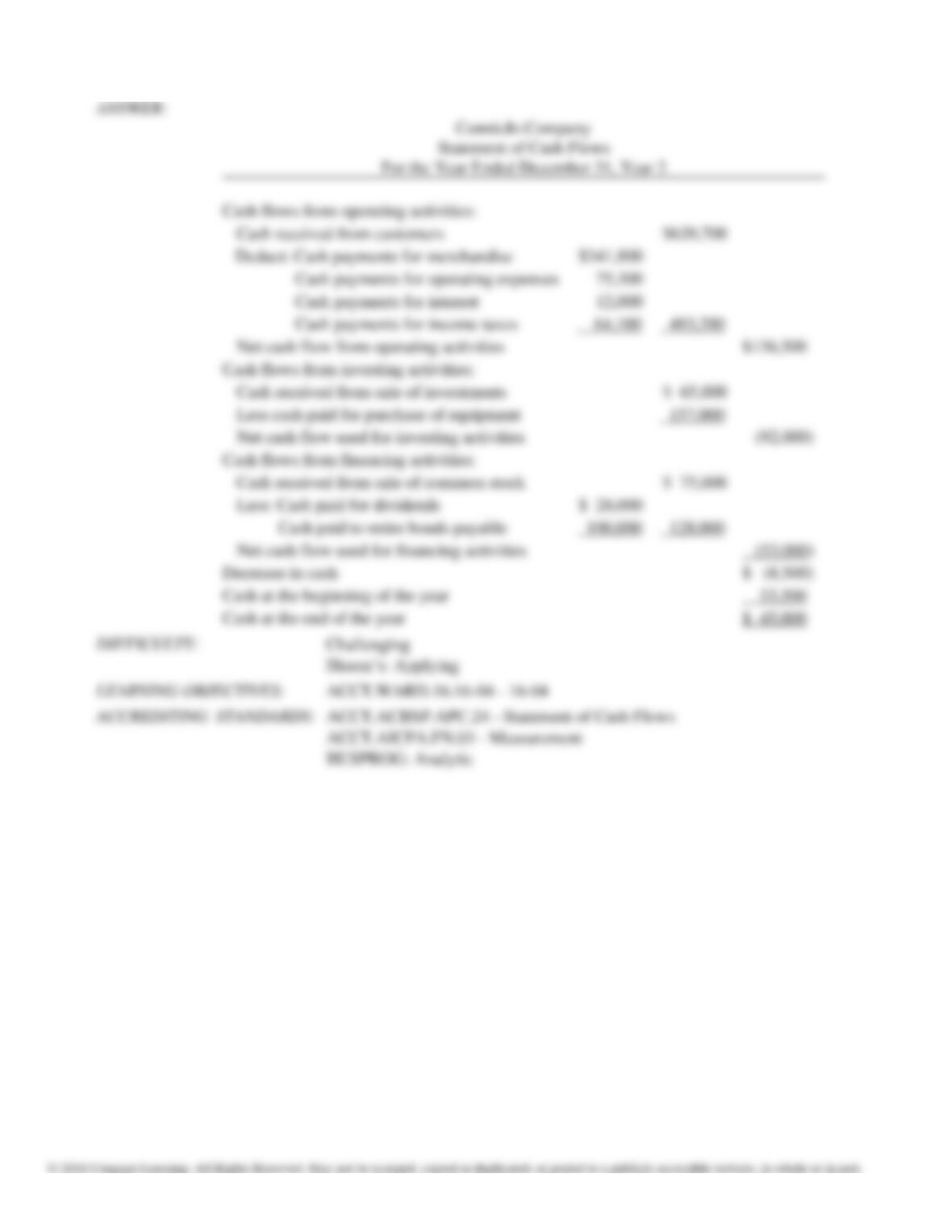
Prepare a statement of cash flows, using the direct method of reporting cash flows from operating activities.
Chapter 16: Statement of Cash Flows
Chapter 16: Statement of Cash Flows
162.
The cash flows from operating activities are reported by the direct method on the statement of cash
flows. Determine the following:
(a)
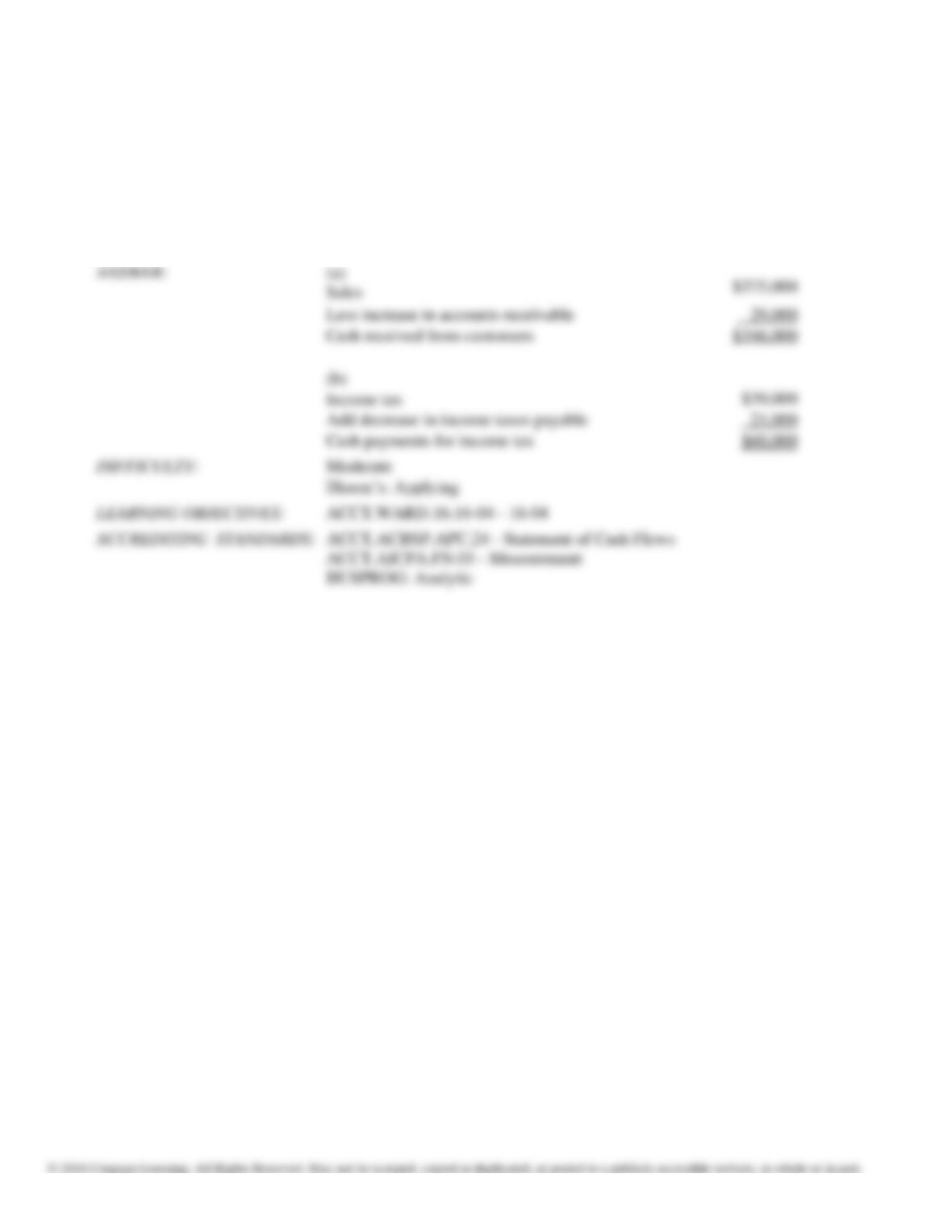
If sales for the current year were $375,000 and accounts receivable increased by $29,000
during the year, what was the amount of cash received from customers?
(b)
If income tax for the current year was $39,000 and income tax payable decreased by $21,000 during the year,
what was the amount of cash payments for income tax?
Chapter 16: Statement of Cash Flows
163.
Selected data for the current year ended December 31 are as follows:
Balance
Balance
December 31
January 1
Accrued expenses (operating expenses)
$29,500
$ 22,000
Accounts payable (merchandise creditors)
90,000
135,000
Inventories
42,500
68,000
Prepaid expenses
23,000
20,000
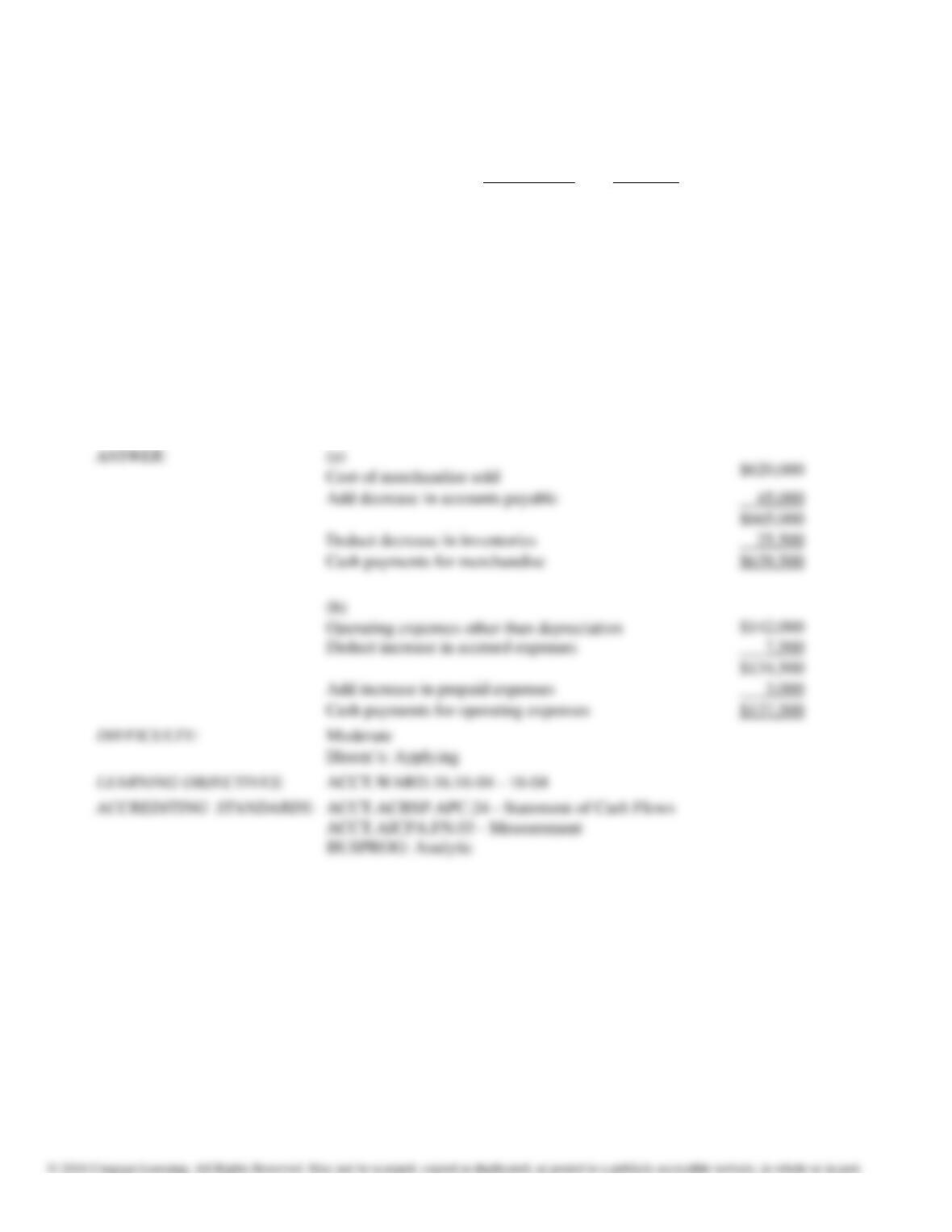
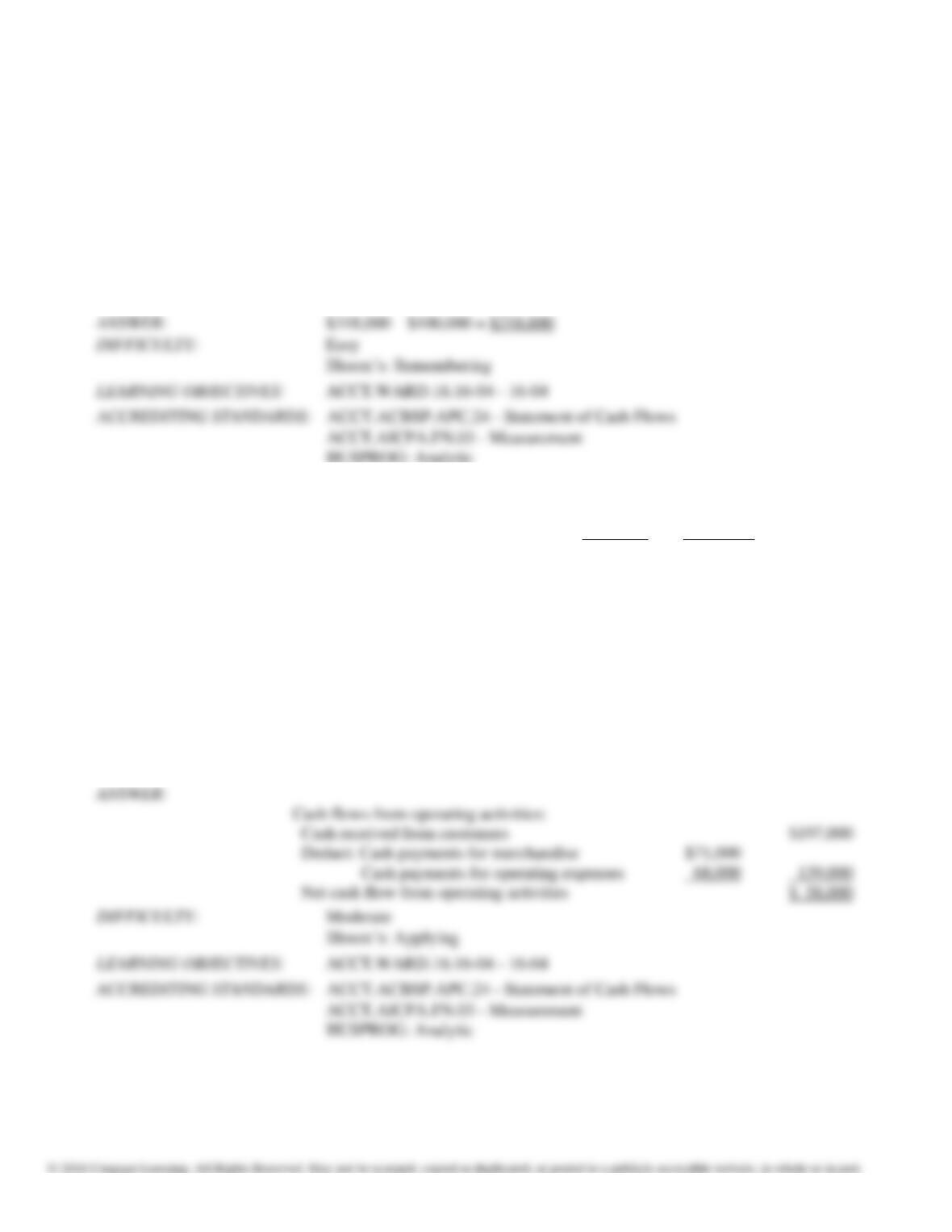
During the current year, the cost of merchandise sold was $620,000 and the operating expenses other than
depreciation were $142,000. The direct method is used for presenting the cash flows from operating activities on
the statement of cash flows.
Determine the amount reported on the statement of cash flows for (a) cash payments for merchandise and (b) cash
payments for operating expenses.
Deduct increase in accrued expenses
7,500
Add increase in prepaid expenses
3,000
Chapter 16: Statement of Cash Flows
164.
Based on the following, what is free cash flow?
Net cash flow from operating activities
$318,000
Net cash flow used for investing activities
(30,000)
Net cash flow from financing activities
30,000
Cash flows from operations include $2,000 for depreciation. Cash flows from investing include the purchase of a
replacement asset for $100,000 and the sale of the one used in production, which is now obsolete, for $70,000. Cash
flows from financing include $70,000 of borrowing.
165.
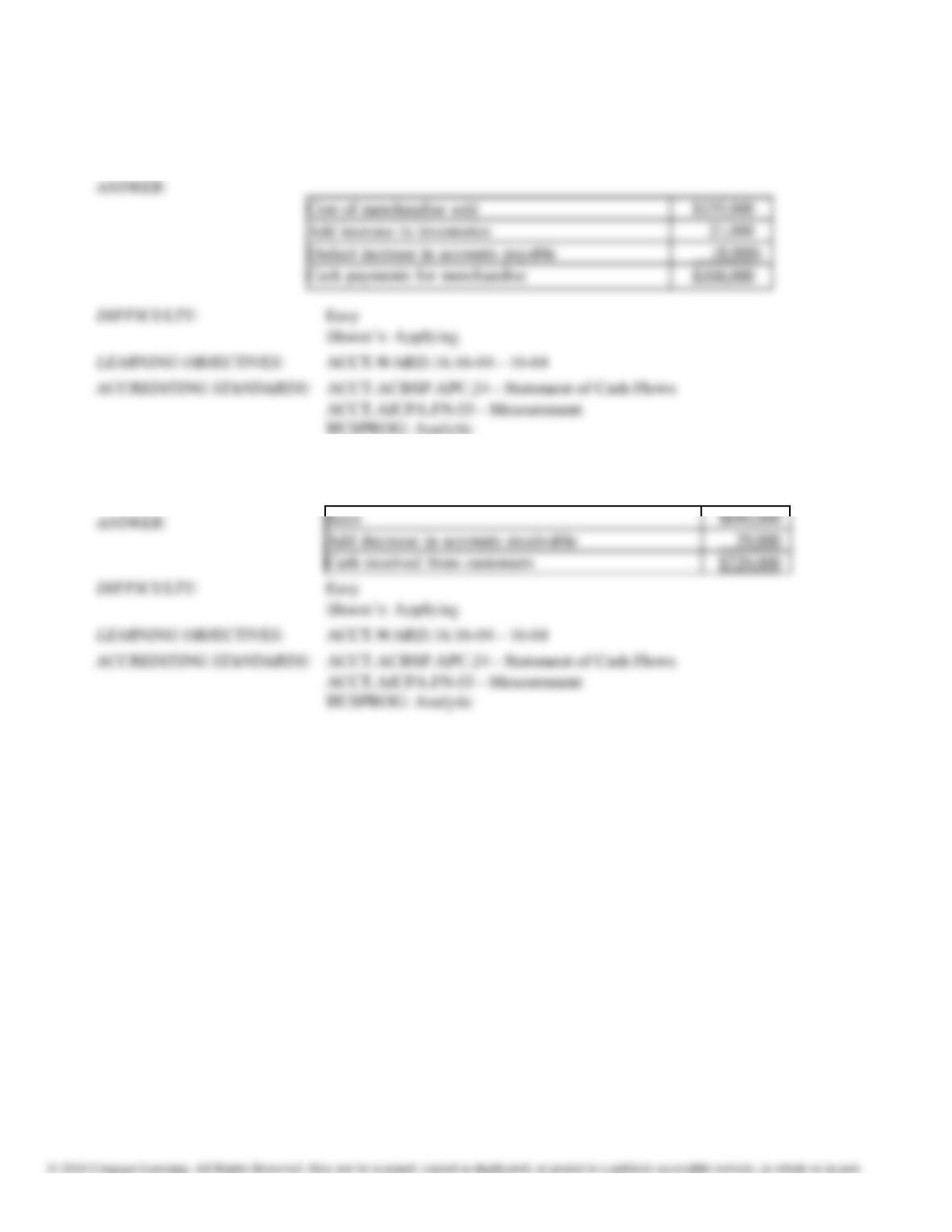
Balances of the current asset and current liability accounts at the end and beginning of the year are as follows:
End
Beginning
Cash
$ 67,000
$73,000
Accounts receivable (net)
73,000
60,000
Inventories
54,000
47,000
Accounts payable
(merchandise creditors)
43,000
37,000
Salaries payable
2,800
3,800
Sales (on account)
210,000
Cost of merchandise sold
70,000
Operating expenses other than depreciation
67,000
Use the direct method to prepare the cash flows from operating activities section of a statement of cash flows.
Cash flows from operating activities:
Cash received from customers
Deduct: Cash payments for merchandise
Cash payments for operating expenses
Net cash flow from operating activities
Chapter 16: Statement of Cash Flows
166.
Cost of merchandise sold reported on the income statement was $155,000. The accounts payable balance
increased $8,000, and the inventory balance increased by $21,000 over the year. Determine the amount of
cash
paid for merchandise.
167.
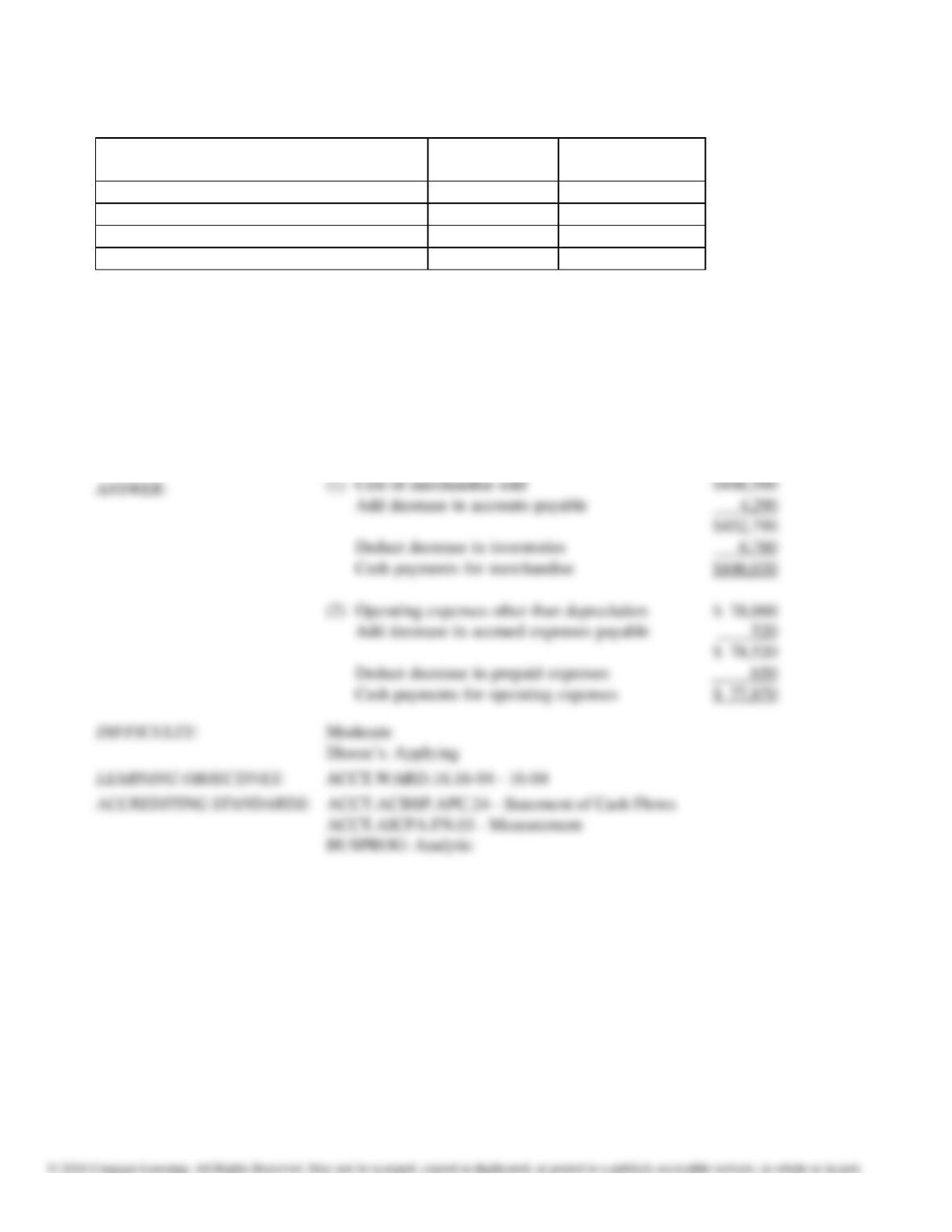
Sales reported on the income statement were $690,000. The accounts receivable balance declined $39,000
over
the year. Determine the amount of cash received from customers.
Chapter 16: Statement of Cash Flows
168.
Selected data taken from the accounting records of Laser Inc. for the current year ended December 31 are as
follows:
Balance,
December 31
Balance,
January 1
Accrued operating expenses
$ 5,590
$ 6,110
Accounts payable (merchandise creditors)
41,730
46,020
Inventories
77,350
84,110
Prepaid expenses
3,250
3,900
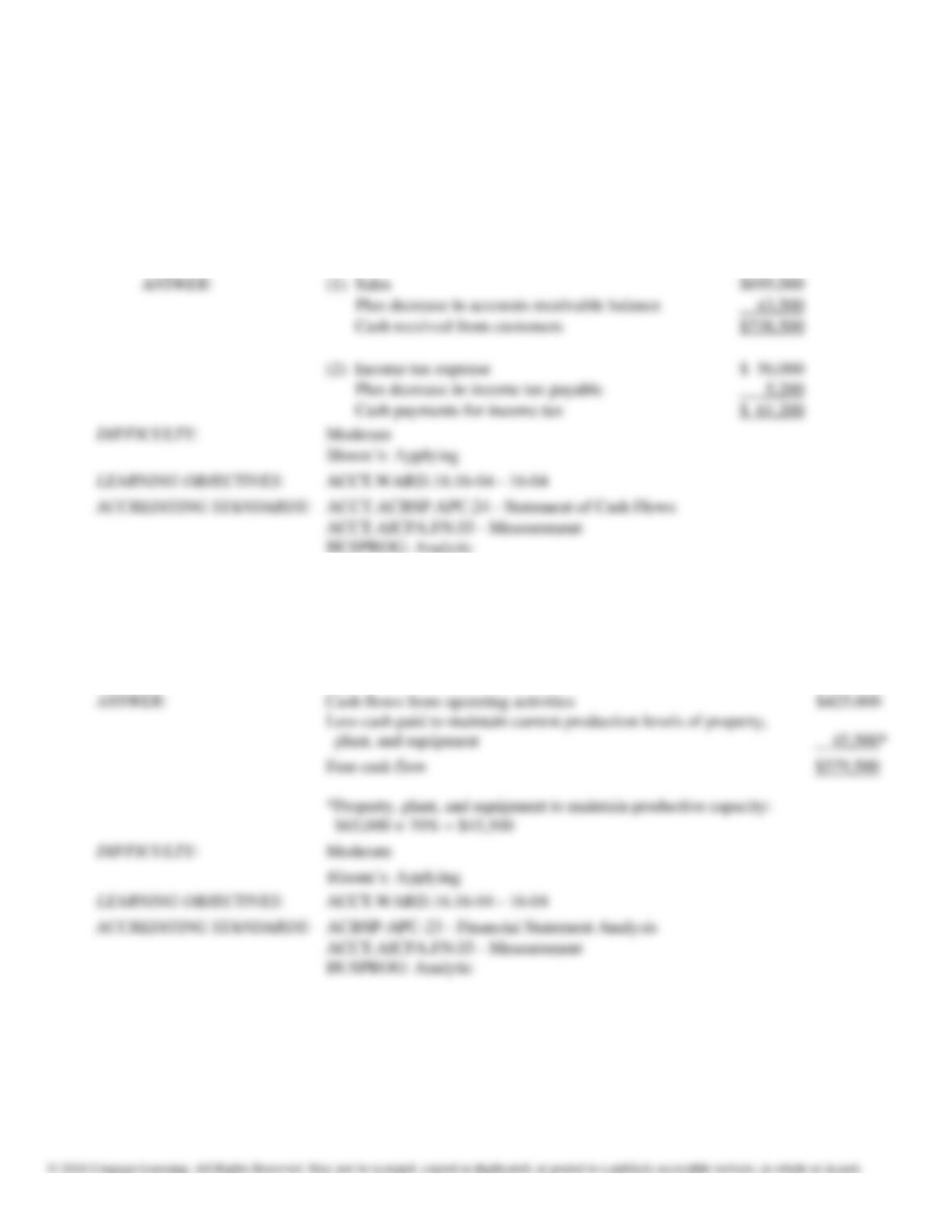
During the current year, the cost of merchandise sold was $448,500, and the operating expenses other than
depreciation were $78,000. The direct method is used for presenting the cash flows from operating activities on
the
statement of cash flows.
Required:
Determine the amount reported on the statement of cash flows for:
(1)
Cash payments for merchandise
(2)
Cash payments for operating expenses
Chapter 16: Statement of Cash Flows
169.
The cash flows from operating activities are reported by the direct method on the statement of cash
flows.
(1)
(2)
Determine the following:
If sales for the current year were $695,000 and accounts receivable decreased
by $43,500 during the year, what was the amount of cash received from
customers?
If income tax expense for the current year was $56,000 and income tax payable
decreased by $5,200 during the year, what was the amount of cash payments of
income tax?
170.
Connor Designs Company has cash flows for operating activities of $425,000. Cash flows used for investments in
property, plant, and equipment totaled $65,000, of which 70% of this investment was used to replace machinery
to
maintain existing capacity.
What is the free cash flow for Connor Designs?
Chapter 16: Statement of Cash Flows
For each of the following activities that may take place during the accounting period, indicate the effect (a-g) on the
statement of cash flows prepared using the indirect method. Choices may be selected as the
answer for more than
one question.
a.
increase cash from operating activities
b.
decrease cash from operating activities
c.
increase cash from investing activities
d.
decrease cash from investing activities
e.
increase cash from financing activities
f.
decrease cash from financing activities
g.
noncash investing and financing supplement
DIFFICULTY: Moderate
Bloom’s: Remembering
LEARNING OBJECTIVES: ACCT.WARD.16.16-02 – 16–02
ACCREDITING STANDARDS: ACCT.ACBSP.APC.24 – Statement of Cash Flows
ACCT.AICPA.FN.03 – Measurement
BUSPROG: Analytic
171.
purchase of equipment
172.
repayment of long-term note payable
173.
amortization of intangible assets
174.
exchange of land for common stock
175.
payment of dividends
176.
sale of land
177.
gain on sale of investments
Chapter 16: Statement of Cash Flows
178.
acquisition of treasury stock
179.
increase in accounts receivable balance
180.
decrease in accounts payable balance
Identify the section of the statement of cash flows (a-d) where each of the following items would be
reported.
a. Operating activities
b. Financing activities
c. Investing activities
d. Schedule of noncash financing and investing
DIFFICULTY: Bloom’s:
Remembering
Easy
LEARNING OBJECTIVES: ACCT.WARD.16.16-02 – 16–02
ACCT.WARD.16.16-04 – 16–04
ACCREDITING STANDARDS: ACCT.ACBSP.APC.24 – Statement of Cash Flows
ACCT.AICPA.FN.03 – Measurement
BUSPROG: Analytic
181.
Increase in income taxes payable
182.
Dividends received on investment
183.
Sale of machinery held for use by the company
184.
Issuance of bond payable
185.
Purchase of the stock of another company as investment
Chapter 16: Statement of Cash Flows
186.
Decrease in inventory
187.
Exchange of land for note payable
188.
Payment of dividends to stockholders
189.
Increase in accounts receivable
190.
Loss on sale of equipment