
CHAPTER 16: COST-VOLUME-PROFIT ANALYSIS
1. Cost-volume-profit analysis focuses on the break-even point and the impact of changes in fixed costs and price.
a. True
b. False
2. The break-even point is the point where total costs equal sales revenues.
a. True
b. False
3. The term net income is used to mean operating income before income taxes.
a. True
b. False
4. To earn a target profit, total costs plus the amount of target profit must equal total sales revenue.
a. True
b. False
5. Units to earn target profit equal total fixed costs plus target profit divided by the contribution margin ratio.
a. True
b. False
6. Sales revenue to earn target profits equals total fixed costs plus target profit divided by the contribution margin.
a. True
b. False
7. Income taxes are generally calculated as a percentage of income.
a. True
b. False
8. When using either the equation or the contribution margin approach, the after-tax profit must be converted to a
before-tax profit target.
a. True
b. False

Chapter 16: Cost-Volume-Profit Analysis
9. In multiple-product analysis, the break-even units for each product will change as the sales mix changes.
a. True
b. False
10. Increased sales of high contribution margin products increase the break-even point.
a. True
b. False
11. Increases in sales of low contribution margin products decrease the break-even point.
a. True
b. False
12. In a CVP graph, the intersection of the total costs line and the total sales revenue line is the break-even point in
units.
a. True
b. False
13. The profit-volume graph depicts the relationship among cost, volume, and profit.
a. True
b. False
14. The cost-volume-profit graph portrays the relationship between profits and sales volume.
a. True
b. False
15. CVP analysis is a short-run decision–making tool since some costs are fixed.
a. True
b. False
16. Multiple-product break-even analysis requires a constant sales mix, which is difficult to predict with certainty.
a. True
b. False
Chapter 16: Cost-Volume-Profit Analysis
17. Uncertainty regarding costs, prices, and sales mix affect the break-even point.
a. True
b. False
18. The operating leverage shows how far the company’s actual sales or units are from the break-even point.
a. True
b. False
19. Sensitivity analysis is a what-if technique that examines the impact of changes in assumptions.
a. True
b. False
20. Under ABC, cost drivers are separated into unit-based and non-unit-based drivers.
a. True
b. False
21. The is where total revenues equal total costs.
22. The ratio expresses variable costs in terms of sales dollars.
23. In cost-volume-profit analysis income taxes the break even point.
24. Target after-tax profit must be converted into profit to calculate units or revenue needed.
25. In multiple-product analysis, direct fixed costs can be to each segment.
26. Increased sales of high contribution margin items the break-even point.
27. On a profit-volume graph, the line intersects the horizontal axis at the break-even point.

Chapter 16: Cost-Volume-Profit Analysis
28. When a company sells more units than the break-even point, the are positive.
29. If all else is the same, if the break-even point increases, then the variable cost per unit
must have __________ .
30. The use of fixed costs to increase the percentage changes in profits as sales activities change is called the
__________ leverage.
31. The break-even point is
a. the volume of activity where all fixed costs are recovered.
b. where fixed costs equal total variable costs.
c. where total revenues equal total costs.
d. where total costs equal total contribution margin.
32. The break-even point in units can be calculated using the contribution margin approach in the formula
a. Total Costs / Unit Contribution Margin.
b. Total Costs / Fixed Costs.
c. Fixed Costs / Selling Price per unit.
d. Fixed Costs / Unit Contribution Margin.
33. Which of the following equations is CORRECT?
a. Sales revenues = Variable expenses – (Fixed expenses + Operating income)
b. Sales revenues – Variable expenses – Fixed expenses = Operating income
c. Sales revenues + Variable expenses + Fixed expenses = Operating income
d. Sales revenues – Fixed expenses = Variable expenses – Operating income
34. The variable cost ratio
a. expresses variable costs as a percentage of total costs.
b. expresses the proportion between fixed costs and variable costs.
c. expresses variable cost in terms of sales dollars.
d. expresses the proportion of sales dollars available to cover fixed costs and provide for a profit.
Chapter 16: Cost-Volume-Profit Analysis
35. Sales × Contribution Margin is a short-cut of what formula?
a. Sales – (Variable cost ratio × Sales)
b. Sales – (Fixed Costs + Variable Costs)
c. Sales / Fixed Costs
d. Fixed Costs / Unit Contribution Margin
36. Which of the following is NOT a use of CVP (Cost-Volume-Profit) analysis?
a. the ability to conduct sensitivity analysis of cost or price changes
b. the identification of price and efficiency variances
c. how many units must be sold to break even
d. what is the impact on the break-even point of an increase or decrease in fixed costs
37. Biscuit Company sells its product for $50. In addition, it has a variable cost ratio of 45 percent and total
fixed costs of $6,875. What is the break-even point in units for Biscuit Company?
a. 250 units
b. 3,600 units
c. 375 units
d. 2,400 units
38. Biscuit Company sells its product for $50. In addition, it has a variable cost ratio of 55 percent and total
fixed costs of $6,875. How many units must be sold in order to obtain a before-tax profit of $12,000?
a. 480 units
b. 240 units
c. 600 units
d. 839 units
Chapter 16: Cost-Volume-Profit Analysis
39. Biscuit Company sells its product for $50. In addition, it has a variable cost ratio of 45 percent and total
fixed costs of $6,875. What is the break-even point in sales dollars for Biscuit Company?
a. $2,750
b. $3,125
c. $6,875
d.$12,500
40. Total contribution margin is calculated by subtracting
a. cost of goods sold from total revenues.
b. fixed costs from total revenues.
c. total manufacturing costs from total revenues.
d. total variable costs from total revenues.
41. Which of the following items would NOT be considered in cost-volume–profit analysis?
a. units of production
b. fixed costs
c. product mix
d. gross profit margin
42. The contribution margin at the break-even point
a. equals total fixed costs.
b. is zero.
c. plus total fixed costs equals total revenues.
d. is greater than variable costs.
Figure 16 – 1
The Cumberland Company provides the following information:
Sales (250,000 units)
Manufacturing costs:
Variable
$625,000
212,500
Fixed
37,500
Selling and administrative costs:
Variable 100,000
Fixed 25,000
Chapter 16: Cost-Volume-Profit Analysis
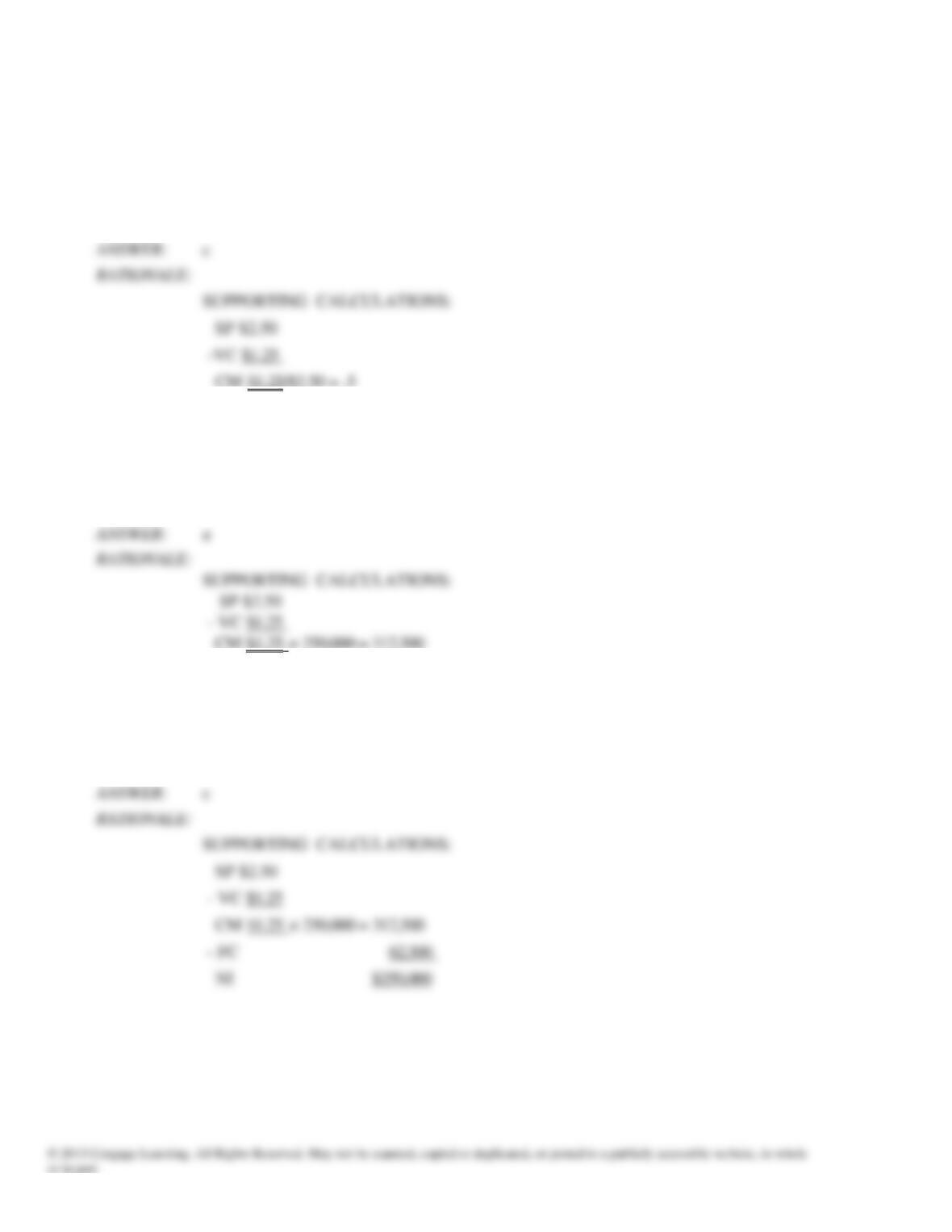
43. Refer to Figure 16–1. What is the break-even point in units for Cumberland?
a. 41,668 units
b. 50,000 units
c. 125,000 units
d. 250,000 units
44. Refer to Figure 16–1. What is the variable cost per unit for Cumberland?
a. $1.25
b. $0.85
c. $0.40
d. $0.75
45. Refer to Figure 16–1. What is the variable product cost per unit for Cumberland?
a. $2.50
b. $1.25
c. $0.40
d. $0.85
46. Refer to Figure 16–1. What is the contribution margin per unit for Cumberland?
a. $1.25
b. $0.85
c. $2.50
d. $1.65
Chapter 16: Cost-Volume-Profit Analysis
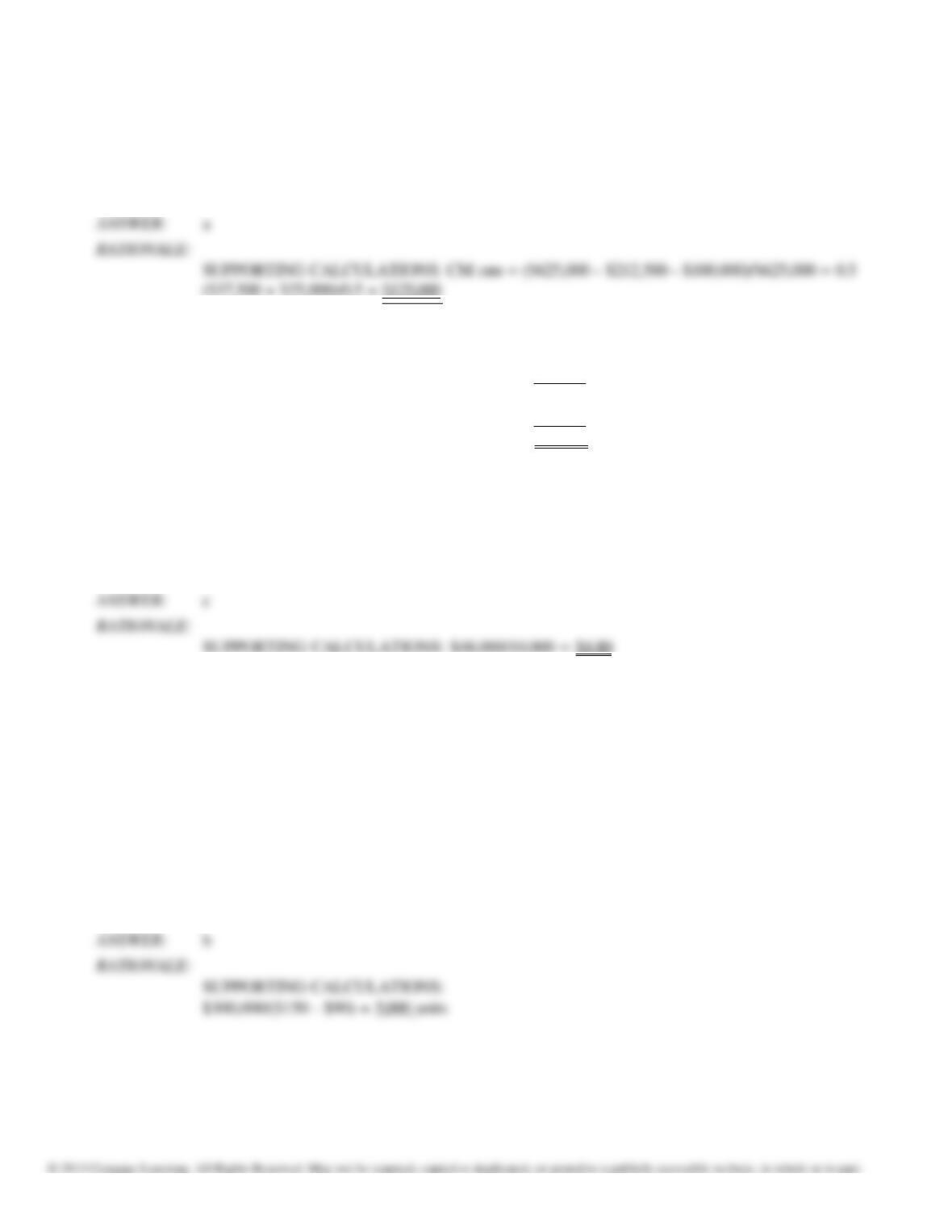
47. Refer to Figure 16–1. What is the contribution margin ratio for Cumberland?
a. 0.16
b. 0.76
c. 0.50
d. 0.34
48. Refer to Figure 16–1. What is the total contribution margin for Cumberland?
a. $312,500
b. $250,000
c. $625,000
d. $50,000
49. Refer to Figure 16–1. What is the operating income for Cumberland?
a. $625,000
b. $312,500
c. $250,000
d. $62,500
Chapter 16: Cost-Volume-Profit Analysis
50. Refer to Figure 16–1. What is the break-even point in sales dollars for Cumberland?
a. $125,000
b. $100,000
c. $37,500
d. $300,000
51. The income statement for Symbiosis Manufacturing Company for 2016 is as follows:
Sales (10,000 units)
$120,000
Variable expenses
72,000
Contribution margin
$48,000
Fixed expenses
36,000
Operating income
$12,000
What is the contribution margin per unit?
a. $7.20
b. $1.20
c. $4.80
d. $120,000
52. Summersville Production Company had the following projected information for 2016:
Selling price per unit
$150
Variable cost per unit
$90
Total fixed costs
$300,000
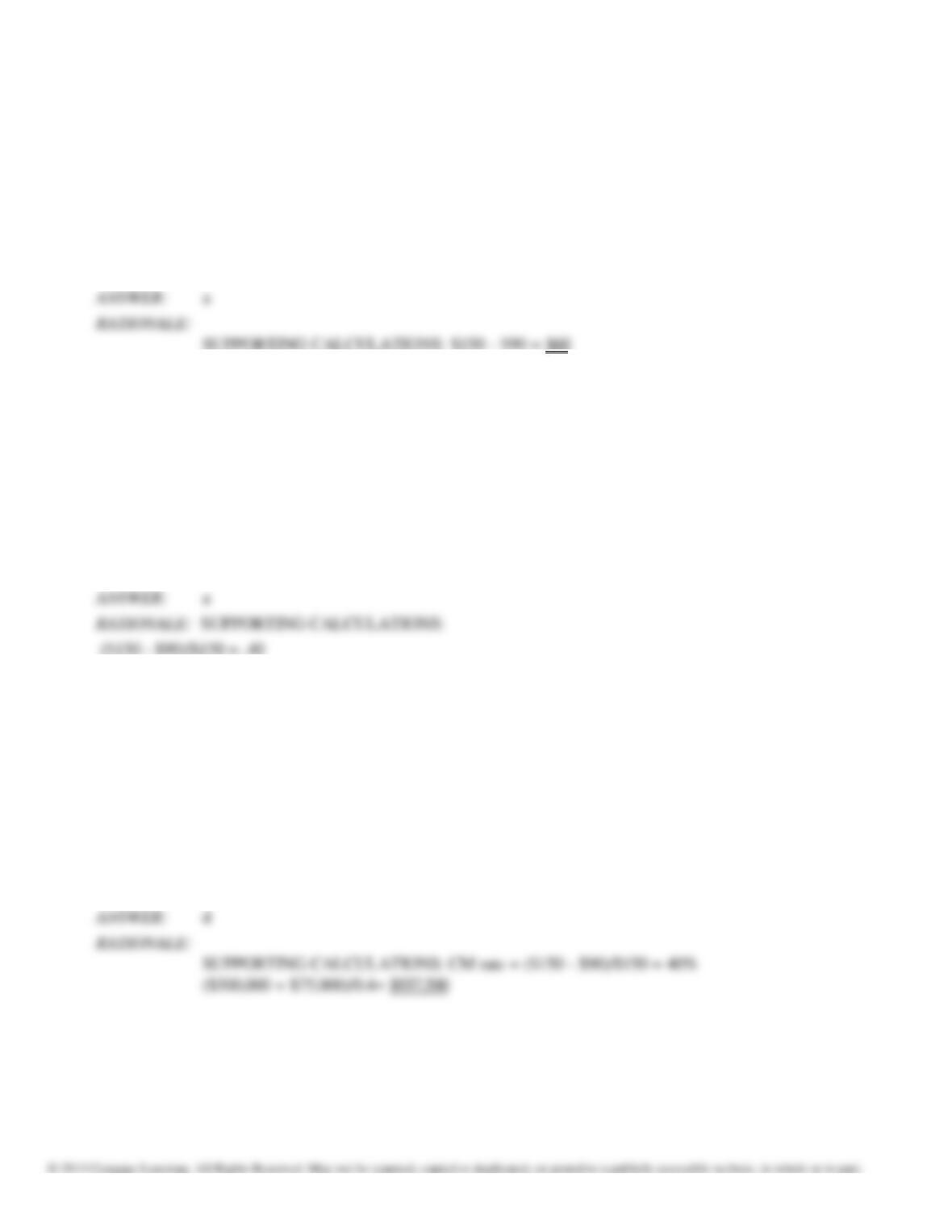
What is the break-even point in units?
a. 2,000 units
b. 5,000 units
c. 3,333 units
d. 60,000 units
Chapter 16: Cost-Volume-Profit Analysis
53. Summersville Production Company had the following projected information for 2016:
Selling price per unit
$150
Variable cost per unit
$90
Total fixed costs
$300,000
What is the profit when one unit more than the break-even point is sold?
a. $60 b. $150
c. $1,500,150 d. $600,060
54. Summersville Production Company had the following projected information for 2016:
Selling price per unit
$150
Variable cost per unit
$90
Total fixed costs
$300,000
What is the contribution margin ratio? a. 0.400
b. 1.667
c. 2.500
d. 0.600
55. Summersville Production Company had the following projected information for 2016:
Selling price per unit
$150
Variable cost per unit
$90
Total fixed costs
$300,000
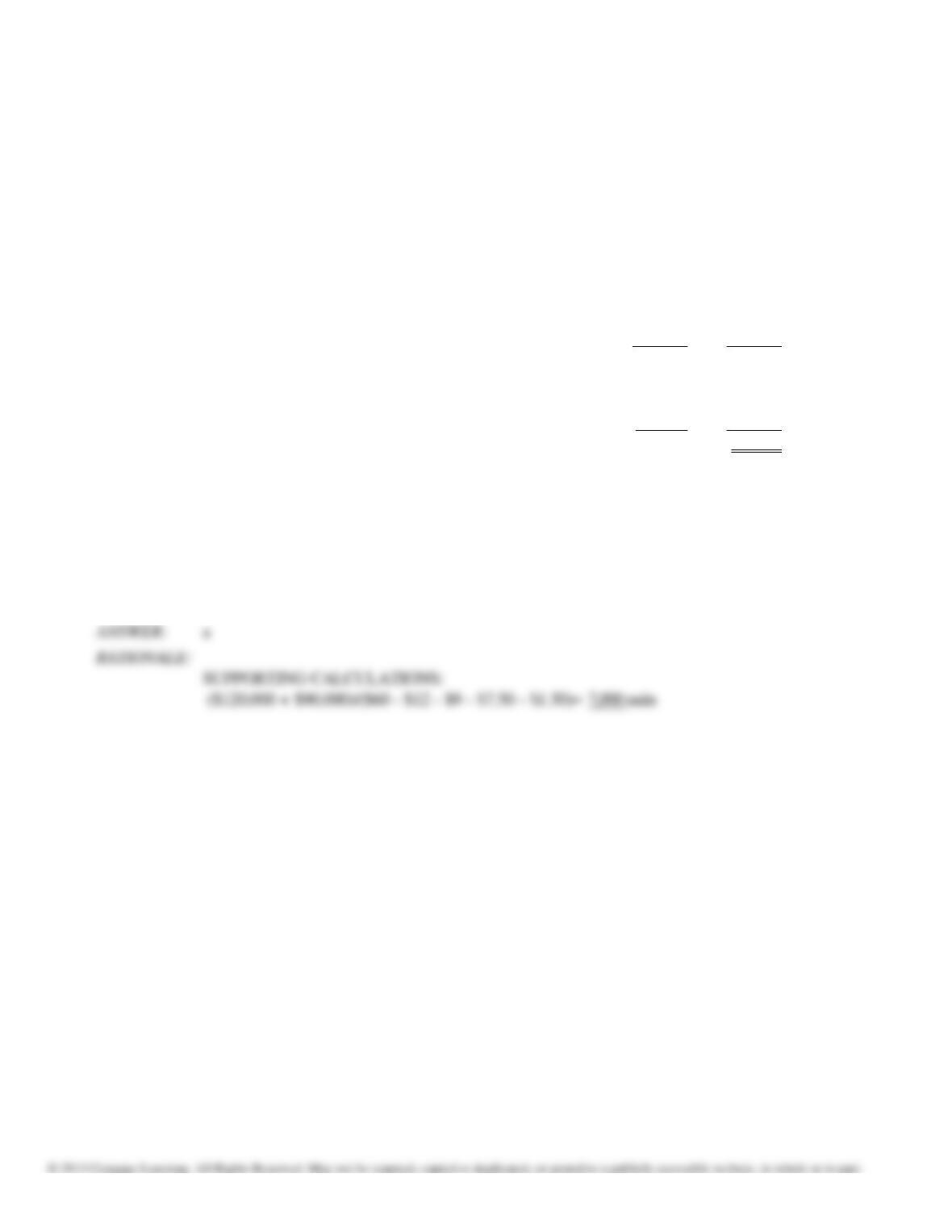
What level of sales dollars is needed to obtain a target before-tax profit of $75,000?
a. $375,000
b. $625,000
c. $750,000
d. $937,500
Chapter 16: Cost-Volume-Profit Analysis
56. The DesMaris Company had the following income statement for the month of November 2016:
DesMaris Company
Income Statement
For the Month of November 2016
Sales ($60 × 10,000)
$600,000
Cost of goods sold:
Direct materials ($12 × 10,000)
$120,000
Direct labor ($9 × 10,000)
90,000
Variable factory overhead ($7.50 × 10,000)
75,000
Fixed factory overhead
120,000
405,000
Gross profit
$195,000
Selling and administrative expenses:
Variable ($1.50 × 10,000)
$ 15,000
Fixed
90,000
105,000
Operating income
$90,000
DesMaris Company’s break-even sales volume is
a. 7,000 units.
b. 20,000 units.
c. 11,211 units.
d. 10,000 units.
Chapter 16: Cost-Volume-Profit Analysis
57. The DesMaris Company had the following income statement for the month of November 2016:
DesMaris Company
Income Statement
For the Month of November 2016
Sales ($60 × 10,000)
$600,000
Cost of goods sold:
Direct materials ($12 × 10,000)
$120,000
Direct labor ($9 × 10,000)
90,000
Variable factory overhead ($7.50 × 10,000)
75,000
Fixed factory overhead
120,000
405,000
Gross profit
$195,000
Selling and administrative expenses:
Variable ($1.50 × 10,000)
$ 15,000
Fixed
90,000
105,000
Operating income
$90,000
What is the sales volume required to earn an operating profit of $9,000?
a. 3,300 units
b. 10,000 units
c. 4,300 units
d. 7,300 units
58. Assume the following information:
Selling price per unit
$180
Contribution margin ratio
48%
Total fixed costs
$270,000
How many units must be sold to generate a before-tax profit of $54,000?
a. 4,000 units
b. 2,750 units
c. 3,570 units
d. 3,750 units
Chapter 16: Cost-Volume-Profit Analysis
59. Jamie Quinn, a sole proprietor, has the following projected figures for next year:
Selling price per unit $150.00
Contribution margin per unit $45.00
Total fixed costs $630,000
How many units must be sold to obtain a target before-tax profit of $270,000?
a. 6,000 units
b. 20,000 units
c. 8,572 units
d. 14,000 units
60. Jamie Quinn, a sole proprietor, has the following projected figures for next year:
Selling price per unit $150.00
Contribution margin per unit $45.00
Total fixed costs $630,000
What is the contribution margin ratio? a. 0.300
b. 1.429
c. 0.429
d. 3.333
61. Jamie Quinn, a sole proprietor, has the following projected figures for next year:
Selling price per unit
$150.00
Contribution margin per unit
$45.00
Total fixed costs
$630,000
What is the break-even point in dollars?
a. $426,000 b.
$900,000 c. $189,000
d. $2,100,000
Chapter 16: Cost-Volume-Profit Analysis
62. The income statement for Symbiosis Manufacturing Company for 2016 is as follows:
Sales (10,000 units)
$120,000
Variable expenses
72,000
Contribution margin
$ 48,000
Fixed expenses
36,000
Operating income
$12,000
What is the contribution margin ratio?
a. 30%
b. 60%
c. 100%
d. 40%
63. In 2016, Samantha’s Bath and Body Shop had variable costs of $27,000, fixed costs of $18,000, and a net loss of
$4,500.
Samantha’s 2016 break-even sales volume was
a. $36,000.
b. $54,000.
c. $49,500.
d. $37,500.
64. In 2016, Samantha’s Bath and Body Shop had variable costs of $27,000, fixed costs of $18,000, and a net loss of
$4,500.
The annual sales volume required for Samantha’s to have a before-tax income of $18,000 is
a. $126,000.
b. $84,000.
c. $73,500.
d. $42,000.
Chapter 16: Cost-Volume-Profit Analysis
65. Assume the following information:
Variable cost ratio
80%
Total fixed costs
What volume of sales dollars is needed to break even?
$60,000
a. $75,000
b. $300,000
c. $48,000
d. $12,000
66. Which of the following equations is TRUE?
a. Contribution margin = Sales revenue × Variable cost ratio
b. Contribution margin ratio = Contribution margin/Variable costs
c. Contribution margin = Fixed costs
d. Contribution margin ratio = 1 – Variable cost ratio
67. Nonesuch Company sells only one product at a regular price of $7.50 per unit. Variable expenses are 60 percent of
sales and fixed expenses are $30,000. Management has decided to decrease the selling price to $6.00 in hopes of
increasing its volume of sales.
What is the contribution margin ratio when the selling price is reduced to $6 per unit?
a. 40%
b. 25%
c. 75%
d. 60%
68. Nonesuch Company sells only one product at a regular price of $7.50 per unit. Variable expenses are 60 percent of
sales and fixed expenses are $30,000. Management has decided to decrease the selling price to $6.00 in hopes of
increasing its volume of sales.
What is the sales dollars level required to break even at the old price of $7.50?
a. $50,000
b. $12,000
c. $18,000
d. $75,000
Chapter 16: Cost-Volume-Profit Analysis
69. Hologram Printing Company projected the following information for next year:
Selling price per unit $75.00
Contribution margin per unit $30.00
Total fixed costs $120,000
Tax rate 40%
How many units must be sold to obtain an after-tax profit of $67,500?
a. 3,750 units
b. 5,167 units
c. 5,625 units
d. 7,750 units
70. Hologram Printing Company projected the following information for next year:
Selling price per unit
$75.00
Contribution margin per unit
$30.00
Total fixed costs
$120,000
Tax rate
40%
What is the break-even point in dollars?
a. $200,000
b. $120,000
c. $300,000
d. $500,000
71. Tiramisu Company projected the following information for next year:
Selling price per unit $60.00
Contribution margin per unit $30.00
Total fixed costs $100,000
Tax rate 20%
How many units must be sold to obtain an after-tax profit of $40,000?
a. 3,750 units
b. 5,625 units
c. 5,000 units
d. 5,167 units
Chapter 16: Cost-Volume-Profit Analysis
72. In the cost–volume–profit analysis, income taxes
a. are treated as a fixed cost.
b. increase the sales volume required to break even.
c. increase the sales volume required to earn a desired profit.
d. are treated as a fixed cost.
73. Assume the following cost behavior data for Graphic Arts Company:
Sales price $18.00 per unit
Variable costs $13.50 per unit
Fixed costs $22,500
Tax rate 40%
What volume of sales dollars is required to earn a before-tax income of $27,000?
a. $90,000
b. $180,000
c. $198,000
d. $270,000
74. Assume the following cost behavior data for Graphic Arts Company:
Sales price $18.00 per unit
Variable costs $13.50 per unit
Fixed costs $22,500
Tax rate 40%
What volume of sales dollars is required to earn an after-tax income of $40,500?
a. $360,000
b. $90,000
c. $252,000
d. $495,000
Chapter 16: Cost-Volume-Profit Analysis
75. Which of the following is a TRUE statement about sales mix?
a. Profits may decline with an increase in total dollars of sales if the sales mix shifts to sell more of the high
contribution margin product.
b. Profits may decline with an increase in total dollars of sales if the sales mix shifts to sell more of the lower
contribution margin product.
c. Profits will remain constant with an increase in total dollars of sales if the total sales in units remains
constant.
d. Profits will remain constant with a decrease in total dollars of sales if the sales mix also remains constant.
76. Sales mix refers to
a. the different volume of sales achieved during the year.
b. the contribution margins achieved on the different products during the year.
c. the relative proportions of different products that constitute total sales.
d. the mix of variable and fixed costs.
77. Victoria Company produces two products, X and Y, which account for 60 percent and 40 percent, respectively, of
total sales dollars. Contribution margin ratios are 50 percent for X and 25 percent for Y. Total fixed costs are
$120,000. What is Patricia‘s break-even point in sales dollars?
a. $328,767
b. $300,000
c. $342,856
d. $375,000
78. In multiple-product analysis, direct fixed costs are
a. fixed costs that are not traceable to the segments and would remain even if one of the segments were
eliminated.
b. fixed costs which can be traced to each segment and would remain even if one of the segments were
eliminated.
c. fixed costs that are not traceable to the segments and would be avoided if the segment did not exist.
d. the fixed costs which can be traced to each segment and would be avoided if the segment did not exist.
Chapter 16: Cost-Volume-Profit Analysis
79. Information about the Harmonious Company‘s two products includes:
Unit selling price
Product X
$11.25
Product Y
$11.25
Unit variable costs:
Manufacturing
$5.25
$6.75
Selling
.75
.75
Total
$6.00
$7.50
Monthly fixed costs are as follows:
Manufacturing
$82,500
Selling and administrative
45,000
Total
$127,500
What is the total monthly sales volume in units required to break even when the sales mix in units is 70 percent
Product X and 30 percent Product Y?
a. 4,333 units
b. 26,563 units
c. 8,667 units
d. 28,667 units
Chapter 16: Cost-Volume-Profit Analysis
80. Information about the Harmonious Company‘s two products includes:
Unit selling price
Product X
$11.25
Product Y
$11.25
Unit variable costs:
Manufacturing
$5.25
$6.75
Selling
.75
.75
Total
$6.00
$7.50
Monthly fixed costs are as follows:
If the sales mix in units is 50 percent Product X and 50 percent Product Y, the monthly break-even total sales
dollars is
a. $75,000.
b. $318,746.
c. $275,000.
d. $315,000.
81. Product 1 has a contribution margin of $6.00 per unit, and Product 2 has a contribution margin of $7.50 per unit.
Total fixed costs are $300,000. Sales mix and total volume varies from one period to another. Which of the
following is TRUE?
a. At a sales volume in excess of 25,000 units of 1 and 25,000 units of 2, operations will be profitable.
b. The ratio of net profit to total sales for 2 will be larger than the ratio of net profit to total sales for 1.
c. The contribution margin per unit of direct materials is lower for 1 than for 2.
d. The ratio of contribution to total sales always will be larger for 1 than for 2.
Manufacturing
$82,500
Selling and administrative
45,000
Total
$127,500