Chapter 16 – Advanced Topics Concerning Complex Auditing Judgments
b.
Balance sheet.
c.
Internal control over financial reporting.
d.
Cash flow statements.
AUDT.JOHN.16.16-08 – LO: 16-08
United States – BUSPORG: Analytic
United States – AK – AICPA BB-Critical thinking
Assessing Deficiencies in Internal Control
112. Which of the following factors can mitigate concerns that the auditor might otherwise have about a
material weakness that was identified at an interim date?
a.
Remediation of the control deficiency after the interim date.
b.
Existence of a compensating control at the year-end date that was also present at the interim date.
c.
Weaknesses in the control environment.
d.
Ineffectiveness of oversight and governance.
AUDT.JOHN.16.16-08 – LO: 16-08
United States – BUSPORG: Analytic
United States – AK – AICPA BB-Critical thinking
113. Which of the following factors is not relevant when assessing identified internal control deficiencies?
a.
Weaknesses in the control environment.
b.
The absence of a material misstatement in the financial statements.
c.
Volume of transactions affected by the deficiency.
d.
Effectiveness of oversight/governance.
AUDT.JOHN.16.16-08 – LO: 16-08
United States – BUSPORG: Analytic
United States – AK – AICPA BB-Critical thinking
Assessing Deficiencies in Internal Control
114. Which of the following reflects the scope of services performed in external auditing by a CPA?
a.
Risk analysis.
b.
Control analysis.
c.
Operations analysis.
d.
Audits of financial statements.
115. Which of the following is not included in the scope of services performed in internal auditing by a CIA?
a.
Assurance and consulting.
b.
Operations analysis.
c.
Operational efficiency reviews.
d.
Internal control analysis.
e.
They are all included in the scope of services.
1
AUDT.JOHN.16.16-09 – LO: 16-09
United States – BUSPORG: Analytic
United States – AK – AICPA BB-Critical thinking
Internal Audit Function
116. Which of the following statements is true of external auditing?
a.
Major focus areas are processes, including risks, controls, and effectiveness and efficiency of
processes.
b.
External auditors perform both assurance and consulting services for public companies.
c.
Primary scope of services performed includes audits of financial statements.
d.
The primary client for a public company is upper management.
1
AUDT.JOHN.16.16-09 – LO: 16-09
United States – BUSPORG: Analytic
United States – AK – AICPA BB-Critical thinking
Internal Audit Function
117. Which of the following statements is true of internal auditing?
a.
The primary client is the investor in the company.
b.
The primary nature of services include assurance and consulting.
c.
The parties receiving assurance are regulatory agencies and stockholders.
d.
Internal auditing must be responsible for gathering evidence in all audits, including external audits.
b
1
1
AUDT.JOHN.16.16-09 – LO: 16-09
United States – BUSPORG: Analytic
United States – AK – AICPA BB-Critical thinking
Internal Audit Function
118. Which of the following is the IIA’s stated position regarding the internal auditing activity?
a.
All responsibilities for internal auditing activity can be outsourced.
b.
An in-house liaison, such as an executive or senior management member, should be assigned the
responsibility for internally managing the internal auditing activity.
c.
All internal auditors involved in the internal auditing activity must be CIAs.
d.
Internal auditors for the internal auditing activity should be supervised by CPAs.
AUDT.JOHN.16.16-09 – LO: 16-09
United States – BUSPORG: Analytic
United States – AK – AICPA BB-Critical thinking
Internal Audit Function
119. Which of the following factors is not considered in assessing the quality of the internal audit?
a.
Quality of working-paper documentation, reports, and recommendations.
b.
Review of quality of audit policies, programs, and procedures.
c.
Attestation services as demanded by market place.
d.
Educational level and professional experience.
AUDT.JOHN.16.16-09 – LO: 16-09
United States – BUSPORG: Analytic
United States – AK – AICPA BB-Critical thinking
Internal Audit Function
120. The partial or complete outsourcing of internal audit activities is most likely made to public accounting
firms or to other specialized firms who perform which of the following?
a.
Primarily risk, control, and audit activities.
b.
Attestation services as demanded by market place.
c.
Operations analysis and risk analysis.
d.
Analytical and substantial procedures.
AUDT.JOHN.16.16-09 – LO: 16-09
United States – BUSPORG: Analytic
United States – AK – AICPA BB-Critical thinking
Internal Audit Function
121. A best practice is to have an oversight of the internal audit function as a responsibility of which of the
United States – AK – AICPA BB-Critical thinking
Internal Audit Function
Chapter 16 – Advanced Topics Concerning Complex Auditing Judgments
following?
a.
Management.
b.
Internal auditors.
c.
Audit committee.
d.
External auditors.
1
AUDT.JOHN.16.16-09 – LO: 16-09
United States – BUSPORG: Analytic
United States – AK – AICPA BB-Critical thinking
Internal Audit Function
122. Which of the following is the international body that sets standards for the practice of internal auditing
across the world?
a.
The Internal Audit Reporting Standards Board.
b.
The Institute of Internal Auditors.
c.
The International Accounting Standards Board.
d.
The Charter of Certified Internal Auditors.
b
1
AUDT.JOHN.16.16-09 – LO: 16-09
United States – BUSPORG: Analytic
United States – AK – AICPA BB-Critical thinking
Internal Audit Function
123. Assume that the external auditor decides that because of work performed by internal auditors, the audit risk
has been reduced to an acceptable level. As a result of this assessment, the auditor can do which of the
following?
a.
The auditor must test the assertions directly and document a separate conclusion.
b.
The auditor can decide that direct testing is not necessary.
c.
The auditor must delegate the responsibility of expressing an opinion to the internal auditors.
d.
The auditor can assume that inherent risk is zero.
b
1
AUDT.JOHN.16.16-09 – LO: 16-09
United States – BUSPORG: Analytic
United States – AK – AICPA BB-Critical thinking
Internal Audit Function
124. In making judgments about the effect of the internal auditors’ work on the external auditor’s procedures in
specific audit areas, which of the following is not one of the issues related to the specific audit areas that is
considered by the external auditor?
Chapter 16 – Advanced Topics Concerning Complex Auditing Judgments
a.
Materiality of the financial statement amounts.
b.
Risk of material misstatement of the assertions related to these financial statement amounts.
c.
Degree of subjectivity involved in the evaluation of the audit evidence gathered in support of the
assertions.
d.
All of the above are considered by the auditor.
d
1
AUDT.JOHN.16.16-09 – LO: 16-09
United States – BUSPORG: Analytic
United States – AK – AICPA BB-Critical thinking
Internal Audit Function
125. Purpose of Materiality Judgments and Common Benchmarks
What are the key perspectives and concerns that auditors should be aware of when making materiality
judgments? Explain the purpose of materiality judgments and common benchmarks.
1
AUDT.JOHN.16.16-02 – LO: 16-02
126. Considering Qualitative Factors
What are the considerations that may cause a quantitatively small misstatement to be considered material?
127. Assessing Whether Misstatements Are Material
What additional information might the auditor choose to analyze to determine whether or not the financial
statements are misstated by a material amount?
128. Auditing Merger and Acquisition Transactions
How does a company measure the cost of an acquisition of another company? What factors often complicate the
determination of actual cost? Explain how each factor complicates the calculation of cost and the steps the
auditor has to take to reach a conclusion about the cost of the acquisition.
129. Audit Program for Goodwill Impairment Testing
Outline the major elements of an audit program to determine whether there is a goodwill impairment, and if
there is, the extent of the goodwill impairment.
Chapter 16 – Advanced Topics Concerning Complex Auditing Judgments
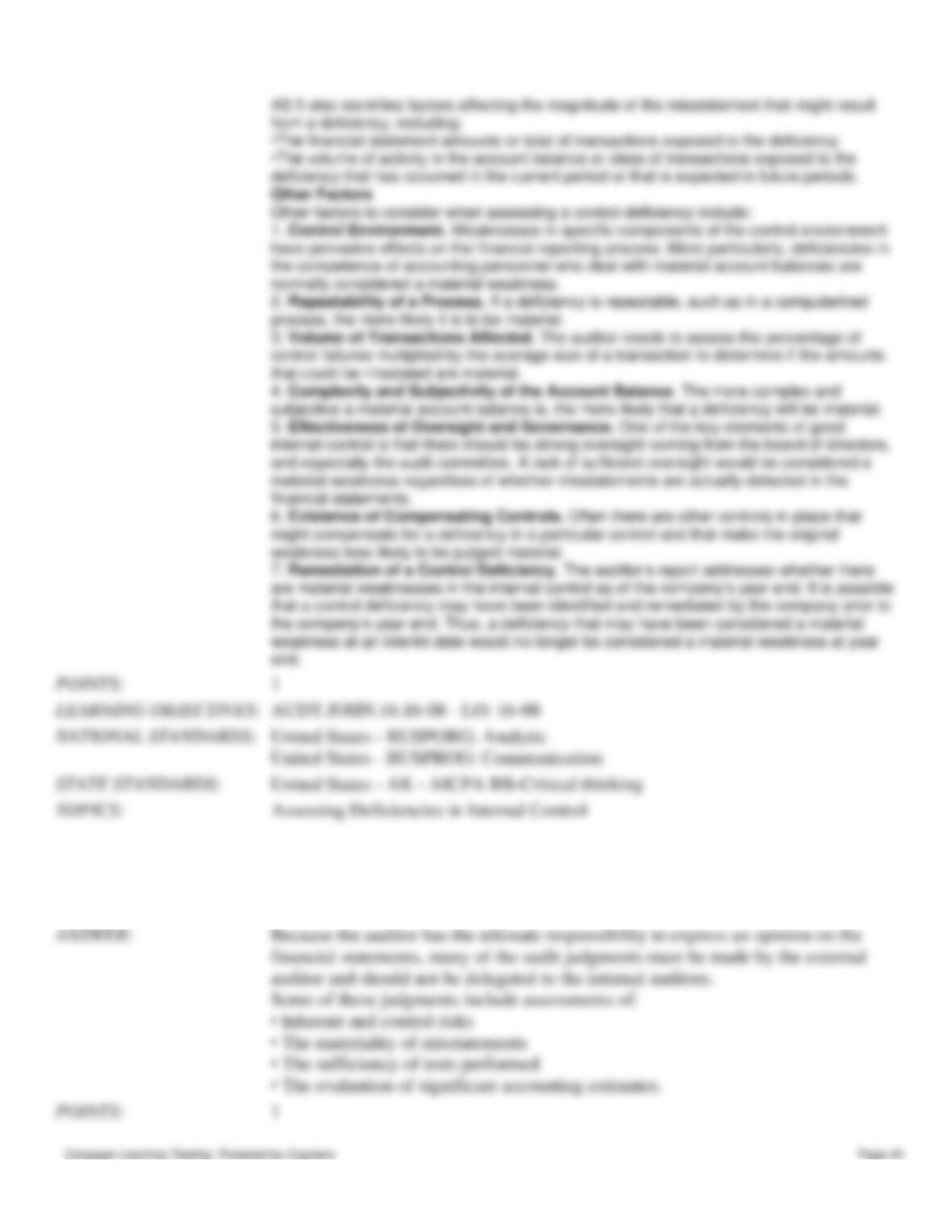
130. Critical Criteria in Assessing Identified Internal Control Deficiencies
What general factors should be considered by an auditor in evaluating whether or not a control deficiency is a
material weakness, or a significant deficiency, or a control issue of lesser severity?
Chapter 16 – Advanced Topics Concerning Complex Auditing Judgments
131. Effect of Internal Audit’s Work on the External Audit
Provide examples of audit judgments made by the external auditor which would not typically be delegated to
the internal auditor.
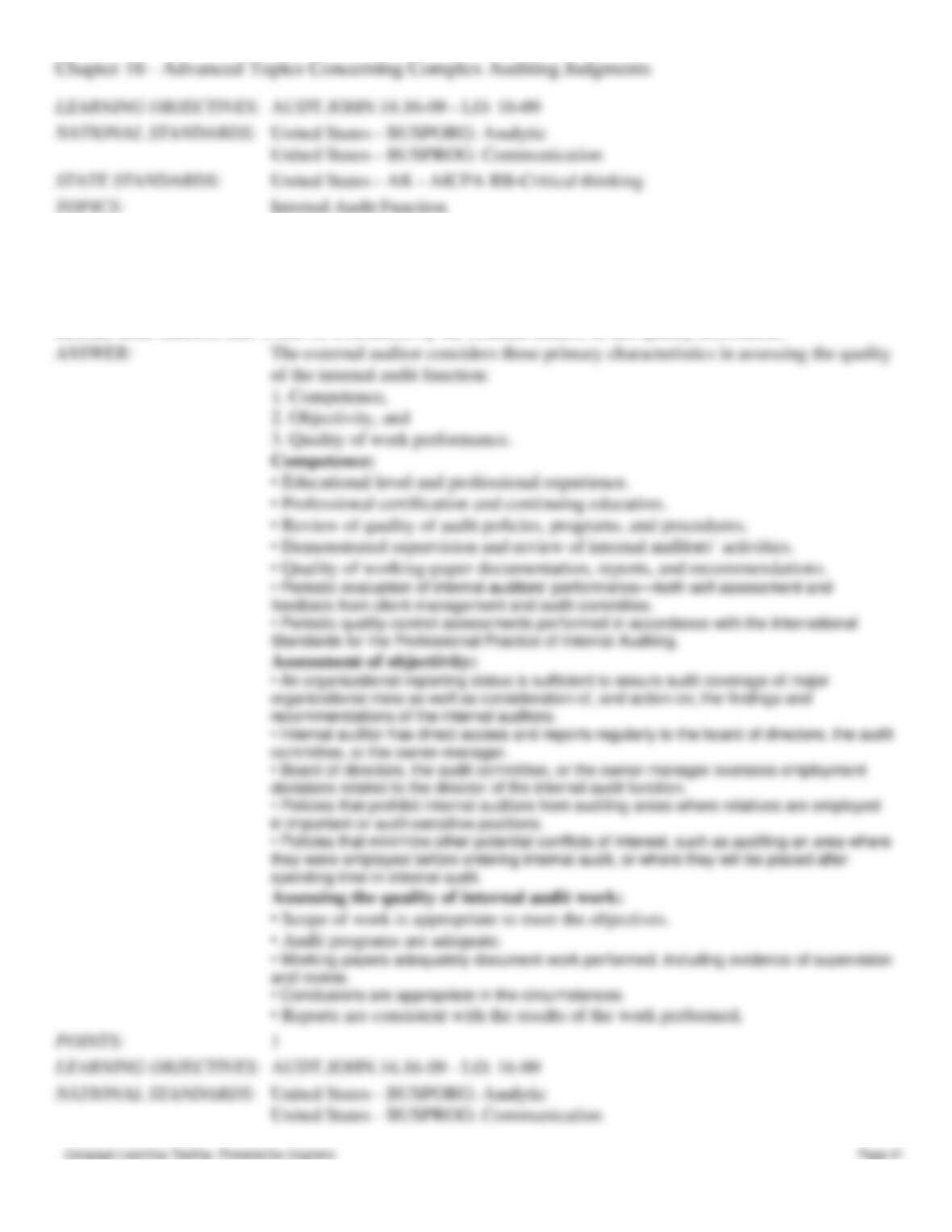
132. Evaluating the Quality of Client’s Internal Audit Function
An external auditor assesses the quality of the internal audit function to determine whether the internal auditors’
work is relevant to the external audit and of sufficient quantity and quality. Describe the three factors of the
internal audit function that would be considered by the external auditor in this quality assessment.