Use the information for the question(s) below.
You own your own firm and you need to raise $50 million to fund an expansion. Following the
expansion, your firm will be worth $75 million in its unlevered form. You want to go ahead with
the expansion, but you are concerned that you may not be able to maintain ownership of over
50% of your firm’s equity. In other words, you are concerned that if you use equity to finance
the expansion, you may lose control of your firm.
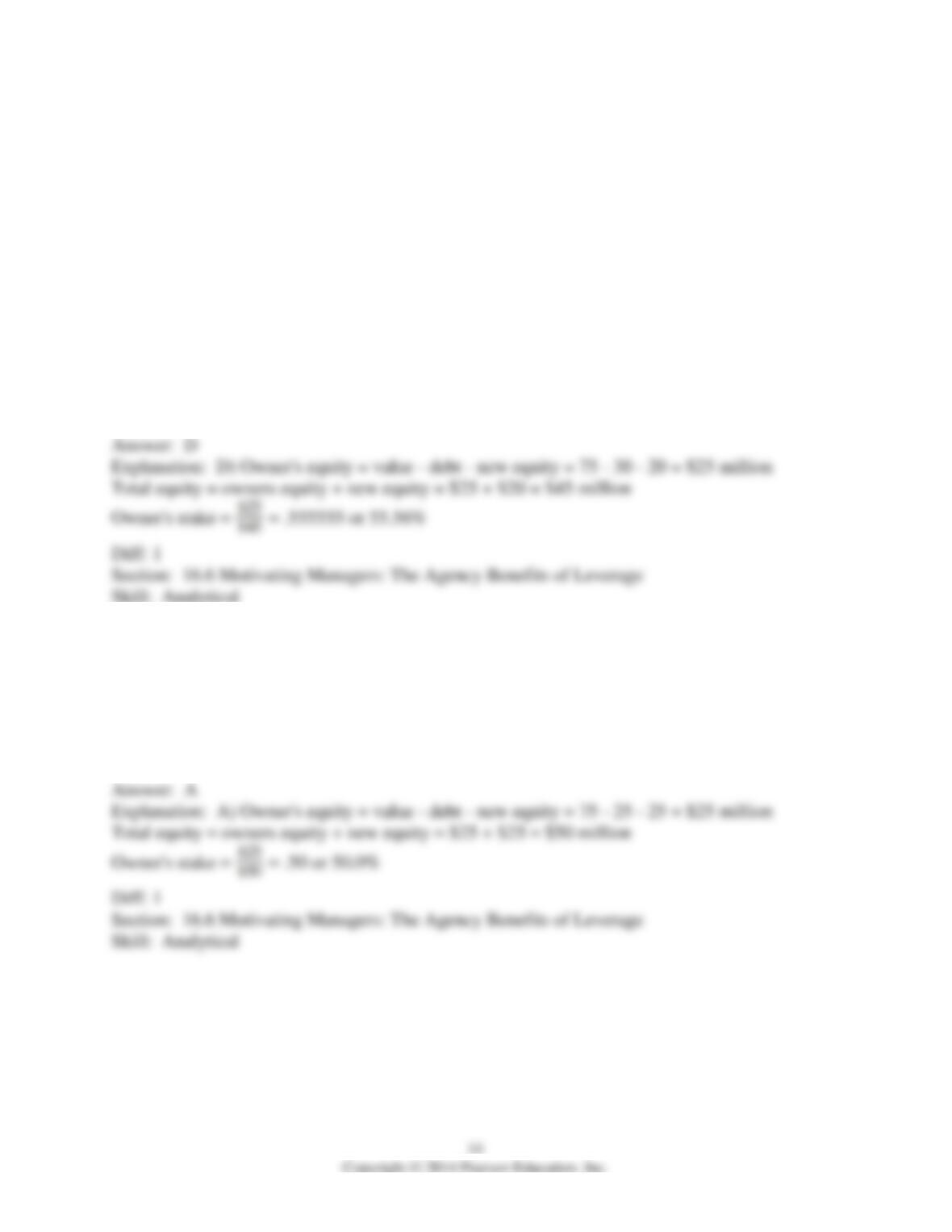
4) Assume that capital markets are perfect, you issue $30 million in new debt, and you issue $20
million in new equity. You ownership stake in the firm following these new issues of debt and
equity is closest to:
A) 58%
B) 50%
C) 33%
D) 55%
5) Assume that capital markets are perfect, you issue $25 million in new debt, and you issue $25
million in new equity. You ownership stake in the firm following these new issues of debt and
equity is closest to:
A) 50%
B) 55%
C) 58%
D) 33%
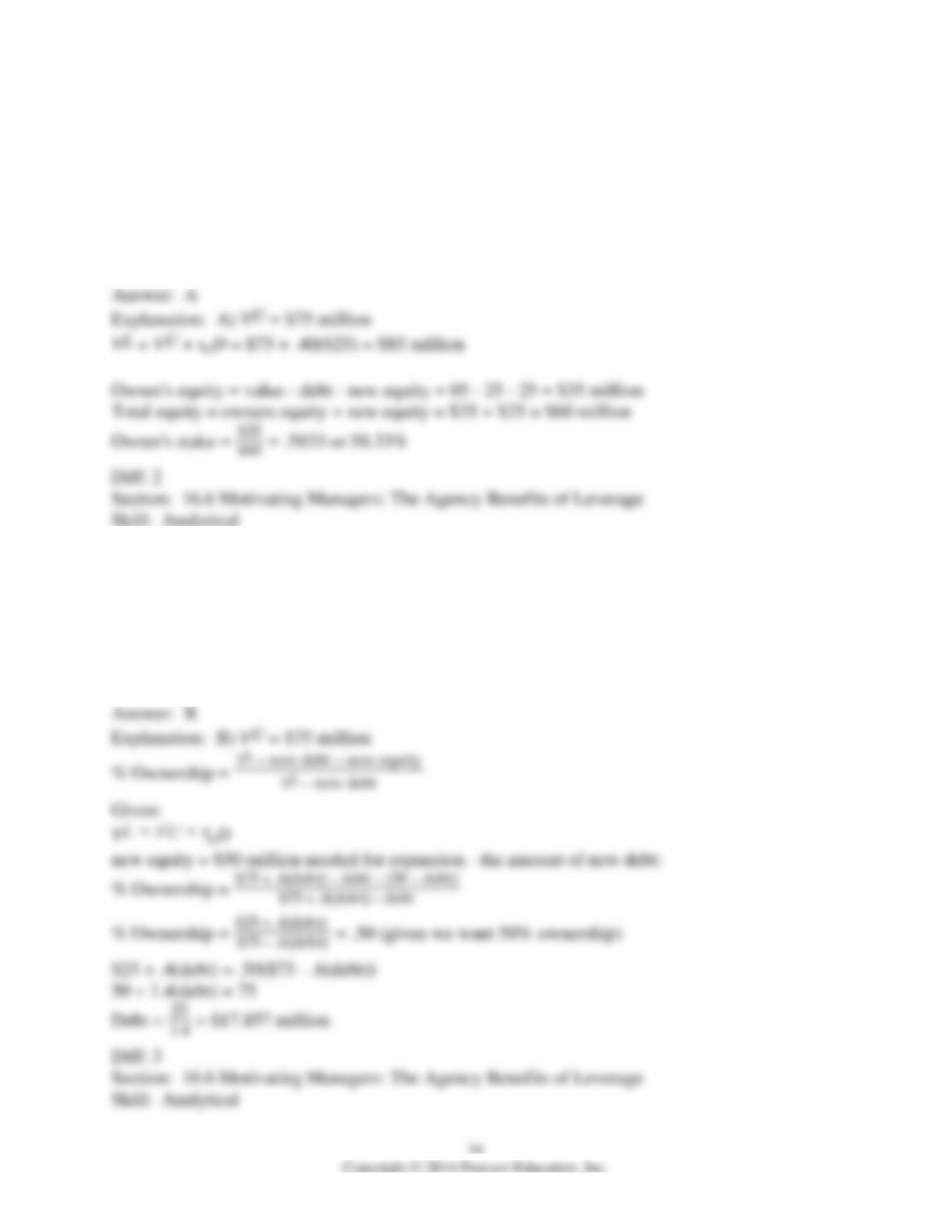
6) Assume that capital markets are perfect except for the existence of corporate taxes. Your firm
pays 40% of earnings in taxes and you decide to issue $25 million in new debt and $25 million in
new equity. You ownership stake in the firm following these new issues of debt and equity is
closest to:
A) 58%
B) 55%
C) 33%
D) 50%
7) Assume that capital markets are perfect except for the existence of corporate taxes and that
your firm pays 40% of earnings in taxes. If you want to maintain ownership of at least a 50%,
then the minimum amount of debt that you must issue to fund the expansion is closest to:
A) $19 million
B) $18 million
C) $16 million
D) $20 million
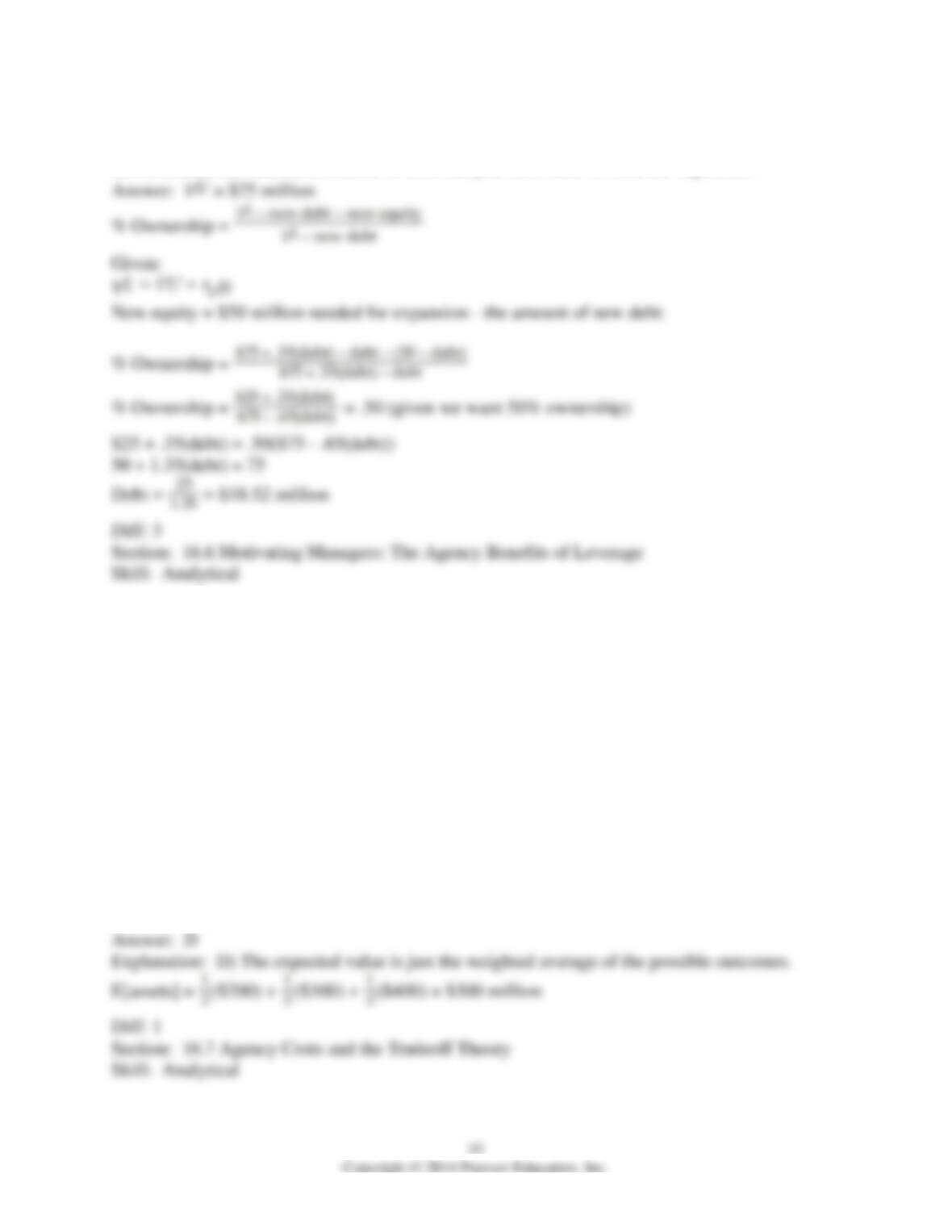
8) Assume that capital markets are perfect except for the existence of corporate taxes and that
your firm pays 35% of earnings in taxes. If you want to maintain ownership of at least a 50%,
then calculate the minimum amount of debt that you must issue to fund the expansion.
16.7 Agency Costs and the Trade-off Theory
Use the following information to answer the question(s) below.
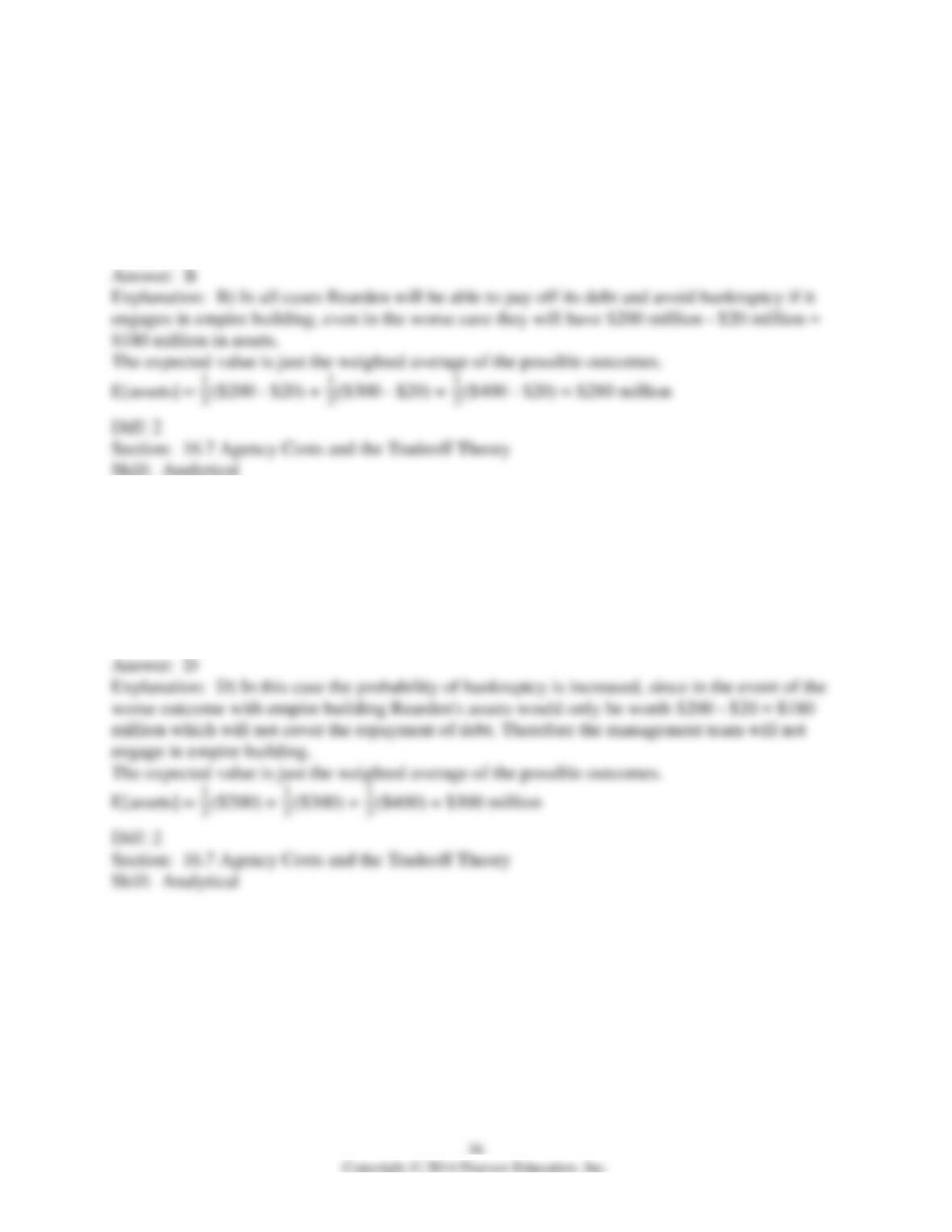
If managed effectively, Rearden Metal will have assets with a market value of $200 million,
$300 million, or $400 million next year, with each outcome being equally likely. Managers,
however, may decided to engage in wasteful empire building, which will reduce Rearden’s
market value by $20 million in all cases. Managers may also increase the risk of the firm,
changing the probability of each outcome to 50%, 5%, and 45% respectively.
1) What is the expected value of Rearden’s assets if it were run efficiently?
A) $265 million
B) $280 million
C) $295 million
D) $300 million
2) Suppose that the managers at Rearden Metal will engage in empire building unless that
behavior increases the likelihood of bankruptcy. If Rearden has $180 million in debt due in one
year, then the expected value of Rearden’s assets is closest to:
A) $265 million
B) $280 million
C) $295 million
D) $300 million
3) Suppose that the managers at Rearden Metal will engage in empire building unless that
behavior increases the likelihood of bankruptcy. If Rearden has $190 million in debt due in one
year, then the expected value of Rearden’s assets is closest to:
A) $265 million
B) $280 million
C) $295 million
D) $300 million
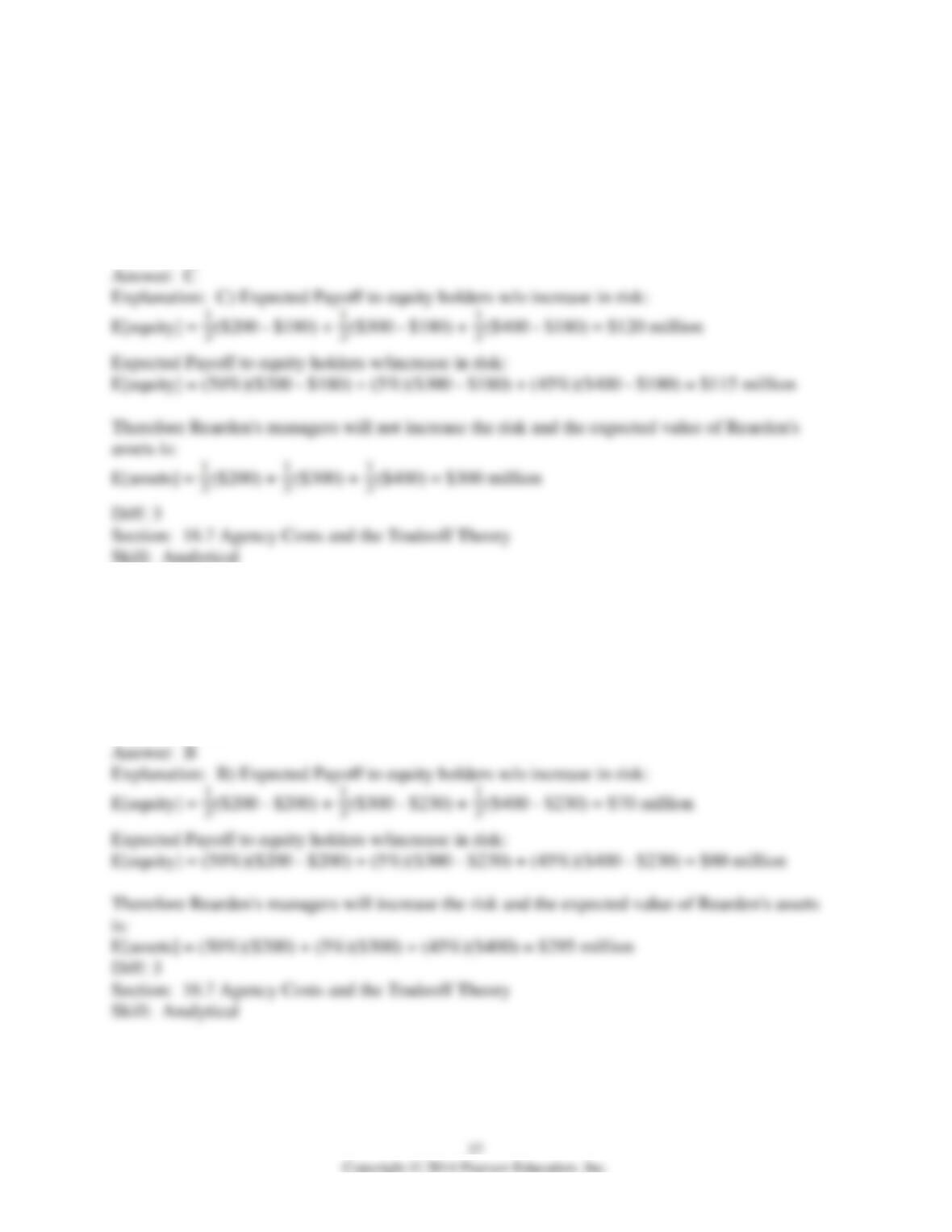
4) Suppose that the managers at Rearden Metal will increase risk to maximize the expected
payoff to equity holders. If Rearden has $180 million in debt due in one year, then the expected
value of Rearden’s assets is closest to:
A) $280 million
B) $295 million
C) $300 million
D) $900 million
5) Suppose that the managers at Rearden Metal will increase risk to maximize the expected
payoff to equity holders. If Rearden has $230 million in debt due in one year, then the expected
value of Rearden’s assets are closest to:
A) $280 million
B) $295 million
C) $300 million
D) $900 million
6) Which of the following statements is FALSE?
A) The optimal level of debt D*, balances the costs and benefits of leverage.
B) As the debt level increases, the firm benefits from the interest tax shield (which has present
value τ*D).
C) If the debt level is too large firm value is reduced due to the loss of tax benefits (when interest
exceeds EBIT), financial distress costs, and the agency costs of leverage.
D) As the debt level increases, the firm faces worse incentives for management, which increase
wasteful investment and perks.
7) Which of the following statements is FALSE?
A) Firms with high R&D costs and future growth opportunities typically maintain high debt
levels.
B) The tradeoff theory explains how firms should choose their capital structures to maximize
value to current shareholders.
C) With tangible assets, the financial distress costs of leverage are likely to be low, as the assets
can be liquidated for close to their full value.
D) Proponents of the management entrenchment theory of capital structure believe that managers
choose a capital structure to avoid the discipline of debt and maintain their own job security.
8) Which of the following firms is likely to maintain low levels of debt?
A) An electric utility
B) A tobacco company
C) An Internet firm
D) A mature restaurant chain
Use the information for the question(s) below.
If it is managed efficiently, Luther industries will have assets with market value of $100 million,
$300, million, or $500 million next year, with each outcome being equally likely. Managers
may, however, engage in wasteful empire building which will reduce the firm’s market value by
$20 million in all cases. Managers may also increase the risk of the firm, changing the
probability of each outcome to 50%, 20%, and 30% respectively.
9) If it is managed efficiently, then the expected market value of Luther’s assets is closest to:
A) $300 million
B) $260
C) $240
D) $280 million
10) If its managers engage in empire building, then the expected market value of Luther’s assets
is closest to:
A) $260
B) $280 million
C) $240
D) $300 million
11) If its managers increase the risk of the firm, then the expected market value of Luther’s assets
is closest to:
A) $260
B) $240
C) $300 million
D) $280 million
16.8 Asymmetric Information and Capital Structure
1) The idea that managers who perceive the firm’s equity is under-priced will have a preference
to fund investment using retained earnings, or debt, rather than equity is known as the:
A) signaling theory of debt.
B) lemons principle.
C) pecking order hypothesis.
D) credibility principle.
2) The idea that claims in one’s self-interest are credible only if they are supported by actions that
would be too costly to take if the claims were untrue is known as the:
A) pecking order hypothesis.
B) credibility principle.
C) lemons principle.
D) signaling theory of debt.
3) The idea that when a seller has private information about the value of good, buyers will
discount the price they are willing to pay due to adverse selection is known as the:
A) pecking order hypothesis.
B) signaling theory of debt.
C) lemons principle.
D) credibility principle.
Use the information for the question(s) below.
Electronic Gaming Incorporated (EGI) is a firm with no debt and its 20 million shares are
currently trading for $16 per share. Based on the prospects for EGI’s new hand held video game,
management feels the true value of the firm is $20 per share. Management believes that the
share price will reflect this higher value after the video game is released next fall. EGI has
already announced plans to raise $100 million from investors to build a new factory.
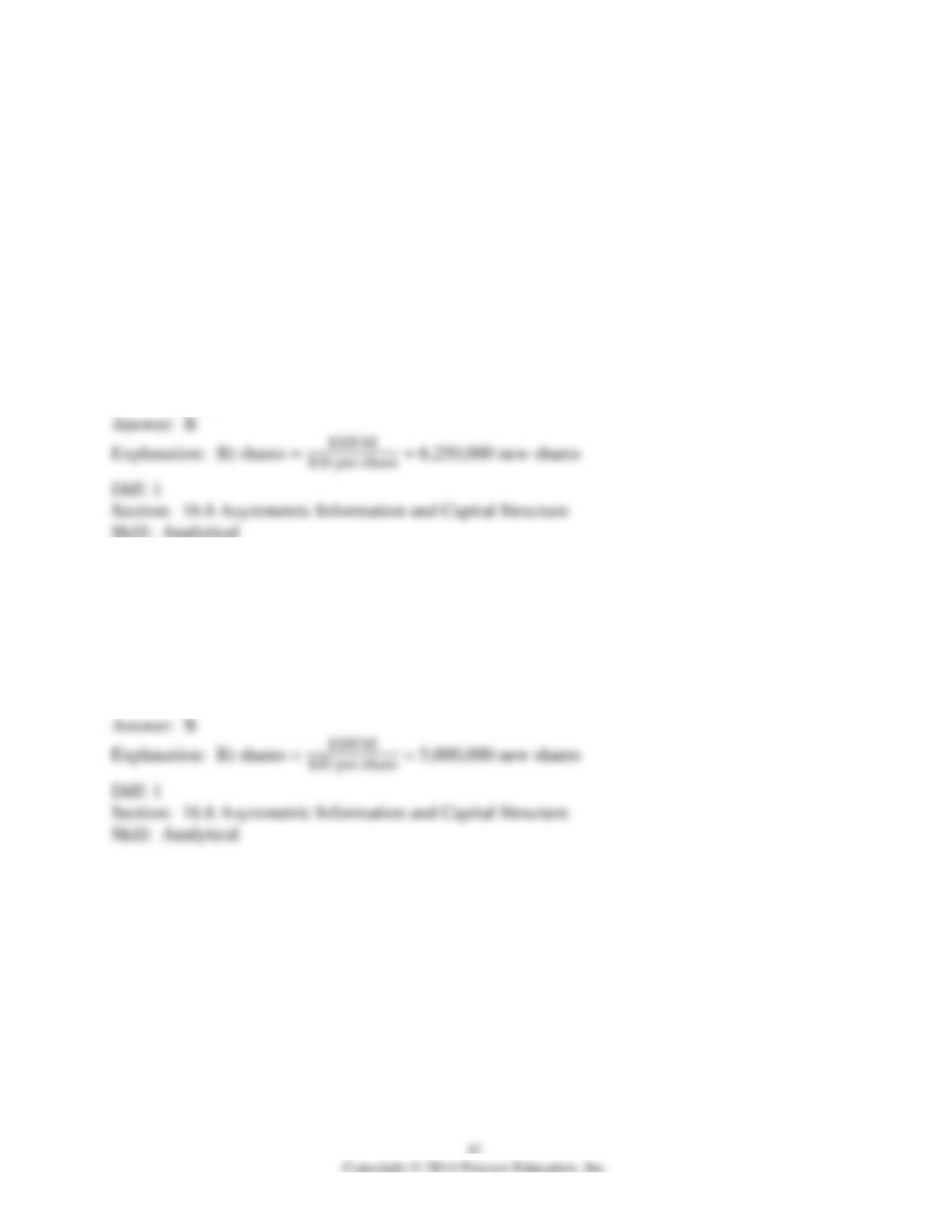
4) Assume that EGI decides to raise the $100 million through the issuance of new shares prior to
the release of the new video game. The number of new shares that EGI will issue is closest to:
A) 5.0 million
B) 6.25 million
C) 10 million
D) 1.6 million
5) Assume that EGI decides to wait until after the release of the new video game before they
raise the $100 million through the issuance of new shares. The number of new shares that EGI
will issue is closest to:
A) 1.6 million
B) 5.0 million
C) 10 million
D) 6.25 million
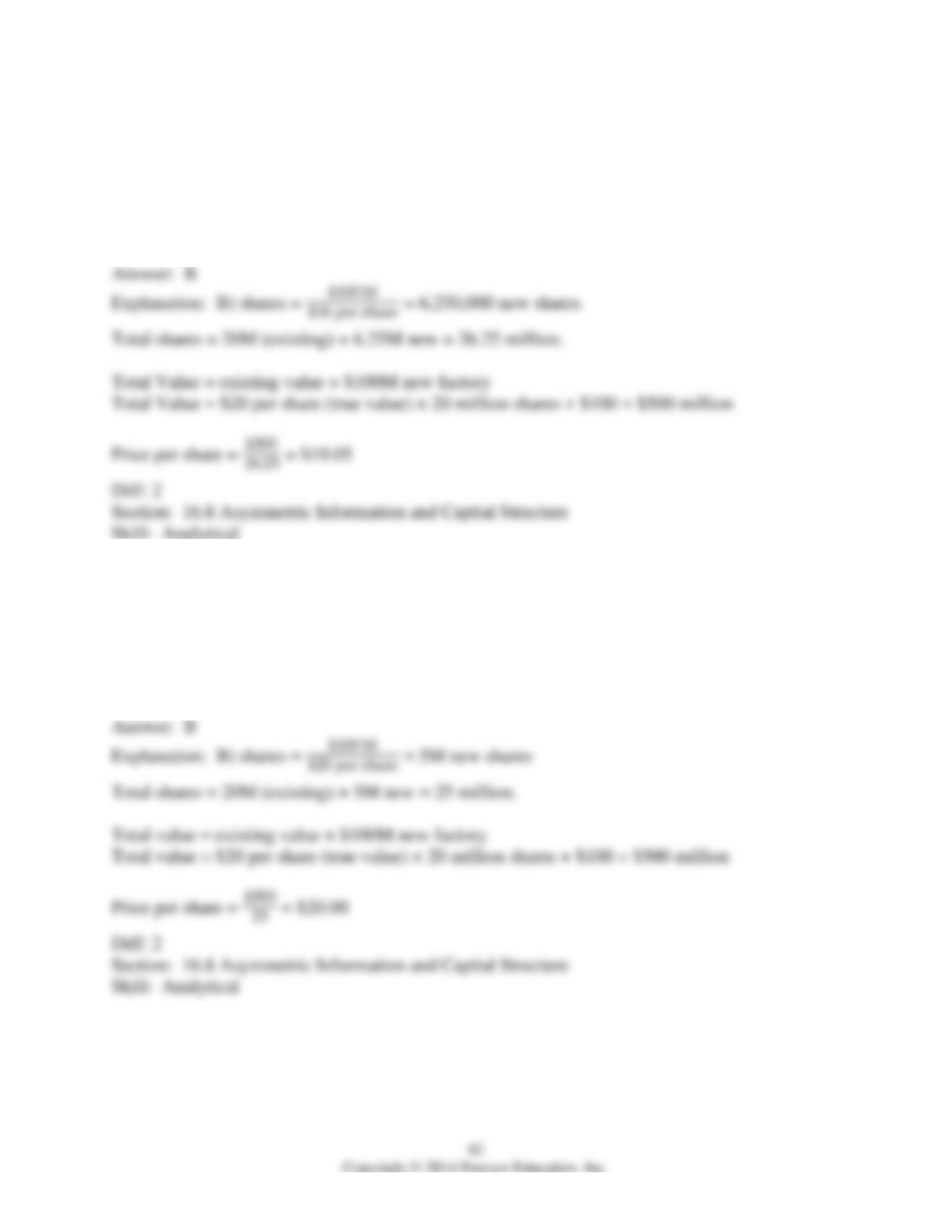
6) Assume that EGI decides to raise the $100 million through the issuance of new shares prior to
the release of the new video game. EGI’s share price following the release of the new video
game will be closest to:
A) $18.00
B) $19.00
C) $20.00
D) $16.00
7) Assume that EGI decides to wait until after the release of the new video game before they
raise the $100 million through the issuance of new shares. EGI’s share price following the
release of the new video game will be closest to:
A) $18.00
B) $20.00
C) $16.00
D) $19.00
16.9 Capital Structure: The Bottom Line
1) Which of the following statements is FALSE?
A) The most important insight regarding capital structure goes back to Modigliani and Miller:
With perfect capital markets, a firm’s security choice alters the risk of the firm’s equity, but it
does not change its value or the amount it can raise from outside investors.
B) When agency costs are significant, short-term debt may be the most attractive form of
external financing.
C) Too much debt can motivate managers and equity holders to take excessive risks or over-
invest in a firm.
D) Of all the different possible imperfections that drive capital structure, the most clear-cut, and
possibly the most significant, is taxes.
2) Which of the following influences a firm’s choice of capital structure?
A) Taxes
B) Agency costs and benefits of leverage
C) Signaling and adverse selection
D) All of the above influence capital structure decisions.
3) Which of the following is unlikely to influence a firm’s choice of capital structure?
A) Taxes
B) Agency costs and benefits of leverage
C) Transaction costs
D) All of the above influence capital structure decisions.