Fundamentals of Corporate Finance 3e Test Bank
49.
Cadmium Electronics Inc. currently has a capital structure that is 40% debt and 60% equity. If
the firm’s cost of equity is 12%, the cost of debt is 8%, and the risk-free rate is 3%, what is the
appropriate WACC?
A)
8.4%
B)
9.6%
C)
10.4%
D)
9.2%
Ans:
C
50.
Gangland Water Guns, Inc. has a debt-to-equity ratio of 0.5. If the firm’s cost of debt is 7% and
its cost of equity is 13%, what is the appropriate WACC?
A)
9%
B)
10%
C)
11%
D)
None of the above.
Fundamentals of Corporate Finance 3e Test Bank
51.
Swirlpool, Inc. has a WACC of 11%, cost of debt of 8%, and a cost of equity of 12%. What
must the debt-to–equity ratio be?
A)
1/2
B)
1/4
C)
1/6
D)
1/3
52.
Melba’s Toast has a capital structure with 30% debt and 70% equity. Its pretax cost of debt is
6%, and its cost of equity is 10%. The firm’s marginal corporate income tax rate is 35%. What
is the appropriate WACC?
A)
8.17%
B)
6.35%
C)
8.80%
D)
7.44%
Ans:
A
WACC with taxes = xDebt kDebt pretax (1 − t) + xEquity kEquity = (0.30 × 0.06 × (1 − 0.35)) + (0.70 ×
Fundamentals of Corporate Finance 3e Test Bank
53.
A firm has $300 million in outstanding debt and $900 million in outstanding equity. Its cost of
equity is 11%, and its cost of debt is 7%. What is the appropriate WACC?
A)
6%
B)
8%
C)
9%
D)
10%
54.
A firm has a WACC of 8.5%, a pretax cost of debt of 5%, a cost of equity of 12%, and a
marginal corporate income tax rate is of 35%. What percent of the firm’s capital structure is
financed with equity?
A)
50%
B)
60%
C)
70%
D)
None of the above.
Fundamentals of Corporate Finance 3e Test Bank
55.
Bellamee, Inc. has a required rate of return on its assets of 12% and a cost of debt of 6.25%. Its
current debt-to–equity ratio is 1/5. What is the required rate of return on its equity?
A)
12.15%
B)
13.15%
C)
14.15%
D)
None of the above.
56.
Bellamee, Inc. has a required rate of return on its assets of 12% and a cost of debt of 6.25%. Its
current debt-to–equity ratio is 1/5. What is its required return on equity if its debt-to-equity ratio
changes to 2/5 and this increases the required rate of return on its debt to 7%?
A)
14%
B)
14.25%
C)
14.50%
D)
15%
Fundamentals of Corporate Finance 3e Test Bank
57.
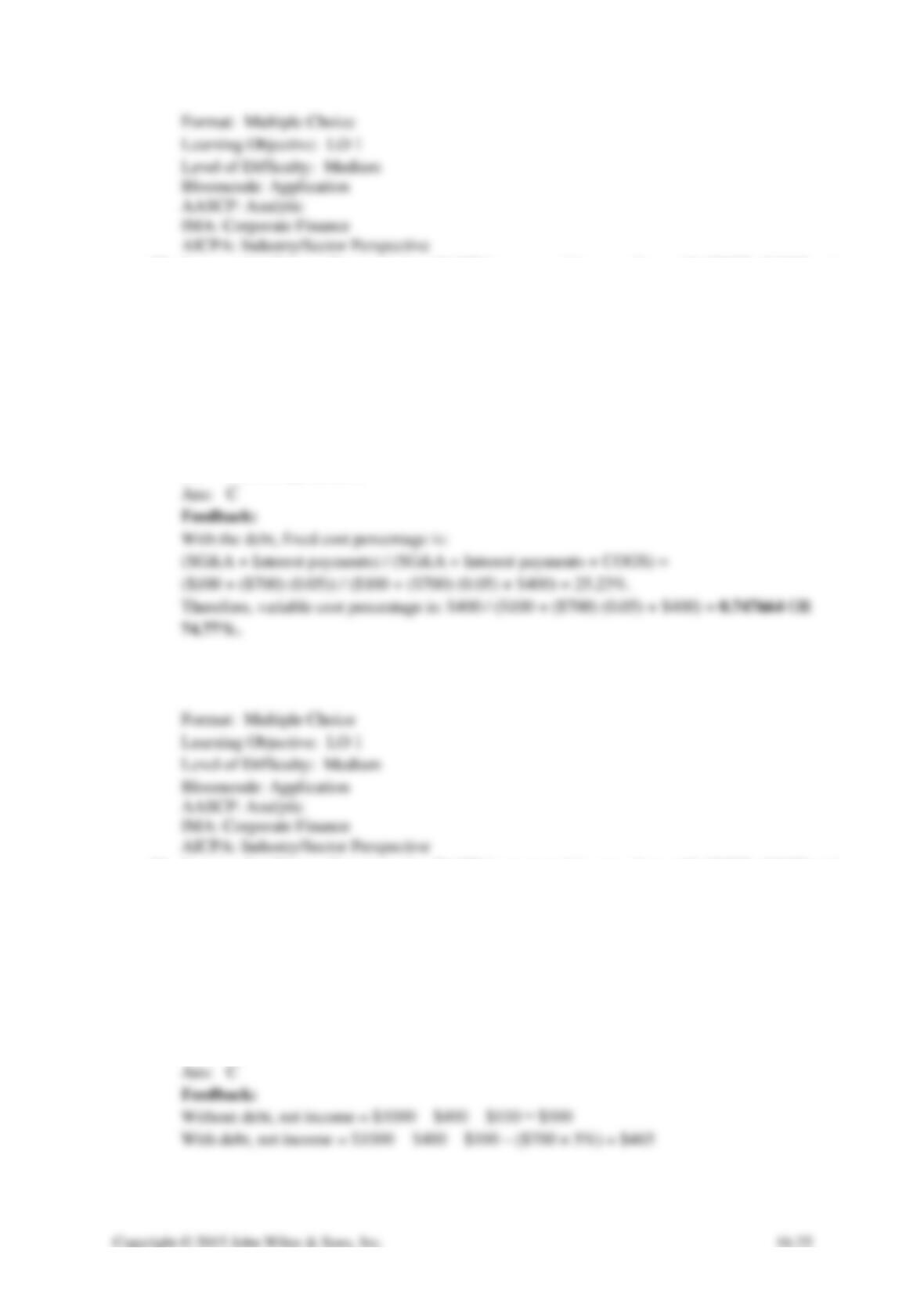
Suppose that Banana Computers has $1,000 in revenue this year, along with COGS of $400 and
SG&A of $100. The required rate of return on its equity is 14%, and the risk-free rate is 5%.
Assume that the COGS only include the marginal costs of selling a computer. Banana is
considering adding $700 worth of debt with a coupon rate of 5% and an YTM of 7.9% to its
capital structure. What percent of the firm’s costs are fixed, and what percent of costs are
variable with the added debt? (Round the percentage answer to two decimal places.)
A)
27.9% and 72.1%
B)
72.1% and 27.9%
C)
25.23 and 74.77%
D)
74.77% and 25.23%
Ans:
C
58.
Suppose that Banana Computers has $1,000 in revenue this year, along with COGS of $400 and
SG&A of $100. The required rate of return on its equity is 14%, and the risk-free rate is 5%.
Assume that the COGS only include the marginal costs of selling a computer. Banana is
considering adding $700 worth of debt with a coupon rate of 5% and an YTM of 7.9% to its
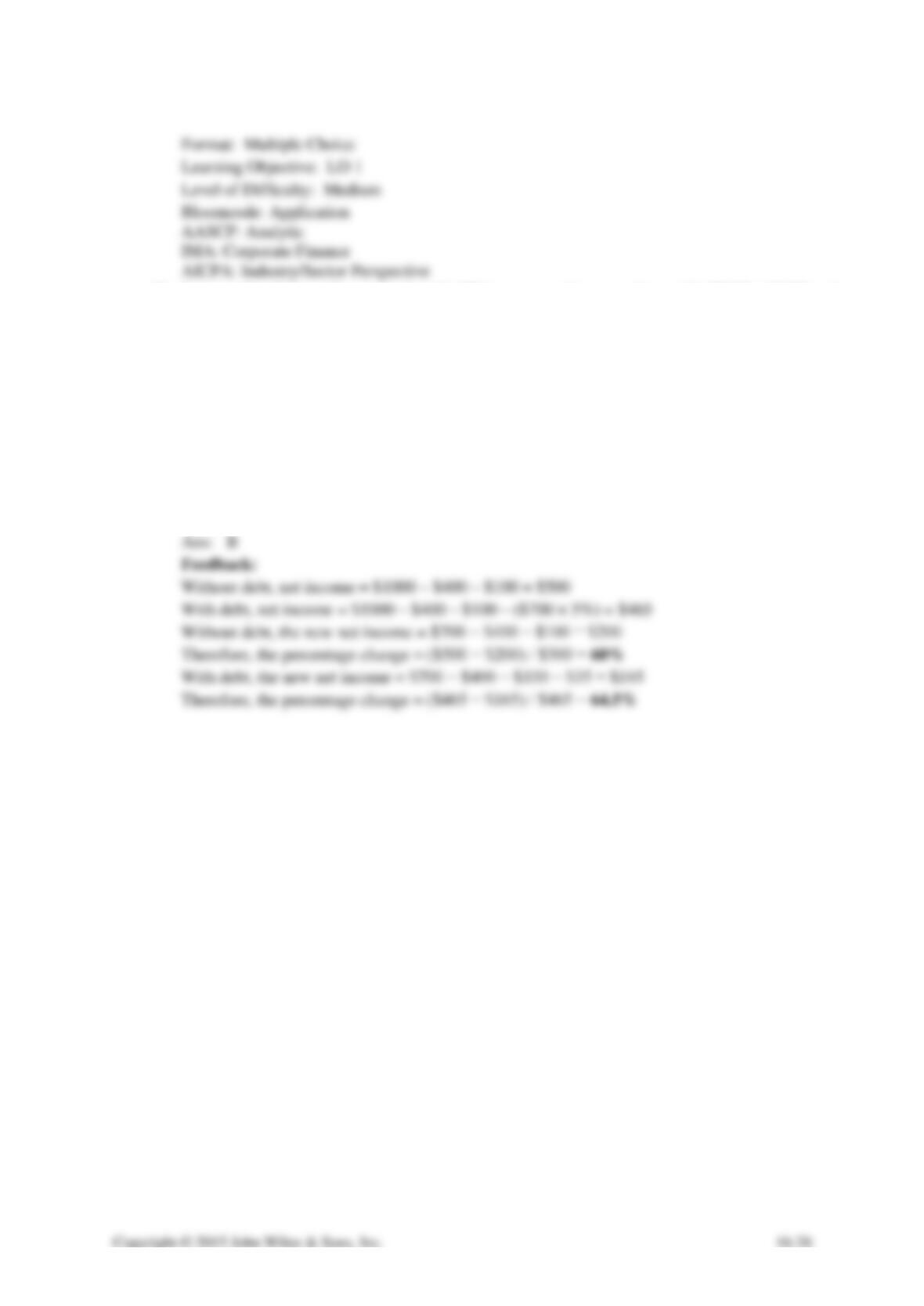
capital structure. What is the net income of Banana without and with the debt?
A)
$500 and $484.2
B)
$484.2 and $500
C)
$500 and $465
D)
$490 and $500
Ans:
C
Fundamentals of Corporate Finance 3e Test Bank
59.
Suppose that Banana Computers has $1,000 in revenue this year, along with COGS of $400 and
SG&A of $100. The required rate of return on its equity is 14%, and the risk-free rate is 5%.
Assume that the COGS only include the marginal costs of selling a computer. Banana is
considering adding $700 worth of debt with a coupon rate of 5% and an YTM of 7.9% to its
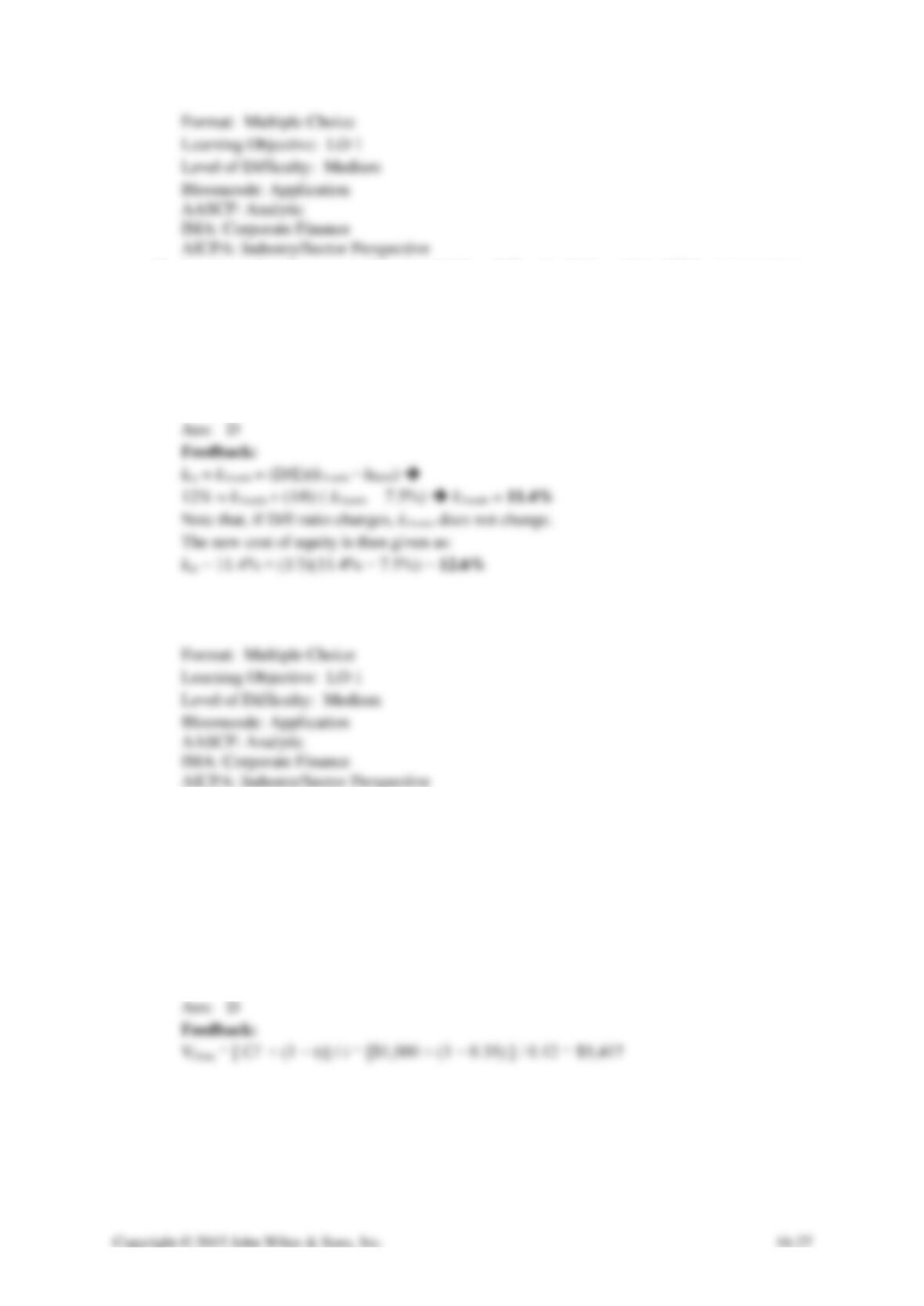
capital structure. Suppose, revenues fall by $300, what is the percent change in net income with
and without the debt? Assume that the total variable production costs remain the same.(Round
the answer to one decimal places.)
A)
64.5% and 60%
B)
60.0% and 64.5%
C)
59.2% and 40.8%
D)
40.8% and 59.2%
Ans:
B
Fundamentals of Corporate Finance 3e Test Bank
60.
Suppose a firm has a cost of equity of 12%, a D/E ratioof 1/6, and the YTM on its bonds is
7.5%. The risk-free rate is currently 3%. What is the current required rate of return on its assets
and equity if the D/E is changed to 1/3?(Round the answer to one decimal place of percentage.)
A)
11.35% and 13.25%
B)
11.35% and 8.25%
C)
13.25% and 11.35%
D)
None of the above
Ans:
D
61.
Millennium Motors has current pretax annual cash flows of $1,000 and is in the 35% tax
bracket. The appropriate discount rate for its cash flows is 12%. Suppose the firm issues a
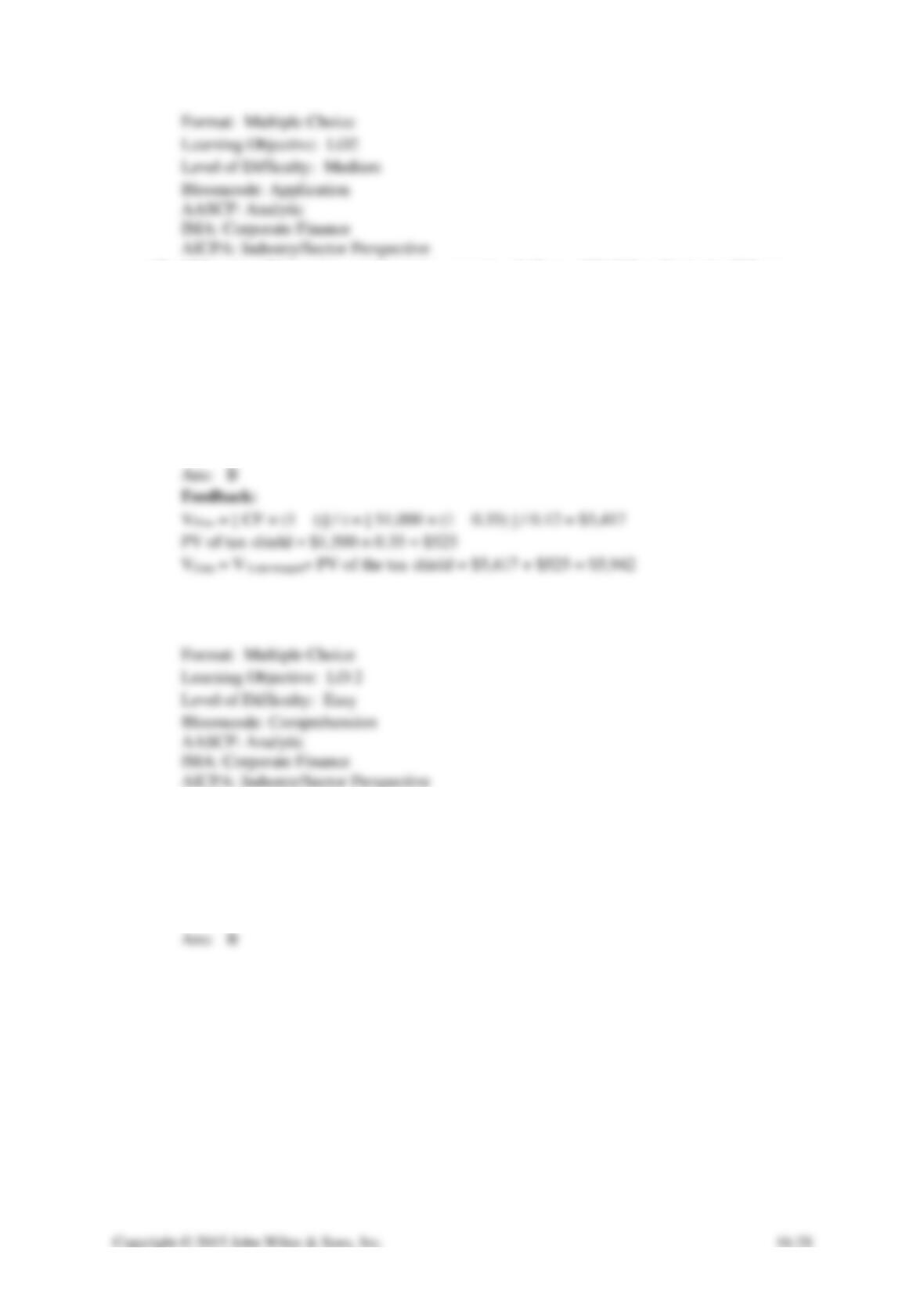
$1,500 bond and uses these proceeds to pay a one-time special dividend to stockholders. Using
the perpetuity model, calculate the value of the firm without debt in the capital structure.
Assume that the pretax annual cash flows are perpetual. Round to the nearest dollar.
A)
$350
B)
$650
C)
$2,917
D)
$5,417
Ans:
D
Fundamentals of Corporate Finance 3e Test Bank
62.
Millennium Motors has current pretax annual cash flows of $1,000 and is in the 35% tax
bracket. The appropriate discount rate for its cash flows is 12%. Suppose the firm issues a
$1,500 bond and uses these proceeds to pay a one-time special dividend to stockholders What is
Millennium’s value after the debt issuance? Assume that the pretax annual cash flows are
perpetual.
A)
$5,417
B)
$5,942
C)
$6,392
D)
None of the above
Ans:
B
63.
The interest tax shield
A)
does not affect the WACC.
B)
makes it less costly to distribute cash to the investors through interest payments than
through dividends.
C)
is given as: D × (1 − t).
D)
Both B and C
Ans:
B
Fundamentals of Corporate Finance 3e Test Bank
64.
In order to calculate the present value of debt tax savings, the _____ is used as the discount
rate.
A)
WACC
B)
risk-free rate
C)
required rate of return on debt
D)
None of the above
65.
Academic studies have estimated that the tax benefit of debt realized by firms is approximately
A)
10% of firm value.
B)
a 10% reduction in WACC.
C)
a 10% reduction in the cost of debt.
D)
10% of debt value.
Ans:
A
AICPA: Industry/Sector Perspective
66.
The use of debt financing
A)
causes a manager to take on riskier projects in order to make interest payments.
B)
is more expensive than issuing equity due to the use of covenants.
C)
allows managers to make discretionary interest payments.
D)
limits the ability of managers to waste stockholders’ money.
Ans:
D
Fundamentals of Corporate Finance 3e Test Bank
AICPA: Industry/Sector Perspective
67.
Which of these statements about direct bankruptcy costs is NOT true?
A)
Direct bankruptcy costs include the hiring of additional accountants, lawyers, and
consultants.
B)
Direct bankruptcy costs are less than indirect bankruptcy costs.
C)
Direct bankruptcy costs include payments to suppliers on delivery.
D)
Direct bankruptcy costs can be reduced by negotiating with lenders.
68.
Which of these is NOT an example of indirect bankruptcy costs?
A)
A firm’s customers become concerned about whether or not warranties will be honored.
B)
Employees begin to leave the firm.
C)
New accountants are brought in to help with the bankruptcy process.
D)
A bankruptcy judge orders new projects to be halted.
Ans:
C
Fundamentals of Corporate Finance 3e Test Bank
AICPA: Industry/Sector Perspective
69.
The use of debt financing
A)
reduces agency costs between the stockholders and management by increasing the
amount of risk the managers take.
B)
increases agency costs between the stockholders and management by limiting the amount
of risk the managers take.
C)
increases agency costs since managers prefer to keep more retained earnings rather than
paying dividend.
D)
Both B And C
Ans:
D
AICPA: Industry/Sector Perspective
70.
The asset substitution problem occurs when
A)
managers substitute more risky assets for less risky ones to the detriment of bondholders.
B)
managers substitute less risky assets for more risky ones to the detriment of bondholders.
C)
managers substitute more risky assets for less risky ones to the detriment of equity
holders.
D)
managers substitute less risky assets for riskier ones to the detriment of equity holders.
Ans:
A
Fundamentals of Corporate Finance 3e Test Bank
AICPA: Industry/Sector Perspective
71.
The underinvestment problem occurs in a financially distressed firm when
A)
the value of investing in a positive NPV project is likely to go to debt holders instead of
equity holders.
B)
the value of investing in a positive NPV project is likely to go to equity holders instead
of debt holders.
C)
management invests in negative NPV projects to reduce their own risk.
D)
issuing equity becomes difficult due to increased risk.
Ans:
A
AICPA: Industry/Sector Perspective
72.
Packman Corporation has a reported EBIT of $500, which is expected to remain constant in
perpetuity. The firm borrows $2,000, and its coupon rate is 8%. If the company’s marginal tax
rate is 30% and its average tax rate is 20%, what are its after-tax earnings?
A)
$238
B)
$272
C)
$259
D)
None of the above
Ans:
A
Fundamentals of Corporate Finance 3e Test Bank
73.
A firm plans to issue $1 million worth of debt at an YTM of 9%. The debt is trading at par. The
firm’s marginal corporate tax rate is 25%, while its average tax rate is 15%. By how much will
this debt issuance reduce the firm’s annual tax liability?
A)
$13,500
B)
$22,500
C)
$32,500
D)
None of the above
Ans:
B
74.
A firm plans to issue $1 million worth of debt at an YTM of 9%. The debt is trading at par. The
firm’s marginal corporate tax rate is 35%. What is the present value of the tax savings in
perpetuity?
A)
$11,025
B)
$20,475
C)
$350,000
D)
$227,500
Ans:
C
Fundamentals of Corporate Finance 3e Test Bank
75.
Suppose that UBM Corp. has invested $100 million in 8% risk-free bonds that mature in one-
year. The firm also has $80 million in debt outstanding that will also mature in a year. UBM
shareholders are considering selling the $100 million in debt and investing in a project that has
a 60% chance of returning $200 million and a 40% chance of returning $2 million. What will
the equity value of UBM be in one-year without stockholders taking on the project?
A)
$100 million
B)
$80 million
C)
$20 million
D)
$8 million
Ans:
C
Value of Equity of UBM = Value of risk-free debt owner − Value of bonds maturing
76.
Suppose that UBM Corp. has invested $100 million in 8% risk-free bonds that mature in one-
year. The firm also has $80 million in debt outstanding that will also mature in a year. UBM
stockholders are considering selling the $100 million in debt and investing in a project that has
a 60% chance of returning $200 million and a 40% chance of returning $2 million. What is the
expected value of the bonds to the lenders if the stockholders sell the debt?
A)
$100 million
B)
$88.8 million
C)
$48.8 million
D)
None of the above
Ans:
C
Fundamentals of Corporate Finance 3e Test Bank
77.
Suppose that UBM Corp. has invested $100 million in 8% risk-free bonds that mature in one-
year. The firm also has $80 million in debt outstanding that will also mature in a year. UBM
stockholders are considering selling the $100 million in debt and investing in a project that has
a 60% chance of returning $200 million and a 40% chance of returning $2 million. What is the
expected value of the equity if the stockholders sell the debt?
A)
$175 million
B)
$97.5 million
C)
$51 million
D)
$40 million
Ans:
D
78.
Suppose that UBM Corp. has invested $100 million in 8% risk-free bonds that mature in one-
year. The firm also has $80 million in debt outstanding that will also mature in a year. UBM
stockholders are considering selling the $100 million in debt and investing in a project that has
a 60% chance of returning $200 million and a 40% chance of returning $2 million. Given the
payoffs of the project, what does the percent chance of success need to be in order for the
expected value of equity with the project to be equal to the expected value of equity without the
project?
A)
1/3
B)
1/4
C)
1/5
D)
1/6
Ans:
D
Fundamentals of Corporate Finance 3e Test Bank
79.
Suppose that, JMK, Inc. has debt with a face value of $100 million and assets worth $70
million. The firm’s management has just identified a project that will require an initial outlay of
$10 million and will return a NPV of $16 million, risk-free. The firm currently has no cash.
What would be the net return to stockholders if they took on this project?
A)
−$10 million
B)
$0 million
C)
$26 million
D)
$70 million
Ans:
A
If it takes on the project, the firm will receive its $10 million back, along with the $16 million.
80.
Which of the following supports the trade-off theory of capital structure?
A)
Firms use cash on hand first, since issuing equity and debt is expensive.
B)
A firm’s capital structure is the result of past equity and debt issuance decisions.
C)
Firms have a target capital structure.
D)
Both A and B
Ans:
C
Fundamentals of Corporate Finance 3e Test Bank
81.
A firm wishes to undertake a project that costs $150 million. It currently has $10 million in
cash on hand and believes that it can raise $75 million in debt and $100 million in equity if
needed. According to the pecking order theory of the capital structure, what percent of the
project will be financed by debt?
A)
0%
B)
26.67%
C)
50%
D)
None of the above
Ans:
C
According to the pecking order theory, the firm will first use its available cash, which is $10
82.
Which of the following should a company consider when deciding to buy or lease an asset?
A)
Taxes.
B)
Information or transaction costs.
C)
If the choice would affect the real investment policy of the firm.
D)
All of the above.
Ans:
D
Fundamentals of Corporate Finance 3e Test Bank
83.
Which of the following would arise if the lessee can have the incentive to use the asset more
than the lessor would prefer?
A)
Operating lease conflict
B)
Capital lease conflict
C)
Intensity of use conflict
D)
Maintenance conflict
Ans:
C
AICPA: Industry/Sector Perspective
84.
Which of the following arises when the lessee can have the incentive to use the asset more than
the lessor would prefer?
A)
Track the total services obtained from the asset and charge the lessee based on usage.
B)
Bundle the lease contract with a service contract.
C)
Provide the lessee with the right to buy the asset when the lease expires.
D)
All of the above.
Ans:
D
Fundamentals of Corporate Finance 3e Test Bank
85.
LMNO Manufacturing needs a new laser and is comparing buying or leasing. Under either
alternative, the company will only need the laser for 5 years. Assume LMNO’s marginal tax
rate is 30 percent.
Purchase Alternative: It would cost $50,000 to purchase the laser and the amount could be
financed with a five year balloon loan at 9%. The laser will be depreciated on straight line and
have no salvage value. Maintenance on the laser is expected to be $1,200 per year.
Lease alternative: The company that manufactures the laser offers a 5 year leasing option with
annual lease payments of $12,500.With this option, the lessor will be responsible for
maintenance of the laser and will take it back after 5 years. The lease will be classified as an
operating lease.
Which is the best option for LMNO Manufacturing?(Do not round the intermediate calculation.
Round off final answer to the nearest dollar.)
A)
Purchase, the company will be $4,416 better off
B)
Lease, the company will be $4,416 better off
C)
Purchase, the company is $10,496 better off
D)
Lease, the company is $10,496 better off
Ans:
B
Fundamentals of Corporate Finance 3e Test Bank
86.
One of the conditions that the M&M Propositions required was for not to have taxes. Briefly
discuss whether the introduction of taxes decreases or increases the value of the firm.
87.
Briefly explain how an increase in the amount of debt that a firm has outstanding may actually
decrease the agency costs caused by the conflict between managers and stockholders.
88.
The pecking order theory of capital structure suggests that managers will choose to utilize
retained earnings before issuing additional debt when financing new projects. Does that imply
anything about the flotation costs of issuing new securities?